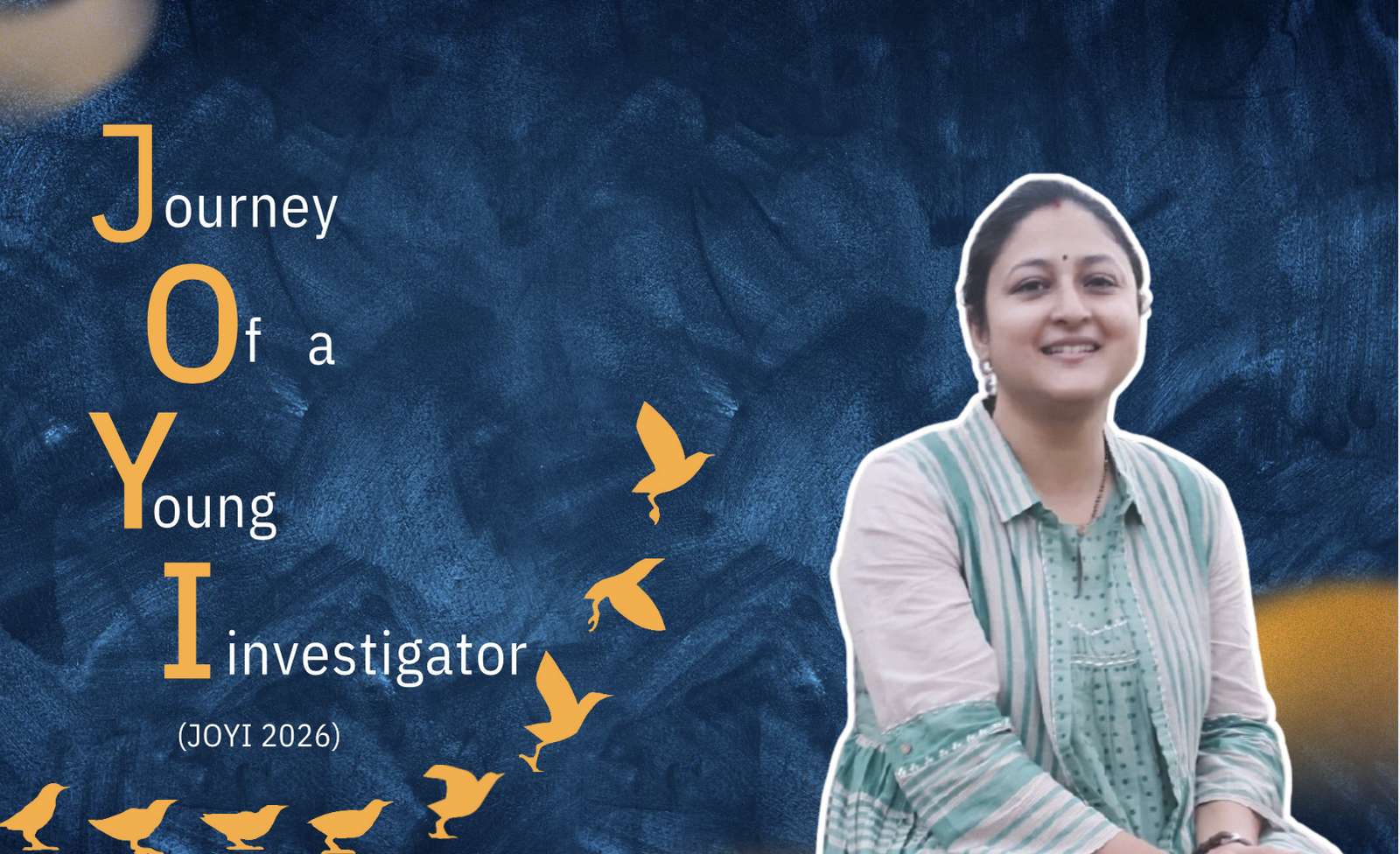
This article is part of the Journey of a Young Investigator (JOYI) 2026 series, highlighting Amrita Saxena’s journey shaped by curiosity, mentorship, and unexpected turns. Now an Assistant Professor at the Department of Biotechnology, Faculty of Allied and Health Sciences, Ramaiah University of Applied Sciences, Bengaluru, she studies plant stress biology to understand crop resilience while mentoring and inspiring the next generation of scientists.
From microbes to morphogenesis
I did not begin with a map. I began with a small, stubborn curiosity: what unseen forces shape the world we touch? That question nudged me from one discipline to another, and it kept me moving through moments of failure, surprise, and quiet discovery.
The chemistry that led me elsewhere
As an undergraduate, I was drawn to the clean logic of chemical structures — the way a reaction could be predicted, written down, and then watched unfold in a flask. I chose Chemistry Honours even though I was a merit-holder in Botany. The choice was partly practical — access to placement drives and a clearer path to a job — but it also reflected a desire to learn a rigorous way of thinking. After graduation, I briefly secured a job offer; yet a chance conversation during address verification changed the script. The officer suggested I consider further study rather than stepping into the workforce immediately. That nudge, combined with a restless curiosity, led me to an MSc in Applied Microbiology at Banaras Hindu University.
Microbiology let me keep the chemist’s eye — molecules and mechanisms — while opening a window into living systems. During my MSc, I completed a dissertation at Delhi University South Campus on heterologous gene expression in Escherichia coli and Mycobacterium. Handling mycobacterial cultures and cloning constructs for tuberculosis research was my first encounter with research that mattered beyond the bench. The work was exciting and often frustrating, but intoxicating. Those months convinced me that I wanted to pursue research, not just a job. The gold medal in my Master’s affirmed the choice, but it was the unfinished questions from the lab that kept me awake at night: how do microbes behave outside controlled plates, and how do they influence the health of whole plants in real fields?
The trial that taught me to listen
For my PhD at the Institute of Agricultural Sciences, Banaras Hindu University (BHU), I chose agricultural microbiology and set out to study anthracnose in chilli. I wanted to know whether beneficial microbes could control disease under real field conditions, not just in petri dishes.
A year into the project, my supervisor handed me a new challenge: a complex phytopathogen in a crop no one else in the institute worked on. Overnight, I became the only person responsible for chilli anthracnose. There were no local protocols, no seniors’ lab book — only primary literature, scattered advice, and a great deal of trial and error.
One field trial remains vivid. I had screened promising biocontrol agents in vitro and designed a field experiment to test them. Lacking agronomy training, I guessed the transplant age for seedlings. The next morning, every seedling drooped and died. I walked to my supervisor expecting a reprimand. Instead, he looked at the wilted trays and said, “Seedlings have developmental stages. You cannot force them before they are ready.” That sentence landed like a small revelation. Plants, I learned, are not passive objects to be manipulated at will; they have timing, thresholds, and rhythms that must be respected.
When I repeated the experiment with properly aged seedlings, the trial succeeded, and we observed a significant reduction in disease incidence. The data mattered, but the deeper lesson was that failure is information. The drooping seedlings taught me to observe first and intervene second — to let the organism’s biology guide the experimental design rather than imposing my assumptions on it.
The shock and the new phase of life
I was deeply absorbed in my research, working to understand how pathogens survive inside host plants. The seedlings were planted, the pathogen inoculated, and I was preparing samples for RT-PCR when, early the next morning, a call from my family changed everything — my mother had passed away. At that moment, the ground beneath me seemed to give way. Science, which had been my anchor, suddenly felt meaningless, and I thought seriously about leaving research behind.
My mentors, Richa Raghuwanshi and H B Singh were compassionate and gave me the space I needed. One day, Singh Sir gently reminded me, “Amrita, you should finish what you started”. Those words stayed with me. Slowly, I gathered myself, completed my thesis, and learned a hard truth: life does not pause for anyone. It keeps moving, and we must find the strength to move with it.
A year later, I got married and moved to Bangalore. Restless but uncertain of my next step, I began exploring postdoctoral opportunities. My husband suggested Indian Institute of Science, Bengaluru (IISc)—the pinnacle of science in India — , and that idea reignited my spark. It felt like the beginning of a new chapter, one in which I could rebuild my journey with fresh purpose.
The conversations that opened a door
The idea of a postdoc at the Indian Institute of Science felt aspirational and distant. My work had been rooted in crop pathology and field trials; IISc seemed like a world of molecular precision and cell biology I had not yet earned. Still, I wrote to Utpal Nath’s lab, expecting a polite decline. Instead, I was told to talk to the students and find a question that excited me.
Those hallway conversations became my real interview. Students explained auxin signalling, floral mutants, and how spatial and temporal gene expression sculpt organs. I remember sitting in a lab meeting, listening to someone describe how a transcription factor’s expression in a narrow tissue domain could change leaf shape, and feeling the same thrill I had felt watching the action of BCAs in pathogen control. The question that intrigued me was deceptively simple: how does TCP4-mediated cell-to-cell signalling regulate organ morphogenesis in Arabidopsis?
Joining the lab as a DBT-Research Associate meant learning new tools — confocal microscopy, reporter lines, quantitative expression analysis — and a new kind of patience. Fieldwork had taught me to read environments; developmental biology taught me to read patterns inside tissues. The shift was not a break but a continuation: both fields ask how signals — genetic, microbial, environmental — are integrated to produce form and function.
Returning to crops with new eyes
After IISc, I returned to BHU as an IOE-Malviya Postdoctoral Fellow to work on rice SWEET genes and their role in drought and blast resistance. It felt like closing a loop. I was back in crop and stress biology, but now with a molecular toolkit that let me ask deeper questions about regulation and resilience. The same curiosity that had driven me from chemistry to microbes now helped me connect gene expression patterns to field-level outcomes.
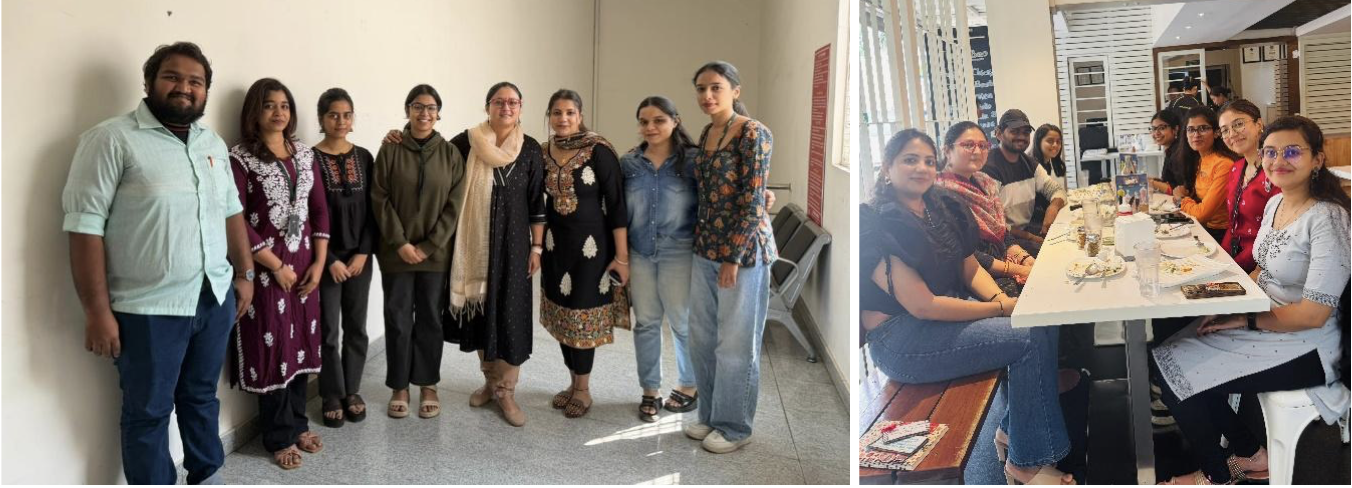
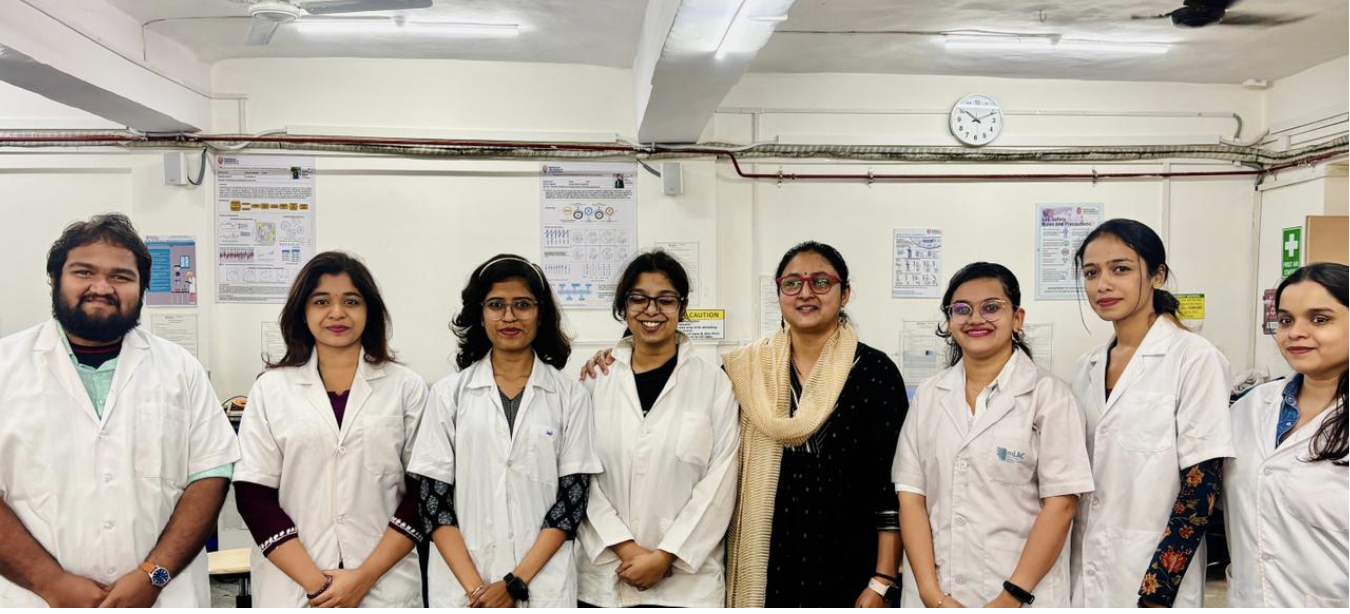
In December 2024, I joined Ramaiah University of Applied Sciences in Bengaluru as an Assistant Professor in Biotechnology. My current research sits at the intersection of plant – microbe interactions, transcriptional regulation under combined stresses, and developmental logic that shapes plant architecture. I teach students to respect both the field and the microscope — to understand how a seedling’s transplant age matters as much as the timing of a transcription factor’s activation.
What the journey taught me
If there is a single thread through this journey, it is resilience — of plants and of careers.
Plants wait for the right season; seedlings wait for the right age. Careers, too, are iterative. My path — chemistry to tuberculosis research to chilli pathology to Arabidopsis morphogenesis to rice stress biology — was not a detour but a curriculum. Each pivot added a layer of understanding: field failures taught agronomy, confocal confusion taught precision, hallway conversations taught me how to find a question that fits.
Mentors who trusted me with new problems, competitive fellowships, and small recognitions helped. But the deepest growth came from everyday struggles: failed trials, long nights of reading, and the humility of being a beginner again and again. Those moments taught me to treat failure as data, to build questions through conversation, and to respect the developmental timing of both plants and careers.
To early-career researchers, I would say: your zigzag path is not a weakness. It is a source of strength. Send the cold email, sit in the lab meeting, repeat the experiment when it fails. Science is messy, humane, and slow — but it is also generous. It rewards curiosity, persistence, and the courage to become a beginner more than once.