From a small town in Uttar Pradesh to leading interdisciplinary research, this Journey of a Young Investigator (JOYI) 2026 story follows Santosh Kumar Chaudhary, Distinguished Professor at UPES, Dehradun. His journey — spanning structural biology, chemical biology, and drug discovery — highlights how mentorship, persistence, and integrating disciplines can shape scientific careers and enable new directions in research.
In cells, when molecules meet, new functions emerge. Much of biology depends on these interactions — On proximity.
Looking back, my own journey into science feels shaped by a similar principle. It has not been a linear academic progression, but a series of intersections — between curiosity, opportunity and experience. Each step emerged from a moment where different ideas or influences came together, opening up new directions I had not planned for.
I come from Basti, a small district in Uttar Pradesh, and studied at the Kendriya Vidyalayas in Basti, and Noida. These deeply formative years taught me to adapt to change, to compete fairly and to dream without a clearly drawn map ahead. Looking back, they showed me that the environment shapes possibility. When people share space and opportunity, new ambitions take root.
My early fascination with science was not dramatic. It was quiet and persistent. During my undergraduate years, I had my first real encounter with research when I joined an ICMR laboratory — the National JALMA Institute for Leprosy and Other Mycobacterial Diseases in Agra. Walking into a research laboratory for the first time was both intimidating and exhilarating. The lab had its own rhythm — discipline, precision and accountability. My project involved working in a Biosafety Level‑3 facility, an experience that left a lasting impression. Wearing protective gear, adhering to carefully controlled procedures and recognising the seriousness of infectious disease research instilled in me a deep respect for scientific responsibility. Handling clinical material and knowing that the results could directly influence diagnosis grounded my curiosity in reality. Research was no longer abstract; it was immediate, consequential and human.
Supported by a DBT fellowship, I pursued postgraduate training at WBUT, now Maulana Abul Kalam Azad University of Technology (MAKAUT), Kolkata. That financial support was pivotal — it provided both validation and opportunity. During my coursework, I joined a year-long research project under my mentor, Joydeep Mitra, who instilled in me a deep inspiration to continue in academia. His mentorship went beyond technical guidance. He encouraged me to think across disciplines, question assumptions we develop after years of working in a research area, and engage with biology through the lenses of physics and chemistry. This experience reshaped how I viewed science — not as compartmentalised domains, but as interconnected questions — and played a key role in my decision to pursue a PhD.
This philosophy led me to the Indian Institute of Science, Bengaluru (IISc Bengaluru) for my PhD, unexpectedly through the Department of Physics, to study protein crystallography — a subject that taught me that while discipline helps structure learning, discovery often demands their integration. Surrounded by physicists, chemists and biologists, I experienced first-hand what an integrative scientific environment feels like.
In Kanagaraj Sekar’s laboratory, I immersed myself in structural biology, particularly X‑ray crystallography. Long hours were spent optimising crystals, collecting diffraction data and solving structures. There is something profoundly humbling about watching a protein’s atomic architecture emerge from electron density maps — a reminder that life’s complexity is built on precise geometry.
My doctoral work focused on enzyme catalysis and DNA repair pathways, using X‑ray crystallography, molecular dynamics and computational approaches. Each method revealed a different layer of truth. Crystallography offered structural snapshots; molecular dynamics simulations added motion and context; computational analysis allowed hypotheses to be tested before stepping into the lab. Gradually, I began to see how structural insights could inform therapeutic strategies. Understanding enzyme mechanisms and DNA repair pathways naturally drew me towards questions of drug discovery.
That intellectual pull led me to the Broad Institute of MIT and Harvard University, Cambridge, USA, for my postdoctoral research. The Broad Institute was a different scale of science — fast-paced, collaborative and deeply translational. There, structural biology, computation and chemical biology converged seamlessly to accelerate drug discovery. Projects moved from structural insight to small-molecule design with remarkable fluidity. It was exhilarating to be surrounded by experts from so many disciplines, each bringing their perspective, and to see how ideas could accelerate when they collided and merged. Within this environment, I became deeply involved in designing Phosphorylation-Inducing Chimeric Small molecules (PHICS), engineered to bring specific proteins together and induce targeted phosphorylation. Beyond the technical challenge, the project exemplified what I valued most about this collaborative ecosystem: tackling complex biological problems required integrating structural knowledge, computational modeling, and cellular experimentation. Watching a conceptual design translate into measurable changes in cell signalling revealed the power of working at the intersection of disciplines.
My postdoctoral years also allowed me to explore a range of chemical biology tools to address diverse scientific questions, but more than any individual technique, what I gained was an orthogonal perspective — the confidence to approach scientific problems from unconventional angles, integrating multiple strategies to control biological function. This experience sharpened my conviction that genes may provide instructions, but protein – protein interactions execute decisions. If we could precisely control those interactions, we could reshape cellular function dynamically rather than permanently rewriting DNA.
Returning to India as a Ramalingaswami fellow at UPES, Dehradun, was both exhilarating and demanding. I was aware that academic timelines in India — whether for fellowships or faculty positions — can stretch over months, sometimes close to a year. With that in mind, I applied early for re-entry opportunities while still in the US.
A key moment came through a recruitment drive organised by Sci-ROI in the United States, where a direct interaction with the hiring committee at UPES turned a distant application into a tangible possibility. It reinforced once again how proximity, being present, visible and engaged, can shape outcomes.
Dehradun may not be the most obvious destination for academic research, but I chose to accept the first opportunity that aligned with my vision rather than wait for a more conventional path. After years of training in well-established institutions, I felt a strong motivation to return and create something from the ground up and to strengthen the research ecosystem back home.
Setting up my own research group meant articulating a vision clearly enough that others could believe in and grow with. Our work focuses on understanding and shaping protein – protein interactions to influence cellular function — an approach rooted in the idea that bringing the right components together can reveal new biological possibilities.
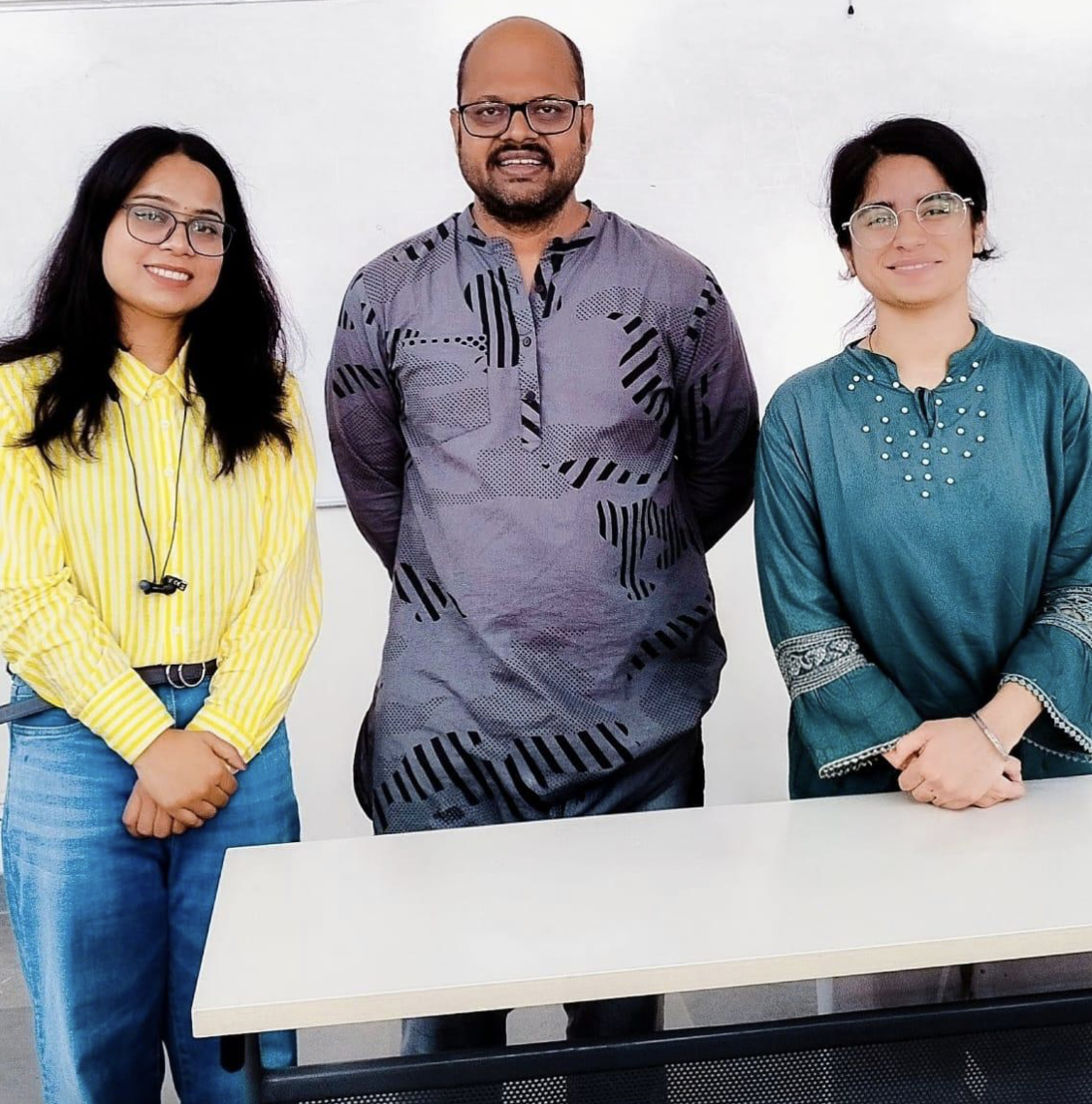
This perspective also shaped how I mentor students. Today’s PhD researchers are more aware of possibilities than ever before. My role is to help refine their ideas, equip them with ways of learning and encourage them to stay curious while building strong fundamentals. Ultimately, I hope to create a space where they feel confident to explore, question and even engineer their own “intersections” — because it is often through such altered or induced interactions that genuinely new insights emerge.
Today, when I reflect on my journey, I see it as a story of integration. A humble beginning did not limit ambition; it grounded it. Early exposure to infectious disease research taught responsibility and discipline. Mentorship during my M Tech. instilled purpose and courage. Structural biology during my PhD cultivated precision and depth. Drug discovery and chemical biology training during my postdoc expanded perspective and ambition. And now, as a young investigator, I strive to create an environment where ideas and people come into meaningful proximity.
If there is a single lesson I carry forward, it is this:
Integration drives discovery: While subjects are taught in silos, real scientific progress happens when ideas meet.
My journey has not been defined by isolated milestones, but by the moments where different worlds met — and quietly reshaped its direction.