The second day of the Young Investigators’ Meeting (YIM) 2026 in Pune was dedicated to one of the most pressing practical concerns for early-career researchers in India: how to find, apply for, and receive research funding. A series of spotlight talks by representatives from Indian and international funding organisations, followed by an open ask-me-anything session, brought together researchers at different stages of their careers with funders and senior scientists in what turned out to be a candid and wide-ranging conversation.
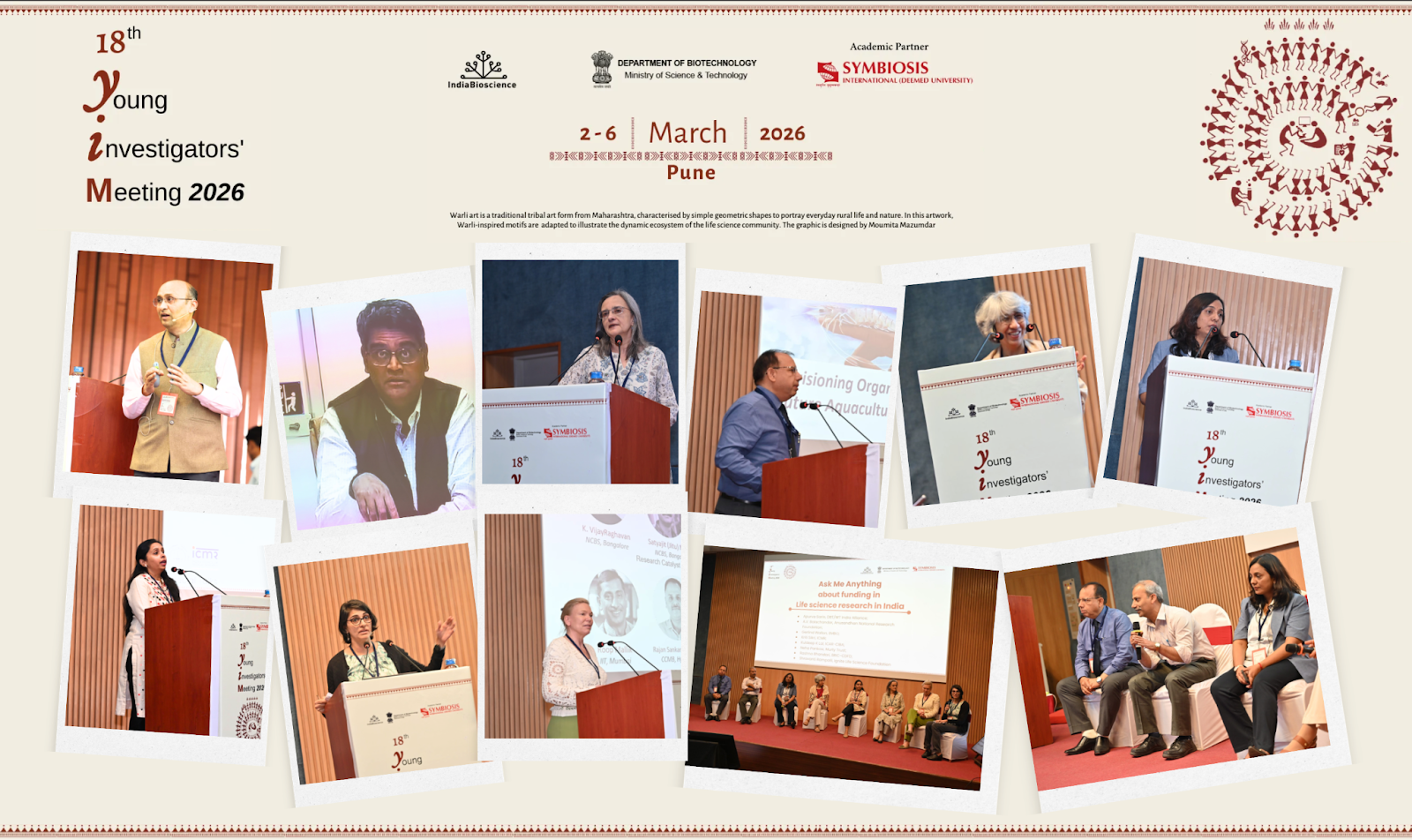
An expanding landscape for science funding
Rajesh Gokhale, Secretary, Department of Biotechnology, during his keynote on the first day of YIM 2026, opened with a provocation that reframed the conversation before it had properly begun.
I just wish I were 25 today, as the world is so much more amazing. We could only have dreamt of doing impactful science. This is the opportunity of life”.
Later in the day, when a researcher returning from the US asked Shivkumar Kalyanraman, CEO, Anusandhan National Research Foundation, how ANRF relates to DBT and DST, and where a junior faculty member should apply, Kalyanraman was explicit:
It’s not an ‘either-or’ proposition. It is an ‘and’ proposition. DBT and DST will continue to have their own programmes. We will try not to overlap with those. We tend to do things at the intersection of these entities… ANRF is an entity which, I keep joking, is like a movie. We bring everybody into a happy family and get them to collaborate. We are more of a collaborative entity that helps stitch together programmes across multiple stakeholders”.
The funding sessions that followed on day 2 were shaped by that tension: a landscape that, by many measures, is richer in opportunity than ever, yet one that early-career researchers continue to find difficult to navigate. Representatives from various funding agencies outlined the range of mechanisms available, from fellowships for researchers in the final stages of their postdoctoral fellowships to project-based extramural grants for those with established laboratories. While the funding landscape has grown considerably over the past decade, that growth in the number of schemes has not always been matched by clarity about how to navigate them. Kriti Sikri, Indian Council of Medical Research, said,
Each of the funding agencies has a very specific mandate which is set by the Government of India. Whenever you’re applying for any of the grants, do look at the mandates and the vision of each of the organisations that you’re applying to, and align yourself with the agency and with the particular call”.
A recurring theme among the national agency representatives was that funding priorities are not purely scientific but also policy-driven. One example was shared by Kuldeep Lal, Director, ICAR-Central Institute of Brackishwater Aquaculture, where he shared that ICAR’s focus on food security, sustainability, and resource management was an example of how agency mandates shape what gets funded and what does not.
“A lot of times [ICMR] gets complaints that ‘Why have you rejected our project? We’re working with medicinal plants’. If you’re not showing the medicinal value of those plants, ICMR cannot fund you. So, align yourself with the national health priorities. With every call, there is a list of emerging national-level priorities. Read every call very well. This keeps updating with every call”, Kriti advised while discussing the necessity of mandate alignment.
What international and philanthropic funders bring to the table
Gerlind Wallon, European Molecular Biology Organization (EMBO), described the organisation’s India-facing programmes not only as funding opportunities but as platforms for leadership development and global networking. She said,
We as scientists learn how to write a paper, how to think about our experiments, how to write grants more or less. But we do not learn how to run a lab, how to deal with the people in our labs and make our group successful, which is, of course, the most important”.
Speaking about the Scientific Exchange Grants, she said, “The success rate of these fellowships is around 50%. With a really decent project, you have a good chance to actually get it”.
The Human Frontier Science Program (HFSP) represented a different register entirely. HFSP programmes require cross-continental collaboration and carry high selectivity.
Philanthropic funding and flexibility in how they fund came into focus through talks from the Ignite Life Science Foundation and the Murty Trust. Shravanti Rampalli, CEO, Ignite Life Science Foundation said,
In most of the successful countries in research and innovation, the funding comes from private philanthropies and private organisations as well, which India lacks big time. We don’t ask you for exhaustive 15-page proposals. For grants below 50 lakhs, our turnaround is 45 days. Within 45 days, we will get back to you, and in the next eight days, we will release the money”.
Turnaround time is the operational definition of agility for an ECR waiting to set up a lab. Neha Pankow, Director, Murty Trust, said what it means to be a Trust and not a section 8 company or how their mechanisms are different from CSR funding, “We don’t have a board. The turnaround time for project decisions can be literally overnight in our case. The funds are disbursed to the institute but controlled entirely by the fellow. If the fellow is not happy at their host institute, they can move, and the entire funds move with them”. She added,
You want to hire the best postdoc, the best technician — you’re going to have to offer them something competitive. With private funds, we say: go out and hire whomever you want”.
What funders are actually looking for
Across the different funding types, the panellists converged on a small number of expectations, but the discussion was more specific than a simple checklist.
On research questions, Kriti was direct: proposals that attempt to address several problems at once tend to fare worse than those that focus on a single question and pursue it rigorously. “Don’t overpromise your objectives. Be more realistic and time-bound”, she advised the audience. She added, “Define measurable deliverables; what will you give at the end of three or five years? These have to be very definitive and beyond publications”.
A specific misunderstanding while finding collaborators is that adding names of senior collaborators automatically adds credibility. Kriti noted, “Show your team and institutional strength. Even if you are younger PIs and early-career researchers looking for mentors, align yourself and your project with your mentor’s skill. It is not important to have big names on your project; that is not how things work. Align the skills. You should know where to tap into the skills of your mentor”.
Contrasting meaningful collaboration with performative partnership, Apurva Sarin, CEO, DBT/WT India Alliance, explained it to be, “a direction arising from your work that is best executed or explored in partnership with an individual from another discipline or capability. We do want you to diversify your portfolio and sample hopefully some of the joys of collaborating with individuals across different disciplines”.
What researchers asked and what the answers revealed
The ask-me-anything session surfaced several tensions that the spotlight talks had not fully addressed.
The distinction between grants for basic research and support for translational work or startups generated significant confusion. Shravanti addressed this confusion by naming the structural gap:
Much of the funding in our country is directed toward applications, inventions, and startups. “But to have originals for ourselves, if we have originals, do we have the bandwidth of scientists who can take it to the next level? That is also missing. If you have done research till TRL4, going to TRL8, where a company will come and pick you up, there are four more numbers which lie in between. How you work with those four numbers is something which is very important”.
Technology Readiness Levels (TRLs) came up repeatedly, with several researchers unsure whether they were expected to demonstrate applied relevance even for basic science proposals. Shravanti was clear when she said that TRLs are a consideration for translational funding, not for basic research proposals, and conflating the two unnecessarily constrains how researchers frame their work.
The most pointed exchange of the session came around institutional disadvantage. Several participants observed that funding tends to concentrate in a small number of institutions, and asked whether researchers at smaller or less-resourced institutes are effectively competing on an equal footing. “When we looked at where our travel fellowship applications were coming from, we were getting applications mostly from the same places: Bangalore, Hyderabad, and Delhi. There are approximately 580 research organisations in India that award PhD degrees, and fewer than 20% of applications come from these institutions. The rest of India, what is it doing”? Shravanti issued a provocation to the concern. She described the example of the Sohan Modak national travel fellowship as a concrete institutional response: “We have started this travel fellowship for students who are not from IITs and IISc but who are interested in pursuing research and coming from tier‑2 cities”.
Grant disbursement delays, a complaint that has persisted in the Indian research community for years, came up again here. Shivkumar, in his keynote from day 1 had spoken about it too — “To be fully transparent, in the last ARG programme we got 12,600 proposals plus another 3,000 proposals. We got over 50,000 reviews. There tends to be greater dispersion in review quality. The country is maturing in the quality of its feedback. This will be a continuing work in progress. We hope to use AI in a responsible way, but with the provision that AI will not decide on your proposals. AI will help humans decide”. A helpful instruction from multiple panellists was to “pay equal attention to both the scientific aspects of the proposal and administrative compliance”.
Beyond the grant: What building a research career actually requires
From the ask-me-anything session and informal talks on YIM, what came across was that while a lot of informally obtained advice, albeit well-meaning, could discourage ECRs from applying to well-funded, high-absorption fellowships.
Apurva, in her talk about opportunities at the DBT/WT India Alliance, asked participants not to rely on the past, as some things will be different.
We are recommending that you start framing your proposals now — the full proposal, put in the abstract. If you’re called, be very ready to put in your full proposal, because that time is also hugely reduced now”.
On day 1, to a postdoctoral fellow’s query on informal advice for not applying for Ramanujan fellowships, Shiv had a candid response — “Whoever is giving you the advice not to apply is unfortunately giving misguided advice. Each programme stands on its own feet. Once you become full-time faculty, you can apply for the Prime Minister’s Early Career Grant and so on. Whatever grants you get, you can transfer them to whichever institution you go to”. L S Shashidhara, Director, National Centre for Biological Sciences (NCBS)-TIFR, was in the audience and added that the Ramanujan fellowship has an 80% absorption rate, which means 80% of fellows go on to secure permanent positions, which is quite high by global standards. The Ramalingaswami fellowship sits at 90%.