IndiaBioscience Outreach Grants awardees Pratibha Gaur and Rishikesh Shukla reflect on their Science for All outreach project in Moradabad, sharing how accessible, hands-on activities helped engage specially-abled children, challenge myths and superstitions, and reveal why inclusive science communication begins with listening, adapting, and ensuring every child can ask, “Why?”
When we first started discussing science outreach activities for children in Moradabad, Uttar Pradesh, one question kept returning to us: Who is usually left out of science communication?
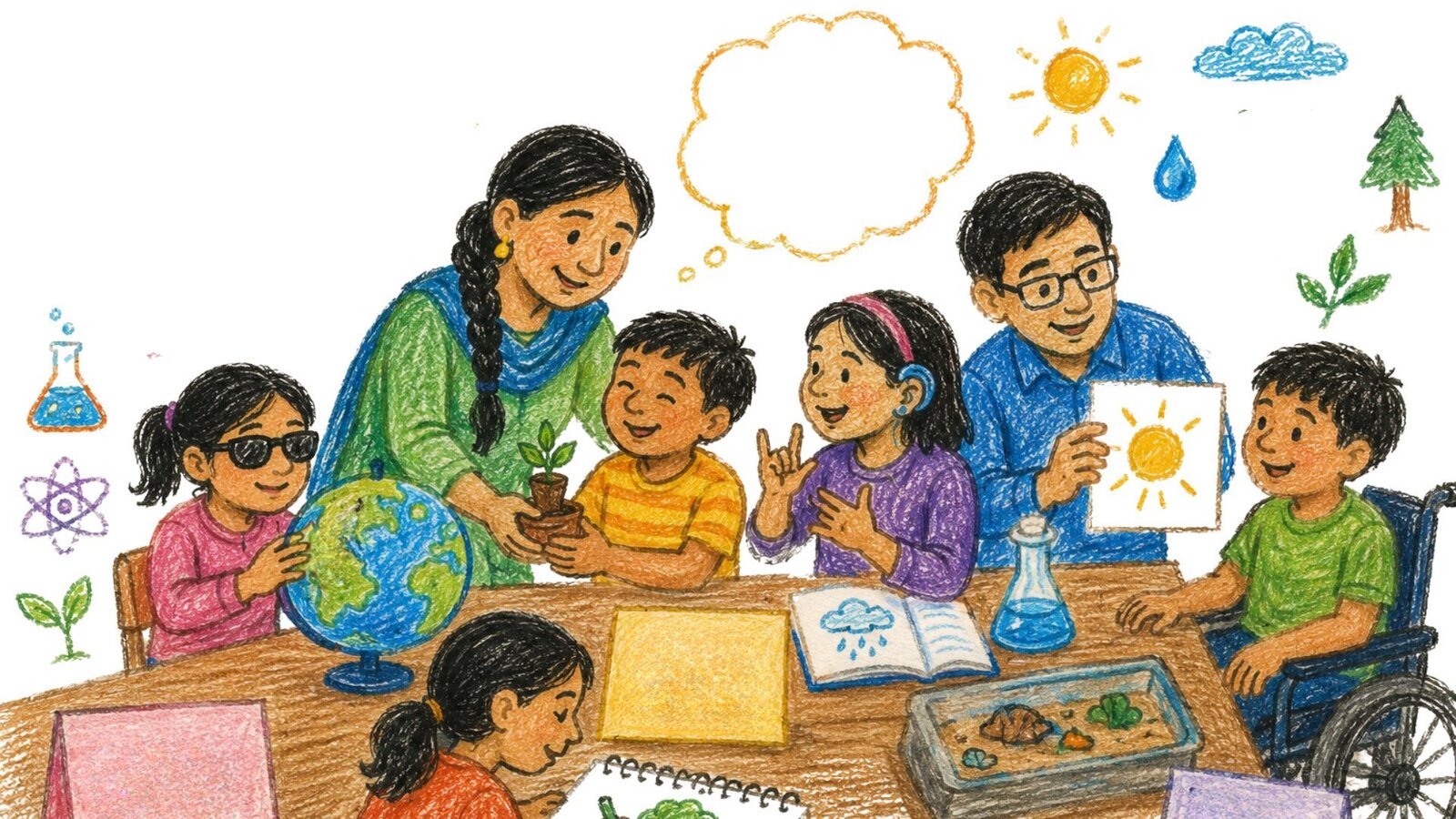
Most science outreach programmes are designed for mainstream classrooms. They assume that participants can read printed material, follow verbal explanations, or perform experiments in conventional ways. But what about children with visual impairments, hearing impairments, intellectual disabilities, or developmental challenges? They are often excluded — not because they lack curiosity, but because outreach activities are rarely designed with accessibility in mind.
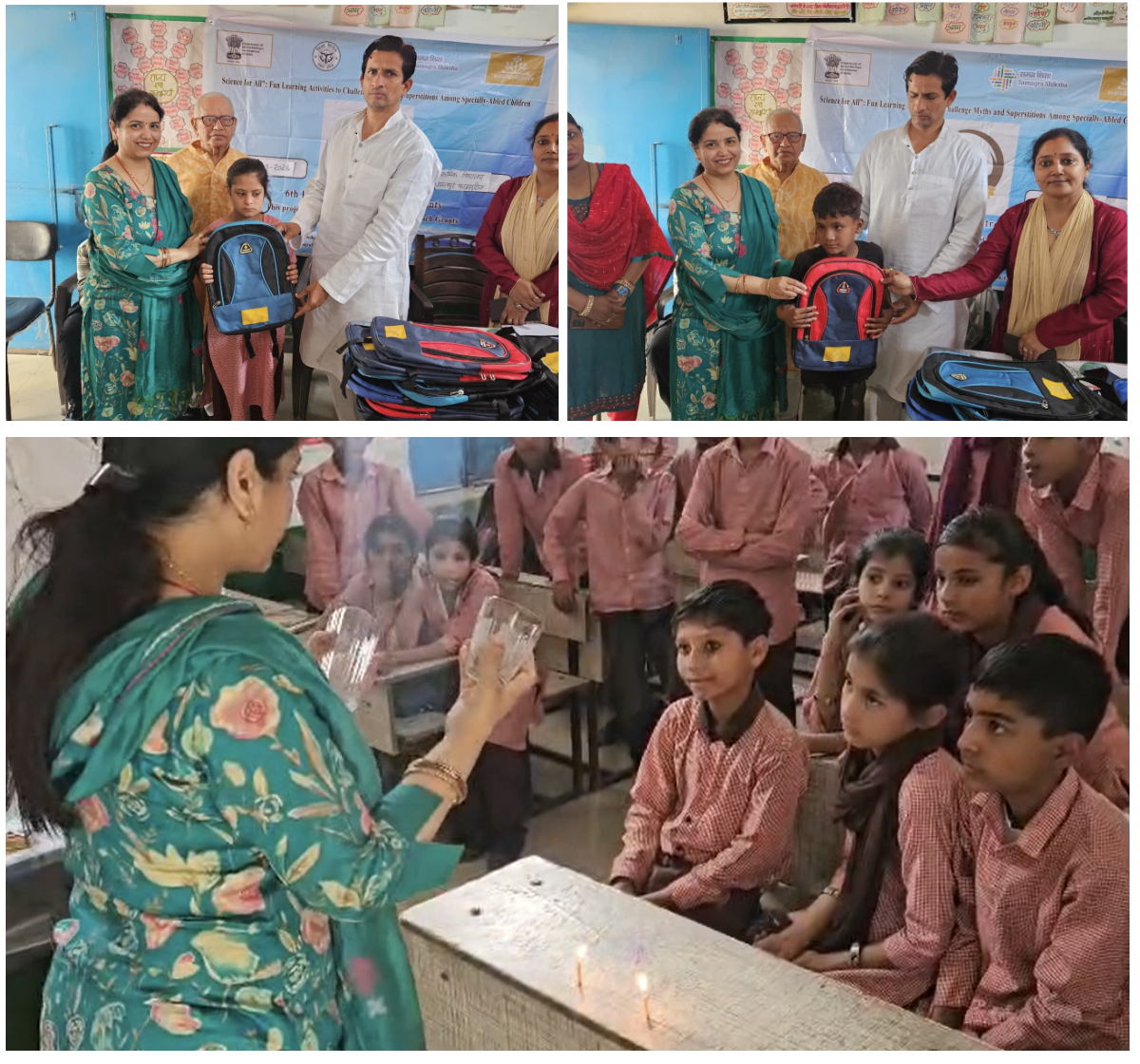
That realisation became the starting point of our project, Science for All: Fun Learning Activities to Challenge Myths and Superstitions Among Specially-Abled Children, supported through the 6th IndiaBioscience Outreach Grant.
Our motivation went beyond making science enjoyable. During interactions with teachers and community members, we observed that myths and superstitions continue to influence how many everyday events — health, illness, eclipses, weather, or environmental changes — are understood. For children who already face barriers in accessing quality education, opportunities to develop scientific reasoning are even more limited. We wondered whether accessible, hands-on science activities could help nurture curiosity while encouraging children to ask questions rather than accept explanations unquestioningly.
We chose outreach instead of a conventional educational intervention because outreach allows science to be experienced rather than simply taught. Interactive storytelling, demonstrations, drawing activities, and conversations can create an environment where every child participates according to their abilities. We hoped that by adapting activities to different sensory and learning needs, we could make science feel inclusive rather than intimidating.
At the beginning, we assumed that our biggest challenge would be simplifying scientific concepts. We soon discovered that this was not the case.
The real challenge was learning how to communicate differently with different groups of children. A single activity rarely worked equally well for everyone. Some children responded enthusiastically to visual demonstrations, while others preferred tactile experiences, storytelling, or one-to-one interactions. We quickly realised that accessibility is not about creating one “special” activity — it is about being flexible enough to modify every activity according to the needs of participants.
Working closely with special educators became one of the most valuable aspects of the project. Their insights helped us rethink our assumptions about learning and participation. Rather than focusing on what children could not do, they encouraged us to build activities around what children enjoyed and how they naturally engaged with the world.
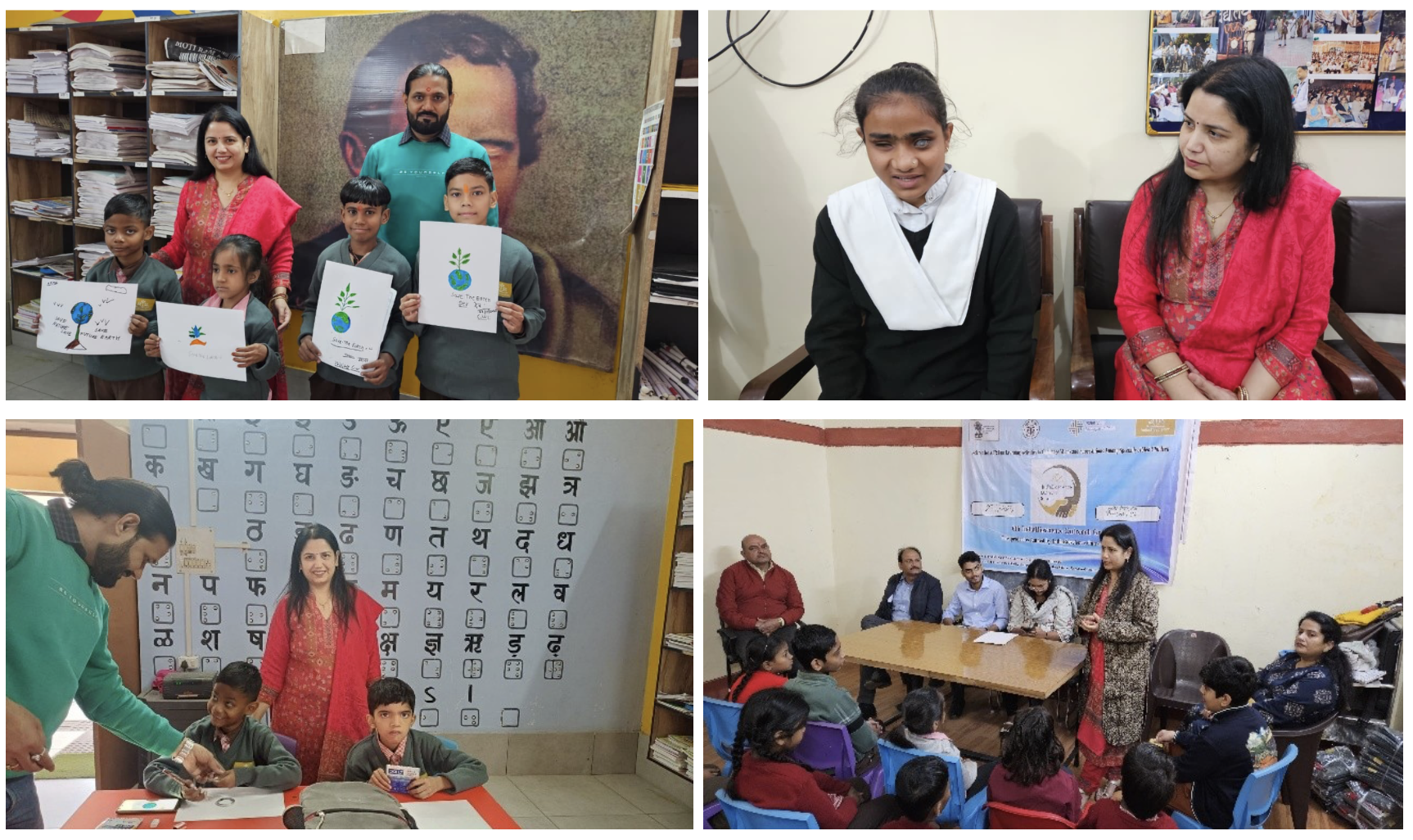
Our first major outreach programme at Composite School Majhola brought together children with visual, hearing, and intellectual disabilities. We designed storytelling sessions around everyday scientific phenomena and encouraged children to discuss why certain commonly held beliefs may not always have scientific evidence behind them. Drawing and creative expression activities helped children communicate ideas about environmental protection, water conservation, and global warming in ways that did not depend solely on spoken language.
The children’s enthusiasm was one of the biggest surprises. Some participants who were initially hesitant, gradually began asking questions, sharing observations, and participating actively in discussions. Their curiosity reminded us that interest in science is rarely absent, it simply needs the right environment to emerge.
Our second activity at Prathmik Vidyalaya Imratpur reinforced another important lesson. While we had initially focused primarily on the children, we realised that lasting change depends equally on teachers, parents, and community members. Many discussions naturally expanded beyond science experiments to conversations about hygiene, environmental responsibility, and critical thinking in everyday life. We began to see the project not just as science communication for children, but as community engagement through science.
Not everything went according to plan.
Some activities required far more time than we had anticipated because they had to be adapted on the spot. Communication methods that worked in one classroom were less effective in another. Coordinating schools, educators, parents, and local authorities also demanded considerably more planning than we had expected. These logistical challenges reminded us that successful outreach depends as much on relationships and preparation as on scientific content.
Perhaps our biggest learning was that inclusion cannot be treated as an afterthought. Accessibility needs to be built into the project from the very beginning, from planning activities and preparing materials to choosing venues and working with educators. The project also changed our understanding of outreach itself. We began with the goal of improving scientific temper among specially-abled children, but we finished with a much broader appreciation of how science communication can strengthen confidence, participation, and community dialogue.
If someone were planning a similar outreach initiative elsewhere in India, our advice would be simple: spend time listening before designing activities. Teachers, caregivers, and especially the children themselves understand their needs far better than any project proposal can anticipate. Their feedback is essential for making outreach genuinely inclusive.
Looking back, we would devote even more time to co-designing activities with special educators from the earliest stages of planning. We would also develop more multilingual, reusable, and accessible learning resources that schools could continue using after the outreach programme ended. Measuring long-term changes in scientific thinking is another aspect we hope to strengthen in future projects.
The IndiaBioscience Outreach Grant gave us much more than financial support. It provided the opportunity to experiment, adapt, and learn from the community. More importantly, it reminded us that inclusive science communication is not about creating separate spaces for specially-abled children, it is about ensuring that science belongs to everyone.
For us, the greatest success of the project was not the number of schools visited or activities conducted. It was seeing children become confident enough to ask, “Why?” That single question is perhaps the strongest foundation for developing scientific temper, and it is one that every child deserves the opportunity to ask.