Starting science outreach as an early-career researcher did not require me to have a large programme or a perfect plan. It began with the organism I already studied, the teaching experience I already had and one opportunity to bring the two together.
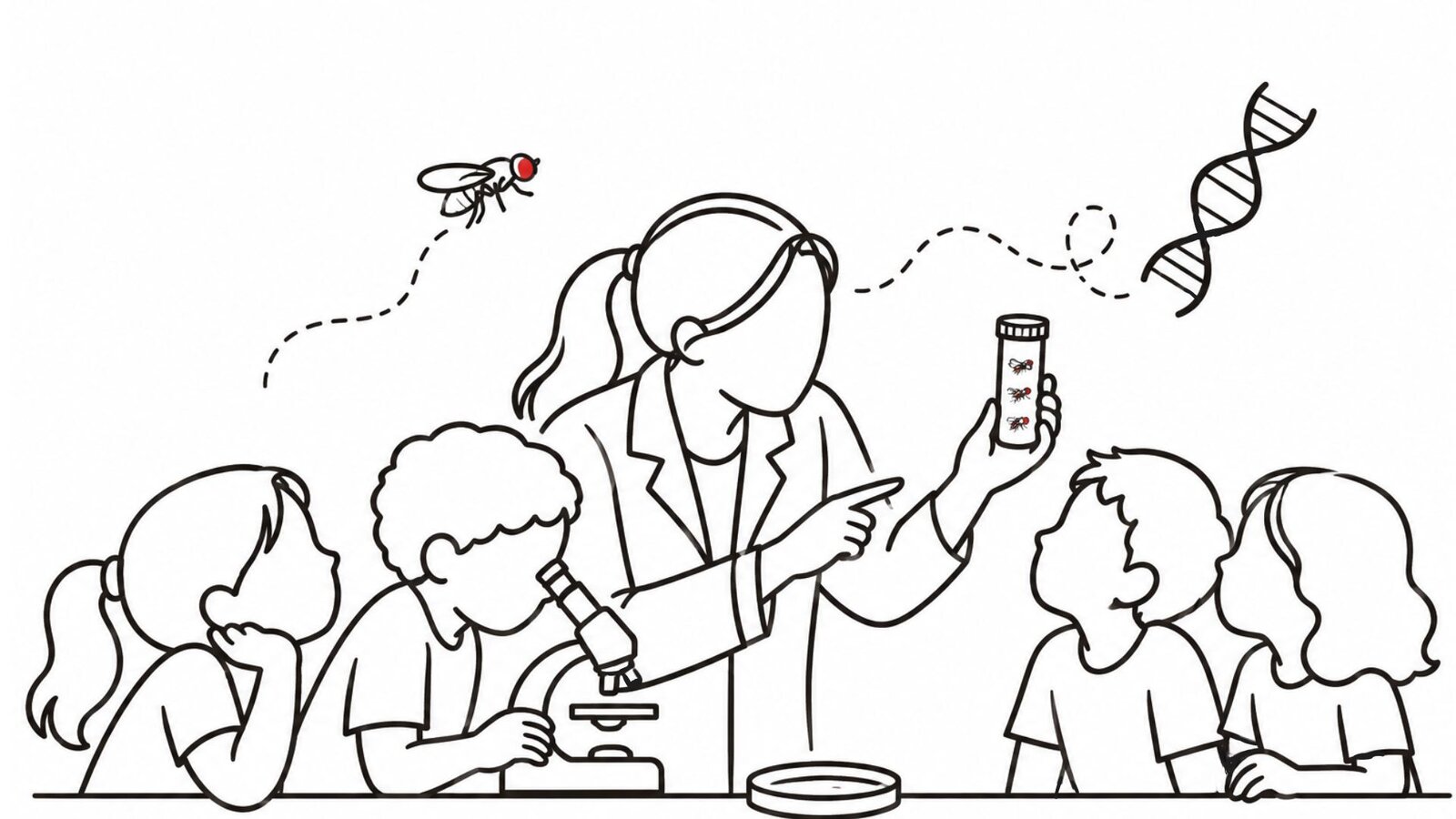
On most days, fruit flies in our laboratory are part of my PhD research. I study metabolism and ageing using Drosophila melanogaster. I look at them as researchers do: carefully planning experiments, collecting data and trying to understand what these tiny organisms can tell us about biology.
But one day, I found myself looking at the flies differently. I began wondering what a child would see. Would they notice their red eyes? Would they be surprised that something so small has a brain, a heart and genes? Would they understand why scientists have studied fruit flies for more than a century?
That question eventually became the starting point for my science outreach work.
Before coming to the United States for my PhD, I taught biology in India. Teaching had already shown me that students become curious when science feels close enough to touch, observe or question. I also knew that explaining more information does not always lead to more understanding. Sometimes one specimen, one story or one well-timed question can do far more than a long lecture.
When I began thinking about outreach as a graduate researcher, however, I felt the same uncertainty that many early-career researchers feel. I was interested, but I did not know exactly where to begin. I had laboratory work, teaching responsibilities and academic deadlines. I did not have unlimited time or money, and I was not a professional science communicator. What I did have was experience teaching children, access to an organism I knew well and a desire to help young learners see science as something they could participate in.
The beginning
My first important decision was not to choose a completely new topic. I began with fruit flies because they were already part of my everyday scientific life. I understood the organism, had access to appropriate laboratory cultures and could explain why it mattered. This reduced the amount of new scientific preparation I needed and allowed me to spend more time thinking about the children.
The idea gradually developed into Drosie the Fly, an outreach initiative that uses storytelling and hands-on activities to introduce children to biology, genetics and scientific observation. I did not begin by trying to explain my own unpublished research. Instead, I focused on established ideas that children could see for themselves: a fruit fly has a head, thorax and abdomen; it passes through distinct life-cycle stages; flies can have visible differences in traits; and scientists use model organisms to answer much larger biological questions.
This was one of the first lessons I learned: outreach does not require us to simplify our current research paper for children. Sometimes the best starting point is the organism, tool or broad question that sits behind our research. It is familiar to us, but completely new to someone else.
The pilot
In June 2026, I had the opportunity to conduct a hands-on outreach programme at a summer camp in Lubbock for 79 children between the ages of five and ten years. Until then, many of the ideas existed in plans, notes and activity drafts. The event was where those plans had to work with real children, real time limits and real materials.
We brought sealed vials containing fruit flies so the children could observe them safely. They used microscopes, looked at the stages of the fly life cycle, labelled basic anatomy and compared visible traits such as red and white eyes and curly and straight wings. We also used movement and age-appropriate activities rather than depending only on verbal explanations.
The children were divided into different age groups, and the same explanation could not simply be repeated for everyone. The youngest children needed short instructions, movement and obvious visual differences. Older children could spend more time comparing traits and discussing what their observations might mean. My classroom experience helped me recognise this, but the outreach setting made the lesson even clearer: knowing your science is only half of the preparation. You also need to know who is in front of you.
I could have tried to include every interesting fact I knew about Drosophila. Instead, the activities centred on a few things the children could observe and do. That choice made the programme more manageable for us and more meaningful for them.
What teaching taught me
My experience as a teacher continues to shape the way I develop outreach. Researchers naturally begin with content: What facts should I include? Which scientific terms are essential? Teachers are more likely to begin with the learner: What can this child already understand? What will keep them involved? How will I know whether they understood?
For example, showing children the stages of a fruit fly’s life cycle is not enough. They need a way to work with the idea. They can arrange images of an egg, larva, pupa and adult in order, act out the stages through movement, or draw one change they noticed. A technical explanation becomes a learning experience only when the audience has something to do with it.
This is why I believe researchers should work with teachers instead of designing school outreach alone. A short conversation with a teacher can reveal whether an activity suits the age group, connects with the curriculum and is realistic in that classroom. It can also prevent us from creating beautiful resources that are too difficult, too expensive or too time-consuming to use.
For researchers in India, former schools and teachers can be especially valuable starting points. Many institutions do not have a dedicated outreach office, but an existing relationship with one teacher may be enough to begin. The first collaboration does not have to be formal or large. One carefully planned session can teach us more than months spent imagining the perfect programme.
The behind-the-scenes
From the outside, an outreach event may look like one enjoyable hour with children. The preparation behind it is much less visible. Materials have to be selected, scientific explanations checked, activities adapted for different ages and safety considered. If live organisms or laboratory equipment are involved, transport and handling also need careful planning.
This hidden workload matters for graduate students and other early-career researchers. Outreach was not the only responsibility on my calendar. I still had experiments to run, students to teach, research meetings to attend and deadlines to meet. I learned that enthusiasm can easily make a small idea grow into a second full-time project.
What helped was giving the project boundaries. I reused the same core scientific ideas across the story, activities and educator materials. I asked for feedback instead of trying to perfect everything alone. I also sought support. A $1,000 outreach grant from the Society for the Study of Evolution helped turn the idea into a real programme, and collaboration with the Museum of Texas Tech University created an audience and setting for the work.
Institutional support does not always have to be a large grant. A department may be able to lend microscopes, cover printing, provide a room, connect a researcher with a school or help with safety and consent requirements. I have found that asking for one specific form of help is more useful than asking generally whether someone “supports outreach”.
One step at a time:
My outreach work did not begin as a complete children’s book, a full educator guide and a collection of polished activities. Those pieces developed gradually. The pilot came first, and it showed me what needed to be clearer, what could be simplified and how differently children of different ages engage with the same organism.
That experience changed how I think about starting outreach. Early-career researchers often believe they need a finished product before approaching an audience. In reality, a small pilot is part of the development process. It allows us to see whether instructions make sense, whether everyone can view the materials and whether the activity takes ten minutes or thirty.
Evaluation can also be simple. If children are learning a life cycle, ask them to put the stages in order. If the goal is observation, ask them to draw or name one feature they noticed. Teacher feedback, participant questions and notes written immediately after the session can all help improve the next version. The purpose is not to prove that the first attempt was perfect. It is to learn from it honestly.
The Indian context
My training as an educator in India also makes me think carefully about where outreach activities are created and who they are created for. A resource designed for a well-equipped classroom in the United States cannot always be transferred unchanged to an Indian school. Access to microscopes, printing, laboratory materials, transport and even reliable internet varies widely between institutions and regions.
Language is another important part of access. A child may understand a scientific idea but hesitate to express it in English. Allowing discussion in Bengali, Hindi, Urdu, Tamil or another familiar language does not make the science less rigorous. It may give the child a better opportunity to observe, reason and ask questions.
Low-cost outreach does not have to be low-quality. A locally available organism, a set of carefully chosen pictures or a simple comparison activity can create genuine scientific engagement. But we should not romanticise doing more with less. If universities and research institutes want early-career researchers to participate in outreach, they should provide small grants, recognised time, training, reusable materials, translation support and long-term relationships with schools. Individual enthusiasm can begin a project, but it should not have to carry the entire system.
What I learned:
I would not tell someone to wait until their schedule becomes empty, because that time may never arrive. I would tell them to begin with something small enough to fit into the life they already have.
Choose a topic you know well. Find one teacher, school, museum or community partner. Ask what their learners need before deciding what to create. Plan one activity with one clear goal. Use an existing reliable resource if it can be adapted. Decide in advance how much time and money you can give. Then test the activity and allow the first version to be imperfect.
I began by looking at the same fruit flies I saw every day and asking what a child might see in them. That question led to an outreach programme for 79 children, new educational activities and a children’s science initiative that is still growing. None of it appeared fully formed. It developed one conversation, one activity and one revision at a time.
That is perhaps the most reassuring thing I have learned. We do not need to become senior scientists before we can share science. We do not need a national platform before work matters. We need accurate science, respect for the audience and a beginning that is small enough for us to make.