A college teacher from Bihar reflects on pursuing a PhD in computational chemistry at IIT Kanpur through study leave. Navigating deadlines, financial constraints, age-related expectations and career pressures, the author shares lessons on managing a time-bound doctorate, choosing research projects wisely and balancing academic ambitions with professional responsibilities.
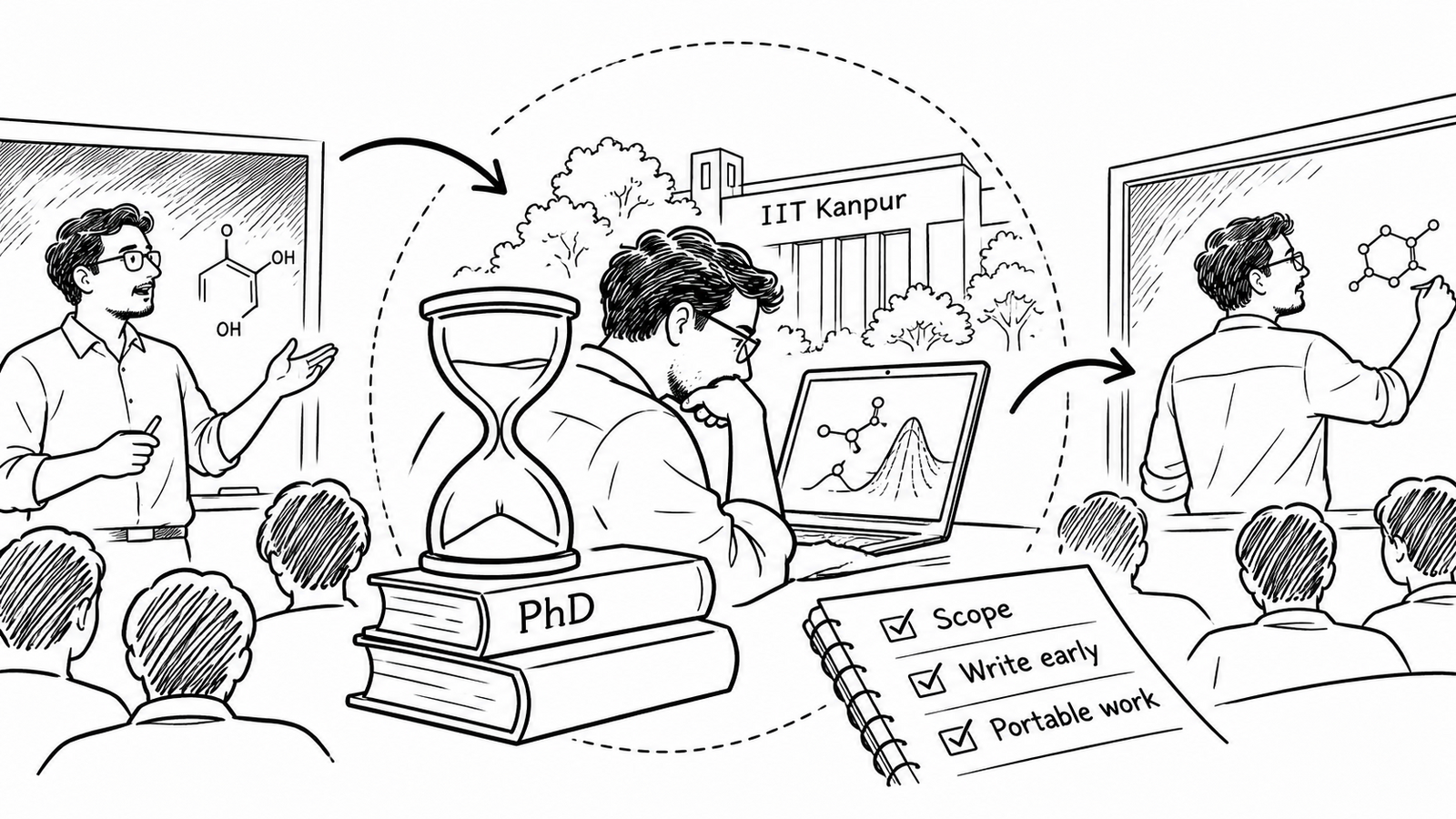
I teach chemistry to undergraduates at a college in Bihar. Four years ago, I left that classroom to pursue a doctorate in computational chemistry at IIT Kanpur, and I have since returned to teaching.
The route I took was study leave, which a fair number of college teachers in India are on or thinking about, and which many researchers outside that world have never heard of. The college holds your post for the years you are away, you receive reduced pay, and you return to the same job at the end.
Not much is written about what those years are actually like. The thing that shaped mine was not the research, nor was it being away from home. It was a clock.
When I applied, I asked for three years.
I had worked out that a doctorate could be done in three years if nothing went badly wrong, and I believed it. At the end of the third year, I did not have results solid enough to build a thesis on. That was the most anxious period of the whole doctorate. I took an extension of six months, and then another. Nobody asks for a year. You ask for six months, because six months is still what you think you need.
A student without a clock can afford a year that goes nowhere. It is miserable while it lasts, but people come through it, and good work comes out of those years. I did not have that kind of room. People assume the response is to work harder. That was not really it.
The first effects were small ones. A calculation that fails is information, and I learned to read it that way faster than I otherwise would have, because I could not afford to spend the week feeling demoralised by it.
I also worked long hours, including most weekends. I am not going to present that as a strategy, because it was not one. Looking back, it had more to do with anxiety than with any calculation about time, and my labmates used to joke that I was never not in the lab. I finished. I do not know that I finished sooner because of those long hours, and I would not recommend working that way.
The bigger thing was what I never started.
Alongside the thesis, I had a side project on zeolites, porous minerals used as industrial catalysts. There was a more demanding and more accurate way of doing those calculations, and I wanted to try it. It would have taken months of computing.
With three years in front of me, I did not start it. With five, I would have. The thesis was fine. What a deadline eats is the work standing next to the thesis, and nobody ever sees what is missing.
The other difference was age. I started at thirty. Most people around me had arrived at about twenty-three, straight out of a master’s, and I had been teaching for several years before becoming a student again. Most of what I learned in the first year came from the senior students in the group, nearly all of them younger than me, and I had to go to them with basic questions, the way any new student does. There is an awkwardness in that for which nobody prepares you.
What I had instead was patience. Research involves long stretches where nothing visibly moves, and at twenty-three I would have given up on problems that, at thirty, I was willing to sit with for months.
There is a social clock in India running alongside the academic one, and at thirty it is loud. A permanent post is the thing you are supposed to arrive at, not the thing you step away from, and going back to being a student looked to many people outside the university like a move in the wrong direction.
The questions from inside the profession were harder. The degree was needed for my promotion, and most colleagues in my position had done the obvious thing and registered at the university where they already worked, finishing alongside their duties, without leaving and without the pay cut. More than one asked why I was not doing the same. On paper, they were right. What I wanted was to be trained where the work I was interested in was actually being done, by people doing it full time. The same degree earned in the evenings between classes would have been a different thing in substance. That did not persuade everyone, and after a while I stopped offering that explanation.
Three things, then, for anyone weighing this now.
Settle the scope of the problem before you start. Tell your prospective supervisor how long your leave runs, in the first conversation, and ask whether what they have in mind can be finished in that time. Most will answer honestly if you ask.
It took me embarrassingly long to work out that a methods chapter does not need results. The theory, the algorithms, the computational details can all be written while the calculations are still running. Once that occurred to me, I started writing mine a year before I needed it, and the time it gave back at the end was the most useful thing I did to stay on track. Start in the first year.
And choose work you can carry on with after you return. I did think about this one. Knowing I would go back to a teaching post with no research laboratory, I built the doctorate around computational work, which is the kind of research that travels with you.
Would I do it again? Yes, and sooner. The constraint was real, and it narrowed what I attempted. It also meant I finished, and I am not certain I would have finished without it.