Bodhisatta Nandy, Associate Professor and evolutionary biologist at IISER Berhampur, looks back on his association with the Young Investigators’ Meetings (YIMs) over the years, in this conversation with IndiaBioscience. His first interaction with YIM was in 2019, as a faculty representative from IISER Berhampur. The meeting helped him gain an insider’s view of the meeting as a platform for aspiring faculty and institutional networking. He later returned as a panellist at YIM 2021 and is a mentor at YIM 2026.
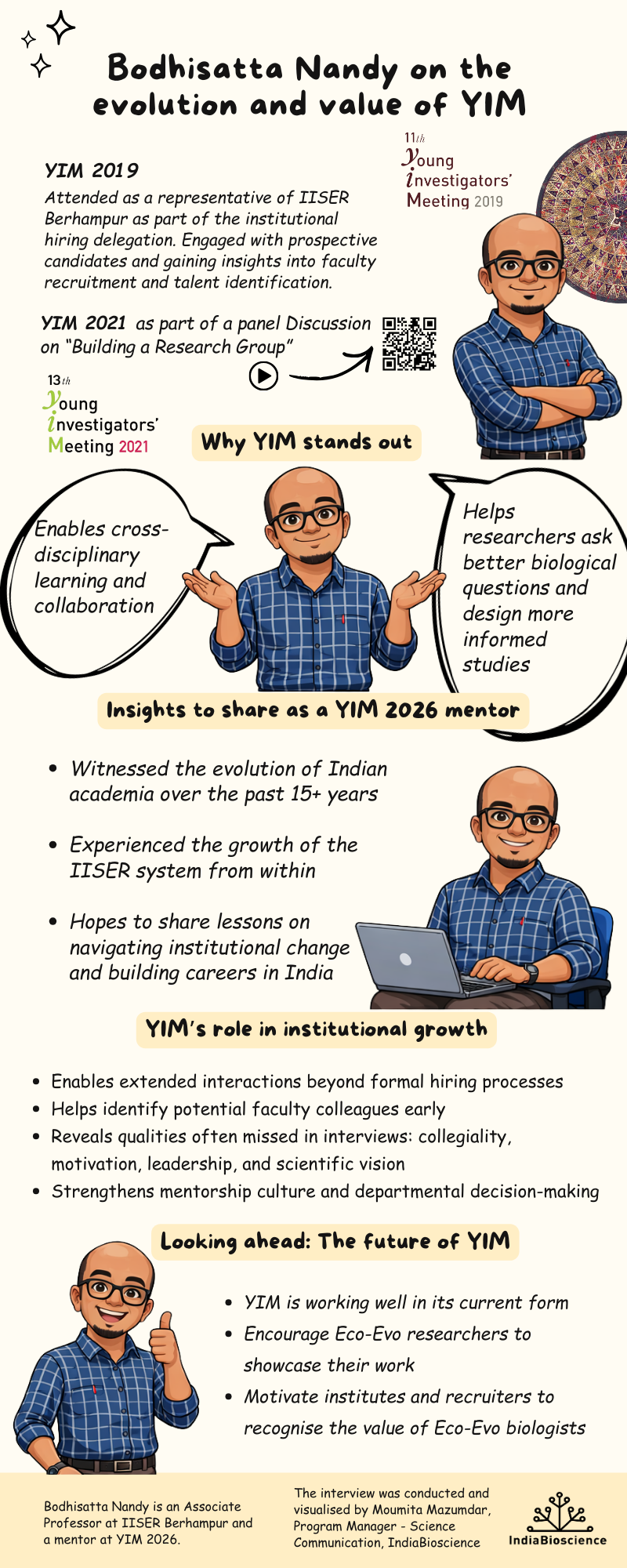
Having experienced YIM from various vantage points, Bodhi shares that the meeting serves as a rare space for extended scientific dialogue across disciplines and for thoughtful faculty engagement. He reflects on YIM’s role in bridging organismal and molecular biology, shaping hiring conversations, and fostering a research culture rooted in long-term thinking, mentorship, and academic community-building.
How has your participation at YIM over the years shaped your perspective on the value and evolution of the meeting?
I did not participate in YIM before joining as a faculty member. My first YIM experience was in 2019, when I represented IISER Berhampur at YIM Guwahati. It was a wonderful experience for me.
For aspiring young faculty members, it provided a valuable opportunity not only to showcase their work but also to interact with potential employers and understand the nuances of faculty recruitment in the country.
YIM brings together scientists from diverse backgrounds and career stages. From your perspective as an evolutionist working in India and a faculty leader, what makes YIM a distinctive platform for creating meaningful scientific connections?
There is a serious dearth of interaction between organismal biologists, especially ecologists and evolutionary biologists, and sub-organismal biologists such as molecular biologists, cell biologists, and biochemists.
YIM has great potential to bring together these diverse yet complementary domains of the biological sciences.
While organismal biologists can benefit from incorporating molecular techniques into their studies, sub-organismal biologists can gain a more holistic biological perspective, develop new questions, and make more informed decisions about study design through such interactions.
As a mentor at YIM 2026, what insights from your academic journey do you hope to share with early-career researchers navigating their paths in academia?
I have witnessed the transformation of the Indian academic landscape over the past one and a half decades. I hope to share insights gained from observing the evolution of the IISER system over the years, particularly regarding institutional growth, expectations, and opportunities for early-career researchers.
You have played a central role in building the Department of Biological Sciences at IISER Berhampur and currently serve as Dean of Student Affairs. How do meetings like YIM contribute to institutional growth, mentorship culture, and the broader research ecosystem in India?
YIM provides an opportunity to meet young, aspiring scientists who may become valuable assets to academic departments. The faculty hiring process often misses nuances of personality and temperament that are crucial for long-term success as a faculty member. Extended interactions at meetings such as YIM allow us to better assess potential colleagues before encouraging them to apply for faculty positions.
Looking ahead, how do you envision this meeting evolving to adapt to the needs of India’s next generation of scientists?
I think YIM is functioning very well and does not necessarily need to evolve into something entirely different. However, I would like to see a stronger focus on ecology and evolutionary biology, both by encouraging researchers from these fields to showcase their science and by motivating recruiters and decision-makers to recognise that many institutions would greatly benefit from hiring more ecologists and evolutionary biologists.