Does our internal clock dictate our ability to fight infection? While we sleep, our body undergoes a massive physiological shift governed by the circadian rhythm. Recent research in chrono-immunology suggests that our immune system is not a constant shield but a rhythmic force that fluctuates between day and night. Understanding these peaks and troughs, driven by molecular clocks and hormonal shifts, offers a roadmap for timing vaccines and treatments more effectively.
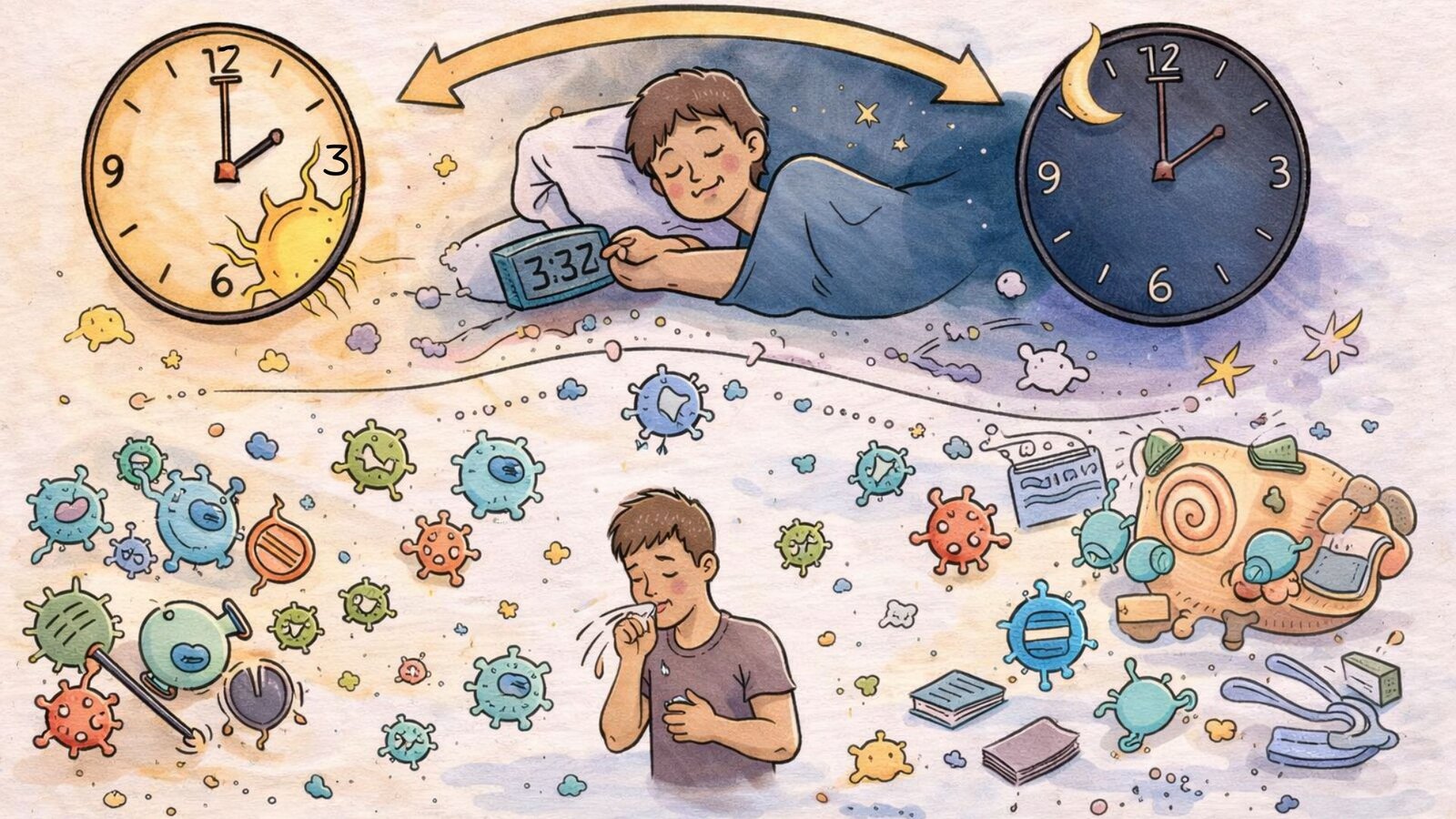
When we fall ill, symptoms often seem to worsen as the sun goes down. The sudden spike in fever or the intensification of a cough during late hours isn’t just a trick of the mind; it is a reflection of our immune system’s internal schedule. For a long time, the immune system was viewed as an ‘always-on’ surveillance team. However, we now know that it operates on a strict 24-hour cycle, leading scientists to ask: is our immunity actually ‘reduced’ at night, or is it simply changing its strategy?
Research indicates that the immune system is highly rhythmic. While certain protective barriers might be less active at night, other parts of the immune system are working overtime while we sleep. This rhythmic fluctuation is governed by our circadian clock—the same internal ticker that tells us when to wake and when to rest.
Chrono-immunology in plain language
Across the animal kingdom, biological processes are timed to coincide with the environment. Just as a flower opens during the day to attract pollinators, our immune cells move through the body in predictable waves. This field, known as chrono-immunology, reveals that our ‘defence budget’ is reallocated depending on the time of day.
During the day, when we are active and likely to encounter pathogens through food or social interaction, our immune system focuses on ‘immediate response’ cells in the blood. At night, the strategy shifts. The body moves its resources away from the ‘front lines’ and into the ‘training camps’ — the lymph nodes — to process information and build long-term memory.
The ‘night shift’ of T‑cells
One striking example of this rhythm involves T‑cells, the specialised soldiers of the immune system. Research has shown that during deep sleep, the levels of T‑cells in our bloodstream drop significantly. A study published in the Journal of Experimental Medicine found that this isn’t because the cells have disappeared, but because they are migrating to the lymph nodes.
This migration is triggered by the drop in ‘stress’ hormones like adrenaline that occurs during sleep. When these hormones are low, T‑cells are better able to ‘stick’ to their targets and move into lymphoid organs to memorise the signatures of viruses encountered during the day. Sleep acts as a master regulator that enhances the ‘stickiness’ of these cells, meaning that ‘reduced’ immunity in the blood at night is actually a sign of a highly efficient system moving into a specialised ‘repair and learn’ mode.
Molecular clocks: The BMAL1 regulator
The immune system’s rhythm is hardwired into our DNA. Nearly 8% of the genes in our immune cells fluctuate in activity based on the time of day. A central actor in this genetic play is a protein called BMAL1 (Brain and Muscle ARNT-Like 1).
BMAL1 acts as a master switch that regulates inflammation. In studies involving mice, researchers found that those with a ‘broken’ BMAL1 clock in their immune cells suffered from much more severe inflammation and higher mortality rates when infected with bacteria at night compared to the morning. This suggests that the body uses these molecular clocks to dampen inflammatory responses at specific times to prevent tissue damage. When the clock is disrupted — by shift work or jet lag — this regulation fails, leaving the body vulnerable to its own overactive immune response.
What could this mean for human health?
All of this raises a transformative possibility: ‘Time-of-day’ medicine. If our immunity follows a predictable schedule, we can time our medical interventions to catch the immune system at its most receptive.
There are several promising avenues:
Vaccine timing: A cluster-randomised trial suggested that flu vaccines administered in the morning produce a significantly higher antibody response than those given in the afternoon, as the immune system is naturally gearing up for the day’s threats.
Chronotherapy: Understanding when inflammatory pathways peak could allow doctors to prescribe anti-inflammatory drugs at the exact hour they are most needed, maximising efficacy while minimising side effects.
Shift-work interventions: Recognising that a disrupted clock leads to ‘leaky’ immunity could lead to new light-based therapies or dietary schedules to protect the health of millions of night-shift workers.
The circadian rhythm of our immune system shows that biological timing is just as important as biological strength. Our defences are not simply ‘reduced’ at night; they are refined. By decoding the schedule of our internal ‘night shift’, biotechnology may turn these rhythmic cycles into a powerful tool for preventing and treating human disease.