A missed detail on a petri dish became a reminder: Not every anomaly is noise. A puzzling observation in a petri dish became a lens to examine how discovery often begins with observation, not hypotheses. This piece by Navneet Shahi reflects on reclaiming the value of careful seeing in science — where patience, curiosity, and attention to unexpected patterns can shape meaningful questions, challenging the linear narratives that dominate research and training.
I almost ignored it.
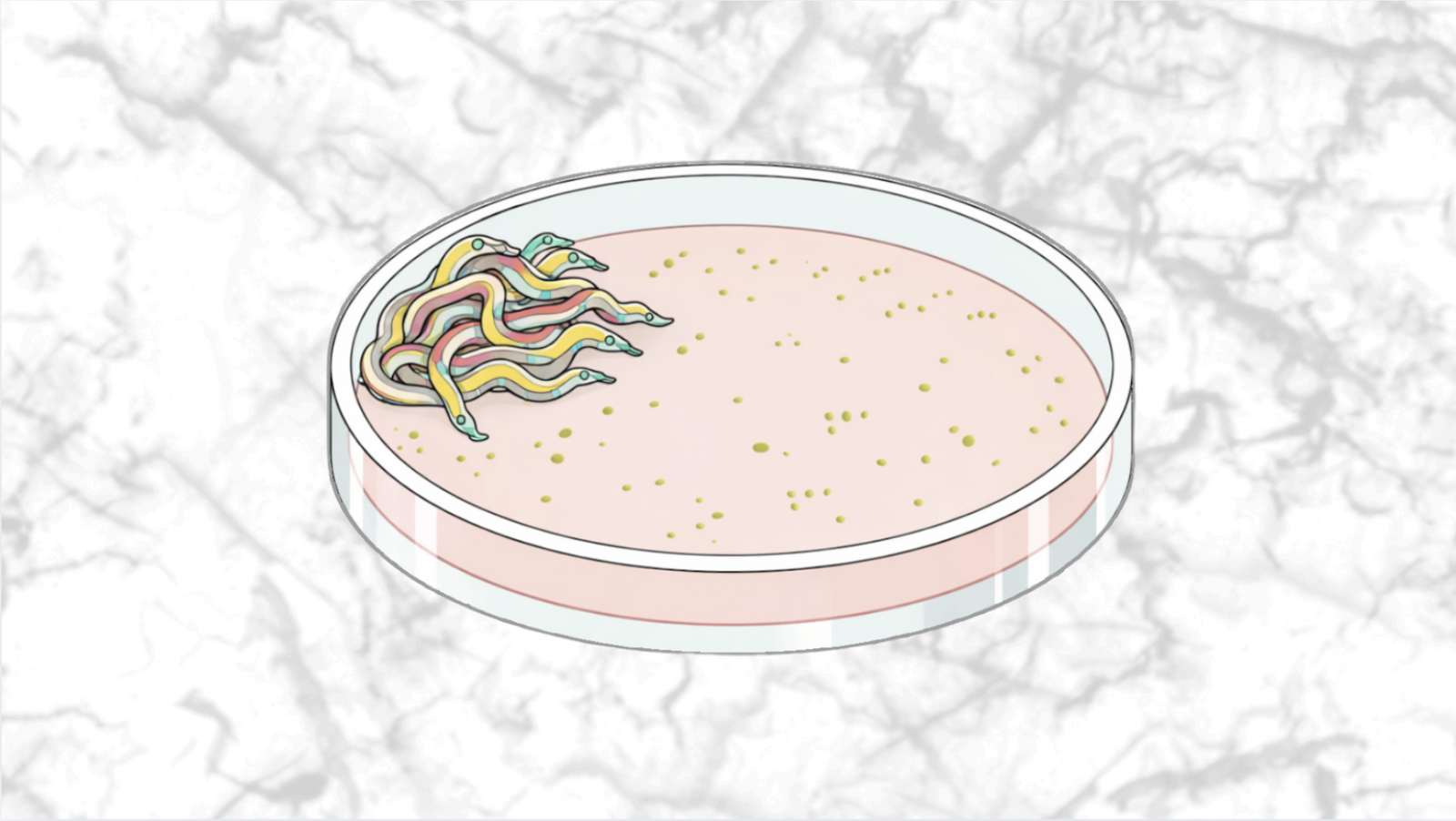
On a plate seeded with bacteria, our C. elegans mutants were not feeding in the dispersed manner we expected. Instead, they formed distinct clusters at the edge of the food and did not disperse well despite being starved in that confined space. It would have been easy to dismiss the pattern as noise — a population density effect, a plating inconsistency, or a minor behavioural fluctuation. Biology is full of variation, and we are trained to average it away.
But the aggregation persisted. It appeared again. And again.
Most scientific papers begin with a hypothesis. Many scientific discoveries do not. They begin with a moment of hesitation and a pause long enough to ask: Why is this happening?
In the early days of ethology, scientists such as Nikolaas Tinbergen and Karl von Frisch spent years simply watching animals, without a defined map of what they should see. The zig-zag courtship of a fish, the waggle dance of a bee — these were not predictions tested into existence. They patiently allowed the organism to define the question. That spirit of disciplined observation still matters.
Starting from an observation rather than a predefined roadmap allowed us to explore the worm swarming phenomenon without prematurely narrowing its meaning. We did not yet know whether the behaviour reflected altered sensory processing, neuromodulatory imbalance, or something else entirely. What we did know was that it was reproducible.
For us, that shift from seeing to measuring marked a turning point. Recording videos, quantifying aggregation, and developing assays transformed a fleeting observation into something testable. Hypotheses emerged, but they emerged honestly, grounded in description rather than imposed upon it. There were many failed attempts. There were also moments when the animals behaved exactly as predicted. Those moments did not feel like confirmation of a prewritten story. They felt like alignment, as if the original observation had been pointing toward something real all along.
Yet scientific culture often narrates discovery differently. By the time a paper is written, the path appears linear. The hypothesis comes first. The experiment follows. The answer emerges. The uncertainty, the false starts, and the long period of simply watching rarely make it to print. This is not merely a stylistic issue. It shapes how young scientists are trained.
In many Indian research settings, students are encouraged, and often required, to define precise hypotheses early, sometimes before they have deeply encountered their system. Grant applications demand clear deliverables. Doctoral committees ask for directional clarity. These structures are not unreasonable; they provide accountability. They can also unintentionally signal that exploratory observation is unfocused or risky.
Observation-driven science is risky. It requires time without immediate narrative payoff. It requires tolerating ambiguity long enough for patterns to clarify. In environments where productivity is measured in short cycles, that patience can feel indulgent.
In my teaching, I try to carve out space for this discipline of attention. When students encounter C. elegans for the first time, I do not begin with an explanation. I hand them a plate and ask them to record eight to ten observations before attempting interpretation. Only afterward do we discuss the meaning behind those observations. The exercise separates noticing from explaining.
In practical sessions, I present a single behavioural phenomenon and ask: What questions arise? What assumptions are you making? How would you test this? The goal is not to extract the correct answer. It is to cultivate the habit of careful seeing before structured reasoning.
This approach does not oppose hypothesis-driven science. It strengthens it. Clear predictions are more powerful when they arise from faithful description. If we only reward predefined narratives, we risk overlooking the phenomena that generate the best hypotheses in the first place.
Today, our tools are becoming extraordinarily powerful, such as automated imaging, large-scale behavioural tracking, and machine learning – based analysis. These technologies expand what we can measure. They do not replace the first step: noticing that something is worth measuring.
Before logic, before models, before validation, there is the simple act of seeing.
Reclaiming the value of observation is not a call to abandon rigour. It is a reminder that rigour begins with attention. By protecting space for careful observation in our labs, our classrooms, and our funding structures, we protect the source from which meaningful questions arise.