From ancient Mesopotamian observations of dangerous dog bites to Pasteur’s first rabies vaccine, the history of rabies reveals how centuries of observation transformed fear and superstition into a scientifically grounded strategy for preventing a diabolical disease that remains almost invariably fatal once neurological symptoms appear.
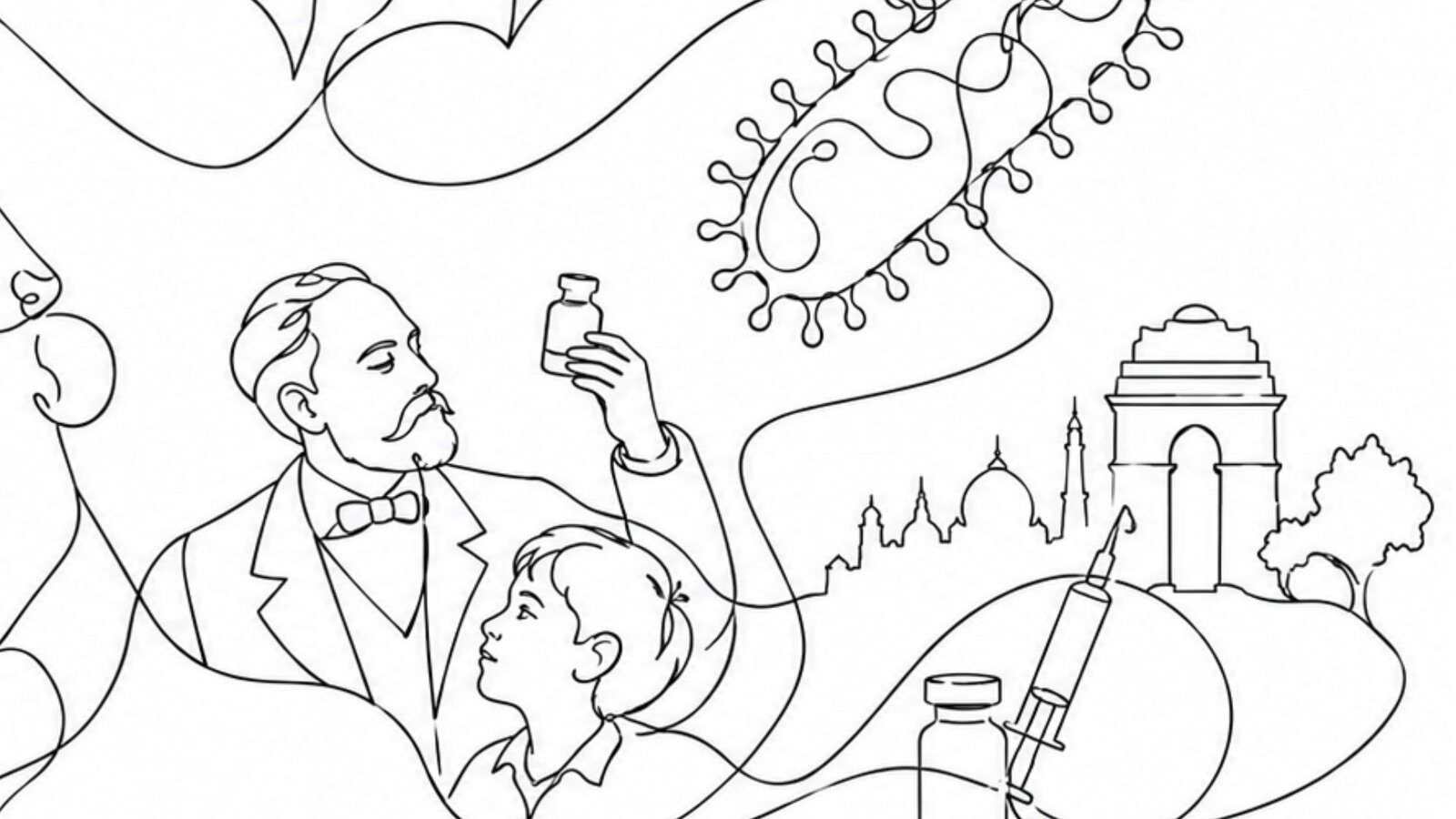
Long before modern virology, humanity had begun to recognise something unusual about the bites of certain animals. A seemingly minor wound could be followed, sometimes after a long interval, by profound behavioural changes, spasms, difficulty swallowing and almost inevitable death. Over thousands of years, observations of these frightening illnesses gradually converged on what we now know as rabies.
Rabies is caused by rabies virus, a neurotropic, bullet-shaped virus of the genus Lyssavirus and the family Rhabdoviridae. Several lyssaviruses have bats as important natural hosts, while rabies virus is maintained predominantly in terrestrial mammals, particularly dogs in many parts of the world. Its evolutionary history is complex, but its history with humans is more familiar: rabies became intertwined with human civilisation as people and animals increasingly shared the same environments.
Human interactions with canids stretch back tens of thousands of years. Archaeological evidence suggests that humans and dogs may have coexisted as far back as 30,000 years ago. At ‘Uyun al-Hammam in the Levant, a red fox was buried alongside a human approximately 14,500 years ago, providing an intriguing glimpse into relationships between people and wild canids in antiquity. Such interactions also created opportunities for pathogens circulating among animals to cross into human populations, although there is no evidence that the burial itself was associated with rabies.
Written evidence for rabies, however, is considerably more recent. The Laws of Eshnunna, from around 1930 BCE in ancient Mesopotamia, describe a dangerous dog bite in connection with subsequent human death. Other Mesopotamian clay tablets dating from approximately 1900 to 1600 BCE contain incantations associated with dangerous dog bites and appear to recognise a harmful substance in the saliva of an afflicted animal. Although the explanation was framed within the beliefs of the time, the observation itself was remarkably relevant: saliva from an infected animal can transmit the rabies virus through a bite.
Rabies was not merely observed; it was feared. During the classical era, Greek and Roman physicians and writers described the disease in animals and humans with increasing detail. They recognised that illness could remain hidden after a bite before neurological symptoms appeared. Agitation, spasms, difficulty swallowing, hydrophobia, aerophobia and striking behavioural changes became characteristic features of the disease.
Yet recognising the clinical features did not mean understanding the underlying biology. Through the Middle Ages and Renaissance, wound cleansing and cauterisation were recommended at different times, while religious sites offered prayers, amulets and other supposed protections. These approaches may appear irrational from a modern perspective, but they reflected a fundamental medical reality: once clinical rabies developed, survival was extraordinarily unlikely, while the mechanism of prevention remained unknown.
A major conceptual shift began during the eighteenth and nineteenth centuries, as observation and experimentation increasingly replaced speculation. Physicians and scientists recognised that the risk of infection could vary according to the location of the bite and that saliva played a central role in transmission. Experimental studies subsequently demonstrated that the infectious agent could be transmitted through saliva and provided evidence that the disease reached the central nervous system through peripheral nerves rather than simply spreading through the bloodstream.
This insight was crucial. If the infectious agent required time to travel from the site of exposure to the nervous system, then the interval between a bite and the onset of neurological disease might represent an opportunity for intervention.
In 1879, French veterinarian Pierre-Victor Galtier demonstrated experimental transmission of rabies and began investigating whether exposure could induce protection. His work was an important precursor to Louis Pasteur’s later experiments on rabies.
The significance of this work became clear on 6 July 1885.
Nine-year-old Joseph Meister had been bitten fourteen times by a rabid dog. At a time when rabies was considered fatal once symptoms developed, Pasteur and his collaborators decided to attempt an experimental post-exposure treatment because of the severity of the exposure. Over ten days, Meister received 13 inoculations of progressively more virulent preparations of attenuated rabies virus. He survived.
The episode marked a turning point in infectious disease history. Although Pasteur’s treatment was experimental by modern standards, it demonstrated the possibility of preventing rabies after exposure and became a landmark in the development of post-exposure prophylaxis.
The principle established in the nineteenth century continues to underpin rabies prevention today. Modern cell-culture vaccines are safer and better tolerated than early preparations, while rabies immunoglobulin can provide immediate passive antibodies at the site of exposure. Together with prompt and thorough wound washing, these measures form the basis of post-exposure prophylaxis (PEP) and can prevent the virus from reaching the central nervous system when administered promptly and appropriately.
The biology of rabies makes this timing particularly important. Following exposure, the virus can enter peripheral tissues and eventually gain access to the nervous system. Once neurological disease is established, the situation changes dramatically. Clinical rabies remains extraordinarily difficult to treat, and WHO states that once clinical symptoms appear, the disease is fatal in 100% of cases. Prevention therefore has to occur before irreversible neurological disease develops.
This creates one of the most striking paradoxes of rabies: it is among the most lethal infectious diseases known, yet human deaths following exposure are preventable through timely and appropriate PEP.
The history of rabies also has an important Indian chapter. Following Pasteur’s work, people exposed to rabies in India initially had to travel to Paris for treatment. The establishment of Pasteur Institutes and anti-rabies services in India gradually brought post-exposure treatment closer to those at risk and contributed to the development of rabies research and vaccine production in the country.
Four thousand years of observation have taken humanity a remarkable distance. Ancient Mesopotamian descriptions of dangerous dog bites, classical accounts of neurological disease, centuries of empirical treatments and nineteenth-century experiments gradually contributed to a coherent understanding of transmission and disease progression. That knowledge ultimately led to vaccines, post-exposure prophylaxis, molecular diagnostics and modern approaches to rabies control.
Yet the story is not simply one of scientific triumph. Rabies remains a major public-health concern, particularly in regions where dog-mediated transmission persists, and access to timely post-exposure prophylaxis is uneven. WHO estimates that rabies causes tens of thousands of deaths each year, with most human cases linked to infected dogs. Its control depends not only on treating people after exposure, but also on preventing exposure through mass dog vaccination, responsible animal management, public awareness, prompt wound cleansing, and timely access to vaccines and immunoglobulin.
This is especially relevant to India, which bears a substantial burden of dog-mediated human rabies. Historical and contemporary public-health efforts in the country show that rabies control requires more than medical intervention after a bite; it also requires sustained animal vaccination, surveillance, access to care and community engagement.
Rabies also illustrates why human health cannot be separated from animal health and the environments we share with them. Its history is a story of biology, human behaviour and the changing relationship between people and animals.
Perhaps the most important lesson from four thousand years of rabies is therefore also the simplest: the decisive battle is not fought after neurological disease begins. It is fought in the interval between exposure and disease – before the bite becomes a death sentence.