Biographies of Indian scientists usually follow a pattern, often bordering on hagiography – early life and education, inspiring moments or turning points, initiation into science and research, scientific contributions, institution building and legacy. D D Kosambi: One Life, Many Worlds, written by Ram Ramaswamy, ducks this pattern. This is because the life of Kosambi did not fit any such mould, nor did it remain glued to one area of scientific inquiry or intellect.
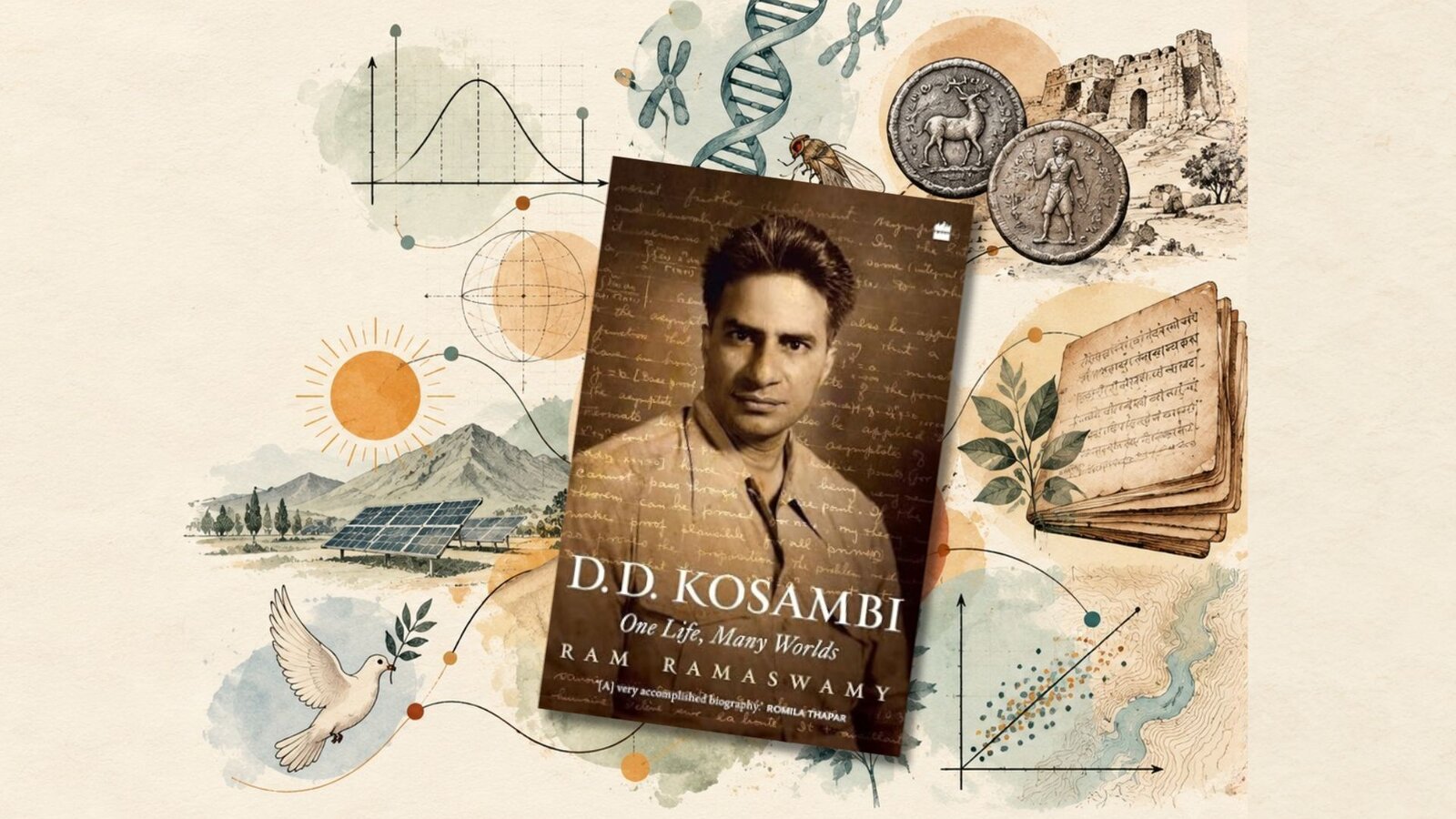
D D Kosambi (Kosambi, hereafter) (1907−1966) saddled many horses – from mathematics and genetics to historiography and peace activism. He worked at diverse academic and research institutions, did not have a PhD, and proposed seemingly unconnected new ideas like harnessing solar energy and remote sensing. How did he do all this? How did he deal with rigid institutional systems that discourage crossing of disciplinary boundaries? Did he falter, or was it a smooth sailing life all along? All such questions, many of which remain relevant even today, make Kosambi’s life enigmatic. Ram Ramaswamy’s book answers all such questions about the multi-faceted, even complex, life of Kosambi.
In a way, much of Kosambi’s interdisciplinary life was shaped or engineered by his father, Dharmanand Kosambi (Dharmanand, hereafter), who was perhaps the greatest influence on Kosambi. Dharmanand was a Buddhist and Pali scholar, and a Marxist and a Gandhian too. Going to England and America for higher studies was the norm in the first half of twentieth century India, but rarely did one go to the West for schooling. Kosambi did his schooling in America, as Dharmanand took him and his sister Manik along when he went to Harvard to work on the Harvard Oriental Series. After schooling in Boston, Kosambi graduated in mathematics from Harvard, where George Birkhoff and Marshall Stone were among his teachers. It is not clear why he did not stay on at Harvard or in America for a PhD (he never did one).
Schooling in America and the liberal academic environment of Harvard shaped Kosambi.
The academic flexibility allowed him to chart his own intellectual course and imbibe as much as he was capable of, notes the author.
Alongside, Dharmanand gave his son the necessary support and helped him develop varied interests, including Sanskrit poetry and history. Dharmanand’s interest in Marxist thought and attraction to the USSR also influenced Kosambi, who, in his later life, independently studied Marxism and played a major role in leftist endeavours such as the scientific workers’ movement and peace activism, though he never became a card-carrying communist.
After teaching stints at Banaras Hindu University and Aligarh Muslim University (at the invitation of French mathematician Andre Weil, who developed the Department of Mathematics there), Kosambi joined the maths faculty at Fergusson College in Poona (present-day Pune). The collegial atmosphere at Fergusson helped him pursue his interest in applied statistics and publish research papers, and also delve deep into his other interests – history, Sanskrit, Indology and scientific numismatics. The Bhandarkar Oriental Research Institute, being just a short walk away from Fergusson, helped a great deal. It was in Fergusson that he did the foundational work on ‘Statistics in Function Space’, which would eventually lead him to build Kosmagraph, an elementary analogue computing machine. Kosambi left Fergusson after a few years, after he was recruited by Homi Jehangir Bhabha to develop the School of Mathematics at the Tata Institute of Fundamental Research (TIFR) in Bombay (present-day Mumbai).
He was at his creative best between 1939 and 1944, publishing 35 articles including two landmark papers. The first appeared in the Journal of the Indian Mathematical Society and described a method for decomposing an arbitrary signal into its significant components, which became known as the Karhunen – Loève expansion (named after Karhunen and Loève, who followed up on Kosambi’s work). The second fundamental contribution of Kosambi, published in 1944 in the Annals of Eugenics, was about genetic distance.
“His work in genetics, on what is termed the map distance, quantifies the genetic similarity in terms of the recombination frequency of linked genes. At the time when Kosambi did the work, his knowledge of genetics was probably minimal, and the structure of DNA was itself largely unknown. Nevertheless, he provided an interesting and useful method to estimate the map distances from recombination values. And this work continues to be used and cited even to this day,” says Ram Ramaswamy.
The ‘Kosambi distance function ’ is a mathematical tool to determine the rate of separation between genes as an accurate map distance (measured in units called centimorgans) while accounting for ‘crossover interference.’ It is noteworthy that while explaining his concept in his paper, Kosambi used the term ‘markers’, much ahead of it coming into vogue in modern biology.
Yet, when Soviet agricultural scientist Trofim Lysenko rejected the existence of genes and chromosomes and branded modern genetics as a ‘Western fabrication’, Kosambi wrote an essay in defence of Lysenko. The essay that remained unpublished was full of ‘poorly formed arguments that are all the more surprising given that Kosambi’s basic understanding of genetics was sound,’ reveals the book. This Lysenko episode shines light on the ironies in Kosambi’s life.
The most striking was that while he spent a substantial part of his professional life at TIFR, he contributed little to the task of institution building there, as revealed in historical records and correspondence cited in the biography. He was acclaimed as a pathbreaking mathematician, yet he made a questionable claim of solving a key research problem in pure mathematics (Riemann hypothesis), which his peers dubbed a ‘mathematical scandal.’
Ramaswamy also sees a pattern in Kosambi’s stints with academic institutions: ‘there was a brief period of camaraderie, followed by a variable détente, and this usually led up to a confrontation and considerable unpleasantness’ and finally, an exit. The pattern was to repeat at Kosambi’s next destination, TIFR, where he was the first employee H J Bhabha recruited. Bhabha wanted Kosambi to develop a school of mathematics, but it soon became clear to him that Kosambi’s interest lay elsewhere.
Other than developing a prototype of Kosmagraph using electric motors and cathode-ray oscillographs and proposing a project in medical statistics, the book notes that Kosambi’s mathematics research in the 1950s took a backseat in terms of both novelty and volume. He himself realised, after a trip to the US and UK under a UNESCO fellowship, that his scientific pursuits were lagging behind global standards.
While writing about Kosambi’s work on Sanskrit poetics and his book, An Introduction to the Study of Indian History (which has never been out of print since its first publication in 1956), Ramaswamy points out that Kosambi brought a scientific approach to the writing of history, supporting it with field studies. The biography explains how Kosambi’s seemingly unrelated interests were actually connected.
‘The statistics of coins had led him to Sanskrit poetry, and this in turn would lead him to examine caste and related matters such as the system of gotras.
Gradually, as one or the other connection became clearer, the broad contours of different kinds of history fell into place,’ according to Ramaswamy.
Kosambi’s life was also full of idiosyncrasies and strange behaviour. He had an interest in hunting, which he developed while in America and continued after returning to India. He had a rifle and would hunt small game near Aligarh and Bangalore. He had once suggested to Bhabha that TIFR be shifted to Jalahalli in Bangalore. He travelled every day from Poona to TIFR in Bombay by the Deccan Queen in First Class, spending a large part of the working day (and money) on the commute (it took three hours one way). So much so, the train is mentioned as his address in the preface of his book on Indian history. He wrote articles and research papers under pseudonyms (such as S Ducray, derived from dukker, the Marathi word for pig), often quoting his own work and even thanking himself for reviewing. He was somewhat of a hypochondriac and malingerer too.
The story of Kosambi’s life remains relevant even six decades after his passing for several reasons.
He lived in an age when academic credentials were considered very important. Yet he worked in many disciplines and made fundamental contributions. He transposed learnings from one field to another, like bringing scientific rigour to history or applying scientific methods to numismatics.
Teaching and research at all levels should encourage multi- and inter-disciplinarity, especially in an age when discoveries are made at the intersection of disciplines.