What if the future of gut health has been quietly fermenting in Indian kitchens for generations? From a century-old idli batter starter to the hidden “dark microbiome,” scientists are uncovering how traditional fermented foods may hold the key to restoring microbial diversity and developing gut health solutions uniquely suited to Indian populations.
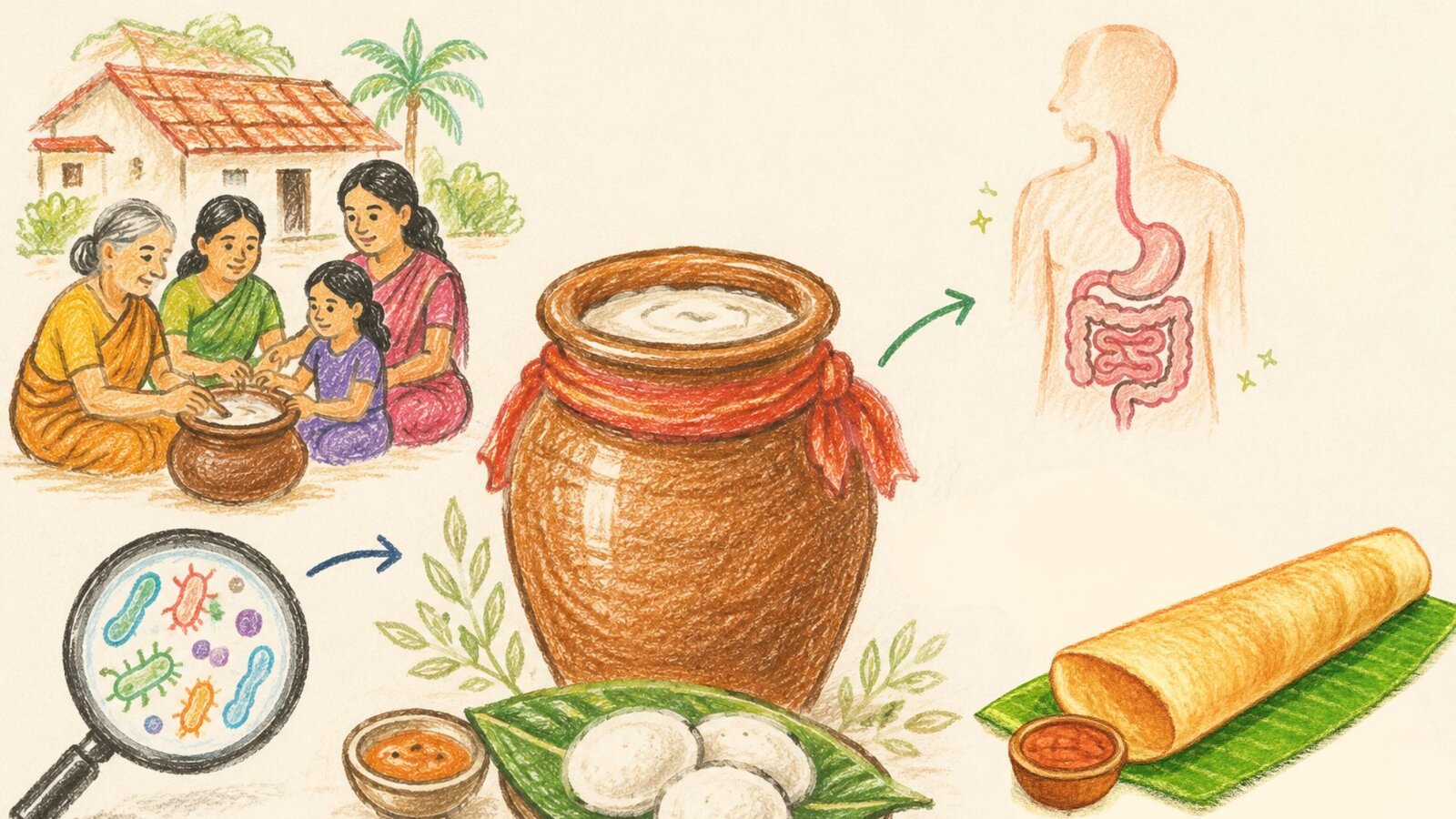
In a high-tech lab in Bengaluru, the future of medicine isn’t being found in a synthetic compound or a sterile petri dish. Instead, it’s sitting inside a hundred year old jar, the ceramic gone the color of weak tea, and it has never once been washed clean. It has traveled from a kitchen in Madurai to a laboratory in Bengaluru, passed hand to hand through four generations of the same family, each of them feeding it the same way their mothers did: a little rice, a little urad dal, water, warmth, and much patience. What’s inside the jar is idli batter or it will be, in a few hours, once the fermentation does its quiet work. But to the scientists who have started studying jars like this one, what’s inside is something more than just fermented food. A hundred years of continuous microbial life, shaped by nothing more than one family’s hands and one region’s air, still humming along exactly as it did before India had refrigerators, before it had antibiotics, before it had the word “probiotic.”
That jar is the reason this story exists. And it’s also, unfortunately, becoming a kind of elegy.
When researchers ran the starter culture through modern metagenomic sequencing, the technique that reads the genetic material of an entire microbial community at once, rather than trying to grow and identify each organism one at a time, they found what they expected: familiar genera like Lactobacillus and Saccharomyces, the workhorse organisms of fermentation everywhere. But a portion of the genetic material simply didn’t match anything in the reference databases scientists use to identify microbial life. It was not contamination or a sequencing error but rather organisms, and possibly whole functional pathways, that haven’t been catalogued.
Researchers have started calling this the “dark microbiome,” borrowing the metaphor from dark matter: something whose presence is unmistakable even though its nature isn’t yet mapped. The open questions are the interesting part. Are these previously undocumented species, or known species carrying genes nobody has annotated yet? Do they produce metabolites: the small molecules that gut bacteria use to communicate to the immune system, regulate inflammation, or break down fiber the human body can’t digest on its own, that aren’t found in the commercial probiotic strains sold in pharmacies? Nobody can say yet with certainty. That uncertainty is precisely why a hundred-year-old jar of idli batter has become a research subject instead of just food for breakfast.
This discovery matters beyond scientific curiosity as this jar, and thousands like it sitting in kitchens across the country, may hold the last intact record of a gut ecosystem that the rest of India is actively losing.
A mapping study by BRIC-National Centre for Cell Science (NCCS), set out to compare the gut microbiomes of urban and rural Indian populations, and what it found reads more like a warning. As diets shift away from high-fiber, minimally processed regional food toward packaged and processed alternatives, microbial diversity in the gut is falling. It is not gradually reshuffling, but narrowing, with entire lineages of native bacteria becoming harder to find in urban guts than in rural ones eating more traditional diets.
This isn’t an abstract statistic. It shows up in bodies. The Indian Society of Gastroenterology’s own position statement puts GERD prevalence in India between 7.6 and 30 percent, typically under 10 percent in general population studies, but climbing considerably higher in clinical cohorts, a gap that itself points to how much chronic acidity goes unmeasured outside a doctor’s office. Layered on top of that is Helicobacter pylori, the bacterium behind most peptic ulcers. A 2025 systematic review pooling 52 studies across 15 Indian states put national prevalence at roughly 54 to 61 percent of adults though the real picture is far patchier than one number suggests, ranging from under 10 percent in Gujarat to nearly 70 percent in Rajasthan. Most of those infected are unaware about carrying it, because the infection is often silent for years before it starts to show.
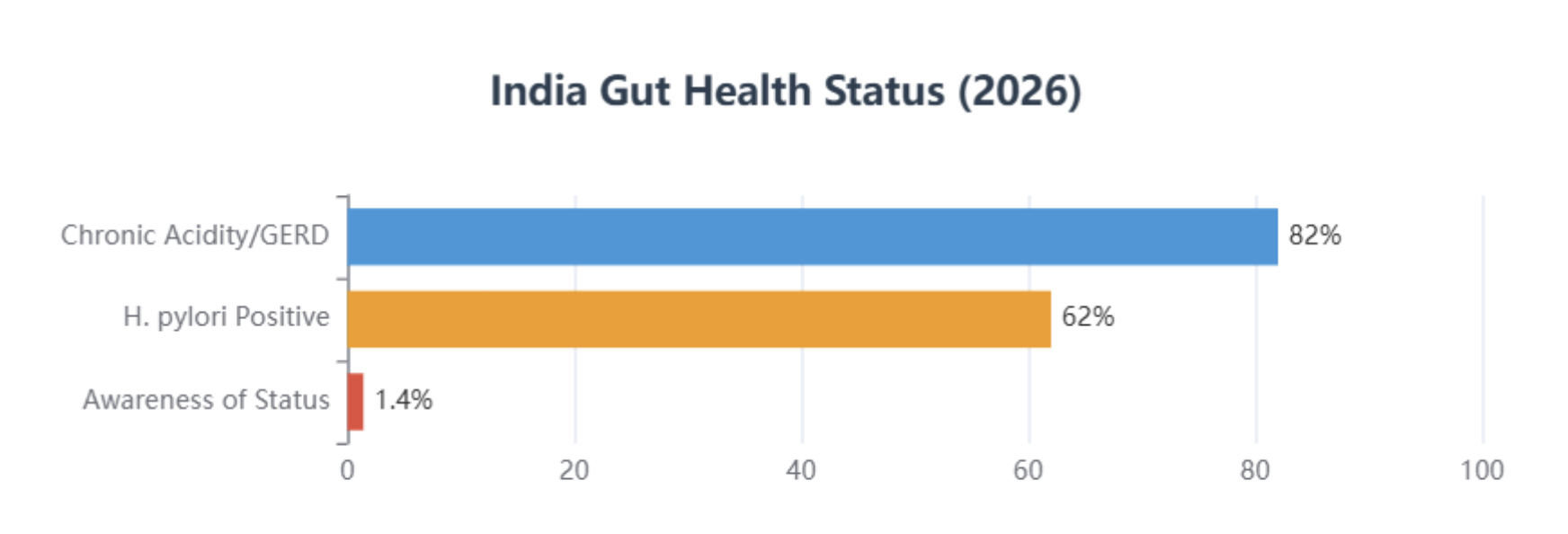
None of these problems exist in isolation from each other. A gut stripped of the fiber-fermenting bacteria that once buffered it is a gut with less defense against the pathogens moving in, less capacity to regulate inflammation, and increasingly, researchers suspect, it becomes a gut more vulnerable to the metabolic disorders climbing across urban India: rising rates of type 2 diabetes, obesity, and inflammatory bowel disease that track disturbingly closely with the shift toward processed food. Add to that the slow creep of antibiotic overuse, which doesn’t just kill the infection it’s aimed at but takes out swaths of the resident microbial community along with it, and the picture that emerges isn’t of a single disease but of an ecosystem in retreat.
Which is what makes the jar in Bengaluru feel less like a curiosity and more like a time capsule. It’s a working sample of what an Indian gut microbiome looked like before the fiber disappeared from the plate, before antibiotics became routine, before “protective bacteria” became something you had to go looking for in a hundred-year-old family heirloom instead of finding it, unremarkably, in everyone’s gut.
For years, the default response to gut trouble in India has been the same pill that claims to work everywhere else: a probiotic capsule loaded with Bifidobacterium and Lactobacillus strains isolated from European or American populations. Increasingly, researchers studying the Indian gut say this approach is failing on its own terms. Strains selected for a gut shaped by a Western, lower-fiber, higher-fat diet often don’t colonize a gut shaped by centuries of a fiber-heavy, plant-forward Indian diet. It’s less like taking medicine and more like transplanting a species built for one climate into an ecosystem that was never going to sustain it.
Indigenous fermented foods like gundruk: the sun-dried fermented mustard greens of the Himalayan belt; kanji: rice fermented overnight into a tangy, faintly effervescent drink; and idli batter itself aren’t just old recipes. Researchers increasingly view them as microbial reservoirs, cultivated over generations to survive the specific gauntlet of the Indian digestive tract: the acid, the bile, the long transit to the colon. Some scientists in this space have started using the phrase “microbial decolonization” to describe the shift they’re pushing for , away from imported, one-size-fits-all microbial solutions, and toward the diet-specific ecosystems that were already sitting in Indian kitchens the whole time.
Yogesh Shouche, the NCCS scientist whose lab has spent years studying the Indian gut, has traced his own interest in the subject back to a conversation with a pediatrician friend, who told him that commercial probiotics which are built for Western populations simply weren’t working for Indian patients, and that almost no one had studied why. That gap is what set Shouche on this path in the first place. In earlier interviews, he’s been skeptical that there’s even a single “Indian gut microbiome” to speak of and his expectation is that India’s diversity will surface as a patchwork of regional and ethnic cores rather than one common baseline, shaped by exactly the geography and food habits now being flattened by urban diets.
That gap between imported solutions and Indian biology has been measured. In the largest gut microbiome study of the Indian population to date, spanning 110 subjects across north and south India and benchmarked against nine other populations worldwide, researchers at IISER Bhopal found that geography and diet leave a distinct signature on the Indian gut, one unlike anything catalogued elsewhere. “Diet has been known to be the key driver in shaping the gut microbiome. Indian population has diverse lifestyles and food habits, and so far, the Indian gut genome is not well explored,” says Vineet Sharma, the IISER Bhopal scientist who led the study. It’s a fitting admission from the researcher who mapped it most closely: even the most extensive Indian gut study on record is still, by his own account, an early sketch of something far larger.
That reservoir is also feeding into a broader push toward precision medicine in India, where researchers are combining genomic tools with the Ayurvedic concept of prakriti, an individual’s constitutional type, in a field some are calling Ayurgenomics. The World Health Organization has flagged India’s work integrating artificial intelligence with traditional medicine as a notable development in this space. But that’s the second story, not this one. The first story is simpler and more urgent: something is disappearing from the Indian gut faster than science can finish describing it.
Which brings the story back to Bengaluru, to the ceramic jar that has never been washed. It isn’t precious because it’s old. It’s precious because it’s still alive, a hundred years of uninterrupted microbial continuity, still doing in a lab today exactly what it did in a Madurai kitchen a century ago. Everything the NCCS study found missing from the modern urban gut is, in some form, still fermenting quietly inside jars like this one, in kitchens most of the country has already stopped keeping.
The scientists studying it aren’t chasing a new drug. They’re racing to read a record before the last jars stop being refilled, before the grandmothers who know exactly how much rice and how much water stop being around to teach the next generation, before “dark microbiome” stops meaning not yet catalogued and starts meaning gone. The next major advance in Indian gut health may not come from a laboratory at all. It may just come from finally listening to what’s been sitting on the counter the whole time, from the simple act of recognition.