What if a gene behaves the same in a mouse and a human, but leads to entirely different outcomes? At BRIC-inStem, Bhavana Muralidharan is uncovering how unique regulatory networks shape the human brain, challenging long-held assumptions in biology while advancing our understanding of neurodevelopment, mental health, and precision medicine.
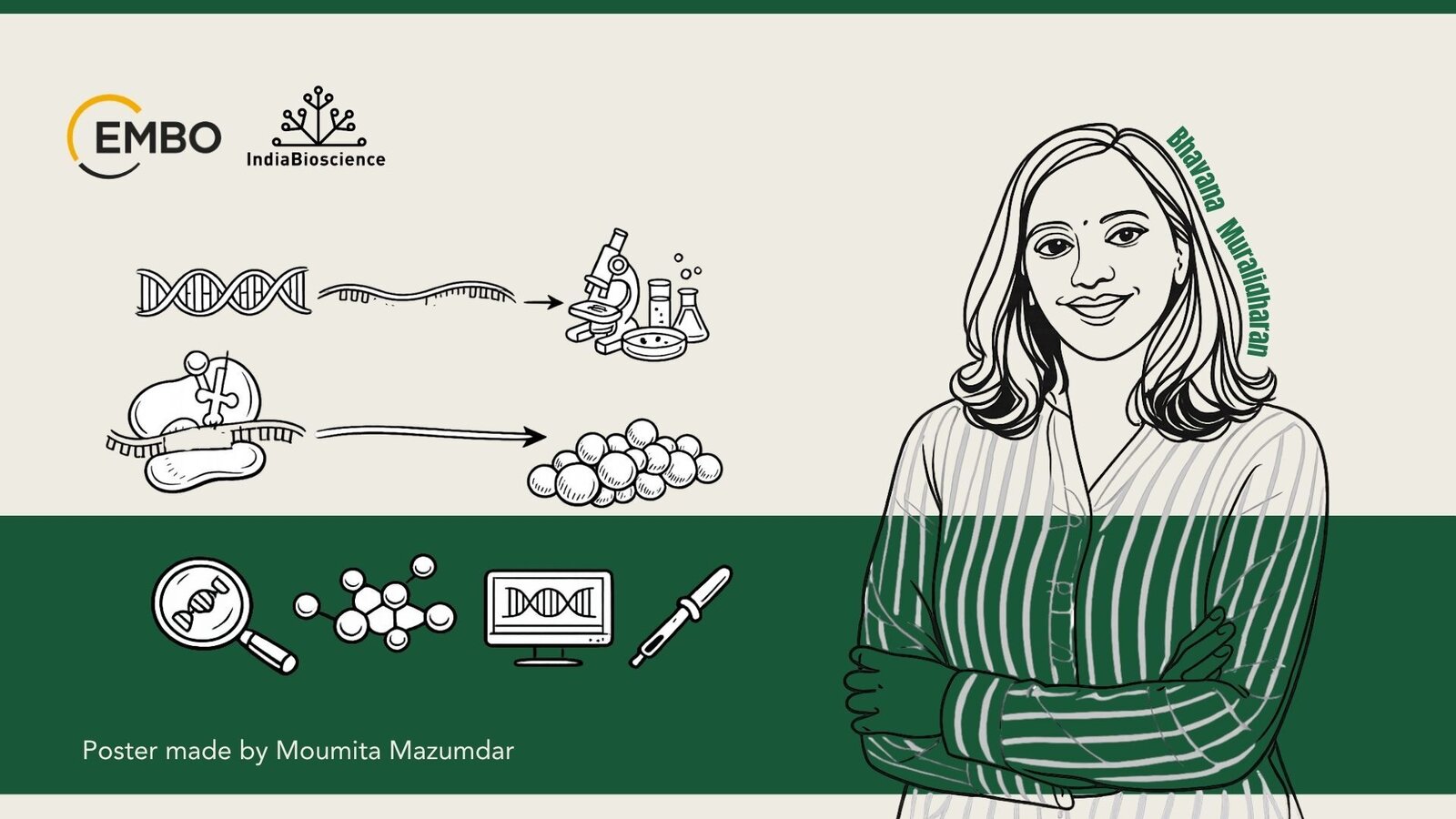
In the quiet corridors of molecular biology, a long-standing “golden rule” has guided researchers for decades: if a gene is conserved across species, it performs the same function, whether in a mouse or a human. While this principle has long justified our reliance on animal models, modern genomics has revealed a far more nuanced reality. Deep sequence conservation does not always translate into identical functional roles, leaving room for striking exceptions.
For Bhavana Muralidharan, Principal Investigator at the BRIC-Institute for Stem Cell Science and Regenerative Medicine (BRIC-inStem) in Bengaluru, this biological dogma was not a boundary; it was an invitation to look closer. While her laboratory was investigating a specific gene of interest, they stumbled upon a discovery that challenged a fundamental assumption of evolutionary biology: the gene was not behaving according to the established rules.
At the molecular level, the protein encoded by this conserved gene behaves exactly as expected, removing epigenetic modifications from the DNA whether isolated from a mouse or a human. Yet, when her team looked at how this identical protein operates in a living tissue context, they discovered that the human brain follows an entirely different, brilliantly complex script.
In simpler terms, if the protein is the software of a computer, the human brain has developed its own unique hardware to run it. This hardware consists of specific molecular “switches”, known as enhancers, which are different in humans and mice. Enhancers act like volume knobs, turning certain genes on, off, or fine-tuning their activity. By leveraging unique enhancers and human-enriched targets, the human brain assembles a cellular machine far more sophisticated than any animal model could predict.
This paradox challenges the very way biologists predict gene function from sequence data. In the lab, a protein might show identical binding affinity and structure across species, leading researchers to assume its biological role is fixed. But as Bhavana points out, looking at a protein in isolation only tells half the story.
You look at a conserved gene and think that it will have a conserved function,” she reflects, “and then you find that the protein biochemistry is conserved but ultimately the protein function and phenotype is not.”
This single revelation didn’t just alter a project; it illuminated a new path into the “black box”- the intricate, mysterious machinery of the human brain. It reveals that our unique cognitive abilities do not necessarily require entirely new genetic building blocks. Instead, evolution has modified how existing conserved genes are regulated and deployed. Such changes in genomic wiring may ultimately underlie the complexity that distinguishes the human brain from the rest of the animal kingdom.
The accidental architect: An organic evolution
Bhavana’s journey into this microscopic frontier began not with a grand, rigid plan but through a series of unexpected detours. Like many high school students navigating India’s fiercely competitive academic landscape, her initial aim was firmly set on medicine. When the gruelling entrance exams did not yield a seat on her first attempt, she pivoted to a BTech programme in Biotechnology..
It was a redirection she now describes as an “organic evolution,” fueled by the right mentors appearing at just the right moments. The definitive spark came from her Head of Department, Krishnamoorthy Kannan, a teacher who famously bypassed stagnant textbooks and placed research papers directly into his students’ hands.
In those pages, the concepts of stem cells, developmental biology, and organiser functions came alive. Science, to her, transformed from a static list of memorised facts into a living, breathing detective story. “That’s when I understood research, how people even do research,” she recalls. For her, it was a major turning point that made her realise that a PhD was perhaps what she wanted to pursue next.
Playing the long game: The 5‑year strategy
As she progressed through her academic journey, Bhavana became highly trained in the intricate world of RNA biology. Yet, during her PhD, she sensed a shifting tide. For decades, fields such as chromatin biology and RNA biology had been at the forefront of biological discovery. Over time, however, these fields became increasingly saturated, leaving a crowded landscape where research often centered on incremental answers to well-worn questions. Recognising this shift, Bhavana chose a different path. Rather than retracing familiar steps in a crowded arena, she decided to apply her expertise in genetic regulation to a far less explored frontier: human neurodevelopment.
Drawing on a forward-thinking philosophy that she now instils in her own graduate students, she chose to play the long game. She realised that while science had uncovered an immense amount of mechanisms within the mouse brain, the molecular inner workings of the human brain remained a vastly unexplored territory.
Her transition crystallised during a Journal Club meeting that seamlessly bridged RNA biology and neurobiology, focusing on the local translation of a protein at the synapse. In that moment, she recognised that the molecular tools and perspectives she had developed in RNA biology could be applied to some of neuroscience’s most compelling questions.
Bhavana advises researchers against simply chasing whatever field happens to be popular or in high demand today, as that rarely leaves room for fully transformative contributions. Instead, she emphasises the importance of looking ahead:
You should think of what’s gonna happen in the next 5 years, which area is gonna need more people.”
By thinking far ahead, she strategically positioned her research at the intersection of neurodevelopment and molecular biology, bringing a unique perspective to an emerging field. Her trajectory demonstrates that the most meaningful scientific contributions often come not from following established trends, but from identifying unanswered questions and venturing into unexplored territory.
Learning from dysfunction
Today, her research group tackles some of the most complex aspects of neurological development: autism, intellectual disability, and neuropsychiatric disorders like schizophrenia. While society often views these disorders through a lens of tragic finality, Bhavana sees them as powerful windows into understanding how the brain works.
She operates on a core scientific conviction that bridges fundamental bench science with translation: “Dysfunction can also teach you a lot about function”. By mapping the exact moments where the brain’s molecular wiring goes off-script, her team uncovers the fundamental, hidden rules that keep a healthy mind on track.
This meticulous approach is born from therapeutic necessity. Historically, because the human brain has been treated as a biological “black box,” clinicians have relied on broad treatments without fully understanding the molecular pathways involved. For example, drugs such as lithium have long been used to treat bipolar disorder despite incomplete knowledge of their precise mechanisms of action.
To move towards a future of truly personalised medicine, Muralidharan argues that understanding disease requires dissecting its molecular underpinnings, because, as she puts it, “the devil is in the details”. Today, her lab sits at the intersection of precision medicine, mental health, and non-animal model (NAM) systems.
Specifically, her lab focuses on chromatinopathies—disorders arising from the dysregulation of chromatin architecture and function. Chromatin acts as the master controller of our genetic instruction manual, controlling which genes are turned on or off during development. When this packaging system fails, it fundamentally alters early neurodevelopment, setting the stage for lifelong conditions such as autism and intellectual disability.
To study human brain development without relying purely on animal models, her team employs advanced human stem-cell-based systems that recreate key features of brain development in the laboratory. They achieve this by taking patient-derived induced pluripotent stem cells (iPSCs) and cultivating them into three-dimensional cerebral organoids and assembloids. These miniature, tissue-like cultures allow the lab to study the actual molecular mechanisms of psychiatric disorders directly in human cells, providing insights that would be difficult to obtain from animal models alone.
The true cost of discovery: Facing ecosystem hurdles
While her laboratory at BRIC-inStem has gained momentum and is making significant strides toward solving critical questions in neurodevelopment, the pursuit of these high-impact discoveries comes with a demanding and grounded reality. Translating an ambitious scientific vision into daily laboratory operations requires navigating an immediate set of systemic and structural challenges. While conceptualising bold research questions demands foresight, sustaining a productive research programme requires overcoming the everyday constraints of the scientific ecosystem.
Beyond the structural hurdles of funding and infrastructure, the daily reality of running a lab often demands a pivot in roles that many principal investigators find difficult to navigate. “I am being more and more drawn towards admin work and the scientist in me is finding less and less time,” she notes candidly. Describing herself as a “novice administrator,” she openly acknowledges the delicate act of balancing institutional paperwork with scientific mentorship.
Yet, her most fierce advocacy is reserved for the structural health of the Indian scientific ecosystem itself, particularly the issue of fellowship support for students and early-career researchers. She stands firmly against the outdated notion that a passion for science justifies financial hardship.
This concern for the research environment directly shapes her perspective on the financial realities facing early-career scientists. “The amount of fellowship is too little for the kind of work you’re doing, which is intellectually and physically demanding,” she argues.
For Bhavana, supporting the next generation of scientists requires more than providing research opportunities, it also means ensuring that talented students can pursue science without being burdened by financial uncertainty. In her view, a healthy scientific ecosystem depends not only on cutting-edge research and infrastructure but also on investing in the people who drive discovery forward.
Mentorship, collaboration, and the global stage
Bhavana’s trajectory is a tapestry of lessons gathered from her own mentors, which she carefully curates for her students. From her very first college professor, she learned how to deeply dissect a research paper — teaching her students to ignore the written results section initially, look directly at the raw figures, and draw their own unbiased conclusions. From her PhD advisor, she inherited a structured approach to scientific reasoning and hypothesis formulation. From her postdoctoral mentor, Shubha Tole, she learned tenacity, hard work, and the absolute necessity of rigorous future planning.
Beyond mastering experimental design, navigating the unique rhythm of Indian procurement requires a distinct kind of operational foresight.“Especially in India, planning ahead of time helps because things take time,” she remarks, noting the logistical lag of importing laboratory reagents.
This blend of meticulous planning and bold science has earned her significant international recognition, notably the prestigious EMBO Global Investigator Award. Beyond the immediate institutional limelight, the award acts as a massive catalyst for her entire lab group. It provides critical funding to take her students to global conferences, provides specialised lab leadership courses, and plugs her team directly into an elite network of investigators across India and Europe. The recognition, as she notes, has “definitely upped the science by a notch.”
Expanding horizons: What it means to be a scientist
Looking at the rapidly changing landscape shaped by artificial intelligence and big data, Bhavana challenges early-career researchers to expand their definitions of success. The old, rigid academic pipeline- PhD to postdoc to PI is no longer the only honourable path.
“The fact that you don’t have to be at the bench for research is very good,” she emphasises, pointing toward expanding, vital roles in science policy, science communication, patent law, regulatory affairs, data science, and a thriving industrial research sector.
Drawing from her experience in the UK, she highlights a philosophy of total inclusivity across the scientific workforce:
Anybody who’s at the bench, in the lab, or in the field is a scientist. You’re not just a scientist because you became a PI. You’re a technician, you’re a scientist; you’re a PhD scholar, you’re a scientist…”
Whether her lab members are navigating complex datasets, engineering human cerebral organoids, or communicating basic brain perception to the public, Muralidharan views science as a deeply collaborative, collective effort. By decoding the human brain’s silent molecular drama, her work serves as a powerful reminder that understanding the mind is not just about correcting what goes wrong. It is about uncovering the fundamental principles that govern how the brain develops, adapts, and functions. In doing so, her research demonstrates that some of the most profound insights emerge precisely where familiar biological rules begin to break down.