When Anjali Karande reflects on her career in science, what surprises her most is not how far she has come, but how unhurried the journey has felt. Nearly five decades in academia — spanning continents, institutions, and generations of students — unrolled without what she calls “rushing behind awards or accolades”. Instead, her compass was directed towards values that mattered to her deeply: contentment in teaching, joy in discussing science, and the belief that this satisfaction is essential to do good science.
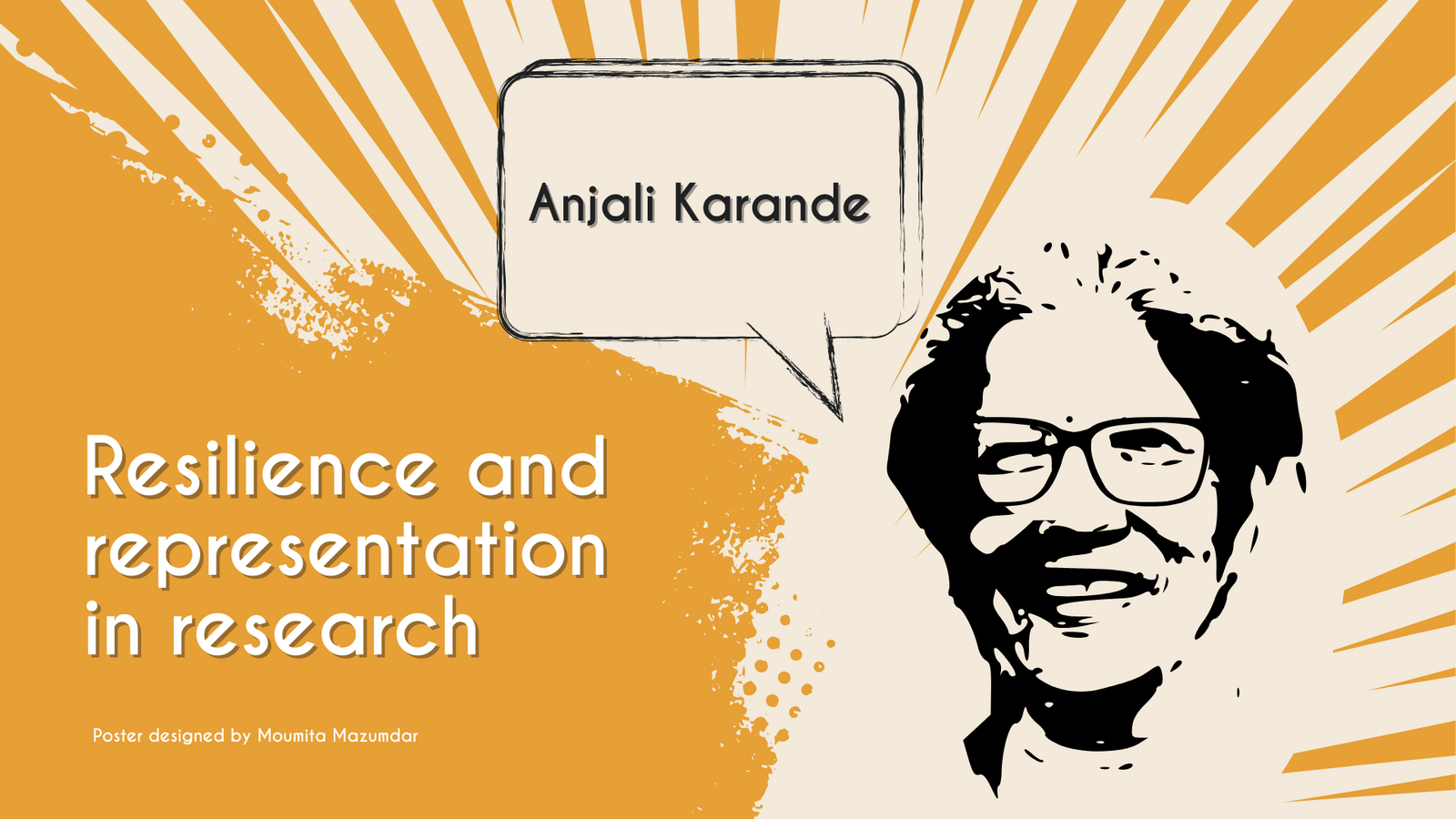
Anjali completed her Master’s in Zoology at Nagpur University in 1973 and moved to Mumbai soon after for her PhD at the Cancer Research Institute (CRI), now known as ACTREC. A postdoctoral stint in tumour biology took her to The Karolinska Institutet, Stockholm, Sweden, for two years, offering her valuable international exposure at a young age. Yet, despite the opportunities abroad, she chose to return to India.
After brief stints at ACTREC and the Kidwai Memorial Cancer Institute in Bengaluru, Anjali joined the Indian Institute of Science (IISc) in 1983. She became a faculty member in 1987 and retired in 2018 as a professor. Retirement, however, did not put a full stop to her career. She continues to mentor students as an adjunct professor and currently serves as Dean at the Centre for Human Genetics in Bengaluru. “I hope to continue till I can speak and teach”, she says simply.
Choosing both science and family
Anjali married in 1975, a choice she states was entirely her own. At 24, when she left for Stockholm, she also made what she describes as one of the hardest decisions of her life: leaving behind her young family which included her first child. Though she had a strong support system that encouraged her to go, the separation weighed heavily on her and eventually played a role in her decision to return to India. Five years later, she had her second child.
Her parents later moved to Bengaluru after her father’s retirement, helping raise her children. Two years into this arrangement, her mother was diagnosed with cancer and passed away, a loss that reshaped her personal life. Her father stayed on, becoming her central support system during those years. Looking back, Anjali reflects, “I hardly had any struggle and easily went on with my life. This was also probably a result of me never being highly ambitious. I was very content with having my students and discussing science”.
Her husband, she adds, was an equal partner. He was self-sufficient, deeply involved in parenting, and was a patient cheerleader of her career. Raised by a doctor mother himself, he understood the importance of shared responsibility. That model of mutual respect, she believes, shaped her sons’ understanding of relationships and partnership.
Institutions and their uneven evolution
During the course of her career, Anjali witnessed significant changes in the scientific ecosystem in India — better infrastructure, more governmental funding, and greater institutional support. Yet, the experience of women across institutions varied widely. At ACTREC, she recalls, women scientists were as numerous as men, and gender discrimination was not apparent. IISc, however, presented a different picture.
In the Department of Biochemistry, women faculty were initially two among ten or twelve men, eventually increasing to only four. Other departments fared worse. Chemistry, for instance, had no women faculty for years. “Back then, we wondered whether this was a regional difference or something else”, Anjali recalls. Even within the Dept. of Biological Sciences, gender imbalance was more pronounced at the faculty level than among students.
Recruitment practices, she notes, often worked subtly against women. While there existed unwritten rules to favour women candidates when qualifications were equal, these were frequently ignored. The justification was familiar: doubts about women’s commitment due to childbirth or caregiving. Over time, some of these practices evolved at IISc, shares Anjali. Publication criteria began factoring in career breaks for pregnancy and childbirth. Anjali sees these as important, even though belated, amends. “Such measures”, she says, “will accelerate the growth of women recruitment”.
Learning what not to do
Interestingly, Anjali does not recall having formal mentors. Instead, her approach to mentorship was shaped by observing behaviours she chose not to replicate. Early in her career, Anjali observed that senior faculty were inclined to guard knowledge as personal capital, unwilling to share protocols or reagents with colleagues/students from the discipline. She rejected this model outright. “If I agree to help or teach, no matter who, I have to give one hundred percent. Otherwise, I should not”. Though conditions are much better now, Anjali believes that sharing resources is not just a kind gesture, it is essential to keep the scientific community going.
Her philosophy extended to student relationships. “You’ve got to be friends with your students”, she says. “You cannot be a schoolmaster”. Trust, transparency, and mutual respect, she believes, are essential when working closely.
If she had a role model, Anjali says, it was her mother — a postgraduate in political science who instilled independence in her daughters and encouraged them to make their own choices. One conversation with her mother in particular proved pivotal for Anjali’s career. While working at IISc in a temporary position, she received an offer for a permanent assistant professorship at another institute. Torn between security and intellectual fulfilment, she turned to her mother for advice, who asked her a simple question:
Where will you be happy? If you’re happy, you’ll do well,if you’re happy, your family will do well. So you need to be where you listen to your head and your heart, don’t think about the financial aspect”.
her mother told her. Anjali stayed at IISc, a decision she believes shaped her career.
Bias, spoken and unspoken
Despite overall progress, Anjali is aware of the persistent biases in academia. While this does not apply to excellent candidates, borderline male candidates, she observes, are still more readily accepted than borderline female candidates. Serving on recruitment committees, she made it a point to speak up for women. Beyond professional mentoring, she often found herself advising young women on navigating life — childcare, time, and guilt. “Even if half your salary goes into a good crèche, it’s worth it, because you will be able to work better”. she would tell them. Today she admits to seeing encouraging signs of change – like a male colleague who openly asked for a half-day leave to take care of a sick child.
Having entered academia at a young age, Anjali did not begin her career with a heightened awareness of gendered inequities. One incident, however, stands out as particularly painful, but it made her aware of how biases shape women’s experiences in academia. Early in her career, she was encouraged by a senior professor to apply for a faculty position. Though she performed well, the position went to a male colleague. When she questioned the decision, she was told, “Your salary is cheese and jam; his salary is bread and butter”. The implication that her income was dispensable because she was married left her shaken. The experience sharpened her awareness of an unspoken, often unacknowledged truth within academic systems: when decisions have to be made, men and sometimes women tend to instinctively lean towards supporting a man for positions of responsibility. It is not always a conscious choice, she recognises. Most of us move through these systems unaware of the blinders that society has placed on us, mistaking familiarity for merit. She recalls being deeply upset, though later somewhat vindicated when the selected candidate himself acknowledged that she had been the stronger applicant. The incident, she says, taught her to always be prepared, to never hold back, and to give her best regardless of the outcome.
For Anjali, the solution to gender inequity lies not only in mentoring women but in sensitising men. Many forms of discrimination, she argues, are unconscious. She recalls organising a symposium where speaker selection appeared balanced until she and another female colleague pointed out that only they [women] had suggested female speakers. The men had not even noticed their bias. She describes this as a “male club” or informal networks formed through casual conversations, coffee breaks, and shared time, from which women often exclude themselves due to domestic responsibilities. Over time, these networks translate into visibility and opportunity. “Perhaps they are not doing it consciously”, she says. “That’s why discussion and awareness matter”.
Academia may be populated by intellectuals committed to inquiry and scientific progress, yet it often mirrors the social hierarchies and biases it exists within. This is why groups like Power Bio exist today and Anjali underscores the need for such platforms to mentor men by sensitising them to the unspoken biases within academia. In a POWERBio meeting that happened at IIT Bombay last year, Anjali says that she was happy to see a few male colleagues participate in discussions. These participants pointed out that when women are sole representatives in male-dominated committees, it can be challenging to speak up – especially if they are early/mid-career researchers. They emphasised the responsibility of male colleagues to be attentive to this imbalance and to create space for these voices through encouragement and open discussion. Anjali strongly believes that these conversations should move beyond gender and that is probably the only way that platforms like Power Bio will stay relevant and sustainable. Change, she insists, must be conversational rather than confrontational.
You cannot make your point with aggression”,
Anjali says.
Building lasting structures
One of Anjali’s most tangible contributions was helping establish a better day-care facility at IISc. Triggered by an administrative staff member’s struggle to find quality childcare, she and her colleagues pushed for change despite resistance. It took over a year, but the new crèche, now operational since 2015, serves faculty, students, postdocs, and staff. “That’s my contribution to women and motherhood”, she says with quiet pride.
Starting her academic career at 26, Anjali sometimes wonders if being so young made things harder — or easier. “I was very malleable”, she reflects. “Maybe that helped”. What remains constant is her belief in listening — to science, to one’s instincts, and to the people around her. Academia may be filled with intellectuals striving to change the world, but it remains a mirror of society and its biases. Progress is on-going, but incomplete. The way forward, she believes, lies in empathy, reflection, and collective responsibility, not just among women, but across the system. As a scientist, mentor, and human being, Anjali continues to shape futures quietly, one conversation at a time.