In this piece, moderator Sanchari Banerjee (Sai Life Sciences, Hyderabad) reflects on the panel “Balancing the Equation: Motherhood, Career Shifts, and Success in STEMM”, hosted by IndiaBioscience on 25 November 2025. The discussion highlights mentorship, work – life integration, and systemic change needed to support women navigating careers in STEMM.
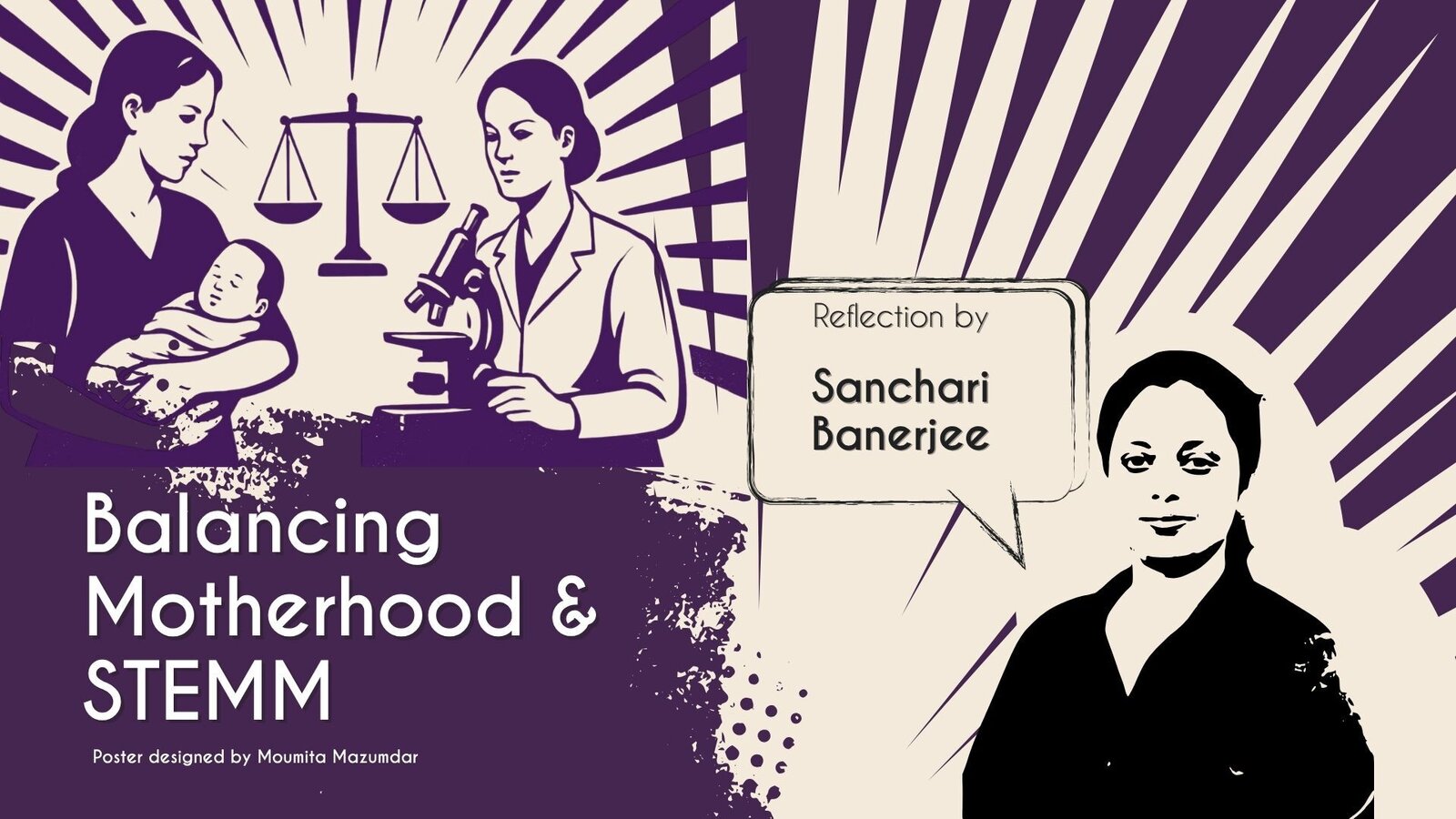
Motherhood is a journey that knows no boundaries. Whether we are mothers to newborns, toddlers, older kids, or adults, every stage of motherhood is unique and has its own challenges. Having a progressive career alongside it adds to this complexity.
Before I moved back to India in 2024, I was working as a postdoc in Denmark for four years and it was remarkable to see the infrastructure provided by the government and the society to support working parents. This led me to reflect on the infrastructure in India for working mothers. Later, when I was contributing to a book, Beyond the Pipeline, written by the lead author Cassie Leonard (one of the panellists in this session) with women authors and contributors from six different continents, I realised how important sharing lived experiences can be, knowing that we are not alone in this world.
Thanks to IndiaBioscience for hosting a panel discussion around this important conversation and for providing a platform to engage with and understand lived experiences both within India and globally. This panel on “Balancing the Equation: Motherhood, Career Shifts, and Success in STEMM” brings together women leaders from academia and industry across Indian and international contexts to discuss the structural and cultural challenges mothers face in science, technology, engineering, mathematics, and medicine (STEMM). It also reflects on how balancing these roles is crucial for sustaining a career alongside motherhood.
Gender equity in science is often discussed in silos; this panel aims to create a shared space for “lived experiences” to spark reflection and institutional action. The primary goal is to identify the structural and cultural shifts needed to build an environment where everyone in the STEMM ecosystem can thrive. The conversation brought together four mothers who are leaders and successful in their careers: Radhika Nair (Centre for Human Genetics, Bengaluru), Ramona Parsani (Ignite Life Science Foundation), Uma Ramakrishnan (National Centre for Biological Sciences-TIFR (NCBS-TIFR), Bengaluru), and Cassie Leonard (ELMM Coaching).
The metaphor, “leaky pipeline” describes the attrition of women in STEMM at higher rates as they progress toward leadership roles. Data shows that globally, only 52% of women aged 25 — 54 years are in the labour force compared to 95% of men. In India, an alarming 73% of women quit their jobs after childbirth, a statistic driven by cultural expectations around marriage and motherhood. This reflects the impact of cultural, social, organisational, and governmental factors on Indian mothers. Ramona suggested that “leaky pipeline” implies that women are at fault for dropping out. Shifting the narrative from a “leak” to “bad plumbing” highlights systemic issues such as corroded ecosystems, outdated practices, and a lack of investment in women returning from career breaks.
Radhika noted that the most productive professional years (late 20s to early 30s) clash exactly with our reproductive years, creating a “push and pull” that is difficult to navigate without support. Reflecting on her career trajectory, she emphasised that a two-year career break is effectively a four-year setback in science due to the time needed to rebuild networks and publish papers. Similarly, returning to India required “learning to navigate the system”, where she highlighted the absolute necessity of having mentors to navigate the local academic landscape.
Cassie’s narrative highlights that “leaky pipeline” is a global phenomenon, having herself written a book to motivate women and mothers worldwide to navigate beyond those leaks. She shared her experience as an aerospace engineer when she tried to plan children around career milestones (e.g., reach level X before child #1). Ultimately, she left her senior leadership role of 16 years to find more joy in coaching and mentoring, emphasising that the system is never perfectly ready and one can’t always plan the “perfect” time for a family.
Coming from a banking and Xerox background, Ramona discussed the gender barriers in corporate service roles. She highlighted that only 11% of board members in India are women, despite a larger presence at lower levels. After she has had several transitions, she returned to learning Digital Transformation to stay relevant, proving that career shifts are viable at any stage. This provides an important lesson on upskilling at every career stage that will make you stay relevant.
Uma shared her difficult PhD experience in the US led her to question whether she should continue in academia. She admitted to having a “major imposter syndrome,” particularly when returning to India to work at an elite institution like NCBS alongside leading scientists in the field. She moved back to India, started a new faculty position, and had her first daughter all within a four-month span, describing it as a period of intense transition. She credited her perseverance to having people who believed in her, both scientific mentors and a family that didn’t impose traditional restrictions on what she could achieve. She stresses that a true mentor understands the “whole personality” of a researcher and helps them build a career based on their individual strengths and interests, rather than just focusing on publications.
A recurring theme globally is the necessity of building “the Village” and utilising the support networks. While India provides one of the best maternity break benefits globally (26 weeks with 100% for the first two children), it still lacks in providing proper support systems post-maternity and for mothers rising into leadership roles. A widely recognised proverb is that “it takes a village to raise a child”, became especially meaningful to me during my time in Denmark.. My parents have always been my village, even being online baby-sitters at times. In my initial years in Denmark, I was apprehensive about seeking help from unknown people. It was actually the families of my daughter’s friends who reached out first and that went on to build my village. Radhika also stressed that we should be “shameless” about asking for help.
Institutional and organisational support becomes very critical. Ramona points out that childcare is actually a mandate for organisations with 50 or more employees in India, yet implementation remains a matter of institutional will. This brought me back to my time post maternity break at NCBS, which offers on-campus enriching and safe childcare for kids till 14 years of age. Ramona highlighted how Ignite Life Science Foundation has started to support young researchers by paying for caregivers to travel with them to national conferences, removing a major barrier to professional growth. Looking back, the first time I took my three month old daughter to a conference in Hyderabad, my mother also travelled with me and my fellowship partly supported only the accommodation for all three of us. In hindsight, I wish I had the confidence to travel independently with my daughter, baby-wearing her throughout the conference, even during poster sessions or talks.
A preconceived notion is that there is only the traditional “PI-only” (Principal Investigator) definition of success in academia. We need to break this mindset and explore options beyond academia and industry like being a lab manager, a project assistant, or moving into philanthropy or coaching, which are equally valid and successful paths. Being in industry myself, I can see that women have many options beyond technical roles — including human resources, project management, and application science roles, among others.. Radhika and Uma mentioned that success in science requires a “fire” or passion to understand things, which helps researchers push through the unique social and bureaucratic challenges of the Indian system.
As we transition into motherhood and simultaneously build our career, there are times we feel different emotions. Managing and navigating them can help us to overcome some of these hurdles. A “live poll” was conducted with the panellists to see who has experienced common career hurdles. The results were telling:
Burnout: Nearly all raised their hands.
Imposter syndrome: A common struggle even for all.
Guilt: Unanimously felt by the panellists
Difficulty balancing responsibilities: A universal experience at some stage.
Cassie noted that burnout is a systemic issue rather than an individual failure. She explained that it stems from the layers of expectations, being the “ideal worker” while managing demands of intensive parenting.
Uma mentioned that whenever she has imposter syndrome, she manages this by focusing on the purpose of her work and the inspiration it provides to younger researchers. Radhika agreed that the feeling is common, particularly after career breaks, where women may feel they have fallen behind in terms of networks and publications.
Interestingly, Ramona provided a profound take on guilt, describing it as “self-created.” She reflects on how she tried to be a “superwoman”, rather than accepting that she couldn’t attend every soccer match or school event. Her advice to younger women is to reject the “superwoman myth” and accept that they need help from friends, family, and the wider community.
The way forward for all mothers in STEMM is mentorship, integration, and advocacy. Finding mentors who share your core values and understand the pressures of family life is vital for navigating “the system”. We should aim for work-life integration rather than work – life balance, as a perfect balance is often unrealistic. Expecting a strict 9‑to‑5 work structure may not support career advancement while navigating these challenges.
Uma suggested “folding your family into your career”, such as taking children on field research trips or conferences can bridge the gap between being a scientist and a parent. Additionally, I believe that involving children in understanding our work can help them appreciate both our passion and the pressures we navigate.
There is a collective need to push for better infrastructure, specifically affordable and high-quality “crèches” near workplaces to ensure women can return to work. The cost of childcare, as Radhika mentions, is like a “second mortgage”, and unless funding agencies provide specific grants for childcare, the pipeline will continue to “leak”.
The discussion ends with a message of empowerment through community. The panellists agree that the playing field is not yet equal globally, and women in India still have to work “twice as hard” to be considered equal to their male counterparts. However, by building “villages”, finding mentors with shared values, and rejecting the internal pressure of guilt, women can navigate successful and fulfilling careers in STEMM.
The complete panel discussion video can be accessed here.