In this Resilience and Representation in Research interview article, Manisha Goel reframes equity as an investment, not charity. Her journey through bias, career pauses, and motherhood underscores the importance of choice without guilt. By challenging systemic barriers, she highlights how inclusive support and visible role models can reshape scientific spaces for future generations.
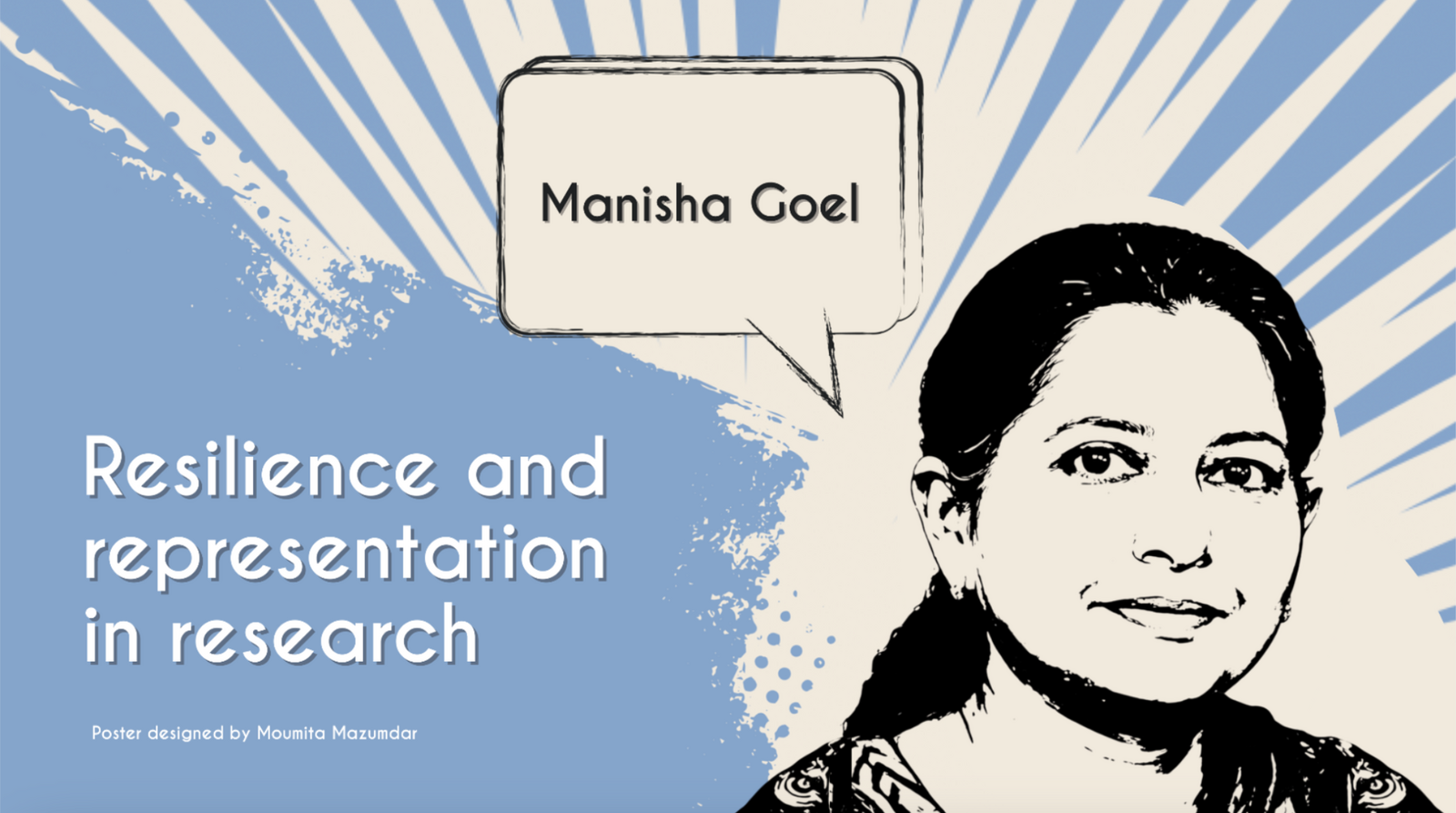
For Manisha Goel, equity is neither a slogan nor an indulgence. It is a commitment to inclusivity, ensuring that every individual can contribute meaningfully to society. The pursuit of equity may be mistaken for a demand for concessions, or even practised as charity or just a moral choice. To her, this misses the point entirely. She emphasises that equity is not charity; it is an investment, one that enables more people to participate fully and contribute positively to both society and its systems.
The reality that women may need support systems in their professional lives to navigate societal expectations does not diminish their scientific calibre. It simply reflects practical necessity. Creating such support systems is not preferential treatment; it is a rational step toward unlocking potential. What we need, she believes, is a fundamental shift in perspective, a willingness to “flip that switch” in our minds.
Over the course of her journey, from a biotechnology student in Dehradun to a structural biologist and bioinformatician leading a department at the University of Delhi’s (DU) South Campus, Manisha’s story is defined by her choices: some naïve, some stubborn, some slowed by doubt, but all guided by the belief that the freedom to choose without guilt or judgment is the true yardstick of equity.
Finding structural biology
Owing to her father’s transferable job, Manisha’s schooling spanned multiple towns, before settling in Dehradun. She completed her undergraduate degree at Hemavathi Nandan Bahuguna Garhwal University and went on to pursue a Master’s in Biotechnology at the Indian Institute of Technology (IIT) Roorkee, where she graduated as a gold medallist.
She went on to do a PhD in structural biology at the BRIC-National Institute of Immunology (NII), New Delhi. She attributes her initial interest in the subject to classes with Ritu Barthwal during her Master’s, which led to an instinctive connection to the subject.
At NII, she was trained as a crystallographer with Dinakar M Salunke. She describes NII as a special academic place where she was offered not only equal opportunities, but also held to equally high expectations. It gave her a sense of a level playing field and an adrenaline rush. The training was rigorous yet motivating, allowing her to test her capabilities and grow in confidence about pursuing scientific research.
Later, during her postdoctoral years at the Stowers Institute for Medical Research in Kansas City, she transitioned into structural bioinformatics in the lab of Arcady Mushegian. In the early 2000s, bioinformatics had yet to acquire a clear identity. “It wasn’t taught; we learned hands-on”, she recalls. “Some people were still sceptical of its utility, while others were beginning to explore its promise. Our generation helped shape its syllabus”. The genomics boom opened new possibilities, and her early entry into the field gave her a distinct advantage. Her hybrid interdisciplinary expertise proved to be a valuable asset during her hiring at the University of Delhi.
The myth of neutral systems
As a young student, with supportive and encouraging parents, Manisha did not imagine that gender would significantly influence her professional trajectory. “I was probably naïve”, she says. “I had expected commitment, hard work, and productivity to be the key attributes shaping professional success”.
Two early incidents, however, led her to redefine her assumptions.
While seeking help for securing an internship, she was told that the boys needed to be accommodated first, because they “needed it more”. On another occasion, a well-meaning professor advised her to pursue molecular biology in PhD instead of structural biology. Structural biology, he suggested, was too specialised and could be challenging as a woman whose career may be constrained by family responsibilities.
Her younger self did neither engage with or challenge the advice, rather chose to continue down the path she felt was right for her. It was only later that she understood the deeper impact of such encounters. These incidents revealed how biases often operate subtly — not through overt hostility, but through assumptions framed as practicality.
“Biases are often deep-rooted”, she reflects. “People may carry their best intentions to be fair, and yet be influenced by implicit biases”. Such biases represent the invisible fault lines of inequity — assumptions so normalised that they often go unquestioned.
A department in formation
In 2010, Manisha joined the Department of Biophysics at DU’s South Campus as an Assistant Professor. The department was in its formative stages, with only two faculty members initially, and another joining a few months later. Together, they built a Master’s programme in biophysics, launched in 2020, and steadily strengthened the department’s research profile.
The institutional culture in South Campus, she notes, respects scientific and academic calibre. The direct hiring system meant faculty positions were permanent, fostering research stability. Until then, her singular focus had been her own career, but as a teacher and mentor, Manisha became more aware of the “leaky pipeline” pattern. While many Master’s and PhD students in biology are women, only a few continue to postdoctoral positions or pursue long-term academic research careers. Some step away after Master’s; and many even after successful PhDs. Academic Research is, as she puts it, “a long road” and she often sees women give up in “fatigue” — that comes from fighting the system, and, often their own families’ and society’s expectations.
Pause, not an exit
The early years of Manisha’s career were defined by expansion into new scientific territory, but soon, her career was punctuated by an unexpected pause.
After her marriage, Manisha relocated briefly to the US, where she found a suitable postdoctoral position. She thought she was prepared “mentally” for the challenges that motherhood would bring in creating a new work-life balance, but life has a way of showing you that you could never be prepared enough. She conceived twins and the doctor’s evaluation marked it as a “high-risk pregnancy”. Even as she was in the midst of winding up her work before proceeding to her “expected/planned” maternity leave, she developed complications, forcing her to be confined to bed rest. Her twin children were born prematurely at seven months. One was critically ill and both the infants spent nearly two months in the neonatal intensive care unit. Given the circumstances, she was certain that it would be impossible to go back to work in the near future. She informed her postdoctoral adviser that she would need to resign. His response remains etched in her memory. There was no expression of disappointment, only understanding.
For the next one year, Manisha devoted herself to caregiving. The following year she returned to India without a fellowship or re-entry grant, a move many colleagues advised against. But this was not a calculated career decision; it was, she says, simply what she needed to do. “The only thing I was sure about was that I would go back to work when I was ready”, she recalls. Whether the path ahead was going to be academic or industry did not matter, “I was as flexible about the kind of career I would pursue as I was determined to treat this as a break, not as an ending”, she mentions.
Meanwhile, it was her postdoc adviser who spotted an advertisement for faculty positions at DU and forwarded it to her. Such small gestures from a mentor can make a tremendous difference. She applied, and acknowledges with appreciation that the break in her career wasn’t held against her. While the career gap was discussed in the interview, the final question from the chairperson, Deepak Pental,“whether everything was in place and if she was ready to be back”, put an end to any further speculation, gently and firmly. She had hoped that her eager and resolute “yes” had carried the decision in her favour. Reflecting on the process, she says, “The interview itself offered me a glimpse of the kind of positive leadership at my future workplace. It reassured me that this would be a good place to build a career”. It took her about a month to reorganise her living situation, before she joined the position offered, which would anchor the next phase of her career.
Here, she set up a lab that is an amalgamation of bioinformatics and structural biology, probing protein folding systems and “proteastasis” in cellular systems, hoping to contribute to the yet unresolved “protein folding problems” while also designing possible interventions for “protein misfolding” diseases.
Ambition and noise
While her return was largely celebrated, it was frequently accompanied by cautionary remarks about the difficulty of balancing research and family, especially with young twins. In retrospect, she recognises that such narratives subtly influenced her choices. She found herself holding back instead of fully engaging with her potential. This phase, however, was temporary. Support from mentors, colleagues, and role models helped her regain her footing. This experience leads her to emphasise the importance of visible role models.
Motherhood, she reflects, does open a new “tab” in your brain, one that runs parallel to everything else you do. Initiality, it felt like “conflict” — a constant battle for her time and energy between work and childcare, until she learnt to let the two co-exist without guilt. Instead of drawing rigid lines between home and work, Manisha now believes in allowing them to intersect. She shares her work life experiences with her children, making them part of her professional journey. This balance is now grounded in the belief that “My children, too, deserve a chance to be proud of my professional achievements, as much as I look forward to being of theirs”. “But, of course, there were trade-offs”, she acknowledges, including fewer travels and conferences, “but there are no regrets”. The key learning, she says, is that decisions should come from clarity, not external noise.
Rethinking equity: The freedom to choose
In the long time she has been in academics and scientific research — watching friends, former classmates and colleagues, and her own students make these decisions in their individual lives, she has come to respect every version of courage, the courage to persist, and the courage to step away.
For her, equity now has a newer meaning: “being able to reach that decision without fear of judgment”.
Organisations such as POWERBio, she believes, could play an important role in sustaining dialogue for creating awareness — the first step towards mending the fault lines of bias. She joined POWERBio in the hope that interactions with like-minded women would refine her line of thinking and strengthen conversations around equity, enabling her to encourage people to reflect on the status-quo and be more willing to address their unapparent biases.
Within her own sphere, she focuses on a quieter intervention: bringing families into the conversation. She emphasises that many women treat their work as a “black box” at home — not only do their struggles remain invisible, but their achievements also often go undiscussed. Manisha encourages her students to share their journey with parents, spouses, siblings — to explain what it means to publish a paper, to articulate why their work matters to them and to the world. When families understand the self-worth tied to these achievements, she believes they are less likely to ask women to forgo them lightly. She respects students who choose to take a break, as much as she does those who continue, fully aware of how difficult that decision can be. The goal is not uniform persistence, but informed autonomy. Whether continuing, pausing, or stepping away, women should not feel embarrassed or guilty for making those choices.
As a professor, head of a department, lab leader, and a mother, Manisha sees equity as a system, with both the infrastructure and the mindset, that enables individuals to contribute fully, without friction or guilt. Her journey is an example of what that might look like: biases encountered, yet failed to limit her; a career paused but not extinguished; ambition dampened briefly but ultimately reclaimed; all pursued without guilt or the need to sacrifice.