In this Resilience and Representation in Research feature, Deeksha Tripathi’s journey traces the realities of building a scientific career alongside motherhood and institutional constraints. From creating a lab from scratch to navigating systemic gaps, her story underscores resilience, mentorship, and the urgent need for support systems for women in academia.
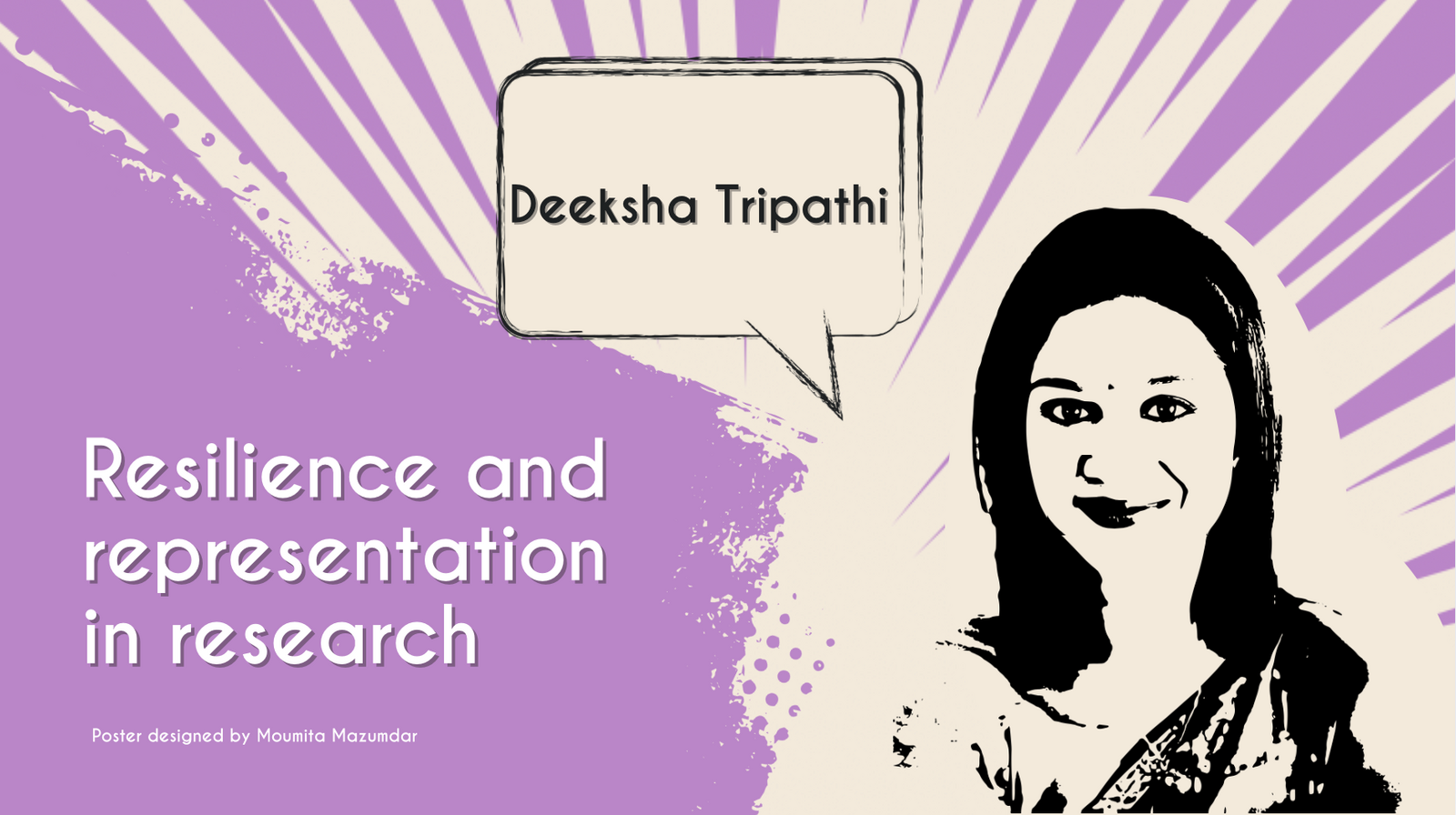
Deeksha grew up in Delhi watching her father Sheo Dutt Tripathi, a professor of history at Shaheed Bhagat Singh College, Delhi University, build his days around teaching and scholarship. Raised in Saket in South Delhi, Deeksha completed her schooling at New Green Fields. As she reflects on those early days, she feels that what stayed with her was this atmosphere that encouraged ambition and excellence in academics.
Deeksha’s father, she recalls, was deeply invested in his children’s futures. “He used to stay awake all night, giving time to all of us”, she says. “Even though he had an evening college, he would stay up till four in the morning. Today, two of her siblings live abroad — one in the United States and the other in Dubai. Deeksha is the only one who stayed back in India.
Her own academic trajectory began in University of Delhi as well. She pursued her bachelor’s degree in microbiology at the Institute of Home Economics, University of Delhi. From there, she moved to South Campus, University of Delhi for her master’s in microbiology, and later joined Jawaharlal Nehru University (JNU) for her PhD. Here, she worked with Rakesh Bhatnagar on infection biology, focusing on tuberculosis. A portion of her doctoral work was conducted at the International Centre for Genetic Engineering and Biotechnology (ICGEB), where she worked with Nirupama Banerjee for almost two and a half years.
Deeksha completed her PhD at 27 — an age when many researchers are still settling into the uncertainties of their doctoral work. Like most freshly-minted PhDs, she began applying for postdoctoral positions and soon secured one at the University of Pennsylvania. Although this seemed like a straightforward next step, her parents had other expectations, as they wanted her to get married before moving abroad.
In the interim, Deeksha decided to take up a postdoctoral position in India. She joined IIT Delhi to work with Padma Shri, Seyed Hasnain, whom she describes as one of the pioneers in her field. She spent one and a half years there, strengthening her research base. It was also here that she met Saurabh Pandey, then a PhD student in the lab, who later became her husband.
After her partner completed his PhD, the couple decided to move to the US, where he had secured a postdoctoral position. In October 2016, Deeksha moved with him on a dependent visa, planning to find a second postdoctoral position there so they could stay in the same city. Soon, she received two postdoctoral opportunities in the US in the same city. But to accept either, she would need to return to India to get her own J1 visa sponsored by these Universities. She flew back and that was when her career took a sudden, unexpected turn.
“When I turned on my phone on the flight, I saw a job offer from the Central University of Rajasthan”, she recalls. “I had given that interview eight months earlier. But in India, it takes time — stay orders, delays — so I had almost forgotten about it”. This was a permanent academic position in a central university — rare, stable, and highly valued in Indian academia. “For my parents and in-laws it was a huge thing”, she says.
Though it was the first year of her marriage and her husband was already in the US, both families strongly encouraged her to accept the offer. The logic was pragmatic: even after a postdoc abroad, there was no guarantee that one would land in such a position. After consulting her PhD guide and postdoctoral mentor, Deeksha decided to join the Central University of Rajasthan. She reasoned to herself that a postdoc or research opportunity abroad could always come later, a permanent faculty position may not.
A campus far from the city
The Central University of Rajasthan was not just a new workplace — it was a new world. Located 80 kilometres from Jaipur and 60 kilometres from Ajmer, the campus sits in a remote stretch of land with Kishangarh, a small town 30 kilometres away, as the nearest urban access point. For someone raised in Delhi, and fresh from Pennsylvania, the transition required a significant adjustment. The isolation was immediate, but the job mattered. It was permanent, and it aligned with a long-standing aspiration — she had always wanted to teach, like her father. At the same time, her personal life was entering a difficult phase. She was newly married, but living alone. The long-distance relationship was further challenged by time zones, leaving them with limited opportunities to connect.
“I had to start everything from scratch”, she says. “There is one year of probation in central universities. Also, you don’t get much in terms of seed grants or research funding when compared to IITs, IISERs and other research institutions.” Her research ambitions, however, were non-negotiable.“My Vice Chancellor gave us a small amount as a seed grant with which I could purchase a pipette set”, she recalls. “And I remember thinking — what will I even do with this”? The question was not rhetorical. It reflected the reality of many Indian universities where faculty members are hired before research infrastructure is fully built. To do research, the faculty must create the lab ecosystem almost from nothing.
During her probation period, Deeksha secured a UGC startup grant of ten lakh rupees. She purchased a workstation and began in silico work while waiting for the lab to take shape.
At the time, she had no family around. She lived in a hostel room, and from the first day was appointed warden because the university had very few women faculty members. “In the whole university, there were very few women, out of 150 faculty members”, she says. “So I was living like a student, but also managing responsibilities. The students were just five or six years younger than me”. Her days were consumed by teaching, grant-writing, administrative duties, and the relentless effort of establishing credibility as a young faculty member in a remote institution. That is how Deeksha’s career began.
Motherhood and lab taking shape hand-in-hand
Two years later, Deeksha’s husband returned to India and joined Jamia Hamdard in Delhi as a faculty. The couple wanted to start a family, but living in different cities made the decision complicated and her doctor advised not to delay since she was already 31.
For women in academia, the pressures of career advancement and motherhood do not arrive in sequence. They arrive simultaneously… There is no convenient pause button, and no version of the timeline that does not ask for sacrifice”.
Deeksha was soon able to conceive.
Around the same time, Deeksha had applied for a women-specific research grant DBT Biocare grant worth fifty-five lakh rupees. She cleared all rounds and attended the interview while seven months pregnant. She got the grant, but the timing was brutal. “The sanction letter came the same day I was starting maternity leave”, she says. “I had to utilise the funds before March, otherwise they would lapse”. She requested a six-month extension, which the funding agency approved. That small administrative decision made all the difference.
The months that followed were among the most challenging of her life. Her child was born premature and spent two weeks in the NICU. When her maternity leave ended, she returned to the university campus with her three-month-old baby because she had to begin utilising the grant. With no faculty quarters available, she stayed in the guest house. Her father-in-law came to support her, staying with her to help care for the baby. Even basic healthcare access was a struggle. The nearest hospital was 35 kilometres away. “But I managed to utilise the entire grant, set up my lab”, she says.
Then COVID hit. The pandemic intensified everything — professional uncertainty, personal isolation, and the everyday responsibility of childcare. Her husband could visit only on weekends. “It has been a long-distance marriage throughout”, she says.
Her child has now started school, but even that comes with logistical strain. She chose not to enrol him in the campus school, which she felt was inadequate in terms of facilities. Instead, her child travels 70 kilometres to and fro every day to attend school in Kishangarh. “I cannot move to Jaipur because I have no support system there”, she says. “I have to stay on campus so I can be available for him”.
This is the quiet, often invisible labour behind many academic careers, especially for women. The research output may be visible, but the personal costs rarely are.
When her first batch of PhD students joined, something shifted. “They became my strength”, Deeksha shares.
When you are motivated, your students also become motivated — it percolates”.
The lab began producing results. The team worked hard, published papers, and built momentum. But a larger challenge soon emerged. After returning from maternity leave, Deeksha realised that her university lacked a BSL‑3 facility which was critical for the kind of research she intended to do. Instead of changing her research direction, she chose to build what did not exist. She along with Inshad Ali Khan in her department collaborated with five institutions, applied for a grant, and secured funding worth 9.6 crores. The result was the establishment of an ABSL‑3 facility on campus — the only university in the state to have this. It became one of the defining milestones of her career, Deeksha says
In the early stages of her career, Deeksha says she often felt that she lacked international research exposure. Determined to address this, she applied for the SERB-SIRE fellowship and received the opportunity to work at University College London (UCL) for six months. The fellowship allowed her to step into neuroscience and expand her research from microbiology into interdisciplinary work involving Alzheimer’s disease and immunology. “That experience gave me exposure to international labs, ethical practices, and new research perspectives”, she says. Her child accompanied her, and her father-in-law joined them to help manage childcare.
Mentorship beyond academia
Deeksha recognises how important mentors can be in shaping one’s path in science and academia. Reflecting on her own journey, she expresses deep gratitude to Rakesh Bhatnagar and Seyed E. Hasnain — both eminent figures in Indian science — whose mentorship has been a constant thread through her career. From navigating the uncertainties of her doctoral work to finding her footing as a young faculty member, their guidance shaped not just her research but her sense of what was possible. She also gratefully acknowledges L.S. Shashidhara, whose guidance at a critical juncture offered her a wider perspective on her scientific journey and left a lasting impression on how she thinks about her work and her role in the larger scientific community.
Having benefited from such mentorship, Deeksha now thinks about what it means to guide the next generation of scientists, especially women. She shares a common concern shared by many women in science: the “leaky pipeline”. “At the bachelor’s and master’s levels, most students are women”, she says.“But at the faculty level, the numbers drop drastically. In the School of Life Sciences, Central University of Rajasthan of 30 faculty members, only three are women”. For her, the explanation is not complicated. She points to the lack of support systems, especially for women navigating dual-career marriages. Her own decade-long long-distance marriage is not something she presents as a heroic sacrifice, but as an example of what many women are forced to navigate. “Not everyone can sustain that”, she says. She believes institutions must build mechanisms that support dual-career couples, enabling them to work in the same city. Without such systems, women will continue to leave academia at higher rates. She also stresses the importance of financial independence and stage-specific fellowships that can provide stability when careers and caregiving responsibilities overlap.
Deeksha says she did not find many women role models navigating similar challenges in her early years, and this has guided her own mentoring style. “I try to mentor my students not just academically, but also personally”, she says. “Guiding them on how to manage their careers, make decisions, and stay motivated”. She also believes exposure is crucial, particularly for students from smaller institutions who may never have seen a high-functioning research ecosystem. “Programmes like the SERB-SIRE fellowship help a lot”, she says. “They open up new perspectives and improve confidence”.
One story remains especially close to her. Her first PhD student was from Afghanistan, a mother of three who came to India for her PhD. During COVID, she had to return home — and then the Taliban took over. She was stuck and reached out for help. Deeksha coordinated with her university and managed to bring her back to India. The student completed her PhD and is now doing a postdoc in Germany. “That experience was very meaningful for me”, Deeksha says. “It showed how important support systems and mentorship are. It made me realise that as mentors, we have a responsibility that goes beyond academics”.
Research focus and future directions
Today, in her lab at the University, Deeksha has carved out a research programme centred around mycobacterial pathogenesis.While maintaining focus on this theme, she has developed distinct research directions addressing stress adaptation mechanisms, enzymatic functions influencing immune modulation, and structure-guided therapeutic targeting in other bacterial pathogens like Bacillus anthracis.
Deeksha’s team has also worked on Mycobacterium indicus pranii (MIP) as a surrogate tuberculosis model, demonstrating its resilience to stress, antibiotic tolerance, and immunomodulatory potential and characterised various enzymatic activities in mycobacteria as novel drug targets. Under her SIRE grant, she revealed neuroprotective effects of MIP in Alzheimer’s models. With over 25 peer-reviewed publications and sustained grant leadership, her work continues to advance host – pathogen research and therapeutic development. Additionally, she contributes as an editorial board member for prestigious journals such as Infection and Immunity and Scientific Reports.
Deeksha hopes to build more collaborations and fully utilise the BSL‑3 facility she helped establish. But beyond research, she remains committed to the broader question of representation — particularly the question of why women disappear from the academic pipeline as careers advance. For early-career researchers, her advice is direct. “There will be challenges, both personal and professional”, she says. “But if you stay motivated and keep working, things do fall into place”. She pauses before adding something that reflects the emotional architecture of her journey. “Don’t hesitate to ask for help. Build networks, seek mentorship, and support each other”, she says. “And most importantly, believe in yourself”.