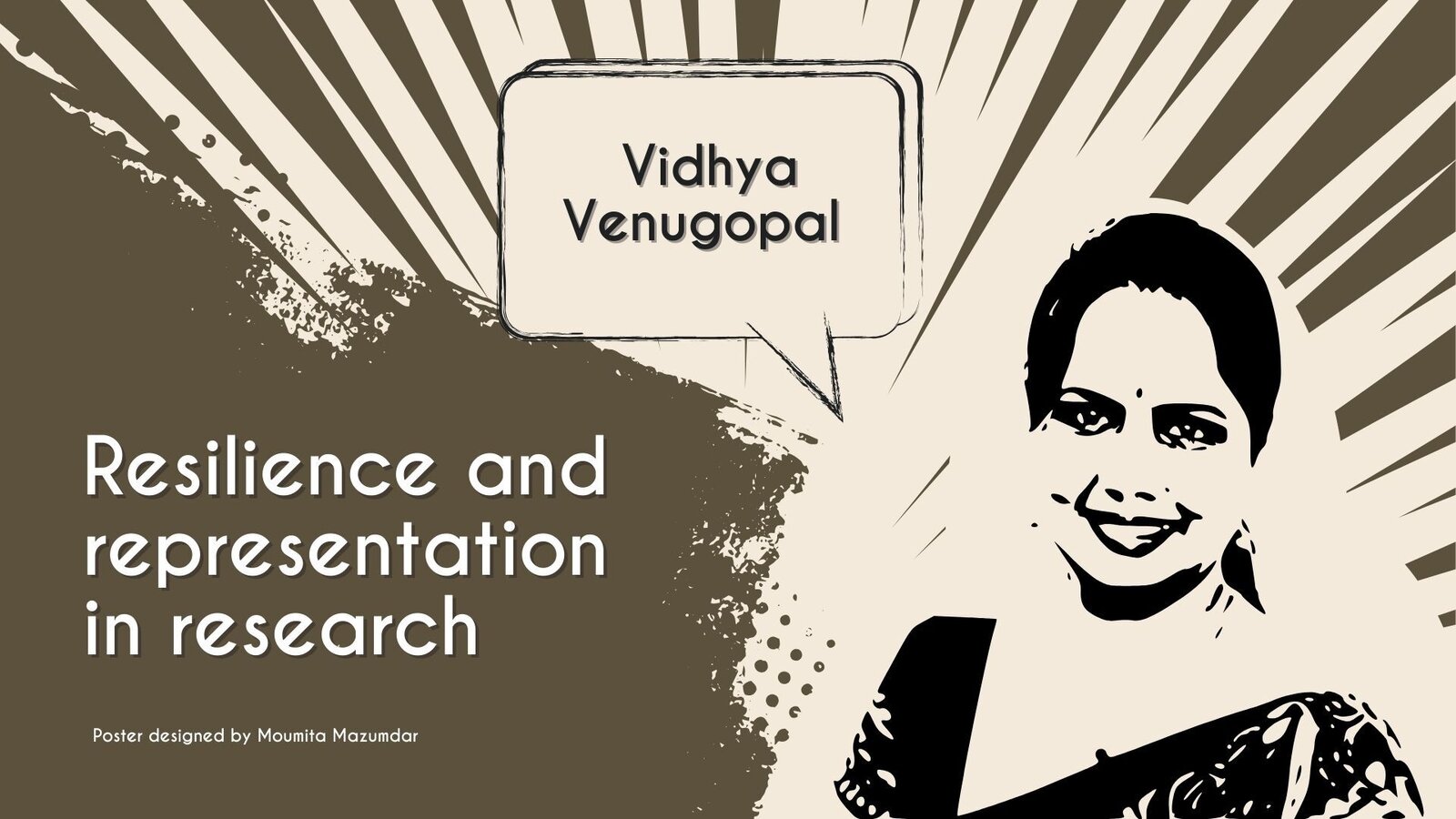
For many scientists, career trajectories are imagined as a steady progression of predictable milestones, with clearly demarcated roles. Vidhya Venugopal’s journey, however, unfolds differently. From early academic detours to leadership roles in global health research, Vidhya’s story shows us what it means to build a meaningful research career while navigating structural constraints, caregiving responsibilities, and persistent gendered perceptions in academia.
An early detour that shaped direction
Vidhya completed her schooling at a government-funded school in Chennai in 1986, with aspirations of becoming a medical doctor. Missing a government medical seat by a narrow margin led her to pursue a bachelor’s degree in chemistry, which she went on to complete in 1989. During this period, environmental chemistry captured her interest as she saw it as an interdisciplinary space that brought together physics, chemistry, and biology. Despite intense competition, she secured one of only seven available seats (from over 400 applicants) for a Master’s programme in Environmental Chemistry at the University of Madras, eventually graduating with first rank.
Following her Master’s degree, Vidhya began her career as a lab chemist at Richardson and Cruddas, but within six months moved to CSIR- National Environmental Engineering Research Institute (NEERI), Nagpur. Relocating from Chennai to Nagpur felt daunting at the time, yet encouragement from P Khanna, then Director of CSIR-NEERI, proved pivotal. Although unsure about her interview performance, she remembers the panel chaired by Khanna as supportive. Soon after, she received an offer letter and moved to Nagpur, where she worked for three years before joining the Chennai Zonal Office after her marriage.
It was Khanna who encouraged her to apply for a CSIR fellowship and register for a PhD. With this support, Vidhya completed her doctoral work at CSIR-NEERI, followed by postdoctoral research at the University of Queensland, Australia. In 2000, she was awarded the British Chevening Scholarship, enabling her to work in the UK. She later returned to India for a postdoctoral position with Kalpana Balakrishnan at the Sri Ramachandra Institute for Higher Education and Research (SRIHER) in Chennai.
Industry experience and a return to academia
Vidhya’s career took another turn when she immigrated to Canada to join Johnson & Johnson as a Stability Coordinator, a role she held until 2009. During this period, she developed a strong interest in health and safety, complemented by her voluntary work with St. John’s Ambulance Canada. Serving on and later chairing the health and safety committee, she gained hands-on experience in industrial hygiene alongside her core responsibilities.
Family reasons eventually brought her back to India, and she was offered a professorship by SRIHER, recognising the value of her industry experience. “In 2009, the offer was lucrative considering the balance between work and family,” she reflects. “However, I went for research and continue to engage in a competitive rat race. So I’m still running the race now. There was a choice not to do research, but only teach. Academic teaching alongside research is what I choose because of my passion for improving workers’ workplace conditions”.
At SRIHER, Vidhya began teaching occupational and environmental health to Master’s students in Public Health. She recalls an experience from this period that would later shape her foray into industrial hygiene. “Once, there was a course on industrial hygiene which showed me the stark but preposterous difference in the kind of protections used in India compared to Canada and other developed nations. That pushed me to become a certified industrial hygienist, and I started consulting with the industry through the university”.
This period also revealed an unexpected passion for teaching. “I was glad that I could impart learnings from the industry side as well”, she says, describing how this dual engagement with practice and pedagogy aligned naturally with her interest in public health.
Mentorship and building research capacity
In 2010, Kalpana introduced Vidhya to Tord Kjellstrom, an international expert in heat stress and occupational health. Although she had no prior background in heat-stress research, his mentorship guided her initial work consolidating data on heat stress in the automotive manufacturing sector. Eight months later, she was invited to attend a course on climate change and health at Umeå University, Sweden. Supported by Kalpana and partially funded by Umeå University and Kjellstrom, Vidhya joined an international cohort at the University.
Towards the end of the course, Vidhya had the opportunity to lead a project to design a questionnaire to assess occupational heat exposure. This work later evolved into the HOTHAPS (Hot Occupational Temperatures and Work on Productivity Suppression) questionnaire. In 2012, Kjellstrom invited her to serve as Co – Principal Investigator on a funded project from India. “His trust was valuable not just in bringing me my first project but also in the establishment of the Centre of Excellence — National Institute of Health Care Research Centre. As an homage to the one I consider my Guru in heat research, I have dedicated a conference room in his name in the Centre”, she reflects, acknowledging the long-term impact of Kjellstrom’s mentorship on her journey.
Navigating systems, leadership, caregiving, and drawing boundaries
Vidhya believes her professorship was rooted in her extensive industry experience. She is currently the Country Director for the NIHR Global Health Research Centre for Non-Communicable Diseases and Environmental Change (NIHR – GHRC NCD-EC) SRIHER, India, leading efforts to improve the health of marginalised populations, alongside Indonesia and Bangladesh. The centre hosted by the George Institute of Global Health is one of five global health centres under this NIHR initiative. Although the position is funded by NIHR UK, she credits the university for its consistent institutional and infrastructural support.
Balancing teaching, research, limited staffing, and funding pressures has shaped her leadership philosophy.
This balancing act taught me to prioritise quality over quantity”,
she explains.
“Hence, in my latest project, I have paid from the project fund to be able to release 75% of my time from the university, and so the university does not pay me my salary anymore, which offers me more time for research”, Vidhya says. “To manage the remaining workload, especially in my absence, I hire and train post-docs/scientists, who are my vital pillars of support.
Married during her PhD, Vidhya practiced early on to approach research as a structured job. In Canada, she worked part-time for 1.5 years after becoming a mother, coordinating schedules with her partner so their daughter spent limited hours in day-care. Returning to Chennai with her daughter while her partner remained in Canada required careful planning and reliance on extended family support.
There were moments when asserting boundaries became necessary. “I had to hear, ‘research is twenty-four hours; scientists are twenty-four hours,” she recalls after leaving a meeting early to pick up her child. Over time, she learnt to express boundaries through consistent actions rather than confrontation. “Sometimes passive assertion is more effective in grey areas at work,” she notes, even if it led to labels such as “rigid” or “inflexible, qualities she observes are often perceived differently in men.
I would not regret a career setback if it resulted from actions aligning with my values,as I think job titles are meaningless without job satisfaction and the ability to care for the family. What is the point of working so hard with a PhD and postdoc and everything if there is no freedom to care for my family?”,
Vidhya asks.
She acknowledges the continued gendered differences in leadership perception within academia and emphasises the importance of women supporting other women, particularly in navigating insecure or exclusionary systems.
Her resilience, she explains, is reflective — choosing when to speak up, when to wait, and when to prioritise collective impact over individual advancement. “Over time, age, experience, and achievements give you the confidence to confront, knowing the system values your contribution”, she adds.
Building protective spaces — and letting go
Since 2024, Vidhya has been a fellow of WomenLift Health, a forum that has helped her hone her leadership skills. Today, she shares these lessons with her students and postdocs. As head of a Centre located within SRIHER’s Faculty of Public Health, Vidhya secures complete funding for the unit. She defines this system as a “fully provisioned kitchen” where scholars have access to necessary resources and higher funding than other scholars within the university. Heading this centre has created in her what she describes as a “mother hen” instinct – creating a fully funded, well-resourced environment that shields scholars from many external pressures she herself faced.
At the same time, she remains conscious of the need to encourage independence. “I worry that too much protection may hinder long-term growth”, Vidhya admits, emphasising why it is important to let go and allow her students to face the realities of the system sometimes. Vidhya also explains that while the Centre acts like a cocoon shielding the scholars from external pressure, the protective space itself would not have enabled excellence in research. She names collaboration and accountability as key drivers of excellence. “Success hinges less on structure and more on how well we sustain collaborative relationships”, she adds.
Vidhya’s journey illustrates that resilience in science is not always loud. It is sometimes defined by quiet persistence, principled choices, and the courage to define success on your own terms.