Quantum dots — tiny, glowing nanoparticles, are reshaping India’s cancer research landscape. From fruit waste – derived diagnostics to targeted nanotherapies, researchers across the country are harnessing these tools to reveal disease earlier, improve precision, and reimagine accessible, innovative cancer care.
A pinprick of light in a complex disease
When 46-year-old Meera from Pune visited her doctor with persistent fatigue, cancer was the last thing she expected to hear. By the time her tumour was detected, it had already advanced. In India, every year, thousands of cancer cases are detected far later than they should be, as early warning signs in many patients remain invisible, buried deep within the cells before symptoms appear.
But what if we had tools that could reveal these signs much earlier? Tools so small that they could slip inside a single cell and light up disease before it took root?
Scientists across the country have been trying to solve this challenge using a surprising tool: a tiny, glowing nanoparticle known as a quantum dot (QD). These few-nanometer specks of matter can illuminate specific molecules inside a cell with a remarkable luminosity.
In recent years, QDs have emerged as pioneers in cancer imaging and diagnostics worldwide. But what role do these tiny nanoparticles play in India’s growing cancer research ecosystem? And how are Indian institutions, from IITs and IISc to CSIR laboratories, exploring and advancing their potential?
This article takes a closer look at how QDs are being engineered, tested, and applied in India, and why these “glowing particles” hold strong promise for the future of cancer detection and personalised treatment in the country.
What exactly are QDs, and why do they matter?
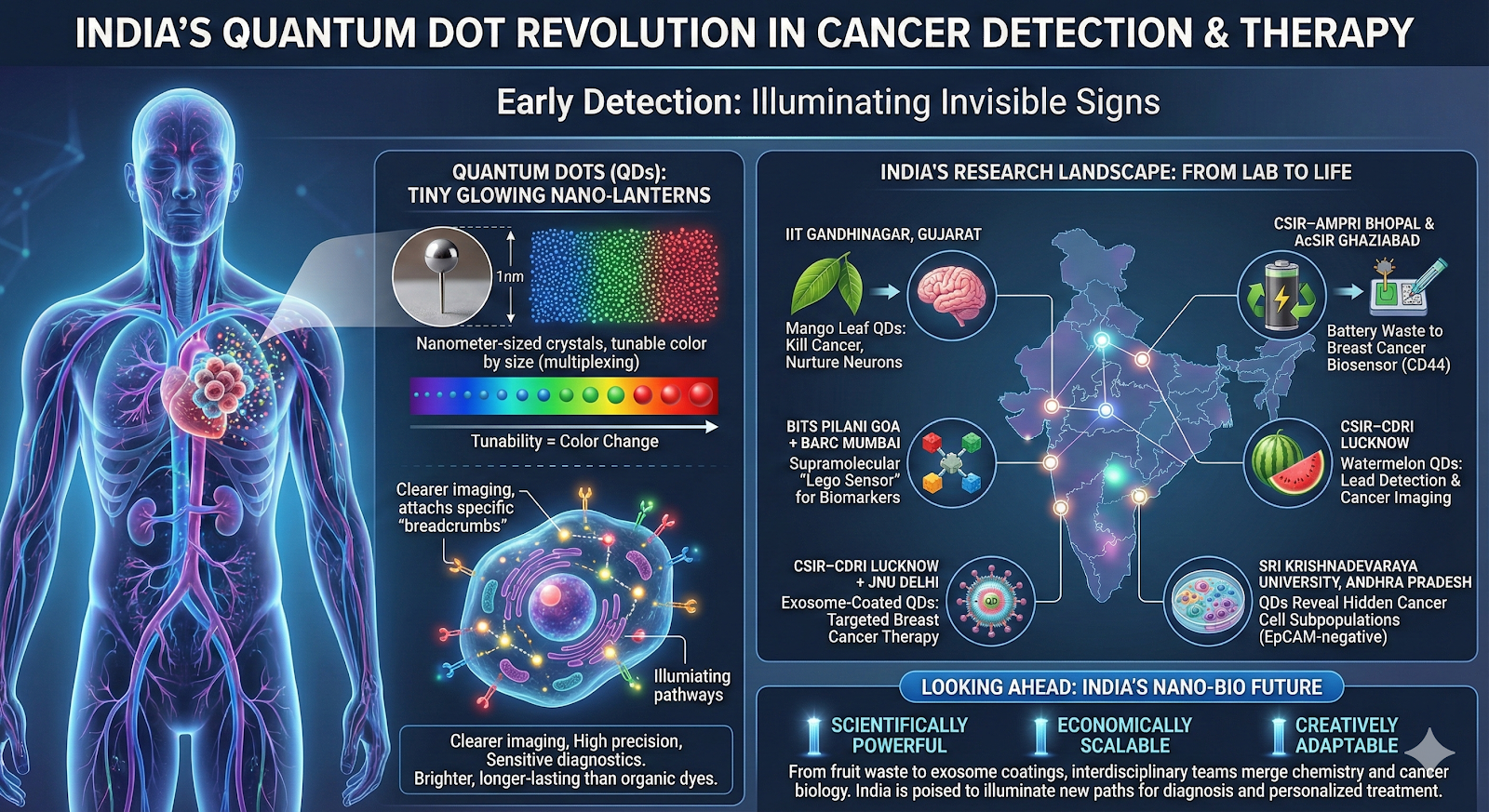
QDs are nanometre-sized crystals, tiny lanterns that glow brightly when illuminated by light. Each QD is so small that thousands could sit on the head of a pin, yet they emit light with a clarity far beyond ordinary fluorescent organic dyes.
What makes QDs distinctive is their tunability: changes in size can precisely adjust the colour they emit, much like tuning the pitch of a musical note. This property enables multiplexing, creating a nanoscale palette of light, from smaller dots glowing blue to larger ones glowing red.
Inside a cell, these dots act as glowing breadcrumbs, binding to specific molecules and illuminating biological pathways that are otherwise invisible. These dots help the researchers to track even the faintest signals of disease through their brightness, stability, and precision. Today, these “nano-lanterns” are helping scientists follow tumour cells, detect cancer biomarkers, and monitor drug movement in real-time, making them one of the most powerful visual tools in modern biomedicine.
Breaking down their key strengths, we get:
Clearer imaging with brighter, longer-lasting signals than traditional dyes
High precision with the potential to guide drugs directly to tumour cells
Sensitive diagnostics capable of detecting trace biomarkers in blood or tissue
With this foundation in mind, how are Indian laboratories putting QDsinto action?
India’s QD research landscape: Tiny tools, big impact
Below is a curated set of studies representing some of India’s most exciting strides in QD-based cancer research, each offering a glimpse into how diverse institutions are shaping this fast-growing field.
IIT Gandhinagar, Gujarat
Mango leaf QDs that kill cancer and nurture neurons
Outcome: A plant-derived, multi-functional nanomaterial with imaging, therapeutic, and neuro-regenerative potential.
CSIR – AMPRI, Bhopal & AcSIR, Ghaziabad
Battery waste transformed into a breast cancer biosensor
Outcome: Low-cost, sustainable cancer diagnostics from waste-derived QDs.
CSIR-CDRI, Lucknow & AcSIR, Ghaziabad
Watermelon-based QDs for lead detection and cancer imaging
Outcome: Eco-friendly QDs bridging environmental monitoring and cancer diagnostics.
BITS Pilani, Goa Campus & BARC, Mumbai
A supramolecular “Lego Sensor” for cancer biomarkers
Outcome: A sensitive, modular sensor suitable for clinical samples.
CSIR – CDRI, Lucknow & JNU Delhi
Exosome-coated QDs for targeted breast cancer therapy
Outcome: A promising bio-inspired platform for targeted nanomedicine.
Sri Krishnadevaraya University, Andhra Pradesh
QDs reveal hidden cancer cell subpopulations
Outcome: A simple in-vitro system that helps detect cancer cells usually missed in routine diagnostics.
Supporting examples strengthening India’s QD landscape
IIT Hyderabad
Bharathiar University, Tamil Nadu
RGCB, Thiruvananthapuram & RCB, Faridabad
High drug-loading CQDs with pH-controlled release improved doxorubicin delivery profiles.
IIT Guwahati
IIT Jodhpur
Looking ahead: India’s nano-bio future
QDs offer India a unique platform — scientifically powerful, economically scalable, and creatively adaptable. From fruit waste to exosome coatings, Indian researchers are proving that innovation doesn’t always require exotic materials or expensive infrastructure; sometimes, it begins with a simple idea and the right scientific question.
The interdisciplinary teams across the country continue to merge chemistry to shine light on cancer biology. India stands poised to illuminate new paths for diagnosis and therapy — one quantum dot at a time.