As DNA synthesis becomes faster and more accessible, ensuring it is used responsibly has become a global priority. This article explores key discussions and recommendations from an international workshop on strengthening nucleic acid synthesis screening, highlighting India’s opportunity to build robust biosecurity frameworks while supporting innovation.
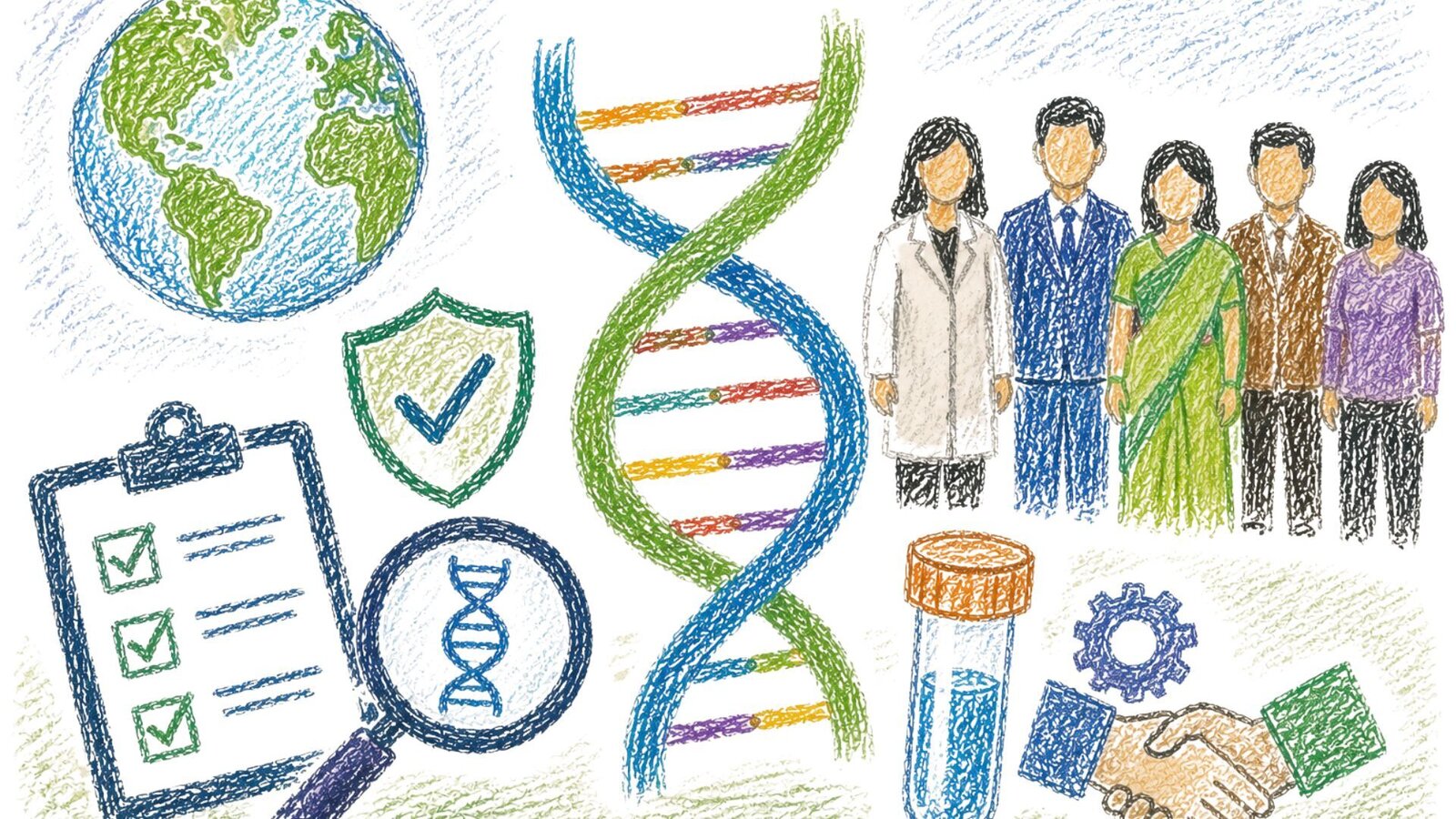
A scientist can now order a custom DNA sequence as easily as ordering laboratory reagents online. The same technology that helps researchers develop vaccines, engineer crops, and design new therapies can also be used to recreate dangerous pathogens. As the barriers to synthesising biological material continue to fall, a pressing question is emerging worldwide: who decides which sequences should never be made? It was this question that brought scientists, policymakers, industry representatives, and biosecurity experts together in Bengaluru on 24 — 25 February 2026, for a workshop conducted jointly by the Engineering Biology Research Consortium (EBRC) and the Bio-Responsibility Initiative, Indian Institute of Science (IISc) titled ‘Building International Best Practices for Robust Nucleic Acid Synthesis Screening’.
At the heart of the problem is a gap in oversight. Imagine a researcher placing an online order for a synthetic DNA sequence. How can a supplier know whether the order is part of legitimate scientific research or an attempt to recreate a harmful pathogen? Two safeguards are supposed to answer that question: sequence screening and customer screening. Broadly asking if the sequence itself is safe or potentially dangerous ? And is the person ordering it for a legitimate purpose or not? respectively. Sequence screening means checking whether a DNA order matches known dangerous sequences, while customer screening means verifying that the person placing the order has a legitimate scientific reason to do so. According to the Global DNA Synthesis Map published by The International Biosecurity and Biosafety Initiative for Science (IBBIS) in December 2025, over 700 companies worldwide provide synthetic nucleic acids, and more than 500 of them are required under local policy to screen their orders but currently do not do so consistently. There is also no globally agreed list of which sequences should be considered dangerous, meaning even companies that want to screen do not know where to start.
Around the world, governments are responding at different speeds. The United States has moved towards mandatory screening for federally funded research. The United Kingdom has issued voluntary guidance, while the European Union is exploring biosecurity registries. New Zealand is experimenting with an even more ambitious idea, building screening mechanisms directly into synthesis machines. Together, these efforts reveal an emerging global consensus: DNA synthesis can no longer be treated as an ordinary commercial transaction.
For India, the debate is especially urgent. The country’s bioeconomy has expanded from USD 10 billion in 2014 to USD 165 billion in 2025, placing it among the world’s fastest-growing biotechnology sectors. Yet this growth has occurred without a dedicated DNA synthesis screening framework. The result is a paradox: India is becoming a major biotechnology player while lacking many of the safeguards now being discussed internationally. No Indian company is a member of the International Gene Synthesis Consortium (IGSC), the leading global industry body for responsible synthesis practices. Most Indian firms do not manufacture DNA at all; they distribute products made abroad, often without applying the safety standards the original manufacturer follows. Basic customer-screening tools like institutional order forms are largely absent. What India decides to do next will matter not just domestically, but globally.
Major themes and discussions
The discussions across two days centred on four key themes.
Theme 1: Making screening work without slowing the science.
One of the workshop’s central concerns was to strengthen security measures without creating unnecessary barriers for legitimate scientific research. Participants broadly agreed that the most practical near-term approach for India is a bottom-up model, where Institutional Biosafety Committees (IBSCs), the bodies already present in research institutions under India’s existing biosafety rules, serve as the first layer of verifying who is placing an order and why. Rather than building an entirely new system, this approach works with existing infrastructure. Critically, participants agreed that screening must be designed to feel easy for honest users, not punitive. As one participant noted, poorly designed guardrails tend to hinder responsible researchers; bad actors will simply find another route.
Theme 2: The Distributor dilemma
Perhaps the most difficult question concerned responsibility within India’s distributor driven DNA supply chain. Unlike countries with significant domestic DNA synthesis capacity, most synthetic DNA used in India is manufactured abroad, primarily in the United States or China and sold through local distributors. This creates a gap: the foreign manufacturer may screen orders before shipping, but once the product enters India, there is no check on who ultimately uses it or why. The participants could not reach a consensus on resolving this question, but agreed it needs urgent multi-stakeholder dialogue, potentially backed by legal frameworks that clearly assign liability at each step of the chain.
Theme 3: Can existing systems support biosecurity screening?
Rather than building an entirely new regulatory architecture, participants explored whether India’s existing biosafety infrastructure could be adapted to address emerging biosecurity challenges. The Indian Biosafety Knowledge Portal (IBKP), a web-based platform already aimed at researchers and industry, was identified as a potential platform that could be used for screening-related reporting across the country. However, a significant gap was also flagged: IBSCs currently meet only once or twice a year, and their members are trained in biosafety, managing known biological risks in laboratories, rather than biosecurity, which involves anticipating and preventing deliberate misuse. Participants agreed that targeted biosecurity training for IBSC members is an immediate priority, supported by free and open-source screening tools such as the IBBIS Common Mechanism, which could be customised for Indian setting.
Theme 4: Screening as a strategic opportunity
A recurring theme throughout the workshop was the need to frame screening not as a regulatory burden but as a strategic opportunity. Countries and companies that build trusted, verified supply chains become more attractive partners for international investment and collaboration. Participants recommended that the Indian government should be approached with a clear message: establishing a national screening framework would position India as one of the safest and most reliable partners in synthetic biology globally, opening doors in the G20, Quad, and EU-India diplomatic channels rather than closing them. India’s experience in building large-scale digital public infrastructure was cited as proof that scalable systems can be built quickly when the political will exists.
Unresolved challenges and open questions
Despite broad agreement on the need for screening, participants acknowledged that several difficult questions remain unresolved.
Distributor accountability: One of the most persistent challenges concerns accountability within India’s distributor-driven DNA supply chain. While overseas manufacturers may conduct screening, responsibilities of distributors and end users remain unclear, highlighting the need for clearer legal and regulatory frameworks.
False positives: Participants cautioned that overly restrictive screening systems could generate excessive false alerts, creating delays for legitimate research and potentially driving users toward unscreened providers. Balancing security and usability was therefore identified as a critical design challenge.
AI-generated sequences: Advances in AI are enabling the design of novel biological sequences that may not match existing databases, limiting the effectiveness of traditional screening methods. Participants suggested benchmarking exercises, similar to cybersecurity stress tests, to support the development of next-generation screening approaches.
Split orders: Deliberately dividing a hazardous sequence into smaller fragments and ordering them from multiple providers remains a significant vulnerability. Addressing this challenge would require greater information sharing among providers, raising commercial and legal concerns.
Incident response: Discussions noted that screening efforts have focused largely on prevention. Given that no system can guarantee complete security, participants emphasised the need for response frameworks that define actions when suspicious orders are detected or dangerous sequences are synthesised despite existing safeguards.
Major recommendations
By the end of the workshop, a broad roadmap had begun to emerge:
For the Indian government, the priorities should be to develop a national biosecurity policy that makes DNA synthesis screening a condition of operating in the Indian market; to create an official national Sequence of Concern (SOC) list maintained through a coordinated inter-ministerial process; to invest in biosecurity training for IBSC members and build digital infrastructure to support screening; and to consolidate the currently fragmented responsibilities across biosafety, biosecurity, biodefence, and bioethics into a single national authority. Amending the existing laws or enacting new ones to create a specific legal basis for synthesis screening was also recommended.
For industry, the ask is straightforward: join or establish an industry consortium for sharing information on flagged sequences and suspicious customers, adopt IGSC protocols voluntarily as a starting point, and integrate basic customer verification into existing ordering platforms as a first, low-friction step. For funders and academic institutions, the recommendation is to condition research grants on the use of synthesis providers that follow best-practice screening, and to engage with bodies like the Association of Biotechnology Led Enterprises (ABLE) to build voluntary norms ahead of formal regulation. For the international community, the call is to ensure that open-source tools are available to providers in lower-income countries, and design frameworks are developed to make screened synthesis accelerated, convenient and cost effective rather than relying on penalties alone.
Conclusion
The EBRC – IISc conference of February 2026 took place at a genuine turning point. AI-based biodesign tools are lowering the barriers to engineering biological sequences faster than governance frameworks can keep up. A biosecurity gap in one country quickly becomes a problem for everyone, and the frameworks built for a slower, more centralised era are simply not equipped for what is coming.
For India, the stakes are especially high. A bioeconomy of USD 165 billion, growing under the BioE3 policy, currently rests on a regulatory foundation with serious gaps, and India’s rapid growth is happening with limited visibility into how its supply chains could be misused. Yet the grounds for optimism are real: IBSCs offer a functioning institutional backbone, India’s voice in the G20, Quad, and bilateral strategic dialogues gives it the standing to shape global norms, and the country’s track record in building digital public infrastructure shows that a national screening system is entirely achievable.
The path forward is clear: build screening into India’s bioeconomy as an asset, not a constraint, and act before the window for shaping global norms closes. The costs of inaction, in lives, in economic disruption, and in strategic positioning, are far higher than the costs of acting now.