Despite decades of global effort, malaria remains one of the world’s most devastating infectious diseases, with Plasmodium falciparum responsible for the most severe and deadly form. While extensive research has focused on the parasite’s DNA and proteins, a crucial regulatory layer of chemical modifications on RNA has only recently begun to attract attention. Understanding this hidden system of gene control could open new avenues for malaria intervention.
In a series of pioneering studies (1, 2, 3) led by Gayathri Govindaraju, carried out at the Rajiv Gandhi Centre for Biotechnology (RGCB), Thiruvananthapuram, and the Department of Biotechnology, IIT Madras, under the guidance of Arumugam Rajavelu, researchers uncovered how Apicomplexan parasites including Plasmodium falciparum modify their RNA to regulate gene expression. While the core work focused on P. falciparum, this represents the first systematic report of RNA methylation machinery in any Apicomplexan parasite, marking a significant milestone from Indian laboratories.
Why RNA modifications matter
RNA is commonly described as a messenger that carries instructions from DNA to produce proteins. However, RNA molecules are far from passive. They are decorated with chemical modifications that influence RNA stability, translation efficiency, and lifespan. Such modifications allow organisms to rapidly fine-tune gene expression without changing their DNA sequence, a feature especially valuable for parasites that must adapt quickly to hostile host environments.
A parasite-specific RNA methylation system
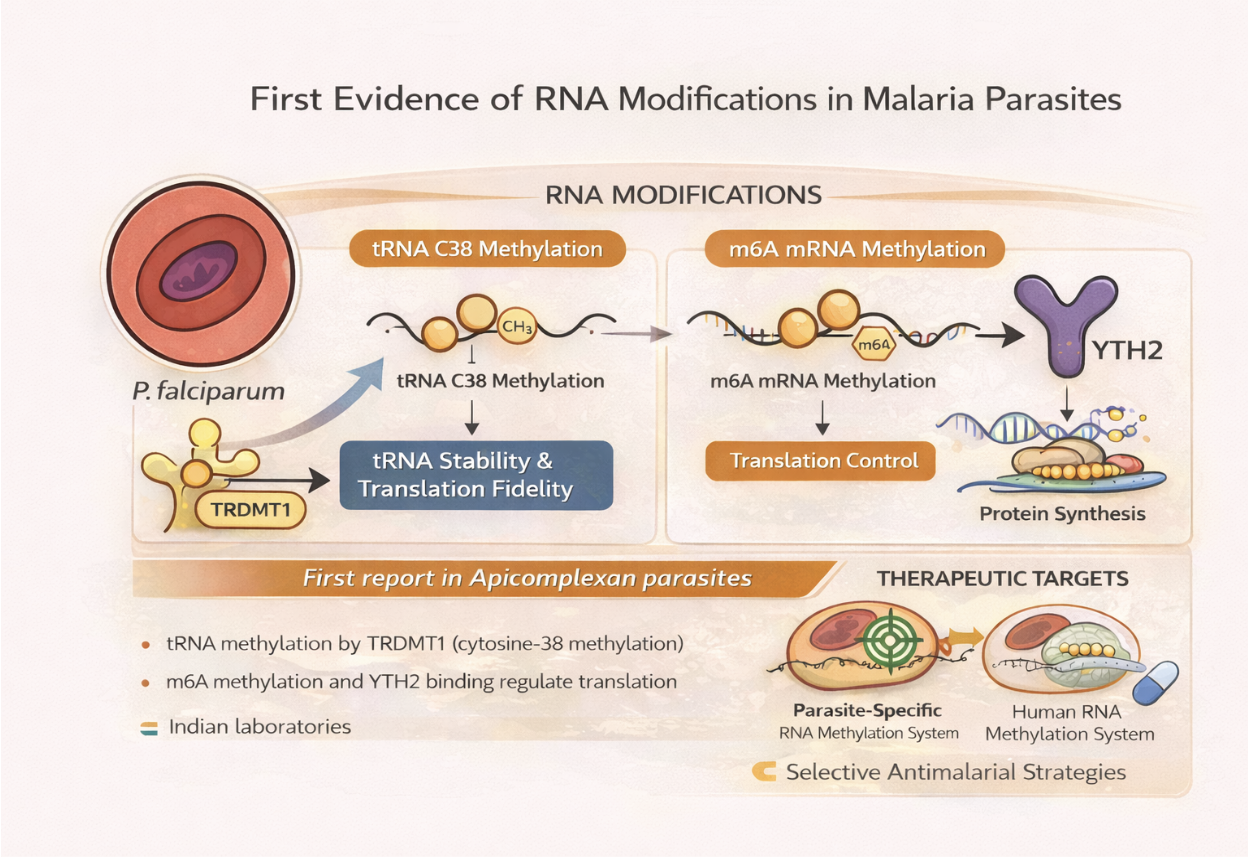
One of the earliest discoveries from this work was the identification of a DNA methyltransferase homologue, TRDMT1 (tRNA aspartic acid methyltransferase 1), in P. falciparum. Unexpectedly, this enzyme did not modify DNA. Instead, it was proven as a tRNA methyltransferase, specifically catalysing cytosine-38 (C38) methylation of endogenous aspartic acid tRNA.
This modification is critical for the efficient translation of proteins enriched in aspartic acid residues, many of which are essential for parasite survival and virulence. In addition, tRNA C38 methylation appears to protect parasite tRNAs from cellular stress, potentially contributing to resilience against drug pressure. This finding challenged long-held assumptions about methyltransferase function and highlighted how malaria parasites repurpose conserved enzymes for parasite-specific needs.
m6A: A new layer of mRNA regulation
Building on these findings, the research team explored whether messenger RNAs in P. falciparum also carry chemical modifications. Using biochemical and molecular approaches, they provided evidence for N6-methyladenosine (m6A) modifications on parasite mRNA.
How the parasite “reads” m6A marks
Chemical marks on RNA are biologically meaningful only if cells can interpret them. In higher eukaryotes, m6A marks are recognised by specialised YTH-domain proteins, which bind methylated RNA and regulate its fate. Whether malaria parasites possessed such “reader” proteins was previously unknown.
This study identified a YTH2 domain – containing protein in P. falciparum that specifically recognises and binds m⁶A-modified mRNAs. Functional analyses demonstrated that this interaction modulates protein translation by regulating the efficiency with which methylated transcripts are translated into proteins. Collectively, these findings establish that malaria parasites harbour a complete m⁶A regulatory axis-comprising writers, readers, and m⁶A-modified-RNAs previously believed to be exclusive to higher eukaryotes. Notably, P. falciparum lacks canonical m⁶A erasers (RNA demethylases), underscoring the multifaceted and central role of the YTH2 reader in parasite gene regulation.
Why this matters for malaria control
P. falciparum undergoes rapid developmental transitions inside human red blood cells yet has limited transcriptional regulation. RNA modifications therefore act as a critical regulatory switchboard, enabling precise control of protein production throughout the parasite life cycle.
Importantly, several components of the parasite’s RNA methylation machinery are structurally and functionally distinct from human counterparts, making them attractive candidates for selective therapeutic targeting. Disrupting RNA methylation could impair parasite growth while minimising host toxicity.
In the battle between parasite and host, it’s no longer just the DNA that matters-but how RNA is written, read, and regulated”,
the author’s quote.
An Indian contribution to global parasitology
Epi-transcriptomics: the study of RNA modifications is a rapidly expanding field, largely explored in cancer and viral biology. Extending this framework to malaria parasites represents a major conceptual advance. By being the first to report RNA methylation systems in any Apicomplexan parasite, this work positions Indian research at the forefront of global parasitology.
The findings have been published in leading peer-reviewed international journals, including BBA – Gene Regulatory Mechanisms, Epigenetics & Chromatin, mBio, and the Biomedical Journal, with a recent piece in the Biomedical Journal further highlighting the translational relevance of this work.
Looking ahead
Future research could map RNA methylation across the parasite transcriptome, explore how these modifications change across life-cycle stages, and determine how disrupting RNA methylation affects parasite survival and drug resistance. Advances in sequencing technologies and computational analysis may further accelerate such studies.
By uncovering how Plasmodium falciparum writes and reads chemical marks on RNA, this research reveals a new regulatory layer in parasite biology, underscores India’s growing contribution to global biomedical science, and opens new possibilities for precision-targeted antimalarial strategies.