In this reflection, Manoj Saxena revisits conversations sparked during YIM 2026 and a train journey afterwards to examine India’s evolving innovation ecosystem. From team science and biomanufacturing ambitions to fragmented execution, funding gaps, and barriers faced by returning scientists, the piece explores the tension between collective aspiration and structural reality.
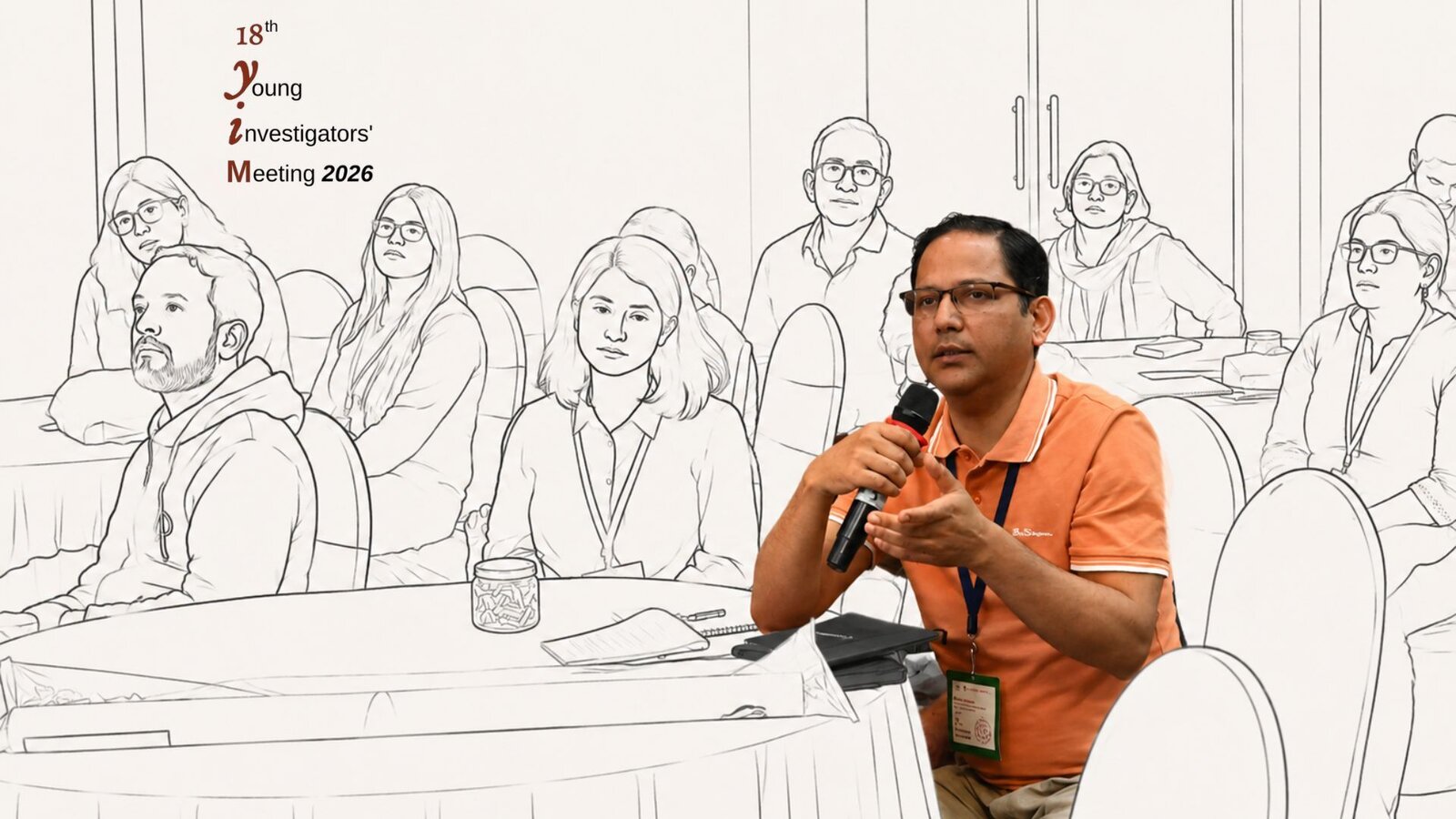
On a train from Pune to Mumbai after attending Young Investigator Meeting 2026, Pune (YIM 2026), I found myself thinking about a contradiction at the heart of Indian innovation. This started as a casual conversation with a fellow traveller, a young entrepreneur, someone who has taken the path I was contemplating to take. I was still carrying a certain energy from the meeting, the optimism, urgency, and a sense that something important is trying to take shape in the Indian biosciences ecosystem.
Coming from the UK after more than a decade abroad, this visit felt different. The conversations at YIM 2026, especially the repeated emphasis on team science, translational research, biomanufacturing, and mission-mode efforts felt like a clear signal. There is intent. There is direction. There is, at least at the level of vision, a strong alignment on where India needs to go.
And yet, somewhere between that vision and what one sees on the ground, there is a noticeable gap. The energy of the meeting initially masked this gap. But it became harder to ignore during a short post-YIM 2026 tour across Pune, Hyderabad, Mumbai, and Delhi. Conversations with academics, industry professionals, and startup ecosystems revealed a growing disconnect between vision and execution.
During the YIM 2026 meeting, many university representatives spoke about supporting startups, incubators, faculty-driven ventures, and student entrepreneurship. It all sounded right, motivating, and familiar. The language of innovation has clearly spread across the system.
But when the conversation moved from intent to outcomes and specific support, things became less clear. There were only a handful of examples of startups that had truly emerged from faculty and scaled meaningfully. A few exceptions stood out but it was hard to tell whether they were the result of strong institutional ecosystems or simply driven by exceptional individuals, or even advantages tied to specific cities.
What seemed more widespread was something else: a kind of collective momentum driven by the fear of being left behind — a kind of institutional FOMO. Incubators are being set up. Programmes are being launched. Everyone wants to participate in the startup narrative.
But mere participation is not the same as impact. The harder questions, around how many of these efforts translate into real companies, meaningful IP, or revenue-generating technologies remain largely unanswered. There is still a visible gap between patents filed and patents that matter, between announcements made and systems that deliver.
This is where the tension deepens. Because at the same time, the broader call from leadership at YIM 2026 was powerful and necessary: to move towards mission-driven science, to build teams rather than silos, to focus on translation and manufacturing, and to think at scale. There is a kind of consonance in this vision almost everyone agrees on the direction. And yet, the execution ecosystem feels fragmented. For someone like me, standing at the edge looking in, this creates a very real dilemma.
Because in parallel, there is another pattern that continues to play out globally. Many founders and scientists of Indian origin still choose to anchor their intellectual property and companies in the US or UK, while building operational or execution layers in India. This is not about lack of intent to build in India. It is about where systems make it easier to take risks.
Setting up a company abroad is faster. Funding for uncertain, early-stage science is more accessible. There is more patience for ideas that take time to mature.
In India, bold, long-horizon work often falls into a gap, too applied for academia, too early for venture capital, and not yet fully supported by mission-mode structures at scale. So the outcome becomes almost predictable: the thinking happens in one geography, the execution in another. Over time, ownership follows the thinking. And that is the heart of the “two-body problem.”
Sitting on that train, this is what stayed with me, the contrast between what is being said, and what is still being built. This is not about intent, the intent, if anything, feels genuine.
YIM 2026 felt like a rare and important space, one where these conversations are happening honestly, and where a generation of scientists is trying to imagine a different system. If anything, it made me feel that platforms like YIM are not just useful, they are essential.
But they are also too small. If India is serious about building in deep-tech, biotech, and frontier science, spaces like this need to grow 50 –100 times in scale, depth, and continuity. Hearing that even this kind of platform faces funding constraints is concerning. These are the spaces where alignment begins.
They could also become places where something more concrete emerges, shared roadmaps, policy inputs, sustained networks, and even training for those returning after years abroad, trying to re-understand a system that has evolved in their absence.
Because that is the other layer to this story, the human one.
For many of us working outside India, the question of returning is never fully settled. It sits somewhere in the background, shaped by both emotion and practicality. You feel the pull to come back, to contribute, to build something meaningful in the place that shaped your early curiosity. But you also see the friction, the delays, the uncertainties, the structural gaps. So for those who are contemplating the question of coming back to India, you end up, quite literally, on the fence.
There was one more thing that came up at YIM 2026, almost unanimously, and yet strangely quietly, that felt like a quintessential example of this gap: age. Everyone acknowledged it as a real barrier for talented people considering a return. Too old for certain fellowships, ineligible for schemes designed for an earlier career stage, structurally locked out by limits that were never designed with the diaspora in mind.
And yet, despite broad agreement in the room, it remained one of those things nobody wanted to say too loudly, the kind of problem everyone sees clearly, but that sits just above the threshold of open confrontation.
To be fair, there has been some movement. There is gradual progress toward revising age limits in certain programmes and that matters. But it is difficult not to notice a deeper pattern.
We often admire the scientific and innovation ecosystems of the western countries like the US, and the UK, and often attribute their success primarily to resources and funding. What we speak about less is what quietly enabled those systems to flourish: the removal of artificial barriers such as rigid age limits, and the prioritisation of merit over inconsequential parameters. It was not just wealth that built those ecosystems. It was also the decision to step aside and allow talent to emerge — regardless of when in life it appeared.
And that is why this moment feels important. Because there is momentum. There are signals. There is a growing recognition that India needs to move towards team science, translational impact, and biomanufacturing at scale.
The question is whether the systems will evolve fast enough to match that vision.
And that is perhaps where this becomes less of a reflection, and more of a call for action.
To the people shaping these systems, the leaders across funding agencies, institutions, and policy bodies, this is the moment where alignment needs to move from language to structure. Because small decisions made at that level determine much larger outcomes: who returns, who stays, who builds, and where.
India does not lack talent. It does not lack ambition. It does not even lack vision.
What it needs now is coherence — a system willing to remove artificial barriers to innovation, whether age, rigid credentialism, or institutional risk aversion toward backing ambitious early-stage ideas. And for those of us watching, deciding, and hoping to return, and build in India, that makes all the difference.