Researchers from IISER Bhopal have demonstrated, in a study published in 2022, that the efficiency of stop codon readthrough translation can be markedly improved by strengthening the binding between the UAG stop codon and its suppressor tRNA. Incorporation of non-natural amino acids into proteins using this approach can be applied to several applications, such as visual tracking of fluorescent amino acid-bearing proteins in studies of protein localisation in cells and the introduction of photocrosslinker molecules into proteins to identify protein-protein interactions.

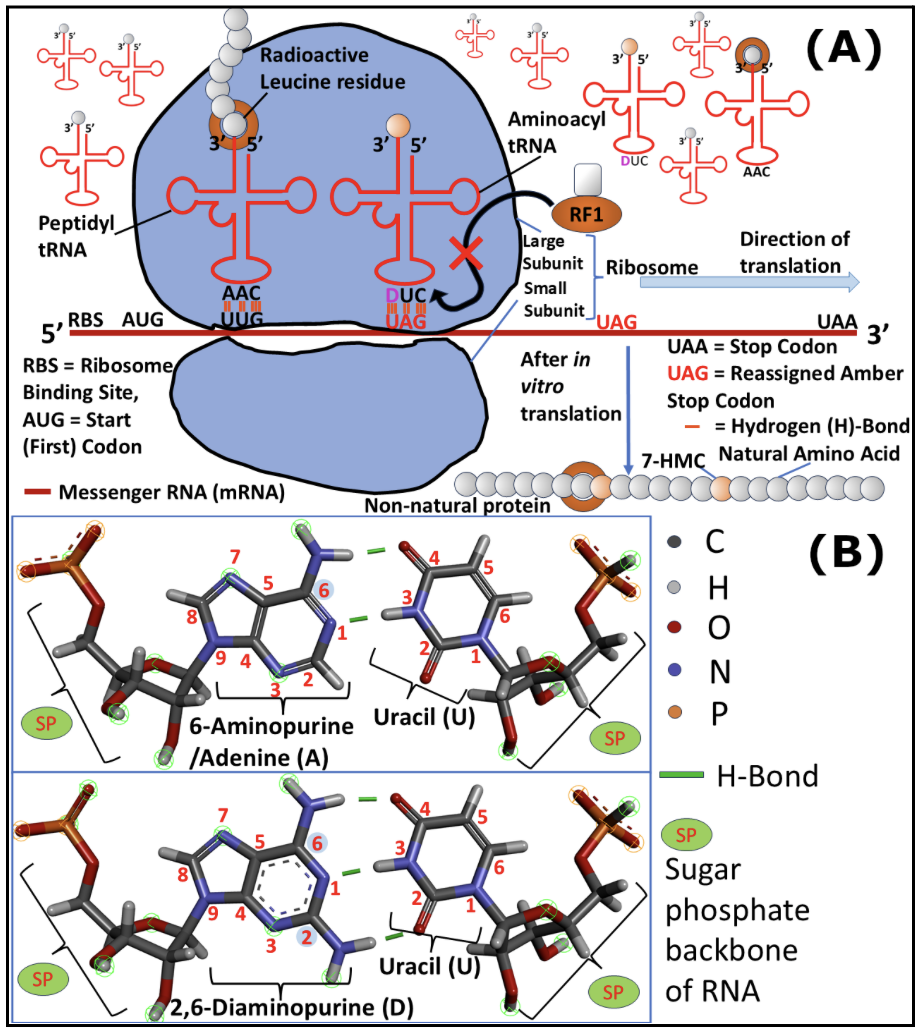
Ishu Saraogi, Associate Professor, Organic Chemistry and Chemical Biology, Indian Institute of Science Education and Research Bhopal (IISER Bhopal) and her PhD student at the time of publication of the study, Purnima Mala (now a postdoctoral researcher in RNA biochemistry at the University of Massachusetts Amherst (UMass), USA), showed that introduction of 2,6‑Diaminopurine (D) at the 3’ position of the anticodon (5’-CUD‑3’) in the suppressor tRNA (tRNACUD), which recognises the 5’-UAG‑3’ stop codon, significantly strengthens this codon – anticodon interaction relative to that involving the normal suppressor tRNA (tRNACUA) anticodon 5’-CUA‑3’.
This stronger interaction enables the suppressor tRNA to efficiently compete with release factor 1 (RF1) for 5’-UAG‑3’-binding, thereby preventing the premature termination of translation (protein synthesis). In contrast, RF1 displaces tRNACUA, triggering the subsequent disassembly of the ribosome (translation machinery).
Protein synthesis naturally utilises only 20 standard (canonical) amino acids in most organisms. Normally, a specific transfer RNA (tRNA) is covalently attached to a particular amino acid (aminoacylated) by a dedicated aminoacyl tRNA synthetase enzyme. Each codon (triplet of consecutive nucleotides) in messenger RNA (mRNA) binds to its cognate aminoacyl tRNA via the latter’s anticodon nucleotide-triplet. Codons and their anticodons have complementary sequences (RNA sequences are read from the 5’ end to the 3’ end. Complementary sequences bind each other through specific hydrogen bonds between the nucleotides ‘A’ and ‘U’, and between ‘G’ and ‘C’, when the interacting nucleotides from complementary sequences are positioned opposite one another and the 5’-to‑3’ orientations of the complementary sequences run antiparallel).
Over the decades, researchers have developed and refined stop codon readthrough technologies for encoding non-natural (non-canonical) amino acids (NAAs) (Learn more through this review article). This strategy involves expanding mRNA’s genetic code by attaching an NAA to a ‘suppressor’ tRNA, which is engineered to recognise one of the stop codons — 5’-UAG‑3’ (Amber), 5’-UAA‑3’ (Ochre), or 5’-UGA‑3’ (Opal/Umber). Since multiple different stop codons provide beneficial redundancy for translation termination, one stop codon can be repurposed to encode an NAA while another signals termination at the 3’ end of the mRNA.
In this study, the incorporated NAA was (7‑hydroxycoumarin-4-yl) ethylglycine (7‑HMC), which was conjugated by coumaryl tRNA synthetase to an optimised tyrosyl tRNA derived from Methanocaldococcus jannaschii. The 7‑HMC was encoded by either one or two Amber stop codons (with three different two-Amber-site positional variants) introduced into green fluorescent protein (GFP) by mutation. Translation was carried out in the Escherichia coli T7 S30 cell-free translation system. 14C-leucine autoradiography revealed yields of intact GFP, relative to unmutated GFP yield (defined as 100%), as tabulated below:
Yield | ||
tRNACUA | tRNACUD | |
1 Amber | 23% | 47% |
2 Ambers | 0%* | 20 – 25% |
*due to inefficient stop codon read-through
Jiantao Guo, Professor, Chemical Biology, University of Nebraska-Lincoln, Nebraska, USA, who was not associated with this study, commented on the applications of this technique: “Enhancing codon – anticodon interaction enables more efficient incorporation of noncanonical amino acids. This methodological advance can augment current efforts to expand protein chemical diversity, thereby accelerating studies of protein structure, dynamics, and post-translational modifications, while empowering the design of new biotherapeutics, such as site-specifically modified antibodies and controllable protein drugs, with improved stability, specificity, and tailored biological functions”.