Researchers in India have developed a non-invasive way to stimulate neurons using a biocompatible semiconductor. By modulating calcium signalling without electrodes or magnets, this approach could open new paths for treating neurodegenerative disorders and for building biocomputing systems.
Once upon a time…
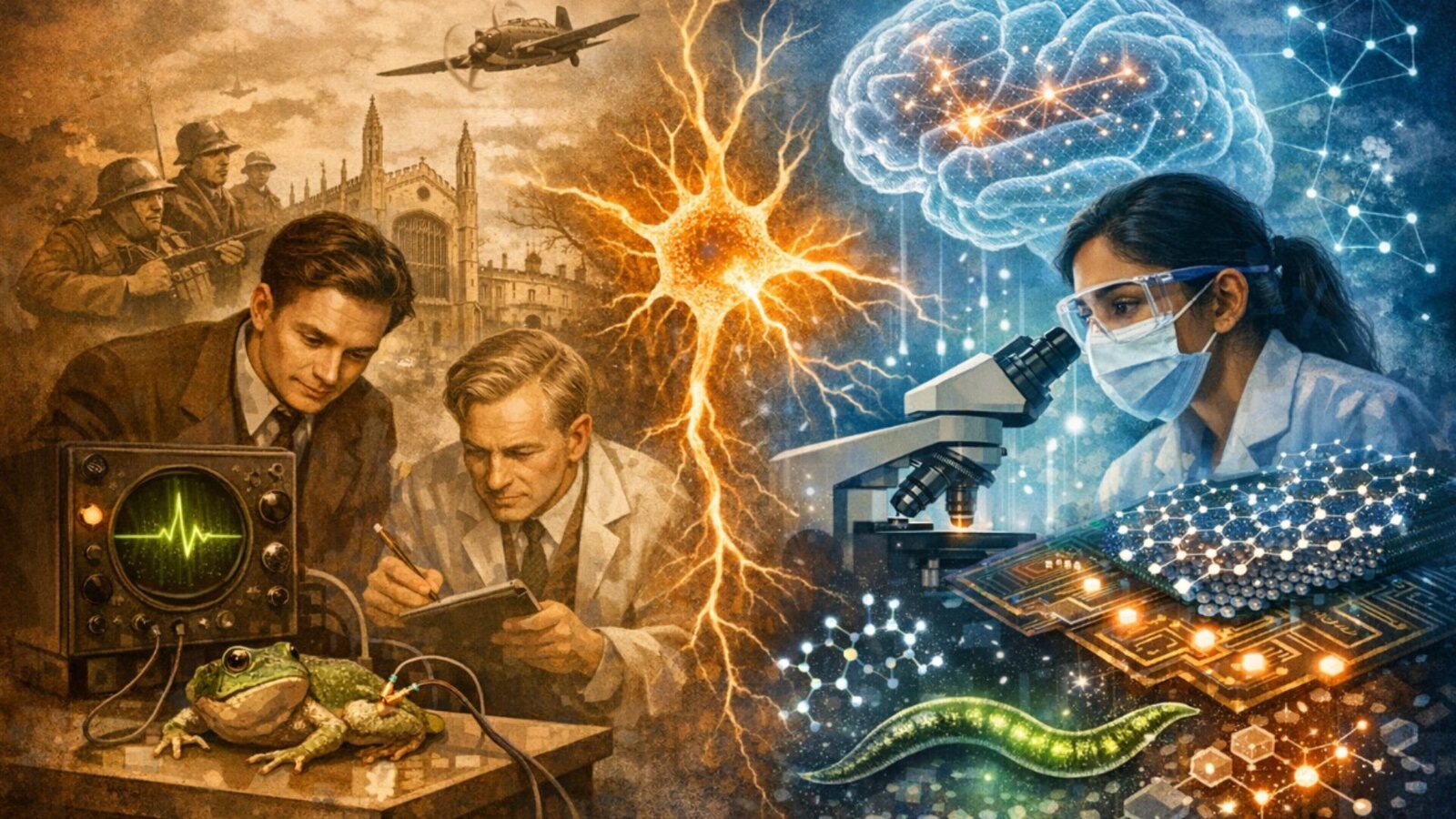
In the Autumn of 1944, the world was expecting the end of bloodshed that had been occurring for the past five years. The Allied Forces had invaded France and were advancing towards Hitler’s Germany. With these developments, the general public was anticipating normalcy any time from then. The grocer who had become an artilleryman could go back to his store and the physicist who worked on bombs could go back to his studies on water droplets.
In the midst of this, a young physiologist named Alan Hodgkin was working with the allied forces on the effect of altitude on the human body to design better aircraft. Before the war began, his Roman Empire was the nerve in the thigh of frogs. Utilising the frog sciatic nerve as a model, he used to study the electrical impulses transmitted in the nerves. With the end of the War in sight, he was released from military service and summoned back to Cambridge under the influence of an aristocratic electrophysiologist and Nobel Laureate, The Lord Adrian to continue his work on biophysics. Subsequently, in 1952, Hodgkin, along with his collaborator Andrew Huxley, published a series of 5 papers which elaborated, mathematically, the workings of electricity inside living tissues, building on years of experimental data. They eventually won the Nobel Prize in 1963. What did they show? Their model showed how neurons behave while firing. This firing is fundamental for everything that our brain does from emotions to intellect.
Today
Fast forward 80 years, the same excitement on nerve excitability is now being collaboratively explored by a group of Indian nanotechnologists working across Mohali, Hyderabad, and Lucknow, who have developed a brand new way to tap the potential of neuronal excitability to treat debilitating conditions such as Alzheimer’s and Parkinson’s, using a semiconductor. The same class of materials that make up our phones are now changing brain chemistry (in a good way, unlike phones!). Researchers used graphitic carbon nitride to understand how they might affect neuronal modulation. The results were so multifaceted that they defy a singular, linear narrative of explanation.
Brainology
All cells maintain an electrical gradient around them. This potential is created by a bunch of ions like sodium, chloride, potassium, and calcium. A rule of thumb is that the outside of a cell, or the water in which the cell floats, is like sea water — abundant in sodium, chloride, and calcium. On the other hand, the inside of a cell has an abundance of potassium ions.
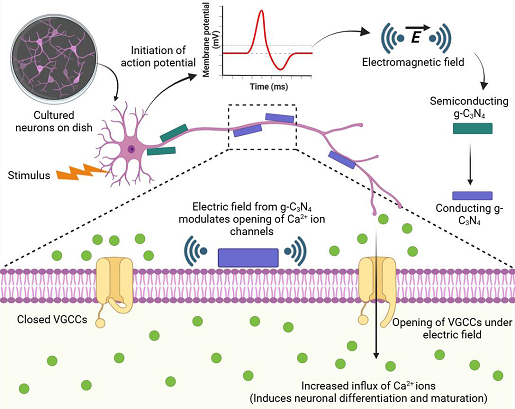
The influx of calcium ions into the cell from the outside is fundamental for changes in neuronal membrane potential to occur. This influx happens through tiny tubes. These tubes have gates guarding them so that too much or too little ions don’t enter. Whenever there is a change in potential around the cells, the floodgates of these tubes open, allowing vast amounts of calcium to enter the cell.
Once so much calcium enters inside, the simpleton ion transforms itself into a polymath. Aiding hormone synthesis? Check. Genetic regulation? Check. Muscle contraction? Check. Growth? Check. When calcium is known to play such a central role inside the cell, it should be of no surprise that this attracts researchers around the globe, and public attention, for at least the past 40 years.
Going nano
Indranil De, Abhinoy Kishore, Subhabrata Das, Sownyak Mondal, Sakshi Yadav, Prashant Sharma, Mansi Pahuja, Srishti Singh, Aamir Nazir, Soumya Ghosh, Kaushik Ghosh, and Manish Singh, from the Institute of Nano Science and Technology (INST), Mohali; Tata Institute of Fundamental Research (TIFR) Hyderabad; and CSIR-Central Drug Research Institute, Lucknow, worked in collaboration to test the potential of carbon nitride nanosheets both in cell cultures and in living worms.
In cell cultures, over a period of 21 days, nerve cells showed increased differentiation and formed more outgrowths. What was happening in parallel (or driving it) was an increase in calcium influx into the cells. How do we know that calcium is doing the work here? For the above-mentioned processes, dopamine is required inside the cells. To synthesise dopamine cells use a whole arsenal of molecular machines which in turn require calcium to function. The scientists found out that there is an increased concentration of molecular machines inside the cell, which confirmed that the graphite carbon nitride was playing its role.
To test the nanomaterial’s impact on living cells, they used a worm called Caenorhabditis elegans. It is considered as the workhorse of genetics. It has a bunch of unique properties such as easy to grow, short life span, limited number of cells which makes it ideal for genetic research. It was observed that carbon nitride nanosheets prevented some protein blobs from forming inside the cells. This kind of aggregation of protein blobs is implicated in Alzheimer’s and Parkinson’s diseases, which wreak havoc in patients’ and their loved ones’ lives. This feature of the nanomaterial holds immense promise in devising treatment methods for these diseases in the future.
Bio-hacking
The impact of this development is not limited to medical advantage. An idea in vogue among Biotech bros and nerds is the concept of Biocomputing, with brain tissue performing computations, replacing, or aiding machines. This research has the potential to improve the function of brain tissue as a biological processor. This is an area where the boundaries between the biological mind and technological machine get blurred, and important ethical questions such as machine consciousness emerge, but that’s a topic for another day.
The idea of compounds altering brain function isn’t new. Drugs do exactly that. We have been cracking open the brain up and changing its structure safely for at least 120 years. So what’s new here? The material used here is a biocompatible semiconductor. This is where the “brain stuff” and “phone stuff”, for the lack of better term, get blended, and create a novel junction point around which medical and machinist revolutions can pivot around. That India is at the centre of this research signals the pace at which Indian scientific ideas and capabilities are advancing.