Chickpea, a staple crop for millions, is highly vulnerable to Fusarium wilt. A new study reveals how activating systemic acquired resistance through AtNPR1 and identifying the RNA helicase CaDEAD-box20 can significantly enhance disease resistance, opening pathways for durable, broad-spectrum protection in chickpea and other legumes.
Chickpea (Cicer arietinum L.), the world’s second-most widely cultivated pulse, covers nearly 14.84 million hectares globally and forms a nutritional backbone for millions. As a protein-rich food and nitrogen-fixing crop, chickpea sustains both diets and soils, especially in India, which contributes nearly 90% of global production.
Yet this essential crop remains highly vulnerable to Fusarium wilt (FW), a destructive soil-borne disease caused by Fusarium oxysporum f. sp. ciceris. FW routinely causes 10 – 40% yield losses, and severe outbreaks can wipe out entire fields. The pathogen’s long-term survival in soil, high genetic diversity, and multiple physiological races make chemical control largely ineffective and often overcome resistance in conventionally bred cultivars.
Although genomics and multi-omics studies have highlighted pathways linked to wilt resistance, achieving durable and broad-spectrum immunity requires pinpointing the core molecular regulators that orchestrate defense. One promising route involves activating systemic acquired resistance (SAR), a robust, whole-plant immune response governed by the master regulator non-expressor of pathogenesis-related genes 1 (NPR1).
A recent study published in Plant Cell Reports by a team led by Subhasis Karmakar (ANRF-National Post-Doctoral Fellow; ICAR – Central Rice Research Institute), in collaboration with Sabarinathan Selvaraj (Odisha University of Agriculture and Technology), Subhankar Mondal (Utkal University), and Dipak Gayen (Central University of Rajasthan), has uncovered a powerful new defense strategy for chickpea.
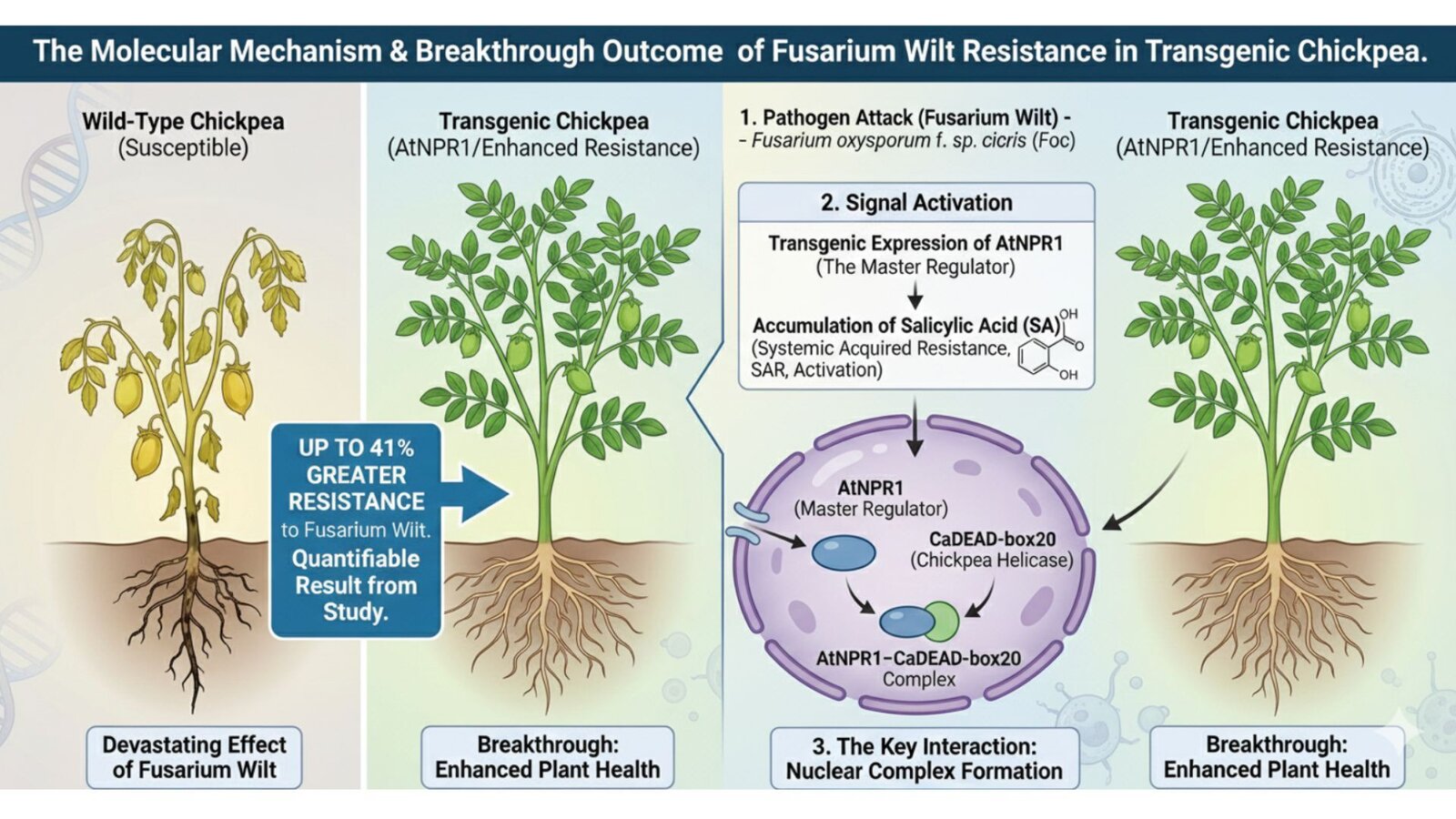
Using multi-omics profiling and CRISPR – Cas9 genome editing, the team demonstrated that heterologous expression of Arabidopsis NPR1 (AtNPR1) significantly enhances Fusarium wilt resistance in transgenic chickpea. They also identified CaDEAD-box20, a previously uncharacterised RNA helicase, as one of the most strongly induced proteins in AtNPR1-expressing plants.
Further protein – protein interaction assays and structural modeling pointed to a potential interaction between AtNPR1 and CaDEAD-box20. Functional studies sealed the discovery: overexpression of CaDEAD-box20 strengthened wilt resistance, while CRISPR – Cas9 knockout plants showed heightened susceptibility. This firmly establishes CaDEAD-box20 as a positive regulator of chickpea immunity.
The author notes,
Our collaborative study reveals AtNPR1-mediated immunity and identifies CaDEAD-box20 as a key wilt-resistance regulator, offering new avenues for durable, broad-spectrum chickpea defense”.
Together, these findings provide the first functional evidence of AtNPR1-mediated defense in chickpea and identify CaDEAD-box20 as a central node in its immune pathway. The study opens up exciting avenues for engineering durable, broad-spectrum resistance against Fusarium wilt, one of the most persistent threats to global chickpea production, and potentially other legumes as well.