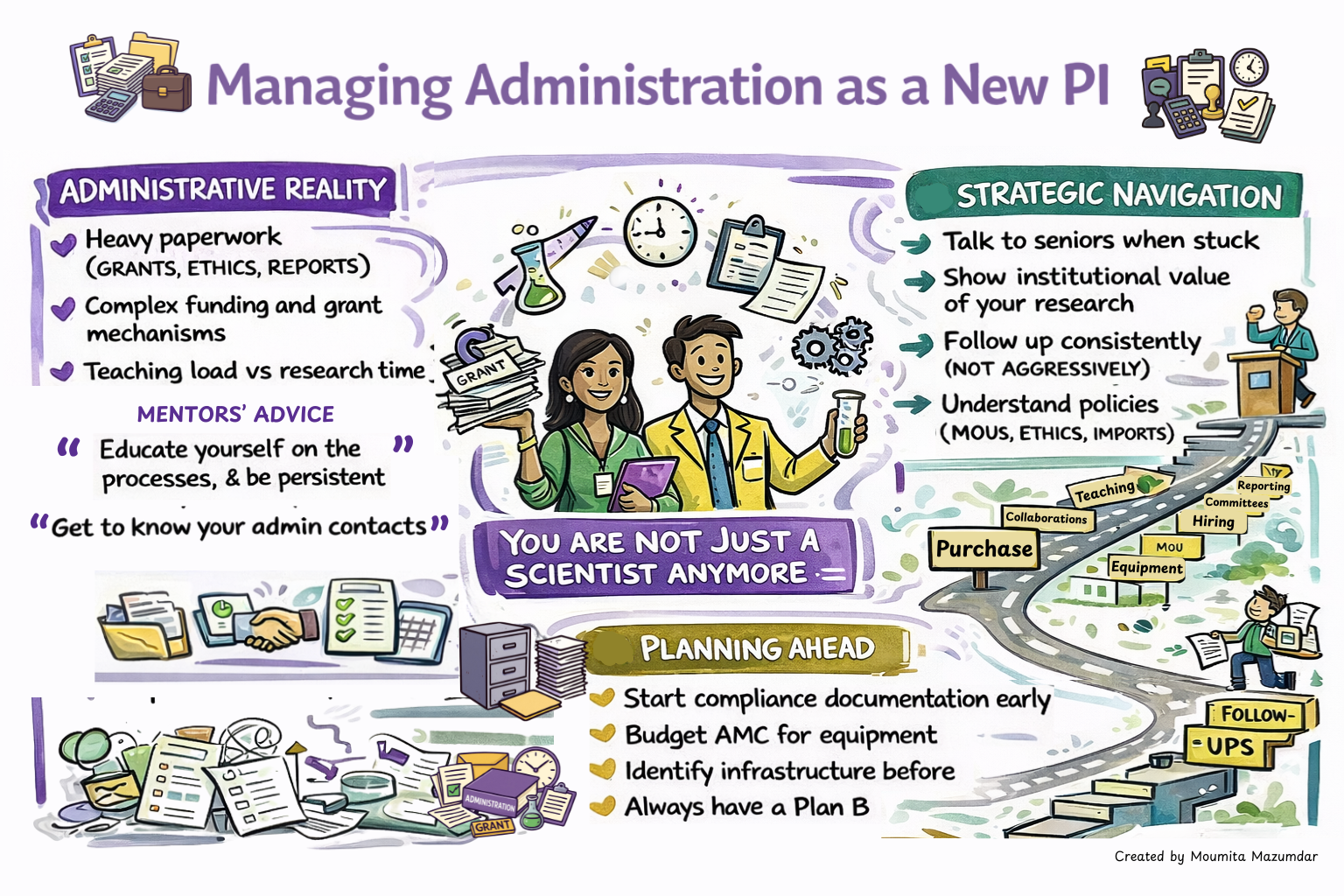
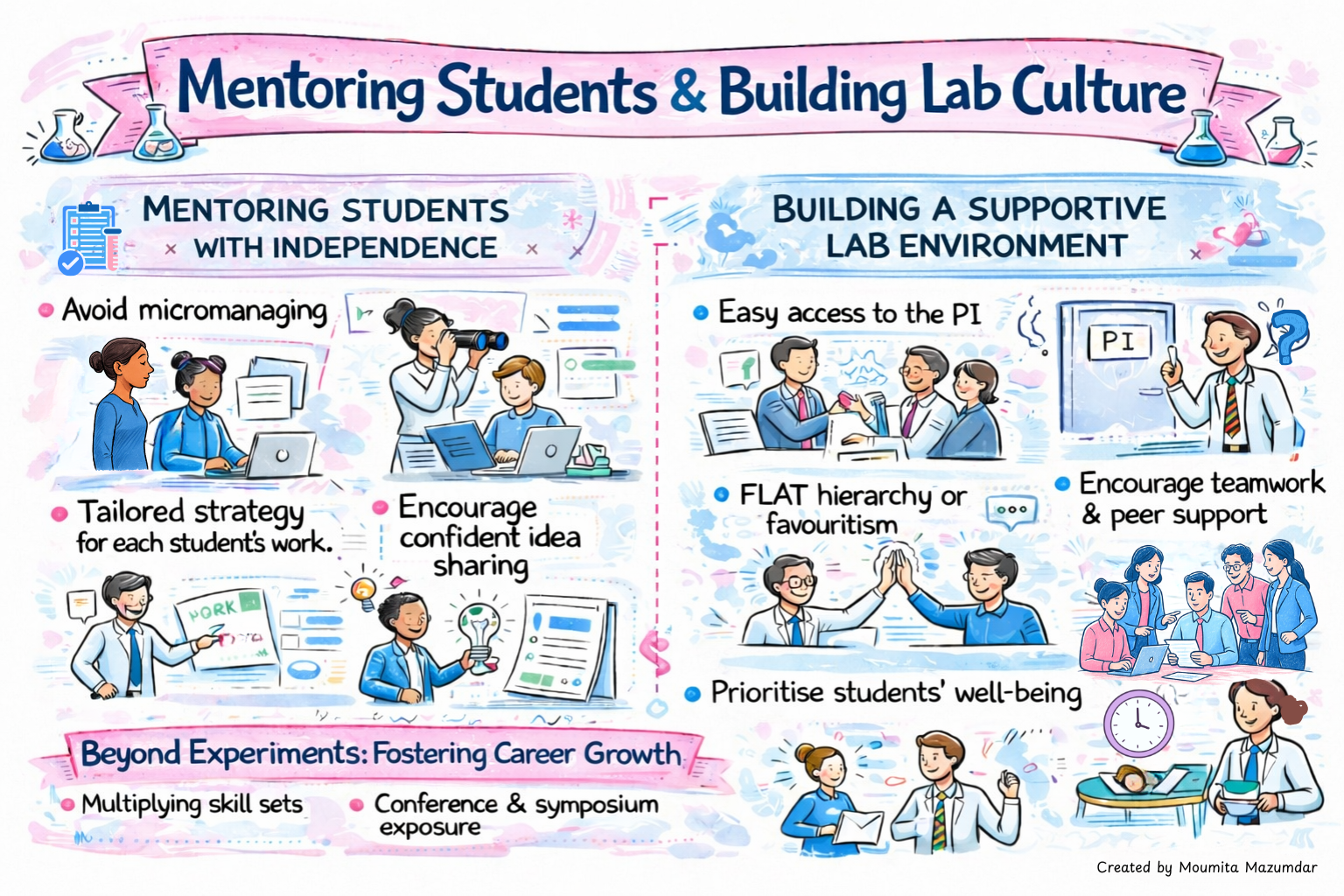
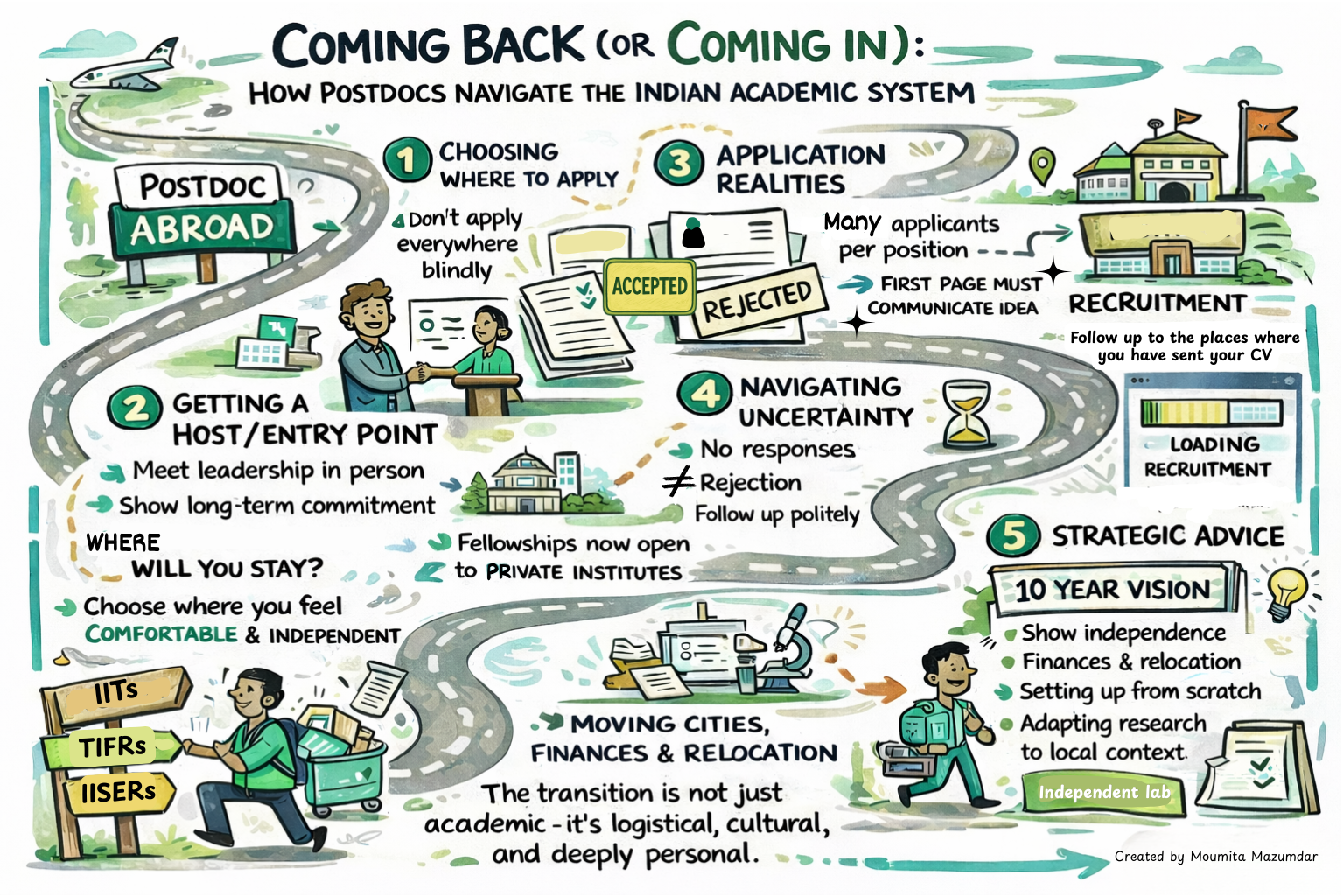
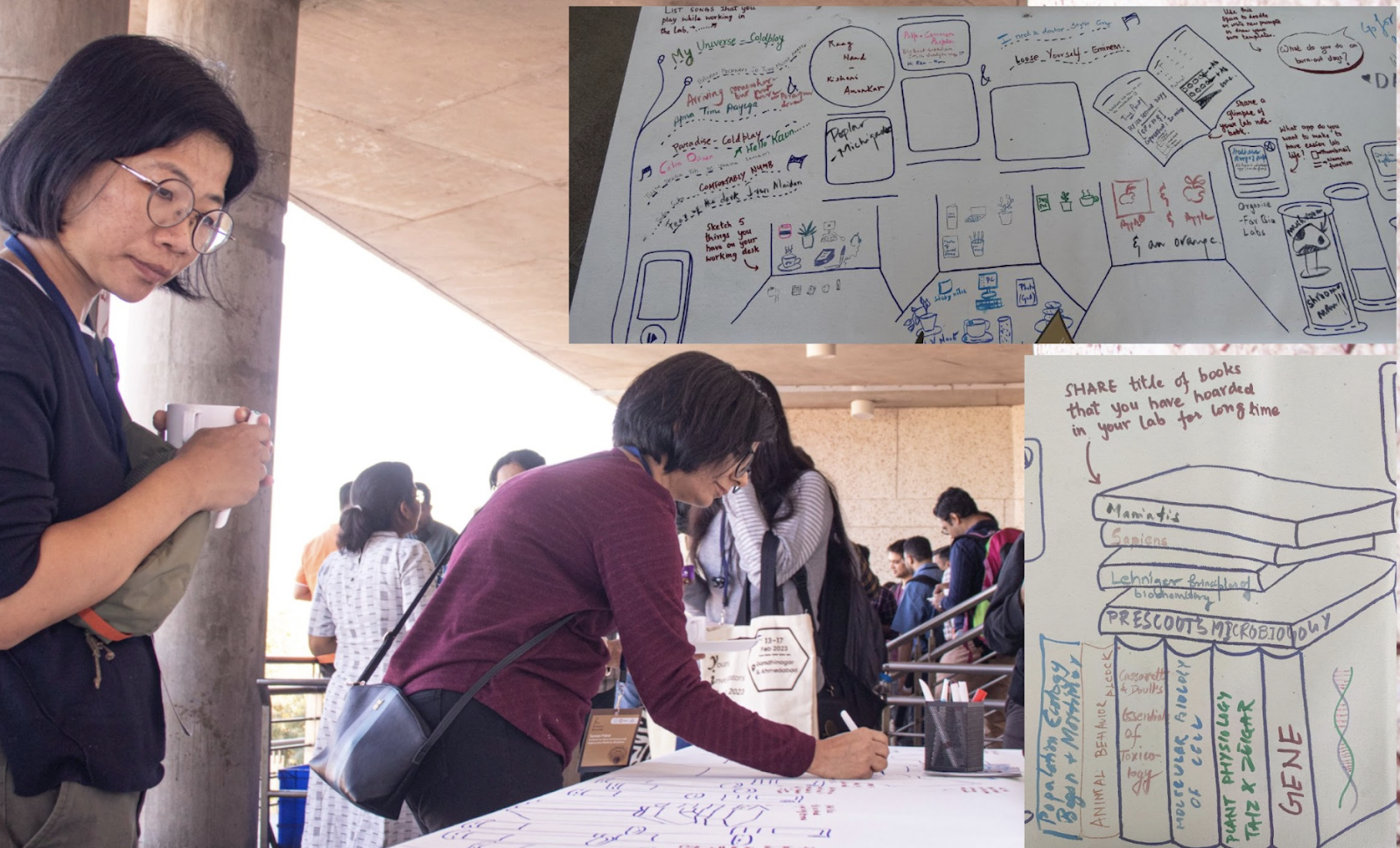
<?xml version="1.0" encoding="UTF-8"?><feed xmlns="http://www.w3.org/2005/Atom" xml:lang="en"><title>IndiaBioscience - @IndiaBioscience </title><link
    rel="alternate"
    href="https://indiabioscience.org/columns/indiabioscience-blog"
    type="text/html"
    /><link
    rel="self"
    href="https://indiabioscience.org/columns/indiabioscience-blog/feed"
    type="application/atom+xml"
    /><id>https://indiabioscience.org/columns/indiabioscience-blog/feed</id><updated>2026-06-23T12:50:23+05:30</updated><entry><title>Insights from breakout sessions at YIM 2026</title><link
                  rel="alternate"
                  href="https://indiabioscience.org/columns/indiabioscience-blog/insights-from-breakout-sessions-at-yim-2026"
                  type="text/html"
                  /><summary type="html"><![CDATA[
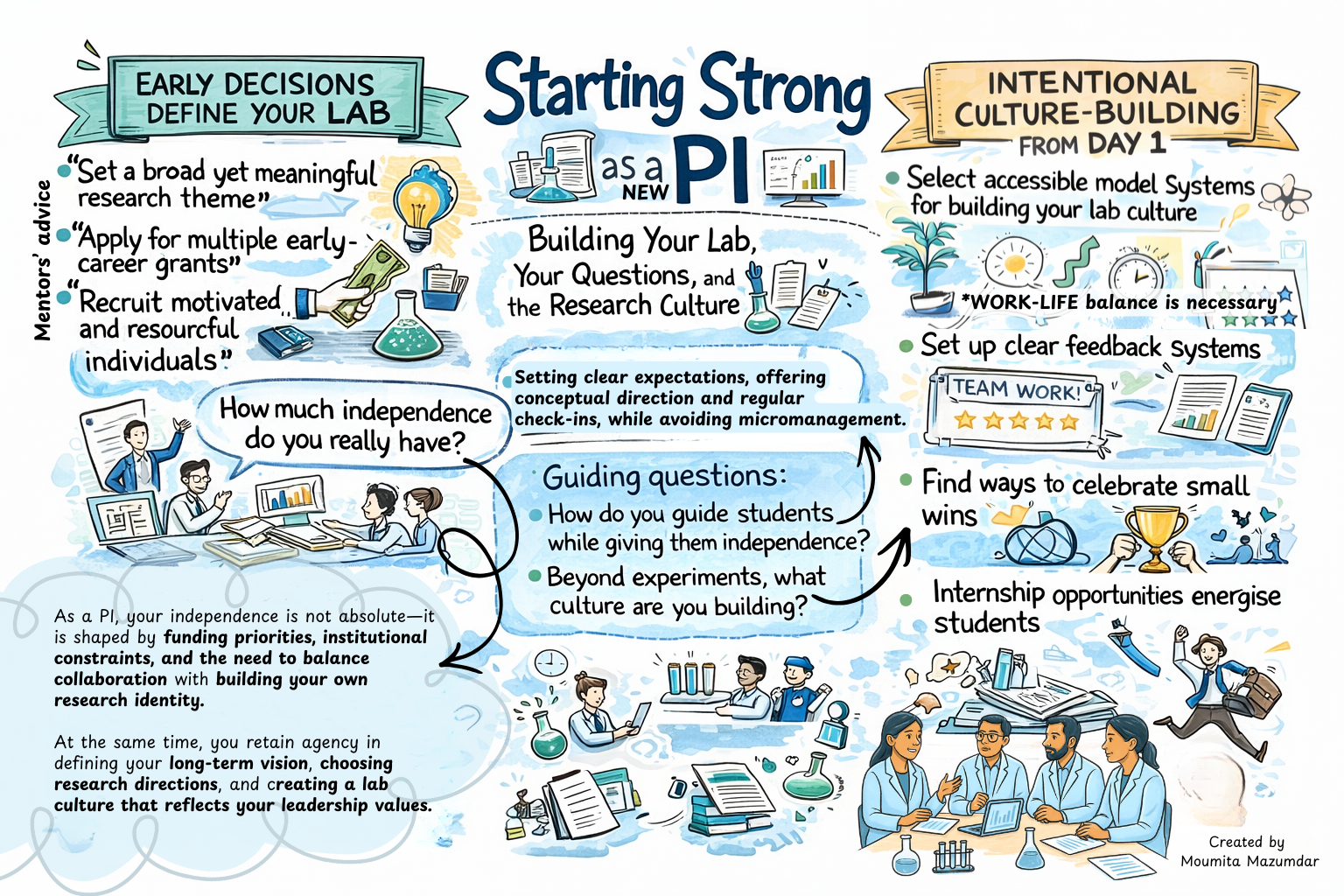
                <p dir="ltr">Breakout sessions at the <a href="https://indiabioscience.org/meetings/yim-2026" target="_blank" rel="noreferrer noopener">Young Investigators’ Meeting 2026</a> revealed that building a lab goes beyond science; it is also about defining one’s identity, nurturing people, and sustaining momentum amid constraints. Accompanied by visual notes, this piece is a collation of insights on the role of culture, collaboration, and persistence in shaping resilient research ecosystems and crafting meaningful scientific careers in life sciences.</p>              ]]></summary><id>tag:indiabioscience.org,2026-04-17:/columns/indiabioscience-blog/insights-from-breakout-sessions-at-yim-2026</id><published>2026-04-17T00:00:00+05:30</published><updated>2026-04-16T22:36:19+05:30</updated><author><name>Moumita Mazumdar</name><uri>https://indiabioscience.org/authors/moumita</uri></author><content type="html"><![CDATA[
                
<p>Breakout sessions at the <a href="https://indiabioscience.org/meetings/yim-2026" target="_blank" rel="noreferrer noopener">Young Investigators’ Meeting 2026</a> revealed that building a lab goes beyond science; it is also about defining one’s identity, nurturing people, and sustaining momentum amid constraints. Accompanied by visual notes, this piece is a collation of insights on the role of culture, collaboration, and persistence in shaping resilient research ecosystems and crafting meaningful scientific careers in life sciences.</p><figure><a href="https://indiabioscience.org/columns/indiabioscience-blog/insights-from-breakout-sessions-at-yim-2026"><img
                width="1920"
                height="1080"
                style="max-width: 100%; height: auto"
                src="https://cdn.indiabioscience.org/media/articles/YIM-breakout-sessions.jpg"></a></figure><p>The breakout sessions at Young Investigators’ Meetings feature semi-structured conversations among senior researchers and research professionals, as well as Young Investigators and Postdoctoral Fellows, on themes emerging from experiences in establishing a research laboratory and in career development during the early years of research.</p><p><strong>The first decisions: Defining the “soul” of a lab</strong></p><p>Session title: Getting started as a PI</p><p>Focus - Starting strong: Building your lab, your questions, and the research culture<br></p><p><em>What happened in the breakout groups</em><br></p><p>Participants reflected on the critical first few years of establishing an independent research laboratory in India. The conversations drew on personal experiences to examine what it truly means to shape a lab’s identity from the ground up, moving well beyond formal advice and best practices.<br></p><p>A central tension emerged early: how much should a new PI diverge from their postdoctoral work to establish an independent identity? Discussions wove together research direction, funding strategy, recruitment, and culture, with participants recognising that choices made in the first few years define the “soul” of the lab.<br></p><p><em>Questions</em><br></p><p><strong><em>In your first 2–3 years as a PI, which decisions most strongly define what your lab becomes?</em></strong><br></p><p><strong><em>If you are starting with an empty room and one or two personnel, how do you intentionally shape the culture of your lab?</em></strong><br></p><p><strong><em>In contexts where infrastructure, administrative support, or facilities are limited, how do you maintain scientific and team momentum?</em></strong><br></p><p><em>Voices from the sessions</em></p><p><strong><em>“Sometimes you take funding, do the work, publish, and then use that momentum to do the ‘dream’ research you actually want”.</em></strong></p><p><strong><em>“Success lies not only in what a lab produces, but in the culture it nurtures, the people it shapes, and the resilience it sustains”.</em></strong></p><p><strong><em>“Use networking to outsource samples or trade resources”.</em></strong></p><p><strong><em>“Choosing a broad yet meaningful research theme shapes the ‘soul’ of the lab”.</em></strong></p><p><strong><em>“When experiments stall, literature reviews and journal clubs can sustain productivity”. </em></strong></p><figure style="margin-left: auto; margin-right: auto; text-align: center;"><img src="https://cdn.indiabioscience.org/media/articles/1_2026-04-16-071950_alyb.png" data-image="838037"></figure><figure style="margin-left: auto; margin-right: auto; text-align: center;"><img src="https://cdn.indiabioscience.org/media/articles/2_2026-04-16-072037_hehs.png" data-image="838038"></figure><p><strong>Thinking about hiring new people? Think ‘</strong><strong><em>people before projects</em></strong><strong>’</strong></p><p dir="ltr">Session title: Beyond the Bench</p><p dir="ltr">Focus - Mentorship and building meaningful research careers</p><p dir="ltr"><em>What happened in the breakout groups</em></p><p dir="ltr">Conversations in the second breakout session shifted the focus from building labs to shaping people’s careers. Transitioning into a mentorship role was identified as one of the most complex aspects of becoming a PI, and one that is rarely acknowledged during the course of formal training.</p><p dir="ltr">The various groups explored the challenge of guiding students without micromanaging and of being approachable without losing boundaries. Discussions also highlighted the emotional weight of leadership: how a PI’s personal stress can affect the entire lab environment, often invisibly. Career pathways, the ethical responsibilities that come with becoming a PI, and the realities of collaboration one faces during their early years in research featured prominently.</p><p dir="ltr"><em>Questions</em></p><p dir="ltr"><strong><em>As a PI, how do you guide your students while giving them independence, without micromanaging or stepping back too much?</em></strong></p><ol></ol><p dir="ltr"><strong><em>Beyond experiments and papers, what kind of lab culture are you building, and how does it influence your students’ careers?</em></strong></p><p dir="ltr"><strong><em>How do you decide on collaborations and publication strategies in ways that build long-term careers, for both you and your trainees?</em></strong></p><p dir="ltr"><em>Voices from the sessions: </em><br></p><p dir="ltr"><strong><em>“Lab culture ultimately reflects the PI’s leadership style”.</em></strong></p><p dir="ltr"><strong><em>“Independence should ultimately help students develop the mindset of a scientist”.</em></strong></p><p dir="ltr"><strong><em>“Create an environment where students have the freedom to fail and learn”.</em></strong></p><p dir="ltr"><strong><em>“There is life beyond the lab; science is not our entire identity”.</em></strong></p><p dir="ltr"></p><figure style="margin-left: auto; margin-right: auto; text-align: center;"><img src="https://cdn.indiabioscience.org/media/articles/3_2026-04-16-072231_zgdn.png" data-image="838039"></figure><p dir="ltr"><strong>Mentorship Circles at YIM 2026</strong></p><p dir="ltr">These breakout sessions were held during the two-day PDF satellite meeting, which followed the main YIM event. Here, postdoctoral fellows at YIM seek advice on starting independent careers as life science researchers in India engaged directly with institutional heads and mentors, asking a range of questions about faculty applications, research careers, infrastructure, and navigating the academic ecosystem.</p><p dir="ltr"><em>Voices from</em><em> the mentorship circles:</em></p><p dir="ltr"><strong><em>“Tailor each application carefully rather than submitting generic proposals”.</em></strong><br></p><p dir="ltr"><strong><em>“A strong research statement should reflect your scientific journey and long-term vision, not read like a grant proposal”.</em></strong><br></p><p dir="ltr"><strong><em>“Understanding the ‘pulse’ of the institution improves both alignment and application quality”. </em></strong><br></p><p dir="ltr"><strong><em>“Facilities and support vary by institution, location, and your requirement”.</em></strong></p><p dir="ltr"><strong><em>“Do not rely entirely on highly specialised equipment, design projects that can sustain momentum”. </em></strong></p><p dir="ltr"><strong><em>“Growth of new areas depends on departmental interest and gradual expansion”. </em></strong><em>(paraphrased from discussion)</em><br></p><p dir="ltr"><strong><em>“Only shortlisted candidates are typically contacted due to large application volumes”. </em></strong><em>(paraphrased from discussion)</em><br></p><p dir="ltr"><strong><em>“Start the ethical approval process early, funding is often contingent on it”. </em></strong><br></p><p dir="ltr"><strong><em>“Difficulty in accessing resources and lack of centralised systems remain persistent challenges”. </em></strong><em>(paraphrased from discussion)</em><br></p><p dir="ltr"><strong><em>“Written feedback is rarely provided; outcomes are usually communicated only after final decisions”.</em></strong></p><p dir="ltr"><strong><em>“Evaluation is inherently subjective; success depends on timing, opportunity, and persistence”.</em></strong></p><figure style="margin-left: auto; margin-right: auto; text-align: center;"><img src="https://cdn.indiabioscience.org/media/articles/4_2026-04-16-072339_emfc.png" data-image="838041"></figure>
              ]]></content><category term="leadership" label="Leadership" /><category term="training" label="Training" /><category term="networking" label="Networking" /></entry><entry><title>From the Young Investigators’ Meeting 2025: What do Institutional Representatives say about hiring?</title><link
                  rel="alternate"
                  href="https://indiabioscience.org/columns/indiabioscience-blog/from-the-young-investigators-meeting-2025-what-do-institutional-representatives-say-about-hiring"
                  type="text/html"
                  /><summary type="html"><![CDATA[
                <p>At the <a href="https://indiabioscience.org/meetings/yim-2025" target="_blank" rel="noreferrer noopener">17th Young Investigators’ Meeting (YIM 2025)</a> in Agra, IndiaBioscience asked representatives from different institutions and universities across India questions about faculty hiring. Let’s take a look at their responses. <br /></p>              ]]></summary><id>tag:indiabioscience.org,2025-04-25:/columns/indiabioscience-blog/from-the-young-investigators-meeting-2025-what-do-institutional-representatives-say-about-hiring</id><published>2025-04-25T01:00:00+05:30</published><updated>2025-06-18T11:32:26+05:30</updated><author><name>Aishwarya Segu</name><uri>https://indiabioscience.org/authors/rbydKYwo8pMAJjG</uri></author><content type="html"><![CDATA[
                
<p>At the <a href="https://indiabioscience.org/meetings/yim-2025" target="_blank" rel="noreferrer noopener">17th Young Investigators’ Meeting (YIM 2025)</a> in Agra, IndiaBioscience asked representatives from different institutions and universities across India questions about faculty hiring. Let’s take a look at their responses. </p><figure><a href="https://indiabioscience.org/columns/indiabioscience-blog/from-the-young-investigators-meeting-2025-what-do-institutional-representatives-say-about-hiring"><img
                width="740"
                height="440"
                style="max-width: 100%; height: auto"
                src="https://cdn.indiabioscience.org/media/articles/IR-report.png"></a></figure><p>At the PDF Satellite Meeting in YIM 2025, IndiaBioscience initiated focused conversations around the criteria that research institutes in India prioritise when recruiting faculty members. For this, we engaged in insightful conversations with representatives from various institutions across the country. Among them were <a href="https://www.ssbs.edu.in/faculty-anuradhaVaidya" target="_blank">Anuradha Vaidya</a> from <a href="https://www.siu.edu.in/" target="_blank">Symbiosis International (Deemed University</a>), SIU; <a href="https://actrec.gov.in/dr-prasanna-venkatraman" target="_blank">Prasanna Venkatraman</a> from <a href="https://actrec.gov.in/home" target="_blank">Advanced Centre for Treatment, Research, and Education in Cancer</a>, ACTREC, Navi Mumbai; <a href="https://tigs.res.in/people/scientists/rakesh-mishra/" target="_blank">Rakesh Mishra</a> from <a href="https://tigs.res.in/" target="_blank">Tata Institute for Genetics and Society</a>, TIGS, Bengaluru; <a href="https://www.bio.iitb.ac.in/~roop/" target="_blank">Roop Mallik</a> from <a href="https://www.iitb.ac.in/" target="_blank">Indian Institute of Technology Bombay</a>, IIT-Bombay, Mumbai; and <a href="https://chanakyauniversity.edu.in/faculties/prof-h-s-subramanya/" target="_blank">H.S Subramanya</a> from <a href="https://chanakyauniversity.edu.in/" target="_blank">Chanakya University</a>, Bengaluru. These institutions represent a wide spectrum, ranging from non-profit private universities to private deemed universities, as well as public institutions, all of which have a strong emphasis on both research and teaching. Furthermore, a conscious choice to have equal representation from both the sexes was considered.</p><p><em>Let’s have a look at their responses</em><em><br></em></p><p><strong>1. What are the two most important things you look for in a curriculum vitae and interview during the hiring process?</strong></p><p><br><strong>
Vaidya:</strong> The two most important things we look for in a CV are, first, the candidate’s background and its alignment with what we are seeking. These are the first aspects we consider in our rule of elimination. The institutional goals should align with the applicant’s research profile,teaching profile or both.</p><ol></ol><p><strong>Venkataraman:</strong> A candidate's academic background, research focus and domain expertise, is crucial in the selection process. A very good research proposal with a long-term vision that aligns with the institutional goal is mandatory.</p><p><strong>Mallik:</strong> Innovation in their research is one of the primary aspects we look for in their work. </p><blockquote class="pull-quote">Apart from this, we assess how different their ideas are and how they approach problems in novel ways. </blockquote><p><strong>Mishra:</strong> For recruitment, we prioritise relevant background and domain expertise, including PhD, postdoc experience, or specialised training. Additionally, we seek scientists who are motivated to apply their research to solve real-world problems, like in healthcare and agriculture, ensuring the benefits of science reach society.<br></p><p><strong>2. How important are networking and mentorship opportunities in securing academic positions?</strong></p><ol></ol><p><strong>Vaidya:</strong> It's absolutely important. </p><blockquote class="pull-quote">A strong professional network greatly benefits applicants in securing collaborative grants. It enhances institutional visibility, especially for institutions less known for life sciences or fundamental research. </blockquote><p>When faculty bring strong collaborations, it not only supports their work but also fosters great networking and research opportunities for the institution.<br><br><strong>
Subramanya: </strong>Mentorship and networking are very important. Building a new school or lab requires a supportive ecosystem where collaboration, networking, and mentorship thrive. Beyond technical expertise, candidates must be able to mentor PhD students and foster meaningful academic relationships. </p><p><strong>Venkataraman: </strong>Networking is an art; not all of us can excel in it. However, being an expert in your research domain is essential.<br></p><p><strong>Mishra: </strong>Collaboration is fundamental to our institution. </p><blockquote class="pull-quote">Every scientist works with multiple collaborators to scale efforts, reach stakeholders faster, and leverage shared expertise. This approach accelerates research progress.</blockquote><p><strong>3. What leadership roles do institutes look for while making hiring decisions?</strong></p><p><br><strong>
Vaidya: </strong>Leadership is important for faculty; however, the ability to work collaboratively is the key to success. Leadership qualities develop over time, and individuals bring different strengths—some may need to tone down dominant traits to work effectively with peers. As careers progress, honing these skills becomes essential.</p><p><strong>
Mallik: </strong>Some of the leadership roles we look for include the capacity to expand a new field within the department, collaborate effectively with younger colleagues, and contribute to shaping long-term departmental policies. They should also demonstrate a vision that extends beyond their own lab.</p><p><strong>4. How are institutions working to improve diversity, equity, and inclusion (DEI) in faculty hiring? </strong></p><p><br><strong>
Subramanya: </strong>Diversity and inclusivity are basic tenets of the University. We seek applicants from various backgrounds, regions, and languages while ensuring merit remains the priority. When candidates are equally qualified, preference is given to those who enhance diversity.</p><ol></ol><p><strong>Venkataraman: </strong>I come from a cancer biology institute, where faculty composition has naturally been 50-60% women, though this has shifted slightly in the recent years. </p><blockquote class="pull-quote">However, we remain mindful of maintaining balance and there is a conscious effort to include women in leadership and administrative roles.</blockquote><p><strong>Mallik: </strong>We prioritise inclusivity as much as possible. The biology department at IIT Bombay, for example, has a strong representation of women. We also have dedicated policies for gender inclusion and disability support. Additionally, newer building designs are thoughtfully structured to accommodate accessibility needs.</p><p><strong>5. What strategies can young scientists adopt to stand out in a competitive job market?</strong></p><ol></ol><p><strong>Vaidya: </strong>To stand out, young researchers should be proactive and persuasive rather than complacent. With increased opportunities compared to past generations, they must actively seek out challenges and not just wait for them to come their way. They should also ensure that their skills align with what is stated in their CVs.<br></p><p><strong>Subramanya: </strong></p><blockquote class="pull-quote">To stand out in a competitive job market, candidates must excel in research, present a unique teaching philosophy, or demonstrate strong leadership. </blockquote><p>Additionally, establishing informal connections by visiting institutions, engaging with faculty, and understanding their work, can make a significant difference in securing opportunities.<br></p><p><strong>Venkataraman: </strong>Candidates must thoroughly prepare their applications to align with job requirements, demonstrating a true understanding of the subject. Strong publications also add a significant value.</p><p>The diverse perspectives shared by these esteemed institutional representatives highlight the importance of aligning research and teaching expertise with institutional goals, fostering collaboration and mentorship, and prioritising diversity and inclusivity in the hiring process, offering valuable insights for young scientists aiming to make their mark in the academic world.<br></p>
              ]]></content><category term="other" label="Other" /><category term="leadership" label="Leadership" /><category term="networking" label="Networking" /><category term="career-development" label="Career Development" /><category term="advice" label="Advice" /><category term="young-investigators" label="Young Investigators" /></entry><entry><title>YIM 2025: Let&#039;s hear from the organisers</title><link
                  rel="alternate"
                  href="https://indiabioscience.org/columns/indiabioscience-blog/yim-2025-organisers-the-team-making-it-happen"
                  type="text/html"
                  /><summary type="html"><![CDATA[
                <p dir="ltr">The <a href="https://indiabioscience.org/meetings/yim-2025" target="_blank" rel="noreferrer noopener">17th Young Investigators’ Meeting (YIM)</a> is coming to Agra, Uttar Pradesh, from 3 to 7 March 2025, in partnership with <a href="https://snu.edu.in/home/" target="_blank" rel="noreferrer noopener">Shiv Nadar Institution of Eminence (SNIoE)</a>. We interacted with the YIM 2025 organisers – <a href="https://indiabioscience.org/authors/qw8pNKgnooLdJRA" target="_blank" rel="noreferrer noopener">Karishma S Kaushik</a>, IndiaBioscience; <a href="https://aripune.res.in/scientist/dr-karthick-balasubramanian/" target="_blank" rel="noreferrer noopener">Karthick Balasubramanian</a>, Agharkar Research Institute, Pune; <a href="https://snu.edu.in/faculty/rohini-garg/" target="_blank" rel="noreferrer noopener">Rohini Garg</a> and <a href="https://snu.edu.in/faculty/anil-kumar-challa/" target="_blank" rel="noreferrer noopener">Anil Kumar Challa</a> from the Shiv Nadar Institute of Eminence, Greater Noida – to catch a glimpse of what goes into organising yet another power-packed edition of YIM.<br /></p>              ]]></summary><id>tag:indiabioscience.org,2025-02-14:/columns/indiabioscience-blog/yim-2025-organisers-the-team-making-it-happen</id><published>2025-02-14T13:00:00+05:30</published><updated>2025-02-07T13:54:09+05:30</updated><author><name>Yousuf Khan</name><uri>https://indiabioscience.org/authors/bO3xKO5m3ZM79W5</uri></author><content type="html"><![CDATA[
                
<p>The <a href="https://indiabioscience.org/meetings/yim-2025" target="_blank" rel="noreferrer noopener">17th Young Investigators’ Meeting (YIM)</a> is coming to Agra, Uttar Pradesh, from 3 to 7 March 2025, in partnership with <a href="https://snu.edu.in/home/" target="_blank" rel="noreferrer noopener">Shiv Nadar Institution of Eminence (SNIoE)</a>. We interacted with the YIM 2025 organisers – <a href="https://indiabioscience.org/authors/qw8pNKgnooLdJRA" target="_blank" rel="noreferrer noopener">Karishma S Kaushik</a>, IndiaBioscience; <a href="https://aripune.res.in/scientist/dr-karthick-balasubramanian/" target="_blank" rel="noreferrer noopener">Karthick Balasubramanian,</a> Agharkar Research Institute, Pune; <a href="https://snu.edu.in/faculty/rohini-garg/" target="_blank" rel="noreferrer noopener">Rohini Garg</a> and <a href="https://snu.edu.in/faculty/anil-kumar-challa/" target="_blank" rel="noreferrer noopener">Anil Kumar Challa</a> from the Shiv Nadar Institute of Eminence, Greater Noida – to catch a glimpse of what goes into organising yet another power-packed edition of YIM.</p><figure><a href="https://indiabioscience.org/columns/indiabioscience-blog/yim-2025-organisers-the-team-making-it-happen"><img
                width="2048"
                height="1250"
                style="max-width: 100%; height: auto"
                src="https://cdn.indiabioscience.org/media/articles/YIM-2025_title-image.png"></a></figure><p dir="ltr"><strong>Q. Have you attended a YIM before? How was your experience?</strong></p><p dir="ltr"><strong>Karishma Kaushik</strong>: Well, here goes! I was a Young Investigator (YI) at <a href="https://indiabioscience.org/columns/indiabioscience-blog/yim-2019-glimpses-from-guwahati" target="_blank">YIM Guwahati in 2019</a>, a co-organiser for the first virtual YIM in 2021, a mentor at the second virtual YIM in 2022, a speaker at <a href="https://indiabioscience.org/meetings/yim-2023">YIM 2023</a> in Gandhinagar & Ahmedabad, and now as part of IndiaBioscience for <a href="https://indiabioscience.org/news/2024/beginnnings-in-bhopal-reflections-from-yim-2024-part-i" target="_blank">YIM 2024 at Bhopal</a> and YIM 2025 at Agra.</p><p dir="ltr"><strong>Rohini Garg:</strong> I have not attended YIM but had been a co-organiser for one of the <a href="https://indiabioscience.org/columns/indian-scenario/impact-of-young-investigators-meetings-on-life-sciences-research-in-india" target="_blank">regional YIMs</a>. It was a great experience to connect with the life sciences community.</p><p dir="ltr"><strong>Anil Challa</strong>: Yes, as <a href="https://indiabioscience.org/columns/indiabioscience-blog/rewind-to-yim-2009-with-anil-challa" target="_blank">a YI in 2009</a>, the first ever-YIM by IndiaBioscience. I had a great time. It was a very valuable networking event that enabled me to forge several collaborations in undergraduate education.<br></p><p dir="ltr"><strong>Q. Why did you choose to be a part of the organising team for YIM 2025?</strong></p><p dir="ltr"><strong>Rohini Garg</strong>: YIM provides a great platform for YIs and Postdoctoral Fellows (PDF) to connect with each other and with mentors, who can support them during their scientific journey in India. I like to think of my role as an enabler, bringing people together for discussions on their scientific goals and how one can navigate the research space in India.</p><p dir="ltr"><strong>Karthick Balasubramanian</strong>: I chose to be part of the YIM 2025 organising team because it is a great platform to promote collaboration among YIs and senior scientists. As someone who hasn’t attended YIM before, I bring a fresh perspective and look forward to contributing to meaningful discussions and networking opportunities.<br></p><p dir="ltr"><strong>Q. What do you think the participating YIs and PDFs can hope to gain from this YIM?</strong></p><p dir="ltr"><strong>Karishma Kaushik</strong>: I would strongly recommend that YIs and PDFs leverage this YIM to better understand the diverse opportunities to engage with the wider life science ecosystem in India. This was the driving force in designing the <a href="https://indiabioscience.org/meetings/yim-2025/programme" target="_blank">YIM 2025 programme</a> which includes sessions focused on funding for life science research in India, grant writing, research ethics, biotech entrepreneurship, pedagogical practices, advances in publishing, and many more. It will provide a broad overview of the aspects, intersections, and considerations when engaging with life science in India.</p><p dir="ltr"><strong>Rohini Garg</strong>: They should connect with others, interact with mentors, present their research, and find collaborators.</p><p dir="ltr"><strong>Karthick Balasubramanian</strong>: YIs and PDFs can network with peers, senior scientists, and potential recruiters. They can gain insights into building academic careers, align with recruiter expectations, and explore collaborations. </p><blockquote dir="ltr" class="pull-quote">YIs and PDFs will also learn about funding opportunities and India’s scientific ecosystem.<br></blockquote><p dir="ltr"><strong>Q. Any specific session/talk that you are looking forward to at YIM 2025?</strong></p><p dir="ltr"><strong>Karishma Kaushik</strong>: I would say the 'Ask Us Anything' sessions at the PDF Satellite Meeting! These are going to be open, spontaneous, and interactive sessions between the PDFs and institutional representatives, and I am looking forward to listening to what is the most prominent concern in a postdoctoral fellow’s mind when they think of returning to India as faculty. Also, it would be interesting to see how directors and heads of institutes present opportunities and solutions to existing challenges and considerations in the life sciences in India.</p><p dir="ltr"><strong>Rohini Garg</strong>: I am looking forward to the 'Opportunities and challenges in graduate/PhD training in India' panel discussion on Day 3. I am also excited for the EMBO (European Molecular Biology Organization) Global Lecture Series talk by Julie Welburn. </p><p dir="ltr"><strong>Anil Challa</strong>: I think the panel discussion on graduate training in India would be interesting. I am keen to hear the panellists' views.</p><p dir="ltr"><strong>Karthick Balasubramanian</strong>: I am particularly looking forward to the talks 'When Darwin meets Pasteur' and 'Blending research and teaching: towards a rewarding academic life,' as they promise to provide unique perspectives on integrating interdisciplinary research and balancing academic roles effectively.<br></p><p dir="ltr"><strong>Q. What do you think is unique about YIM 2025?</strong></p><p dir="ltr"><strong>Karishma Kaushik</strong>: YIM 2025 incorporates many unique elements into the programme such as an informational webinar for prospective applicants, a pre-event session for selected applicants, a mini-workshop, to name a few. </p><blockquote dir="ltr" class="pull-quote">We also have widespread representation from government bodies, industry, publishing houses, and central, state, and private academic institutions.</blockquote><p dir="ltr">Another unique and special aspect is the inclusion of two international mentors (out of 3) from the Global South (Nepal and Taiwan), something which is very meaningful for YIs in India and postdocs looking to return to India. I am also looking forward to the group visit to the Taj Mahal; it is only befitting to visit a one-of-a-kind monument during a one-of-a-kind meeting!</p><p dir="ltr"><strong>Karthick Balasubramanian</strong>: YIM 2025 is unique for its focus on interdisciplinary collaboration and blending research with teaching. </p><blockquote dir="ltr" class="pull-quote">There would be fresh perspectives from first-time attendees and organisers, fostering meaningful discussions and networking—truly a 'Wow Taj' experience for participants.<br></blockquote><p dir="ltr"><strong>Q. Which aspect of work are you looking after at this YIM?</strong></p><p dir="ltr"><strong>Karishma Kaushik</strong>: Two major aspects: executing this meeting with Team IndiaBioscience and engaging with participants, speakers, mentors, resource personnel, and colleagues.</p><p dir="ltr"><strong>Rohini Garg</strong>: I am involved in accommodation and organising the Taj Mahal Tour. I am also incharge of the poster session arrangements where YIs and PDFs will be able to showcase their work to colleagues and other attendees.</p><p dir="ltr"><strong>Anil Challa</strong>: I am the moderator on Day 2 of YIM where we have sessions under the themes of 'Funding for life science researchers in India' and an open Q&A with funding agency representatives. I am also moderating the panel discussion on opportunities and challenges in graduate/PhD training in India.</p><p dir="ltr"><strong>Karthick Balasubramanian</strong>: I am involved in selecting participants based on their abstracts and have actively participated in all organising team meetings. I am also managing travel claims jointly with Shwetha from IndiaBioscience. I will be coordinating a breakout session on 'Setting up and running a life science research group in India.' Additionally, I will be moderating the events on 05 March 2025.<br></p><p dir="ltr"><strong>Q. Please share any 'behind-the-scenes' anecdote or personal experience as a YIM organiser.</strong></p><p dir="ltr"><strong>Karishma Kaushik</strong>: After the widespread appreciation for the way YIM 2024 showcased Gond art from Madhya Pradesh, there was higher pressure to do even better this time! With the Taj Mahal being <em>sine qua non</em> in the context of a meeting in Agra, I knew we would have to draw the iconic monument into our creative design. However, we wanted to add our own twist to it. So instead of featuring the monument in its entirety, we took inspiration from the inlay marble art (<em>parchin kari</em>) that adorns the Taj Mahal. </p><blockquote dir="ltr" class="pull-quote">The Mughal motifs represent art from the Taj Mahal and were specially sourced by IndiaBioscience from the craft workshops in Fatehabad, Agra.</blockquote><p dir="ltr"><strong>Anil Challa</strong>: Working with the IndiaBioscience team in the organisation of the event is a very special experience. It is one thing to participate in an event but a totally different thing to help organise it. It is a lot of work that may seem unimportant at times but is essential to make the event happen, and the task is not complete until the last day of the event. I have had the privilege of contributing to several aspects of the organisation, but I feel the best is yet to come over the duration of the meeting. I am looking forward to that experience.</p><p dir="ltr"><strong>Karthick Balasubramanian</strong>: A memorable experience has been reading and scouring abstracts spanning various aspects of biological sciences and learning about the fascinating journeys of participants. Another memory in the making is the upcoming battle with travel claims at Agra, which I’m sure will be both challenging and unforgettable!<br></p><p dir="ltr"><strong>Q. What has been the most rewarding part of being a YIM 2025 organiser?</strong></p><p dir="ltr"><strong>Karishma Kaushik</strong>: I recollect pitching YIM 2025 in Agra to Sanjeev Galande from <a href="https://snu.edu.in/home/" target="_blank">Shiv Nadar Institution of Eminence</a> (SNIoE) at YIM 2024 Bhopal. He was on board instantly, and I am grateful and thrilled that we are making this happen! I enjoyed putting the YIM 2025 programme together with our board member Rashna Bhandari and the co-organisers, reaching out to colleagues and resource personnel, building partnerships, and seeing the five-day programme take shape. I hope the YIs and PDFs enjoy participating in it as much as we did creating it!</p><p dir="ltr"><strong>Karthick Balasubramanian</strong>: The most rewarding part of being a YIM 2025 organiser has been the chance to read so many abstracts outside my research area, which has broadened my perspective. I’m also excited to meet young minds at the event and learn from senior scientists, especially their views on recruiting. Organising a national-level event has been a great learning experience, and I’ve gained valuable organisational skills from the IndiaBioscience team.<br></p><p dir="ltr"><em><strong>The co-organisers and team IndiaBioscience take this opportunity to extend a warm welcome to YIM 2025 attendees!</strong></em></p>
              ]]></content><category term="networking" label="Networking" /><category term="yim" label="YIM" /><category term="networking" label="Networking and Collaboration" /><category term="events" label="Events" /></entry><entry><title>From the Young Investigators’ Meeting 2024: What do Institutional Representatives say about hiring?</title><link
                  rel="alternate"
                  href="https://indiabioscience.org/columns/indiabioscience-blog/from-the-young-investigators-meeting-2024-institutional-representative-shorts"
                  type="text/html"
                  /><summary type="html"><![CDATA[
                <p>At the 16th <a href="https://indiabioscience.org/meetings/yim-2024/about">Young Investigators’ Meeting (YIM 2024)</a> in Bhopal, IndiaBioscience asked representatives from a diverse range of institutions and universities across India some quick questions about faculty hiring. Let’s take a look at their responses!</p>              ]]></summary><id>tag:indiabioscience.org,2024-04-29:/columns/indiabioscience-blog/from-the-young-investigators-meeting-2024-institutional-representative-shorts</id><published>2024-04-29T15:00:00+05:30</published><updated>2024-04-29T15:40:03+05:30</updated><author><name>Ankita Rathore</name><uri>https://indiabioscience.org/authors/Ppx8KpvnoRMVQ5W</uri></author><content type="html"><![CDATA[
                
<p>At the 16th <a href="https://indiabioscience.org/meetings/yim-2024/about">Young Investigators’ Meeting (YIM 2024)</a> in Bhopal, IndiaBioscience asked representatives from a diverse range of institutions and universities across India some quick questions about faculty hiring. Let’s take a look at their responses!</p><figure><a href="https://indiabioscience.org/columns/indiabioscience-blog/from-the-young-investigators-meeting-2024-institutional-representative-shorts"><img
                width="2940"
                height="1796"
                style="max-width: 100%; height: auto"
                src="https://cdn.indiabioscience.org/media/articles/IR-article_yim2024_titleimage.png"></a></figure><p>At the PDF Satellite Meeting in YIM 2024, IndiaBioscience initiated focused conversations around the criteria that research institutes in India prioritise when recruiting faculty members. For this, we engaged in insightful conversations with representatives from various institutions across the country. Among them were <a href="https://azimpremjiuniversity.edu.in/people/divya-uma">Divya Uma</a> from <a href="https://azimpremjiuniversity.edu.in/">Azim Premji University</a> (APU), Bengaluru, Rajesh Singh from <a href="https://www.bhu.ac.in" target="_blank">Banaras Hindu University</a>, Varanasi, <a href="https://www.sastra.edu/sashmaths/index.php/contact-us.html">Uma Maheshwari Krishnan</a> from <a href="https://www.sastra.edu/">Sastra Deemed University</a>, Thanjavur, and <a href="https://www.tifrh.res.in/~aprotim/">Aprotim Mazumder</a> from <a href="https://www.tifrh.res.in/">Tata Institute of Fundamental Research (TIFR) Hyderabad</a>. These institutions represent a wide spectrum, ranging from non-profit private universities to private deemed universities as well as public institutions, all of which have a strong emphasis on both research and teaching.</p><p>Let’s take a look at the responses!<br></p><p><strong>1. </strong><strong>What do you look for in a curriculum vitae (CV) and from an interview during the hiring process?</strong></p><ol></ol><p>Mazumder: When evaluating CVs and conducting interviews, we prioritise a candidate's genuine interest in the field. We don't focus on prestigious journals or publication numbers, but rather on the substance of their research and its alignment with our institute's goals. TIFR Hyderabad welcomes candidates from various fields within biology and other sciences. </p><blockquote class="pull-quote">It's a sort of cliched answer, but it is the science, which is paramount.</blockquote><p>Krishnan: Firstly, we assess candidates based on their sound fundamentals. Secondly, we evaluate their aptitude and attitude, particularly their ability to work well in a team setting. Lastly, we prioritise candidates who demonstrate a willingness to contribute to both research and teaching. During the interview process, we assess their teaching capabilities by having them conduct a teaching demonstration. We prefer candidates who can communicate broad-based concepts, rather than delving into their specific research.</p><p>Uma: In our hiring process at APU, we prioritise candidates who demonstrate a strong passion for teaching alongside academic excellence. While research credentials are valued, it's essential that applicants also show a genuine interest in education for social change, which is at the heart of our institution's mission. In reviewing CVs, we look for evidence of teaching philosophy and research statements to gauge this commitment. </p><blockquote class="pull-quote">We encourage a balanced approach, where research complements teaching rather than overshadowing it. </blockquote><p><strong>2.</strong><strong> Apart from the science and the technical knowledge of the candidate, are there any soft skills that you look for?</strong></p><ol></ol><p>Mazumder: While technical skills are crucial, we also value soft skills like communication and team work. However, assessing these qualities is challenging from CVs alone. We typically evaluate them during interviews or virtual discussions to ensure a well-rounded fit for our team.<br></p><p>Singh: Therefore, we prioritise candidates who possess strong leadership qualities and a commitment to promoting well-being within the university community and society at large.</p><blockquote class="pull-quote">Science doesn't operate in a vacuum; it's deeply intertwined with society.<br></blockquote><p>Uma: We value a collaborative mindset among our faculty members. Those solely focused on their own research without regard for broader community engagement may not align with our ethos. At APU, we have a supportive, healthy, and happy faculty community, and it's important for candidates to fit into this environment. </p><p>Krishnan: Teaching qualities and soft skills are essential. We are not concerned about using fancy vocabulary, but rather about effectively conveying concepts to students. Soft skills, such as effective communication and interpersonal abilities, are vital in both teaching and research roles. </p><p><strong>3. </strong><strong>How much is non-publication-related experience relevant for hiring, for instance outreach, teaching etc?</strong></p><ol></ol><p>Mazumder: The relevance of non-publication-related experience, such as outreach and teaching, depends on the specific position being hired for. For science communication roles, these experiences are highly valued. </p><blockquote class="pull-quote">However, for faculty positions, while teaching and outreach are important, the primary focus remains on the candidate’s scientific expertise.<br></blockquote><p>Communication abilities are also considered, serving as a differentiating factor among applicants. While not always central, they contribute to the overall evaluation process.</p><p>Uma: Outreach and community engagement is really valued at APU. Typically, a postdoc may not have engaged in such activities, but an interest in outreach is appreciated. Interest in teaching is required as we really value people who are enthusiastic about teaching.</p><p>Singh: I'm not suggesting that we won't consider publications; they are equally important as outreach activities. As I mentioned earlier, outreach groups, well-being initiatives, and social science activities hold equal significance.</p><p>Krishnan: When evaluating candidates based on their research area, we consider factors beyond just the impact factor. If their domain aligns with areas we aim to expand into in the future, we're particularly interested. In such cases, even if a candidate has fewer publications, we may still consider them if they offer something unique and align with our institutional goals. Publications alone may not be the decisive factor in these cases.</p><p><strong>4. </strong><strong>What can one do to make themselves and their CV more attractive to employers?</strong></p><ol></ol><p>Mazumder: Attention to detail is the key. This includes ensuring there are no grammatical or spelling errors. Visual formatting also matters; organising publications and experiences clearly and prominently can make a difference. It's essential to convey both past accomplishments and future aspirations. </p><p>Uma: We request a research statement and a teaching statement, which is also referred to as a teaching philosophy. These documents provide insights into how candidates approach teaching and their journey in the field. By reading these statements, we can gain a better understanding of the individual. We do encourage applicants to include their publications along with their CV. While some may include plans for the next three to five years in their research statement, it's not mandatory, and not everyone includes them.</p><p>Singh: It is essential to identify and align your interests and expertise with the prevailing regional and national issues. By showcasing your technical knowledge and demonstrating your commitment to addressing these challenges, you can significantly strengthen your CV.</p><p>Krishnan: Honesty is the key in my opinion. We appreciate when candidates accurately represent their achievements and contributions. When reviewing CVs, we look beyond just a list of publications or titles. Brief descriptions of their PhD or postdoc work can provide valuable insights into their contributions and expertise. Sometimes, the titles alone may not fully convey the depth of their research. </p><blockquote class="pull-quote">A concise summary of their work can greatly enhance their application, allowing us to quickly assess their contributions and determine their suitability for our requirements.</blockquote><p><strong>5.</strong><strong>What kind of steps are recruiters taking to employ more women in Indian science?</strong></p><ol></ol><p>Mazumder: Recruiters in Indian science are actively addressing gender imbalance by implementing various strategies. While reservations or quotas for women may seem like an easy solution, in one instance, many female graduate students opposed such measures fearing it may be held against them in the long run. Instead, our efforts are focused on making workplaces more attractive and supportive for women scientists. This includes measures such as childcare leave and caregiving services, and creating systems and environments that actively support the many exceptional women scientists who apply to us.</p><p>Uma: At APU, we've actively addressed gender disparities, where the ratio of women to men isn't an issue, and in some fields like biology, there are even more women scientists. We've made deliberate efforts to recruit more women, particularly in areas like physics. We not only encourage diversity but also attract candidates from varied backgrounds and geographical locations. Our job advertisements explicitly state our commitment to diversity and encourage applicants from all backgrounds to apply.</p><p>Singh: I believe the agenda of sensitisation has been quite vocal, particularly at BHU. There's a notable emphasis on achieving equal representation for both male and female scientists, which aligns with our mandate.</p><p>Krishnan: We maintain a gender-neutral approach in our selection process, prioritising merit above all else. Currently, we have approximately fifty percent women in our faculty, achieved solely on the basis of merit. Our focus remains on ensuring parity and providing opportunities to individuals based on their abilities.</p>
              ]]></content><category term="other" label="Other" /><category term="science" label="Science" /><category term="leadership" label="Leadership" /><category term="career-development" label="Career Development" /><category term="yim" label="YIM" /><category term="young-investigators" label="Young Investigators" /></entry><entry><title>Rewind to YIM 2023 with Dhiraj Bhatia</title><link
                  rel="alternate"
                  href="https://indiabioscience.org/columns/indiabioscience-blog/rewind-to-yim-2023-with-dhiraj-bhatia"
                  type="text/html"
                  /><summary type="html"><![CDATA[
                <p dir="ltr">In this new series, leading up to YIM 2024, researchers who have attended YIMs from the past tell us about what it was like for them back then, what they took away from the experience, how things have changed, their ideas for future YIMs, and tips for the newest generation of life scientists gearing up for their first meeting. <a href="https://iitgn.ac.in/faculty/bioe/fac-dhiraj" target="_blank" rel="noreferrer noopener">Dhiraj Bhatia</a> is a DNA nanotechnologist at <a href="https://iitgn.ac.in" target="_blank" rel="noreferrer noopener">Indian Institute of Technology in Gandhinagar</a>. In this interview, he shares his YIM experience with Nandita Jayaraj.<br /></p>              ]]></summary><id>tag:indiabioscience.org,2024-03-13:/columns/indiabioscience-blog/rewind-to-yim-2023-with-dhiraj-bhatia</id><published>2024-03-13T10:00:00+05:30</published><updated>2024-03-08T10:26:25+05:30</updated><author><name>Nandita Jayaraj</name><uri>https://indiabioscience.org/authors/ndkALVqkZrMqYl6</uri></author><content type="html"><![CDATA[
                
<p>In this new series, leading up to YIM 2024, researchers who have attended YIMs from the past tell us about what it was like for them back then, what they took away from the experience, how things have changed, their ideas for future YIMs, and tips for the newest generation of life scientists gearing up for their first meeting. <a href="https://iitgn.ac.in/faculty/bioe/fac-dhiraj" target="_blank" rel="noreferrer noopener">Dhiraj Bhatia</a> is a DNA nanotechnologist at <a href="https://iitgn.ac.in/" target="_blank" rel="noreferrer noopener">Indian Institute of Technology in Gandhinagar</a>. In this interview, he shares his YIM experience with Nandita Jayaraj.</p><figure><a href="https://indiabioscience.org/columns/indiabioscience-blog/rewind-to-yim-2023-with-dhiraj-bhatia"><img
                width="2938"
                height="1796"
                style="max-width: 100%; height: auto"
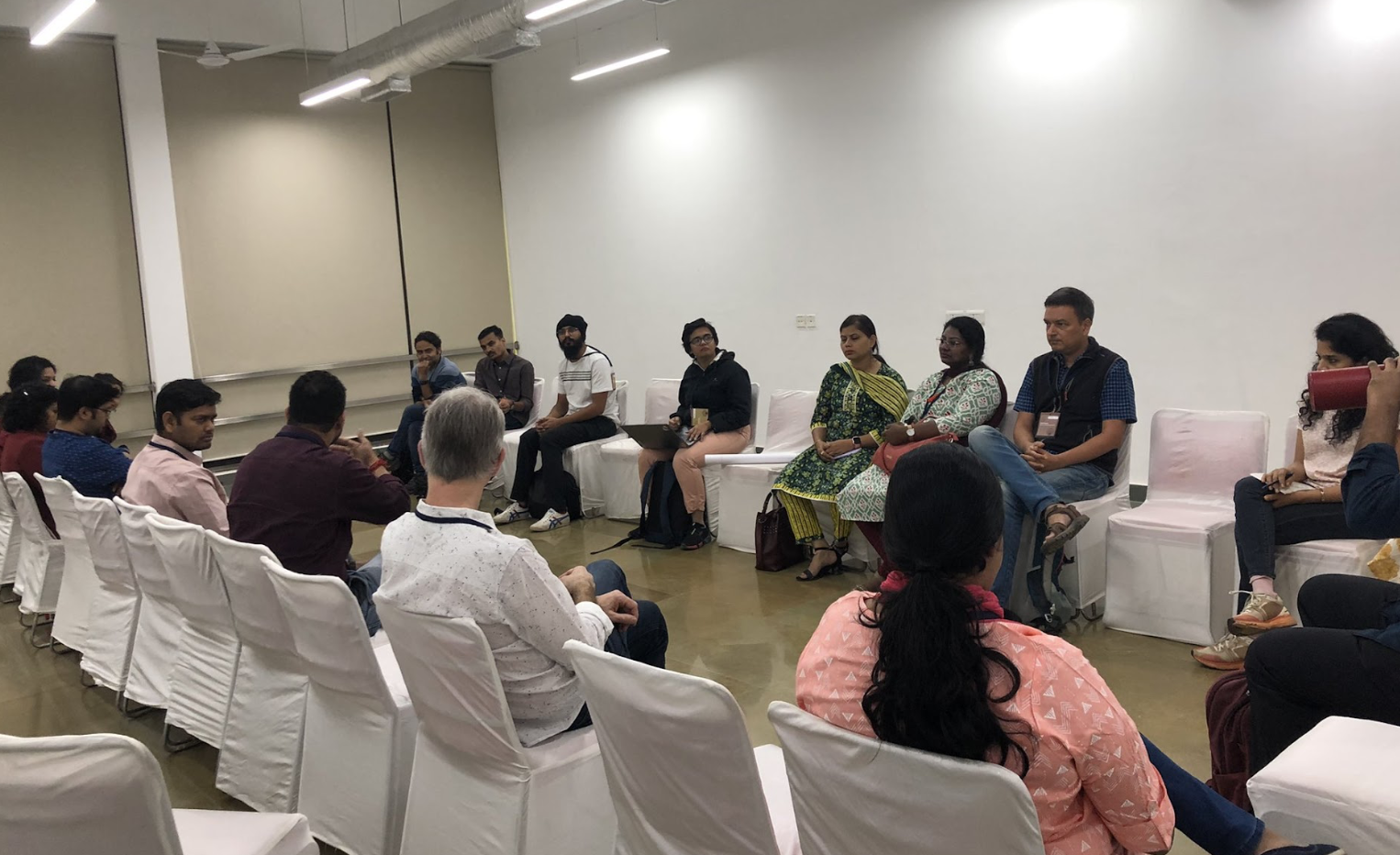
                src="https://cdn.indiabioscience.org/media/articles/YIM-2023-Dhiraj-Bhatia.png"></a></figure><p dir="ltr"><strong>Which YIMs have you been part of?</strong><br></p><p dir="ltr">My first YIM was as a young faculty in <a href="https://indiabioscience.org/yim-series/yim-2019" target="_blank">2019</a> at Guwahati. Then COVID hit, and I participated in the online <a href="https://indiabioscience.org/yim-series/yim-2021" target="_blank">YIM 2021</a> and <a href="https://indiabioscience.org/yim-series/yim-2022" target="_blank">YIM 2022</a> as the representative of IIT Gandhinagar. Further, I was one of the co-organisers of <a href="https://indiabioscience.org/columns/indiabioscience-blog/galvanising-ideas-yim-2023-in-gujarat" target="_blank">YIM 2023</a> at Gandhinagar. </p><p dir="ltr"><strong>Tell us about where you were in your career & research back in 2023. </strong></p><p dir="ltr">I had finished four years at my institute and thankfully, I was tenured. I was in a stage of transition between Assistant and Associate Professor, moving on from the early-career to mid-career phase. By then, the scientist in me was craving exposure to the broader community. So when the opportunity came to organise a YIM in our campus, I took it. </p><p dir="ltr">I was actually still setting up a new stem cell lab. Though I started in 2018, it took me two years to do this and then COVID hit, which delayed grants. Things had just started resuming and I was in the process of setting up my BSL 2 lab when YIM was happening. IIT Gandhinagar really supported me. They offered me flexibility, and since the event was on our campus, and it was teamwork between the four of us organisers, it didn't take me away from my lab or teaching too much.</p><p dir="ltr"><strong>Tell us about where you are in your career & research today - how have things changed? </strong></p><p dir="ltr">First of all, I got promoted to Associate Professor. YIM helped this happen because when we are evaluated, they also look at your experience hosting social networking events. The IITs consider not just what you contribute to research or your institute but also to society, or at least the scientific community. My students are graduating, my publications are coming out. </p><blockquote dir="ltr" class="pull-quote">Another impact of the YIM has been the collaborations and the networks it has built with my peers. </blockquote><figure style="margin-left: auto; margin-right: auto; text-align: center; width: 505px; max-width: 505px;"><img src="https://lh7-us.googleusercontent.com/43xUQjLnR3FqNf5lFSUkwPUl2T6L5ZWeHxpQkUajn6sddeI_CFpP2QfSQVan0N5AJr0WwuWZUgpvzRkimz1nA2hOYMNi13gW7hggZ7GCqbrxtLwLAS1e7ceUxIS_RXhWpuXxhJjB0nKQON4tgmm4eYE" width="505" height="306" data-image="wik99k28n8am" alt="Participants at YIM 2023 express their science through art. Credit: Ankita Rathore"><figcaption style="text-align: center;">Participants at YIM 2023 express their science through art. Credit: Ankita Rathore</figcaption></figure><p dir="ltr"><strong>Can you recall for us how you came to be involved with YIM? </strong></p><p dir="ltr">I did my PhD from <a href="https://www.ncbs.res.in" target="_blank">National Centre for Biological Sciences (NCBS)</a> from 2007 to 2013 with <a href="https://chemistry.uchicago.edu/faculty/yamuna-krishnan" target="_blank">Yamuna Krishnan</a>. That was the time when the <a href="https://indiabioscience.org/columns/indiabioscience-blog/indiabioscience-knitting-together-the-life-sciences-community" target="_blank">seeds of IndiaBioscience</a> and the YIMs were sprouting. Yamuna took part in some of the initial YIMs and she used to narrate her experiences to us. I used to wonder when I would get to be at a YIM. At the time there used to be these DST-supported YIM-like meetings in Cambridge and other European countries. I took part in one such, as a postdoc, in Barcelona in 2017. That gave me a good boost, and I understood what the bottlenecks in India were. It enabled me to move back to India the next year. When the YIM at Guwahati was announced shortly after, I applied and got to attend my first YIM. </p><p dir="ltr"><strong>Tell us about one meaningful connection you made at a YIM </strong></p><p dir="ltr">As a postdoc, I was a <a href="https://www.hfsp.org" target="_blank">Human Frontier Science Program (HFSP)</a> fellow. Funding agencies like HFSP give awards at different levels. If you are a postdoc, you can go abroad with this fellowship, and then when you return, you can apply for the HFSP career development award. If you're a mid-career fellow or experienced faculty, you can also apply for international HPSP grants. I was not so aware of the requirements of those kinds of fellowships. So to have people like <a href="https://www.indiaalliance.org/fellow/tamal-das" target="_blank">Tamal Das</a> from <a href="https://www.tifrh.res.in" target="_blank">TIFR Hyderabad</a> and <a href="https://www.iiserpune.ac.in/research/department/biology/people/faculty/regular-faculty/thomas-pucadyil/318" target="_blank">Thomas Pucadyil </a>from <a href="https://www.iiserpune.ac.in">IISER Pune</a> as mentors at the YIM was really helpful. This gave people like me crystal clear ideas of what these funding agencies are looking for, how we should present our stories and stories to these different organisations like HFSP or <a href="https://www.embo.org" target="_blank">European Molecular Biology Organization (EMBO)</a>. </p><p dir="ltr"><strong>Can you tell us one memorable behind-the-scenes story from your time organising YIM 2023?</strong></p><blockquote dir="ltr" class="pull-quote">YIM 2023 was a huge experiment-cum-adventure. Until then, YIMs happened in places that were a bit isolated from the city, to enable more in-depth discussions, but this was the first time it was happening at an academic campus. </blockquote><p dir="ltr">IIT Gandhinagar and <a href="https://ahduni.edu.in" target="_blank">Ahmedabad University </a>were chosen to host it. The main motivation for this was to give the participants (young investigators and postdocs) a first-hand experience of what academic institutes look like, how labs are arranged, and address many questions they may have while transitioning into academia. </p><p dir="ltr">It was an adventure, but eventually, YIM 2023 was successful. I must give credit to people in my own department and institute. Though it was our faces on the website, we were just the monitors and there were many others who helped make it happen. Many of the faculty members had been to YIMs before and were super excited. </p><p dir="ltr">IIT Gandhinagar, being close to the airport, has a very robust system for booking the guesthouse, food, airport transits, etc. So it was not a very big struggle for us. Rather, it was a good learning exercise for students who came in as volunteers.</p><figure style="margin-left: auto; margin-right: auto; text-align: center; width: 541px; max-width: 541px;"><img src="https://lh7-us.googleusercontent.com/v3SFnzzyNG1y8sSNbnWtW9jR3EJfk6OCDMSIcdSH48knyniKfVQbV73LzMfusLWYRSrRE9T_EIIsDjog7IjKjEmB0x70ybu-GHjWjKMtkUbefcQMpYvzh56kCFYfN9B1d34HPIGtj-hSSzoHTFebkc0" width="541" height="331" data-image="mukrt5ygt4qx" alt="One of the breakout sessions during YIM 2023. Credit: Dhiraj Bhatia"><figcaption style="text-align: center;">One of the breakout sessions during YIM 2023. Credit: Dhiraj Bhatia</figcaption></figure><p dir="ltr"><strong>Describe for us one YIM 2023 session that made a strong impression on you?</strong><br></p><p dir="ltr">I was on a panel discussing work-life balance with <a href="http://www.cdfd.org.in/labpages/dr_rashna_bhandari.html" target="_blank">Rashna Bhandari </a>and some others. This was extremely important, especially coming after COVID when we were returning from work-from-home to the labs and the real world. As scientists, we are passionate about our jobs and we tend to put so much effort into setting up our labs. These are, of course, important, as are getting grants and publications, but it’s equally important to look after our families and health. We discussed how we need to take breaks whenever possible. The world will not end if the proposal is submitted after two days, or a manuscript takes another week. The key is to start early and not wait to do tasks until the last moment. </p><p dir="ltr"><strong>If you could pick the brain of any scientist from the past, who would it be and what would you ask them?</strong></p><p dir="ltr">My academic journey began at one of the best schools in India, NCBS. This is where many people like <a href="https://en.wikipedia.org/wiki/Obaid_Siddiqi" target="_blank">Obaid Siddiqui</a>, <a href="https://www.ncbs.res.in/former-faculty/veronica" target="_blank">Veronica Rodrigues</a> and <a href="https://news.ncbs.res.in/archivednews/story/k-vijayraghavan-remembers-krishnan" target="_blank">KS Krishnan</a> worked. I got to spend some time with Veronica Rodrigues and she really left a mark on me. She always stood like a mother, a guide to us, whenever we needed help. There was so much to learn from her, not just the science but also managing laboratories and sensitive issues at the institution. I found her to be a very, very mature person. Sometimes, we get anxious over small problems in the lab, or a manuscript rejection, but Veronica would stay very calm even in the most turbulent situations. I wish I could have had more time to learn from her but unfortunately, she passed away soon after I started my PhD. . </p><p dir="ltr"><strong>If you could add one programme to the next YIM schedule, what would it be?</strong></p><p dir="ltr">I’ve realised something over the last five years of my journey. As academics in elite institutes, we tend to complain about small things such as delayed flights. However, there are regions for example, in Jammu Kashmir, Andaman and Nicobar Islands, the northeast, Jharkhand, where academics face more fundamental problems. They may have ideas, they may even be much better scientists than us, but they don't even have offices, electricity, clean water... I think IndiaBioscience should reach out to these remote places and bring in people from there. Perhaps we can empower them, support them and get them connected with the rest of the country. </p><p dir="ltr"><strong>What message would you like to pass to someone who is attending their first YIM in 2024?</strong></p><blockquote dir="ltr" class="pull-quote">I would advise young investigators and postdocs to ask questions, no matter how trivial, and no matter how senior the mentors are. </blockquote><p dir="ltr">Even if it is a matter of how to order a reagent, I am sure people like <a href="https://www.ncbs.res.in/faculty/vijay" target="_blank">K VijayRaghavan</a> will answer. At YIM 2019, I admired how <a href="https://www.karishmakaushiklab.com" target="_blank">Karishma Kaushik</a> was so open-minded and asked so many questions, regardless of who it was in front of her - whether it was the director of an institute, a minister or secretary of a funding agency. </p><p dir="ltr">There is one more thing: Now that YIMs are happening in institutes, I would caution young postdocs from applying to the host institute after they get selected for the event. This is not a good practice and is not the way the system works. <br></p>
              ]]></content><category term="science-communication" label="Science Communication" /><category term="personal-experience" label="Personal Experience" /><category term="yim" label="YIM" /><category term="networking" label="Networking and Collaboration" /></entry><entry><title>Rewind to YIM 2020 with Aravindhan Vivekanandhan</title><link
                  rel="alternate"
                  href="https://indiabioscience.org/columns/indiabioscience-blog/rewind-to-yim-2020-with-aravindhan-vivekanandhan"
                  type="text/html"
                  /><summary type="html"><![CDATA[
                <p dir="ltr">In this new series, leading up to YIM 2024, researchers who have attended YIMs from the past tell us about what it was like for them back then, what they took away from the experience, how things have changed, their ideas for future YIMs, and tips for the newest generation of life scientists gearing up for their first meeting. <a href="https://www.unom.ac.in/index.php?route=department/department/publications&amp;deptid=33&amp;facultyid=345" target="_blank" rel="noreferrer noopener">Aravindhan Vivekanandhan</a> is an immunologist at <a href="https://www.unom.ac.in" target="_blank" rel="noreferrer noopener">University of Madras </a>in Chennai. In this interview, he shares his YIM experience with Nandita Jayaraj.<br /></p>              ]]></summary><id>tag:indiabioscience.org,2024-03-06:/columns/indiabioscience-blog/rewind-to-yim-2020-with-aravindhan-vivekanandhan</id><published>2024-03-06T10:00:00+05:30</published><updated>2024-03-07T10:01:58+05:30</updated><author><name>Nandita Jayaraj</name><uri>https://indiabioscience.org/authors/ndkALVqkZrMqYl6</uri></author><content type="html"><![CDATA[
                
<p>In this new series, leading up to YIM 2024, researchers who have attended YIMs from the past tell us about what it was like for them back then, what they took away from the experience, how things have changed, their ideas for future YIMs, and tips for the newest generation of life scientists gearing up for their first meeting. <a href="https://www.unom.ac.in/index.php?route=department/department/publications&amp;deptid=33&amp;facultyid=345" target="_blank" rel="noreferrer noopener">Aravindhan Vivekanandhan</a> is an immunologist at <a href="https://www.unom.ac.in/" target="_blank" rel="noreferrer noopener">University of Madras </a>in Chennai. In this interview, he shares his YIM experience with Nandita Jayaraj.</p><figure><a href="https://indiabioscience.org/columns/indiabioscience-blog/rewind-to-yim-2020-with-aravindhan-vivekanandhan"><img
                width="2047"
                height="1251"
                style="max-width: 100%; height: auto"
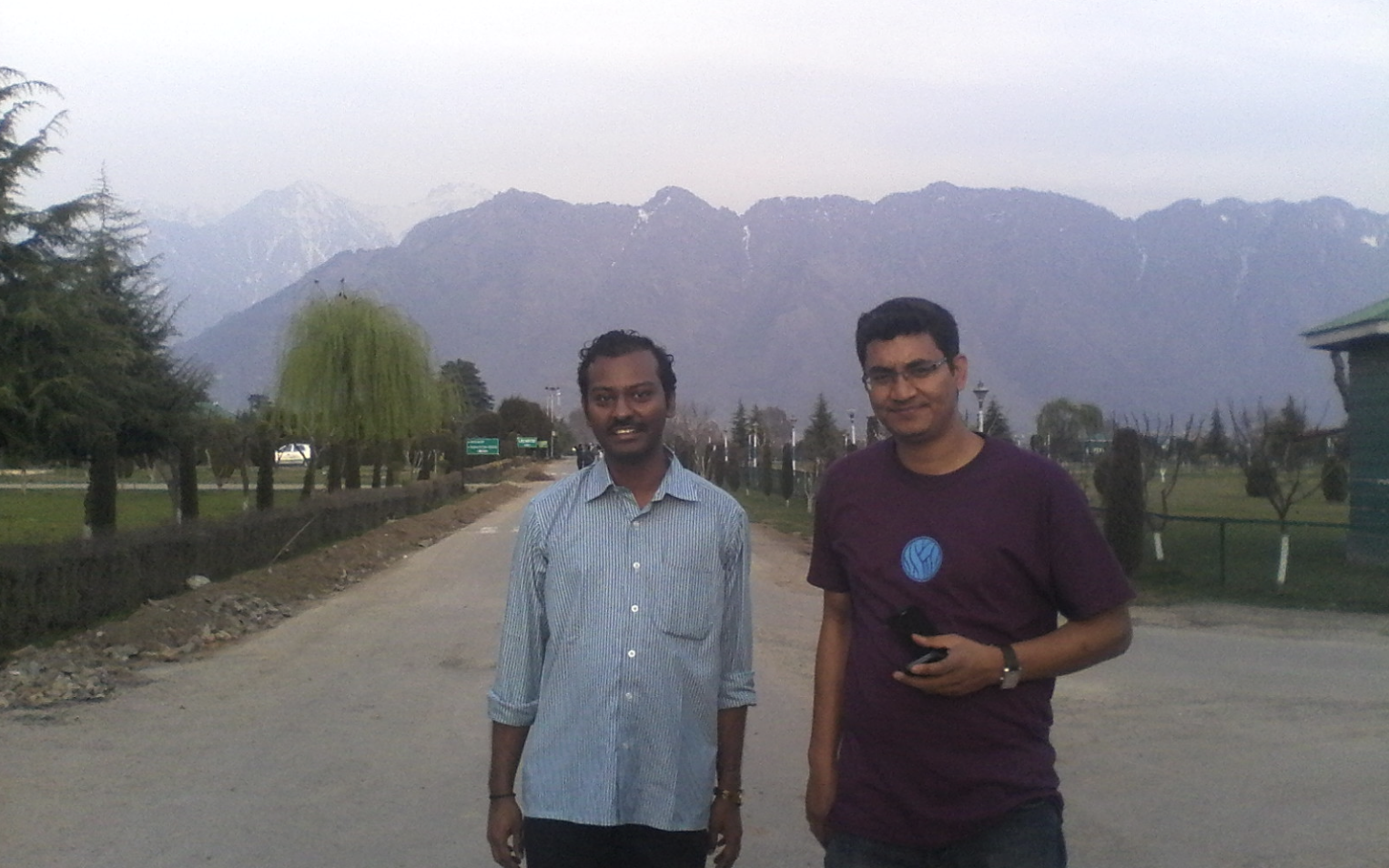
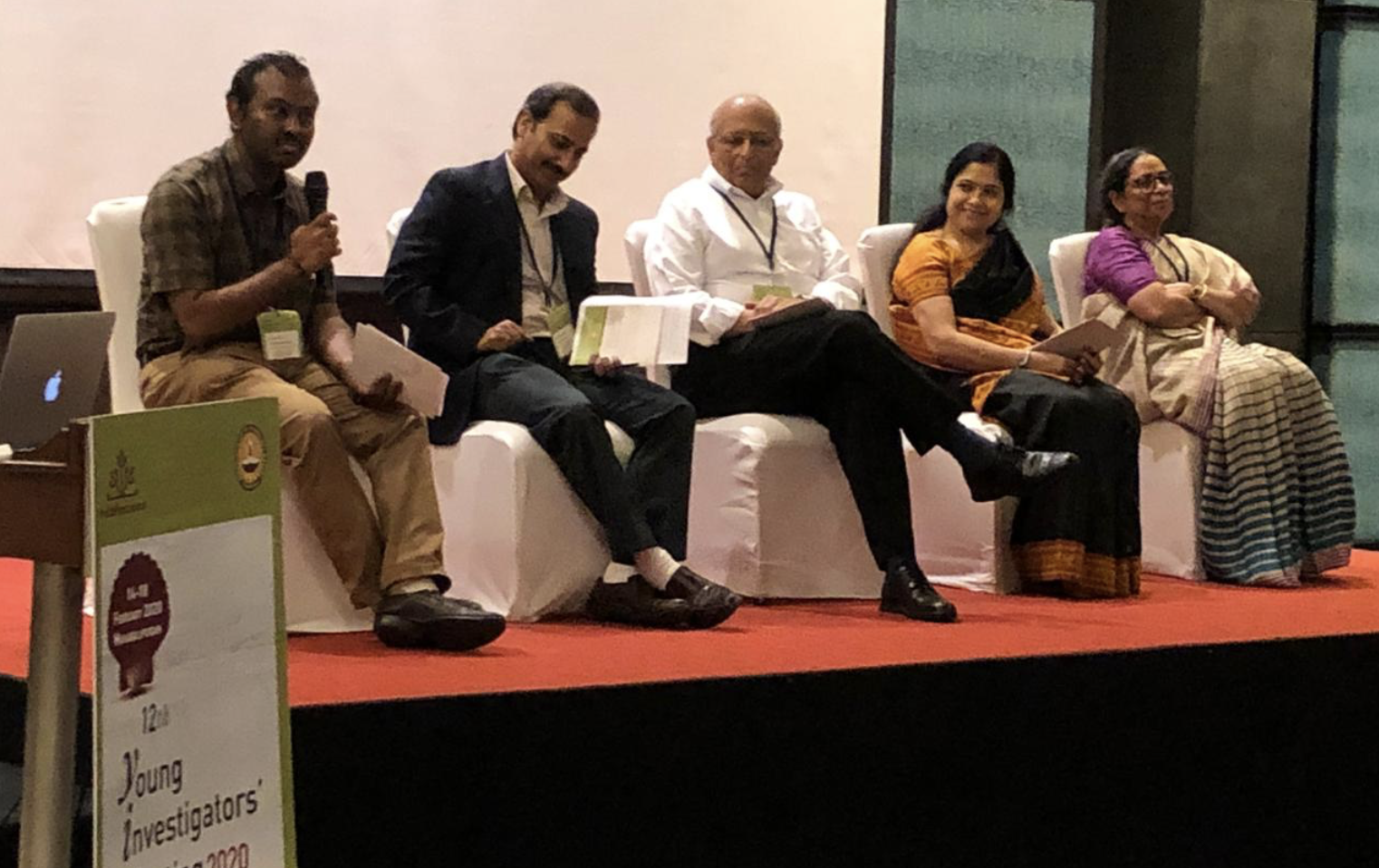
                src="https://cdn.indiabioscience.org/media/articles/YIM-2020-title-image.png"></a></figure><p dir="ltr"><strong>Which YIMs have you been part of?</strong><br></p><p dir="ltr">Quite a few. It started with <a href="https://indiabioscience.org/yim-series/yim-2013" target="_blank">YIM 2013</a> in Jodhpur. Then I went to <a href="https://indiabioscience.org/yim-series/yim-2015" target="_blank">YIM 2015</a> in Kashmir, <a href="https://indiabioscience.org/yim-series/yim-2018" target="_blank">YIM 2018</a> in Trivandrum, and then I coordinated <a href="https://indiabioscience.org/yim-series/yim-2020" target="_blank">YIM 2020 </a>in Mahabalipuram. </p><p dir="ltr"><strong>Tell us about where you were in your career & research back in 2013 when you attended your first YIM. </strong></p><p dir="ltr">My career has taken a lot of turns. I did my postdocs at the<a href="https://www.nih.gov" target="_blank"> National Institutes of Health</a> in the US, but had to come back to Chennai for personal reasons. I landed at <a href="https://mdrf.in" target="_blank">Madras Diabetes Research Foundation</a>. So I was an immunologist forced to work on diabetes - I really was a fish out of water. The first time I attended a YIM, I was a scientist at <a href="https://www.au-kbc.org" target="_blank">Anna University - K. B. Chandrasekhar (AU-KBC) Research Centre</a>. I had established a hypothesis based on the discovery that people infected with the disease <a href="https://www.iomcworld.com/proceedings/extended-hygiene-hypothesis-can-filariasis-confer-protection-against-diabetes-33057.html" target="_blank">filariasis</a> are actually conferred protection against diabetes. Back then, I didn't have too many facilities and there was hardly a possibility of networking. I generally feel Tamil Nadu is a desert for biotechnologists, compared to other places. </p><p dir="ltr"><strong>Tell us about where you are in your career & research today - how have things changed? </strong></p><p dir="ltr">Many foreign labs have started working on our filariasis-diabetes hypothesis. Now they are trying to use filarial antigens as therapeutics for diabetes. They are even exploring if we can develop a diabetes vaccine based on the filariasis antigen. </p><p dir="ltr">Since 2020, we have also published many papers on the interface of metabolic disease and infectious disease. We identified something very unique to the Indian population: an antagonistic <a href="https://pubmed.ncbi.nlm.nih.gov/35832818/" target="_blank">relationship</a> between insulin resistance and latent tuberculosis. Recently, we also had our first <a href="https://www.linkedin.com/feed/update/urn:li:activity:7029447908030636032/" target="_blank">patent</a> granted to us, for a diagnostic test to detect early gestational diabetes.</p><blockquote dir="ltr" class="pull-quote">The YIMs played a very important role in shaping my career, especially with regard to scientific networking. </blockquote><p dir="ltr">For example, my first PhD student just finished. For this we had to invite three examiners from Tamil Nadu, three from rest of India and three from other countries. All should be working in a field directly related to the candidate’s PhD thesis. It was no problem to identify people in Tamil Nadu, but to find others from India was difficult. This was the time I felt that the networking at YIM helped me a lot. I was able to contact them and they immediately agreed. Usually, it's a lot more complicated. </p><figure style="margin-left: auto; margin-right: auto; text-align: center; width: 570px; max-width: 570px;"><img src="https://lh7-us.googleusercontent.com/g5dLowKlbTwSq-uOm9yjuNDcPaOtJy4POoRLtxjcZZ6qdM78Vu6QRpdC2XHjF9E97QTZlXaXTdH9rpt5CweHk6XByG0IjiD1LngqQFplHZvlTOU-m6_ImC7AX7STZ9NCYn-TI5mED2Nn5EKHVTwXAqs" width="570" height="356" data-image="xh8mxmun03lr" alt="Aravindhan, with Sunil Raghav from ILS, Bhubaneshwar, on a sightseeing trip in Srinagar during YIM 2015. Credit: V. Aravindhan"><figcaption style="text-align: center;">Aravindhan, with Sunil Raghav from ILS, Bhubaneshwar, on a sightseeing trip in Srinagar during YIM 2015. Credit: V. Aravindhan </figcaption></figure><p dir="ltr"><strong>Can you recall for us how you came to be involved with YIM? </strong></p><p dir="ltr">The YIMs started in 2009 and a colleague of mine had participated in that one. She recommended that I apply. I applied for a number of years but kept getting rejected. That’s when I wrote to a senior scientist associated with IndiaBioscience saying that if YIM wants to promote young investigators, I should be considered too. He immediately responded and at the last minute, my name was included for YIM 2013. At YIM 2015 in Kashmir, I pointed out to <a href="https://www.iisertirupati.ac.in/oldwebsite/faculty/nandini/nandini.php" target="_blank">Nandini Rajamani</a>, the then co-director of IndiaBioscience, that YIM had geographically covered most places in India except for Tamil Nadu. And Tamil Nadu really needs events like YIM. The biotechnology field is very shrunken. Maybe she spoke to <a href="https://indiabioscience.org/authors/Smita" target="_blank">Smita Jain</a>, because one fine day, Smita approached me to coordinate YIM 2020 which was being planned in Chennai. I said I'd be very happy to do it. </p><p dir="ltr"><strong>Tell us about one meaningful connection you made at a YIM </strong></p><p dir="ltr">I met <a href="https://en.wikipedia.org/wiki/Subhash_Chandra_Lakhotia" target="_blank">SC Lakhotia</a> from <a href="https://www.bhu.ac.in/Site/Home/1_2_16_Main-Site" target="_blank">Banaras Hindu University</a> at YIM 2018 in Trivandrum. It was a very, very productive interaction as he is a very senior person who had worked extensively on heat shock proteins. Though he was retired, he was able to give me some good advice about the dos and don’ts during the early stages of one’s scientific career.</p><p dir="ltr">He told me that doing science in universities demands a lot of patience. He advised me never to lose my cool. The moment you antagonise someone, it may endanger the future of your project. </p><p dir="ltr"><strong>Can you tell us one memorable behind-the-scenes story from your time organising YIM 2020? </strong></p><p dir="ltr">Organising YIM involved such little stress that at one point I wondered if I really was organising it or if I was just attending one. IndiaBioscience is totally devoted to it and they have been doing it for so many years. So they know exactly what they want. The only time I remember being exhausted was the time we sat with Smita at <a href="https://www.iitm.ac.in" target="_blank">IIT Madras</a> and did the selection process for the participants. But apart from that, it was smooth sailing.</p><p dir="ltr"><strong>Describe for us one YIM 2020 session that made a strong impression on you?</strong></p><p dir="ltr">I have always been very interested in discussing difficulties in science. I believe that unless we open up, there will be no solution. Initially, the participants were very reluctant; it was a heterogeneous crowd with senior scientists. But once we broke the ice, everybody started sharing their experiences. It went on and on and Smita actually had to enter to say that the next session had begun. </p><figure style="margin-left: auto; margin-right: auto; text-align: center; width: 575px; max-width: 575px;"><img src="https://lh7-us.googleusercontent.com/HqV4bhkcn7ky22oBoorc3s-OgxcMzr7Uyk6nlZpP3gOQSpRwZLwAqiNRrWznDUY0Lir8v_UtWAlM8a-KTj27diT6bfxF1nVyR7oiy4mkcYURK9QBHbAsQWqsTqihkt62BZQWUEtRU9LHzRTH9ji0Lt0" width="575" height="362" data-image="c30s5wt2cuyc" alt="Aravindhan (left) speaks on a panel with representatives of funding agencies such as (left to right) Balachander from SERB, Shahid Jameel from India Alliance and Meenakshi Munshi from DBT, at YIM 2020 Credit: V. Aravindhan"><figcaption style="text-align: center;">Aravindhan (left) speaks on a panel with representatives of funding agencies such as (left to right) Balachander from SERB, Shahid Jameel from India Alliance and Meenakshi Munshi from DBT, at YIM 2020 Credit: V. Aravindhan </figcaption></figure><p dir="ltr"><strong>If you could pick the brain of any scientist from the past, who would it be and what would you ask them?</strong></p><p dir="ltr">I'm a geneticist to start with, so it would have to be <a href="https://www.nobelprize.org/prizes/medicine/1962/watson/biographical/" target="_blank">James Watson</a> and <a href="https://www.nobelprize.org/prizes/medicine/1962/crick/facts/" target="_blank">Francis Crick</a>. I would like to know their personal motivations and struggles as they went ahead deciphering the biology of DNA. It was a monumental thing! </p><p dir="ltr"><strong>If you could add one programme to the next YIM schedule, what would it be?</strong></p><p dir="ltr">I would restrict the number of talks and have more interactive sessions. A direct interaction with funding bodies is an absolute must. If the YIMs are to be really useful to the scientific community, it must include policymakers and allow participants from various sectors to interact with them. The kinds of problems I face at a university will be very different from those faced by someone from IISc or an IIT, or someone from the industry. There is a huge communication lag between the policymakers and the end users. Only IndiaBioscience can bridge this. </p><p dir="ltr">One more point: right now at the YIMs, you have the young investigators and then the seniors. But they do not cover a huge group, the mid-career scientists, who are between 35 and 50. There could be a provision by which mid-career scientists who are interested in mentoring have an option of applying as well. </p><p dir="ltr"><strong>What message would you like to pass to someone who is attending their first YIM in 2024?</strong></p><blockquote dir="ltr" class="pull-quote">Go with an open mind. You may be shy or a little bit confused in your first YIM as you don’t have any idea what to expect. But you must come out of your shell at the first opportunity. </blockquote><p dir="ltr">It may be because of language skills, but I personally feel that there is no language barrier in science. If you are good in science, you will be able to convince people and get their inputs. <br></p>
              ]]></content><category term="science-communication" label="Science Communication" /><category term="personal-experience" label="Personal Experience" /><category term="yim" label="YIM" /><category term="networking" label="Networking and Collaboration" /></entry><entry><title>YIM 2024: Meet the organisers</title><link
                  rel="alternate"
                  href="https://indiabioscience.org/columns/indiabioscience-blog/yim-2024-meet-the-organisers"
                  type="text/html"
                  /><summary type="html"><![CDATA[
                <p>The 16th Young Investigators’ Meeting (<a href="https://indiabioscience.org/meetings/yim-2024" target="_blank" rel="noreferrer noopener">YIM 2024</a>) is scheduled to take place from 11 to 15 March 2024 in central India at Bhopal, Madhya Pradesh. We interviewed the YIM 2024 organisers: <a href="https://indiabioscience.org/authors/qw8pNKgnooLdJRA" target="_blank" rel="noreferrer noopener">Karishma Kaushik</a>, IndiaBioscience; <a href="https://www.igib.res.in/?q=LipiThukral" target="_blank" rel="noreferrer noopener">Lipi Thukral</a>, IGIB, New Delhi; <a href="https://yennamalli-lab.in/" target="_blank" rel="noreferrer noopener">Ragothaman M. Yennamalli</a>, SASTRA Deemed to be University; <a href="https://bio.iiserb.ac.in/faculty_profile.php?id=MTA=&amp;lname=dmFydW4uYw==" target="_blank" rel="noreferrer noopener">Varun Chaudhary</a>, IISER Bhopal; and the <a href="https://indiabioscience.org/team" target="_blank" rel="noreferrer noopener">IndiaBioscience team</a>. We asked them a few questions about the upcoming meeting, and here is what they had to say.<br /></p>              ]]></summary><id>tag:indiabioscience.org,2024-03-04:/columns/indiabioscience-blog/yim-2024-meet-the-organisers</id><published>2024-03-04T10:00:00+05:30</published><updated>2024-03-04T10:13:31+05:30</updated><author><name>Ankita Rathore</name><uri>https://indiabioscience.org/authors/Ppx8KpvnoRMVQ5W</uri></author><content type="html"><![CDATA[
                
<p>The 16th Young Investigators’ Meeting (<a href="https://indiabioscience.org/meetings/yim-2024" target="_blank" rel="noreferrer noopener">YIM 2024</a>) is scheduled to take place from 11 to 15 March 2024 in central India at Bhopal, Madhya Pradesh. We interviewed the YIM 2024 organisers: <a href="https://indiabioscience.org/authors/qw8pNKgnooLdJRA" target="_blank" rel="noreferrer noopener">Karishma Kaushik</a>, IndiaBioscience; <a href="https://www.igib.res.in/?q=LipiThukral" target="_blank" rel="noreferrer noopener">Lipi Thukral</a>, IGIB, New Delhi; <a href="https://yennamalli-lab.in/" target="_blank" rel="noreferrer noopener">Ragothaman M. Yennamalli</a>, SASTRA Deemed to be University; <a href="https://bio.iiserb.ac.in/faculty_profile.php?id=MTA=&amp;lname=dmFydW4uYw==" target="_blank" rel="noreferrer noopener">Varun Chaudhary</a>, IISER Bhopal; and <a href="https://indiabioscience.org/team" target="_blank" rel="noreferrer noopener">IndiaBioscience team</a>. We asked them a few questions about the upcoming meeting, and here is what they had to say.</p><figure><a href="https://indiabioscience.org/columns/indiabioscience-blog/yim-2024-meet-the-organisers"><img
                width="2047"
                height="1253"
                style="max-width: 100%; height: auto"
                src="https://cdn.indiabioscience.org/media/articles/YIM-2024-meet-the-organisers_titleimage.png"></a></figure><p>1. <strong>Have you attended a YIM before? How was your experience?</strong></p><p dir="ltr"><strong>Karishma S Kaushik</strong>: I had the opportunity to be a Young Investigator (YI) at <a href="https://indiabioscience.org/meetings/yim-2019" target="_blank">YIM Guwahati</a> in 2019, a co-organiser for the first virtual YIM in 2021, a mentor at the second virtual YIM in 2022, a speaker at <a href="https://indiabioscience.org/meetings/yim-2023" target="_blank">YIM 2023 </a>in Gandhinagar & Ahmedabad, and now, as part of IndiaBioscience, I am involved in organising <a href="https://indiabioscience.org/meetings/yim-2024" target="_blank">YIM 2024</a> in Bhopal.</p><p dir="ltr"><strong>Ragothaman M Yennamalli:</strong> Yes, I was on a panel for faculty who recently joined India at YIM 2018 in Chicago, USA. I spoke about my experience as a faculty member in a private university.</p><p dir="ltr"><strong>Varun Chaudhary:</strong> No, this will be my first YIM. I am looking forward to it.</p><p dir="ltr"><strong>Lipi Thukral:</strong> I was selected for one of the YIMs but couldn’t attend.</p><p dir="ltr"><strong><a href="https://indiabioscience.org/authors/Manjula" target="_blank">Manjula Harikrishna:</a></strong> Yes, I have been part of the organising team for 8 years now, providing me with a tremendous learning experience. Each YIM is distinctive, and I feel privileged to have collaborated with and learned from diverse team members at different levels throughout these years. </p><p>2. <strong>Why did you choose to be a part of the organising team for <a href="https://indiabioscience.org/meetings/yim-2024" target="_blank">YIM 2024</a>?</strong></p><p dir="ltr"><strong><a href="https://indiabioscience.org/authors/an8deK8VXoMrGjk" target="_blank">Rohini Karandikar:</a></strong> As an Associate Director, being part of the organising team entails significant responsibility. Personally, I enjoy working with a team, especially when striving to achieve substantial goals.</p><p dir="ltr"><strong>Ragothaman M Yennamalli:</strong> I believe that being part of the organising team is the best way to understand how the future of science in India is shaping up. The individuals participating in YIM are the future leaders who will shape the Indian science scene.</p><p dir="ltr"><strong>Varun Chaudhary: </strong>YIM serves as a vital platform connecting YIs and postdoctoral fellows (PDFs) with seasoned mentors and institutional leaders. It was exciting to hear that IndiaBioscience was planning to bring YIM to Bhopal. For me, it offers a great opportunity not only to actively contribute to the event but also to collaborate with like-minded individuals on the organising team. </p><p dir="ltr"><strong><a href="https://indiabioscience.org/authors/Vijeta" target="_blank">Vijeta Raghuram:</a></strong>I have been attending YIMs since 2021. However, due to the pandemic and a maternity break in 2023, this is going to be my first <strong>in-person</strong> meeting. This time, as an organiser in the thick of planning this mega event alongside my colleagues, I feel excitement at a whole different level! </p><p>3. <strong>What do you think the participating YIs and PDFs can hope to gain from this YIM?</strong></p><p dir="ltr"><strong>Karishma Kaushik:</strong> To begin with, I strongly recommend that selected YIs and PDFs leverage this YIM to gain a better understanding of the diverse opportunities to engage with the wider life science community and ecosystem in India. This principle guided the design of the YIM 2024 program, which includes sessions focused on funding for life science research in India, human-relevant research, research ethics, science communication, outreach and journalism, biotech entrepreneurship, pedagogical practices, advances in publishing, and many more. </p><blockquote dir="ltr" class="pull-quote">The YIM 2024 program has been designed to provide a comprehensive overview of the various aspects, intersections, and considerations when engaging with the life sciences in India.</blockquote><p dir="ltr"><strong>Ragothaman M Yennamalli:</strong> There are three key aspects: Firstly, networking. Secondly, finding their tribe of scientists to collaborate and be peers. And lastly, seeing how Indian science has evolved in all these years.</p><p dir="ltr"><strong>Varun Chaudhary: </strong>YIs and PDFs can gain insights into recent research trends and career development strategies. This opportunity allows them to learn about the challenges of starting a research group in India and receive early career guidance from established mentors.</p><p dir="ltr"><strong>Lipi Thukral:</strong> A lot is said about how much science operates outside the lab. You learn about the Indian science ecosystem and what works or doesn't. This is difficult to grasp within the walls of your lab.</p><figure style="margin-left: auto; margin-right: auto; text-align: center; width: 483px; max-width: 483px;"><img src="https://cdn.indiabioscience.org/media/articles/YIM-2024-BTS-collage.jpg" data-image="624533" alt="Behind the scenes of YIM 2024 at IndiaBioscience office. Credits: Collage by Ankita Rathore" width="483" height="483"><figcaption style="text-align: center;">Behind the scenes of YIM 2024 at the IndiaBioscience office. Credits: Collage by Ankita Rathore</figcaption></figure><p dir="ltr"><strong>4. <strong>Any specific session/talk you’re looking forward to at YIM 2024?</strong></strong></p><p dir="ltr"><strong>Manjula Harikrishna:</strong> This is the first time that all the team members will be giving a talk about their respective verticals. I am excited about my presentation, where I will discuss the IndiaBioscience Outreach Grants over the past 5 years!</p><p dir="ltr"><strong>Karishma Kaushik: </strong>I would highlight the 'Ask Us Anything' sessions at the PDF Satellite Meeting! These sessions promise to be open, spontaneous, and interactive, fostering communication between the PDFs and institutional representatives. I am eager to hear about the primary concerns on the minds of postdoctoral fellows when contemplating a return to India as faculty. </p><blockquote dir="ltr" class="pull-quote">It will be interesting to observe how directors and heads of institutes present opportunities and solutions to the prevailing challenges and considerations in the life sciences in India.</blockquote><p dir="ltr"><strong>Ankita Rathore: </strong>Along with science communication interns Anuja Vartak and Sindhu M, I will be conducting the icebreaker session on the first day of YIM 2024. I am excited to interact with PDFs and YIs and share ways for them to engage with the science communication vertical at IndiaBioscience.</p><p>5. <strong>What do you think is unique about this YIM 2024?</strong></p><p dir="ltr"><strong><a href="https://indiabioscience.org/authors/8nqEP1JvEm1Djxl" target="_blank">Arushi Batra:</a></strong>I have never been a part of YIM before, so this marks my inaugural participation in this event, and I'm excited to be part of it for the first time. This year, we've incorporated tailored workshops designed to address the needs of YIs and PDFs. We also have 'Exhibition in a box' by Science Gallery Bengaluru at YIM 2024.</p><p dir="ltr"><strong>Rohini Karandikar: </strong>The childcare grant is a new addition to this year’s YIM, allowing attendees and resource personnel to address their childcare needs while attending the event. I am honoured to be one of the awardees.</p><p dir="ltr"><strong>Ankita Rathore: </strong>We hosted an informational webinar for prospective applicants this year, along with a pre-event session for selected applicants just before YIM 2024! Also, this marks the first time we are bringing all four of our interns to YIM.</p><p dir="ltr"><strong>Karishma Kaushik:</strong> A unique and special aspect is the inclusion of two international mentors (out of 3) from the Global South (Bangladesh and Chile). I think this is very relevant for the selected group of YIs and PDFs to understand the opportunities and challenges, and I will add unique rewards, of doing science in their home country.</p><p dir="ltr"><strong>Vijeta Raghuram: </strong>In the past YIMs I attended, teaching practices received limited attention. This year, there's a dedicated talk on novel pedagogical approaches by <a href="https://indiabioscience.org/authors/kZyaKo26pAL6q5J" target="_blank">Tamralipta Patra</a>. Additionally, I'll be utilising this opportunity to represent '<em>i wonder...'</em> and deliver a talk about school science education and how scientists can contribute to it.</p><p>6. <strong>Which aspect of work are you looking at this YIM?</strong></p><p dir="ltr"><strong>Ankita Rathore: </strong>The science communication team, consisting of myself, social media intern <a href="https://indiabioscience.org/authors/NmEVMkG4nqMQPAr" target="_blank">Anuja Vartak</a>, and science writing intern <a href="https://indiabioscience.org/authors/rZeGMwP0aELo8lY" target="_blank">Sindhu M</a>, is managing all social media, website content, and feedback from participants for YIM 2024. I am pleased to have extra hands-on deck this year for the science communication vertical. </p><blockquote dir="ltr" class="pull-quote">As a team, we have managed to get a photobooth this year on the gala dinner night, and I am excited to see the social media updates of participants during #YIM2024!</blockquote><p dir="ltr"><strong>Arushi Batra:</strong> Along with Digital Initiative intern Agastya Singh, I will be focusing on the audio-visual aspects of the program. Currently, we are in the process of counting and calculating the number of microphones, speakers, and connectors needed – a task that has its moments of humour! Also, on the fourth day of the meeting, we will be recording <a href="https://indiabioscience.org/indiabiospeaks/radio-pdf" target="_blank">RADIO PDF podcasts</a>.</p><p dir="ltr"><strong>Shwetha C</strong>: I am managing travel settlements for the participants, coordinating local travel, shipping printable materials, and handling all things finance-related for YIM 2024!</p><p dir="ltr"><strong>Manjula Harikrishna:</strong> I am involved in several major tasks, including planning, creating and updating the meetings page, managing the application process, coordinating with mentors, participants, directors/institute reps, and special invitees at various levels, designing creatives/collaterals in collaboration with the team, and handling accommodations. </p><p dir="ltr"><strong>Rohini Karandikar:</strong> I am involved in managing arrangements at the venue and handling food at YIM, both at Courtyard by Marriott and IISER Bhopal. I am also responsible for managing the printing and shipping of posters and brochures for the meeting with the help of the team.</p><p dir="ltr"><strong>Vijeta Raghuram:</strong> I was in charge of developing the abstract book, the PDF database, and a variety of posters and brochures. I have been working with <a href="https://indiabioscience.org/authors/PRYwLlJm431gO0Q" target="_blank">Shrutika Raut</a> on these tasks; she is an intern from the Education vertical at IndiaBioscience. I am also involved in the arrangements of food and venue at Courtyard by Marriott and IISER Bhopal.</p><p>7. <strong>Please share a "Behind-the-scenes" story of YIM 2024?</strong></p><p dir="ltr"><strong>Karishma Kaushik:</strong> During our pre-YIM planning visit to Bhopal, the Gond art across the airport struck me as my first impression of the city. The subsequent encounter with a sizable Gond mural on the IISER Bhopal campus was truly awe-inspiring. Remembering a Gond artist family's work on Twitter, discovered through a mutual connection, I found the post and reached out to Gangotri and Devlal Tekam, accomplished Gond artists from Patangarh, Madhya Pradesh.</p><blockquote dir="ltr" class="pull-quote">The artwork for YIM 2024 was specially commissioned from them by IndiaBioscience. This collaboration provided a wonderful opportunity to work with local artists and showcase a traditional art form from one of central India's largest and oldest tribal communities.</blockquote><p dir="ltr"><strong>Ragothaman M Yennamalli:</strong> Ensuring the smooth execution of the agenda in every meeting and ensuring that we are all on the same page was a positive experience, as meetings seldom start and end on time with every agenda point covered.</p><p dir="ltr"><strong>Lipi Thukral: </strong>The judging experience and providing comments on why some applications succeed was memorable. And, of course, everyone applies on the last day!</p><p dir="ltr"><strong>Arushi Batra:</strong> I would say that sartorial discussions during coffee chats are my favourite. We are hopeful that we could pull off wearing saree while running around for YIM preparations at the venue. Fingers crossed!</p><p dir="ltr"><em><strong>The co-organisers and team IndiaBioscience take this opportunity to extend a warm welcome to YIM 2024 attendees!</strong></em><br></p><ol></ol><ol></ol><ol></ol><ol></ol>
              ]]></content><category term="yim" label="YIM" /><category term="networking" label="Networking and Collaboration" /><category term="events" label="Events" /></entry><entry><title>Rewind to YIM 2019 with Dipyaman Ganguly</title><link
                  rel="alternate"
                  href="https://indiabioscience.org/columns/indiabioscience-blog/rewind-to-yim-2019-with-dipyaman-ganguly"
                  type="text/html"
                  /><summary type="html"><![CDATA[
                <p dir="ltr">In this new series, leading up to YIM 2024, researchers who have attended YIMs from the past tell us about what it was like for them back then, what they took away from the experience, how things have changed, their ideas for future YIMs, and tips for the newest generation of life scientists gearing up for their first meeting. <a href="https://iicb.res.in/faculty/dipyaman-ganguly" target="_blank" rel="noreferrer noopener">Dipyaman Ganguly</a> is a cellular immunologist at <a href="https://iicb.res.in" target="_blank" rel="noreferrer noopener">Indian Institute of Chemical Biology (IICB)</a> in Kolkata. In this interview, he shares his YIM experience with Nandita Jayaraj.<br /></p>              ]]></summary><id>tag:indiabioscience.org,2024-02-29:/columns/indiabioscience-blog/rewind-to-yim-2019-with-dipyaman-ganguly</id><published>2024-02-29T11:00:00+05:30</published><updated>2024-02-29T16:30:01+05:30</updated><author><name>Nandita Jayaraj</name><uri>https://indiabioscience.org/authors/ndkALVqkZrMqYl6</uri></author><content type="html"><![CDATA[
                
<p>In this new series, leading up to YIM 2024, researchers who have attended YIMs from the past tell us about what it was like for them back then, what they took away from the experience, how things have changed, their ideas for future YIMs, and tips for the newest generation of life scientists gearing up for their first meeting. <a href="https://iicb.res.in/faculty/dipyaman-ganguly" target="_blank" rel="noreferrer noopener">Dipyaman Ganguly</a> is a cellular immunologist at <a href="https://iicb.res.in/" target="_blank" rel="noreferrer noopener">Indian Institute of Chemical Biology (IICB)</a> in Kolkata. In this interview, he shares his YIM experience with Nandita Jayaraj.</p><figure><a href="https://indiabioscience.org/columns/indiabioscience-blog/rewind-to-yim-2019-with-dipyaman-ganguly"><img
                width="2047"
                height="1250"
                style="max-width: 100%; height: auto"
                src="https://cdn.indiabioscience.org/media/articles/YIM-2019-Dipyaman-Ganguly_titleimage.png"></a></figure><p dir="ltr"><strong>Which YIMs have you been part of?</strong></p><p dir="ltr">I'm kind of an outlier, because the first and only YIM I attended was the one I co-organised in <a href="https://indiabioscience.org/meetings/yim-2019" target="_blank">2019 in Guwahati</a>. Apart from this, I have attended two <a href="https://indiabioscience.org/columns/indiabioscience-blog/regional-yim-kolkata-2019-some-highlights" target="_blank">regional YIMs in Kolkata</a>.</p><p dir="ltr"><strong>Tell us about where you were in your career & research back when you attended YIM 2019. </strong></p><p dir="ltr">I joined IICB in 2013, so when I took up the role of organising YIM 2019, it had already been over five years since I started my independent career. I'm a cellular immunologist primarily working on autoreactive inflammation with a major focus on an innate immune cell called plasmacytoid dendritic cells. In 2016, we <a href="https://pubmed.ncbi.nlm.nih.gov/27561727/" target="_blank">discovered</a> that this innate immune cell was involved in metabolic diseases in human patients. The following two years were really exciting, because other groups from different parts of the world started confirming our findings through their own genetic validation studies. So at the time of YIM 2019, I was feeling confident about my independent career. </p><p dir="ltr"><strong>Tell us about where you are in your career & research today - how have things changed? </strong></p><p dir="ltr">After our revelation that this plasmacytoid dendritic cell was involved not only in autoimmune diseases but also in metabolic diseases, our lab began exploring <a href="https://pubmed.ncbi.nlm.nih.gov/28826817/#:~:text=The%20central%20pathogenetic%20role%20of,different%20components%20of%20metabolic%20disorders." target="_blank">other clinical contexts </a>where the same innate immune activation event was happening. We also ended up discovering interesting regulatory pathways in these cells, including how mechanical cues were playing some role in them, involving the Piezo1 mechanosensors. This was then explored by other scholars in the lab for other human immune cells.</p><p dir="ltr">The year after YIM 2019, the COVID pandemic struck. Being in a Council of Scientific and Industrial Research (CSIR) institute, there are emergent mandates that we also have to take care of. As I was one of the few immunologists in CSIR then and also had a clinical background, the then-DG of CSIR Shekhar Mande asked me to run a randomised control trial. And so my lab suddenly got involved in leading a <a href="https://pubmed.ncbi.nlm.nih.gov/35076698/#:~:text=Conclusions%20and%20relevance%3A%20The%20findings,used%20to%20guide%20treatment%20recommendations." target="_blank">clinical trial</a> on convalescent plasma therapy as well as doing immunological studies with COVID-19 patients. That was a small detour we took during the pandemic. </p><p dir="ltr"><strong>Can you recall for us how you came to be involved with YIM? </strong></p><p dir="ltr"><a href="https://indiabioscience.org/authors/Smita" target="_blank">Smita Jain</a> called me up to ask me to be part of YIM 2019, and I readily accepted. I was at a career stage where I could devote some time to help younger investigators. My co-organisers <a href="https://www.iiserpune.ac.in/research/department/biology/people/faculty/regular-faculty/richa-rikhy/327" target="_blank">Richa Rikhy</a> and <a href="https://www.iitg.ac.in/biotech/faculty_profile.php?fname=B&lname=Anand&iitg=1103&mail=banand@iitg.ac.in" target="_blank">B. Anand</a> were also at similar career stages, in terms of when we started our labs in India. I knew that a whole lot of postdoctoral fellows were trying to come back to the country and they should get the proper guidance. I was really motivated towards that.</p><p dir="ltr">I was initially apprehensive that Guwahati was chosen as the venue. I wondered if more postdocs would turn up if it was a destination where more academic institutions were located. Ultimately, so many people became involved that our fears were proved untrue. I think it may have a lot to do with the speaker line-up! </p><figure style="margin-left: auto; margin-right: auto; text-align: center; width: 560px; max-width: 560px;"><img src="https://lh7-us.googleusercontent.com/oVy-pJk6sZmJBS-R8WRKixXshiPS3CdK0qpY3DZmR_YxaN6IMyogG7xl7n2fiFq2MTnu-_-SdgEC1uOiHlBRnZZGveYb7HTGbl_7tQzbqPuB2fHfTPGDjWSM8q8YkN1FgwgKmwvv-bgtAEbsSEQTIHI" width="560" height="373" data-image="72tl5fuwo7wr" alt="The YIM 2019 organisers and mentors, (left to right) Roop Mallik, Rashna Bhandari, Smita Jain, Richa Rikhy, B. Anand, Dipyaman Ganguly, LS Shashidhara, Dipyaman Ganguly. Credit: Dipyaman Ganguly"><figcaption style="text-align: center;">The YIM 2019 organisers and mentors, (left to right) Roop Mallik, Rashna Bhandari, Smita Jain, Richa Rikhy, B. Anand, Dipyaman Ganguly, LS Shashidhara, Dipyaman Ganguly. Credit: Dipyaman Ganguly</figcaption></figure><p dir="ltr"><strong>Tell us about one meaningful connection you made at a YIM. </strong></p><p dir="ltr">I met many fantastic young investigators. Some of them I’m still connected with. I remember meeting <a href="https://www.ashoka.edu.in/profile/imroze-khan/">Imroze Khan</a> who is now at <a href="https://www.ashoka.edu.in">Ashoka University</a>. We had a lot of interests in common. Similarly, I met <a href="https://biochem.iisc.ac.in/saravanan-palani.php">Saravanan Palani</a>, and tried to convince him to join IICB. He eventually joined <a href="https://iisc.ac.in">IISc</a> and is doing well. Many of the YIs who came to YIM 2019 have proven themselves as independent investigators in India, and that gives some kind of satisfaction. </p><p dir="ltr"><strong>Can you tell us one memorable behind-the-scenes story from your time organising a YIM? </strong></p><p dir="ltr">I was on the same flight to Guwahati from Kolkata as two of our speakers, <a href="https://biology.stanford.edu/people/dominique-bergmann">Dominique Bergmann</a> and <a href="https://med.nyu.edu/faculty/boris-reizis">Boris Reizis</a>. It was Dominique’s first time in India, and I remember her being amused and overwhelmed by us having to take a bus from the airport to the flight. Boris had heard about the Kamakhya temple in Guwahati and insisted that he wanted to visit. I remember being unsure, but we organised a trip for him anyway. I remember when he came back, he was so overwhelmed, after witnessing the animal sacrifices. However, this made for some interesting conversations at the event. It took us into a philosophical discussion of the impact of witnessing such rituals on Indians’ approach to science and rationalism. <br></p><figure style="margin-left: auto; margin-right: auto; text-align: center; width: 279px; max-width: 279px;"><img src="https://lh7-us.googleusercontent.com/vLMhAsfxtD0XWKQTupxq3_4BLumsJLhFB_v4Pt9QVbD6cBagphd-1HpyNWislEoN9v2YI2ymwdkPtilJffRVB3mGb3-for8BvsnHTwMgUOXYWns-pq225omQxKdmi7_ZZB1-zWDoG8OoXYSJLrkW-C4" width="279" height="380" data-image="fuwl3yxgbtmv" alt="Dipyaman Ganguly with Boris Reizis. Credit: Boris Reizis"><figcaption style="text-align: center;">Dipyaman Ganguly with Boris Reizis. Credit: Boris Reizis</figcaption></figure><p dir="ltr"><strong>Describe for us one 2019 YIM session that made a strong impression on you?</strong></p><p dir="ltr">I've always been very interested in public communication of science. We wanted to incorporate this in YIM 2019 so we had <a href="https://en.wikipedia.org/wiki/Arvind_Gupta" target="_blank">Arvind Gupta</a> come over for a session on his toys developed from trash. This session gathered a lot of traction among even the young investigators. Though they were still looking for jobs, they were motivated to also contribute to the ecosystem in other ways.</p><p dir="ltr">Suddenly the childlike inquisitiveness in all of us came out. Even the senior speakers like Dominique were really moved. </p><blockquote dir="ltr" class="pull-quote">After all, science is not only about getting funds, data and getting published, right? It is a way of life.</blockquote><p dir="ltr"> We wanted all the young people, the new torchbearers of Indian science, to understand that science is something to be shared. It’s not just about celebrating your own success, but those of all people. Science can influence anyone’s life, not just that of scientists. </p><p dir="ltr"><strong>If you could pick the brain of any scientist from the past, who would it be and what would you ask them?</strong></p><p dir="ltr">Definitely, <a href="https://www.nobelprize.org/prizes/physics/1933/schrodinger/biographical/" target="_blank">Erwin Schrodinger</a>. I have read his work, <em><a href="https://en.wikipedia.org/wiki/What_Is_Life%3F" target="_blank">What is Life</a></em>and tried to understand his idea about automatons. I wish he could come back and look at the developments that are happening in artificial intelligence today, and then revisit his own ideas about what life is. We have progressed to a great extent in terms of understanding the randomness of biology that underlie the architecture of life. Now, this is being replicated by computer scientists into developing artificial intelligence. I'm not sure whether Schrodinger ever imagined this would happen.</p><p dir="ltr"><strong>If you could add one programme to the next YIM schedule, what would it be?</strong></p><p dir="ltr">I would include a session on digital health, big data and the implications of AI tools in health sciences. Someone who actually works in that area should be present. There should also be panel discussions that enable a crosstalk between basic science and health sciences. Thirdly, I would include a session on public communication of science. We still have a long way to go with public communication of science in this country. All Indian scientists should take up responsibility for this and this sensibility should be inculcated in such fora.<br><br><strong>What message would you like to pass to someone who is attending their first YIM in 2024?</strong></p><p dir="ltr">The crux of these events are meeting seniors and figuring out what to expect when you get to start a lab, but it is also about making new friends. Look at your peers and seniors as people you may be friends with very soon. These kinds of connections are very important, not only for oneself, but also for the scientific ecosystem. </p><blockquote dir="ltr" class="pull-quote">Friendship goes a long way compared to professional relationships, and the YIMs actually provide such opportunities.<br></blockquote>
              ]]></content><category term="science-communication" label="Science Communication" /><category term="personal-experience" label="Personal Experience" /><category term="yim" label="YIM" /><category term="networking" label="Networking and Collaboration" /></entry><entry><title>Rewind to YIM 2018 with Smita Jain</title><link
                  rel="alternate"
                  href="https://indiabioscience.org/columns/indiabioscience-blog/rewind-to-yim-2018-with-smita-jain"
                  type="text/html"
                  /><summary type="html"><![CDATA[
                <p dir="ltr">In this new series, leading up to YIM 2024, attendees of the past YIMs tell us about what it was like for them back then, what they took away from the experience, how things have changed, their ideas for future YIMs, and tips for the newest generation of life scientists gearing up for their first meeting. <a href="https://indiabioscience.org/authors/Smita" target="_blank" rel="noreferrer noopener">Smita Jain </a>is an Associate Director at <a href="https://cactusglobal.com" target="_blank" rel="noreferrer noopener">Cactus Communications</a>, and previously the Executive Director of IndiaBioscience. In this interview, she shares her YIM experience with Nandita Jayaraj.<br /></p>              ]]></summary><id>tag:indiabioscience.org,2024-02-20:/columns/indiabioscience-blog/rewind-to-yim-2018-with-smita-jain</id><published>2024-02-20T11:00:00+05:30</published><updated>2024-02-19T17:51:17+05:30</updated><author><name>Nandita Jayaraj</name><uri>https://indiabioscience.org/authors/ndkALVqkZrMqYl6</uri></author><content type="html"><![CDATA[
                
<p>In this new series, leading up to YIM 2024, attendees of the past YIMs tell us about what it was like for them back then, what they took away from the experience, how things have changed, their ideas for future YIMs, and tips for the newest generation of life scientists gearing up for their first meeting. <a href="https://indiabioscience.org/authors/Smita" target="_blank" rel="noreferrer noopener">Smita Jain </a>is an Associate Director at <a href="https://cactusglobal.com/" target="_blank" rel="noreferrer noopener">Cactus Communications</a>, and previously the Executive Director of IndiaBioscience. In this interview, she shares her YIM experience with Nandita Jayaraj.</p><figure><a href="https://indiabioscience.org/columns/indiabioscience-blog/rewind-to-yim-2018-with-smita-jain"><img
                width="2048"
                height="1251"
                style="max-width: 100%; height: auto"
                src="https://cdn.indiabioscience.org/media/articles/YIM-2018-Simta-Jain_updated.png"></a></figure><p dir="ltr"><strong>Which YIMs have you been part of?</strong></p><p dir="ltr">I joined IndiaBioscience in January 2016, and was kind of thrown into the climax of the <a href="https://indiabioscience.org/yim-series/yim-2016" target="_blank">YIM 2016</a> preparation. That was the first YIM that I attended. I was not so involved in organising it as I had just joined a month before. But I understood the structure of YIM well, thanks to support from the team. It was in 2017, for the <a href="https://indiabioscience.org/yim-series/yim-2017" target="_blank">Goa meeting</a>, that I took the full charge. Then in 2018, we had the <a href="https://indiabioscience.org/yim-series/yim-2018" target="_blank">10th year anniversary YIM</a>. In <a href="https://indiabioscience.org/yim-series/yim-2019" target="_blank">2019</a> and <a href="https://indiabioscience.org/yim-series/yim-2020" target="_blank">2020</a> we had meetings in Guwahati and Mahabalipuram. And that's when the pandemic struck. <a href="https://indiabioscience.org/yim-series/yim-2021" target="_blank">YIM 2021</a> was an online meeting, and my last as an organiser. By 2022, I had already moved out of IndiaBioscience. I was supposed to participate in one of the panel discussions, but I came down with COVID and had to miss it. </p><p dir="ltr">In YIM 2023, I was again invited to the <a href="https://indiabioscience.org/columns/indiabioscience-blog/galvanising-ideas-yim-2023-in-gujarat" target="_blank">Gandhinagar meeting</a>, also the first YIM to take place in an institutional setting, for a panel discussion on science and society. Until then, YIMs were always organised in a remote location away from any academic campus. </p><p dir="ltr"><strong>Tell us about where you were in your career back in 2018. </strong></p><p dir="ltr">I was involved in a plethora of activities at IndiaBioscience. It is a giant task to lead such a programme, but super fun. </p><blockquote dir="ltr" class="pull-quote">One thing was definite when the planning for the next YIM started: YIM 2018 should not just be a replica of any other YIM. </blockquote><p dir="ltr">We were finishing 10 years of the meeting so we wanted to reflect and examine the kind of impact YIMs have made over the decade. How have we contributed? What is the feedback from the community? How can we chart the future? Keeping these in mind, there was a lot of brainstorming we were doing to decide the structure of YIM 2018. </p><p dir="ltr">Besides the YIM, I distinctly remember that this was the time the ‘<a href="https://indiabioscience.org/careers-in-science" target="_blank">Career in Science’</a> programme was starting to take shape at IndiaBioscience. Until then, we were mostly focused on people who are either postdocs or have independent faculty positions in India. I was very keen on a programme for masters and PhD students that would help them craft their careers. The team wholeheartedly supported this idea. So we were working extensively on the <a href="https://indiabioscience.org/projects/crafting-your-career" target="_blank">‘Crafting Your Career’</a> workshop, the structure, the curriculum and all that. The first workshop was in RCB in 2018. </p><figure style="margin-left: auto; margin-right: auto; text-align: center; width: 445px; max-width: 445px;"><img src="https://lh7-us.googleusercontent.com/JCVENHRiLH5Gbc987oGkuRyMRz3rqsqMS6RJcQsnIJnmQMXYSZKVw6FVFxVor0ixKEUjyIGt9ydt-MElI6BUCQH4BuuN1vUctzHWyW6puTjtOMIfqWAUidX-crbbH5CwoXL9QOmGQI_mxgwWXzNrh-0" width="445" height="261" data-image="s7dro42re2m9" alt="Organisers of YIM 2018; Smita Jain, Sharmistha Banerjee, Piyali Mukherjee, Debasree Dutta (R to L) Credit: Smita Jain"><figcaption style="text-align: center;">Organisers of YIM 2018; Smita Jain, Sharmistha Banerjee, Piyali Mukherjee, Debasree Dutta (R to L) Credit: Smita Jain</figcaption></figure><p dir="ltr"><strong>Tell us about where you are in your career today - how have things changed? </strong></p><p dir="ltr">At IndiaBioscience, I learned a lot about leadership skills, working with teams and with the large extensive, diverse community. I gained a lot of experience, maturity and I’ve definitely evolved as a person. I gained an understanding of the life science ecosystem, its gaps and challenges. At CACTUS, my role is very different compared to what I was doing at IndiaBioscience. It has more to do with developing the right strategies for business growth, numbers, sales and marketing, something I was always interested in. </p><p dir="ltr">When I joined CACTUS, I participated in a six-month long workshop on conscious entrepreneurship. During this time, I did a lot of introspection and realised that the purpose of my life is to empower researchers. I understood why I enjoyed my previous roles as each gave me the space and opportunity to follow my purpose of empowering researchers. Acknowledging this has given me a lot of clarity in terms of the kinds of roles I take up. It has really helped me stay on the course.</p><blockquote dir="ltr" class="pull-quote">At a personal level, I have become a much more balanced person. I have learned to say no, not just to others but also to myself when required. Now I take up projects more judiciously. </blockquote><p dir="ltr">With my kids having grown up, I get more time for my own career and I'm able to maintain a work-life balance really well. I have got a voice of my own and I'm able to articulate things better, with more confidence. </p><p dir="ltr"><strong>Can you recall for us how you came to be involved with YIM? </strong></p><p dir="ltr">Getting to lead the programme at IndiaBioscience, I was sure to be involved in YIM. The board made it very clear to me that I was to direct all my focus towards YIM to start with; it was the biggest responsibility that was given to me. It turned into one of the most beautiful things that have happened in my life because it gave me a chance to connect with such a large community and understand its nuances. </p><p dir="ltr"><strong>Tell us about one meaningful connection you made at a YIM. </strong></p><p dir="ltr">Honestly speaking, I will treasure each and every connection I made through YIM for life. I still maintain the relations and friendships I developed over the years of being an organiser. I was lucky enough to get the chance to be mentored by people like <a href="https://www.ncbs.res.in/faculty/lsshashidhara">LS Shashidhara</a>, <a href="https://en.wikipedia.org/wiki/Shahid_Jameel">Shahid Jameel </a>and <a href="https://www.ncbs.res.in/faculty/mayor">Satyajit Mayor</a>. Then there are others who became friends, people I can just pick up the phone and have long conversations with. </p><figure style="margin-left: auto; margin-right: auto; text-align: center; width: 520px; max-width: 520px;"><img src="https://lh7-us.googleusercontent.com/J8cxQG7MmzO9xxG5MsXhNB-Xse14ZsjLEvdhMUTR1alDcuYogl14o3ST9PzMMaHtZ_ebgMo3XTACRzqDgHrfCsGUKyFvbAEoc5PTZoK8wWwvZuAjX0UZfQevMUZgh-stM85CaVhDGh6Egmq7Y_nTfMQ" width="520" height="273" data-image="yp35gi915s79" alt="A panel consisting of Shahid Jameel, Suman Govil, Meenakshi Munshi, Vandana Gambhir and Arabinda Mittra (R to L) discuss funding challenges. Credit: Smita Jain"><figcaption style="text-align: center;">A panel consisting of Shahid Jameel, Suman Govil, Meenakshi Munshi, Vandana Gambhir and Arabinda Mittra (R to L) discuss funding challenges. Credit: Smita Jain</figcaption></figure><p dir="ltr"><strong>Can you tell us one memorable behind-the-scenes story from your time organising a YIM? </strong></p><p dir="ltr">Behind the scenes, before, during and after, a lot of things happened at YIM 2018. The planning was exhaustive, as I said earlier. Yet, there were last minute incidents that caused some panic, but once the meeting started, things fell in place. I remember <a href="https://valelab.ucsf.edu/ron_vale/" target="_blank">Ron Vale</a> met with an accident during the YIM. I was just getting ready for the session in the morning when I got a call from Satyajit Mayor that they needed help. These things were, of course, emotionally draining, but one had to keep calm and go on. </p><p dir="ltr">There was also an instance of someone behaving inappropriately to a woman colleague during an evening dance party. For me, that was one of the first times to witness such an incident happen at such close quarters. We did not just let this go. We called for an impromptu session to address sexual harassment in academia, and confronted the perpetrator. <a href="https://www.stolelab.co.in" target="_blank">Shuba Tole</a> was extremely vocal about the topic. Later, she and Shashi wrote an article about it that was <a href="https://www.currentscience.ac.in/Volumes/114/12/2425.pdf" target="_blank">published</a> in Current Science. </p><p dir="ltr"><strong>Describe for us one YIM session that made a strong impression on you?</strong></p><p dir="ltr">It was the last session, where all the thoughts were put together and presented. This was the product of careful collation of thoughts by each table leader at each session. These were later compiled so that we could publish a <a href="https://www.currentscience.ac.in/Volumes/116/03/0357.pdf" target="_blank">report</a> in Current Science. </p><p dir="ltr">This open session with participants and board members was where many new ideas were churned. The whole concept of <a href="https://indiabioscience.org/meetings/regional-young-investigators-meeting-grants-2023-2024" target="_blank">regional YIMs</a> came up then, as did the idea of the <a href="https://indiabioscience.org/indiabioscience-outreach-grants" target="_blank">IndiaBioscience Outreach Grant</a> (IOG). Both these were later brought into fruition and are running very successfully. We also discussed the future of funding for IndiaBioscience, and gradually built the foundation for bringing in the private money to IndiaBioscience. The end of that session was a mixed, emotional moment for me. It was overwhelming to realise how beautifully it all went, after all the effort we put in. </p><figure style="margin-left: auto; margin-right: auto; text-align: center; width: 477px; max-width: 477px;"><img src="https://lh7-us.googleusercontent.com/FRLYKiB4LyqoA_K6DORU25LwMyn_s5go8G2CkKnRm0nML9zxBwILSN_AdyNF9mwXlekOR_zF82kFEC7da1VMAt1gzv1h5ctGz56Pu7el1_gA3t27ppO3ep1HUX6YjMhXny0shz_u5vLIca27VCpKD1c" width="477" height="293" data-image="j8yasbze1ehw" alt="Smita with Sharmistha Banerjee and Jitu Mayor. Credit: Smita Jain"><figcaption style="text-align: center;">Smita with Sharmistha Banerjee and Jitu Mayor. Credit: Smita Jain</figcaption></figure><p dir="ltr"><strong>If you could pick the brain of any scientist from the past, who would it be and what would you ask them?</strong></p><p dir="ltr">I want to understand the thought process of people like<a href="https://en.wikipedia.org/wiki/Homi_J._Bhabha" target="_blank"> Homi Bhabha</a> and <a href="https://en.wikipedia.org/wiki/Vikram_Sarabhai" target="_blank">Vikram Sarabhai</a>. Yes, the Rocket Boys! Those were really difficult times, yet they stayed motivated towards their vision of starting a nuclear program or starting a space programme for a country like India. So, if given a chance, I would really want to dig deeper into their lives to understand how they managed to contribute to the growth of those sectors in India in spite of all kinds of challenges being thrown in front of them. </p><p dir="ltr"><strong>If you could add one programme to the next YIM schedule, what would it be?</strong></p><p dir="ltr">There could be a session on upskilling. It could be any topic of interest - outreach, science writing, social media… Most importantly, there could be a hands-on workshop on leadership, which talks about what to do, what not to do, negotiations, conflict management, human resource management and other nuances of setting up a lab etc. All the participants are or are going to be independent leaders of a lab, so this is very critical.</p><p dir="ltr"><a href="https://www.embo.org" target="_blank">EMBO</a> runs a leadership program, but that's a very restricted program in terms of the number of participants. If YIM starts a similar programme, participants could get trained in skills that are needed to run their independent labs. It can be a structured training program, but in an informal setting. </p><p dir="ltr"><strong>What message would you like to pass to someone who is attending their first YIM in 2024?</strong></p><p dir="ltr">Visionaries like<a href="https://www.ncbs.res.in/faculty/vijay" target="_blank"> K. VijayRaghavan</a> have been saying very openly that it’s not enough to expect a change, you need to be the change. The way I see it: we have one life to make the best and most out of. Many participants come from outside the country with very high expectations from the ecosystem. However, it is important to understand your own ecosystem, and tackle those issues without getting bogged down by them. You have to know your country and what it has to offer. </p><blockquote dir="ltr" class="pull-quote">Once you start feeling that you belong to this community, you are no longer an alien. You should be able to make or inspire those changes. And that is a very happy space to be in.<br></blockquote>
              ]]></content><category term="science-communication" label="Science Communication" /><category term="personal-experience" label="Personal Experience" /><category term="yim" label="YIM" /><category term="networking" label="Networking and Collaboration" /></entry><entry><title>Rewind to YIM 2017 with Sumit Biswas</title><link
                  rel="alternate"
                  href="https://indiabioscience.org/columns/indiabioscience-blog/rewind-to-yim-2017-with-sumit-biswas"
                  type="text/html"
                  /><summary type="html"><![CDATA[
                <p dir="ltr">In this new series, leading up to YIM 2024, researchers who have attended YIMs from the past tell us about what it was like for them back then, what they took away from the experience, how things have changed, their ideas for future YIMs, and tips for the newest generation of life scientists gearing up for their first meeting. <a href="https://www.bits-pilani.ac.in/goa/sumit-biswas/" target="_blank" rel="noreferrer noopener">Sumit Biswas</a> is a biologist at <a href="https://www.bits-pilani.ac.in/goa/" target="_blank" rel="noreferrer noopener">BITS Pilani in Goa</a>. In this interview, he shares his YIM experience with Nandita Jayaraj.</p>              ]]></summary><id>tag:indiabioscience.org,2024-02-14:/columns/indiabioscience-blog/rewind-to-yim-2017-with-sumit-biswas</id><published>2024-02-14T10:00:00+05:30</published><updated>2024-02-09T10:22:13+05:30</updated><author><name>Nandita Jayaraj</name><uri>https://indiabioscience.org/authors/ndkALVqkZrMqYl6</uri></author><content type="html"><![CDATA[
                
<p>In this new series, leading up to YIM 2024, researchers who have attended YIMs from the past tell us about what it was like for them back then, what they took away from the experience, how things have changed, their ideas for future YIMs, and tips for the newest generation of life scientists gearing up for their first meeting. <a href="https://www.bits-pilani.ac.in/goa/sumit-biswas/" target="_blank" rel="noreferrer noopener">Sumit Biswas</a> is a biologist at <a href="https://www.bits-pilani.ac.in/goa/" target="_blank" rel="noreferrer noopener">BITS Pilani in Goa</a>. In this interview, he shares his YIM experience with Nandita Jayaraj.</p><figure><a href="https://indiabioscience.org/columns/indiabioscience-blog/rewind-to-yim-2017-with-sumit-biswas"><img
                width="2047"
                height="1249"
                style="max-width: 100%; height: auto"
                src="https://cdn.indiabioscience.org/media/articles/YIM-rewind_Sumit-Biswas_titleimage.png"></a></figure><p dir="ltr"><strong>Which YIMs have you been part of?</strong><br></p><p dir="ltr">I attended <a href="https://indiabioscience.org/yim-series/yim-2016" target="_blank">YIM 2016 in Manesar</a>, co-hosted <a href="https://indiabioscience.org/meetings/yim2017" target="_blank">2017 YIM in Goa</a>, and then attended <a href="https://indiabioscience.org/meetings/yim-2018" target="_blank">YIM 2018 </a>which was the 10th YIM and kind of a get-together. So that's a hattrick of YIMs for me!</p><p dir="ltr"><strong>Tell us about where you were in your career & research back in 2017. </strong></p><p dir="ltr">I became a PI in 2010, and was an Assistant Professor at the time of the YIM. Till 2016, I think I was pretty uni-dimensional in my research; I was focusing mostly on structural biology, in which I was trained. The YIMs actually opened up my vistas and since 2019, my work has expanded a lot. </p><p dir="ltr"><strong>Tell us about where you are in your career & research today - how have things changed? </strong></p><p dir="ltr">Presently, I work as a full professor in <a href="https://www.bits-pilani.ac.in/goa/" target="_blank">BITS Pilani Goa</a>. I should attribute YIM for taking away my apprehensions about diversifying into different branches, into things I wanted to do in the past when I started my journey in Indian science. Apart from continuing protein crystallography, I'm also doing work in marine sciences and <a href="https://www.eurekaselect.com/article/129008" target="_blank">biofilms</a>. </p><p dir="ltr">One of the most important research questions that we are tackling since 2018 concerns horseshoe crabs. Many of us have heard of the LAL test which involves a component contained in these primitive animals (which are technically not true crabs or crustaceans, but arthropods). The LAL test is used to check for endotoxins in everything from medicines to the food industry. Unfortunately, horseshoe crab populations <a href="https://www.millenniumpost.in/sundaypost/inland/bengals-horseshoe-crabs-in-dire-need-of-protection-497378" target="_blank">are at risk</a> because of this extraction process and several other anthropogenic interventions. There is an Indian counterpart of the horseshoe crab living on our eastern shores, called <em>Tachypleus gigas</em>. The Indian horseshoe crabs have been very poorly studied, despite being extremely interesting. They date back to 350 million years ago, making them more primitive than dinosaurs! What our lab does is look into some of its developmental pathway genes, its life cycle, and its changing proteome. This is what takes up most of the time these days. </p><p dir="ltr">The past six years have been really challenging. To start working on the ‘crabs’, I had to overcome political and linguistic hurdles. But it's been really enriching, and after the initial hiccups, now we are pretty much into it. </p><figure style="margin-left: auto; margin-right: auto; text-align: center; width: 579px; max-width: 579px;"><img src="https://lh7-us.googleusercontent.com/m7YaRQWldq_tARYabufkXhuBC03d5g6PcjSQ_azhbCSdjJaUxZT1e-2OcLlyWfK1IAZpyz_pPhNhmxDz2wskq1vDU2gzzi05GcTjATv75XY1qmoU8pyoHBdilgx7Kwz-QPebsjPAdCKkSlizQhMTHDo" width="579" height="321" data-image="5l6gzu2mkpc0" alt="Sumit (left) with the other co-hosts of the YIM 2017 at Goa: Praveen Vemula, Deepa Subramanyam, Smita Jain and Sudha Rajamani. Credit: Sumit Biswas"><figcaption style="text-align: center;">Sumit (left) with the other co-hosts of the YIM 2017 at Goa: Praveen Vemula, Deepa Subramanyam, Smita Jain and Sudha Rajamani. Credit: Sumit Biswas</figcaption></figure><p dir="ltr"><strong>Can you recall for us how you came to be involved with YIM? </strong><br></p><p dir="ltr">The first YIM I attended was with the goal of having fruitful discussions with people in my area. During one such discussion with <a href="https://www.ncbs.res.in/faculty/lsshashidhara" target="_blank">LS Shashidhara</a>, we thought about having a meeting in Goa. What unfurled since then was a rather exciting journey. </p><p dir="ltr">During YIM 2016, I had seen <a href="https://www.rcb.res.in/index.php?param=empdetails/141" target="_blank">Sam Mathew</a> and others working very hard to get the thing on the ground, but for me it was more of a learning experience. I still cherish those moments. </p><p dir="ltr"><strong>Tell us about one meaningful connection you made at a YIM </strong></p><p dir="ltr">I have a lifelong friendship with <a href="https://www.instem.res.in/faculty/praveen" target="_blank">Praveen Vemula,</a> who was introduced to me by <a href="https://iisertirupati.irins.org/profile/95620" target="_blank">Nandini Rajamani </a>and <a href="https://indiabioscience.org/authors/Smita" target="_blank">Smita Jain</a> during the organising meetings of YIM 2017. He had a lot of ideas that motivated me to look at product-based or application-based aspects of research. Until then, I was more interested in basic science, understanding physiological or metabolic processes. I also became great friends with <a href="https://nccs.res.in/research-scientist/details/19" target="_blank">Deepa Subramanyam </a>and <a href="https://www.iiserpune.ac.in/research/department/biology/people/faculty/regular-faculty/sudha-rajamani/322" target="_blank">Sudha Rajamani</a>, and the four of us still meet every now and then. Meeting such people with such different perspectives helped me shape my future course of action. </p><p dir="ltr"><strong>Can you tell us one memorable behind-the-scenes story from your time organising a YIM? </strong></p><p dir="ltr">Back then, we were not supposed to repeat participants, since YIM used to cover their airfare, accommodation and other expenses, and we wanted to give new people a chance. However, when we were shortlisting participants for YIM 2017, we somehow included a person who had attended YIM 2016 with me in Manesar. So when this guy turned up, I was shocked. When we went back and checked, it turned out that he had used a different version of his name the previous year. That was a faux pas, and there were other challenges, but we put our heads together and sorted it all out. It ended up being fun. </p><figure style="margin-left: auto; margin-right: auto; text-align: center; width: 521px; max-width: 521px;"><img src="https://cdn.indiabioscience.org/media/articles/Screenshot_20240207-012000.png?1707374383434" data-image="620655" alt="Sumit delivering the organiser's talk during the inauguration of YIM 2017 in Goa. Credit: Sumit Biswas" width="521" height="388"><figcaption style="text-align: center;">Sumit delivering the organiser's talk during the inauguration of YIM 2017 in Goa. Credit: Sumit Biswas</figcaption></figure><p dir="ltr"><strong>Describe for us one YIM session that made a strong impression on you?</strong></p><p dir="ltr">I think the best sessions were the breakouts, where we put together select groups of people around a table with a mentor. This particular breakout was about hand-holding young PIs and taking their research aspirations forward. There were, I think, eight or nine young PIs and a few others who were more experienced. </p><p dir="ltr">I started to get the feeling that the session was going in a one-way direction and views were not being expressed freely. We were also running late, and so some of us organisers went to three different tables, and we were trying to wrap up the session as fast as possible. </p><p dir="ltr">Maybe I tried to micromanage things too much. That’s when one of the young PIs told me that this was not working out. Once I let go, that’s when the session really started. During the next 30 minutes, we got a real understanding of the problems that people were facing when they were setting up labs. It turned out that “handholding” was never the correct word for the process. “Handholding” can be a bit of a condescending term as it suggests you are trying to embolden somebody who doesn't have the expertise to work. But here are people who do have expertise. Most of us understood then that a top down approach cannot work; instead, we need localised solutions and buddies in the community who we can confide in. </p><blockquote dir="ltr" class="pull-quote">It was that session, which taught me that it's always better to allow folks to discuss things at their own pace rather than trying to hustle views together. </blockquote><p dir="ltr"><strong>If you could pick the brain of any scientist from the past, who would it be and what would you ask them?</strong></p><p dir="ltr">Off the top of my head, <a href="https://www.newscientist.com/people/alan-turing/" target="_blank">Alan Turing</a>. Initially, Turing was being sought after by everybody. He had developed those decoder machines for understanding German messages and formed the genesis of this artificial intelligence and biological computing. It all went fine as long as he was serving the interests of most people. However, later, there were some issues and he was subjected to punishment, enforced hormone therapy, etc. He died at the age of 41 and it was discovered that cyanide might have been the reason. </p><p dir="ltr">I would like to find out how Alan Turing managed to be so creative, and not bogged down despite the hurdles. How was he able to create in the midst of multiple adversities - the World War, the lack of resources, the lack of understanding among his peers, and of course, the slander that was subjected to. I would like to pick his mind and figure out how he was able to handle that sort of negativity and still persist with so many creative ideas. </p><figure style="margin-left: auto; margin-right: auto; text-align: center; width: 568px; max-width: 568px;"><img src="https://lh7-us.googleusercontent.com/OVumoeSWyBoi8-57aW8Y1L64kYIOggCLaNZcrInuhPVVMmSxyevssMBjwXB32idOnZhoerIdZ7Adou4MdYcM8FtLKJeFKeUikzftZQZ8Ix3fU02-aNQTl4dI6HOIm5cBrjeUZmTR-pSyZtr1VsIYHBE" width="568" height="339" data-image="imfeiisy8rf8" alt="Sumit, with fellow YIM alumni during YIM 2018. Credit: Sumit Biswas"><figcaption style="text-align: center;">Sumit, with fellow YIM alumni during YIM 2018. Credit: Sumit Biswas</figcaption></figure><p dir="ltr"><strong>If you could add one programme to the next YIM schedule, what would it be?</strong></p><p dir="ltr">There are a lot of transitions going on in the way we do research. Roadblocks to funding certain aspects of research have forced us to experiment with new avenues. try out things. As far as I know, these are rarely spoken about in public fora, though people do discuss this in small, private groups. </p><blockquote dir="ltr" class="pull-quote">I would expect the YIMs to help PIs make transitions. Unless you are in an environment that is encouraging, making these transitions are pretty difficult. </blockquote><p dir="ltr">There is still a lot of dilemma associated with a person transitioning into new fields of work. Speaking about this reduces the burden on a PI and enables them to exchange ideas with others. I think transitions are very important in Indian science right now and we should have sessions in YIMs to help us deal with them. </p><p dir="ltr"><strong>What message would you like to pass to someone who is attending their first YIM in 2024?</strong></p><p dir="ltr">I think the best thing that you can do is mingle with other people and form long lasting bonds. There may be a certain group that you want to meet, but I would advise you to try to find others who are not in your area of research, see how they work or how they can really make a difference to your own work. That's the best thing that YIM offers. <br></p>
              ]]></content><category term="science-communication" label="Science Communication" /><category term="personal-experience" label="Personal Experience" /><category term="yim" label="YIM" /><category term="networking" label="Networking and Collaboration" /></entry><entry><title>Rewind to YIM 2016 with Sam Mathew</title><link
                  rel="alternate"
                  href="https://indiabioscience.org/columns/indiabioscience-blog/rewind-to-yim-2016-with-sam-mathew"
                  type="text/html"
                  /><summary type="html"><![CDATA[
                <p dir="ltr">In this new series, leading up to YIM 2024, researchers who have attended YIMs from the past tell us about what it was like for them back then, what they took away from the experience, how things have changed, their ideas for future YIMs, and tips for the newest generation of life scientists gearing up for their first meeting. <a href="https://www.rcb.res.in/index.php?param=empdetails/141" target="_blank" rel="noreferrer noopener">Sam J Mathew</a> is a biologist at <a href="https://www.rcb.res.in/index.php" target="_blank" rel="noreferrer noopener">Regional Centre for Biotechnology</a> (RCB), Faridabad, and in this interview, he shares his YIM experience with Nandita Jayaraj.</p>              ]]></summary><id>tag:indiabioscience.org,2024-01-31:/columns/indiabioscience-blog/rewind-to-yim-2016-with-sam-mathew</id><published>2024-01-31T02:30:00+05:30</published><updated>2024-03-04T10:10:56+05:30</updated><author><name>Nandita Jayaraj</name><uri>https://indiabioscience.org/authors/ndkALVqkZrMqYl6</uri></author><content type="html"><![CDATA[
                
<p>In this new series, leading up to YIM 2024, researchers who have attended YIMs from the past tell us about what it was like for them back then, what they took away from the experience, how things have changed, their ideas for future YIMs, and tips for the newest generation of life scientists gearing up for their first meeting. <a href="https://www.rcb.res.in/index.php?param=empdetails/141" target="_blank" rel="noreferrer noopener">Sam J Mathew</a> is a biologist at <a href="https://www.rcb.res.in/index.php" target="_blank" rel="noreferrer noopener">Regional Centre for Biotechnology</a> (RCB), Faridabad, and in this interview, he shares his YIM experience with Nandita Jayaraj.</p><figure><a href="https://indiabioscience.org/columns/indiabioscience-blog/rewind-to-yim-2016-with-sam-mathew"><img
                width="2047"
                height="1251"
                style="max-width: 100%; height: auto"
                src="https://cdn.indiabioscience.org/media/articles/YIM-2016-Sam-Mathew.png"></a></figure><p dir="ltr"><strong>Which YIMs have you been part of?</strong></p><p dir="ltr">As a postdoc, I attended <a href="https://indiabioscience.org/yim-series/yim-2012" target="_blank">YIM 2012</a> in Lonavala, and then <a href="https://indiabioscience.org/yim-series/yim-2014" target="_blank">YIM 2014</a> as a young investigator. I was one of the co-organisers of <a href="https://indiabioscience.org/yim-series/yim-2016" target="_blank">YIM 2016</a> in Manesar.</p><p dir="ltr"><strong>Tell us about where you were in your career & research back in 2016. </strong></p><p dir="ltr">When I joined <a href="https://www.rcb.res.in" target="_blank">Regional Center for Biotechnology (RCB)</a> in 2012, it was located in a rented building in Gurgaon, in the midst of factories. We worked there with relatively rudimentary labs and facilities. There was no possibility for an animal facility. Thanks to my India Alliance grant, I could go abroad for a few months every year to do my animal work. I would ship samples back to India, so my students and postdocs could access them. Back home, we were doing work on Drosophila, which doesn’t require an animal facility. The majority of the work was using cell cultures. There were limitations, but there were also opportunities to overcome those limitations.</p><p dir="ltr">The planning for YIM 2016 started in 2015 itself, and this was the time we were shifting to our permanent campus. So there was a lot of turmoil as we relocated our labs and arranged new accommodation for the students. A lot of things were happening, but as a young faculty at that point, it was definitely an enjoyable journey. Co-organising with me were <a href="https://www.rcb.res.in/index.php?param=empdetails/139" target="_blank">CV Srikanth</a> from RCB and <a href="https://genetics.du.ac.in/?Research-Department/Plant-Pathogen-Interaction-Group-Prof.-Jagreet-Kaur" target="_blank">Jagreet Kaur</a> from<a href="https://www.du.ac.in" target="_blank"> Delhi University</a>. We kind of tag-teamed and managed it.</p><p dir="ltr"><strong>Tell us about where you are in your career & research today - how have things changed?</strong></p><p dir="ltr">Settling into the new campus was very difficult. Internet, phone connectivity, were all problems. By 2017, things improved dramatically. Now we have an animal facility, and it’s probably one of the best in the country. From having very few resources, we are now comparable to any good institute in India. This was the combined effort of the leadership, scientists, administrative staff and everyone. </p><p dir="ltr">We work on animal development and regeneration. We are mainly interested in a family of proteins known as myosins. These are motor proteins important for the contraction of the skeletal muscle. We need them to sit, to perform any kind of locomotion, to maintain our posture, apart from many other functions. Mammals like us have multiple myosin proteins, so the question was why we need them all. What are the specific functions of each of these myosin proteins? We study this by deleting one myosin at a time in mice, and observing the effects. We have just scratched the surface, but we have already found a direct connection to human diseases. This gives us the opportunity to generate disease models to understand many of these diseases. </p><p dir="ltr">In the past six years, I have been able to take most of my planned projects close to completion. Of course, new directions have come up, old ideas have evolved, and it's been very exciting.</p><p dir="ltr"><strong>Can you recall for us how you came to be involved with YIM? </strong></p><p dir="ltr">I don't remember how I heard about it, but I remember taking a lot of effort while applying to attend YIM 2012. I didn’t really expect I would be selected, but I was happy when I did. As a postdoc for close to five years, it was really an eye opener for me. I was at that point in my career when I had started wondering if I should stay back in the US or return. I had no real idea of what I was getting into when I went for the YIM. But an amazing thing happened. Back then, the CVs of all the postdocs attending the YIMs would be circulated among institutions. RCB had just started hiring around then and I received an email from the then-Director <a href="https://en.wikipedia.org/wiki/Dinakar_Mashnu_Salunke" target="_blank">Dinakar Salunke</a> asking if I would like to come and give a talk. Later, I met him at the YIM.</p><blockquote dir="ltr" class="pull-quote"> That was the first time I heard of the institute, but I had nothing to lose so I went ahead and gave the talk. As it turned out, I ended up joining RCB and that’s where I still am! </blockquote><p dir="ltr">Regarding organising YIM 2016, I think <a href="https://valelab.ucsf.edu/ron_vale/" target="_blank">Ron Vale </a>had already planned for RCB to be anchoring it. Somehow, I ended up being asked, along with my colleague Srikanth. It was definitely a great opportunity.</p><figure style="margin-left: auto; margin-right: auto; text-align: center;"><img src="https://lh7-us.googleusercontent.com/MwW8CV52RyW0D8hgOxtzPW72c290He19vPGk2rpxQS9ZfjR3nm55yBXp71u1loisZPFip3ymEqnF0dkibslqkkDkNgCEDIFN-vRnZjwqLtv2gTzEQ2TXe6TDk5KWUCN2FGtmAGZHVra_qccVWSH79EE" width="602" height="296" data-image="x3mvcbcfalwp" alt="Sam delivers the introduction session on the opening day of YIM 2016. Credit: Sam Mathew."><figcaption style="text-align: center;">Sam delivers the introduction session on the opening day of YIM 2016. Credit: Sam Mathew.</figcaption></figure><p dir="ltr"><strong>Tell us about one meaningful connection you made at a YIM</strong><br></p><p dir="ltr">Back then - I don’t know if it still happens this way - a young investigator and a postdoc would share a room during the YIM. My roommate was somebody called<a href="https://seas.yale.edu/faculty-research/faculty-directory/madhusudhan-venkadesan" target="_blank"> Madhusudhan Venkadesan</a>, a faculty at National Centre for Biological Sciences <a href="https://www.ncbs.res.in" target="_blank">(NCBS)</a> at that time. He was an engineer, into physics, and he was looking at how our gait has evolved. This got me thinking about the proteins that help us move, like myosin. I went on to visit him at NCBS and he actually put me in touch with others at institutes around there. </p><p dir="ltr"><strong>Can you tell us one memorable behind-the-scenes story from your time organising a YIM? </strong></p><p dir="ltr">In 2015-16, I think there was some problem with the issuing of visas. One of the speakers couldn’t make it because of this. Similarly, the virologist <a href="https://bc.biol.ethz.ch/research/helenius/HeleniusPeople/ari-helenius.html" target="_blank">Ari Helenius</a> wrote to us one day before his flight saying his visa had not yet been approved. We tried a lot of things, but ultimately thanks to <a href="https://www.ncbs.res.in/faculty/mayor" target="_blank">Satyajit Mayor</a> and <a href="https://www.ncbs.res.in/faculty/vijay">K VijayRaghavan</a>, something worked out and Ari made it, though he had to postpone his flight. A couple of other scientists from abroad encountered problems too, so I distinctly remember the last minute scramble. </p><p dir="ltr"></p><p dir="ltr"><strong>Describe for us one YIM session that made a strong impression on you?</strong></p><p dir="ltr">There were these sessions where they would put young investigators and the postdocs together in a room, and all the senior faculty would just leave. I was a little sceptical of it, but it was a big success. I think Ron was considering dropping it in 2016, but we insisted on keeping it.</p><blockquote dir="ltr" class="pull-quote">This is an opportunity for people to speak freely without being judged or fearing for their job prospects. </blockquote><p dir="ltr">I also remember the EMBO keynote lecture by <a href="https://www.ice.mpg.de/person/111845/2824" target="_blank">Ian Baldwin</a> in 2016. I could really resonate with what he was saying, and more so today as my career is moving ahead. He spoke about how scientists should be addicted to knowledge, how you should choose the right people for your lab. He felt it was important to ensure that PhD students come up with hypotheses and are given the opportunity to test them as they go along. Another very interesting thing he brought up was the difference between scientific English and regular spoken or written English. He said that often those who call themselves native English speakers are not great at scientific English. These were all great insights. </p><figure style="margin-left: auto; margin-right: auto; text-align: center;"><img src="https://lh7-us.googleusercontent.com/1WO00DzPTYHOXb7KzmxswECVc5q4aS9XqRgLENgCIzn3OAXAnpWy3QDkUZ5KCk58bsfqvHf3ENIWiS4y7RpVRuJfuvYj_xW1weFKvH_P8kmpC7IvYFFwoEszB8JQ1jubnPZa7hqHeu_kAnAknWV1nBA" width="602" height="373" data-image="idm84iouuuhy" alt="Sam (top left) along with the volunteers from RCB, IndiaBioscience staff and Ian Baldwin (bottom right). Credit: Sam Mathew."><figcaption style="text-align: center;">Sam (top left) along with the volunteers from RCB, IndiaBioscience staff and Ian Baldwin (bottom right). Credit: Sam Mathew.</figcaption></figure><p dir="ltr"><strong>If you could pick the brain of any scientist from the past, who would it be and what would you ask them?</strong></p><p dir="ltr">I’d choose to speak to<a href="https://www.nobelprize.org/womenwhochangedscience/stories/barbara-mcclintock" target="_blank"> Barbara McClintock</a>. Like many other scientists, she made a discovery that was well ahead of her time. She discovered mobile genetic elements, which are also known as transposons, or jumping genes. She showed this very elegantly in the late 1940s and early 1950s. She used maize as a model plant and the colour of its kernels as the readout for her studies. But people at that time did not believe her. So much so that McClintock was asked to stop publishing this work in the 1950s. Only with time did people start appreciating her findings. She won the Nobel Prize in 1983, more than 30 years since her discovery. I would ask her what motivated her to keep on continuing despite criticism from many corners. Also I’d love to hear how she came to choose this particular model system. </p><p dir="ltr"><strong>If you could add one programme to the next YIM schedule, what would it be?</strong></p><p dir="ltr">One of the things that we did in 2016 was to involve PhD students at RCB as volunteers. There was a lot of logistics to take care of, but instead of outsourcing this to an event management company, we circulated an email in the institute and picked five PhD students to help out. They had the best time. Getting to listen to all these great speakers, seeing postdocs who have done work abroad, and meeting young investigators from various other Indian institutes were perks for them. I think they gained a lot from this. </p><blockquote dir="ltr" class="pull-quote">So one of my suggestions would be to have a method or a modality by which PhD students can also benefit from this. </blockquote><p dir="ltr"><strong>What message would you like to pass to someone who is attending their first YIM in 2024?</strong></p><p dir="ltr">I would echo Ron’s words and say that people should not be seeing YIM as a job fair alone. Yes, certainly, people should be looking for jobs, but this is more than that. I would advise them to try to build networks with the young investigators and Indian institutes to get realistic ideas of everything from the funding situation to the working environment, how much administrative responsibility to expect, mentoring students, etc.<br></p>
              ]]></content><category term="personal-experience" label="Personal Experience" /><category term="yim" label="YIM" /><category term="networking" label="Networking and Collaboration" /></entry><entry><title>Rewind to YIM 2015 with Manzoor Shah</title><link
                  rel="alternate"
                  href="https://indiabioscience.org/columns/indiabioscience-blog/rewind-to-yim-2015-with-manzoor-shah"
                  type="text/html"
                  /><summary type="html"><![CDATA[
                <p dir="ltr">In this new series, leading up to YIM 2024, researchers who have attended YIMs from the past tell us about what it was like for them back then, what they took away from the experience, how things have changed, their ideas for future YIMs, and tips for the newest generation of life scientists gearing up for their first meeting. <a href="https://kashmiruniversity.irins.org/profile/171273" target="_blank" rel="noreferrer noopener">Manzoor A. Shah</a> is a botanist at <a href="https://www.kashmiruniversity.net" target="_blank" rel="noreferrer noopener">University of Kashmir</a>, Srinagar. In this interview, he shares his YIM experience with Nandita Jayaraj.</p>              ]]></summary><id>tag:indiabioscience.org,2024-01-16:/columns/indiabioscience-blog/rewind-to-yim-2015-with-manzoor-shah</id><published>2024-01-16T15:30:00+05:30</published><updated>2024-03-04T10:10:32+05:30</updated><author><name>Nandita Jayaraj</name><uri>https://indiabioscience.org/authors/ndkALVqkZrMqYl6</uri></author><content type="html"><![CDATA[
                
<p>In this new series, leading up to YIM 2024, researchers who have attended YIMs from the past tell us about what it was like for them back then, what they took away from the experience, how things have changed, their ideas for future YIMs, and tips for the newest generation of life scientists gearing up for their first meeting. <a href="https://kashmiruniversity.irins.org/profile/171273" target="_blank" rel="noreferrer noopener">Manzoor A. Shah</a> is a botanist at <a href="https://www.kashmiruniversity.net/" target="_blank" rel="noreferrer noopener">University of Kashmir</a>, Srinagar. In this interview, he shares his YIM experience with Nandita Jayaraj.</p><figure><a href="https://indiabioscience.org/columns/indiabioscience-blog/rewind-to-yim-2015-with-manzoor-shah"><img
                width="2047"
                height="1252"
                style="max-width: 100%; height: auto"
                src="https://cdn.indiabioscience.org/media/articles/YIM-2015-Manzoor-Shah.png"></a></figure><p dir="ltr"><strong>Which YIMs have you been part of?</strong></p><p>I attended <a href="https://indiabioscience.org/yim-series/yim-2011" target="_blank">YIM 2011</a> at Bhubaneswar and the <a href="https://indiabioscience.org/yim-series/yim-2018" target="_blank">10th YIM at </a><a href="https://indiabioscience.org/yim-series/yim-2018" target="_blank">Thiruvananthapuram</a><a href="https://indiabioscience.org/yim-series/yim-2018" target="_blank">
in 2018</a>. Apart from this, I co-organised <a href="https://indiabioscience.org/yim-series/yim-2015" target="_blank">YIM 2015 at Srinagar</a>.<br></p><p dir="ltr"><strong>Tell us about where you were in your career & research back in 2015. </strong></p><p>I work largely on biological invasions from a biogeographic perspective, exploring how invasive species behave in native and non-native regions, using macro- and molecular-ecological approaches. These were the questions that I used to ask back then as an assistant professor in University of Kashmir’s department of botany. <br></p><p dir="ltr"><strong>Tell us about where you are in your career & research today - how have things changed? </strong></p><p>Now, I'm a full professor. Since 2015, I have been able to run 15 research projects including three major international projects - an Indo-Canadian one, an Indo-US one, and an Indo-German one. I see these as an outcome of the learnings from meetings such as YIM. Through these bilateral projects, many opportunities for student exchanges came up, and so have a series of high impact research publications. <br></p><p><strong>Can you recall for us how you came to organise the 2015 YIM? </strong></p><p>It was at the 2011 YIM at Bhubaneshwar that I casually floated the idea of having one of the YIMs organised at Srinagar with <a href="https://www.ncbs.res.in/faculty/mayor" target="_blank">Satyajit Mayor</a>, <a href="https://valelab.ucsf.edu/ron_vale/" target="_blank">Ron Vale</a> and <a href="https://www.ncbs.res.in/faculty/lsshashidhara" target="_blank">LS Shashidhara</a>. Then evening in 2014 while I was organising an <a href="https://kashmirobserver.net/2013/08/23/ku-to-hold-inspire-from-september-07/">I</a><a href="https://kashmirobserver.net/2013/08/23/ku-to-hold-inspire-from-september-07/" target="_blank">NSPIRE camp for school kids</a>, there was a knock on my office door. I opened it and to my surprise, I found Ron Vale outside! I remember it wasn’t a normal day in the city; there was a transport strike, but somehow he had managed to come. He told me that he happened to be in Ladakh and felt that he should meet me to discuss the possibility of having the next YIM in Srinagar. Ron ended up giving a plenary talk at <a href="https://www.dailyexcelsior.com/come-up-with-solutions-to-mitigate-challenges-of-global-warming-climate-change-governor-to-scientists/">the camp</a> and that was so good. That’s how we ended up organising t<a href="https://indiabioscience.org/columns/indiabioscience-blog/yim-2015-meet-the-organizers" target="_blank">he 2015 YIM in Gulmarg</a>. <strong><br></strong></p><figure style="margin-left: auto; margin-right: auto; text-align: center; width: 480px; max-width: 480px;"><img src="https://cdn.indiabioscience.org/media/articles/YIM_slide-ptx.png" data-image="606988" alt="Messages left for Manzoor from Ron Vale, Satyajit Mayor and LS Shashidhara, after the successful completion of YIM 2015. Credit: Manzoor A. Shah." width="480" height="360"><figcaption style="text-align: center;">Messages left for Manzoor from Ron Vale, Satyajit Mayor and LS Shashidhara, after the successful completion of YIM 2015. Credit: Manzoor A. Shah.</figcaption></figure><p dir="ltr"><strong>Tell us about one meaningful connection you made at a YIM.</strong><br></p><p>After the 2015 YIM, Shashi wrote a note to me expressing gratitude at finding a long-term partner in Srinagar for future discussions. Since then, my connection with him has become stronger. And I must tell you that he has come here during difficult times, interacted with students, faculty, and contributed a lot to the academic and research discourse that's happening here. </p><p>There’s also <a href="https://indiabioscience.org/authors/nandini" target="_blank">Nandini Rajamani</a> who was at IndiaBioscience and with me in the organising team. She works on marmot ecology in the Ladakh landscape. We later <a href="https://onlinelibrary.wiley.com/doi/abs/10.1111/risa.13913" target="_blank">worked together </a>on a DBT project on plant invasions in the Dachigam National Park, and how these affect the feeding ecology and breeding behaviour of the Hangul or the Kashmir stag deer. She is co-supervising a PhD student with me who spent some good time at her lab in IISER Tirupati recently. </p><p>Besides this, I also got to know <a href="https://iiim.res.in/people-iiim/5803/" target="_blank">Fayaz Malik </a>and <a href="https://www.bio.iitb.ac.in/people/faculty/nair-s/" target="_blank">Sreelaja Nair</a>, who organised the meeting with me. Fayaz belongs to the same place as me but we actually met in the YIM. Now we are good friends doing some interesting work together. <br></p><p dir="ltr"><strong>Can you tell us one memorable behind-the-scenes story from your time organising a YIM? </strong></p><p>The 2015 meeting was held in Gulmarg in the middle of the winter. It was snowing extremely heavily and many people told me that it gave them a better feeling than Davos, Switzerland, which is generally the venue of the World Economic Forum. </p><p>There were many challenges behind the scenes, however. We had to take care of everyone’s transport. Reaching Gulmarg is an uphill journey and in the winters, vehicles need special chains to ply on those roads. We had to engage with several departments and the government to make sure all the participants were picked up and dropped safely. </p><p>There are also some specific security concerns when it comes to Kashmir. In view of some advisories in place, some people were concerned about whether it was safe to come. It was sometimes hard to convince them that they would be well taken care of, and the situation on-ground is not as bad as the media portrays it. Ultimately, we were able to resolve all the last-minute issues. Everyone made it and we had a great meeting! <strong><br></strong></p><figure style="margin-left: auto; margin-right: auto; text-align: center;"><img src="https://cdn.indiabioscience.org/media/articles/MAS_Tim-Hunt.JPG" data-image="606986" alt="Manzoor (second from left), along with Nobel laureate Tim Hunt (centre) and some others at the YIM 2015 meeting. Credit: Manzoor A. Shah." width="506" height="337"><figcaption style="text-align: center;">Manzoor (second from left), along with Nobel laureate Tim Hunt (centre) and some others at the YIM 2015 meeting. Credit: Manzoor A. Shah.</figcaption></figure><p dir="ltr"><strong>Describe for us one YIM session that made a strong impression on you?</strong><br></p><p>Nobel laureate <a href="https://www.nobelprize.org/prizes/medicine/2001/hunt/biographical/">Tim Hunt</a> delivered the concluding session and he left a take home message which I quote quite often to young people. When the biochemist first discovered the cyclin protein, his supervisor was not interested. But Hunt was convinced that this was something new and special. So he went to a different lab in Europe, repeated the experiment and the professor there confirmed his hunch. That conviction led Tim Hunt to a Nobel Prize.</p><blockquote class="pull-quote">That shows that sometimes you need to believe in yourself even as a student, even if your supervisors themselves aren't convinced with what you have discovered. <br></blockquote><p dir="ltr"><strong>If you could pick the brain of any scientist from the past, who would it be and what would you ask them?</strong></p><p dir="ltr">One that comes to mind is <a href="http://www.knskashmir.com/jk-lost-scientist-of-global-stature-26790" target="_blank">AR Naqshi</a>. He was actually our teacher at the Department of Botany at University of Kashmir. As a taxonomist, he was a class apart. People from all corners of the university and even outside the university would come to him for identification of plants. He could simplify all complex taxonomic issues for us. Over time, taxonomists have become a rare breed all over the world. These days, taxonomists (and even other scientists) seem more interested in what benefit they would get out of identifying something. If I had a chance to talk to Naqshi, I would request him to advise young people in the field to work selflessly, for the larger good of the society. Unfortunately, he passed away just a couple of years back.</p><p dir="ltr"><strong>If you could add one programme to the next YIM schedule, what would it be?</strong><br></p><p>Future YIMs should, I believe, look at the funding scenario of research in India. Somehow there is an emphasis on applied research. Funding agencies are more inclined to fund you, if your research output has immediate applications. But all the great applications of research have their roots in basic science. Of course, we need to support research that addresses immediate concerns and needs of society, but at the same time we shouldn’t lose sight of fundamental research. I believe there has to be a session that deliberates upon how to balance this and how to get these funding agency directors on board in this regard. <strong><br></strong></p><p dir="ltr"><strong>What message would you like to pass to someone who is attending their first YIM in 2024?</strong><br></p><blockquote class="pull-quote">I would like to convince young investigators in India to think of local concerns but be more global in their discourses. To think beyond borders, when they are doing science.</blockquote><p>Most young investigators have come back after postdocs across the world, but when they join institutes in India, they forget those connections. Even while asking questions in an Indian context, speaking to and working with people outside can help you answer them in a better way. I’ve experienced this myself while working on <em>Conyza canadensis</em> or Canadian Horseweed, an invasive species in Kashmir Himalaya that came from North America. </p><p>Over a decade, we have built a network of more than 300 scientists globally working on this plant species. We share data, protocols and sometimes it opens up many opportunities for student exchanges. Thanks to this we are able to understand the species, how it behaves in the non-native and native regions. We have been able to study its population genetics and how it varies between and across different populations and ranges. Many of these <a href="https://nph.onlinelibrary.wiley.com/doi/full/10.1111/nph.12733" target="_blank">studies</a> have been published in various journals as a series. An important story is emerging and we are having a lot of fun doing this! <br></p>
              ]]></content><category term="personal-experience" label="Personal Experience" /><category term="yim" label="YIM" /><category term="networking" label="Networking and Collaboration" /></entry><entry><title>Behind the scenes at IndiaBioscience: Conversations with 2023 interns</title><link
                  rel="alternate"
                  href="https://indiabioscience.org/columns/indiabioscience-blog/behind-the-scenes-at-indiabioscience-conversations-with-2023-interns"
                  type="text/html"
                  /><summary type="html"><![CDATA[
                <p>IndiaBioscience opened its doors to five interns in 2023. This article is a conversation between <a href="https://indiabioscience.org/authors/Ppx8KpvnoRMVQ5W">Ankita Rathore</a>, Program Manager-Science Communication at IndiaBioscience, and the interns about their internship experience and insights.</p>              ]]></summary><id>tag:indiabioscience.org,2024-01-08:/columns/indiabioscience-blog/behind-the-scenes-at-indiabioscience-conversations-with-2023-interns</id><published>2024-01-08T15:30:00+05:30</published><updated>2024-01-08T12:57:53+05:30</updated><author><name>Anuja Vartak</name><uri>https://indiabioscience.org/authors/NmEVMkG4nqMQPAr</uri></author><content type="html"><![CDATA[
                
<p>IndiaBioscience opened its doors to five interns in 2023. This article is a conversation between <a href="https://indiabioscience.org/authors/Ppx8KpvnoRMVQ5W">Ankita Rathore</a>, Program Manager-Science Communication at IndiaBioscience, and the interns about their internship experience and insights.</p><figure><a href="https://indiabioscience.org/columns/indiabioscience-blog/behind-the-scenes-at-indiabioscience-conversations-with-2023-interns"><img
                width="2047"
                height="1250"
                style="max-width: 100%; height: auto"
                src="https://cdn.indiabioscience.org/media/articles/Interns-at-IndiaBioscience.png"></a></figure><p>In 2023, IndiaBioscience recruited five interns across several verticals, such as Community Building, Data and Policy, Science Communication, and Skill Building. <a href="https://indiabioscience.org/authors/nl8y13JGQgKQvzE" target="_blank">Atharv Salvi</a> joined the <a href="https://indiabioscience.org/policy-resources">Data and Policy vertical</a>, Shalini Sanyal joined the Community Building vertical, and Shrutika Raut joined the Skill Building vertical. <a href="https://indiabioscience.org/authors/NmEVMkG4nqMQPAr" target="_blank">Anuja Vartak</a> and <a href="https://indiabioscience.org/authors/8XNQKeEewYKoy6l">Debraj Manna</a>
joined the Science Communication vertical as Social Media and Science Writing interns, respectively. Each of these verticals is managed by the IndiaBioscience team members.</p><p>During our 3-6 months internship from June to September/December 2023, we learned a lot and were always excited about learning by doing. Recently, <a href="https://indiabioscience.org/authors/Ppx8KpvnoRMVQ5W">Ankita Rathore</a>, Program Manager-Science Communication at IndiaBioscience, spoke to us regarding our internship experience. This article presents the conversation which followed.</p><p><strong>1) What motivated you to pursue an internship at IndiaBioscience, and how does it align with your career goals?</strong></p><p><strong>Anuja:</strong> The spark for my journey in science communication was ignited during the COVID-19 lockdown. What began as a hobby soon transformed into a profound passion and, gradually, a potential career path. Over the past two years, I have delved into various facets of communication, ranging from blog writing to science journalism, with a particular focus on ecology and conservation. However, delving into science communication within academia had always piqued my interest, although I had yet to find the opportunity to explore it thoroughly.</p><p>In this context, IndiaBioscience has provided me with the perfect fusion of my skills in social media content creation, which I was already accustomed to, and the world of popular science in the life sciences.</p><p><strong>Atharv:</strong> I aspire to build my career in the science policy domain, and this internship was a perfect opportunity to gain some exposure to it.</p><p><strong>Debraj:</strong> I have been interested in science communication for quite some time now. Having initially gained experience in science communication at my institute, I yearned to broaden my horizons. With its mission to promote life science research and communication in India, IndiaBioscience <a href="https://indiabioscience.org/authors/8XNQKeEewYKoy6l" target="_blank">offered the perfect opportunity</a>. Working here allowed me to collaborate with professionals nationwide, enriching my writing. This experience has ignited my enthusiasm, propelling me to engage more deeply with the community as a science writer.</p><p><strong>Shalini:</strong> Having been a “wet lab” researcher all these years, I was curious about Science Communication as a career prospect. While everything I read about the subject seemed to indicate that it would be something that I would enjoy doing, I wanted to check the waters, so to speak, before deciding to make a career jump. The IndiaBioscience internship was the perfect opportunity to wet my feet and choose. And yes, this experience did allow me to decide that I wanted to turn from a SciComm enthusiast to someone who is actually a Science Communicator!</p><p><strong>Shrutika:</strong> After diving into research post-masters, I was exposed to international grant opportunities that drive global science projects. While working on a project, I was pretty hooked on how these grants work and how they benefit global scientific collaborations. What’s even more remarkable is that I’ve got this creative side I’ve been itching to use. IndiaBioscience gave me the freedom to use my creativity to design posters and find exciting ways to make more people aware of international grants and how they can help researchers like me. Plus, I’m planning to do a postdoc abroad, and understanding the ins and outs of international grants is crucial for that journey. This internship is like a golden ticket to gaining experience and connections that will be useful when I take that next big step.</p><p><strong>2) How has your experience at IndiaBioscience contributed to your personal and professional growth?</strong></p><p><strong>Anuja:</strong> My experience at IndiaBioscience has been instrumental in enhancing both my personal and professional growth. As a full-time science journalist, my usual beat revolves around reporting on weather, environment, and wildlife conservation topics. However, during my internship at IndiaBioscience, I had the invaluable opportunity to delve into the intricate world of molecular biology and neuroscience.</p><blockquote class="pull-quote">One of the most significant lessons I garnered from this internship is the art of simplifying complex and less mainstream subjects while retaining the essence of the research study. </blockquote><p>This newfound skill has expanded my horizons as a science journalist and allowed me to effectively communicate intricate scientific concepts to a broader audience, bridging the gap between research and the public.</p><p><strong>Atharv:</strong> I have learned quite a bit in this internship, from <a href="https://indiabioscience.org/policy-resources/science-and-technology-in-the-union-budget" target="_blank">visualising complex data</a> to gain insights, analysing government budgets for mapping trends in spending and improving outreach for a newsletter. I developed a good understanding of working in a team with geographically distant members.</p><p><strong>Debraj:</strong> My journey at IndiaBioscience involved every facet of article creation, from ideation to <a href="https://indiabioscience.org/columns/indian-scenario/how-to-foster-a-culture-of-open-science-in-research-labs">writing</a>, <a href="https://indiabioscience.org/news/2023/cordycepin-emerges-as-a-potential-therapeutic-agent-for-cadmium-induced-toxicity">editing</a>, and <a href="https://indiabioscience.org/indiabioreads/joyi-journey-of-a-young-investigator-2021-2023-edition">proofreading</a>. It offered me invaluable insights into crafting compelling pieces from inception. The most empowering aspect was the creative autonomy I enjoyed as an intern. The team fostered an inclusive and supportive environment, and as a remote part-timer, I honed time management skills while seamlessly balancing daily responsibilities. This experience helped me realise that I can excel under constraints.</p><p><strong>Shalini:</strong> The IndiaBioscience internship gave me a chance to gain some hands-on skills and the opportunity to learn so much — people who are in the field, the kind of prospective career opportunities that this field holds and most importantly, find an encouraging team that allows me to experiment and grow.</p><p><strong>Shrutika:</strong> These three months as an intern have given me invaluable learnings on the professional and personal fronts. It has deepened my understanding of international grants and their intricacies and refined my design skills and knowledge of colour psychology as a technical design aspect. Beyond that, the importance of teamwork became evident to me during my time at IndiaBioscience. </p><blockquote class="pull-quote">Collaborating on projects taught me that the success of an initiative often hinges on collective effort.</blockquote><p><strong>3) Can you share an example of a challenging situation you encountered during your internship and how you overcame it?</strong></p><p><strong>Anuja:</strong> Multitasking on multiple projects with tight deadlines is something I initially struggled with. However, the team’s unwavering support and motivation helped me to overcome the challenge and manage time better.</p><p><strong>Atharv:</strong> Not the most challenging, so to speak, but one of the most learning experiences was when suddenly I was tasked to work on a past project with a restrictive deadline. I learned how to prioritise tasks at the time.</p><p><strong>Debraj:</strong> While not inherently challenging, coordinating interviews within tight deadlines posed difficulties. With repeated instances during my internship, I learned to structure my work effectively, ensuring timely discussions without compromising on quality or missing critical insights. It helped improve my interview management skills.</p><p><strong>Shalini:</strong> Well, I wouldn’t call it challenging, but the looming deadline for the close of my internship tenure and the number of things I still want to accomplish before then does seem daunting. </p><p><strong>Shrutika:</strong> Well, to be honest, I did face a creative block while trying to make newer poster designs; I was unable to create unique, original designs after many attempts. However, discussions with the team and their suggestions helped me regain confidence and incorporate their ideas into designing a better and more appealing poster. </p><p><strong>4) Can you share a memorable achievement or moment from your internship that you are particularly proud of?</strong></p><p><strong>Anuja:</strong> Undoubtedly, my most cherished achievement during the internship was the opportunity to spearhead the design of the <em><a href="https://indiabioscience.org/indiabioreads/joyi-journey-of-a-young-investigator-2021-2023-edition">Journey of a Young Investigator (JOYI) 2021- 2023</a></em> compendium. Initially, when I was asked if I had any prior experience in book design, I must admit I was nervous. However, my career in social media had inadvertently introduced me to the world of graphic design, albeit in small doses.</p><p>After careful consideration, I embraced the challenge of designing the compendium. To my astonishment, it turned out to be a precious experience and a revelation of a hidden talent. Crafting this compendium pushed my creative boundaries and allowed me to explore a facet of my skills that had remained largely untapped until then. It was a moment of personal triumph and professional growth that I shall always hold dear.</p><p><strong>Atharv:</strong> Every last edit of the spreadsheet or the PowerPoint which <a href="https://indiabioscience.org/policy-resources/science-and-technology-in-the-union-budget" target="_blank">concluded a project</a> made me smile. I feel fortunate that I felt it twice.</p><p><strong>Debraj:</strong> Engaging with experts to capture their diverse perspectives has been rewarding. Witnessing how a single word can have distinct meanings due to our inherent biases was eye-opening. These conversations have enriched my understanding, and I take pride in accurately representing these varied viewpoints in my articles.</p><p><strong>Shalini:</strong> I was tasked with updating an IndiaBioscience booklet, <strong>'</strong><a href="https://indiabioscience.org/indiabioreads/means-to-a-beginning-funding-opportunities-for-phd-students-and-postdocs-in-india-edition-ii" target="_blank"><em>Means to a Beginning - Funding Opportunities for PhD Students and Postdocs in India</em></a><strong>,'</strong> during my internship. However, I was given free rein to make the booklet my own — to add things and make changes, even to try designing stuff for it. So, while it is still a work in progress, I am proud of how it has come up.</p><p><strong>Shrutika:</strong> Well, the realisation that the <a href="https://indiabioscience.org/international-grants-and-fellowships/igapsept">posters</a>
I designed with the help of the team would be featured under the <a href="https://indiabioscience.org/projects/international-grants-awareness-program-igap">International Grants Awareness Program (iGAP)</a> resources on the IndiaBioscience website is a thing of pride for me. Knowing that my work would be visible to a broad audience and contribute to the platform’s identity fills me with immense satisfaction and fulfilment. </p><p><strong>5) What is a quirky and unexpected hobby or interest that your colleagues might be surprised to learn about?</strong></p><p><strong>Atharv:</strong> I like writing and reading fiction. In fact, the only section of English exams I wholeheartedly wanted to attempt was writing a short story based on a given prompt.</p><p><strong>Debraj:</strong> Beyond science communication, I indulge in diverse interests. I’m passionate about reading and reciting poetry, participating in plays, and playing the violin. However, my most calming pursuit is nurturing the plants on my balcony. Their vibrant foliage and flowers, blooming even in unconventional seasons, never fail to excite me.</p><p><strong>Shalini:</strong> I enjoy nature — tiny flowers, creepy snakes, and spiders! In fact, spiders were not something I had appreciated earlier, and someone at IndiaBioscience taught me to appreciate them. Now, I spot “beautiful” spiders everywhere I go.</p><p><strong>Shrutika:</strong> I love painting and sketching. It’s my way of finding balance and letting my creativity flow. Whether it’s capturing the beauty of nature or creating abstract pieces, it allows me to release all the week’s stress on blank canvases, which eventually go up on my collection wall!</p>
              ]]></content><category term="personal-experience" label="Personal Experience" /></entry><entry><title>Rewind to YIM 2014 with Rashna Bhandari</title><link
                  rel="alternate"
                  href="https://indiabioscience.org/columns/indiabioscience-blog/rewind-to-yim-2014-with-rashna-bhandari"
                  type="text/html"
                  /><summary type="html"><![CDATA[
                <p dir="ltr">In this new series, leading up to YIM 2024, researchers who have attended YIMs from the past tell us about what it was like for them back then, what they took away from the experience, how things have changed, their ideas for future YIMs, and tips for the newest generation of life scientists gearing up for their first meeting. <a href="https://indiabioscience.org/authors/RashnaBhandari" target="_blank" rel="noreferrer noopener">Rashna Bhandari</a> is a cell biologist at <a href="http://www.cdfd.org.in" target="_blank" rel="noreferrer noopener">Centre for DNA Fingerprinting and Diagnostics (CDFD)</a>, Hyderabad. In this interview, she shares her YIM experience with Nandita Jayaraj.<br /></p>              ]]></summary><id>tag:indiabioscience.org,2023-12-30:/columns/indiabioscience-blog/rewind-to-yim-2014-with-rashna-bhandari</id><published>2023-12-30T00:00:00+05:30</published><updated>2024-03-04T10:11:11+05:30</updated><author><name>Nandita Jayaraj</name><uri>https://indiabioscience.org/authors/ndkALVqkZrMqYl6</uri></author><content type="html"><![CDATA[
                
<p>In this new series, leading up to YIM 2024, researchers who have attended YIMs from the past tell us about what it was like for them back then, what they took away from the experience, how things have changed, their ideas for future YIMs, and tips for the newest generation of life scientists gearing up for their first meeting. <a href="https://indiabioscience.org/authors/RashnaBhandari" target="_blank" rel="noreferrer noopener">Rashna Bhandari</a> is a cell biologist at <a href="http://www.cdfd.org.in/" target="_blank" rel="noreferrer noopener">Centre for DNA Fingerprinting and Diagnostics (CDFD)</a>, Hyderabad. In this interview, she shares her YIM experience with Nandita Jayaraj.</p><figure><a href="https://indiabioscience.org/columns/indiabioscience-blog/rewind-to-yim-2014-with-rashna-bhandari"><img
                width="2047"
                height="1250"
                style="max-width: 100%; height: auto"
                src="https://cdn.indiabioscience.org/media/articles/YIM-2014-Rashna-Bhandari_2023-12-19-045300_ggdt.png"></a></figure><p dir="ltr"><strong>Which YIMs have you been part of?</strong></p><p dir="ltr">I had attended the 1st <a href="https://indiabioscience.org/columns/indiabioscience-blog/rewind-to-yim-2009-with-anil-challa" target="_blank">YIM in 2009</a>, and I took a lead on organising the 2014 one in Hyderabad. In 2018, I became part of IndiaBioscience’s Board, and I’ve attended every YIM since.</p><p dir="ltr"><strong>Tell us about where you were in your career & research back in 2014. </strong></p><p dir="ltr">At the <a href="http://www.cdfd.org.in/labpages/cellsignalling.html" target="_blank">Lab of Cell Signalling</a>, we work on phosphate-rich small molecules. In 2014, I was six years into my independent career. Around that time, we had just set up to be able to start using a mouse model. Getting there was a big struggle for me because CDFD moved campuses a lot. Things were finally chugging along and we had published our first few papers. Having established myself, I felt it was the right time to start engaging more with the rest of the community. </p><p dir="ltr"><strong>Tell us about where you are in your career & research today - how have things changed? </strong></p><p>Some things change and others don’t. Seeing new students coming in with their enthusiasm to take up new challenges is rewarding - it’s what keeps me going. Now that I've completed 15 years as an independent PI and reached the level of Professor, the number of responsibilities increase. I'm on many, many committees - some very interesting, some very annoying <em>(laughs)</em> - so that takes up a lot of my time. Saturdays are the only day without any administrative work so this is when I make time for the lab and academic work.</p><figure style="margin-left: auto; margin-right: auto; text-align: center; width: 556px; max-width: 556px;"><img src="https://cdn.indiabioscience.org/media/articles/YIMeet-020.JPG" data-image="599363" alt="Rashna and her husband Raghunand Tirumalai at the 2009 YIM. Credits: Anil Challa" width="556" height="417"><figcaption style="text-align: center;">Rashna and her husband Raghunand Tirumalai at the 2009 YIM. Credits: Anil Challa</figcaption></figure><p dir="ltr"><strong>Can you recall for us how you came to be involved with YIM? </strong></p><p dir="ltr">Back in 2009, the community of young PIs in the life sciences in India was not very large. We were part of the wave of postdocs who had done well abroad, and were looking at India to set up our labs. A bunch of us came back, and we were connected by email. This is when NCBS organised the <a href="https://indiabioscience.org/yim-series/yim-2009" target="_blank">first YIM in Trivandrum</a>. I think it was by invitation at the time, so I signed up. </p><p dir="ltr"><strong>Tell us about one meaningful connection you made at a YIM. </strong></p><p dir="ltr">It was at the 2009 YIM that I exchanged notes with <a href="https://www.nibmg.ac.in/p/people?id=34" target="_blank">Sagar Sengupta</a>, who was at the <a href="https://nii.res.in" target="_blank">National Institute of Immunology</a>, New Delhi, at the time. This resulted in my first collaboration and the first <a href="https://www.ncbi.nlm.nih.gov/pmc/articles/PMC3561551/" target="_blank">paper</a> to come out of my lab. I was the corresponding author, Sagar was the collaborator, and my PhD student Rathan Singh Jadav was the first author. This was the first of many collaborations to come.</p><p dir="ltr"><strong>Can you tell us one memorable behind-the-scenes story from your time organising a YIM? </strong></p><p dir="ltr">IndiaBioscience was in a churning at the time (early 2014). The director who was there at the time I joined as organiser left midway, and the Associate Director took over. We had already begun the organisational work with the team in Hyderabad and Bangalore, when the new Co-Director was appointed, <a href="https://indiabioscience.org/authors/nandini" target="_blank">Nandini Rajamani</a> (who is now at IISER Tirupati). Nandini was late to the party and she had to take on a lot. She had many new ideas and so we changed many things such as the poster design and the logos at the last minute. And she was right! </p><p dir="ltr">The stuff we had designed wasn’t so aesthetic and the final poster turned out really beautiful. But at the time, we wondered what was going to happen. Would the abstract book be printed on time? As it turned out, the books came on the morning of the meeting, still smelling of fresh glue. And I think some of the books did fall apart later <em>(laughs)</em>.</p><figure style="margin-left: auto; margin-right: auto; text-align: center;"><img src="https://cdn.indiabioscience.org/media/articles/Old-new-poster.png" data-image="599365" alt="The initial and final versions of the YIM 2014 poster. Credits: Rashna Bhandari & IndiaBioscience" width="472" height="354"><figcaption style="text-align: center;">The initial and final versions of the YIM 2014 poster. Credits: Rashna Bhandari & IndiaBioscience</figcaption></figure><p dir="ltr"><strong>Describe for us one YIM session that made a strong impression on you?</strong></p><p dir="ltr">The icebreaker social in the evening of the first day comes to mind. I felt that if you want it to be a meeting of young people, it cannot be like every other conference with a sitar recital or whatnot. So we put in extra into the budget to get an emcee to organise games for participants. She was very lively, and everyone joined in and had a really good time. </p><p dir="ltr"><strong>If you could pick the brain of any scientist from the past, who would it be and what would you ask them?</strong></p><p dir="ltr">Arthur Kornberg, who was awarded the Nobel Prize for his work on DNA polymerase. What many don’t know is that Kornberg spent a large part of his career working on polyphosphates, something that was considered a ‘molecular fossil’. Polyphosphates are simply a string of phosphates. It used to be dismissed as something that emerged from the prebiotic soup and coalesced into chains, discarded by life and not really very useful. Kornberg, however, thought that there's more to these molecules, and being a biochemist, he set up methods to assay them. He worked on bacterial polyphosphates until he passed away at the age of 90. </p><p dir="ltr">He was actually alive at the time I started working on polyphosphates. When I was a postdoc in the US, he still had a lab of two people. I had spoken on the phone with his postdoc, but never had the chance to speak to him. Now that we have been working on this molecule so much, I wish I could have had the opportunity to at least listen to a talk by him, on this part of his story. Nobody really cared about his polyphosphate work back then. Even today, polyphosphate biology is still an emerging field. </p><p dir="ltr"><strong>If you could add one programme to the next YIM schedule, what would it be?</strong></p><p dir="ltr">Like it or not, academia is an extremely competitive profession. And like all competitive professions, we do sometimes climb on top of each other to reach the top. We also impose a lot of ethical restrictions on ourselves, for example, our personal ambition should in no way overtake the sanctity of our data. But ambition should not subliminally influence our students to take shortcuts. There is the pressure of time, being expected to produce data, produce papers, keep showing progress, graduating students on time, all while doing something for which you have no guarantee of the outcome. </p><blockquote dir="ltr" class="pull-quote">I think we need to have discussions around ethics more often. </blockquote><p dir="ltr">Added to that are the frustrations associated with doing science on the Indian budget and restrictions. With all this, it's very difficult to walk straight and narrow. There are lots of grey zones associated with ethics in science. And I think we need to discuss that a little more, have open discussions as we have had in the past about gender and inclusivity. </p><p dir="ltr"><strong>What message would you like to pass to someone who is attending their first YIM in 2024?</strong></p><p dir="ltr">I wasn't aware how competitive attending YIMs has become. As much as I feel YIMs should not be exclusive, it’s so hard for that to happen. The number of outstanding people is increasing, but the number of seats cannot. I would just say, please keep applying, even if you weren’t invited the last time. </p><blockquote dir="ltr" class="pull-quote">YIMs are inclusive, they are fun. They make you feel that you're not in this alone. There are many people with you who share the same joys and the same frustrations. So, please apply. It's worth it. <br></blockquote>
              ]]></content><category term="personal-experience" label="Personal Experience" /><category term="yim" label="YIM" /><category term="networking" label="Networking and Collaboration" /></entry><entry><title>Rewind to YIM 2013 with Kavita Babu</title><link
                  rel="alternate"
                  href="https://indiabioscience.org/columns/indiabioscience-blog/rewind-to-yim-2013-with-kavita-babu"
                  type="text/html"
                  /><summary type="html"><![CDATA[
                <p dir="ltr">In this new series, leading up to YIM 2024, researchers who have attended YIMs from the past tell us about what it was like for them back then, what they took away from the experience, how things have changed, their ideas for future YIMs, and tips for the newest generation of life scientists gearing up for their first meeting. <a href="https://babulab.org" target="_blank" rel="noreferrer noopener">Kavita Babu</a> is a neurobiologist at the Centre for Neuroscience at <a href="https://iisc.ac.in" target="_blank" rel="noreferrer noopener">Indian Institute of Science</a> (IISc),Bengaluru. In this interview, she shares her YIM experience with Nandita Jayaraj.<br /></p>              ]]></summary><id>tag:indiabioscience.org,2023-12-16:/columns/indiabioscience-blog/rewind-to-yim-2013-with-kavita-babu</id><published>2023-12-16T10:30:00+05:30</published><updated>2024-03-04T10:11:27+05:30</updated><author><name>Nandita Jayaraj</name><uri>https://indiabioscience.org/authors/ndkALVqkZrMqYl6</uri></author><content type="html"><![CDATA[
                
<p>In this new series, leading up to YIM 2024, researchers who have attended YIMs from the past tell us about what it was like for them back then, what they took away from the experience, how things have changed, their ideas for future YIMs, and tips for the newest generation of life scientists gearing up for their first meeting. <a href="https://babulab.org/" target="_blank" rel="noreferrer noopener">Kavita Babu</a> is a neurobiologist at the Centre for Neuroscience at <a href="https://iisc.ac.in/" target="_blank" rel="noreferrer noopener">Indian Institute of Science</a> (IISc),Bengaluru. In this interview, she shares her YIM experience with Nandita Jayaraj.</p><figure><a href="https://indiabioscience.org/columns/indiabioscience-blog/rewind-to-yim-2013-with-kavita-babu"><img
                width="2047"
                height="1251"
                style="max-width: 100%; height: auto"
                src="https://cdn.indiabioscience.org/media/articles/Kavita-Babu-YIm-2013.png"></a></figure><p dir="ltr"><strong>Which YIMs have you been part of?</strong></p><p dir="ltr">I was at the <a href="https://indiabioscience.org/yim-series/yim-2010" target="_blank">2010 YIM in Kolkata</a> as a postdoc, and then at the <a href="https://indiabioscience.org/yim-series/yim-2013" target="_blank">2013 YIM at Jodhpur</a> as an organiser.</p><p dir="ltr"><strong>Tell us about where you were in your career & research back in 2013. </strong></p><p dir="ltr">I had joined <a href="https://www.iisermohali.ac.in/" target="_blank">Indian Institute of Science Education and Research (IISER) Mohali</a> in August 2011, but it was only in April 2013 that we got our lab space. It was an overwhelming time for me. </p><p dir="ltr">Our lab works on the small free living nematode called <em>Caenorhabditis elegans</em>. One of the questions our lab was asking (and still is) was how the cell surface molecules allow for functioning of the synapse. These molecules are known to bring cells closer together, but they could also be involved in regulating neurotransmitter release from neurons or maintaining postsynaptic receptors on muscles. We could start working on worms fairly early on, even before we had a lab, but since it was a small space that many people shared, we had lots of problems with contamination. It was quite a trying time. Moreover, around then, Chandigarh had a big power outage. You can keep <em>C. elegans</em> alive indefinitely at -80℃ but because of the power outage, we lost everything! At the time, it was very worrying, but looking back, I realise these things happen. </p><blockquote dir="ltr" class="pull-quote">When I was asked to help organise YIM 2013, I was worried because our first set of experiments were taking off, and things were tricky. </blockquote><p dir="ltr">Thankfully, I did not have to do very much. It was largely the IndiaBioscience team that was most involved. It felt like I was just a part of the program committee. I think it worked out well. </p><p dir="ltr"><strong>Tell us about where you are in your career & research today - how have things changed? </strong></p><p dir="ltr">Around four years ago, I moved from IISER Mohali to IISc. We still work on <em>C. elegans</em>, but apart from looking at cell surface molecules, we also look at circuits. We ask questions like “how do neurons talk to each other” by using small molecules called neuropeptides. We look at how these neuropeptides allow one neuron to communicate with another one that is some distance away from it. This is something that my first graduate student, Ashwani Bhardwaj at IISER Mohali decided to follow up on after he saw a very nice phenotype. I had convinced him to look at cell surface molecules, but after a few years, he decided that looking at neuropeptides was more interesting. He used to show me the data, and it was so interesting that I could not tell him to stop working <em>(laughs)</em>. He went on to do very well, but most significantly, he managed to influence a lot of people around him to recognise how interesting looking at circuits could be. So this is something that we work on now.</p><p dir="ltr"><strong>Can you recall for us how you came to be involved with YIM? </strong></p><p dir="ltr">I remember this very clearly. It was thanks to <a href="https://www.tifr.res.in/~dbs/faculty/koushika/index.html" target="_blank">Sandhya Koushika</a>. I had met Sandhya at a <a href="https://www.grc.org" target="_blank">Gordon Research Conference</a> in 2008. She had just started a lab and she told me about the YIMs. At the time I was a postdoc at <a href="https://www.massgeneral.org" target="_blank">Massachusetts General Hospital</a>. Sandhya suggested that I apply for the next YIM if I was serious about coming back to India. I know she has tried really hard to get more <em>C. elegans </em>researchers back to India. Now we have quite a few of us here!</p><p dir="ltr"><strong>Tell us about one meaningful connection you made at a YIM. </strong></p><p dir="ltr">During the 2010 YIM, the postdocs were rooming with the young PIs. My roommate was <a href="https://biotech.iitm.ac.in/Faculty/mdixit/" target="_blank">Madhulika Dixit </a>from <a href="https://www.iitm.ac.in" target="_blank">IIT Madras</a>. I remember asking her a lot of questions. She gave me a lot of information about what to expect when setting up my lab. It was a very, very useful experience.</p><p dir="ltr"><strong>Can you tell us one memorable behind-the-scenes story from your time organising a YIM? </strong></p><p dir="ltr">To be honest, I don't remember much from 2013. I do remember, the venue was very beautiful. And I remember speaking to a lot of postdocs, and it seemed to me that they all found it extremely useful. We had a very nice cohort of people from all over the world to give talks and share their insights. I think I was just really stressed out at the time as a very new PI whose lab wasn’t yet set up. </p><p dir="ltr"><strong>Describe for us one YIM session that made a strong impression on you?</strong></p><p dir="ltr">In 2010, there was a wonderful talk by the neurobiologist <a href="https://profiles.stanford.edu/susan-mcconnell" target="_blank">Susan McConnell</a>. Her presentation was fantastic. I loved the way she talked about her scientific journey. After that, I actually went and read up on some of her work. She even has a <a href="https://www.ibiology.org/professional-development/scientific-presentations/" target="_blank">talk on ibiology</a> on how to make good presentations. I talk about her work when I teach developmental neurobiology. </p><p dir="ltr"><strong>If you could pick the brain of any scientist from the past, who would it be and what would you ask them?</strong></p><p dir="ltr">Genetics is one of the few things I really enjoy, and I finally get to teach it at IISc. So it would probably be <a href="https://en.wikipedia.org/wiki/Gregor_Mendel" target="_blank">Gregor Mendel</a>. No doubt his work was interesting, but I would love to know if his results were actually so clean! What did the numbers really look like? </p><p dir="ltr"><strong>If you could add one programme to the next YIM schedule, what would it be?</strong></p><p dir="ltr">I think the funding situation is becoming very different now than when I started. I think it would be useful to know what kind of problems are going to get funded. I know that in the YIM that I attended, most of us were from basic sciences. Since then, I’m wondering if there has been a massive shift to more technology-driven or medical-driven work. Is this the kind of work that is getting more funds these days? Even if you are a basic scientist, how can you start collaborating with people who can enable you to go from the bench to the bedside… a session that would allow for some sort of crosstalk, I think. Maybe it’s already happening. </p><p dir="ltr"><strong>What message would you like to pass to someone who is attending their first YIM in 2024?</strong></p><blockquote dir="ltr" class="pull-quote">My message is for the postdocs attending: Talk to a lot of people, and especially to the young faculty.</blockquote><p dir="ltr"> This will give you a very good idea of what to expect and how long the application process at different institutions may be. These are the people who have just been through that process. For me, at least, it really helped to know what I was getting into. If I hadn’t gone to the YIM, I would definitely not have had a decent picture of what to expect. I think YIM helped me get a lot of clarity on how to expect the application process and the lab set-up process to be as a starting PI in India. <br></p>
              ]]></content><category term="personal-experience" label="Personal Experience" /><category term="yim" label="YIM" /><category term="networking" label="Networking and Collaboration" /></entry></feed>