<?xml version="1.0" encoding="UTF-8"?><feed xmlns="http://www.w3.org/2005/Atom" xml:lang="en"><title>IndiaBioscience - Indian Scenario from 2020</title><link
    rel="alternate"
    href="https://indiabioscience.org/columns/indian-scenario/2020"
    type="text/html"
    /><link
    rel="self"
    href="https://indiabioscience.org/columns/indian-scenario/2020/feed"
    type="application/atom+xml"
    /><id>https://indiabioscience.org/columns/indian-scenario/2020/feed</id><updated>2026-07-13T21:02:23+05:30</updated><entry><title>From lab to market: the journey of an innovation</title><link
                  rel="alternate"
                  href="https://indiabioscience.org/columns/indian-scenario/from-lab-to-market-the-journey-of-an-innovation"
                  type="text/html"
                  /><summary type="html"><![CDATA[
                <p>It is a well-known fact that many of innovations made within academic labs fail to make the leap into the market and general circulation. We approached Praveen Vemula, a researcher-entrepreneur whose team has recently developed a face mask with germicidal properties, to learn about some of the key factors that influence successful translation of a technology developed in the lab.</p>              ]]></summary><id>tag:indiabioscience.org,2020-11-27:/columns/indian-scenario/from-lab-to-market-the-journey-of-an-innovation</id><published>2020-11-27T09:00:00+05:30</published><updated>2020-11-27T10:10:25+05:30</updated><author><name>Susheela</name><uri>https://indiabioscience.org/authors/ANQdMn8qkRK6OE7</uri></author><content type="html"><![CDATA[
                
<p>It is a well-known fact that many of innovations made within academic labs fail to make the leap into the market and general circulation. We approached Praveen Vemula, a researcher-entrepreneur whose team has recently developed a face mask with germicidal properties, to learn about some of the key factors that influence successful translation of a technology developed in the lab. </p><figure><a href="https://indiabioscience.org/columns/indian-scenario/from-lab-to-market-the-journey-of-an-innovation"><img
                width="720"
                height="440"
                style="max-width: 100%; height: auto"
                src="https://cdn.indiabioscience.org/media/articles/Labmarket-01.png"></a></figure><p>So, your research idea took off well, passed a set of rigorous tests, and is now approved by the review committee. Much to your glee, you notice that your idea has the potential to hop from the lab to the marketplace.</p><p>What next? Would it suffice to publish a research paper and stay put, waiting to be approached by a prospective investor? Or would it be better if you took the plunge and explored the business possibilities yourself? Understandably, you are in a dilemma, and the prospect of venturing into entrepreneurship unaided is a daunting one. Many researchers who come up with brilliant ideas with good market potential are often perplexed about the way forward. </p><p>At this juncture, inputs from someone who has gone through the rigours of the process would be invaluable. To this end, we approached Praveen Vemula, Associate Professor at the <a href="https://indiabioscience.org/orgs/instem">Institute for Stem Cell Science and Regenerative Medicine (inStem), Bengaluru</a>. He is an innovator and an entrepreneur with five startups (based in India, USA, and France) to his credit. Vemula’s decade-long experience in the field enables him to offer astute pointers on the translation of a research idea into a product, which may help aspiring scientists to become successful entrepreneurs as well.</p><p>Vemula’s team has recently developed the technology for a germicidal fabric called G-fab which shows potential to inactivate several bacteria and viruses, including SARS-CoV-2. They then translated the G-fab technology into a commercial product by manufacturing economical face masks called G99+, which give advanced protection to the user. </p><figure><img src="https://cdn.indiabioscience.org/media/articles/VH-G99_antiviral_mask.JPG" data-image="206063" alt="The G99+ mask (Photo: Praveen Vemula)"><figcaption>The G99+ mask (Photo: Praveen Vemula)</figcaption></figure><p>Here are Vemula’s guidelines for successful science entrepreneurship.</p><p><strong>Pick the right idea </strong></p><p>An excellent scientific idea need not be a good entrepreneurial idea. According to Vemula, in academia, a complex solution to a research problem is often considered more intelligent and indicative of thorough efforts being invested. “However, for translational science, the simplicity of the solution makes it lucrative to convert into an adaptable product,” he says. The critical element here is to minimise complexity so that the product can quickly jump from the lab to the production line. </p><p>Further, the crucial step for any innovation is identifying an unmet need and understanding the specific gap that needs to be filled. Here, it is also essential to look at the attempts made by others earlier to solve the problem or the reasons why those attempts did not succeed. Such an investigation gives valuable clues for developing a simple solution, says Vemula.</p><p>Taking an example from his work, Vemula points out that masks only act as physical barriers for microbes and are ineffective in destroying them. Usually, following use, masks are disinfected for reuse (posing health hazards) or discarded (burdening landfills). To address these issues, the team came up with the idea of fortifying the fabric with germicidal agents. “Our technology called for minimal additions to an already established industry of mask making and seamlessly fit into the production schedules,” Vemula says. </p><p>However, he also cautions against designing a one-off product. He emphasises that the technology must be versatile and leave room for refinements and upgradations to keep the product alive and in demand for a long time. Also, the modifications should be such that they are scalable at the industry level. For example, G-fab technology can be used to make not only masks but also gloves and PPEs. </p><p><strong>Protect your Intellectual Property</strong></p><p>There is no dearth of piracy, counterfeiting, or theft of ideas all around us. Such malpractices not only devalue a product but the <a href="https://www.businesswire.com/news/home/20171222005383/en/Global-Brand-Counterfeiting-Report-2018-Counterfeited-Goods">businesses that have invested in the original technology suffer heavily</a> due to the unfair competition. It is, therefore, essential that before taking the leap to convert your idea into a manufacturable product, you take steps to protect the Intellectual Property (IP). </p><p>It is the usual norm in academia to immediately publish a paper once one obtains the research results. However, Vemula advises caution, “For a startup, IP is money. So filing for a patent in place of publishing a paper is more lucrative.” Opting for this route, Vemula's team chose to transfer their technology which is being commercialised by Van Heusen from Aditya Birla Fashion and Retail Limited.</p><p>Getting the <a href="http://www.ipindia.nic.in/">IP rights</a> in order ensures that the innovator can reap the full benefit of the research. It also protects the business from the risk of fake goods circulating in the supply chain. IP rights can be in the form of a patent, technology transfer, or licensing. At the same time, products can also be protected by design or trademark registrations, which must be considered at the appropriate stage of the translation. For translational scientists, Vemula points out that it is an excellent investment to train oneself in writing a high-quality patent application and working with legal experts.</p><p><strong>Stay abreast of the latest regulations </strong></p><p>Any product must go through rigorous regulatory screening before being accepted for commercialisation. Sometimes, lab standards and optimisations may not meet the existing regulatory standards. Vemula suggests that it is advantageous to get preliminary information about specific tests the product has to pass before the technology leaves the lab bench. “If the lab assays can encompass the protocols of regulatory levels of testing, then one can avoid being surprised later. The transition to production becomes much easier, also saving valuable time,” he says. </p><p><strong>Build the best team you can</strong></p><p>Whether it is a startup or an industry collaboration, Vemula highlights that it is imperative to build an excellent team for the progress of the venture. It is crucial to find people who share your vision and commitment. Building a team of people who have complementary skills to yours and dividing up tasks based on expertise will bring professionalism, and add value to the product while minimising oversight errors. To successfully build a core team, effective communication, nimbleness in decision making, critical thinking, willingness to take risks, and ability to motivate the group are critical.</p><p>Also, many innovators find themselves at a loss when it comes to marketing strategies or the financial aspects of a business. Here too, teamwork plays a vital role in minimising difficulties you may encounter. An aspiring science entrepreneur will reap rich dividends by having market experts on board or consulting them to get a ‘feel’ of the product idea by way of their feedback. Moreover, presentations to investors and industry experts are essential. Enhancing one’s skills in marketing, communication, networking, and fundraising go a long way in effectively translating an idea for a business, says Vemula. </p><p><strong>When life throws lemons...</strong></p><p>Challenging situations like the current pandemic inevitably pose several setbacks for budding ventures, and Vemula’s team was no exception. The lockdown disrupted their schedules due to lack of transportation and unavailability of raw material. However, several factors, like crucial institutional decisions, dedication, and team efforts, helped them overcome each hurdle one by one. </p><p>On the other hand, the situation had the advantage of allowing the team to learn from the adversity. “It spurred the opportunity to work with a diverse group of people beyond our team who generously shared all available resources and contributed to advancing the work,” Vemula says.</p><figure><grammarly-extension class="_1KJtL"></grammarly-extension><img src="https://cdn.indiabioscience.org/media/articles/VemulaTeam.JPG" data-image="203049" alt="some of the team members who developed G-fab technology"><figcaption spellcheck="false">Some of the team members who developed the G-fab technology (From left: Sanjeeb Kalita, Sandeep Chandrashekharappa, Mahendra Mohan, Kriti Biligiri and Parijat Sil)(Photo: Praveen Vemula)</figcaption></figure><p>Although these are the essential aspects to aggressively pursuing a research idea into a marketable product, sometimes the actual situation may present several unexpected nuances. In such a scenario, Vemula believes that learning always trumps knowing, and an innovator should be alert to such changes, improvising plans as the necessity arises. “It is important to cultivate an open, flexible mind as translational science is a continuous learning process,” he sums up.</p>
              ]]></content><category term="covid19" label="COVID-19" /><category term="entrepreneurship" label="Entrepreneurship" /></entry><entry><title>Mental health and COVID-19: Better living amidst the pandemic</title><link
                  rel="alternate"
                  href="https://indiabioscience.org/columns/indian-scenario/mental-health-and-covid-19-better-living-amidst-the-pandemic"
                  type="text/html"
                  /><summary type="html"><![CDATA[
                <p>Some of those most active in fighting the COVID-19 pandemic are also the ones most vulnerable to its devastating consequences on mental well-being. In this article, Raddur, an undergraduate student who volunteered at the frontline during the pandemic, writes about the effect of this unprecedented crisis on our mental health and a few small steps we can take to protect ourselves and our loved ones.</p>              ]]></summary><id>tag:indiabioscience.org,2020-11-06:/columns/indian-scenario/mental-health-and-covid-19-better-living-amidst-the-pandemic</id><published>2020-11-06T14:00:00+05:30</published><updated>2020-11-06T14:14:43+05:30</updated><author><name>Raddur Samaddar</name><uri>https://indiabioscience.org/authors/AzlDKARda41rWeX</uri></author><content type="html"><![CDATA[
                
<p>Some of those most active in fighting the COVID-19 pandemic are also the ones most vulnerable to its devastating consequences on mental well-being. In this article, Raddur, an undergraduate student who volunteered at the frontline during the pandemic, writes about the effect of this unprecedented crisis on our mental health and a few small steps we can take to protect ourselves and our loved ones.</p><figure><a href="https://indiabioscience.org/columns/indian-scenario/mental-health-and-covid-19-better-living-amidst-the-pandemic"><img
                width="720"
                height="440"
                style="max-width: 100%; height: auto"
                src="https://cdn.indiabioscience.org/media/articles/COVIDMHFeatured.jpg"></a></figure><p>Since the initial outbreak of COVID-19, we have forged ahead. While healthcare workers throughout the world are working tirelessly to provide the best available supportive care and treatment to patients, many of us are caught somewhere between feeling tired of the pandemic and hoping for an end. Most of us may not have imagined that the situation would be this long-drawn. The seriousness of this scenario calls for both self-care and retrospection into our mental well-being. </p><p>Many psychiatrists and healthcare professionals believe that the pandemic would increase concerns related to mental health, both now and in the post-pandemic era. There is a lack of awareness regarding this issue which needs to be addressed. When it comes to mental health awareness and a global pandemic like COVID-19, we cannot deny that our fast-paced lives have hit a metaphorical iceberg. We need to be aware of both individual- and community-level management of mental health issues. </p><p>The scenario is particularly grave for healthcare workers. During the pandemic, I was given a chance to work at the frontline at Peerless Hospital, Kolkata. With my limited experience of interacting with patients as well as in the laboratory, I can say this with conviction - everybody wants to see a COVID-19 free world right now. Watching patients die in such an unprecedented manner also leaves its marks on the living. We put up a happy face, we keep the mood light, we put on our PPEs and walk past like soldiers, collecting maybe 100-200 samples a day for testing, but our brains continue processing the experiences in the background. We have to face the fact that our mental health is being affected by the pandemic. </p><p>When I started working on the frontline, Subhrojyoti Bhowmick (Clinical Director, Peerless Hospital Kolkata), my guide and mentor, alerted me to the ground reality. “Make up your mind that every second person you see while collecting swab might be infected,” he said<em>.</em> On the field, I have had many unique experiences, from seeing positive COVID-19 tests for samples from 2-month-old infants to 97-year-old patients, testing patients with severe trauma or comorbidities, and testing the army men who have been assigned to the borders during this time. In India, the spread has been rapid and far-reaching. The lack of personal protection and the lack of a dedicated healthcare regime are undoubtedly among the world’s biggest concerns at the moment. </p><p>In this trying time, it feels as if we are going through three parallel epidemics simultaneously. Along with COVID-19, there is also an economic and a psychological epidemic wreaking havoc on society. The silver lining is the small mortality rate in our country. Accordingly, people are trying their best to adjust to this 'new normal'. This is the time to show solidarity, shake off ignorance, and follow health advisories meticulously. It is important to make your peace with the fact that the news will not always be comforting, yet we cannot afford to react with panic and fear. This is a test for our societal maturity, and we need to rise to the challenge. Small steps like making sure that every piece of news you are sharing with others is positive, does not humiliate any class of people on any level, and does not have a discriminatory attitude towards infected individuals, can go a long way. </p><p>There are measures we can take to keep ourselves more focused, like keeping a check on our screen time, promoting positivity through social media, maintaining distance but using technology to keep contact. “We know Immunity is the key factor to face a viral attack...we must focus on positivity so that our brain does not process information in a way which can potentially suppress immunological functioning,” says Subrata Bhattacharyya, counselling psychologist, Students' Health Home, Kolkata and HOPE Foundation, India. One can also take the help of tele-consulting with healthcare experts, including mental health professionals, whenever and wherever required. Staying active and fit can help us fight the persistent anxiety which, if unchecked, can lead to many adverse effects on our health.</p><p>Keeping such issues in mind, we need to focus on our strengths, embrace possibilities for collective healing, and remember that our ‘mind’ and ‘body’ are functionally conjoint. We need to treat mental health with the seriousness it deserves. </p><p><strong><em>Author's note (1):</em></strong></p><p><em>I would like to express my gratitude to the following individuals for their insights and help with this article, as well as for the opportunity to work at the frontline - Subhrojyoti Bhowmick, MD, Clinical Director, Peerless Hospital Kolkata; Bappaditya Chowdhury, MD, Consultant Psychiatrist, AMRI Hospital, Kolkata and Subrata Bhattacharyya, Psychological Counsellor, SHH Kolkata and HOPE Foundation India.</em></p><p><strong><em>Author's note (2)</em></strong></p><p><em>Our team is currently researching the mental health issues of healthcare workers across India. We are currently at the stage of data collection from Indian healthcare workers working with COVID-19 patients and samples. Please let us know if you can help us promote it, by sharing this <a href="https://docs.google.com/forms/u/1/d/e/1FAIpQLSf0AJgWIRMYSB-T68R-twLxgsmxaGRyLVY45x5jVE91Xv3Biw/viewform?usp=send_form">online data collection form.</a> We can share the relevant ethical clearance certificate issued by the Ethical Committee of Peerless Hospital, Kolkata. We will acknowledge your help in this study.</em></p>
              ]]></content><category term="covid19" label="COVID-19" /><category term="mentalhealth" label="Mental Health" /></entry><entry><title>Deconstructing hierarchies: A way to address mental health challenges in academia?</title><link
                  rel="alternate"
                  href="https://indiabioscience.org/columns/indian-scenario/deconstructing-hierarchies-a-way-to-address-mental-health-challenges-in-academia"
                  type="text/html"
                  /><summary type="html"><![CDATA[
                <p>Academic hierarchies have existed in more or less the same form since the beginning of modern scientific exploration, with students often constituting the bottommost rung of the ladder. In this article, Madhuri examines how such hierarchies can induce and exacerbate mental distress, as well as perpetuate a culture of bullying and silence, especially for those lower down in the hierarchy.</p>              ]]></summary><id>tag:indiabioscience.org,2020-11-03:/columns/indian-scenario/deconstructing-hierarchies-a-way-to-address-mental-health-challenges-in-academia</id><published>2020-11-03T09:00:00+05:30</published><updated>2020-11-02T11:51:51+05:30</updated><author><name>Madhuri Srinivasan</name><uri>https://indiabioscience.org/authors/AzlDKARVAa1rWeX</uri></author><content type="html"><![CDATA[
                
<p>Academic hierarchies have existed in more or less the same form since the beginning of modern scientific exploration, with students often constituting the bottommost rung of the ladder. In this article, Madhuri examines how such hierarchies can induce and exacerbate mental distress, as well as perpetuate a culture of bullying and silence, especially for those lower down in the hierarchy.</p><figure><a href="https://indiabioscience.org/columns/indian-scenario/deconstructing-hierarchies-a-way-to-address-mental-health-challenges-in-academia"><img
                width="720"
                height="440"
                style="max-width: 100%; height: auto"
                src="https://cdn.indiabioscience.org/media/articles/Hiearchy.png"></a></figure><p>During an individual’s academic journey, unaddressed mental distress can leave a mark on their intellectual capabilities and their ability to make sound judgements. This is one of the reasons why it is important to examine one of the most common sources of mental distress in academia - unbalanced power structures or hierarchies. </p><p>The power structure within academic hierarchies does not arise in isolation and is a reflection of the perspectives of society at large. The inequality and conflicts that stem from this, coupled with a lack of resources to address mental health concerns, pose a major problem for the well-being of Indian academicians.</p><p><strong>Hierarchies come in different shapes and sizes</strong></p><p>Hierarchies and the order they bring originally evolved to offer a sense of structure for an organisation - a way of allowing them to function effectively. In a hierarchical system, an individual can easily recognize their position within the organisation and use it to understand and fulfil their role. Hierarchies are not inherently unhealthy or damaging to a system. However, when hierarchical structures become rigid or static, they end up stifling creativity and increase the risk for abuse of power.</p><p>In a hierarchy with a traditional pyramidal structure, commands often flow in a top-down manner, leaving no room for discussion. A stagnant hierarchy does not allow ideas or concerns to reach the top of the pyramid and communication within the organisation suffers at different levels. This can create a system of unequal opportunities and hinder collaboration and learning. </p><blockquote class="pull-quote">When hierarchical structures become rigid or static, they end up stifling creativity and increase the risk for abuse of power.</blockquote><p>It is also possible for bias to breed in a rigid hierarchy, especially when people’s position within the hierarchy is used to brand them as ‘superior’ or ‘inferior’. This set-up can leave the organisation with an unchecked power balance as those at the lowest rungs of the ladder lose control over their experience and the ability to achieve their potential. This is especially true for structures which demand unconditional deference from those lower in the hierarchy. </p><p>Taking an example from the academic scenario, when advisors and mentors assume power and impose some of their own goals and biases on their students, it is hard for the students to grow from the experience. Hierarchies also make it difficult for those lower in the power structure to communicate their issues and obtain help for mental distress. In addition, they prevent victims from opening up or seeking redressal for unprofessional behaviour, such as bullying. </p><p>A researcher who requested to remain anonymous mentioned experiencing bullying both first and second-hand during her career. She feels people hesitate to speak up out of fear that no one would believe them or that it would have no effect. This is especially true when the person doing the bullying holds a position of power within the organisation. The researcher likens this to how pedestrians often don't stop to help an accident victim on Indian roads, "To put it rather bluntly, no one wants to get their hands dirty or rock the boat," she says. </p><p>Such voicelessness often leads to young academics <a href="https://indiabioscience.org/columns/opinion/speaking-up-ending-the-culture-of-silence">resorting to silence</a> as a way to cope with mental distress. This is a frightful reflection on a system that fails to value and respect the learning experience of its younger members. </p><p>Anindita Bhattacharya, a faculty at <a href="https://indiabioscience.org/orgs/azim-premji-university">Azim Premji University (APU), Bengaluru</a>, discusses the influence of hierarchies on the culture of silence. "There is a prevalent feeling that one will be misunderstood, and one’s symptoms will be attributed to personality flaws, work ethic deficits, underachievement, and health issues,” she says. </p><blockquote class="pull-quote">Hierarchies make it difficult for those lower in the power structure to communicate their issues and obtain help for mental distress.</blockquote><p>The assumption that mental health is an individual's responsibility discounts the fact that many unhealthy experiences are enabled and exacerbated by unsupportive institutional cultures. Many institutions do not prioritise establishing a community wellness culture and lack a clear institutional vision that aligns with wellness for the whole community. </p><p>These concerns become even more relevant in a context where the student is not seen as an equal or as a colleague in an academic endeavour. “The role of a student as subservient to their teachers and elders is well ingrained in our psyche,” says Bhattacharya.</p><p>Preethi Krishnan, a psychologist and a teacher at <a href="http://srishtimanipalinstitute.in/">SRISHTI Institute of Arts, Design and Technology</a>, believes that the relationship between a student and a teacher in an educational institute is complex. When a student is looking up at an experienced and knowledgeable teacher with admiration, there is a tendency to listen to whatever the latter may have to say without questioning. </p><blockquote class="pull-quote">The role of a student as subservient to their teachers and elders is well ingrained in our psyche.”</blockquote><p>Ramchandar Krishnamurthy worked in the IT industry for thirteen years and then as a school teacher for four years before joining <a href="https://indiabioscience.org/orgs/azim-premji-university">APU</a>. Having experienced both academic and corporate work cultures, he believes that hierarchies function differently in the two scenarios. “Hierarchy in the corporate set-up is explicit,” Krishnamurthy says. Such a structure is helpful in deriving profit and growth-associated outcomes, given that the corporate set-up is largely goal-driven and narrowly purposeful.</p><p>However, he believes that the academic set-up functions differently. Since educational outcomes are complex and very different from the ones that industry targets, it makes sense to reduce hierarchies in an academic environment. “APU doesn’t represent a standard academic work environment in India by not being hierarchical in both intent and practice,” says Krishnamurthy.</p><p><strong>Moving towards solutions</strong></p><p>Flattening hierarchies completely in an academic set up may not be a viable solution. Nor would it necessarily ensure an egalitarian environment. A possible solution may be to transition to a comparatively flatter organisational structure that has a measure of flexibility built in. Such a structure would allow individuals to communicate and grow together. </p><p>Vikram Patel, Professor, Department of Global Health and Social Medicine, Harvard Medical School, USA, suggests some potential changes that could facilitate the creation of a healthy working environment. “There needs to be a transformation of the environment to address the work-place determinants of mental health and to help those who are experiencing distress and illness recover,” he says. He also emphasizes the importance of institutional policies that promote zero tolerance for bullying. </p><p>Currently, a functional redressal system is lacking in most institutes. While every academic environment is expected to have a committee for the prevention of harassment or abuse, this does not always translate into practice. There is certainly less scope for distress in a scenario when students and other academic members can report to a body designed specifically to address their issues and are trained in conflict resolution.</p><p>“It’s also essential to create opportunities for peer support of younger researchers as well as people with additional responsibilities (like mothers of young children) and recognise substance misuse as a mental health issue in addition to offering unbiased mental health care,” says Patel.</p><blockquote class="pull-quote">There needs to be a transformation of the environment to address the work-place determinants of mental health and to help those who are experiencing distress and illness recover."</blockquote><p>Other solutions may include encouraging a culture of transparency and honest communication. “An open dialogue can help students realise that they are not alone in their experiences and may even find that their advisors had been through similar situations in the past,” says Bhattacharya.</p><p>To create an egalitarian academic environment, <a href="https://royalsociety.org/~/media/policy/topics/diversity-in-science/understanding-mental-health-in-the-research-environment.pdf">meaningful structural changes</a> are needed to address the underlying factors associated with poor mental health. Here, the necessity to differentiate between individual and institutional remedy is also vital. Institutional remedies are essential to address issues like poor mentoring that concern more than a single individual. </p><figure><img src="https://cdn.indiabioscience.org/media/articles/community_hierarchy.jpg" data-image="203268" alt="Community vs hierarchy by Luc Galoppin (CC BY 2.0)"><figcaption>Community vs hierarchy by Luc Galoppin (CC BY 2.0)</figcaption></figure><p>What can be done to train academics to be better advisors? How can students be prepared, mentally and professionally, to handle challenges that go with hierarchical systems? These are some questions whose answers might determine whether the Indian academic culture is equipped to support people across the organisational spectrum.</p>
              ]]></content><category term="mentalhealth" label="Mental Health" /></entry><entry><title>Preprints and biological research in India: together in sickness and in health?</title><link
                  rel="alternate"
                  href="https://indiabioscience.org/columns/indian-scenario/preprints-and-biological-research-in-india-together-in-sickness-and-in-health"
                  type="text/html"
                  /><summary type="html"><![CDATA[
                <p>Uploading scientific studies to preprint servers before sending them off to journals for peer-review has become a standard practice in the physical and mathematical sciences. However, biologists have been slow in embracing the trend. In this article, Divya examines the advantages offered by as well as the risk associated with the widespread use of preprints during the time of the pandemic.</p>              ]]></summary><id>tag:indiabioscience.org,2020-10-22:/columns/indian-scenario/preprints-and-biological-research-in-india-together-in-sickness-and-in-health</id><published>2020-10-22T09:30:00+05:30</published><updated>2020-10-22T09:54:31+05:30</updated><author><name>Divya Vishwanath</name><uri>https://indiabioscience.org/authors/DivyaVishwanath</uri></author><content type="html"><![CDATA[
                
<p>Uploading scientific studies to preprint servers before sending them off to journals for peer-review has become a standard practice in the physical and mathematical sciences. However, biologists have been slow in embracing the trend. In this article, Divya examines the advantages offered by as well as the risk associated with the widespread use of preprints during the time of the pandemic. </p><figure><a href="https://indiabioscience.org/columns/indian-scenario/preprints-and-biological-research-in-india-together-in-sickness-and-in-health"><img
                width="720"
                height="440"
                style="max-width: 100%; height: auto"
                src="https://cdn.indiabioscience.org/media/articles/Preprints_Featured-01.png"></a></figure><p>What is common among the studies mentioned below?</p><ul><li><a href="https://www.nature.com/articles/s41421-020-0174-y#citeas">SARS-CoV-2 detection with CRISPR diagnostics</a> (<em>Cell Discovery</em>, May 2020)</li><li><a href="https://bmcmedresmethodol.biomedcentral.com/articles/10.1186/s12874-020-01059-y#citeas">Coronavirus disease 2019 (COVID-19): an evidence map of medical literature</a> (<em>BMC Med Res Methodology</em>, July 2020)</li><li><a href="https://app.dimensions.ai/details/publication/pub.1129537666?and_subset_publication_citations=pub.1125456342">Serial interval of SARS-CoV-2 was shortened over time by nonpharmaceutical interventions</a> (<em>Science</em>, July 2020)</li></ul><p>Yes, they are all related to COVID-19. Yes, they have all been published in well-known scientific journals. However, there is another feature that they share: they are all studies that cite preprints. Information from earlier research published as preprints helped these scientists further their research. </p><p><strong>The preprint wave</strong></p><p>COVID-19 has united scientists globally like never before; it has broken down frontiers, opened up paywalls, and made research findings <a href="https://indiabioscience.org/columns/general-science/open-science-responses-during-the-covid-19-pandemic">easily accessible</a>. Ever since the pandemic struck, science has been, much like the virus itself, unfettered, unrestricted, and available to all. </p><p>Preprints have played a huge role in this. Preprints are drafts of scientific research papers published online without the process of peer-review – a step that has come to be synonymous with submission to any scientific journal. The <a href="https://www.nature.com/news/does-it-take-too-long-to-publish-research-1.19320">median time for an article to get published</a> in a scientific journal is around 100 days. A lot of research critical in the fight against COVID-19— sequencing the viral genome, developing vaccines, or using pre-existent drugs for therapy — would have been derailed under these timelines, possibly with terrifying consequences. </p><p>In 1991, with the creation of the preprint repository <a href="https://arxiv.org/">arXiv</a>, physicists, mathematicians, and computer scientists embraced the preprint trend. However, biologists took much longer to warm up to preprints. Today’s best-known biology preprint servers, <a href="https://www.biorxiv.org/">bioRxiv</a> and <a href="https://www.medrxiv.org/">medRxiv</a>, were established only in 2013 and 2019 respectively. In 2019, Indian scientists launched <a href="https://indiarxiv.in/">IndiaRxiv</a>, a preprint repository for researchers in India. Even then, not many Indian biologists seem to be currently riding this wave. </p><p>Sridhar Gutam, senior scientist at <a href="https://indiabioscience.org/orgs/icar-iihr">Indian Institute of Horticultural Research, Bengaluru, </a>convener of <a href="http://openaccessindia.org/">Open Access India</a> and one of the leaders of the IndiaRxiv initiative, feels that scientists across disciplines are not aware of preprints. He bases his observations on a <a href="https://indiarxiv.org/wmav8/">survey</a> that he and his colleague conducted among researchers of SAARC countries in April-May 2020. “The results of the survey show that not many in India cite preprints in their articles or know if their preprints got cited. Many researchers think that journals may not accept their preprints. There is a sense of insecurity that their work might get scooped and someone else might publish ahead of them,” he says.</p><p><strong>Why preprints? </strong></p><p>The first confirmed case of COVID-19 was reported in December 2019 in Wuhan, China. On 10th January this year, a few scientists based in China released the genetic sequence of SARS-CoV-2, the coronavirus that causes COVID-19. Scientists all over the world toiled night and day and within a span of four months, over 16000 scientific studies related to COVID-19 were published. More than 6000 of these were hosted on <a href="https://www.biorxiv.org/content/10.1101/2020.05.22.111294v1">preprint servers</a> – an unprecedented number in biological research thus far. A search on <a href="https://www.biorxiv.org/search/COVID-19%252BIndia%20jcode%3Abiorxiv%7C%7Cmedrxiv%20limit_from%3A2020-01-01%20limit_to%3A2020-09-30%20numresults%3A10%20sort%3Apublication-date%20direction%3Adescending%20format_result%3Astandard">bioRxiv</a> with the search string “COVID-19+India” throws up close to 1300 preprints posted between January and September this year. </p><p>One such <a href="https://www.medrxiv.org/content/10.1101/2020.04.03.20051995v1">study</a>, funded by the Bill and Melinda Gates Foundation, suggested an effective way to identify COVID-19 infected individuals by pooling RT-PCR samples during testing. This proved to be an efficient and cost-effective method to detect disease prevalence, easing the burden on the already-stretched testing infrastructure. Jacob John, MD, Department of Community Health, <a href="https://indiabioscience.org/orgs/cmc">Christian Medical College, Vellore</a>, who was one of the authors of this study, explains why the team chose to publish their findings through a preprint. “Some of the data in that paper was of immediate relevance to the scientific community; therefore the need to openly share our observations was more important than a high impact publication,” says John.</p><p>Sutirth Dey, professor of ecology and evolution at <a href="https://indiabioscience.org/orgs/iiser-pune">Indian Institute of Science Education and Research (IISER), Pune</a> has been the corresponding author for about <a href="https://www.biorxiv.org/search/sutirth%252Bdey%20numresults%3A25%20sort%3Apublication-date%20direction%3Adescending">17 studies first published as preprints</a>. Publications, especially in areas of ecology and evolution take time. In the case of inter-related research, if the initial studies are not accepted by journals right away, subsequent studies suffer a delay. However, preprints offer a solution: subsequent papers can cite preprint versions and be submitted. Dey believes that preprints have brought the scientific community closer. He mentions an earlier instance when comments from some French researchers on his team’s preprint helped them improve their study. </p><p>Many other researchers have also started using preprints regularly to publish their work, irrespective of the pandemic. Vidita Vaidya, professor of neurobiology at <a href="https://indiabioscience.org/orgs/tifr">Tata Institute of Fundamental Research (TIFR), Mumbai</a> says, “We believe it is a timely and effective way of getting our work out to the global community. Also, philosophically we believe that taxpayer-funded science should be freely accessible to the very people who fund our work.” </p><p>“The cost of open access publishing in most journals is unaffordable to many researchers. Preprints solve this paywall problem. Anyone can access our work,” Dey adds.</p><p><strong>Is there a downside?</strong></p><p>Like everything else, there are positives and negatives to this trend. The ‘publish or perish’ philosophy driving research at some institutions could push researchers to put out a publication in haste – without the thorough checks usually done during the peer review process. For example, a <a href="https://www.biorxiv.org/content/10.1101/2020.01.30.927871v1">study</a> that came out in January 2020 from a prominent Indian institute hinted at the SARS-CoV-2 having been engineered by humans in a lab. The article was <a href="https://www.statnews.com/2020/02/03/retraction-faulty-coronavirus-paper-good-moment-for-science/">quickly retracted after sharp criticism</a> by the scientific community, who found glaring loopholes in the study. </p><p>Amidst such stories of rushed research, how can credibility be attached to preprints? Does accuracy become a trade-off in the need for speed? Vaidya strongly disagrees, “Our studies are uploaded on preprint servers and submitted for peer review at the same time. Hence, they are complete and ready for review. I see no reason why you would want your name linked to something that is not carried out and conducted well. That itself is a powerful deterrent in my opinion.”</p><p>John thinks it is not as much about speed as it is about relevance. Citing his study as an example he says, “Figuring out the role of pooled testing after the pandemic is of precious little relevance.” He agrees that the peer review process is a safeguard against misinformation. However, he feels that the pandemic has highlighted the unacceptable delays in the traditional peer-review process. </p><p>Dey has a different take on this matter. “I do not think that preprints are any more a compromise to scientific accuracy than releasing beta-versions of software,” he says.</p><p><strong>The way forward</strong></p><p>How can genuine research continue to make use of the benefits that preprints offer, while keeping the credibility of the study intact? It can be argued that this is a collective responsibility of the scientists as well as the preprint repositories. Scientists should not treat submissions to preprint servers differently from submissions to journal websites, and should only post completed drafts as preprints after careful review. Preprint servers should have measures in place for vetting of the drafts. </p><p>Dey places the onus on the media as well. He says, “The media should stop scanning or reporting preprints and should report only after a paper has been accepted by a peer-reviewed journal. In the absence of publicity for putting out a preprint, scientists will go back to using pre-print servers the way they should be used, which in turn will alleviate some of the issues related to haste that we saw during the pandemic.”</p><p><strong>Are preprints here to stay?</strong></p><p>Vaidya feels that preprints are going to play a key role in the near future, “Preprints will be accepted widely as the first, fast way to disseminate findings before one gets them out as peer-reviewed papers in journals.”</p><p>After the standard peer-review process, reviewers’ comments are made known to the authors and the editors. In the case of preprints, the comments made by the scientific community is out there for everyone to see. “Preprints improve the quality of published science by opening the content to scientific scrutiny even before review. Indian biologists are slowly coming to realize the advantages of the system, and preprints will be embraced <em>en masse</em> sooner than later,” says Dey.</p><p>Gutam has observed that the list of journals accepting preprints is growing. He has a list of steps that can further strengthen this trend. “Indian journals should encourage the submission of preprints. Citing preprints as per standard format will increase their credibility and lead to discussions on the work published. Preprints should be taken into consideration while awarding grants or promotions,” he says. </p><p>It looks like there is considerable work to be done for preprints to gain wide acceptance both in India as well as globally. However, the tide is changing rapidly. It is probably just a matter of time before preprints become the new normal. </p>
              ]]></content><category term="covid19" label="COVID-19" /></entry><entry><title>The echo network – raising voices for a better future</title><link
                  rel="alternate"
                  href="https://indiabioscience.org/columns/indian-scenario/the-echo-network-raising-voices-for-a-better-future"
                  type="text/html"
                  /><summary type="html"><![CDATA[
                <p>Some of the most pressing global concerns of today can only be addressed if disciplinary barriers are breached and a nurturing environment is created to enable free and open exchange of ideas. The echo network is an initiative that aims to facilitate this process by creating a network of like-minded thinkers and bringing them together on a common platform to brainstorm solutions to issues related to human-environment relationships in India.</p>              ]]></summary><id>tag:indiabioscience.org,2020-10-07:/columns/indian-scenario/the-echo-network-raising-voices-for-a-better-future</id><published>2020-10-07T09:00:00+05:30</published><updated>2020-10-07T09:34:54+05:30</updated><author><name>Anusha Krishnan</name><uri>https://indiabioscience.org/authors/AnushaKrishnan</uri></author><content type="html"><![CDATA[
                
<p>Some of the most pressing global concerns of today can only be addressed if disciplinary barriers are breached and a nurturing environment is created to enable free and open exchange of ideas. The echo network is an initiative that aims to facilitate this process by creating a network of like-minded thinkers and bringing them together on a common platform to brainstorm solutions to issues related to human-environment relationships in India. </p><figure><a href="https://indiabioscience.org/columns/indian-scenario/the-echo-network-raising-voices-for-a-better-future"><img
                width="960"
                height="587"
                style="max-width: 100%; height: auto"
                src="https://cdn.indiabioscience.org/media/articles/Echonetworkfeatured.jpg"></a></figure><p><em>When a tree falls in a lonely forest, and no animal is near enough to hear it, does it make a sound?</em></p><p>From a scientific viewpoint, the answer to this question is, apparently, no. This is because one key definition of ‘sound’ is the sensation produced in an ear due to disturbances in the air and so, a ‘listener’ is central for a ‘sound’ to be ‘heard’.</p><p>Therefore, argued from this point of view, would the voices of a million people calling for a better future go unnoticed if no one listened to them? </p><p>But if these voices were heard by the collective ears of a network of listeners, who also happened to be problem-solvers, one could hope for a better, brighter future.</p><p>The <a href="https://www.echonetwork.in/">echo network</a> is one such collective ear. The project is a unique initiative that seeks to bring together like-minded people – innovators, social workers, scientists, doctors, law-makers, and many others – to forge public-private partnerships to address India’s issues on human-environment relationships.</p><p>“All across India, people are raising their voices for a better future, not only for us humans, but also the environment and India’s unique ecosystems – this is happening in schools, homes, cafes, courtrooms, and even boardrooms,” says Shannon Olsson, Director of the echo network, and a professor at the <a href="https://indiabioscience.org/orgs/ncbs">National Centre for Biological Sciences (NCBS), Bengaluru</a>. “And the echo network aims to listen with an open heart. We need to listen to each other, consider different viewpoints, and respond with solutions backed by logic and reasoning,” she adds.</p><p>The concept of a nation-wide network of experts from various sectors of society took shape in 2018, when Olsson and K. VijayRaghavan, the Principal Scientific Adviser (PSA) to the Government of India, discussed the need for a coordinated pan-India effort to conserve the country’s dwindling natural ecosystems. </p><p>VijayRaghavan’s words, “Let’s see what you can do”, spurred Olsson to begin working on the echo network. After much effort and intense discussion sessions to bring partners with widely-ranging areas of expertise onboard, the echo network was finally launched in late 2019, under the guidance of the PSA. The network is currently partnering with the Bill and Melinda Gates Foundation, Hindustan Unilever Limited, RoundGlass, the India Climate Collaborative, <a href="https://indiabioscience.org/orgs/atree">Ashoka Trust for Research in Ecology and the Environment (ATREE)</a>, and the <a href="https://indiabioscience.org/orgs/c-camp">Centre for Cellular and Molecular Platforms (C-CAMP)</a>. </p><p>At present, the echo network has three main goals. First, to establish a network of people from diverse backgrounds to discuss ideas for tackling real-world problems. Second, it aims to support scientific research for feasible solutions and communicate them to the government, industries, and society. Third, the network is looking to create a new generation of interdisciplinary scientists who can tackle problems across different domains of expertise.</p><figure><img src="https://cdn.indiabioscience.org/media/articles/32922_Infograph_website_1440x810.png" data-image="199392"><figcaption>Image: Tea and Oranges</figcaption></figure><p>The echo network is currently working towards its opening goal by starting discussions across different sectors of Indian society to outline real-world problems and possible scientific solutions to these. In its first effort, the network brought together economists, healthcare professionals, lawyers, scholars, policy-makers, activists, journalists, and CEOs to establish a white paper: <a href="https://www.echonetwork.in/download"><em>India’s Journey Beyond COVID-19</em></a>.</p><p>The paper begins by outlining the most urgent problems India has faced during the COVID-19 pandemic and will face in the coming post-pandemic days. It also offers a list of mitigation measures and immediate steps that can be taken to tackle these problems. With this paper, the network aspires to formulate solutions based on scientific research, technology and innovation, and an equitable sharing system, to address some of the most serious of India’s issues. These issues fall under four broad categories: (1) public health systems, (2) dignity and equity for all communities, (3) sustainability of livelihoods, and (4) security for human and environmental ecosystems.</p><p>The network then organised a series of four interactive online sessions in July and August, titled “<a href="https://www.youtube.com/channel/UCZkg1htlQiZmj0q_jwbXb-w">Let’s Talk….We’re Listening</a>”, to stimulate discussions in these areas. Each session, hosted and moderated by Olsson, consisted of a series of questions put forward by members of the public for the experts associated with the network.</p><p><a href="https://www.youtube.com/watch?v=hb4FjBSB-4s">The first session, on communities with dignity and equity</a>, dealt with issues of dignity, job security, and equity associated with migrant workers and women workers. Human rights activist Usha Ramanathan and economist Priya Shyamsundar (Lead economist at <a href="https://www.nature.org/en-us/">the Nature Conservancy</a>) delved into these issues, elucidating the feasibility of using science and technology to address them, and the tradeoffs between nature conservation and economic growth. </p><p>“I think of the COVID pandemic as a kind of pause – someone hit the pause button on the universe. Eventually, it should start up again, but when it does, we can’t go back to the old normal, because there was something clearly wrong with that,” said Usha Ramanathan, who spoke eloquently about poverty, and how the plight of millions of migrant workers was barely given a passing thought during the imposition of sudden lockdowns.</p><p><a href="https://www.youtube.com/watch?v=_rpmUKwibaM">The second session, focusing on sustainable livelihoods</a>, addressed issues of urban versus rural-centric job models, climate change mitigation, sustainability of agricultural livelihoods and economic resilience against disasters. Public policy professionals Arunabha Ghosh (Founder-CEO of the Council on Energy, Environment, and Water), Crispino Lobo (co-founder of the Sampada Trust (ST), Sanjeevani Institute of Empowerment and Development (SIED) and the Sampada Entrepreneurship and Livelihood Foundation (SELF)), and Chirag Gajjar (Head, Subnational Climate Action at the World Resources Institute) addressed these issues during this session.</p><p>Arunabha Ghosh pointed out that over the last 20 years, natural disasters and vector-borne diseases have cost India around Rs 13.5 lakh crores, not counting the effects of the current COVID-19 pandemic. Therefore, while India invests Rs 20 lakh crores as a stimulus to recover from the COVID-19 crisis, the country also needs to fashion a plan to avoid such a massive loss – of about 200 billion US dollars – in the future. Addressing the need for preventive measures and development of economic resilience in the face of disasters like the current pandemic, Ghosh said, “Every dollar invested in resilience saves you two dollars in losses – the biggest lesson we can learn from this pandemic crisis is that early prevention is better than cure.”</p><p><a href="https://www.youtube.com/watch?v=0UWesrKOmf0">The third session, focusing on secure human and environmental ecosystems</a>, had wildlife conservationists Uma Ramakrishnan (Professor, <a href="https://indiabioscience.org/orgs/ncbs">NCBS</a>) and Prerna Singh Bindra (Journalist and author of “The Vanishing: India’s Wildlife Crisis”) discussing issues of protected areas, human-wildlife conflicts, and human-wildlife coexistence.</p><p>“Conservation and the environment are not in a little box, unrelated to health, economy, or social concerns. Without environmental security, without a clean, healthy environment or ecological integrity, we, as a country cannot progress and develop,” said Prerna Bindra. “And any such environmental conservation effort has to be a science-driven and knowledge-based effort, which is why the echo network’s multidisciplinary and partnership approach excites me,” she added.</p><p><a href="https://www.youtube.com/watch?v=C4wqC0gd8IA">The final session, which focused on sustaining a preventive and responsive public health system</a>, examined why such a system is the need of the hour for India. How such a system can be created with the help of science and technology was vigorously discussed by Nimish Shah (Managing Director, Toilet Board Coalition), Nitin Pandit (Director, <a href="https://indiabioscience.org/orgs/atree">ATREE</a>), and Prashanth NS (Assistant Director (Research), <a href="https://indiabioscience.org/orgs/iph">Institute of Public Health(IPH), Bengaluru</a>). </p><p>In this session, a question on how biodiversity conservation can be linked to healthcare led to a discussion of the concept of one-health. <a href="https://www.cdc.gov/onehealth/basics/index.html">One-health is a public health concept</a> based on the <a href="https://www.ncbi.nlm.nih.gov/pmc/articles/PMC6630404/">interconnection between people, animals, plants, and the environment</a>. As human populations grow, human-livestock, human-wildlife, and livestock-wildlife contacts also increase. Coupled with climate change, deforestation, and intensive farming practices, such contacts not only increase the chances of new zoonotic diseases emerging, but also of these diseases spreading rapidly. Apart from zoonotic diseases, one-health issues also include antimicrobial resistance, pollution, food safety and security, and other health threats that tie humans to the environment.</p><p>A key problem in one-health is the estimation of health benefits of preserving ecosystems. This is a tricky issue, as it involves measuring quantities that are not exactly saleable – you cannot ‘sell’ or ‘buy’ the services that an ecosystem provides. However, there are some established methods by which one can measure, to some extent, the economic impacts of environmental degradation.</p><p>“In 2014, India projected a growth rate of about 8.5%, while the degradation, the amount of natural capital we took away from our asset base to fund that growth was 5.7%”, said Nitin Pandit, quoting the results of a study undertaken by the World Bank on the impact of environmental degradation on the Indian economy. This essentially means that the net ‘gain’ that our country acquired was a measly 2.8%. In addition, this study only quantified the economic asset loss due to forest degradation and soil erosion. “It does not include the relationship between forest degradation and health, which is exactly what we will be looking at in <a href="http://news.ncbs.res.in/bigger-picture/national-mission-biodiversity-and-human-well-being-greener-healthier-and-more">the national biodiversity mission</a>,” he added. </p><figure><img src="https://cdn.indiabioscience.org/media/articles/OneHealth.jpg" data-image="199397"><figcaption>Image adapted from: Thddbfk / CC BY-SA (https://creativecommons.org/licenses/by-sa/4.0)</figcaption></figure><p>With sessions like these, the echo network is encouraging interactions between different sectors of society to develop science-based solutions for the real-world problems that India currently faces. </p><p>“We need scientists who will be able to discuss their profession with a bureaucrat or a farmer with equal ease. We need to make a new system where science and research are as much a part of our society as law or medicine,” says Olsson.</p><p>To do this, the next step will be to identify research questions addressing specific knowledge gaps related to the challenges identified through inter-sectoral interactions. The research questions will then be tackled via collaborative research spanning different sectors led by a cohort of young scientists or ‘research ambassadors’. These research ambassadors will work among different organizations, companies, and institutes to learn to think outside of academic walls to apply scientific solutions to real-world problems. In this way, the echo network hopes to integrate scientific thinking for problem-solving into Indian society.</p><p>Our country is a rich, crowded, struggling nation – rich in natural resources, biodiversity, tradition, and culture, crowded with the billion humans who call it home, and currently struggling to balance the needs of its peoples with those of its ecology and environment. </p><p>The echo network’s strategy of “listening with an open heart”, coupled with its efforts to change how science and technology are embedded in society will hopefully help us find solutions to India’s problems and forge a brighter path for the nation’s peoples and its environment.</p>
              ]]></content><category term="covid19" label="COVID-19" /><category term="policy" label="Policy" /><category term="interdisciplinarity" label="Interdisciplinarity" /></entry><entry><title>Hidden in plain sight: A mental health crisis in academia (Part 2)</title><link
                  rel="alternate"
                  href="https://indiabioscience.org/columns/indian-scenario/hidden-in-plain-sight-a-mental-health-crisis-in-academia-part-2"
                  type="text/html"
                  /><summary type="html"><![CDATA[
                <p>While the importance of addressing mental health concerns within academic circles has been recognized time and again, progress has been hampered due to many factors, not the least of which is a paucity of data. This article is the first in a two-part series where we will examine the status of mental health awareness within Indian academia and discuss possible strategies and interventions to improve the situation.</p>              ]]></summary><id>tag:indiabioscience.org,2020-10-02:/columns/indian-scenario/hidden-in-plain-sight-a-mental-health-crisis-in-academia-part-2</id><published>2020-10-02T14:00:00+05:30</published><updated>2020-10-02T14:17:01+05:30</updated><author><name>Debdutta Paul</name><uri>https://indiabioscience.org/authors/DebduttaPaul</uri></author><content type="html"><![CDATA[
                
<p>While the importance of addressing mental health concerns within academic circles has been recognized time and again, progress has been hampered due to many factors, not the least of which is a paucity of data. This article is the second in a two-part series where we will examine the status of mental health awareness within Indian academia and discuss possible strategies and interventions to improve the situation. <a href="https://indiabioscience.org/columns/indian-scenario/hidden-in-plain-sight-a-mental-health-crisis-in-academia">Part 1 can be read here.</a></p><figure><a href="https://indiabioscience.org/columns/indian-scenario/hidden-in-plain-sight-a-mental-health-crisis-in-academia-part-2"><img
                width="720"
                height="440"
                style="max-width: 100%; height: auto"
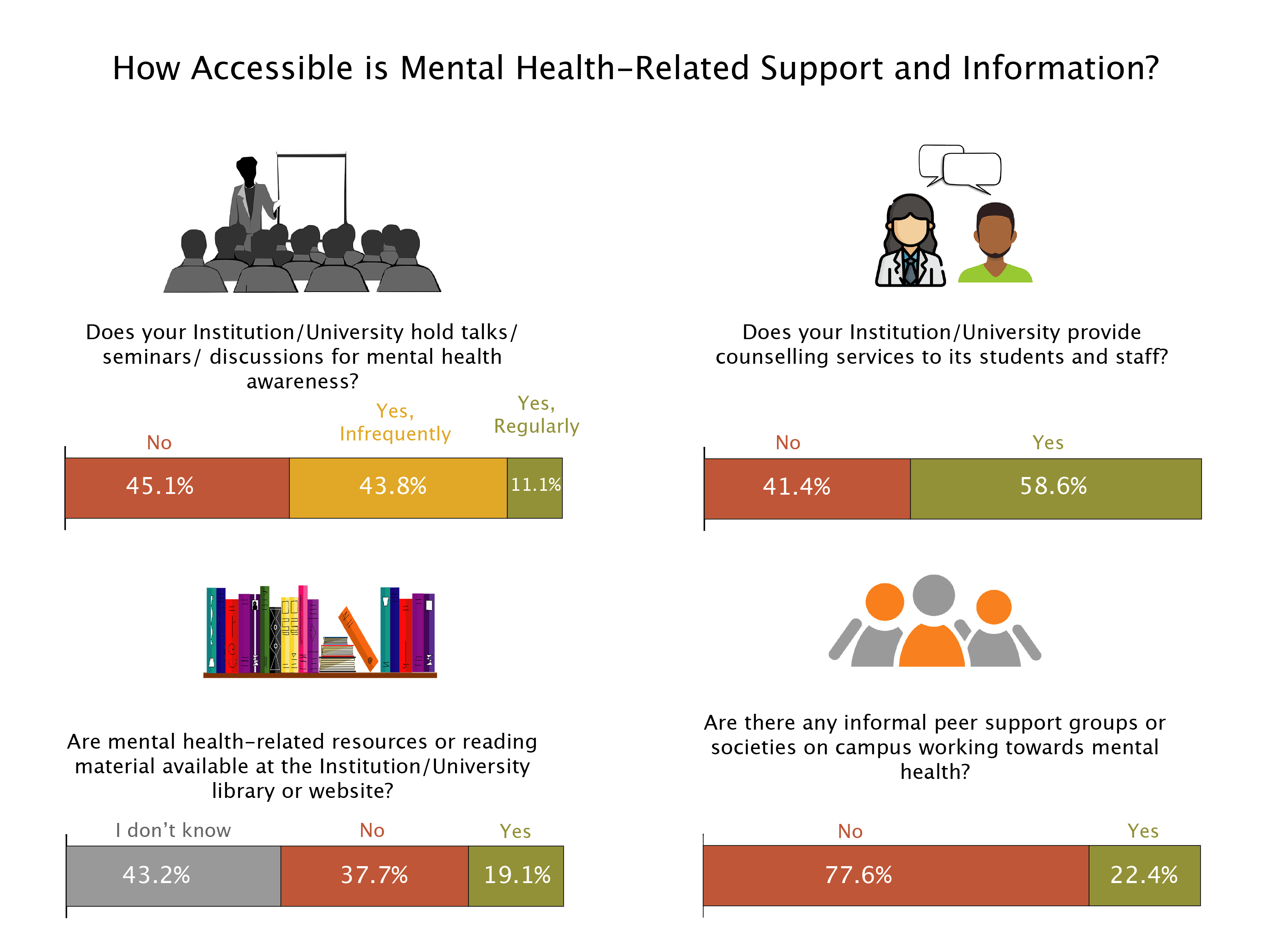
                src="https://cdn.indiabioscience.org/media/articles/MentalHealthSurvey2.jpg"></a></figure><p>In the first part of this article, we delved into the status of mental health-related awareness and the primary causes of mental health concerns in Indian academia. Based on a survey of 883 academics from across the country as well as direct interviews with researchers from 31 different institutes and universities, we identified several common factors associated with mental health issues, including biased hierarchical power structures, lack of work-life balance, unrealistic standards for success, and lack of job security.</p><p>Our findings suggest that a major driver of the high incidence of mental health-related issues in Indian academia is a general lack of awareness about mental well-being, coupled with an acceptance of poor mental health as the norm.</p><p>Many academicians appear to accept that the high output required to maintain competitive academic activity may be achieved only with a generally poor state of mental health. Consequently, mental health issues tend to be neither talked about openly nor taken seriously. This, in turn, gets reflected in the infrastructural and systemic frameworks of mental health support, which are often inadequate to combat the depth and pervasiveness of these issues.</p><p>In this article, we will review the results of our survey on the availability of mental health services on Indian academic campuses. We will also list a set of recommendations generated on the basis of the survey, that may be adopted and applied by academic institutions at all levels.</p><p>As a part of the survey, we asked the question, ‘Does your Institution/University provide counselling services to its students and staff?’ While 58% of the respondents answered in the affirmative, the answers to this question from different individuals in the same institutions or universities contradicted each other in a number of cases. This implied that even when counselling/therapy services are available, knowledge about them may not be universally available to those working at these institutes.</p><div class="tableauPlaceholder" id="viz1601534476017"><object class="tableauViz" style="display:none;"><param name="host_url" value="https%3A%2F%2Fpublic.tableau.com%2F"><param name="embed_code_version" value="3"><param name="site_root" value><param name="name" value="Mentalhealthsurveyinacademia-2019-20/Counselling1"><param name="tabs" value="no"><param name="toolbar" value="yes"><param name="static_image" value="<img class=" redactor-autoparser-object src="https://public.tableau.com/static/images/Me/Mentalhealthsurveyinacademia-2019-20/Counselling1/1.png">"&gt; <param name="animate_transition" value="yes"><param name="display_static_image" value="yes"><param name="display_spinner" value="yes"><param name="display_overlay" value="yes"><param name="display_count" value="yes"><param name="language" value="en-GB"></object></div><p>To those who mentioned that counselling services were available in their institute/university, we also asked if information about these services is easily accessible. 19% voted in the negative, suggesting that a good fraction of institutes did not advertise the available services adequately.</p><p>When we asked the survey respondents whether, on a whole, they find the mental health support systems at their institution/university to be adequate, only 32% answered in the affirmative. However, when we asked whether they know whom to contact in case of a mental health crisis, 57% of the respondents said yes. This suggests that while the majority of respondents may not be placing their full reliance on campus counselling services, they do have an idea of where to obtain help in the case of an emergency.</p><div class="tableauPlaceholder" id="viz1601534769572"><object class="tableauViz" style="display:none;"><param name="host_url" value="https%3A%2F%2Fpublic.tableau.com%2F"><param name="embed_code_version" value="3"><param name="site_root" value><param name="name" value="Mentalhealthsurveyinacademia-2019-20/Counselling2_1"><param name="tabs" value="no"><param name="toolbar" value="yes"><param name="static_image" value="<img class=" redactor-autoparser-object src="https://public.tableau.com/static/images/Me/Mentalhealthsurveyinacademia-2019-20/Counselling2_1/1.png">"&gt; <param name="animate_transition" value="yes"><param name="display_static_image" value="yes"><param name="display_spinner" value="yes"><param name="display_overlay" value="yes"><param name="display_count" value="yes"><param name="language" value="en-GB"></object></div><p>We next sought to understand the quality of such mental health services, as reported by our survey respondents who indicated that mental health services were available on their campuses. According to the answers provided in the survey, only in about 48% of the cases did a counsellor visit the campus more than three days a week. In 31% of the cases, only a single counsellor was available to deal with the concerns of the entire population of the institute. It is possible that such restricted hours and increased workloads would affect the quality of the services, as well as the level of trust that academics put in these services.</p><p>What is also striking is the high percentage of respondents (up to 53%) who admitted that they were not well-informed about the details of the services (i.e. who answered “I don’t know” to the questions above). This also points to a scenario in which the numbers don’t tell the full story. Even when an institute provides mental health-related support structures, lack of clear communication and orientation of campus members towards these services can keep academics from taking full advantage of them.</p><p>From our interviews conducted on the target group, we found that sometimes, availing the facilities on the campus is not perceived as safe exercise. Some of the interviewees alleged that the anonymity of the services was sometimes violated and details of private conversations were revealed to those higher up in the academic hierarchy. Another interviewee mentioned that their pleas to have a regularly functioning counselling service in their institution have been ignored.</p><div class="tableauPlaceholder" id="viz1601534792801"><object class="tableauViz" style="display:none;"><param name="host_url" value="https%3A%2F%2Fpublic.tableau.com%2F"><param name="embed_code_version" value="3"><param name="site_root" value><param name="name" value="Mentalhealthsurveyinacademia-2019-20/Counselling3_1"><param name="tabs" value="no"><param name="toolbar" value="yes"><param name="static_image" value="<img class=" redactor-autoparser-object src="https://public.tableau.com/static/images/Me/Mentalhealthsurveyinacademia-2019-20/Counselling3_1/1.png">"&gt; <param name="animate_transition" value="yes"><param name="display_static_image" value="yes"><param name="display_spinner" value="yes"><param name="display_overlay" value="yes"><param name="display_count" value="yes"><param name="language" value="en-GB"></object></div><p>In view of the above data and insights, we have put together a list of recommendations to improve the status of mental health in our academic institutions. In making these recommendations, we have also drawn from crowdsourced suggestions collected from both the survey and interviews.</p><p><strong>Acknowledge, identify, and investigate</strong></p><p>The first step must be to acknowledge that there is indeed a problem, followed by a sincere attempt to understand why. There need to be more studies enquiring into the state of mental health on our campuses and identifying the factors most closely linked to mental health-associated challenges. It is likely that these would vary in form and severity from region to region and community to community, making it imperative that the studies are conducted at small (e.g. at department level), medium (e.g. at institute level) or large (e.g. state or national level) scales.</p><p><strong>Strategise for better management of mental health crises</strong></p><p>43% of the respondents to our survey said they didn’t know whom to contact in case of a mental health emergency. This points to a concerning gap that institutions and universities should take immediate steps to address. Some ways in which this can be done are:</p><ul><li>A core team of volunteers can be set up who can help direct individuals who require counselling or treatment.</li><li>A set of faculty members can be identified who can volunteer to provide first-point-of-contact counselling to students.</li><li>Information regarding 24/7 helplines or counselling services (telephonic or online) should be made available to everyone on the campus. This should ideally be advertised and displayed prominently, through posters, leaflets, handbooks, and the institute’s website.</li><li>Members of faculty who advise students can be provided sensitisation and mentorship training and encouraged to maintain an approachable relationship with their students and other lab or academic members.</li></ul><p><strong>Improve mental health support facilities</strong></p><p>Our data indicate that the present level of mental health support available on the majority of our institute and university campuses is inadequate to meet the needs of researchers, staff, and students who work there. This calls for steps to ensure more and better support facilities, perhaps using some of the institutes and universities that appear to be serving their communities well in this regard, as models. Here are some ways in which this can be achieved:</p><ul><li>Regular mental health awareness sessions in the form of seminars or workshops should be held. Proactive steps should be taken to ensure that information about such services is easily accessible and available to everyone working on campus.</li><li>Steps should be taken to ensure that on-campus mental health support is inclusive: students, postdoctoral researchers, temporary/permanent staff, and members of the faculty should all be able to freely access the services of the support cell.</li><li>On-campus counsellors should be trained and vetted properly. Highest standards of patient confidentiality should be maintained during all interactions. It is also suggested that the support service be situated in a location which allows visitors to retain their anonymity. While seeking help to manage one’s mental health is something that need not be hidden, owing to the unfortunate, unhealthy judgement that this tends to receive, several people may not be comfortable sharing this information and may be discouraged from seeking help if forced to do so in a public manner.</li><li>Given the limitations of on-campus services, regular tie-ups with external counselling options should be made, to which individuals in need of long-term therapy can be referred. The costs of these sessions should be borne by the institutions as a part of the regular medical coverage.</li><li>Informal sessions about mental health within smaller groups should be encouraged, along with setting up and maintaining active and independent community support systems and peer support groups. Setting up an online forum where students can talk freely about their issues, possibly within the institute, could also be considered.</li><li>Finally, steps should be taken to promote therapy and counselling as ways to achieve general mental well-being, and not simply as solutions to severe mental illnesses. This can also help in reducing the stigma around seeking help for mental health issues.</li></ul><p><strong>Address the root causes of mental health problems</strong></p><p>While addressing mental health-related issues is a necessary step, it is also important to look at the structural or systemic problems that give rise to these challenges in the first place. Based on the results of our survey, we suggest focused efforts in the following areas.</p><ul><li><em>More balanced student-advisor relationships: </em>Students should have access to mentorship from multiple faculty members, either in the form of a thesis committee or an equivalent provision, to avoid a power structure with a single point of focus. Advisors and principal investigators should be trained on student wellness in general, and mental health-related awareness and problems in particular. Rules of professional conduct should be spelt out and followed strictly. A system of independent, anonymous feedback on advisors by students which is reviewed and acted upon would also help in this regard.</li><li><em>Greater awareness about mental health within academicians in positions of authority: </em>Researchers should take steps to educate themselves about mental health and receive training in dealing with such issues in a sensitive, professional, and transparent manner.</li><li><em>Better complaint redressal systems: </em>This would ensure a stronger safety net for those facing untenable situations and circumstances, and help improve conditions.</li><li><em>More transparent and fair evaluation systems for academic success: </em>More holistic criteria for evaluating academic performance should be adapted at all levels, from student assessments to tenure decisions.</li><li><em>Mechanisms for continuous assessment, review, and improvement of mental health services: </em>One way to achieve this is an independent mental health advisory committee that regularly meets with faculty and administrators to determine gaps in support and ways to address them. Collection of anonymous and open feedback from those who use the mental health services should also be encouraged.</li></ul><p><strong>Provide long-term solutions</strong></p><p>Finally, we acknowledge that these problems do not exist in a vacuum and are influenced by the overall socio-cultural fabric of our communities. Proactive steps to eliminate social (religious, gender, caste, class, etc.) and economic biases will go a long way towards reducing the burden of mental health challenges. Improved infrastructure, including better living conditions and remuneration for those lower in the academic hierarchy, would also help in this regard. Other steps can be to proactively encourage extra-academic activities, provide better facilities directed at improving work-life balance (e.g. day-care and parental leave) and to challenge prevalent assumptions about how the ‘ideal academic’ should look, act, and behave.</p><p>To summarise, while our study brings to light several challenges in relation to the mental health situation in Indian academia, it also provides us with an understanding of certain key areas where focused effort may pay large dividends. We hope that this will begin a continuing dialogue and discussion on mental well-being on our campuses and encourage institutes and individuals to step up with efforts to address these issues.</p>
              ]]></content><category term="mentalhealth" label="Mental Health" /></entry><entry><title>Hidden in plain sight: A mental health crisis in academia (Part 1)</title><link
                  rel="alternate"
                  href="https://indiabioscience.org/columns/indian-scenario/hidden-in-plain-sight-a-mental-health-crisis-in-academia"
                  type="text/html"
                  /><summary type="html"><![CDATA[
                <p>While the importance of addressing mental health concerns within academic circles has been recognized time and again, progress has been hampered due to many factors, not the least of which is a paucity of data. This article is the first in a two-part series where we will examine the status of mental health awareness within Indian academia and discuss possible strategies and interventions to improve the situation.</p>              ]]></summary><id>tag:indiabioscience.org,2020-09-29:/columns/indian-scenario/hidden-in-plain-sight-a-mental-health-crisis-in-academia</id><published>2020-09-29T09:00:00+05:30</published><updated>2021-05-11T15:32:30+05:30</updated><author><name>Debdutta Paul</name><uri>https://indiabioscience.org/authors/DebduttaPaul</uri></author><content type="html"><![CDATA[
                
<p>While the importance of addressing mental health concerns within academic circles has been recognized time and again, progress has been hampered due to many factors, not the least of which is a paucity of data. This article is the first in a two-part series where we will examine the status of mental health awareness within Indian academia and discuss possible strategies and interventions to improve the situation. <a href="https://indiabioscience.org/columns/indian-scenario/hidden-in-plain-sight-a-mental-health-crisis-in-academia-part-2">Part 2 can be read here.</a></p><figure><a href="https://indiabioscience.org/columns/indian-scenario/hidden-in-plain-sight-a-mental-health-crisis-in-academia"><img
                width="720"
                height="440"
                style="max-width: 100%; height: auto"
                src="https://cdn.indiabioscience.org/media/articles/MentalHealthSurvey1.jpg"></a></figure><p>The research ecosystem in India arguably employs some of the best minds in the country. However, this population also includes some of those most vulnerable to mental health issues and challenges. So far, the conversation surrounding mental health in academia has been consistently driven by mental health disorders and their causes and consequences, thus playing a reactionary rather than a precautionary role.</p><p>Through a year-long study of mental health awareness within various academic institutions in India, we found that the level of general awareness regarding mental health itself is low within the academic community. This raises concerns about the effectiveness of mental health-related awareness and education campaigns, as well as about the thrust of policy directives aimed at improving the mental health situation within these institutes. </p><p>Surveys conducted in <a href="https://www.sciencedirect.com/science/article/abs/pii/S0048733317300422">other countries</a> have found that a <a href="https://www.nature.com/articles/nbt.4089">large fraction</a> of researchers suffer from or are at a high risk of developing mental illness. Graduate students are more likely to develop mental illness as compared to other highly educated groups. In the Indian context, there is a dearth of statistical data about the mental health of academicians. We attempted to fill this gap partially, by following two approaches.</p><ol><li>An anonymous open online survey circulated within academics across India between August and October 2019, which received 883 responses.</li><li>One-on-one interviews with academics from 31 research institutions spread across the country.</li></ol><p>The survey was circulated through social media channels, newsletters, as well as through direct peer-to-peer communication. We acknowledge that due to the nature of its sampling and distribution, the survey may overrepresent certain communities, including those more familiar with social media or belonging to top-tier institutes. We hope that similar studies inspired by the current one will address this gap in the future and help build on this dataset. </p><p>We would also like to note here that the answers our respondents provided to the survey questions reflect their individual beliefs and worldviews and are, therefore, inherently subjective in nature. The percentages and numbers quoted in this article should also be viewed through this lens. </p><p>While we used the survey to gain preliminary insights into the levels of mental health awareness within the academic populace, our aim with the interviews was to delve deeper into these issues with the help of a targeted subset of the community. While these datasets are not fully representative, we hoped that this combined approach would let us strike a balance and bring out the salient features of the situation. </p><p>Primarily, we sought to answer the following questions:</p><ol><li>What is the level of awareness about mental health within the scientific community?</li><li>What are the major causes of mental health-related issues in academia?</li><li>How accessible is mental health-related help on our university or institute campuses?</li></ol><p>Finally, we also sought recommendations on what can be done to improve the status of mental health within Indian academia. In this first article, we will attempt to answer the first two questions based on the survey and the responses of the target group, while the next article will focus on the availability of mental health support structures and recommendations for improving the situation for all involved. </p><p>Our survey respondents comprised mostly PhD and MSc students, with a significant number of responses from undergraduate students, postdoctoral fellows and faculty, hailing from 209 different institutes, colleges, and universities. 14% of the respondents were faculty or independent researchers, 6% were postdoctoral fellows, 33% were PhD students, and 41% were Bachelor’s or Master's students. The remaining were junior research fellows (JRFs), research interns, scientific staff, or researchers currently between positions. </p><div class="tableauPlaceholder" id="viz1601359279040" style="position: relative"><object class="tableauViz" style="display:none;"><param name="host_url" value="https%3A%2F%2Fpublic.tableau.com%2F"><param name="embed_code_version" value="3"><param name="site_root" value><param name="name" value="Mentalhealthsurveyinacademia-2019-20/Distribution"><param name="tabs" value="no"><param name="toolbar" value="no"><param name="static_image" value="https://public.tableau.com/static/images/Me/Mentalhealthsurveyinacademia-2019-20/Distribution/1.png"><param name="animate_transition" value="yes"><param name="display_static_image" value="yes"><param name="display_spinner" value="yes"><param name="display_overlay" value="yes"><param name="display_count" value="yes"><param name="language" value="en-GB"></object></div><p>From the answers provided by the survey respondents, it appears that in most institutions, there is no clear dissemination of information regarding mental health. Only 11% of the respondents said that their institutions hold regular seminars and discussions for mental health awareness. Only about 19% of respondents reported that their institute’s library or website had any reading material related to mental health and almost 78% said that there are no preventive peer support groups on campus.</p><figure><a href="https://indiabioscience.org/media/articles/MentalHealthAwareness2-01.png"><img src="https://cdn.indiabioscience.org/media/articles/MentalHealthAwareness2-01.png" data-image="193890" alt="accessibility mental health"></a></figure><p><br>A whopping 59% of those who took the survey admitted to having faced mental health-related issues during their academic career either in the past or present. Within this group, 82% admitted to never having been officially diagnosed. This is indicative of the fact that mental health issues are normalised in academia, and many sufferers are hesitant to seek professional help.</p><p>When we investigated this figure further, we found that 68% of the PhD students and 65% of the Master’s students who took the survey reported having faced mental health issues during their stay in an institute. Although the number of postdoctoral fellows and interns/JRFs who took the survey was relatively less, 64% of these respondents also admitted to having faced mental health issues. Interestingly, 35% of members of faculty or principal investigators <a href="https://thewire.in/health/mental-health-in-academia-what-about-faculty-members">reported having had mental health concerns</a>. These statistics, on the whole, align with the findings of <a href="https://www.sciencemag.org/careers/2018/03/graduate-students-need-more-mental-health-support-new-study-highlights">other surveys</a> that show PhD and Master’s students are particularly vulnerable to mental health challenges. Based on this, we decided to focus primarily on these groups for our direct interviews. </p><div class="tableauPlaceholder" id="viz1601359321489" style="position: relative"><object class="tableauViz" style="display:none;"><param name="host_url" value="https%3A%2F%2Fpublic.tableau.com%2F"><param name="embed_code_version" value="3"><param name="site_root" value><param name="name" value="Mentalhealthsurveyinacademia-2019-20/Issues"><param name="tabs" value="no"><param name="toolbar" value="no"><param name="static_image" value="https://public.tableau.com/static/images/Me/Mentalhealthsurveyinacademia-2019-20/Issues/1.png"><param name="animate_transition" value="yes"><param name="display_static_image" value="yes"><param name="display_spinner" value="yes"><param name="display_overlay" value="yes"><param name="display_count" value="yes"><param name="language" value="en-GB"></object></div><p>From the interviews conducted on the target dataset, we found that exceptions aside, many academics, including those hailing from some of the premier institutions in the country, had grave misconceptions about mental health and psychiatric conditions. For example, some interviewees commonly and casually labelled states of sadness as depression. On the other hand, some interviewees dismissed potentially serious cases of depression as being trivial or temporary fluctuations of mood. Many subscribed to the belief that mental health concerns arise from a lack of ‘maturity’ or ‘strength’. </p><p>The responses to our survey also indicate that while the academic environment is not the only cause for poor mental health, it potentially plays a big role in aggravating existing personal, social, and economic concerns amongst academicians, impairing their general mental well-being.</p><p>A careful analysis of the responses from the survey as well as the responses from the target group of interviewees led us to identify a set of commonly prevalent reasons for poor mental health conditions in Indian academia, listed below.</p><ul><li>Skewed hierarchy in favour of those higher up on the academic ladder, e.g. professors</li><li>Strained student-advisor relationships</li><li>Inhumane work hours</li><li>Lack of work-life balance</li><li>The ‘publish or perish’ culture </li><li>Unhealthy levels of competition and peer pressure </li><li>Poor remuneration for those on the lower rungs of the hierarchy</li><li>Lack of job security</li><li>Lack of exposure to future non-academic job prospects</li><li>Social hierarchies of caste and gender</li></ul><p>“Professors talk about the importance of work-life balance on social media platforms. Despite that, we all know well that they themselves don’t let their own graduate students and postdocs practice it,” said an anonymous respondent of the survey, citing examples from their own department in a premier research institute in India.</p><p>A few respondents highlighted how academic hierarchy can take some very ugly forms. “I have come across many cases wherein supervisors had threatened PhD students and used vulgar, derogatory words to address and downgrade their morale,” said one respondent, “If someone complained against them, the institute did not take serious actions against their employees, and later on they too issued warnings against the students to suppress their voice.”</p><p>Distorted and sometimes arbitrary benchmarks of academic performance can be another major source of stress among graduate students. “Students are continually informed of what a successful, dedicated individual should behave like. This stereotypical, incorrect view is damaging,” said another respondent, “It is not communicated clearly that there are other valid ways to be successful.”</p><p>“The only well-accepted measure of success is publication,” said one of the interviewees, who prefers to remain anonymous. Pointing to the lack of clarity of what exactly defines academic performance, they added, “It may take years of failed attempts to get one ‘good’ publication, and this entire time it is entirely unclear if there is any real progress. This uncertainty can be mentally exhausting.”</p><p>Unrealistically high expectations and a low tolerance for failure can be another source of stress for many researchers. “Academia selects for intellectually driven, highly motivated, focused individuals who set high standards for themselves,” said Karishma Kaushik, Assistant Professor at <a href="https://indiabioscience.org/orgs/ibb">Institute of Bioinformatics and Biotechnology (IBB), Savitribai Phule Pune University (SPPU), Pune</a>, “Any delays or deviations along this path mean that highly successful people have to encounter and work around a situation where they do not see themselves as ‘successful’, which certainly creates stress, pressure and mental distress.” </p><p>Many who took the survey reported feeling isolated in their research life, even while surrounded by peers. Several respondents admitted that their loneliness is increased by the lack of community support. Almost 40% of the respondents who faced mental health concerns said that they were unable to talk to anyone about their issues.</p><p>Many respondents also commented on the subtle and pervasive taboo against talking about mental health, a point that is perhaps proven by the fact that the majority of the survey respondents and interviewees chose to remain anonymous. “In my experience as a young investigator, mental health has been an extremely closed issue in higher academia, rarely, if ever, spoken about,” said Kaushik. </p><p>We conclude that there is an urgent need to normalise conversations regarding mental health and to ensure that they are not restricted to short-term reactions to mental health concerns or associated tragedies. “I think a willingness to admit to major and minor mental health concerns would go a long way,” said Gagandeep Kang, Professor, <a href="https://indiabioscience.org/orgs/cmc">Christian Medical College, Vellore</a>, “Frequently, the ones who need help most are the ones with the least insight.” </p><p>Despite the high prevalence of mental health issues, only 18% of the respondents said that they received help through counselling or therapy services available in their institution. Moreover, only 45% of the respondents said that they could talk to <em>someone</em> who was supportive. When asked whether their institutes/universities provide counselling services, 40% of the respondents answered in the negative. Moreover, about 43% admitted that they don’t know whom to contact in case of a mental health crisis. These statistics point to an intensifying mental health crisis in Indian academia.</p><div class="tableauPlaceholder" id="viz1601359380848" style="position: relative"><object class="tableauViz" style="display:none;"><param name="host_url" value="https%3A%2F%2Fpublic.tableau.com%2F"><param name="embed_code_version" value="3"><param name="site_root" value><param name="name" value="Mentalhealthsurveyinacademia-2019-20/Crisis"><param name="tabs" value="no"><param name="toolbar" value="no"><param name="static_image" value="https://public.tableau.com/static/images/Me/Mentalhealthsurveyinacademia-2019-20/Crisis/1.png"><param name="animate_transition" value="yes"><param name="display_static_image" value="yes"><param name="display_spinner" value="yes"><param name="display_overlay" value="yes"><param name="display_count" value="yes"><param name="language" value="en-GB"></object></div><p>In the next article in this series, we will address in further detail the availability of mental health-related help within different academic institutions in India and list a set of recommendations for improving this situation derived from our study.</p>
              ]]></content><category term="mentalhealth" label="Mental Health" /></entry><entry><title>Controlled human infection models: Promises and concerns for India</title><link
                  rel="alternate"
                  href="https://indiabioscience.org/columns/indian-scenario/controlled-human-infection-models-promises-and-concerns-for-india"
                  type="text/html"
                  /><summary type="html"><![CDATA[
                <p>Traditional vaccine trials rely on large sample populations and natural infection processes. A quicker, cheaper, but riskier method, called Controlled Human Infection Model studies (CHIMs), has also been in practice for some time. In CHIMs, volunteers are deliberately infected with a pathogen to study its effects or to test the efficacy of a vaccine. In this article, Aditi examines the science behind CHIMs and the ethical implications of legalising this method in India, where such trials are presently banned.</p>              ]]></summary><id>tag:indiabioscience.org,2020-09-18:/columns/indian-scenario/controlled-human-infection-models-promises-and-concerns-for-india</id><published>2020-09-18T09:00:00+05:30</published><updated>2020-09-14T15:19:20+05:30</updated><author><name>Aditi Jain</name><uri>https://indiabioscience.org/authors/AditiJain</uri></author><content type="html"><![CDATA[
                
<p>Traditional vaccine trials rely on large sample populations and natural infection processes. A quicker, cheaper, but riskier method, called Controlled Human Infection Model studies (CHIMs), has also been in practice for some time. In CHIMs, volunteers are deliberately infected with a pathogen to study its effects or to test the efficacy of a vaccine. In this article, Aditi examines the science behind CHIMs and the ethical implications of legalising this method in India, where such trials are presently banned.</p><figure><a href="https://indiabioscience.org/columns/indian-scenario/controlled-human-infection-models-promises-and-concerns-for-india"><img
                width="960"
                height="587"
                style="max-width: 100%; height: auto"
                src="https://cdn.indiabioscience.org/media/articles/syringe-3902915_960_720.jpg"></a></figure><p>Cholera, a diarrhoeal disease spread through contaminated food and water, is rare in the USA. However, many US citizens who travel to regions where cholera is endemic (parts of Asia, Africa, or the Caribbean) have lost their lives to this disease. In 2016, the US Food and Drug Administration (FDA) approved a vaccine (VaxChora) for this disease based on the results of a quick and cost-effective method called <strong>Controlled Human Infection Model studies (CHIMs)</strong>. As the world now wades through the coronavirus crisis, CHIM studies are again being deliberated upon as a way to fast-track vaccine development. However, insufficient knowledge about the virus and ethical concerns restrict the use of this process.</p><p><strong>What are CHIMs?</strong></p><p>CHIM studies involve intentionally introducing an infectious agent into the body of a healthy volunteer in a regulated manner to induce infection. This can be used to yield information about the efficacy of novel vaccines, generate knowledge regarding disease progression, and gain insights on host-pathogen interactions. Medical researchers, practitioners, and regulatory authorities of our country are currently deliberating on legitimizing this method since this may help reduce the public health burden of infectious diseases in India.</p><p>At first glance, the idea of deliberately introducing an infection may seem dangerous. It can reasonably be asked whether such a risky procedure is needed when similar infection studies have long been conducted on animal models. </p><p>The need to conduct CHIM studies arises due to three reasons. First, several diseases cannot be studied in animal models as the pathogens causing them selectively infect humans (For e.g. rabbits and dogs don’t get dengue). Second, host-parasite interactions can differ between humans and animal models. As a result of this, results obtained through infection studies in animals can often fail to replicate in humans, leading to wastage of funds and resources. Third, CHIM studies can speed up vaccine research as ineffective candidates can be eliminated at an early stage by testing them on a small number of individuals (who are given the vaccines, followed by an injection of the infectious agent).</p><p>Till date, more than 155 CHIM studies have been carried out worldwide involving over 45,000 volunteers, primarily in developed countries like the US, UK, Netherlands etc. Recently, developing nations such as Kenya, Tanzania, and Gabon have also started CHIM trials, but their overall contribution is only 7% of the CHIM study space. CHIM studies, however, are not yet approved in India and currently, vaccines designed in India are sent abroad for CHIM trials. </p><p>Of late, the <a href="https://indiabioscience.org/orgs/dbt">Department of Biotechnology (DBT)</a> along with the Faridabad-based <a href="https://indiabioscience.org/orgs/thsti">Translational Health Science and Technology Institute (THSTI)</a> have started pushing for policy change to introduce CHIMs in India. The organisations are holding consultations with various stakeholders, including researchers, lawyers, media, and ethicists, to understand the regulatory needs and potential issues associated with such studies in India. </p><p>As CHIMs are carried out in many other countries, sceptics argue that one can easily borrow the information and products derived from such studies from other countries where the regulatory norms are already streamlined and medical facilities are better, instead of starting them afresh in India. Researchers in the field, however, caution that due to genetic complexity related to ethnicity, environmental, and nutritional factors, CHIM studies conducted elsewhere may not replicate in India and products tested through such studies elsewhere may not benefit the Indian population. </p><p>One evidence for this is the failure of many phase III clinical trials in India, which involve a large number of volunteers. One can argue that if CHIM studies were conducted in their stead, the results about the inefficacy of vaccine would have come at a lesser cost, in lesser time, and by employing a fewer number of volunteers.</p><p>“Vaccines that protect against Rotavirus, cholera and polio have shown poor efficacy in India due to varying genetic and environmental conditions in the Indian population. It is, therefore, necessary that we do studies in India on the infections which have huge public health burden in India to ensure that the results are relevant to us,” says Gagandeep Kang, former Executive Director, <a href="https://indiabioscience.org/orgs/thsti">THSTI</a>.</p><p>Further imperative for CHIM studies also comes from growing concern over antimicrobial resistance. With more and more drugs failing against infectious diseases, it is important to invest in studies which accelerate the process of vaccine development.</p><p><strong>How safe is the procedure?</strong></p><p>Needless to say, CHIM studies carry a certain level of risk. However, the studies generally use well-known microbial strains, appropriate timing, dose, and route of infection, along with continuous monitoring of the volunteer to ensure their safety. Further, volunteers are selected based on their past history of infection as well as other factors which may hinder the study or enhance the associated health risk for the participant. </p><p>Due to the infectious nature of the pathogen, the volunteers are usually quarantined and monitored for the duration of the study (although this may vary with the nature of the infection) to ensure that they are out of danger and incapable of spreading the diseases once they step outside the study centre. Since the microbial strains used are not very virulent, the symptoms are mild and they generally don’t lead to full-blown disease. Also, such studies are mostly carried out for diseases where effective treatments are available so that the volunteer can be provided medication and hospital care if they exhibit stronger symptoms than expected.</p><p><strong>Ethical concerns</strong></p><p>While the need is established, the deliberate injection of a pathogen in humans raises ethical and regulatory concerns. Although earlier CHIM studies have been successful and no harm to individuals reported so far, risk cannot be ruled out completely, especially in low-income countries where medical facilities are not at par with the developed world.</p><p>In this regard, Indian authorities have resolved to do CHIM studies only in a few specialized centres which have the expertise required to carry out such studies. Even though developing countries like India can learn from the experiences and regulatory framework from the developed countries, it has a different set of challenges pertaining to different socio-economic conditions.</p><p>Manjulika Vaz, lecturer at <a href="https://indiabioscience.org/orgs/sjri">St. John’s Research Institute, Bangalore</a> has studied the ethics surrounding CHIM studies in India. According to her, the general public is apprehensive about CHIM studies due to their unfamiliarity and a perception that poor Indians might be used as guinea pigs.</p><p>Vaz believes that to ensure that CHIM studies in India do not lead to the exploitation of the poor for money, the volunteers of the study should be healthy, urban, financially sound, educated, health literate, aware of research processes, and altruistic. She adds that this view of ensuring that those who participate truly understand why and what they have agreed to and are not being exploited is also shared by the IVIRC (India Volunteer Infection Research Consortium). It is extremely important to ensure that people who participate in any kind of clinical research truly understand it and that the vulnerable (socially, economically, or culturally) are not exploited.</p><p>It is clear that various technical, clinical, ethical and regulatory issues need to be resolved before India joins the CHIM league of countries. The biggest challenge, perhaps, will come from public perception. Amrita Sekhar, Consultant at THSTI, adds that developing guidelines for new types of clinical research like gene editing or controlled human infection is helpful for researchers because they provide standardization and prevent things going awry. However, it is essential to engage the public as well in order to ensure two-way communication, transparency, and trust-building.</p>
              ]]></content><category term="health-and-medicine" label="Health &amp; Medicine" /><category term="policy" label="Policy" /><category term="ethics" label="Ethics" /></entry><entry><title>Adversity quotient In the era of the ‘new normal’</title><link
                  rel="alternate"
                  href="https://indiabioscience.org/columns/indian-scenario/adversity-quotient-in-the-era-of-new-normal"
                  type="text/html"
                  /><summary type="html"><![CDATA[
                <p>Among the COVID-19 pandemic's many consequences is its impact on students and early career researchers all over the country, who have had to face new and challenging adversities, including breaks in experimental work, having to adapt to online education modes, and uncertainty over their future careers. A panel discussion organised by the Department of Biochemistry, JSS Medical College, Mysuru, attempted to address some of these issues.</p>              ]]></summary><id>tag:indiabioscience.org,2020-09-16:/columns/indian-scenario/adversity-quotient-in-the-era-of-new-normal</id><published>2020-09-16T09:00:00+05:30</published><updated>2020-09-16T10:05:11+05:30</updated><author><name>Akshatha N S</name><uri>https://indiabioscience.org/authors/dPpx8KpdvjKVQ5W</uri></author><content type="html"><![CDATA[
                
<p>Among the COVID-19 pandemic's many consequences is its impact on students and early career researchers all over the country, who have had to face new and challenging adversities, including breaks in experimental work, having to adapt to online education modes, and uncertainty over their future careers. A panel discussion organised by the Department of Biochemistry, JSS Medical College, Mysuru, attempted to address some of these issues. </p><figure><a href="https://indiabioscience.org/columns/indian-scenario/adversity-quotient-in-the-era-of-new-normal"><img
                width="720"
                height="440"
                style="max-width: 100%; height: auto"
                src="https://cdn.indiabioscience.org/media/articles/Adversity-01.png"></a></figure><p>With the COVID-19 pandemic bringing to light several adversities such as fear of the unknown, uncertainty, and getting lost in the career race, academia is in immediate need to grow resilience and agility. To address various questions in the minds of undergraduates, postgraduates, research scholars and early career researchers all around the country, the Department of Biochemistry, <a href="https://indiabioscience.org/orgs/jss-medical-college-jssaher">JSS Medical College, JSSAHER, Mysuru</a>, organised a virtual interactive session titled <strong>“Adversity Quotient In The Era of New Normal”</strong>. The session mainly focused on strategies for adapting to the adversity and challenging the limitations posed by the current pandemic.</p><p>The panellists included <strong>Basavanagowdappa H (BH)</strong>, Principal, <a href="https://indiabioscience.org/orgs/jss-medical-college-jssaher">JSS Medical College, Mysuru</a>; <strong>Shubha Tole (ST)</strong>, Professor, <a href="https://indiabioscience.org/orgs/tifr">Tata Institute of Fundamental Research (TIFR), Mumbai</a>; <strong>Swati Patankar (SP)</strong>, Professor, <a href="https://indiabioscience.org/orgs/iitb">Indian Institute of Technology (IIT) Bombay, Mumbai</a>; <strong>Anindita Bhadra (AB)</strong>, Associate Professor, <a href="https://indiabioscience.org/orgs/iiser-kolkata">Indian Institute of Science Education and Research (IISER) Kolkata</a>, and <strong>Arya Soman (AS)</strong>, Assistant Professor, Northwell Health/Zucker Hillside Hospital, New York, USA. </p><p>The panellists provided insights into ways to utilize this unexpected time in a guilt-free manner, treating this adversity as an opportunity. Each one of us is capable of setting our ‘new normal’ up for success, by getting involved with life in many possible ways. The following are the perspectives put forward by the panellists on the points that were discussed during the interactive session.</p><p><strong>How do you define productivity at this time of crisis?</strong></p><p><strong><em>ST: </em></strong>“Productivity” needs to be defined as whatever furthers your journey in life. Focusing on data and papers is a very narrow view of productivity. Here is an opportunity to make the best of available constraints and engaging in “productive” activities that one would have never done otherwise; perhaps you have always felt guilty to divert your time to them. </p><p>Of course, if you are in a situation in which you have to be a caregiver, or there is some family stress you have to help out with, then those are your priorities. Helping your loved ones <em>is</em> the most productive thing for you at this moment. But if you have the luxury of taking this imposed lockdown time for yourself, this would be the perfect time to indulge in activities that promote self-growth. </p><p>Personally, I have been learning Kathak for some decades now, and I continue to do so via the Zoom classes conducted by my guruji, Sanjukta Wagh. I’ve spent time trying to write the todas and parans in <em>taal</em>, something I always wanted to do and never found time for. I began to learn to play on the keyboard recently, and I find my weekly classes via Zoom extremely rewarding as I make baby steps in learning to read western music - a challenge at my age! </p><p>In summary, when we all will look back to this very strange and difficult time, we will only have ourselves to answer to, as to whether we spent it in a manner that was worthwhile to us. </p><p><strong>AB: </strong> In the given scenario, productivity for me is to stay safe and healthy. Catch up with your hobbies. Hobbies not only relieve your stress and boredom but also build your self-esteem so that you can appreciate activities outside of work. Importantly, a career break of a few months will not shatter the entire hardship endured prior to it. Henceforth, start appreciating small things and utilize this time to relax, refresh, and get recharged. If you have any doubts about your chosen career path, this would be the best time to explore other options through webinars, conferences, and workshops, to decide whether you need a switch. How one manages to keep mentally and physically in shape is all that matters in the end.</p><p><strong>AS</strong><strong><em>: </em></strong>Building resilience and agility is the key to staying productive in a phase of crisis. It begins with self-care and can range from focusing on physical health to re-framing one’s thoughts to seek a positive frame of reference despite all the unknowns. Set well-defined personal goals for self-growth. In addition to academic goals, developing new skills, working on health goals or intellectually pouring oneself into something that is not one’s area of work, would all still count in terms of productivity.</p><p><strong>What are some challenges associated with virtual teaching and scientific research?</strong></p><p><strong>BH: </strong>The unprecedented outbreak of the COVID 19 pandemic abruptly paused all activities and caused disruption in every component of life. All students and researchers are anxious and stressed out because of an uncertain career break. As the spread of COVID-19 was anticipated, JSS institution planned, designed and executed academic transactions such that all the faculties were trained and teaching was made virtual. </p><p>Despite all this, the drawback in medical courses is that learning remains incomplete without dealing with live case scenarios. Nonetheless, innovative methodologies have been employed in teaching, including making videos and conducting online exams efficiently. In addition, the institution has strategically planned how well medical courses, in terms of practical/clinical training, can be handled after the lockdown is relaxed, taking precautions and safety measures for the incoming students. </p><p>In general, academic institutions have geared up to discover solutions to the problems arising due to the crisis, simultaneously deciding to act quickly despite bureaucratic hurdles. The real challenge lies in designing excellent action plans to deliver the solution in a disciplined and efficient way. Don’t waste this crisis and never stop learning. </p><p><strong>SP: </strong>Constantly remind yourself that your institution cares deeply about you and is trying to level up the learning experiences. Looking at the brighter side, several quality webinars and online conferences are easily accessible now, which wouldn’t be the scenario otherwise. Nourish this period by expanding the knowledge in the field of your interest and catching up on research papers you downloaded but never read. Professionally, stay in touch with your mentor and seek out help in understanding concepts.</p><p><strong>AB: </strong>Stress, according to me, is not only caused due to worry about an uncertain break in learning but also because of piled up schedules concerning online classes, since so many webinars and work do not follow set schedules. Especially for women having younger kids at home, challenges have doubled. Undoubtedly for some, staying at home for a prolonged period might also be stressful. </p><p>With that said, the way to go forward is to consider yourself lucky that you are getting to spend this time with your family. This is something you will never get again, so make the most of this. Spend this time to learn new concepts, software, techniques etc. using online workshops, courses, videos that are available on open platforms. Publishers have also made many e-books available during the pandemic so make full use of them.</p><p><strong>How do you foresee post-pandemic career opportunities?</strong></p><p><strong>SP: </strong>Careers are highly dynamic these days even without the pandemic, which the younger generation has already accepted as normal. Uncertainty is a perpetual companion in every stage of a career; one has to befriend it. Fortunately, umpteen opportunities are at one’s fingertips. Not being fixated on one career path and staying open to different options is the key to resilience.</p><p><strong>ST: </strong>One of the customary fears in academia is about taking a hiatus from work. Particularly in our country, students are trained to “finish” their training and “settle down” with no breaks whatsoever, career breaks being considered as “wasting a year” or a sign of something gone wrong. But the paradigm is gradually shifting. For anyone who is at the phase of ending a degree program or a course, this would be a wonderful opportunity to engage in some reflection as to whether you’re on the right path for <em>you</em>. Are the reasons you started down this path still appropriate for you, or do you want to change your direction based on your experience or situation? This pandemic has pressed the ‘pause’ button all over the world, so you are now in charge of your time, and it’s an opportunity that we don’t usually give ourselves.</p><p><strong>How important is it to seek guidance and have self-compassion? </strong></p><p><strong>SP: </strong>Be kind; don’t impose too much on your schedule and demand so much of yourself that you are unhappy at the end of the day. Take time to connect with the family. In modern life where we are growing apart, busy in our schedules and devices, this extra time to be with family and developing close ties is a golden gift. This is a wonderful opportunity to learn to appreciate the human beings whom you are privileged to call your family and friends.</p><p><strong>AS: </strong>Worries about the pandemic and the high degree of uncertainty are key causes for stress, anxiety and depression. Reducing risk, building healthy coping skills, and establishing regular routines will help contribute to resilience in this phase of crisis. Adhere to recommended infection control measures to reduce the risk of contracting or transmitting COVID-19. While doing so, remember that social distancing does <em>not</em> mean social isolation. Stay connected virtually to different support networks (e.g. family, friends, colleagues, spiritual or religious communities etc). Focus on self-care, with regular sleep, diet and exercise. Consider meditation or other mindfulness-based practices to steady your mind and thoughts. Finally, know that you are not alone, and one need not ever suffer in silence. Reach out and seek help if you are struggling physically or emotionally. All of us are sailing in the same boat, and we are in this together. </p><p><strong>BH: </strong>The pandemic taught us many things, but foremost is the concept that “Health is Wealth”. So, as a physician, I’d advise keeping a keen eye on overall wellness, both physical and mental. Get enough sleep, stay hydrated and physically active, putting aside all the negative thoughts. Stay connected with family and friends. Many faculties are ready to offer support outside of class so feel comfortable in seeking guidance. The sense of connection is the key to calmness. In any circumstances, reach out for help with no fear. </p><p><strong>Could you define the role of science communication and outreach activities during this time?</strong></p><p><strong>ST: </strong>There are multiple online platforms for popular science writing, which demands both time and creativity thereby taking your mind off the pandemic. To mention just a few, there are opportunities for getting involved in public outreach of science, communicating one’s work in one’s native language, and creating a dedicated YouTube channel to enthuse young minds. Start small with the goal being to communicate (not “convince”) as communication builds trust in science in the general public, which is the need of the hour.</p><p><strong>AB: </strong>As researchers have no access to laboratories, this would be an excellent moment to involve ourselves in science communication. Apart from writing a research paper, you could utilize this time to bring out a beautiful science article conveying your work to the layman who is the actual taxpayer supporting the research. </p><p><strong>What is one take-home message you would like everyone to take away from this discussion?</strong></p><p><strong>AS</strong>: Be kind to yourself and practice self-care. Gauge your well being every day, establish a regular routine for yourself/your family, and take it one step at a time. </p><p><strong>BH</strong>: Stay safe and stay healthy. Remain connected and be happy. </p><p><strong>AB</strong>: Motivate yourself and pursue your passion.</p><p><strong>SP</strong>: Make the best use of this time to widen your knowledge and empower your competencies.</p><p><strong>ST</strong>: The situation is not in your control, but your approach to it is. You can see it as an opportunity to nourish your mind, or you can let your worries about the “time lost” eat into your peace of mind.</p>
              ]]></content><category term="covid19" label="COVID-19" /><category term="career-development" label="Career Development" /><category term="mentalhealth" label="Mental Health" /></entry><entry><title>How one Indian institute is contributing to the battle against COVID-19</title><link
                  rel="alternate"
                  href="https://indiabioscience.org/columns/indian-scenario/how-one-indian-institute-is-contributing-to-the-battle-against-covid-19"
                  type="text/html"
                  /><summary type="html"><![CDATA[
                <p>With improved strategies to fight, prevent, and treat COVID-19 being the need of the hour, many Indian institutes and universities have redirected their research activities towards meeting this challenge. Suchibrata provides a glimpse into how various researchers at one such institute, the Indian Institute of Science Education and Research (IISER) Pune, are contributing to this effort through innovative research solutions.</p>              ]]></summary><id>tag:indiabioscience.org,2020-07-27:/columns/indian-scenario/how-one-indian-institute-is-contributing-to-the-battle-against-covid-19</id><published>2020-07-27T21:00:00+05:30</published><updated>2020-07-27T21:10:08+05:30</updated><author><name>Suchibrata Borah</name><uri>https://indiabioscience.org/authors/Suchibrata</uri></author><content type="html"><![CDATA[
                
<p>With improved strategies to fight, prevent, and treat COVID-19 being the need of the hour, many Indian institutes and universities have redirected their research activities towards meeting this challenge. Suchibrata provides a glimpse into how various researchers at one such institute, the <a href="https://indiabioscience.org/orgs/iiser-pune">Indian Institute of Science Education and Research (IISER) Pune</a>, are contributing to this effort through innovative research solutions.</p><figure><a href="https://indiabioscience.org/columns/indian-scenario/how-one-indian-institute-is-contributing-to-the-battle-against-covid-19"><img
                width="720"
                height="440"
                style="max-width: 100%; height: auto"
                src="https://cdn.indiabioscience.org/media/articles/FeaturedSuchibrataIISERPune.jpeg"></a></figure><p>As the world is shaken by the recent COVID-19 pandemic, all eyes are focussed on the research community and the progress made in countering the novel coronavirus. Scientists are tirelessly working to find a vaccine and a drug to treat this disease that has drastically changed the lifestyle of people around the globe. Scientists at the <a href="https://indiabioscience.org/orgs/iiser-pune">Indian Institute of Science Education and Research (IISER) Pune</a> are amongst those putting in a sincere effort to contribute in this area. </p><p><strong><em>Diagnostics</em></strong></p><p>Nixon Abraham, Assistant Professor in the Department of Biology, is working in collaboration with <a href="http://www.bjmcpune.org/">B.J. Government Medical College, Pune</a>, to detect certain asymptomatic COVID-19 cases where lack/reduction of the sense of smell (known as anosmia/hyposmia) is the only indication of having the disease. His research team has developed an olfactory action meter - an instrument which could be used to detect this symptom. With the help of this instrument, healthy people can be easily distinguished from COVID patients who are suffering from lack/reduction of sensing ability.</p><figure><img src="https://cdn.indiabioscience.org/media/articles/olfactory-action-meter-at-Dr.-Abrahams-lab.jpg" data-image="179800"><figcaption>Olfactory action meter developed by Nixon Abraham's lab (Photo: Suchibrata Borah)</figcaption></figure><p>Chaitanya Athale, Associate Professor in the Department of Biology, is developing an inexpensive and portable method for easy detection of viral RNA from COVID patients, using a paper-based diagnostic approach. His team is designing a special class of RNA (known as toehold RNA switches), which act as a sensor to detect the viral RNA sequence. When these switches interact with trigger RNA from the virus, they help produce a protein that is either a chromophore (coloured) or fluorescent (capable of emitting light upon stimulation) and this can be detected using a smartphone. In the future, the team is planning to build a library of toehold switches RNA to detect most of the strains of this virus, even if it mutates over time.</p><figure><img src="https://cdn.indiabioscience.org/media/articles/Dr.-Athale-explaining-detection-mechanism.png" data-image="179799" alt="Chaityanya Athale"><figcaption>Chaitanya Athale explaining his paper-based diagnostics approach (Photo: Suchibrata Borah)</figcaption></figure><p>To facilitate the standard polymerase chain reaction (PCR)-based COVID-19 testing process, S.G. Srivatsan, Professor in the Department of Chemistry, along with one of his senior students, is working on the synthesis of WHO-recommended fluorescently labelled DNA probes. With initial results showing promising outcomes, Srivatsan is confident that his lab can prepare probes for forty thousand or more tests, which will significantly reduce the country’s dependence on foreign suppliers.</p><p><strong><em>Therapeutics</em></strong></p><p>Sanjeev Galande, Professor in the Department of Biology, and his group aim to improve the state-of-the-art animal facility and generate model systems using genetically modified animals to facilitate animal research into the biology of the novel coronavirus. For this, they are using advanced genome editing technology to manipulate embryos and thereby generate gene-edited models. The future goal of studying these animal model systems lies in improving the understanding of viral pathogenesis and subsequent therapeutics.</p><p>Arnab Mukherjee, Associate Professor in the Department of Chemistry, and his students are working on a computational model to design drug molecules. Usage of such drug molecules would block the receptor to which the coronavirus attaches on human cells, and thereby eliminate the possibility of COVID-19 infection. Based on the computational outcome, the team has screened existing drugs available in the market that have structural similarity with the computationally designed drugs. These screened drugs could be suitable for therapeutic use against COVID-19. </p><p><strong><em>Healthcare Support</em></strong></p><p>Atikur Rahaman, Assistant Professor in the Department of Physics, and co-workers are working on the development of a superior Personal Protective Equipment (PPE) kit coated with a superhydrophobic layer to minimize the attachment of big droplets caused by sneezing or coughing by a COVID patient. The layer is based on hydrophobic nanoparticles, which also show effective germicidal properties. The hydrophobic property hinders the adherence of the incoming droplets on the surface of the PPE kit by reducing their contact area. On the other hand, germicidal properties eliminate the risk of contamination from any remaining attached traces. </p><p>Another significant effort is being made by Sunil Nair and Umakant Rapol, Associate Professors from the Department of Physics with the help of Nilesh Dumbre (Technical Officer), and their former students in building a ventilator to support severe COVID cases. The first version of the ventilator was developed based on the principles of Mechanical Ventilator Milano from Milan and an open-source ventilator from the University of Florida. The researchers are using locally available components to fabricate this hybrid version. However, the second version is a full-fledged low-cost ICU ventilator which can be an important substitute and is based completely upon indigenous technology developed at IISER Pune. Some of the striking features of these ventilators are remote monitoring and subsequent control of various health parameters of COVID patients.</p><hr><p>Researchers all over the world are working hard to mitigate the suffering caused by the pandemic, with researchers at IISER Pune also doing their part in contributing towards fighting this battle. Such efforts and collaborations are the need of the hour in taking the country forward in such unprecedented times. </p>
              ]]></content><category term="health-and-medicine" label="Health &amp; Medicine" /><category term="covid19" label="COVID-19" /><category term="research" label="Research" /></entry><entry><title>How seven Indian labs coped with the immediate aftermath of a global health crisis</title><link
                  rel="alternate"
                  href="https://indiabioscience.org/columns/indian-scenario/how-seven-indian-labs-coped-with-the-immediate-aftermath-of-a-global-health-crisis"
                  type="text/html"
                  /><summary type="html"><![CDATA[
                <p>The nationwide lockdown, imposed to slow the spread of the novel coronavirus, brought the work of several professionals across the country to a grinding halt, and scientists were no exception. From creating emergency glycerol stocks and shifting meetings online to dedicating themselves wholeheartedly to the pandemic efforts, here is a look at how researchers across India have dealt with this unprecedented situation.</p>              ]]></summary><id>tag:indiabioscience.org,2020-07-22:/columns/indian-scenario/how-seven-indian-labs-coped-with-the-immediate-aftermath-of-a-global-health-crisis</id><published>2020-07-22T09:00:00+05:30</published><updated>2020-07-22T11:00:44+05:30</updated><author><name>Anusheela Chatterjee</name><uri>https://indiabioscience.org/authors/AnusheelaChatterjee</uri></author><content type="html"><![CDATA[
                
<p>The nationwide lockdown, imposed to slow the spread of the novel coronavirus, brought the work of several professionals across the country to a grinding halt, and scientists were no exception. From creating emergency glycerol stocks and shifting meetings online to dedicating themselves wholeheartedly to the pandemic efforts, here is a look at how researchers across India have dealt with this unprecedented situation. </p><figure><a href="https://indiabioscience.org/columns/indian-scenario/how-seven-indian-labs-coped-with-the-immediate-aftermath-of-a-global-health-crisis"><img
                width="3000"
                height="1833"
                style="max-width: 100%; height: auto"
                src="https://cdn.indiabioscience.org/media/articles/Anusheela_COVIDLockdown-01.png"></a></figure><p>“Our work is completely <em>in vivo</em>, which means we need our mice to do our experiments. All experiments have come to a sudden pause and work is greatly affected. We have frozen samples and mouse lines to make sure we have something to come back to, in case the lockdown prolongs,” said Hiyaa Ghosh, a Principal Investigator at <a href="https://indiabioscience.org/orgs/ncbs">National Centre for Biological Sciences (NCBS), Bangalore</a>, when we interviewed her at the beginning of April this year.</p><p>Ghosh’s experience is not an isolated one. In the early days of the lockdown, we got in touch with seven researchers across India and enquired about the immediate impact of the COVID-19 pandemic on their research activities. This article attempts to provide a glimpse into how these research groups, spanning across multiple disciplines, have coped with this global health crisis over the past few months.</p><p><strong>The first steps ‘to put a brake on the outbreak’</strong></p><p>Hiyaa Ghosh’s research group investigates the underlying cell biology of multiple processes in the adult brain. When benchwork came to an abrupt halt, her lab members turned their attention towards writing theses and analysing data. Quite a few of their ongoing projects were affected. Ghosh says, “Some of these are long drawn experiments, which will take weeks and months to recover once the lockdown gets over. I am sure that this is the case for many wet-laboratories across the nation and the world. But, we all have to do what is needed for the moment, which is to put a brake on the outbreak before it gets bigger in India.”</p><p>At the <a href="https://indiabioscience.org/orgs/ibb">Institute of Bioinformatics and Biotechnology (Savitribai Phule Pune University)</a>, Karishma Kaushik’s lab conducts research in the area of human-relevant infection biology. A complete ‘wet lab’, all experiments stopped. <a href="https://indiabioscience.org/columns/stories-from-scientists/researchers-in-lockdown-contributing-to-science-from-the-safety-of-your-home">Snehal Kadam</a>, a research assistant in Kaushik’s group, talks about the steps that were immediately taken by the lab members. “We anticipated the probability of the lockdown a couple of days in advance, given that in Pune, cases were on the rise. I made stocks of the cell lines that we were working with. We were able to make stocks of the standard laboratory strains of bacteria and store them at -80°C.”</p><p><a href="https://indiabioscience.org/columns/stories-from-scientists/researchers-in-lockdown-not-sitting-back-looking-ahead">Geetanjali Sundaram’s</a> lab at the <a href="https://indiabioscience.org/orgs/university-of-calcutta">University of Calcutta</a> stopped operations on March 19, 2020. Her lab studies the regulation of the cell cycle and molecular machinery involved, using yeast as a model system. Yeast presents a relatively stress-free maintenance situation, owing to the ease with which it can be stored frozen in vials containing glycerol. While the maintenance of the lab organism was taken care of, Sundaram drew our attention to a different cohort of problems that her group was struggling with. When interviewed towards the end of March, she said, “The outbreak has badly affected not just the academic aspects of research but the logistics also. Scheduled ordering has stopped.”</p><p>With the supply of new resources hampered, the resources which were utilised in then on-going experiments also went down the drain - an unfortunate consequence of halting all benchwork midway. Sundaram continues, “Regular maintenance of all instrumental facilities has been affected as well. So, after the lockdown is over, there would be a second gestation period for bringing everything back on track, in order to make things run as smoothly as before. More importantly, this badly affects the morale of the research scholars in the lab.”</p><p>However, even in such challenging times, she is trying to stay upbeat, “On the brighter side, we can dedicate more time to manuscript writing, analysis of data from high throughput experiments, brainstorming sessions, journal clubs etc.” Her lab has been conducting meetings via online platforms such as <a href="https://www.teamlink.co/">teamlink</a>. She points out how the interactions between her lab members have increased and such conversations have contributed to bringing them closer to each other.</p><p>While the -80° C freezer has thrown a lifebuoy at some labs, the fruit-fly (<em>Drosophila)</em> folks have found no such friend. Manish Jaiswal’s lab at the <a href="https://indiabioscience.org/orgs/tifr-h">Tata Institute of Fundamental Research (TIFR), Hyderabad</a> is exploring the genetic and cell biological factors that play a role in maintaining healthy mitochondria in neurons. Their model of choice is the versatile <em>Drosophila</em>. When the lab operations were about to cease, his group members shifted all <em>Drosophila</em> strains to a temperature of 18° C, seven degrees lower than normal. This would slow down the growth of the fly strains, giving a buffer time of a week after which the flies would need to be shifted to a new vial. During the first phase of the lockdown, Jaiswal and his colleague, Deepa Balasubramanian, visited the fly facility twice a week for maintaining the strains.</p><p>While biology researchers were feeling the heat, their colleagues in experimental chemistry found themselves in a similar fix. Pranav Shirhatti’s lab specialises in the field of surface chemistry and is located in <a href="https://indiabioscience.org/orgs/tifr-h">TIFR Hyderabad</a>. He points out, “We are a relatively new lab and are still in the phase where many of the experimental set-ups are being built, optimized and tested. For most of the ongoing projects, we have a few results which are being analysed. Besides this, we are also concentrating our efforts on laying out plans for future experiments. It is expected that several pieces of equipment and other components, which are to be shipped from different countries, will be delayed. We will have to factor this in our plans for the future.”</p><p>On the other hand, theoreticians and computational scientists have heavily relied on virtual meetings to maintain an uninterrupted exchange of ideas and feedback. P. Ajith, who is an astrophysicist at <a href="https://indiabioscience.org/orgs/icts">International Centre for Theoretical Sciences (ICTS), Bangalore</a> shifted all discussions online, “All the group meetings, journal clubs and discussions are happening through video conferencing. We have asked the group members to stay home. Even those of us who are staying on campus have been asked not to come to their offices.” He adds, “We should be able to continue without major disruptions, assuming that the computational facilities are up and running and our internet connections work.” With impeded access to powerful computational facilities, a physicist in a national radio astronomy research institute, who asked to remain anonymous, relays how the research had indeed hit a speed bump, “All projects that require data reduction with fast computers have come to a standstill. We are focusing on reading and writing right now. Data reduction and analysis is an integral part of my research.”</p><p><strong>Drafting plans and stepping up to the crisis</strong></p><p>Despite the initial setbacks, researchers across various disciplines have reorganised their efforts in contributing to the fight against the pandemic, either in the form of research activities, outreach, or increasing the COVID-19 testing capabilities.</p><p>Karishma Kaushik has been engaged in disseminating information about COVID-19 to a younger audience through a series of webinars, including answering almost a hundred questions from the children who attended the sessions. In addition to conducting webinars and writing articles, Kaushik has also been working towards developing a handbook on guidelines for COVID testing. This work is being done in collaboration with a team of other young scientists and the Principal Scientific Adviser’s office.</p><p>Manish Jaiswal has started working towards developing alternative assays for detecting COVID-19 that are cheaper than current RNA based testing methods. Jaiswal’s group has also been coordinating the training of a cohort of TIFRH members who can aid in ramping up the COVID-19 testing capability in the state of Telangana. Pranav Shirhatti is a part of a team which is working on building a cost-effective open-source real-time quantitative PCR machine. This development can potentially contribute towards large-scale COVID-19 testing.</p><p>Meanwhile, P. Ajith has been brainstorming with his colleagues at ICTS-TIFR to deter the spread of an ‘infodemic’ during this pandemic. He became involved in creating the first of several engaging infographics for <a href="https://covid-gyan.in/">COVID Gyan</a>, which is an online platform dedicated to providing accurate information about COVID-19. Ajith has also been helping with setting up the COVID Gyan website.</p><p>These scientists have found themselves in a fight against a virus that has spread its tentacles across all continents. With scientists all over the world rising to the challenge posed by COVID-19, in whatever form possible, this stands as a testimony to the exemplary resilience of the research community.</p>
              ]]></content><category term="covid19" label="COVID-19" /></entry><entry><title>Innovations to make India self-reliant in tackling COVID-19</title><link
                  rel="alternate"
                  href="https://indiabioscience.org/columns/indian-scenario/innovations-to-make-india-self-reliant-in-tackling-covid-19"
                  type="text/html"
                  /><summary type="html"><![CDATA[
                <p>With the COVID-19 pandemic causing massive disruptions in our healthcare system, many Indian innovators are rising to the challenge. In this article, Vanshika explores some new technologies and ingenious solutions developed by Indian researchers from academia as well as industry that are currently in the pipeline.</p>              ]]></summary><id>tag:indiabioscience.org,2020-07-05:/columns/indian-scenario/innovations-to-make-india-self-reliant-in-tackling-covid-19</id><published>2020-07-05T15:16:00+05:30</published><updated>2020-07-05T15:46:03+05:30</updated><author><name>Vanshika Singh</name><uri>https://indiabioscience.org/authors/VanshikaSingh</uri></author><content type="html"><![CDATA[
                
<p>With the COVID-19 pandemic causing massive disruptions in our healthcare system, many Indian innovators are rising to the challenge. In this article, Vanshika explores some new technologies and ingenious solutions developed by Indian researchers from academia as well as industry that are currently in the pipeline.</p><figure><a href="https://indiabioscience.org/columns/indian-scenario/innovations-to-make-india-self-reliant-in-tackling-covid-19"><img
                width="3000"
                height="1833"
                style="max-width: 100%; height: auto"
                src="https://cdn.indiabioscience.org/media/articles/Featured_Innovations_Mandala.jpg"></a></figure><p>As the old adage goes, necessity is the mother of invention. With the world coming together on a war footing to respond to the COVID-19 pandemic, scientists and medical technology developers are leveraging innovations to mount a scientifically rigorous response to the novel coronavirus.</p><p>The pandemic has imposed trade restrictions worldwide. Subsequently, the import of chemical reagents and medical device components has nearly halted in India. The government is prioritizing the development of indigenous scientific discoveries, which in turn, is fostering a culture of self-reliance and bio-entrepreneurship in Indian laboratories.</p><p>COVID-19 has brought an unprecedented sense of urgency to the evolution of scientific innovations - from the conception of an early idea or a prototype to mass production and on-ground deployment of the innovation. The need of the hour is for the government, industry and academia to consolidate this multitude of innovation efforts for a concerted response to COVID-19.</p><p><strong>Screening and diagnostic tests as the first layer of defence </strong></p><p>From blood-based rapid diagnostic tests to more specific RT-PCR based methods that detect the genetic material of the novel coronavirus, a range of screening and diagnostic tests have emerged in the wake of COVID-19. Some of these novel research contributions have been successful in striking the fine balance between rapid detection and accuracy. </p><p>In its advisory for testing, Indian Council of Medical Research (ICMR) has directed the authorised COVID-testing laboratories to use RT-PCR tests as a reliable, principal diagnostic strategy. Mylab Discovery Solutions, Pune developed the country’s first <strong>indigenous RT-PCR based molecular diagnostic test</strong> that has been approved by the Central Drug Standard Control Organisation (CDSCO). This test detects COVID-19 infection in 2.5 hours as opposed to 7 hours by conventional methods, while maintaining robustness in rooting out false positives. The company is currently ramping up production and deploying the kit en masse at one-fourth the cost of procuring an imported kit.</p><p>Beyond RT-PCR tests, blood-based antibody detection methods have also been developed by institutes like the National Institute of Virology (NIV) Pune, but they have the downside of providing limited accuracy as compared to RT-PCR methods.</p><p><strong>AnuPath</strong> - a strip-based, hand-held biosensor is a technology incubated at PathShodh healthcare and spearheaded by Vinay Kumar and Navakanta Bhat at the Centre for Nano Science and Engineering at Indian Institute of Science, Bengaluru. The device was initially developed to quickly measure vital parameters for diabetes, chronic kidney failure, anaemia, and malnutrition with a finger-prick blood sample. Now, this technology is being redesigned and validated to perform a sensitive antibody test using COVID-19 specific antibodies.</p><p>While the RT-PCR test diagnoses COVID infection by detecting the presence of the live virus, an antibody test traces the history of the infection. This is because antibodies are typically formed weeks after the infection and remain in the bloodstream longer than the virus itself. Blood-based tests, once completely validated, will be useful for identifying if an individual had encountered the novel coronavirus. As a matter of public health strategy, rapid antibody tests are best suited for surveillance and obtaining epidemiological data once the major proportion of a population has become immune to COVID-19. RT-PCR continues to serve as the gold standard to identify, trace and isolate infected people in India, while rapid antigen tests are being used for preliminary screening and clinical decision support prior to conducting a confirmatory RT-PCR test.</p><p><strong>Novel preventatives - an added layer of defence</strong></p><p>Better diagnostics can provide us with a clear edge when it comes to identifying and isolating cases of COVID-19, At the same time, effective personal protective equipment and sanitization measures are also necessary to ensure the safety of frontline healthcare personnel. </p><p>As part of the <a href="https://dst.gov.in/scientific-programmes/mission-nano-science-and-technology-nano-mission">Nano mission programme</a>, a pro-nanoscience initiative of the Department of Science and Technology, the laboratory of Ashwini Kumar at Indian Institute of Technology Delhi has introduced a novel material - <strong>N9 blue nano silver</strong> - as an antimicrobial coating for face masks and personal protective equipment. The nanolayer coating, which has now been reformulated for anti-viral application, will provide an extra layer of protection from accidental contamination by virus-carrying droplets and aerosols. This can find immediate use in high-risk settings for frontline medical workers. </p><p>The researchers are testing the coating’s efficacy under different storage conditions, humidity, and temperature to validate its shelf life. The upscaling is being carried out with industrial partners Resil Chemical Pvt Ltd., Bangalore and Nanoclean Global Pvt Ltd., Delhi. Such industrial partnerships can help public-funded innovations reach a wider market and remain sustainable in the long-term. </p><p>Another emerging preventative is <strong>SciTech Airon</strong>, an ionizer machine developed by JClean Weather Technologies - a company incubated at Pune based Science and Technology Park. The technique is being developed under the aegis of Nidhi Prayas Programme initiated by the Department of Science and Technology. The machine generates negatively charged ions that disrupt the proteins in the outer coating of the virus, reducing the viral load of a room by 99.7%. Tested by several international laboratories in closed spaces, this technology is well on its way to be used for sanitising critical care spaces and quarantine facilities.</p><figure><img src="https://cdn.indiabioscience.org/media/articles/RespirAID_Collate.jpg" data-image="174702" alt="RespirAID a portable breathing support system developed by Biodesign Innovation Labs"><figcaption>RespirAID, a portable breathing support system developed by Biodesign Innovation Labs, being used for a simulation at the trials in Yenepoya hospital (Inset) (Photo: Gautham Pasupuleti)</figcaption></figure><p><strong>Repurposing medical technology (MedTech) innovations for COVID-19 </strong></p><p>India is also placing its bets on start-ups and private enterprises, many of which have flourished under government-led flagship schemes such as BIRAC’s Biotechnology Ignition Grant. Since it is difficult to bring about critical breakthroughs in a limited time window, adapting existing market products as potential COVID-19 solutions is a timely strategy. Several MedTech innovators are repurposing and upgrading their existing innovations to add to our building arsenal against COVID-19.</p><p>InnAccel Bangalore, a Stanford -India Biodesign based medical devices setup, has come to the fore with <strong>SAANS Pro</strong>, a non-invasive breathing support system that was developed to serve as an alternative for ventilators in low resource settings. The device has been designed to function with limited or no oxygen supply, with an added benefit of being portable. This can be used in ambulances to transport patients and in rural tertiary care centres where ventilators are in short supply.</p><p><strong>RespirAID</strong> is a portable breathing support system developed by Biodesign Innovation Labs with an aim to meet the shortage of ventilators in Indian hospitals and globally. It uses a ventilation strategy called Intermittent Positive airway pressure that can moderate essential respiratory parameters. This makes it suitable for patients who are at severe risk of lung collapse. </p><p>RespirAID is supported by the Department of Biotechnology’s BIRAC and Department of Science and Technology’s Nidhi Prayas Programme. Startup India, NITI Ayog and Invest India are also providing support to this initiative for connections with suppliers and custom clearances. When compared with existing ventilator devices in the market, the device is affordable as well. </p><p>“The upgraded version of RespirAID is in the stage of early, on-ground validation at Yenepoya Hospital, Mangalore. Our goal is to manufacture and deploy 50,000 plus ventilators by this year through our mass manufacturing efforts to fight COVID-19.” Gautham Pasupuleti, CEO and Managing Director of Biodesign Innovations Lab, says.</p><p><strong>Prototypes and possibilities</strong></p><p>In a bid to crowdsource more such ideas and solutions, research catalysts like C-CAMP (Centre for Cellular and Molecular Platforms) are issuing calls through programmes like the <a href="http://www.ccamp.res.in/covid-19-innovations-deployment-accelerator">COVID-19 Innovation Deployment Accelerator.</a> Of 1100 pre-existing innovations submitted to C-CAMP’s deployment accelerator, 18 technologies have now been deployed for use on the frontline. One of these is <strong>Emvólio</strong> - a portable, battery-powered cooling device meant to transport vaccines and other biologicals like test samples and viral cultures. Developed by Blackfrog Technologies, this device can keep samples within a stable temperature range of 2-8 ℃ for 12 hours in the field, which ensures that the samples remain viable for testing and vaccines remain effective.</p><p>A series of virtual hackathons are providing an international platform for innovators to ideate and fine-tune solutions to the socio-economic and healthcare issues posed by COVID-19. Divij Kinger, Research Associate at the Tata Institute for Genetics and Society, was part of a team participating at an MIT-led COVID-19 virtual hackathon - <em>Beat the Pandemic</em>. The team (Team Nafisa), which was one of the winners, proposed a <strong>wearable RFID (Radio Frequency IDentification) anklet</strong> to track, monitor and store information about the whereabouts of doctors, patients and administrative support staff within makeshift hospitals.</p><p>On being asked about the prospects of developing such a monitoring device in India, Divij says, “The RFID tech is very much feasible in our hospitals, even if makeshift hospitals are only starting to find its way in India’s COVID-19 response strategy.”</p><p>The immediacy of the present situation has enabled the process of innovation at all levels. This is being supported by increased funding from the public and private sector, faster regulatory approvals, and a robust manufacturing infrastructure. It will be prudent for governing bodies to lay down guidelines that allow these newfound changes in the innovation ecosystem to persist beyond the pandemic.</p>
              ]]></content><category term="health-and-medicine" label="Health &amp; Medicine" /><category term="biotechnology" label="Biotechnology" /><category term="covid19" label="COVID-19" /></entry><entry><title>Going the distance to slow the COVID-19 outbreak</title><link
                  rel="alternate"
                  href="https://indiabioscience.org/columns/indian-scenario/going-the-distance-to-slow-the-covid-19-outbreak"
                  type="text/html"
                  /><summary type="html"><![CDATA[
                <p>A 3-week long nationwide lockdown is an unprecedented experience for most Indians. Recent scientific studies, including one where researchers carried out large-scale mathematical modelling of the COVID-19 outbreak in China, provide insight into why such extreme measures are imperative in current times.</p>              ]]></summary><id>tag:indiabioscience.org,2020-04-06:/columns/indian-scenario/going-the-distance-to-slow-the-covid-19-outbreak</id><published>2020-04-06T14:50:00+05:30</published><updated>2020-07-30T12:30:27+05:30</updated><author><name>Vijeta Raghuram</name><uri>https://indiabioscience.org/authors/Vijeta</uri></author><content type="html"><![CDATA[
                
<p>A 3-week long nationwide lockdown is an unprecedented experience for most Indians. Recent scientific studies, including one where researchers carried out large-scale mathematical modelling of the COVID-19 outbreak in China, provide insight into why such extreme measures are imperative in current times.</p><figure><a href="https://indiabioscience.org/columns/indian-scenario/going-the-distance-to-slow-the-covid-19-outbreak"><img
                width="720"
                height="440"
                style="max-width: 100%; height: auto"
                src="https://cdn.indiabioscience.org/media/articles/Physicaldistancing-01.png"></a></figure><p>Empty roads, closed shops, no public transport, no social gatherings, major restrictions on stepping out of home - most living Indians have never experienced anything like this before. Neither have they experienced a global pandemic or faced a brand new virus that spreads so fast and stealthily through unsuspecting victims. This is our new reality in the wake of the COVID-19 pandemic, caused by the novel coronavirus (SARS-CoV-2). </p><p>The Executive Director of the WHO‘s Health Emergencies Program, Michael Ryan said recently that a vaccine against SARS-CoV-2 is <a href="https://www.aljazeera.com/programmes/talktojazeera/2020/03/dr-mike-ryan-coronavirus-vaccine-year-200325093707677.html">at least a year away</a>. With no vaccine or a cure in hand, strict preventive measures seem to be our only hope to control the COVID-19 outbreak. One such measure is <a href="https://www.aljazeera.com/news/2020/03/physical-distancing-social-distancing-200330143325112.html">“social”, or more accurately, “physical distancing”</a>, which is deemed necessary by health officials all over the world. To enforce it, India went into a complete lockdown on the midnight of 25 March, 2020, joining several other countries that have imposed similar restrictions on their citizens in response to the pandemic. But will the lockdown, or the intended physical distancing, curb the outbreak?</p><p>In the midst of the ensuing public gloom across the world, researchers provide hope that the outbreak could indeed be slowed down if <strong>everyone </strong>practises physical distancing<strong>,</strong> whether they present the symptoms of the disease or not.</p><p>The symptoms under question are fever, dry cough and tiredness - the most common symptoms of COVID-19. Some patients may have runny nose, body pains, nasal congestion, sore throat or diarrhea. In more severe cases (1 out of every 6 patients), the person <a href="https://www.who.int/news-room/q-a-detail/q-a-coronaviruses">may also develop</a> difficulty in breathing. </p><p>Like with other respiratory infections, when someone with COVID-19 coughs, sneezes, or even talks, virus-laden droplets get released from their mouth. These droplets linger in the air for some time before falling on nearby objects where the viruses <a href="https://doi.org/10.1056/NEJMc2004973">may survive for at least 3 hrs (in droplets in the air) to 72 hrs (on different surfaces)</a>. When someone inhales these droplets or touches a contaminated surface and then touches their mouth, nose or eyes, the virus enters their body. Washing hands regularly, not touching the face and covering the mouth while coughing or sneezing can indeed limit the spreading. But this is easier said than done.</p><p>Even if we wash our hands thoroughly, there is a very high chance of touching a contaminated surface between the washes, especially in a public place. Additionally, as most of us would have experienced by now, it takes a lot of discipline to keep our hands away from our faces. Researchers have observed that people normally touch their faces <a href="https://www.ajicjournal.org/article/S0196-6553(14)01281-4/fulltext">over 20 times an hour</a> and nearly half of those contacts are with the nose, the mouth or the eyes- the main routes of respiratory infections, including COVID-19.<br></p><p>The following findings make the situation even more difficult. <a href="https://doi.org/10.2807/1560-7917.ES.2020.25.10.2000180"> An analysis of</a> the COVID-19 outbreak in February, 2020 on the<a href="https://www.businessinsider.in/science/news/how-the-failed-quarantine-of-the-diamond-princess-cruise-ship-started-with-10-coronavirus-cases-and-ended-with-more-than-630/articleshow/74267225.cms"> “Diamond Princess” cruise ship</a> carrying 3711 people, and<a href="https://doi.org/10.1016/j.ijid.2020.03.020"> a study of 565 Japanese nationals</a> who were evacuated from Wuhan, China the same month, revealed that ~30% of all the people infected with the novel coronavirus do not exhibit any symptoms of COVID-19, i.e., they are asymptomatic. In fact, mathematical modelling of the outbreak within a network of <a href="https://doi.org/10.1126/science.abb3221">375 cities in China</a> estimated that ~86% of all the infected people are either asymptomatic or experience symptoms too mild to seek medical attention.</p><p>Now comes the catch. These individuals are infectious. They <strong>can spread the disease,</strong> despite the lack of symptoms. They may even cause severe symptoms in the people they come in contact with, especially the high-risk group that includes the elderly, and people with pre-conditions like diabetes, heart conditions and respiratory problems. </p><p><a href="https://doi.org/10.1126/science.abb3221">The study which mathematically modelled</a> the COVID-19 outbreak in China estimated that people with mild or no symptoms (hence undocumented) were only half as infectious as the documented patients. However, due to their larger numbers, these undocumented individuals were possibly the source of infection for ~79% of the documented cases. This happened <em>before</em> the Chinese government imposed travel restrictions and other preventive measures like physical distancing. </p><p>Indeed, with the imposition of these restrictions, increased awareness, increased testing and stringent practice of physical distancing and personal hygiene, the rate of the spread of the virus in China <a href="https://doi.org/10.1126/science.abb3221">reduced substantially</a>, which aided their healthcare system in better managing the outbreak. The keywords here are “increased testing” and “physical distancing”. Let’s consider them one by one.</p><p>In India, as of 5 April, 2020, <a href="https://icmr.nic.in/node/39071">there are 192 testing labs</a> for COVID-19. For a country with a population of 1.3 billion, that number corresponds to 1 testing lab for every 6.8 million Indians. Clearly, large-scale testing to identify and isolate <em>all</em> the infected people in the country is not feasible at this point. </p><p>In fact, the Indian Council of Medical Research, the key decision-maker in all matters related to COVID-19 in India, currently allows testing of only a subset of the symptomatic people. Only the following categories of people are being tested as per the testing strategy <a href="https://icmr.nic.in/sites/default/files/upload_documents/2020-03-20_covid19_test_v3.pdf">revised on 20 March, 2020</a>:</p><blockquote>1. All symptomatic individuals who have undertaken international travel in the last 14 days:</blockquote><blockquote>2. All symptomatic contacts of laboratory-confirmed cases.</blockquote><blockquote>3. All symptomatic health care workers.</blockquote><blockquote>4. All hospitalized patients with Severe Acute Respiratory Illness (fever AND cough and/or shortness of breath).</blockquote><blockquote>5. Asymptomatic direct and high-risk contacts of a confirmed case should be tested once between day 5 and day 14 of coming in his/her contact.</blockquote><p>People with no travel or contact history are not being tested.</p><p>Fortunately, most of the infected individuals will recover without any medical intervention. However, in light of the fact that many of them will be completely unaware of their infectiousness, their free movement can result in a deluge of patients needing critical care. Our healthcare system simply cannot handle such a deluge. This is where physical distancing becomes important.</p><p>Physical distancing essentially means reducing physical contact with other people. This includes working from home as much as possible and avoiding crowded places, non-essential travels and social gatherings. When it is absolutely needed to step outside, e.g., to buy essentials, or to see a doctor, it is important to stay at least 1 meter (3 feet) away from other people, as recommended by the WHO. This is the minimum distance needed to <a href="https://doi.org/10.1080/02786826.2013.803019">avoid inhaling the droplets released</a> when someone coughs around you. Some public and private entities even encourage a 2-meter rule to be on the safer side.</p><p>To help you visualize the importance of one meter, <a href="https://doi.org/10.1371/journal.pone.0021392">here is a video</a> that describes how droplets from the mouth spread when people cough. <br></p><figure><iframe style="width: 500px; height: 281px;" src="//www.youtube.com/embed/Kqv0Y9yGwFg" frameborder="0" allowfullscreen=""></iframe></figure><p><em>Movement of droplets from the mouth while coughing. [Source: adapted from “Qualitative real-time schlieren and shadowgraph imaging of human exhaled airflows: an aid to aerosol infection control. Tang JW, et al. PLoS One. 2011”; CC-BY]</em></p><p>Hence, put simply, physical distancing helps in keeping a healthy person at a safe distance from an infected person- even an asymptomatic one. It thereby helps in slowing down the outbreak and eases the burden on the healthcare system, buying us some precious time.</p><p>“We need to use whatever time those measures [movement restrictions and physical distancing] are in place to put in place a public health architecture that can then go after the virus,” said WHO’s Michael Ryan in a press conference on <a href="https://www.who.int/docs/default-source/coronaviruse/transcripts/who-audio-emergencies-coronavirus-press-conference-full-20mar2020.pdf?sfvrsn=1eafbff_0">20 March, 2020</a>. India’s healthcare system could use the bought time to create more testing labs, quarantine facilities, ICUs, and stock enough medicines and necessary equipment such as ventilators. This would help provide necessary care to all the patients who need it, hence reducing the mortality rate. (Figure: Why slowing down the outbreak is necessary)</p><figure><img src="https://lh3.googleusercontent.com/e9IHKoidOiSUdtT4i1YIWk3DouAcCyXlDQ06JrjjE_3uILSL4TTIfLkDlfIaWm2eKvIPARx2aWSo-1eZb15dMZaEQGWMRIVcKSVtCDROS01YHzWr9vmhIiUr0bFB1uUZe3jeVdU" width="480" height="274" data-image="epham0hzd3s1"><figcaption>Why slowing down the outbreak is necessary. (Image by Esther Kim & Carl T. Bergstrom; CC BY via Wikimedia Commons)</figcaption></figure><p>As of 6 April, 2020, <a href="https://www.mohfw.gov.in/">there are 3666 identified active cases of COVID-19</a> in India and 109 deaths from it. In the absence of a vaccine or a cure, physical distancing, in addition to practising respiratory and personal hygiene, is our best hope to slow down the outbreak. The more we slow it down, the more lives we will save. A lockdown may be highly inconvenient, but it is necessary for navigating the uncharted waters that we find ourselves in today. </p>
              ]]></content><category term="health-and-medicine" label="Health &amp; Medicine" /><category term="covid19" label="COVID-19" /></entry><entry><title>COVID-19: Busting some Myths</title><link
                  rel="alternate"
                  href="https://indiabioscience.org/columns/indian-scenario/covid-19-busting-some-myths"
                  type="text/html"
                  /><summary type="html"><![CDATA[
                <p>From colloidal silver to essential oils, myths continue to abound on social media about home-grown remedies to treat or prevent COVID-19. We asked Gautam Menon, Professor of Physics and Biology at Ashoka University, Sonipat and Institute of Mathematical Sciences, Chennai to lay some of these myths to rest. You can also check out answers to <a href="https://indiabioscience.org/columns/indian-scenario/coronavirus-disease-covid-19-frequently-asked-questions">some commonly asked questions about COVID-19 here</a>.</p>              ]]></summary><id>tag:indiabioscience.org,2020-04-01:/columns/indian-scenario/covid-19-busting-some-myths</id><published>2020-04-01T11:00:00+05:30</published><updated>2020-07-30T12:29:34+05:30</updated><author><name>Gautam I. Menon</name><uri>https://indiabioscience.org/authors/GautamMenon</uri></author><content type="html"><![CDATA[
                
<p>From colloidal silver to essential oils, myths continue to abound on social media about home-grown remedies to treat or prevent COVID-19. We asked Gautam Menon, Professor of Physics and Biology at Ashoka University, Sonipat and Institute of Mathematical Sciences, Chennai to lay some of these myths to rest. You can also check out answers to <a href="https://indiabioscience.org/columns/indian-scenario/coronavirus-disease-covid-19-frequently-asked-questions">some commonly asked questions about COVID-19 here</a>.</p><figure><a href="https://indiabioscience.org/columns/indian-scenario/covid-19-busting-some-myths"><img
                width="720"
                height="440"
                style="max-width: 100%; height: auto"
                src="https://cdn.indiabioscience.org/media/articles/MythFeatured.jpg"></a></figure><p><strong>Myth: Curfews like ‘Janata curfew’ implemented on 22nd March in India </strong><strong>are enough to kill the majority of viruses</strong></p><p>The novel coronavirus which causes COVID-19 can multiply in infected people and is mainly transmitted between people who are in close contact with one another. It can be transferred through droplets which are produced when an infected person coughs or sneezes, if these droplets reach others nearby, for example when you touch your mouth and nose after shaking hands with someone. This is the main way in which the virus moves from person to person, although this can also happen when someone touches a surface where droplets containing coronavirus have lodged. </p><p>The novel coronavirus can survive for varying amounts of time on different surfaces, ranging from a few hours to a few days, so a 14 hour curfew period is hardly enough to kill all or even most of them from public surfaces, although the longer-term lockdown should help in this. </p><p>Indeed, if a lockdown were sufficient to get rid of viruses, all of our health problems arising from viruses would have been solved by just asking everyone to stay home one day in a year. </p><p>What is true, however, is that <strong>every bit of physical distancing helps</strong> to break the chain by which infected people keep infecting people who don’t have the disease. This is the real purpose behind the lockdown. It can also allow those who have the disease to be identified and quarantined more easily.</p><p><strong>Myth: The acid in our stomach kills the virus if we drink enough water</strong></p><p>Most viruses can survive exposure to stomach acids. If you drink more water, the acid in your stomach would be diluted, much as we dilute acid in a chemistry laboratory by adding water to it. So one would expect any effect of the acid to be weakened, not strengthened if you drank more water. </p><p>The novel coronavirus affects our respiratory tract, leading to difficulty in breathing which is a characteristic symptom of COVID-19. The stomach has nothing much to do with the virus and the acid in the stomach would play no role either.</p><p><strong>Myth: The Indian immune system is better than the west and thus Indians will survive COVID-19 infection better</strong></p><p>If this were indeed true, Indians would be the healthiest people in the world, with a life expectancy exceeding those from other nations. In fact, India ranks 128th in the world in terms of life expectancy. The influenza pandemic of 1918 hit India hardest out of the countries of the world, <a href="https://caravanmagazine.in/history/spanish-flu-1918-changed-india">with between 5-10% of Indians dying from it</a>.</p><p>India has <a href="https://www.aljazeera.com/news/2019/03/india-world-worst-air-pollution-report-190305151923982.html">7 of the 10 most polluted cities in the world</a> in terms of air quality as well as the <a href="https://www.thehindu.com/sci-tech/health/india-has-second-largest-number-of-people-with-diabetes/article29975027.ece">second-highest number of diabetics</a> in the world. Both of these mean that Indians might be more likely to have adverse outcomes when exposed to the coronavirus.</p><p>For a virus that our bodies have not seen before, such as the novel coronavirus, it doesn’t seem likely that there should be any component of immunity that might protect Indians but not others. </p><p><strong>Myth: Warmer climates or weather will kill the virus or prevent it from spreading</strong></p><p>We just don’t know what might happen at this point with this particular virus and what its sensitivity to temperature might be, but there is little we know to suggest that it will go away simply because the weather became warmer or wetter. In some cases, as for the influenza virus, there is some seasonality in infections, with the “flu season” in the cooler parts of the northern hemisphere largely confined to the winter months. However, you should remember that summer in the northern hemisphere is winter in the southern hemisphere, so the virus could find a comfortable home there temporarily and then return to infect us later in the year. This is one of many possibilities with seasonality.</p><p><strong>Myth: Taking ibuprofen worsens COVID-19 symptoms</strong></p><p><a href="https://twitter.com/WHO/status/1240409217997189128">Current advice</a> from the World Health Organisation (WHO) indicates that they see no problem with having ibuprofen if you have COVID-19 symptoms. </p><p><strong>Myth: If I am young and healthy, I don’t need to follow precautionary steps or physical distancing</strong></p><p>While you might manage to beat the infection, you should also think of those around you who may be elderly or infirm or simply have weaker immunity. Do you want to be responsible for the illness they might contract? Another point is that there have been a few cases of death and serious illness in even young and healthy patients, for reasons no one really understands. So being young and healthy doesn’t mean you can escape, both the disease as well as its consequences for others.</p><p><strong>Myth: Inhaling steam can kill the virus</strong></p><p>There is absolutely no reason to believe this and if you are not careful, you might wind up with a bad steam burn. </p><p><strong>Myth: COVID-19 can be treated by colloidal silver, vitamins, teas, and essential oils</strong></p><p>Again there is no evidence for any special role for colloidal silver, vitamins, teas, and essential oils in dealing with COVID-19 symptoms.</p><p><strong>Myth: Ginger, lemon, honey, and Indian spices are good for treating/fighting COVID-19</strong></p><p>There is no evidence for this apart from the fact that some Indian spices might have a weak antibacterial effect. However, COVID-19 is caused by a virus, not a bacterium.</p><p><strong>Myth: Clapping hands creates vibrations that destroy the coronavirus</strong></p><p>Clapping hands creates sound waves. The sound that is created is sensed through the vibrations of our eardrums which then creates oscillations in the fluid in our inner ear. A virus is about a million times smaller than the size of the eardrum and would hardly even sense these vibrations. There is absolutely no reason to believe that this could be true.</p><p><strong>Myth: Religious chants can kill the virus</strong></p><p>The same argument can be applied here as the earlier answer. The vibration created by chanting would not even be sensed by something as small as a virus. </p><p><strong>Myth: The whole COVID-19 situation brings order to nature and forces us to introspect</strong></p><p>Certainly, COVID-19 reminds us that we live in an interconnected, interdependent world and that diseases caused by animal viruses crossing over to humans are at least one consequence of the destruction of natural habitats and the illegal trade in wild animals. Controlling these will ensure that we provide ourselves happier, healthier lives as well as leave the next generation a better world.</p>
              ]]></content><category term="health-and-medicine" label="Health &amp; Medicine" /><category term="covid19" label="COVID-19" /></entry><entry><title>The public-private healthcare gap in the fight against COVID-19</title><link
                  rel="alternate"
                  href="https://indiabioscience.org/columns/indian-scenario/the-public-private-healthcare-gap-in-the-fight-against-covid-19"
                  type="text/html"
                  /><summary type="html"><![CDATA[
                <p>As India moves through the early stages of the COVID-19 pandemic and puts containment procedures in place, the need for rapid and widespread testing is becoming more and more critical every day. In such a scenario, it is crucial for the public and private healthcare sectors to combine their forces and coordinate their actions.</p>              ]]></summary><id>tag:indiabioscience.org,2020-03-23:/columns/indian-scenario/the-public-private-healthcare-gap-in-the-fight-against-covid-19</id><published>2020-03-23T21:00:00+05:30</published><updated>2020-07-30T12:28:44+05:30</updated><author><name>Joel P. Joseph</name><uri>https://indiabioscience.org/authors/rbydKYRYdp1AJjG</uri></author><content type="html"><![CDATA[
                
<p>As India moves through the early stages of the COVID-19 pandemic and puts containment procedures in place, the need for rapid and widespread testing is becoming more and more critical every day. In such a scenario, it is crucial for the public and private healthcare sectors to combine their forces and coordinate their actions. In this article, Joel and Leeba examine the need for, and efforts made towards building such partnerships in India.</p><figure><a href="https://indiabioscience.org/columns/indian-scenario/the-public-private-healthcare-gap-in-the-fight-against-covid-19"><img
                width="720"
                height="440"
                style="max-width: 100%; height: auto"
                src="https://cdn.indiabioscience.org/media/articles/PPF_Featured2.jpg"></a></figure><p><a href="https://en.wikipedia.org/wiki/Tedros_Adhanom">Tedros Adhanom Ghebreyesus</a>, Head, World Health Organization (WHO), told reporters earlier this week, “We have a simple message to all countries – test, test, test.” As of 23 March 2020, there are <a href="https://www.worldometers.info/coronavirus/">343,421</a> confirmed cases of COVID-19 across the world. <a href="https://icmr.nic.in/sites/default/files/whats_new/ICMR_website_update_23March_10AM_IST.pdf">India has</a> reported 415 positive cases of COVID-19 and <a href="https://www.mohfw.gov.in/">7</a> deaths. But it is likely that these numbers are so low only due to India’s <a href="https://science.thewire.in/health/india-coronavirus-testing-community-transmission/">low testing rates</a>. </p><p>India has performed <a href="https://icmr.nic.in/sites/default/files/whats_new/ICMR_website_update_23March_10AM_IST.pdf">18,383</a> tests in the <a href="https://icmr.nic.in/sites/default/files/upload_documents/Govt_Lab_COVID_19_Testing_V2.pdf">89 operational testing centres</a> set up by the government. There are <a href="https://icmr.nic.in/content/covid-19">120 sample collection centres including the testing centres</a>. Further, <a href="https://icmr.nic.in/sites/default/files/upload_documents/Govt_Lab_COVID_19_Testing_V2.pdf">27 laboratories are in the process of operationalization</a>. That means we now have one testing/sample collection centre per 1.12 crore people and have performed 13.73 tests per million people. With the lack of testing for numerous potential COVID-19 positive cases, it is only a matter of time before the <a href="https://www.washingtonpost.com/graphics/2020/world/corona-simulator/">exponential spread of the virus</a> claims numerous casualties. </p><p>If we do not test, identify and isolate COVID-19 positive cases, we risk an outbreak as widespread as (if not more than) what has been seen in China and several European countries so far. To effectively test Indians in large numbers, solely relying on government establishments may not suffice.</p><p><strong>The need for greater and faster testing</strong></p><p>To understand how a virus spreads, let us say the number of cases on a given day is <strong>’</strong><strong><em>N</em></strong><strong><em>d</em></strong><strong>’</strong>. If each person with the virus is exposed to <strong>'</strong><strong><em>E</em></strong><strong>'</strong> number of people on a given day, and each one of those exposures has a probability <strong>'</strong><strong><em>p</em></strong><strong>'</strong> of becoming a new infection, then the number of new cases on a given day, <strong>‘</strong><strong><em>ΔN</em></strong><strong><em>d</em></strong><strong><em>’</em></strong> is <strong><em>E</em></strong><strong>*</strong><strong><em>p*N</em></strong><strong><em>d</em></strong>. (This does not consider recovered patients who can no longer spread the virus. Also, the actual number of cases may be more than the official counts). </p><figure><img src="https://cdn.indiabioscience.org/media/articles/Transmissioninfo2-01.png" data-image="161426"></figure><p>There is also the fact that <em>N</em><em>d</em> is a factor in itself and keeps changing as new cases are added each day. This is what allows the virus to spread so fast: as <em>N</em><em>d</em> gets larger and larger, the rate of growth increases as well. WHO data (COVID-19 cases outside of China) shows that the number of cases each day tends to be <a href="https://www.worldometers.info/coronavirus/coronavirus-cases/#case-distribution-outside-china">1.15-1.25</a> times the number of cases the previous day. Therefore, while the low number of confirmed cases in India could be attributed to insufficient data, it could also be because we are at an earlier stage of the outbreak and the worst is yet to come. If we do not take the necessary steps now, it is only a matter of time before our public healthcare system comes crashing down.</p><p>One way to prevent this catastrophe is to reduce the number of new cases per day by preventing people from being exposed to infected individuals through <strong>social distancing</strong>, thereby reducing the probability of new infections. </p><p>However, social distancing can be truly effective only when we have an accurate estimate of the number of cases, especially given that a <a href="https://science.sciencemag.org/content/early/2020/03/13/science.abb3221">recent study</a> found that <em>“undocumented infections were the infection source of 79% of documented cases”</em> in China. To prevent the spread of the disease from COVID-19 positive individuals exhibiting mild or no symptoms, we need to be testing more people. </p><p>As of now, the <a href="https://indiabioscience.org/orgs/icmr">Indian Council of Medical Research</a> (ICMR) <a href="https://science.thewire.in/health/india-coronavirus-testing-community-transmission/">is only testing those people</a> who are showing severe symptoms of the infection or those who came in contact with people that tested positive for COVID-19. For a country of about 1.33 billion people, testing only these people might not be enough to contain the exponential spread of the virus.</p><p>Mass testing is, therefore, critical. But such an exercise requires more testing centres, infrastructure and trained professionals. This is where the government can take the private healthcare systems into confidence, bridging the gap between the public-private healthcare systems. </p><p>“We have been told that the public labs are coping quite well and are not at capacity. If the testing expands then we will need more testing capacity. Given that the private healthcare delivers most of the clinical laboratory capacity and services in the country, it is a good idea to involve them early,” Gagandeep Kang, Executive Director, <a href="https://indiabioscience.org/orgs/thsti">Translational Health Science and Technology Institute (THSTI), Faridabad</a>, says.</p><p><strong>Bringing private players in</strong></p><p>In a statement made on March 17, 2020, ICMR said that it would provide private labs with the protocols for testing. This is a positive step in bridging the gap, which needs to be implemented quickly. Testing more widely and finding negative results can reassure the people that the containment has worked. Likewise, finding positive results and quickly isolating them can also reassure people that the spread is under control. </p><p>As COVID-19 is a disease caused by a recently emerged virus, experts are also learning a lot every day. Therefore, it is challenging to manage the situation in these early days. Kang explains that while it is important to maintain clear, constant communication and engage private entities, we should also monitor testing and reporting to ensure that quality is maintained and that actions taken in response are known to public health authorities.</p><p>In the past, outbreaks like that of acute encephalitis syndrome in and around Muzaffarpur in 2019, have exposed the ailing public healthcare system in India. Taking private healthcare providers into confidence, training them where necessary and planning a cost-cutting strategy to relay the benefit to the people may lighten the burden on public healthcare system in such scenarios. Such a symbiotic association will benefit the general public greatly in the face of a healthcare emergency.</p><p><strong>Advantages of collaborating</strong></p><p>Public-private partnerships have demonstrated successful containment of infectious disease outbreaks in the past. In 1985, Christian Medical College (CMC), Vellore established a cell to investigate the outbreak of HIV in India. Findings of this cell led the ICMR to establish a task force to design a strategy to control the spread of HIV/AIDS. <a href="https://www.epw.in/journal/2020/11/commentary/how-prepared-india-control-covid-19-pandemic.html">Experts from CMC guided the design of interventions, monitored its progress, and successfully contained the outbreak in collaboration with the ICMR</a>. A more recent demonstration of the success of a public-private partnership is the <a href="https://www.deccanherald.com/state/manipal-virologist-first-reveal-nipah-virus-outbreak-671623.html">containment of the Nipah outbreak in Kerala in 2018</a>. </p><p>Although private laboratories have the capacity to test suspects during an outbreak, the costs associated with the tests is a matter of concern. An RT-PCR based test – the kind of test being used for COVID-19 – can cost about INR 5000-8000. Besides, there can be a surge in the prices when there is a huge demand. </p><p>“Of course, private laboratories must participate. But if private sectors are involved in the beginning, the costs of the test can be very high. So, government bodies like ICMR and <a href="https://indiabioscience.org/orgs/dbt">Department of Biotechnology (DBT)</a> should sit together, consider the opinions of the private entities, and frame regulations that ensure quality and cap the prices,” Abdul Ghafur, a Chennai-based infectious disease expert, says.</p><p>Hundreds of hospitals and laboratories that have been tested for quality by accreditation bodies like National Accreditation Board for Hospitals and Healthcare Providers (NABH) and National Accreditation Board for Testing and Calibration Laboratories (NABL), working around the clock from day zero, may have given us a huge leverage. But it is still not too late. </p><p>“In any outbreak, government laboratories are the first to respond. The same procedure is followed in most countries,” Ghafur says, “The ICMR has now announced that it will allow private laboratories to test for COVID-19. The government labs have done a good job so far and there has been no harm to the country by not involving private laboratories in the beginning. We have not lost any time yet and now is the right time for private entities to participate.” </p><p><strong>The road ahead</strong></p><p>On March 17, 2020, the government announced that it would allow private laboratories to test for COVID-19. Soon afterwards, ICMR rolled out a <a href="https://icmr.nic.in/sites/default/files/whats_new/Performa_Private_Laboratories.pdf">proforma to be filled by the private labs</a> and laid down the <a href="https://icmr.nic.in/sites/default/files/whats_new/Notification_ICMR_Guidelines_Private_Laboratories.pdf">guidelines for testing</a> on March 21, 2020. The government<a href="https://www.indiatoday.in/india/story/icmr-suggests-capping-prices-of-covid-19-tests-at-rs-4-500-5-000-1658184-2020-03-21"> also capped the price of the test at INR 4500-5000</a>. But as of March 22, 2020, five days from the initial announcement, only <a href="https://icmr.nic.in/sites/default/files/upload_documents/Private_Lab_COVID_19_Testing_V2.pdf">six private laboratories have become functional</a>. So while the government and private labs collaborate to catch up on getting representative data on infected individuals, it is important that we all continue to do our part by following social distancing protocols.</p>
              ]]></content><category term="health-and-medicine" label="Health &amp; Medicine" /><category term="covid19" label="COVID-19" /><category term="policy" label="Policy" /></entry></feed>