<?xml version="1.0" encoding="UTF-8"?><feed xmlns="http://www.w3.org/2005/Atom" xml:lang="en"><title>IndiaBioscience - PhD Cafe</title><link
    rel="alternate"
    href="https://indiabioscience.org/columns/phd-cafe"
    type="text/html"
    /><link
    rel="self"
    href="https://indiabioscience.org/columns/phd-cafe/feed"
    type="application/atom+xml"
    /><id>https://indiabioscience.org/columns/phd-cafe/feed</id><updated>2026-06-24T23:09:58+05:30</updated><entry><title>13 reasons why you should do a PhD</title><link
                  rel="alternate"
                  href="https://indiabioscience.org/columns/phd-cafe/13-reasons-why-you-should-do-a-phd"
                  type="text/html"
                  /><summary type="html"><![CDATA[
                <p dir="ltr">I always knew the “P” in PhD stood for “Philosophy,” but I couldn’t help but wonder—how does a degree in biology, for instance, translate to a ‘Doctor of philosophy’? Now, as I near the end of this journey and look back on the path I’ve travelled, I’m struck by how fitting that “Philosophy” part really is. <br /></p>              ]]></summary><id>tag:indiabioscience.org,2025-06-09:/columns/phd-cafe/13-reasons-why-you-should-do-a-phd</id><published>2025-06-09T01:00:00+05:30</published><updated>2025-06-18T11:32:00+05:30</updated><author><name>Swagatama Mukherjee</name><uri>https://indiabioscience.org/authors/4d0o145d63ME5rO</uri></author><content type="html"><![CDATA[
                
<p dir="ltr">I always knew the “P” in PhD stood for “Philosophy,” but I couldn’t help but wonder—how does a degree in biology, for instance, translate to a ‘Doctor of philosophy’? Now, as I near the end of this journey and look back on the path I’ve travelled, I’m struck by how fitting that “Philosophy” part really is. <br /></p><figure><a href="https://indiabioscience.org/columns/phd-cafe/13-reasons-why-you-should-do-a-phd"><img
                width="720"
                height="440"
                style="max-width: 100%; height: auto"
                src="https://cdn.indiabioscience.org/media/articles/BioWorld24.jpg"></a></figure><blockquote dir="ltr" class="pull-quote">I always knew the “P” in PhD stood for “Philosophy,” but I couldn’t help but wonder—how does a degree in biology, for instance, translate to a ‘Doctor of philosophy’? Now, as I near the end of this journey and look back on the path I’ve travelled, I’m struck by how fitting that “Philosophy” part really is. </blockquote><p dir="ltr">It’s not just about research and data; it’s about the way the PhD challenges your thinking, reshapes your perspective, and forces you to question everything you thought you knew. </p><p dir="ltr">Here are some of the lessons this transformative adventure has left me with:</p><p dir="ltr"><strong>1. You develop the mindset of a lifelong learner</strong></p><p>You’ll never stop being a student after a PhD. It trains your brain to stay curious, to constantly seek new knowledge, and to not be afraid of the unknown. A PhD teaches you that there's no shame in saying, ‘I don’t know’—because that’s an opening for you to start. It is all about developing the habit of questioning, exploring, and growing, a mindset that stays with you long after graduation.<br></p><ol></ol><p dir="ltr"><strong>2. You become an expert at problem-solving</strong></p><p>During your PhD, you learn how to break down complicated situations, think on your feet, and figure things out even when nothing seems clear and often without accessible help. For example, during my PhD, which started during the COVID-19 pandemic, there were times when funding delays made wet lab work impossible. Instead of halting my progress, I turned to bioinformatics, utilising publicly available databases to continue my research. This experience taught me that when faced with obstacles, alternative paths often lead to valuable insights. <br></p><ol></ol><p dir="ltr"><strong>3. Trusting your instincts becomes second nature</strong></p><ol></ol><p dir="ltr">Remember when every decision requires validation or advice? A PhD quickly changes that. With countless choices in experiments, research and life, you learn to trust yourself, even with inconclusive data. I learned to ‘trust my gut’ while designing an experiment on noncoding RNA packaging. Despite the limited knowledge available, I planned a simple comparison of cellular and extracellular transcript levels. Though not central to my thesis, the results were surprisingly insightful, supporting my hypothesis, and proving that trusting a hunch can often lead to meaningful discoveries. </p><p dir="ltr"><strong>4. You learn to navigate ambiguity like a pro</strong></p><ol></ol><blockquote class="pull-quote">The PhD journey is filled with ambiguity. Is your hypothesis even remotely correct? Is your data meaningful or just a random set of numbers? You learn to embrace the unknown, and make decisions despite it–an ability that stays with you beyond the lab. </blockquote><p dir="ltr">In my research on Extracellular vesicles, initial results didn’t meet expectations, leaving me unsure how to proceed. With limited resources, I turned to rely on online datasets from and consulted colleagues across disciplines, gaining insights and optimising approaches—a lesson in navigating uncertainty through informed decisions.</p><p dir="ltr"><strong>5. You become a self-reliant problem-solving machine</strong></p><ol></ol><p dir="ltr">During a PhD, you master the art of ‘solution hunting’. While you still seek help when needed, you first learn to seek solutions independently. This autonomy helps you tackle challenges of any complexity. A defining moment for me was organising the 2023 SNEV International Virtual Conference. Despite a team spread across multiple time zones and with no prior experience, we seamlessly coordinated the two-day event remotely. This experience not only honed my resourcefulness, adaptability and independent problem solving skills. <br></p><p dir="ltr"><strong>6. Failure doesn’t feel like the end of the world</strong></p><ol></ol><p dir="ltr">In a PhD, failures are inevitable and transformative. It teaches you to face setbacks gracefully and move past ‘imposter syndrome’ and you learn to see failure as just a detour, not the end of the road. During my master’s, every failed experiment and insignificant p-value felt devastating making me question my abilities. Fast forward to my PhD, and failure doesn’t seem as daunting as it once did. Reporting negative data while simultaneously troubleshooting became opportunities to interpret results and improve, replacing fear with resilience and problem-solving.<br></p><p dir="ltr"><strong>7. Time management—Or: How to do the work of 48 hrs in 24 hours </strong></p><ol></ol><p dir="ltr">A PhD teaches you to prioritise, cut distractions, and pull focus. Yes, you’ll still binge-watch Netflix– but as a reward, not procrastination. Time management becomes second nature, serving you well in all areas of life. For me, a detailed weekly planner over Google calendar has been invaluable. From experiments and manuscripts to scheduling my downtime to catch up on the latest release on Prime– this balance kept me motivated and inspired towards my PhD journey. </p><p dir="ltr"><strong>8. Critical thinking becomes your default mode</strong></p><ol></ol><p dir="ltr">Remember when you just accepted things as they were? Critical thinking is now second nature, questioning everything with scepticism and curiosity. Last year, I had to choose between presenting at an international conference in Europe or a specialised hands-on workshop at the University of Virginia. I chose the workshop for its practical relevance to my research. This decision, driven by careful evaluation of my academic goals and long-term benefits reflects my ability to prioritise effectively. <br></p><p dir="ltr"><strong>9. You learn the art of patience—and then test it</strong></p><ol></ol><p dir="ltr">A PhD is a marathon, not a sprint. Patience is essential, as a result often takes months to materialise, testing your resolve. Experimental failures were a big part of my PhD journey but learning to be patient with myself– understanding failures are due to many factors, not just my skills– helped me focus on troubleshooting rather than stressing over setbacks. <br></p><p dir="ltr"><strong>10. Resilience becomes a part of your DNA</strong></p><ol></ol><p dir="ltr">A PhD is a mental and emotional rollercoaster. But if there’s one thing you’ll walk away with, it’s resilience. It teaches you to face setbacks, tackle new challenges, and keep going despite the odds being against you. Starting my PhD about Extracellular vesicles in India, where the field was emerging, was challenging. Over the past four years, I raised awareness, contributed to workshops and helped build a network of EV researchers. Each hurdle strengthened my resilience, teaching me to turn challenges into opportunities that could benefit others. <br></p><p dir="ltr"><strong>11. You learn to excel at compartmentalising </strong></p><ol></ol><blockquote dir="ltr" class="pull-quote">A PhD teaches you to juggle multiple projects with ease. </blockquote><p dir="ltr">The ability to compartmentalise and focus on various tasks becomes second nature, both inside the lab and beyond. While pursuing my PhD, I launched my own art and design service, balancing client work with lab experiments. Managing both taught me the importance of meticulous planning and compartmentalisation to meet deadlines without compromising quality. <br></p><p dir="ltr"><strong>12. You prefer collecting data before making decisions (Even in Your Personal Life)</strong></p><ol></ol><p dir="ltr">The scientific mindset extends beyond the lab. In personal challenges, you gather context, weigh evidence and take a measured approach to decide on things—skills that enhance both relationships and life's bigger challenges. When facing a personal dilemma, like a disagreement with a colleague, I now rely on gathering ‘data’ by seeking unbiased opinions from friends and mentors. This helps me interpret the situation rationally rather than being reactionary, much like reviewing literature to gain deeper insights in research.<br></p><p dir="ltr"><strong>13. The opportunity to leave a legacy: your research as your digital footprint</strong></p><ol></ol><blockquote dir="ltr" class="pull-quote">The joy of a <em>‘Eureka’</em> moment, watching your concept evolve, and then publishing it is a contribution to the scientific community—a lasting legacy of curiosity, rigour, and dedication. </blockquote><p dir="ltr">For many of us, our first publications are during the tenure of our PhD and the thrill that came with seeing my name flash up on Google Scholar fuelled the passion that made me choose this life altering quest against all odds. <br></p>
              ]]></content><category term="women-in-science" label="Women in Science" /><category term="personal-experience" label="Personal Experience" /></entry><entry><title>Attending a conference as a PhD researcher? Simple tips to make the most out of the experience</title><link
                  rel="alternate"
                  href="https://indiabioscience.org/columns/phd-cafe/attending-a-conference-as-a-ph-d-researcher-simple-tips-to-make-the-most-out-of-the-experience"
                  type="text/html"
                  /><summary type="html"><![CDATA[
                <p>In this PhD café article, <a href="https://indiabioscience.org/authors/qw8pNKgnooLdJRA" target="_blank" rel="noreferrer noopener">Karishma S Kaushik</a>, IndiaBioscience, recounts her transformative experience at an American Society for Microbiology (ASM) conference during her PhD, highlighting mentorship, networking, and professional growth. She emphasises the conference's value beyond scientific input, offering tips for maximising benefits, including attending diverse sessions, and following up post the event.</p>              ]]></summary><id>tag:indiabioscience.org,2023-11-27:/columns/phd-cafe/attending-a-conference-as-a-ph-d-researcher-simple-tips-to-make-the-most-out-of-the-experience</id><published>2023-11-27T03:30:00+05:30</published><updated>2023-11-28T14:29:38+05:30</updated><author><name>Karishma Kaushik</name><uri>https://indiabioscience.org/authors/qw8pNKgnooLdJRA</uri></author><content type="html"><![CDATA[
                
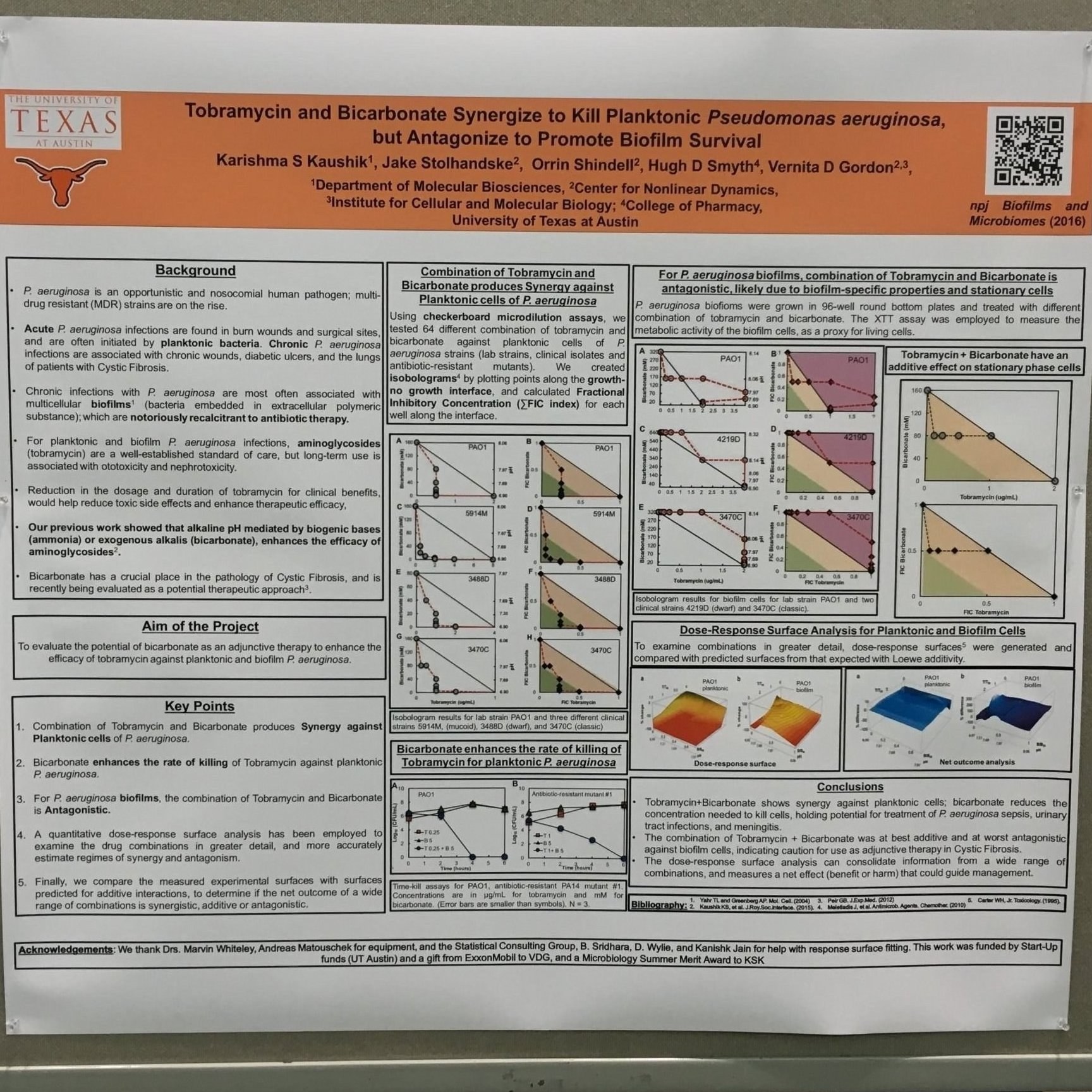
<p>In this PhD café article, <a href="https://indiabioscience.org/authors/qw8pNKgnooLdJRA" target="_blank" rel="noreferrer noopener">Karishma S Kaushik</a>, IndiaBioscience, recounts her transformative experience at an American Society for Microbiology (ASM) conference during her PhD, highlighting mentorship, networking, and professional growth. She emphasises the conference's value beyond scientific input, offering tips for maximising benefits, including attending diverse sessions, and following up post the event.</p><figure><a href="https://indiabioscience.org/columns/phd-cafe/attending-a-conference-as-a-ph-d-researcher-simple-tips-to-make-the-most-out-of-the-experience"><img
                width="2048"
                height="1249"
                style="max-width: 100%; height: auto"
                src="https://cdn.indiabioscience.org/media/articles/PhD-Cafe-article_KSK.png"></a></figure><p>My first conference as a PhD researcher was the <a href="https://asm.org/events" target="_blank">American Society for Microbiology (ASM)</a> Annual General Meeting in San Francisco, USA. I had just returned to bench work after having a baby, and my research on the effect of amphipathic molecules on biofilm formation was yet to get direction. I was also seriously considering whether I wanted to continue in the PhD program. As I designed my poster for the meeting, with very preliminary results, I found myself pondering, for more than one reason, what I would be doing at the meeting. Over a decade later, I look back at the conference as a turning point in my career. </p><figure style="margin-left: auto; margin-right: auto; text-align: center; width: 556px; max-width: 556px;"><img src="https://indiabioscience.org/media/articles/IMG_1163.JPG?1700451853344?1700451914979#asset:590989" data-image="590989" alt="Karishma Kaushik's poster at The ASM Microbe 2017. Picture Credit: Karishma Kaushik." width="556" height="556"><figcaption style="text-align: center;">Karishma Kaushik's poster at ASM Microbe. Picture Credit: Karishma Kaushik.</figcaption></figure><p>At a breakfast mentoring session of the meeting, structured like a ‘speed dating’ circuit, PhD students had the opportunity to interact with early-career researchers and senior scientists across various fields of Microbiology. After a few conversations, I summoned the courage to discuss the possibility of ‘mastering out’ of the PhD program with a senior colleague on the same table. The scientist (a complete stranger) very honestly shared their views about career opportunities with a Master’s versus a PhD, concluding with a memorable line that stayed with me.</p><blockquote class="pull-quote">"Now that you’re in the PhD, if you can, stay the course. You’ll see the other side."</blockquote><p>Later in the day, I attended a discussion related to doing Microbiology in hard places, including the Global South, with women scientists from across the world showcasing their professional stories. The stories spanned attempting to build a Molecular Biology laboratory in Yemen, returning to Kenya as a faculty, and running a group that supports women researchers in Pakistan. I do not remember much of the science at that meeting, but I returned inspired and energised to continue my PhD. </p><p>While these were sessions ‘I happened to attend’ at the meeting, the experience taught me the value of a conference, not only for the scientific input (which it will very likely bring forth) but also for networking, mentorship, and professional advancement. So, what are some simple tips to make the most of a conference as a PhD researcher?</p><p><strong>1. Interactive elements to your poster or slides:</strong> Your poster or talk serves to share your research and present you as a professional. Simple enhancements like including a QR code linking to your publications, resume, lab website, or personal webpage can increase engagement, generate interest, and facilitate follow-up conversations.</p><p><strong>2. Preparing or practicing your elevator pitch:</strong> If you already have an elevator pitch, it's beneficial to practice it a few times to ensure you're comfortable delivering it. If not, crafting concise and direct lines about yourself and your work for meetings with colleagues is essential.</p><p><strong>3. Business cards and Smart resumes: </strong>Despite the shift toward digital communication, a physical business card or smart resume (a small card with basic details and a QR code to your full resume) remains a valuable tool to initiate conversations and serve as a parting exchange while concluding an interaction. Another approach is an e-business card that can be air-dropped or emailed.</p><p><strong>4. Sending an email to someone you want to meet before the conference:</strong> Conference schedules and abstract books published in advance provide an opportunity to craft your individual plan for the meeting. Alongside scheduling scientific sessions to attend, proactively reaching out via email to colleagues you wish to meet can facilitate setting up a mutual time (if they respond) or serve as a convenient icebreaker when meeting them at the conference ('I sent you an email; I'm XYZ').</p><p><strong>5. Attending a wide range of sessions:</strong>
While scientific sessions typically take precedence during a meeting, other sessions like mentorship pods, networking lounges, and talks on visas and immigration for scientists, can offer valuable insights. They are often scheduled at the end of the day or towards the end of the meeting, but making time to attend these sessions can open up broader insights and opportunities.</p><p><strong>6. Joining conversations with colleagues you may not know:</strong> Engaging with colleagues you haven't met or only know through their work might seem daunting, especially as a young researcher. From my experience, joining a group discussion, and contributing when comfortable, can serve as an effective icebreaker. It's also crucial not to confine interactions solely to your lab group (if traveling together) or colleagues from a particular region, for example, your home country. Doing so could mean missing out on valuable opportunities to meet new peers and expand your scientific network.</p><p><strong>7. Staying the course of the conference: </strong>In multiple-day meetings, dropping off the conference schedule after a few days is tempting (sightseeing, anyone?). Based on my experience, spontaneous coffee conversations and invitations for dinners often happen towards the end of the meeting, with attendees becoming more familiar with each other. While these ‘sideline’ meetups can lead to collaborations and opportunities for professional development, they are also an excellent way to reflect on the conference proceedings and discuss plans for future meetings.</p><p><strong>8. Following up with emails after the meeting: </strong>Finally, it is always a good idea to follow up with emails to colleagues and organisers after the meeting, even if there are no concrete plans to work together. These can be ‘Thank you for a great meeting’, ‘Good to meet you’ or ‘Look forward to being in touch’ emails, which will ensure an exchange of email addresses, and provide a means to maintain conversation till the next meeting or reinitiate correspondence when a collaborative opportunity arises.</p><p>A rookie to large meetings, I had forgotten to exchange email addresses with the scientist I met at the breakfast table. I was fortunate that, a few years later at a subsequent ASM meeting, I encountered her again. Approaching her, I recounted the earlier incident, expressing my gratitude, 'I did see the other side of the PhD, thank you for your inputs.' Her response was a simple, 'Well, that's what conferences are for.'<br></p>
              ]]></content><category term="career-development" label="Career Development" /><category term="personal-experience" label="Personal Experience" /><category term="networking" label="Networking and Collaboration" /></entry><entry><title>Empathy: An important ingredient for a rewarding PhD journey</title><link
                  rel="alternate"
                  href="https://indiabioscience.org/columns/phd-cafe/empathy-an-important-ingredient-for-a-rewarding-phd-journey"
                  type="text/html"
                  /><summary type="html"><![CDATA[
                <p>In this PhD cafe article, <a href="https://www.linkedin.com/in/aditi-jain-ba674b78/" target="_blank" rel="noreferrer noopener">Aditi Jain</a>, Development Editor, <a href="https://pubs.acs.org/" target="_blank" rel="noreferrer noopener">ACS Publications</a>, emphasises the importance of empathy in academic settings, particularly research labs, for fostering a supportive and innovative environment. Cultivating empathy enhances relationships, supports colleagues during challenging times, and ultimately contributes to a positive and successful academic experience.</p>              ]]></summary><id>tag:indiabioscience.org,2023-10-23:/columns/phd-cafe/empathy-an-important-ingredient-for-a-rewarding-phd-journey</id><published>2023-10-23T15:30:00+05:30</published><updated>2023-10-06T10:02:05+05:30</updated><author><name>Aditi Jain</name><uri>https://indiabioscience.org/authors/AditiJain</uri></author><content type="html"><![CDATA[
                
<p>In this PhD cafe article, <a href="https://www.linkedin.com/in/aditi-jain-ba674b78/" target="_blank" rel="noreferrer noopener">Aditi Jain</a>, Development Editor, <a href="https://pubs.acs.org/" target="_blank" rel="noreferrer noopener">ACS Publications</a>, emphasises the importance of empathy in academic settings, particularly research labs, for fostering a supportive and innovative environment. Cultivating empathy enhances relationships, supports colleagues during challenging times, and ultimately contributes to a positive and successful academic experience.</p><figure><a href="https://indiabioscience.org/columns/phd-cafe/empathy-an-important-ingredient-for-a-rewarding-phd-journey"><img
                width="2048"
                height="1246"
                style="max-width: 100%; height: auto"
                src="https://cdn.indiabioscience.org/media/articles/PhD-Cafe-EMpathy.png"></a></figure><p>Have you ever been caught in a storm of discouragement and stress, feeling like you're wading through an academic abyss? If so, please know that you're not alone. Our ability to experience emotions is what makes us human. At times, we go through situations that deeply impact us, but can be hard for people around us to comprehend what we are going through. These feelings are natural during academic training and otherwise. </p><p>Although pursuing a Ph.D. can feel isolating and challenging, you have the ability to turn it into a fulfilling experience for yourself and those around you. How? The secret is by practicing empathy. <a href="https://www.emory.edu/LIVING_LINKS/empathy/">Numerous examples</a>, including my own experiences, affirm- that empathy is both unconditional and demanding. It may seem difficult, but in reality, it's also as simple as that.</p><p><strong>Empathy in research labs</strong></p><p>When you witness a research group fuelled by sustained collaborative spirit and mutual gains, you're certainly witnessing <a href="https://hbr.org/2023/02/practice-empathy-as-a-team">empathy in action</a>. The essence of empathy lies in understanding someone's circumstances without any preconceived notions. It's about cultivating a psychologically safe environment, enabling those around you to freely share their thoughts, ideas, and concerns without the shadow of judgment. </p><p><a href="https://www.gallup.com/cliftonstrengths/en/252236/empathy-theme.aspx">CliftonStrengths</a> (a talent assessment platform that describes what you naturally do best), enlists empathy as one of the 34 strengths and shows that people with empathy build strong relationships that unify a team and enhance its overall performance. This concept holds true for research labs, where empathy plays a crucial role in fostering innovation and engagement among lab mates. But it demands patience, mental fortitude, and a selfless disposition to genuinely listen and process any negative emotions being discussed. It's all about leading by example and being the person who cultivates a space for everyone to be heard and seen. Empathy facilitates the formation of deeper connections among lab mates, promoting the generation of unique ideas and benefiting everyone involved. </p><p><strong>A strong support system </strong></p><p>I completed my doctoral degree in 2020 from the Indian Institute of Science, Bengaluru, and stepped into a career in the publishing industry. It was then I took a moment to reflect on my past experiences of working in the lab with a diverse group of individuals. From interns fresh out of college to post-doctoral fellows who were also juggling the responsibilities of being parents, I witnessed a rich tapestry of life experiences. This made me realise how significantly my life has transformed, transitioning from living independently in a college hostel to embracing family life and societal norms. </p><figure style="margin-left: auto; margin-right: auto; text-align: center;"><img src="https://cdn.indiabioscience.org/media/articles/originals/Empathy-article-picture.png" data-image="568115" alt="A souvenir from Aditi’s PhD advisor, Kaushik Chatterjee, Materials Engineering, Indian Institute of Science- Bengaluru, a symbolic of mutual respect and appreciation extending beyond a Ph.D. degree. Picture Credit: Aditi Jain."><figcaption style="text-align: center;">A souvenir from Aditi’s PhD advisor, Kaushik Chatterjee, Materials Engineering, Indian Institute of Science- Bengaluru, a symbolic of mutual respect and appreciation extending beyond a Ph.D. degree. Picture Credit: Aditi Jain.</figcaption></figure><p>All of this led me to ponder if we provide enough support to our colleagues who might be navigating personal matters. Whether it’s having to leave an experiment midway to care for their children or struggling to meet deadlines while dealing with domestic issues —do we truly offer the support and understanding they need? We often underestimate the significance of having a strong support network unless life throws a curveball. I’m finding the courage to hold onto faith even amidst the swirling uncertainties.</p><blockquote class="pull-quote">As I navigate the delicate dance between my personal and professional life, I’m on this continuous journey of learning (and perhaps, improving!). </blockquote><p>It’s remarkable how a simple act of kindness can be a sprinkle of stardust, bringing positivity into the lives of those around us. <a href="https://doi.org/10.3389/fpsyg.2023.1156661">Research</a> backs this up too—when we’re in a happy state, our altruistic instincts kick in, propelling us to extend a helping hand, brainstorm solutions for others, and exhibit compassion. It’s this positive domino effect that fuels our desire to make meaningful changes in the world. </p><p><strong>Cultivating empathetic approach</strong></p><p>Cultivating empathy is essential for building trust and nurturing strong working relationships, which can provide valuable support when dealing with stressful situations. The <a href="https://www.adultdevelopmentstudy.org/">Harvard Study of Adult Development</a> reveals that the quality of our relationships strongly influences our well-being and motivation levels during uncertain times. Here are some situations for us to reflect on where your empathetic approach can have a significant impact:</p><ol><li>A colleague has returned to the lab after a family bereavement. Instead of urging them to swiftly resume their lab responsibilities, it's important to acknowledge and respect their pain by providing the necessary time and space to grieve. Doing so can lead to a quicker and more effective recovery.</li><li>Have you noticed a colleague engrossed in a time-sensitive experiment, skipping lunch or a coffee break? Consider grabbing them a drink or a samosa from the tea stall. Small acts of kindness can wield a significant impact!</li><li>If your advisor is feeling down following the rejection of their grant proposal, offering words of appreciation can be beneficial. Express how much you value being a part of their lab and emphasise working together to move forward. It's important to offer support to your mentor during tough times and otherwise.</li><li>Imagine an alumnus visiting the lab after a few years. How can we express our gratitude for their contribution, which continues to benefit the lab even though they have moved on? A little appreciation can make a lasting difference.</li><li>Before becoming upset and lodging a complaint, consider helping an intern in learning from their mistake. Giving people the benefit of the doubt can work wonders, even when things don't go as planned.</li><li>Celebrate the success of your peers rather than downplaying their achievements. Your actions can leave a lasting positive impact on others.</li></ol><figure style="margin-left: auto; margin-right: auto; text-align: center; width: 608px; max-width: 608px;"><img src="https://cdn.indiabioscience.org/media/articles/originals/Matrix-Aditi.png" data-image="568447" alt="A printable matrix to fill in with words or phrases about what empathy means to you and to remind yourself to practice it in a holistic way. Matrix conceptualised by Aditi Jain." width="608" height="215"><figcaption style="text-align: center;">A printable matrix to fill in with words or phrases about what empathy means to you and to remind yourself to practice it in a holistic way. Matrix conceptualised by Aditi Jain.</figcaption></figure><p>It would make a huge difference if our academic curriculum highlighted the power and significance of empathy not just as a training component, but also as our ambitions escalate. Meanwhile, this article strives to ignite the spark in each one of us to champion a culture of empathy and compassion within our research labs. By doing so, we can navigate challenges and achieve greater success. To help get started with this, I’ve created a matrix for you to fill in with the values that promote mutual affection, admiration, respect, and ultimately, foster happiness.</p><blockquote class="pull-quote">
Empathy comes with being mindful and regularly asking yourself, “How can I be a healing presence in the lives of those around me?”</blockquote><ol></ol>
              ]]></content><category term="personal-experience" label="Personal Experience" /><category term="advice" label="Advice" /><category term="science-communication" label="Science communication" /></entry><entry><title>Work-life balance during a PhD: Reframing the narrative</title><link
                  rel="alternate"
                  href="https://indiabioscience.org/columns/phd-cafe/work-life-balance-during-a-phd-reframing-the-narrative"
                  type="text/html"
                  /><summary type="html"><![CDATA[
                <p>In this PhD café article, <a href="https://indiabioscience.org/authors/qw8pNKgnooLdJRA" target="_blank" rel="noreferrer noopener">Karishma S Kaushik</a>, IndiaBioscience, reflects on her unique journey as a 'non-traditional' PhD candidate who juggled personal and professional commitments, including motherhood. Karishma explores the dynamic nature of work-life balance, and discusses the challenges of applying one-size-fits-all solutions for achieving balance across different phases of personal and professional growth.</p>              ]]></summary><id>tag:indiabioscience.org,2023-08-14:/columns/phd-cafe/work-life-balance-during-a-phd-reframing-the-narrative</id><published>2023-08-14T03:30:00+05:30</published><updated>2023-08-14T15:43:04+05:30</updated><author><name>Karishma Kaushik</name><uri>https://indiabioscience.org/authors/qw8pNKgnooLdJRA</uri></author><content type="html"><![CDATA[
                
<p>In this PhD café article, <a href="https://indiabioscience.org/authors/qw8pNKgnooLdJRA" target="_blank" rel="noreferrer noopener">Karishma S Kaushik</a>, IndiaBioscience, reflects on her unique journey as a 'non-traditional' PhD candidate who juggled personal and professional commitments, including motherhood. Karishma explores the dynamic nature of work-life balance, and discusses the challenges of applying one-size-fits-all solutions for achieving balance across different phases of personal and professional growth.</p><figure><a href="https://indiabioscience.org/columns/phd-cafe/work-life-balance-during-a-phd-reframing-the-narrative"><img
                width="720"
                height="440"
                style="max-width: 100%; height: auto"
                src="https://cdn.indiabioscience.org/media/articles/Monday-article-title-image.png"></a></figure><p>“<em>We would like to invite you for a talk at the </em><a href="https://meetings.embo.org/event/22-func-nucleic-acids" target="_blank"><em>EMBO Lecture Course on Functional Nucleic Acids</em></a><em> at the </em><a href="https://www.rcb.res.in/" target="_blank"><em>Regional Centre for Biotechnology, Faridabad</em></a>,” said the email from the organisers in August 2022.</p><p>Confused, I replied, “<em>I do not work on functional nucleic acids</em>!”</p><p>“<em>It is expected to be a talk on ‘Work-life balance in academic science</em>,’” said the email in response.</p><p>Having never been asked to talk on this subject before, I gathered myself and chuckled, “<em>I am not sure I am doing a good job with that either</em>.” As I reflected on the invitation, I realised, “<em>Maybe I do have something to talk about?”</em></p><p>I started my PhD at 29, after 5.5 years of a medical degree and a 3-year residency in Clinical Microbiology. In addition to being a medical doctor and an older PhD candidate, I was also married, having moved to the United States with my partner. Being a ‘non-traditional’ PhD candidate meant that my PhD was characterised by large commitments on both professional and personal fronts. In the second year of the PhD, I chose to become a mother, and as I often say in a lighter vein, that there is no better situation to ensure work-life balance than <a href="https://www.nature.com/articles/d41586-019-03162-7" target="_blank">becoming a parent during your PhD</a>. </p><p>My days started with dropping my son off to daycare, and reaching the laboratory at 9 am. I structured my day to ensure that time was well-utilised. I learnt to run experiments in parallel (fortunately, bacteria do not need too much cajoling to grow!), ordered reagents while waiting for time-points, and had quick lunches. At 4:30 pm, I wrapped up my work day in the lab, and headed home to relieve the afternoon nanny. The evenings were spent with my son; towards the end of my PhD, I used late evenings to analyse data and write my thesis. I graduated in five years with five research publications.</p><blockquote class="pull-quote">Interestingly, while I built an efficient system to incorporate work and personal choices during my PhD, I struggled with ensuring this balance as an independent investigator. This was likely due to the fact that a well-defined goal (complete the PhD) was now replaced by a range of professional responsibilities and aspirations.</blockquote><p>Building and maintaining a work-life structure is a dynamic entity that varies across people and phases in life. Therefore, while <a href="https://www.ncbi.nlm.nih.gov/pmc/articles/PMC8282063/" target="_blank">actionable steps towards work-life balance</a>
are thought-provoking, they notably, fail to account for individual situations. Along these lines, <a href="https://twitter.com/sofiavlachou28/status/1545709533984587778" target="_blank">a Twitter discussion</a> on ‘Is research 9 to 5?’, presents an interesting example, with responses that range from ‘It’s a job!’ to ‘It’s a way of life’. </p><figure style="margin-left: auto; margin-right: auto; text-align: center;"><img src="https://cdn.indiabioscience.org/media/articles/originals/PhDCafe_KSK2.png" data-image="515607" alt="A compilation of two vastly different responses to the Twitter discussion ‘Is research 9 to 5?’" width="504" height="299"><figcaption style="text-align: center;">Two vastly different responses to the Twitter discussion ‘Is research 9 to 5?’</figcaption></figure><p><strong>An exercise in finding underlying principles behind work-life balance</strong></p><p>Recognising the insufficiencies and challenges of ‘templates’ for work-life balance, I decided to deliver my talk as an exercise with the audience, a large majority of who were PhD researchers. Using a series of four exercises, we approached the subject as ‘Could we find the underlying principles behind work-life balance?’, with prompts, audience responses and take-home messages.</p><p>The four sets of exercises and examples of responses were as follows:</p><p><strong><em>Exercise 1: What does work-life balance on a daily or weekly basis (short-term) look like for you?</em></strong></p><p>Examples of audience responses:</p><ul><li>engaged in formal work during the bulk of the day time</li><li>clear start and end times to work (no digital availability at other times)</li><li>single communication channel (email, for example)</li><li>daily practices related to healthy living, weekends with family</li></ul><p><strong>Take-home message:</strong> Our work-life balance is unique to us. </p><p><strong><em>Exercise 2: How is your work-life structure different from say, 5 weeks ago, 5 months ago, 5 years ago?</em></strong></p><p>Examples of audience responses: </p><ul><li>I need to work more on finding that balance (from 5 years ago)</li><li>the structure changes with work travel, conferences, online meetings, deadlines (from 5 weeks ago)</li><li>varies children's’ sick days, family visiting, home repairs (from 5 days ago)</li></ul><p><strong>Take-home message: </strong>Work-life balance is ever changing and dynamic.</p><figure style="margin-left: auto; margin-right: auto; text-align: center; width: 661px; max-width: 661px;"><img src="https://cdn.indiabioscience.org/media/articles/originals/PhDCafe_KSK3.png" data-image="515609" alt="Examples of the dynamic nature of work-life balance, using #WorkLifeBalance on Twitter" width="661" height="169"><figcaption style="text-align: center;">Examples of the dynamic nature of work-life balance, using #WorkLifeBalance on Twitter </figcaption></figure><p><strong><em>Exercise 3: How would you think about ‘success’ at work and </em></strong><strong><em>how </em></strong><strong><em>would you think about personal ‘success’? </em></strong></p><p>Examples of audience responses (‘success’ at work): </p><ul><li>success at work is being excited about the science, about the Qs and As</li><li>building a happy and productive team</li><li>contributing to the wider science ecosystem in India </li></ul><p>Examples of audience responses (personal ‘success’):</p><ul><li>enjoying my role as a friend / partner </li></ul><ul><li>getting regular exercise </li></ul><ul><li>eating healthy meals </li></ul><ul><li>reading non-science materials </li></ul><ul><li>spending substantial time spent with family and social groups</li></ul><p><strong>Take-home message:</strong> Building our own metrics for professional and personal ‘success’ can help enforce work-life balance </p><p><strong><em>Exercise 4: How does your work-life balance change in the face of peer pressure/expectations?</em></strong></p><p>Examples of audience responses: </p><ul><li>I spent longer hours at work, but not productive hours </li><li>I neglect sleep, exercise and social interactions </li><li>I started to believe that I needed to fit into the culture of ‘overwork’</li></ul><figure style="margin-left: auto; margin-right: auto; text-align: center; width: 564px; max-width: 564px;"><img src="https://cdn.indiabioscience.org/media/articles/originals/PhDCafe_KSK4.png?1691986990108" data-image="515611" alt="An example of advocating for systemic change related to work-life balance. With permission from @AcademicChatter on Twitter" width="564" height="351"><figcaption style="text-align: center;">An example of advocating for systemic change related to work-life balance. With permission from @AcademicChatter on Twitter</figcaption></figure><p><strong>Take-home message:</strong> Believing in our choice of a way of work and life is a continuous process. On an individual level, this may require making thoughtful choices of jobs, organisations, and work portfolios. On a larger level, this can mean advocating for systemic change.</p><p><strong>Reframing work-life balance with underlying principles </strong></p><figure style="margin-left: auto; margin-right: auto; text-align: center; width: 694px; max-width: 694px;"><img src="https://cdn.indiabioscience.org/media/articles/originals/PhDCafe_KSK5.png" data-image="515476" alt="A reflexive framework for achieving work-life balance" width="694" height="330"><figcaption style="text-align: center;">A reflexive framework towards work-life balance</figcaption></figure><p>Taken together, the set of interactive exercises brought forth a framework that highlighted work-life balance as being a unique and dynamic entity, and presented a reflexive structure that could be leveraged towards building, maintaining and revisiting work-life balance across phases and stages of professional and personal growth.<strong><em><br></em></strong></p>
              ]]></content><category term="women-in-science" label="Women in Science" /><category term="personal-experience" label="Personal Experience" /></entry><entry><title>My experiments with science and its engagement</title><link
                  rel="alternate"
                  href="https://indiabioscience.org/columns/phd-cafe/my-experiments-with-science-and-its-engagement"
                  type="text/html"
                  /><summary type="html"><![CDATA[
                <p>This PhD Café article explores the science communication journey of <a href="https://www.linkedin.com/in/guptadevanshi/" target="_blank" rel="noreferrer noopener">Devanshi Gupta</a>, a PhD student at the <a href="http://cdfd.org.in/" target="_blank" rel="noreferrer noopener">Centre for DNA Fingerprinting and Diagnostics (CDFD)</a>, Hyderabad. Devanshi highlights the importance of effective science communication, the challenges she faced, and the rewarding experiences that fuelled her passion for sharing science with broad audiences.</p>              ]]></summary><id>tag:indiabioscience.org,2023-06-26:/columns/phd-cafe/my-experiments-with-science-and-its-engagement</id><published>2023-06-26T03:30:00+05:30</published><updated>2023-06-26T15:11:43+05:30</updated><author><name>Devanshi Gupta</name><uri>https://indiabioscience.org/authors/eZV71Go2on1dk8a</uri></author><content type="html"><![CDATA[
                
<p>This PhD Café article explores the science communication journey of <a href="https://www.linkedin.com/in/guptadevanshi/" target="_blank" rel="noreferrer noopener">Devanshi Gupta</a>, a PhD student at the <a href="http://cdfd.org.in/" target="_blank" rel="noreferrer noopener">Centre for DNA Fingerprinting and Diagnostics (CDFD)</a>, Hyderabad. Devanshi highlights the importance of effective science communication, the challenges she faced, and the rewarding experiences that fuelled her passion for sharing science with broad audiences.</p><figure><a href="https://indiabioscience.org/columns/phd-cafe/my-experiments-with-science-and-its-engagement"><img
                width="2048"
                height="1274"
                style="max-width: 100%; height: auto"
                src="https://cdn.indiabioscience.org/media/articles/Devanshi-Gupta.png"></a></figure><p>Since childhood, I have loved pondering new ideas and exploring them through science. I wondered why garbage smells or why we feel thirsty despite our bodies being mostly composed of water. I rarely found people who could answer my questions; most of them could only appreciate the quench for knowledge.</p><p>It's disheartening to see that our traditional education system doesn't place enough emphasis on questioning, critical thinking, and research. Instead, we're constantly pushed to memorise information to regurgitate it during exams. I never enjoyed the task of memorising the names of cranial nerves in the human body. But what truly fascinated me was understanding how the human brain functions and witnessing its lightning-fast responses to various stimuli.</p><p>While diving deep into advanced science, I took up the challenge of explaining its mind-blowing concepts to my mom. Whether it was understanding the process of milk curdling or exploring the science of floating on water, I made sure to share the science behind everyday phenomena with her. And you know what? It struck me that curiosity is like a spark that sets off a chain reaction of more curiosity.</p><p><strong>How did it start?</strong></p><p>My journey in science communication began during my PhD when I participated in journal clubs. I found most presentations dull and unengaging, lacking storytelling; they simply bombarded western blots and bar graphs on the audiences.</p><p>When my turn to present at journal club arrived, I aimed to make my work understandable to everyone. Since my research involves studying the regulation of multi-protein complex assemblies in the cell, I started my presentation with a quote by John Donne, emphasising that just as no man is an island, proteins cannot function alone. I glanced at my PhD supervisor and noticed a smile on his face — that was my green flag.</p><p>Over the years, I have given numerous presentations within the lab, at other institutes, and at conferences. I constantly experiment with storytelling angles and humour, striving to make my research engaging and memorable for the audience.</p><p><strong>The stepping stone in science communication</strong></p><p>I attended a short course on ‘Freelancing in science communication’ by Ipsa Jain, organised by <a href="https://www.scirio.in/">SciRio</a>. </p><blockquote class="pull-quote">During the course, I mustered up the courage to ask a seemingly foolish question: “Can you please clarify what exactly science communication is? There are so many different definitions, and I'm confused about which one is the real deal”. </blockquote><p>They say that it's worth risking foolishness for greatness. Surprisingly, the place where I voiced my confusion became the very place where my journey in science communication began. </p><p>When I joined SciRio, I had little knowledge about the science communication space in India and abroad. I was unfamiliar with the relevant people, media platforms, content types, target audiences, and the tools involved. All I knew was I am willing to learn whatever comes my way. </p><p>I remember organising a capacity-building workshop at SciRio, specifically designed for beginners in science communication. We aimed to provide a comprehensive overview of the science communication landscape by inviting accomplished professionals such as writers, editors, podcasters, and science artists. They generously shared their career journeys and provided valuable insights. The workshop was a transformative experience for me, as the constructive feedback from these experts greatly improved my writing skills. In fact, one of my writing pieces was selected as one of the best popular science stories in the <a href="https://www.awsar-dst.in/">DST-AWSAR</a> 2021 competition. This achievement served as a significant milestone in my journey and solidified my passion for communicating science in interactive and engaging ways.</p><p>While acquiring a skill and utilising it to the fullest is truly rewarding, sharing that skill with others for their growth is an extraordinary feeling. When I came across a call for mentors in science writing for a science outreach project ‘<a href="https://themindgala.wixsite.com/themindgala">The Mind Gala</a>,’ I knew I had to seize the opportunity. I volunteered to mentor eight participants in crafting popular science stories focused on neuroscience. Together, we compiled our articles into a captivating science book titled "<a href="https://themindgala.wixsite.com/themindgala/talesofneuroscience">Tales of Neuroscience</a>," which was recently launched. The mentorship experience turned out to be a two-way road, and I truly believe in the adage that says, "We Rise by Lifting Others." I learned just as much from my mentees as they did from me, fostering a sense of mutual growth and achievement.</p><p><strong>Taking science outside the lab</strong></p><p>To expand my horizons in science communication, I took on the responsibility of managing social media and curating content for SciRio. This allowed me to observe people, ask relevant questions, and experiment with different formats, constantly trying out new approaches. </p><p>One of the most exciting experiences was participating in the <a href="https://euraxess.ec.europa.eu/worldwide/india/science-slam">Euraxess India Science Slam Competition 2022</a>. Here, I presented my research as a story, without relying on data or results, in an entertaining way. When I was shortlisted for the <a href="https://youtu.be/jsGs4pq53us">live finals</a>, I was overjoyed. On the day of the finale, the sheer happiness and satisfaction I derived from sharing my research with strangers who may not have a science background and making them giggle, laugh, and marvel at the same time, was hugely rewarding. </p><p>In addition to my science communication endeavours, I was fortunate to secure an internship with <a href="https://www.indiasciencefest.org/">India Science Festival</a> 2023. Here, I had the opportunity to delve into diverse<a href="https://www.indiasciencefest.org/unveiling-the-rainbow-of-science-with-india-science-festival/"></a><a href="https://www.indiasciencefest.org/unveiling-the-rainbow-of-science-with-india-science-festival/">roles</a> such as content writing, speaker engagement, and emceeing. Connecting with people and getting a glimpse into their career paths at the festival proved to be an incredibly enriching experience.</p><figure style="margin-left: auto; margin-right: auto; text-align: center; width: 348px; max-width: 348px;"><img src="https://cdn.indiabioscience.org/media/articles/Curated-a-Storybox-of-bios-for-all-the-renowned-scientists-and-science-communication-experts-at-India-Science-Festival-2023.jpeg" data-image="499746" alt="Curated a Storybox of bios for all the renowned scientists and science communication experts at India Science Festival 2023. (Photo Credits: Devanshi Gupta)" width="348" height="472"><figcaption style="text-align: center;">A Storybox of bios for scientists and science communication experts at India Science Festival 2023, Hyderabad. (Photo Credits: Devanshi Gupta)</figcaption></figure><p>In India, many scientists are working on ground breaking technologies, but only a few can effectively communicate their work to wider audiences. While some academic institutions support science outreach initiatives, not all do. However, even when our institute may not provide support, we have the power to support our institute. As an <a href="https://elifesciences.org/inside-elife/f744fae0/elife-community-ambassadors-welcoming-128-researchers-to-the-programme">eLife Community Ambassador</a>, I proudly represented my institute at international events, realising that science should not be confined to the lab, but must reach a broader audience.</p><p><strong>Navigating science engagement while doing a PhD</strong></p><p>As a PhD student, I embrace the dual role of being a scientist by day and a creator by night. The skills I've gained through my research journey, such as observation, hypothesis testing, and resilience, prove invaluable beyond academia. While my days are primarily dedicated to lab work and experiments, I seize any spare moments between tasks to immerse myself in the world of science communication.</p><figure style="margin-left: auto; margin-right: auto; text-align: center; width: 426px; max-width: 426px;"><img src="https://cdn.indiabioscience.org/media/articles/Presenting-my-research-at-a-scientific-conference-AICBC-2022-at-University-of-Kashmir.jpeg" data-image="499744" alt="Presenting my research at a scientific conference, AICBC 2022 at University of Kashmir. (Photo Credits: Devanshi Gupta)" width="426" height="375"><figcaption style="text-align: center;">Presenting my research at the scientific conference AICBC 2022 at the University of Kashmir. (Photo Credits: Devanshi Gupta)</figcaption></figure><p>Driven by an insatiable curiosity, researchers like me constantly seek out new discoveries and innovative ideas. This same drive led me to explore the realm of science communication. I delved into job descriptions of science communicators, read about notable figures in the field, subscribed to newsletters, and immersed myself in relevant books. By keenly observing successful science communicators, I learned different communication styles. Though challenging initially, each small victory boosted my confidence and motivated me to strive for improvement.</p><p>A PhD not only deepens our expertise in specific research areas but also offers personal growth opportunities. It equips us with valuable skills like effective communication, storytelling, strategic thinking, mentoring, self-belief, and perseverance. These skills are not only crucial for a career in science communication but also valuable in various other aspects of professional life.</p>
              ]]></content><category term="personal-experience" label="Personal Experience" /><category term="outreach" label="Outreach" /><category term="science-communication" label="Science communication" /></entry><entry><title>My PhD journey as a woman wildlife researcher on a motorbike</title><link
                  rel="alternate"
                  href="https://indiabioscience.org/columns/phd-cafe/my-phd-journey-as-a-woman-wildlife-researcher-on-a-motobike"
                  type="text/html"
                  /><summary type="html"><![CDATA[
                <p>Brinky Desai, a PhD student at <a href="https://ahduni.edu.in/academics/schools-centres/school-of-arts-and-sciences/faculty/brinky-desai/" target="_blank" rel="noreferrer noopener">Ahmedabad University</a>, shares her challenges as a woman researcher conducting fieldwork on Mugger crocodiles in remote areas of Gujarat. In the first article of this year's PhD Cafe series, she describes the physical and mental strain of fieldwork, particularly during the COVID pandemic, as well as the challenges of working with crocodiles, including navigating hygiene facilities as a woman researcher in the field.</p>              ]]></summary><id>tag:indiabioscience.org,2023-05-01:/columns/phd-cafe/my-phd-journey-as-a-woman-wildlife-researcher-on-a-motobike</id><published>2023-05-01T03:30:00+05:30</published><updated>2023-05-07T15:16:11+05:30</updated><author><name>Brinky Desai</name><uri>https://indiabioscience.org/authors/0P6G19yvNW1Xxzy</uri></author><content type="html"><![CDATA[
                
<p>Brinky Desai, a PhD student at <a href="https://ahduni.edu.in/academics/schools-centres/school-of-arts-and-sciences/faculty/brinky-desai/" target="_blank" rel="noreferrer noopener">Ahmedabad University</a>, shares her challenges as a woman researcher conducting fieldwork on Mugger crocodiles in remote areas of Gujarat. In the first article of this year's PhD Cafe series, she describes the physical and mental strain of fieldwork, particularly during the COVID pandemic, as well as the challenges of working with crocodiles, including navigating hygiene facilities as a woman researcher in the field.</p><figure><a href="https://indiabioscience.org/columns/phd-cafe/my-phd-journey-as-a-woman-wildlife-researcher-on-a-motobike"><img
                width="2930"
                height="1798"
                style="max-width: 100%; height: auto"
                src="https://cdn.indiabioscience.org/media/articles/Brinky-Desai.png"></a></figure><p>Starting my PhD and diving headfirst into academia turned my life upside down. While I was no stranger to fieldwork, it was the only thing familiar in an otherwise unfamiliar place. The rush of adrenaline that comes with searching for data is unparalleled, but fieldwork is not without its challenges.</p><p>To outsiders, my fieldwork may seem like a fun outing, but as a wildlife researcher, I know it's anything but a walk in the park. It's important to recognize that fieldwork can be incredibly isolating, physically taxing, and mentally draining. Further, women in the field face a unique set of challenges. </p><p>As a woman conducting her PhD fieldwork on a motorbike across urban, rural, and remote areas of Gujarat, I have several stories and anecdotes to share.<br></p><blockquote class="pull-quote"><em>Despite the challenges, there's no adrenaline rush quite like fieldwork.</em></blockquote><p><strong>Fieldwork during COVID</strong></p><p>Starting my Ph.D. in mid-2019, my supervisor and I were excited to apply for funds to conduct fieldwork on Mugger crocodiles. Unfortunately, the COVID pandemic derailed our plans as medical research took priority, and our grant applications were rejected. Being someone who loves fieldwork, I felt trapped, unable to do what I love. However, at the beginning of 2021, my supervisor and I came up with a groundbreaking idea: a biometric system using drone images to non-invasively tag individual Mugger crocodiles - an Aadhar card for crocodiles! </p><p>The pandemic continued to make fieldwork difficult, but I found a way around it by traveling on motorbike with all the instruments I needed to collect data. While my supervisor and I made certain of my safety, I was determined to carry out the fieldwork, and had the support of my parents, lab-mates, and close friends. My supervisor checked on me multiple times in a day to make sure I was safe and had everything I needed. The encouragement of my professional and personal communities helped me complete the challenging journey of 3500 km across Gujarat.</p><figure style="margin-left: auto; margin-right: auto; text-align: center; width: 416px; max-width: 416px;"><img src="https://cdn.indiabioscience.org/media/articles/Me-and-my-supervisor-looking-for-scats.jpeg" data-image="491574" alt="Brinky with her supervisor in field (Photo by Brinky Desai)" width="416" height="277"><figcaption style="text-align: center;">Brinky with her supervisor in the field (Photo by Brinky Desai)</figcaption></figure><p><strong>Working with Mugger crocodiles </strong></p><p>During this time, despite the mental and physical strain of the fieldwork, my passion for working with Mugger crocodiles kept me going. After a 30-day field trip from mid-March to mid-April 2021, I had collected all the data I needed for my research, and it was time to head back to the lab. With the help of my interdisciplinary team of co-authors, we developed a deep learning algorithm to <a href="https://india.mongabay.com/2022/11/identifying-individual-mugger-crocodiles-using-drone-technology-to-minimise-conflicts/">identify individual animals</a>, and our model got <a href="https://www.sciencedirect.com/science/article/abs/pii/S1574954122003247">published</a>
at the end of the year. The fieldwork and coding work were equally challenging, but our success was a testament to our perseverance and dedication.</p><p>Recently, I embarked on the final leg of my PhD fieldwork in Vadodara, where I had to collect scat samples from a free-ranging population of Mugger crocodiles, this time with a Master's student who was interning on the project. We were in 'croc' territory, so the biggest challenge was collecting samples without becoming croc-food. One of us would look out for muggers, and the other would collect the scat sample. Sometimes, we could see scat on the bank but could not collect them due to large crocodiles basking nearby. It was dangerous for us, and we had a protocol where we do not disturb animals during basking. To overcome this, we decided to drive in bone-chilling, morning weather to reach before basking time and collect the required scat samples, a 'chilling' experience on a motorbike for 4000 kilometers, despite multiple warm layers.</p><p>Fieldwork is not a vacation. To me, a vacation means lounging by the pool with a cold drink after a refreshing swim (my version of 'basking'). But unless you see me doing that, I'm hard at work in the field, collecting the data that will push my research forward. These challenges are what every fieldworker faces, and I write this to want colleagues and community members to understand the importance of fieldwork and the dedication required to collect data that can drive scientific progress.</p><figure style="margin-left: auto; margin-right: auto; text-align: center; width: 383px; max-width: 383px;"><img src="https://cdn.indiabioscience.org/media/articles/Me-taking-seflie-with-local-community-living-on-the-banks-with-crocodiles.jpg" data-image="491575" alt="Brinky with local community during a field visit in Gujarat (Photo by Brinky Desai)" width="383" height="297"><figcaption style="text-align: center;">Brinky with the local community during a field visit in Gujarat (Photo by Brinky Desai)</figcaption></figure><p><strong>Hygiene and Isolation</strong></p><p>Being a woman in fieldwork, it can be nerve-wracking to discuss hygiene facilities with your administration or university. Past experiences have left me fearing that I'll be seen as incapable or asking too much, despite knowing that I'm physically capable of performing just as well as anyone else. Thankfully, I have a female supervisor and a supportive university that prioritise the safety and hygiene of their students.</p><p>As an extroverted person who loves being around people, fieldwork can be a rollercoaster of emotions, especially during the COVID lockdown. I'm no stranger to feeling isolated during my eight-month stint at Madras Crocodile Bank Zoo in Chennai from November 2021 to December 2022, away from my loved ones. In those moments, my guide would remind me of our mission, saying, "Brinky, remember we are doing all this for good science. A little bit more, and you'll be back in the lab with your people." My lab mates would even send me local Gujarati snacks all the way to Chennai so that I could have a little part of my home with me. One of my close friends even made a trip to Chennai just to see me. Even though my parents couldn't visit due to COVID restrictions, they made sure to call me every day to check on me.</p><p>Through my own fieldwork experiences, I've learned that every research area has its unique set of challenges, and it's crucial to be sensitive to our colleagues' experiences. Despite the challenges, there's no adrenaline rush quite like fieldwork. If I could, I would choose it all over again in a flick of a second. At the end of the day, it's all for the greater good of science and my love for crocodilians!</p>
              ]]></content><category term="ecology" label="Ecology" /><category term="women-in-science" label="Women in Science" /><category term="personal-experience" label="Personal Experience" /></entry><entry><title>A PhD for the love of wisdom</title><link
                  rel="alternate"
                  href="https://indiabioscience.org/columns/phd-cafe/a-phd-for-the-love-of-wisdom"
                  type="text/html"
                  /><summary type="html"><![CDATA[
                <p dir="ltr">What is a PhD – is it a certificate or a way of life? What is the significance of adorning the black robe? Is there a connection between science and philosophy? Is there a historical background to it? In this article, Jithin pays tribute to the doctorate and how it can drive away naive realism and bring substantive reasoning into our lives. He pays homage to the great minds —Plato, Socrates, Aristotle, Whitehead and Einstein —true lovers of knowledge.<br /></p>              ]]></summary><id>tag:indiabioscience.org,2021-12-06:/columns/phd-cafe/a-phd-for-the-love-of-wisdom</id><published>2021-12-06T00:30:00+05:30</published><updated>2021-12-24T11:21:57+05:30</updated><author><name>Jithin Sunny</name><uri>https://indiabioscience.org/authors/8XNQKeb8eZ1oy6l</uri></author><content type="html"><![CDATA[
                
<p dir="ltr"><strong>What is a PhD – is it a certificate or a way of life? What is the significance of adorning the black robe? Is there a connection between science and philosophy? Is there a historical background to it? In this article, Jithin pays tribute to the doctorate and how it can drive away naive realism and bring substantive reasoning into our lives. He pays homage to the great minds —Plato, Socrates, Aristotle, Whitehead and Einstein —true lovers of knowledge.</strong><br /></p><figure><a href="https://indiabioscience.org/columns/phd-cafe/a-phd-for-the-love-of-wisdom"><img
                width="675"
                height="340"
                style="max-width: 100%; height: auto"
                src="https://cdn.indiabioscience.org/media/articles/Source-Pixabay-Images_2021-12-05-045139.png"></a></figure><p dir="ltr">During the days of Socrates, Plato and Aristotle, Greece underwent a cultural transformation. Curiosity, problem solving and scientific counter were at their peak. A methodological approach to critical thinking was developed. Verbal communication was converted into written transcripts and as people’s intellect developed, they acquired new beliefs and assumptions. Even in today’s modern world, the process of learning is based on the knowledge transfer system from the rebellious age of Socrates. This was the origin of philosophy, the way of contemplation. The word philosophy has its roots in the ancient Greek language – ‘philo’ means ‘love’ and ‘sophos’ stands for ‘wisdom’.</p><p dir="ltr">Science, in its true sense, is philosophical. Alfred North Whitehead, an 18th century mathematician and philosopher, <a href="https://teacher.depaul.edu/documents/romance-precision-generalizationtherhythmoflearning.pdf">defined</a> learning as consisting of three steps: romance, precision and generalization. It is implicit that the first step does not involve critical thinking. At this stage, the person is curious about a problem; the narrative is based on a story that has been planted in the mind. In the second step, the theory starts to acquire a proper shape. A significant amount of time is now spent on critical thinking, conceptualization and evaluation. When this ends, in the third step, the mind returns to its original state of imagination. However, this time, the goal is to apply the developed theory further. It is through this process that the existing inconsistencies in inherited ideas are challenged, and theories that do not make much sense are questioned. It is through this process that a philosophical thought opposes the blind adherence to the working of nature.</p><p dir="ltr">A tight historical link exists between science and philosophy. One of the most celebrated physicists of all times Albert Einstein, in his letter to a young African-American philosopher Robert Thornton in 1944, <a href="https://plato.stanford.edu/entries/einstein-philscience/">states that</a> "A knowledge of the historic and philosophical background gives that kind of independence from prejudices of his generation from which most scientists are suffering. This independence created by philosophical insight is—in my opinion— the mark of distinction between a mere artisan or specialist and a real seeker after truth."</p><p dir="ltr">The two fields of science and philosophy are intricately woven together, so much so that even to perceive them differently can contribute negatively to the proposed scientific critique. It is through philosophy that science can formulate novel theories. Lucie Laplane, a philosopher in biology who also works in the field of cancer stem cells, in her recent <a href="https://www.pnas.org/content/116/10/3948">opinion</a> in the Proceedings of the National Academy of Sciences of the United States of America, states that seminal philosophies have greatly impacted modern science. An example is in establishing the distinction between the self and the non-self, especially in the field of auto-immunity, which is rather vague. The self/non-self critique has challenged various existing theories in this field along with tumour growth and cellular interactions. Similarly, the established narrative of an organism’s homogenous-self has been questioned. In this case, the existence of a symbiotic community harbouring in everyone—one that is recognised but not eliminated by the immune system—is a theory derived from philosophical investigation, motivated by the idea of oneness. </p><p dir="ltr">At this juncture, it is critical to understand the true meaning of philosophy beyond the doctorate. For everyone embarking upon this journey to become a Doctor of Philosophy (PhD), the black robe is a symbol of dignity, honour, wisdom and justice. The Platonic academy in ancient Greece would have required a black robe just to enter. Plato believed that once a person wears the black robe, he/she should no longer think of this transitory world; instead, they should expand their knowledge beyond what is seen. The world as others see is, henceforth, dead to them. At that very instance, the PhD becomes a way of life. <a href="https://paulosmargregorios.in/?p=2068">Such reflections could be seen</a> amongst the ancient Indian Sramanas who were inclined to pursue the truth and hold it above all else. Their communications were based on philosophical critique and their scientific endeavours were deeply motivated by it. It is only by a thorough philosophical introspection that altruism can be included in scientific pursuits.<br><br><br></p>
              ]]></content><category term="personal-experience" label="Personal Experience" /></entry><entry><title>Choosing to be a mother while pursuing a PhD</title><link
                  rel="alternate"
                  href="https://indiabioscience.org/columns/phd-cafe/choosing-to-be-a-mother-while-pursuing-a-phd"
                  type="text/html"
                  /><summary type="html"><![CDATA[
                <p>Enam Reyaz, a student at the Jamia Hamdard Institute of Molecular Medicine (JH-IMM), recounts her physical and emotional roller-coaster of experience embracing pregnancy and motherhood while pursuing a PhD degree; what helped her challenge the taboos and what more can be done by research institutions to support expectant mothers.</p>              ]]></summary><id>tag:indiabioscience.org,2021-08-02:/columns/phd-cafe/choosing-to-be-a-mother-while-pursuing-a-phd</id><published>2021-08-02T00:00:00+05:30</published><updated>2021-08-02T00:00:02+05:30</updated><author><name>Enam Reyaz</name><uri>https://indiabioscience.org/authors/35WJ10EJ4XMnm8R</uri></author><content type="html"><![CDATA[
                
<p>Enam Reyaz, a student at the <a href="https://indiabioscience.org/orgs/jamia-hamdard">Jamia Hamdard</a> Institute of Molecular Medicine (JH-IMM), recounts her physical and emotional roller-coaster of experience embracing pregnancy and motherhood while pursuing a PhD degree; what helped her challenge the taboos and what more can be done by research institutions to support expectant mothers.</p><figure><a href="https://indiabioscience.org/columns/phd-cafe/choosing-to-be-a-mother-while-pursuing-a-phd"><img
                width="720"
                height="440"
                style="max-width: 100%; height: auto"
                src="https://cdn.indiabioscience.org/media/articles/Enam_PhDCafe6.png"></a></figure><p>Becoming a mother is an immensely satisfying feeling for many women. Pregnancy brings with it several physical, mental, and emotional changes, be it for a working professional or a homemaker. These changes become very difficult to deal with if the expectant mother happens to be a PhD scholar. Considering the level of dedication required for research, both physical and mental, choosing to be pregnant midway during PhD is often considered a taboo. </p><p>Knowing all this, I still embraced pregnancy during my second year of PhD. Initially, I felt torn between feeling happy and sad. I was afraid that it might mean an end to my career. A news I would typically have rejoiced in had instead sent my mind spiralling into worry.</p><p>My biggest initial challenge was to break this news to my supervisor. It took me more than a week to gather the courage, and what unfolded next gave me an immediate boost. My supervisor’s encouraging and concerned approach let me breathe a sigh of relief.</p><p>The next nine months were not so easy. Initially, it felt like a seesaw – with constant ups and downs. I lived through a variety of experiences in my molecular parasitology laboratory - experiments interrupted by nausea, necessitating a multitude of quick visits to the washroom, terrible backaches induced by constant sitting, attending highly rewarding lectures and conferences, preparing for presentations that provoked a whole new level of anxiety, meeting deadlines, facing a few raised eyebrows from strangers, and receiving some amazing pregnancy tips from peers. With occasional kicks from the life inside me and an immensely supportive bunch of co-researchers, I sailed through those nine months.</p><p>However, not everyone has the same experience. Pregnancy is a phase that treats different people differently, and every woman has her own story to narrate. However, many of the challenges remain the same for all. </p><p>There is a great sense of mental pressure. The pressure to perform, to be productive, and to stand out. The pressure to not be accused of incompetence, the pressure to prove that my pregnancy has not affected my work adversely. We also have to constantly justify to ourselves that we are pregnant physically but have the same rational brain. We might take a few days off to recuperate from the physical changes, but we are always in, mentally.</p><blockquote class="pull-quote">People often say that a PhD is not the right time to have a baby. I believe it is the same at every stage of one’s career for a working woman. <br></blockquote><p>In addition to the mental stress, the long working hours take a toll on the physical well-being of expectant mothers. Sitting in the same posture all day long, with feet flat on the floor, leads to pressure on the spinal cord and can be highly taxing, especially during the third trimester of pregnancy.</p><p>Unlike high-profile corporate offices, wherein subtle infrastructural changes like shifting the workstation of pregnant workers to the ground floor or providing a more comfortable seating arrangement can be arranged overnight, research laboratories with their limited resources cannot always afford to provide such facilities to their researchers. However, it would be good if the authorities can extend whatever accommodations are possible to make the expecting staff feel at ease, at least physically. If not, at least a common room is of paramount importance, to allow pregnant employees to lay their back to rest, for a few moments throughout the day.</p><p>On the part of the institution, expectant PhD students should be allowed to work in a flexible time frame, instead of their designated working hours, especially towards the third trimester. This approach would help them remain mentally at ease and also maintain their productivity throughout.</p><p>In most institutes, expectant female researchers are eligible for a paid maternity leave of six months, which is a great stress buster and confidence builder. Such policies boost morale and keep the research temperament alive, thus preventing bright brains from fading away.</p><p>In my experience, a highly supportive partner and family back home, some encouraging and helping labmates, and a motivating supervisor is the most perfect recipe to steer through this period, happily and productively.</p><p>People often say that a PhD is not the right time to have a baby. I believe it is the same at every stage of one’s career for a working woman. Once into the research fraternity, the onus is always the same. For me, it is always to contribute something through science for the well-being of mankind. It cannot be less or more. No time is the right time, it is on us to make the moment right for us, to stretch the extra mile, turning things in our favour. After all, all the extra mental and physical efforts result in the joy of motherhood, and that was worth the cost for me.</p><p>And I am here to prove it, into my fourth year of PhD, with a beautiful one year old daughter.</p>
              ]]></content><category term="women-in-science" label="Women in Science" /><category term="policy" label="Policy" /><category term="personal-experience" label="Personal Experience" /></entry><entry><title>An Introvert’s Guide to Networking</title><link
                  rel="alternate"
                  href="https://indiabioscience.org/columns/phd-cafe/an-introverts-guide-to-networking"
                  type="text/html"
                  /><summary type="html"><![CDATA[
                <p>Vanshika Singh is a PhD student at the <a href="https://indiabioscience.org/orgs/nbrc">National Centre for Brain Research (NBRC), Manesar</a>. In this next article in our PhD Cafe series, she writes about why networking can be challenging for an introverted graduate student and the strategies that one can employ to derive the benefits of networking while remaining true to their personality.</p>              ]]></summary><id>tag:indiabioscience.org,2019-10-04:/columns/phd-cafe/an-introverts-guide-to-networking</id><published>2019-10-04T12:28:00+05:30</published><updated>2019-10-04T15:22:18+05:30</updated><author><name>Vanshika Singh</name><uri>https://indiabioscience.org/authors/VanshikaSingh</uri></author><content type="html"><![CDATA[
                
<p>Vanshika Singh is a PhD student at the <a href="https://indiabioscience.org/orgs/nbrc">National Centre for Brain Research (NBRC), Manesar</a>. In this article, she writes about why networking can be challenging for an introverted graduate student and the strategies that one can employ to derive the benefits of networking while remaining true to their personality.</p><figure><a href="https://indiabioscience.org/columns/phd-cafe/an-introverts-guide-to-networking"><img
                width="3000"
                height="1833"
                style="max-width: 100%; height: auto"
                src="https://cdn.indiabioscience.org/media/articles/Introvert2-01.png"></a></figure><p>Carl Jung, the influential Swiss psychiatrist, defined “introversion” as “inwardly directed psychic energy”. Modern psychology introduced the concept of the Big Five dimensions of personality, expanding the domain of personalities to include the aspects of neuroticism, agreeableness, conscientiousness and intellect/imagination, in addition to extroversion/introversion. The common perception of what is considered introversion is, in fact, a blend of introversion with some of these other personality traits.</p><p>With the turn of the century, introversion has come to be better understood and accepted, and almost celebrated. While the public opinion of introverts has tuned with time and the immediate cultural context, neuroscientists have delved into the science of human personalities with a more objective lens. </p><p><a href="https://www.ncbi.nlm.nih.gov/pubmed/9989562">Neuroimaging studies</a>
employing PET scans have shown that introverts, as compared to extroverts, have a greater measure of cerebral blood flow in the brain areas associated with planning, problem-solving and personal recollections. On the other hand, brain areas involved in interpreting real-time sensory information showed greater blood flow in extroverts, reflecting on the outward focus that is characteristic of extroverted behaviour. </p><p>Brain circuits aside, another important part of the introvert-extrovert puzzle is the neurochemicals that drive these brain circuits. Dean Hamer and others have shown that low-novelty seekers are highly <a href="https://www.ncbi.nlm.nih.gov/pmc/articles/PMC3619250/">sensitive</a> to <a href="https://www.sciencedirect.com/science/article/pii/S0926641005002880">dopamine</a>, a neurotransmitter associated with seeking external rewards, which can include making money, getting a promotion at work, or climbing the social ladder. An excess of such rewards, therefore, can risk overstimulating introverts. Extroverts or <a href="https://www.nature.com/articles/ng0196-81">high-novelty seekers</a>, on the other hand, are less sensitive to dopamine, which makes them actively seek these situations to derive a sense of reward, say, for example, socializing at length in a cocktail party after a conference.</p><p>The bottom line is that personalities come in many flavours, and most of us lie somewhere in the middle on the spectrum between extreme introversion and extroversion. Scientists have a peculiar reputation, however, of leaning more towards the introverted end. The image of a socially awkward, geeky scientist who’d rather be chalking equations in his den than be the life of a party, is difficult to scrub from the public psyche.</p><p>It is in the very nature of scientists to be contemplative and deep thinkers, personality traits to which introverts are perfectly aligned. Needless to say, the very concept of networking may put an introvert on the edge. However, science survives and thrives on collaborations, and networking is key. Very few aspects of science can be pursued in isolation, and more often than not, it is the chance encounters over high tea breaks or a stimulating conversation during a mid-conference lunch that sparks new ideas.</p><p>As a new entrant into the academia clan, I have come to realise that scientists tend to shed their introvert skin in the lab and interact openly when they gather for scientific discussions and meetings. Free exchange of ideas and understanding the depth and breadth of each other’s work take precedence above all else. Experience does matter here, as one strengthens and expands their scientific network. </p><p>As a first-year PhD student presenting a poster at a Scientific Advisory Committee meeting, I wondered whether I had evolved enough to pull this off. All apprehensions aside, I found myself gaining clarity by communicating my work to people across the board, from young science enthusiasts who needed me to get back to the very basics, to high profile scientists who stopped by my poster to provide valuable feedback and affirm the sense of direction of my project.</p><p>Not all the world’s a stage, as introverts may often feel. Easing into “safer environments” like group meetings with peers and departmental talks first before moving onto more challenging contexts like scientific meetings can help one find one’s voice and exercise it better in scientific interactions.</p><p>With communication styles varying from person to person, mastering communication is a highly personal endeavour. Here are some ideas that, in general, can help break the ice in a scientific milieu.</p><p><strong>Staying Organic</strong></p><p>Though pretending to be a pseudo-extrovert may seem to be the right thing to do, it can come off as inauthentic. To overcome the initial qualms of approaching a stranger, it helps to see networking as a source of knowledge exchange and an opportunity for cultivating relationships rather than a platform for self-promotion.</p><p>Eyeing that bigshot scientist whose work you have been following up close? It helps to step away from your comfort zone and strike up a conversation. More often than not, they’re delighted to interact with young people. Expressing genuine interest and following up with thoughtful questions from their presentation is a good way to break the ice. Allowing the conversation to flow rather than relying on forced small talk requires being intuitive, and introverts know that best.</p><p><strong>Flexing the social muscle just right</strong></p><p>Like any other skill, socialising can be mastered with frequent exposure. Though formal networking can be draining for introverts, putting yourself and your work out there is an essential tool in any PhD scholar’s survival kit. As an ambivert playing a balancing act between introversion and extroversion, I interact with people whose work makes me tick, over a cup of coffee or lunch in scientific gatherings. At the same time, I don’t forget to re-energize in pockets of solitude. Flexing that social muscle is an art, too much or too less of which can be counterproductive. </p><p><strong>Nurturing the network </strong></p><p>A quick follow up email can help a person remember who they have talked to. Making a casual reference to what you talked about and what you gained from it can help build a good professional relationship. Follow-ups can often lead to correspondences that help you leverage a cocktail conversation into building a strong professional network.</p><p><strong>Building an online presence</strong></p><p>A classic nugget of wisdom about introverts that holds true in my experience is that they express themselves best in writing. An exercise in writing and connecting to people online can help introverts network more effectively, as compared to a buzzing conference hall.</p><p>Building a strong online presence is a good practice in one’s networking regime. It can be a good practice pad to engage with the right set of people in a succinct matter. A 140 character long tweet can be the equivalent of an elevator pitch about one’s work.</p><p>Besides the classic LinkedIn and ResearchGate, I find it rewarding to reach out to corresponding authors of research papers that I am particularly intrigued by via email, and frame questions about their research directions and methodology. Their response is usually spontaneous and welcoming, and this personal exercise has helped me establish one-on-one communication with several relevant people in my field of study.</p><p>------------------</p><p>All said and done, it is about finding what works for you and expanding yourself as you work through the unwritten rules of effective communication in scientific circles. Happy navigating!</p><hr><p><em>Did you enjoy this article? Please let us know in the comments below.</em></p>
              ]]></content><category term="networking" label="Networking and Collaboration" /></entry><entry><title>Do&#039;s and Don’ts for a healthy student-advisor relationship</title><link
                  rel="alternate"
                  href="https://indiabioscience.org/columns/phd-cafe/dos-and-donts-for-a-healthy-student-advisor-relationship"
                  type="text/html"
                  /><summary type="html"><![CDATA[
                <p>Parul Anup recently completed her PhD from the Tata Institute of Fundamental Research, Mumbai. In this next article in our PhD Cafe series, she talks about the expectations that graduate students and Principal Investigators (PIs) have from each other, and how keeping these in mind can help in building a healthy mentor-mentee relationship.</p>              ]]></summary><id>tag:indiabioscience.org,2019-09-26:/columns/phd-cafe/dos-and-donts-for-a-healthy-student-advisor-relationship</id><published>2019-09-26T09:00:00+05:30</published><updated>2019-09-26T11:31:24+05:30</updated><author><name>Parul Anup</name><uri>https://indiabioscience.org/authors/0a2nMbwyoaLdV73</uri></author><content type="html"><![CDATA[
                
<p>Parul Anup recently completed her PhD from the <a href="https://indiabioscience.org/orgs/tifr">Tata Institute of Fundamental Research, Mumbai</a>. In this next article in our PhD Cafe series, she talks about the expectations that graduate students and Principal Investigators (PIs) have from each other, and how keeping these in mind can help in building a healthy mentor-mentee relationship.</p><figure><a href="https://indiabioscience.org/columns/phd-cafe/dos-and-donts-for-a-healthy-student-advisor-relationship"><img
                width="1500"
                height="917"
                style="max-width: 100%; height: auto"
                src="https://cdn.indiabioscience.org/media/articles/Expectations-01.png"></a></figure><p>Most relationships have unexpressed underlying expectations which, if unfulfilled, can give rise to frustration, resentment, and misunderstanding between the people involved. Such expectations are prevalent in both personal and professional relationships and an inability to fulfil them could be harmful, particularly in professional scenarios. This is because personal relationships often have a lot of room for acceptance, compromises, and freedom to overcome such issues, which may be missing from professional relationships.<br></p><p>A few years back, my department took a novel initiative by bringing all the graduate students and thesis advisors together in the same room to address these underlying unsaid expectations on an open platform. The plan was to break these expectations down and discuss their importance and feasibility for both advisors and students. </p><p>Looking back, I think it was a great initiative. The points discussed in that meeting were very helpful for both students and advisors. In my own experience, realization of those expectations as a student has helped me significantly in developing a healthy relationship with my thesis advisor as well as my thesis committee members. Some of the advisors present at the meeting have also expressed that the discussion helped them gain useful insights into students’ expectations that they can work upon. </p><p>I am penning down some of the points emerging out of that meeting here, in the hope that other students, and perhaps advisors, see the value of such open discussions. </p><p><strong>What do advisors expect from their students?</strong></p><p>The first point I realized was that most advisors expect their students to <strong>take responsibility for their research projects</strong>. Trust me, nothing puts them more at ease than a student taking full responsibility for the project, which includes being consistently involved in the project, from conception to completion. It also means keeping up with the literature and bringing in new and relevant insights. </p><p>On a daily basis, this responsibility includes thinking about the experiments and potential interpretations of the data, troubleshooting, and planning the next set of experiments. Another very important expectation is that the student should <strong>take the initiative when it comes to discussions</strong> with the advisor and should come to such discussions with a clear agenda in mind. </p><p>None of these expectations seems unreasonable, particularly considering that it is the student’s project and his/her own scientific journey. However, the catch here is maintaining a balance. Both of these scenarios can be actively harmful - (1) doing everything by yourself without factoring in your advisor’s expertise, or (2) not thinking at all and relying on your advisor for every little thing (and blaming them when something does not work out). </p><p>To strike this balance, one must understand the personality and philosophy that their PI operates on. For example, some PIs might just want to know the broad experimental plan, while others would like to see a detailed breakdown of each of your experiments with a timeline. <strong>Frequent and consistent communication</strong> with the PI comes handy in this situation. In fact, a lack of clear communication can stress out both advisors and students. </p><p>Many students think that expressing their thoughts and expectations regarding experiments or their journey as a graduate student and plans for the future might leave a negative impression on their advisors. However, this is not true at all. In fact, most advisors appreciate such a discussion, because it suggests that the student is indeed invested in his/her journey as a graduate student. </p><p>Such a discussion also keeps surprises off the table and helps in opening dialogues on potential points of disagreement that can be worked upon slowly to reach a compromise that would favour both the student and the PI. Such discussions, though they can be uncomfortable at first, go a long way in maintaining a healthy student-mentor relationship.</p><p>Another expectation that the advisors expressed during the meeting was an <strong>understanding on the part of the students that PIs are busy people with many other responsibilities</strong>, such as doing administrative work, writing grants, and monitoring the progress of other graduate students. Advisors, therefore, expect students to organize themselves such that most of the student-mentor interactions are time and value-effective. </p><p>This means that one should avoid abrupt plan changes as far as possible, like cancelling a pre-scheduled meeting, sending an abstract/poster/presentation for revision a day before the deadline, asking for a recommendation letter only a few days before the submission deadline etc. Additionally, it helps to send regular reminders, in case something important skips the PI’s mind. Being organized (time-efficient) also includes giving your advisor frequent, succinct and structured updates of your data.</p><p>While we are on the subject of data, advisors obviously expect students to <strong>follow ethical guidelines with regards to data generation, analysis, and organization</strong>. Since no advisor can micromanage a student at the level of experimentation, they particularly appreciate it if they can rely on the ethical lab practices of a student. A good lab notebook keeping practice is both a starting point and an indicator of such good lab practice. Advisors also expect that the student’s data is readily accessible, replicable, and can be traced back to the original experiments. <strong>Being honest with the advisors about mistakes or errors</strong> while doing experiments also falls under good lab practice. </p><p>Lastly, and very importantly, advisors expect students to <strong>maintain a healthy and scientifically sound environment in the lab</strong>. Research students spend a lot of their time in their labs (sometimes &gt;12 hours a day). It is therefore essential that students invest and put consistent efforts in maintaining an environment that is apt for their mental fitness and growth. This includes openly discussing experiments, ideas, and scientific studies, helping each other, and being receptive of critical feedback from peers. In research, one is likely to feel frustrated for various reasons, and a healthy and supportive lab environment can cater to exactly such situations and help sustain an overall positive environment. </p><p><strong>What do students expect from their advisors?</strong></p><p>When it came to students, a common theme was immediately apparent: the students attending the meeting expected their PIs to be <strong>mentors, rather than just scientific advisors</strong>. They expected a mentor-mentee relationship with a more balanced power equation, rather than a boss-employee relationship. To students, being a mentor meant that the advisor would be more open to the student’s ideas about experiments, science, careers, or their journey as a researcher or as an individual. </p><p>Another aspect of mentorship that came up during the meeting was PIs <strong>treating their relationship with their students as a partnership</strong>. This also involves extending <strong>empathy</strong> (not sympathy) to students for the troubles they faced and providing <strong>support</strong> (not hand-holding) when required. Students also want their advisors to understand or at least <strong>take into consideration the student’s point of view, strengths, and weaknesses</strong> before assigning them a project, or while assessing their performance and guiding them through the research program. </p><p>The students expressed that when advisors act as mentors, it gives them (the students) a sense of lowered communication barriers, more freedom, and independence. The students understood that mentorship required more time and effort on the part of the advisor and conveyed that if advisors are open and willing to put some effort in this direction, they would feel reassured. </p><p>Besides this, surprisingly, many of the students’ expectations were similar to the advisors’ expectations. Students expected advisors to <strong>value their time </strong><strong>equally</strong>. They would also greatly appreciate if advisors send revisions on important documents including synopsis, paper drafts, abstracts, posters in time or otherwise inform them about the delays, if any. Students also expect advisors to be <strong>sensitive to the fact that students have limited time</strong> to finish their PhD or projects. </p><p><strong>Following ethical practices</strong> was another expectation that was similar between advisors and students. Additionally, students expect that advisors would work towards giving a <strong>healthy, happy and safe working environment which is unbiased</strong> with respect to gender, nationality, origin or background of the students. </p><p>Finally, students expect that they would be given their own <strong>physical, mental and emotional space</strong> where they can exist as individuals free to follow their passions, hobbies, or personal lives, and where <strong>professional and personal boundaries</strong> are respected. </p><p>--------------------------------------------------</p><p>I don’t know if listing all these points out in the open transformed the mentors and students but it definitely made them more aware and sensitive to each other’s expectations, which is the basic foundation of a healthy environment. I hope such open discussions would be adopted by more institutes who strive towards a healthy working environment.</p>
              ]]></content><category term="advice" label="Advice" /><category term="mentorship" label="Mentorship" /></entry><entry><title>From Challenges to Lessons</title><link
                  rel="alternate"
                  href="https://indiabioscience.org/columns/phd-cafe/from-challenges-to-lessons"
                  type="text/html"
                  /><summary type="html"><![CDATA[
                <p>Zill e Anam is a PhD student at the Special Centre for Molecular Medicine, Jawaharlal Nehru University. In this next article in our PhD Cafe series, she discusses some of the speed-breakers in her journey, solutions that helped her, and what she learned from each episode.</p>              ]]></summary><id>tag:indiabioscience.org,2019-09-16:/columns/phd-cafe/from-challenges-to-lessons</id><published>2019-09-16T12:09:00+05:30</published><updated>2021-07-28T16:27:11+05:30</updated><author><name>Zill-e-Anam</name><uri>https://indiabioscience.org/authors/jaXZ1ydEJaKDwzO</uri></author><content type="html"><![CDATA[
                
<p>Zill e Anam is a PhD student at the Special Centre for Molecular Medicine, Jawaharlal Nehru University. In this next article in our PhD Cafe series, she discusses some of the speed-breakers in her journey, solutions that helped her, and what she learned from each episode.</p><figure><a href="https://indiabioscience.org/columns/phd-cafe/from-challenges-to-lessons"><img
                width="1500"
                height="917"
                style="max-width: 100%; height: auto"
                src="https://cdn.indiabioscience.org/media/articles/Hurdles-01.png"></a></figure><p>PhD students across disciplines face many unexpected problems that directly and indirectly affect their capacity to work. Here, I shall discuss some of the challenges that I faced over the course of my PhD, the strategies that helped me overcome them, and what I learned from these experiences.</p><p><strong><u>Challenge 1: Joining a completely new lab</u></strong></p><p>The year I joined my supervisors’ lab for pursuing my doctoral degree was the same year he had shifted to the university from another institute. Since he had been using communal instruments in his previous institute, he did not have any equipment with him when he moved to the new university. As a result, we found ourselves in a lab that just had four walls and no instruments. </p><p>I started in the lab at the same time as one of my batch mates and a lab attendant. As soon as we joined, my supervisor advised us to take up the responsibility of setting up the lab since he was very busy with administrative work at the time. Even though there was a central instrumentation facility, there was a dire need for purchasing some basic instruments. Also, we could not start any routine experimental work before getting chemicals, plasticware and basic items like pipettes. </p><p>I found myself in a highly confusing situation for which I was completely unprepared. The work required not only scientific knowledge but also management, administrative and decision-making skills. </p><p>There was so much to do – selecting lab instruments and chemicals to be bought, choosing vendors, keeping records of what was bought and when, taking approvals for everything based on their value, convincing vendors to give us discounts – these were just a few of the tasks we had. </p><p>Funds were really precious and very tough to obtain; hence, we had to be very careful not to waste them. There were deadlines for spending funds, beyond which the unspent funds would go back, which obviously we didn't want. </p><p><strong>Solution: </strong></p><p>It is important that lab members work as a team and the division of work is clearly defined. Regular meetings with our seniors from the previous institute and our supervisor helped us decide what were the chemicals and instruments we needed to order most urgently. </p><p>Having a clear understanding of budgeting and division of money i.e. how much to spend where, especially in cases where consumables and non-consumables could be brought from the same grant, helped. Clubbing orders from the same vendor together also helped reduce a lot of paperwork. </p><p><strong>What I learned from this episode: </strong></p><p>Working smartly and makings tentative budgets for each category helps in spending money wisely. For newly set up labs, Central Instrumentation Facilities are a real saviour. </p><p>Apart from these, principal investigators can collaborate with already well-established and running labs to allow students to use basic instruments and chemicals during the first few months after setting up the lab. This will help the lab run smoothly. Start-up grants are also quite helpful for making one-time purchases. </p><p><strong><u>Challenge 2: Managing lab work as a day scholar</u></strong></p><p>Due to a long list of students waiting to get accommodation on campus, especially in universities, chances are that one would get hostel accommodation only in the third or fourth year of PhD. Since my permanent address was in the same city as the university, my chances of getting a hostel room were even slimmer. Hence, I was left with no other option but to travel 40 km daily from my home to campus and back. </p><p>I was not new to commuting and had done it during my MSc days as well. But pursuing a PhD was very different from the coursework and dissertation during an MSc, as I didn’t have to bother about the background work much in the latter case. Here, each day I juggled planning experiments and reaching home on time. Once I reached home, I hardly had any strength left to do anything else. </p><p><strong>Solution: </strong></p><p>Starting from home early not only made my ride in public transport much easier, but also cut the travel time since most roads were empty. Utilizing the travel time in listening to podcasts related to latest research and careers ensured that the travel time was not being wasted. </p><p>Most instruments are free during the wee hours of the morning which helped me begin my work smoothly. Planning my work the evening before gave me a fair idea of the amount of work I had for the day. Putting it down on paper helped me pin down incubation times which I used for administrative paperwork, pouring agar plates, making buffers, media, etc. Most of the free time in between was dedicated to reading related to troubleshooting of experiments.</p><p><strong>What I learnt from the episode: </strong></p><p>Being a day scholar gave me a set timeframe within which I had to plan my experiments and complete my work each day. This kept me from being lazy and loitering around in between. I made the best possible use of incubation periods in between by planning parallel experiments. Going back home also gave me some time away from the lab, and helped me get back with new enthusiasm the next day.</p><p><strong><u>Challenge 3: Managing reading and benchwork together</u></strong></p><p>It is quite easy to become so busy with lab work that we have no idea about any new knowledge coming up in our own as well as other areas of research, especially during the peak times when we are busy carrying out experiments. This not only disconnects students from the latest research but also shuts down the possibility of newer research directions that one might want to enter into. Learning to take forward benchwork and regular literature review in parallel is therefore quite useful and important. </p><p><strong>Solution: </strong></p><p>Dedicating a specific time of the day, like early mornings, or a particular day of the week, during which one just reads papers can be quite helpful. Discussing the latest research in informal settings with other students away from academic settings can also boost awareness about new knowledge coming up. </p><p><strong>What I learned from this episode</strong></p><p>Reading papers from areas unrelated to your own research is definitely not a waste of time, and helps in gaining a holistic perspective. It also places one in a better position to initiate interactions and improves understanding during scientific meetings and conferences.</p><p><strong><u>Challenge 4: Changing my thesis project halfway through the PhD</u></strong></p><p>We embark upon our PhD journeys with a thorough literature review and a detailed plan of the aspects that we are fascinated by and want to find answers to. As we work on our projects, we unconsciously get attached to them. </p><p>After a year of working on a project trying to understand <em>Mycobacterium tuberculosis</em> invasion strategies, I suddenly contracted tuberculosis myself (note: this was completely independent of my experiments). This was a huge setback for me to a point that I thought of giving up. I had to go on a long medical leave and faced eight months of heavy medication. The doctor advised me not to take up anything that will re-challenge my immuno-compromised body. </p><p><strong>Solution: </strong></p><p>Keeping in mind my health, I decided to take up a different project that was more compatible with my medical condition. The immense support that my supervisor and lab members gave me at the time instilled in me the confidence, space and freedom to focus on a new area. Working jointly with other lab members not only reduced the initial work pressure but also ensured that things began smoothly again. </p><p><strong>What I learned from this episode</strong></p><p>At any point, if one is forced to leave something they have invested time and effort into, it is important to understand that it is not the end of the world or the death-knell to our degree. We need to have a bigger picture and know the pros and cons of carrying something forward. At times we get too engrossed in our work to a point that it may take a toll on one’s health. It is important, however, to take a step backwards, prioritize things, get a bird’s eye view, and then decide.</p><p>----------------------------</p><p>I would like to conclude with the fact that one might face similar or very dissimilar challenges during their PhDs; after all, it’s a unique journey for each one of us. But acknowledging and accepting such challenges, brainstorming possible solutions, and seeking advice from those around keeps one moving forward.</p><hr><p><em>Did you enjoy this article? Please let us know in the comments below.</em></p>
              ]]></content><category term="career-development" label="Career Development" /><category term="personal-experience" label="Personal Experience" /><category term="advice" label="Advice" /></entry><entry><title>Juggling science and life:  The trapeze that kept me swinging</title><link
                  rel="alternate"
                  href="https://indiabioscience.org/columns/phd-cafe/juggling-science-and-life-the-trapeze-that-kept-me-swinging"
                  type="text/html"
                  /><summary type="html"><![CDATA[
                <p>Starting her career as a nursery school teacher, Shobha Anilkumar went on to earn first an MSc and then a PhD degree while working full time and bringing up two young children. In this next article in our PhD Cafe series, Shobha writes about her journey and the highs and lows along the way.</p>              ]]></summary><id>tag:indiabioscience.org,2019-08-12:/columns/phd-cafe/juggling-science-and-life-the-trapeze-that-kept-me-swinging</id><published>2019-08-12T08:00:00+05:30</published><updated>2019-08-12T10:52:11+05:30</updated><author><name>Shobha Anilkumar</name><uri>https://indiabioscience.org/authors/ShobhaAnilkumar</uri></author><content type="html"><![CDATA[
                
<p>Starting her career as a nursery school teacher, Shobha Anilkumar went on to earn first an MSc and then a PhD degree while working full time and bringing up two young children. In this next article in our PhD Cafe series, Shobha writes about her journey and the highs and lows along the way.</p><figure><a href="https://indiabioscience.org/columns/phd-cafe/juggling-science-and-life-the-trapeze-that-kept-me-swinging"><img
                width="720"
                height="440"
                style="max-width: 100%; height: auto"
                src="https://cdn.indiabioscience.org/media/articles/Shobha_Trapeze.jpg"></a></figure><p>Love for being around kids led me to accept a job as a nursery teacher when a friend’s colleague went on maternity leave. I loved the job and even if I missed a single day, I used to get calls from parents mentioning that the kids are missing me. My family noticed this engrossment and asked me to take a serious call on my career choice. </p><p>That’s when the <a href="https://thenimhansbrainbank.in/">Human Brain Bank</a> at <a href="https://indiabioscience.org/orgs/ncbs">National Institute of Mental Health & Neurosciences (NIMHANS)</a> advertised for the post of a Junior Scientific Assistant. The notion of getting a prestigious central government job was the driving force for me to apply. I got through the application process and accepted the job.</p><p>NIMHANS was a different world altogether and I felt like a little fish in a big pond. Human Brain Bank was part of the pathology department and S.K. Shankar was the principal investigator. He was a perfectionist and though many people were scared of him, I felt lucky working with him. Some phrases he hated were ‘may be’, ‘could be’, ‘I don’t know’. This taught me to think deeply and to be prepared from all perspectives before having a discussion with him. <strong><br></strong></p><p><strong>On the road to a Master's degree</strong></p><p>I only had a Bachelor’s degree to my credit when I joined the department. I was exploring options for a Master’s degree when my family got me married. I thought that my Master’s options were gone and I would have to focus on the family as I was the eldest daughter-in-law in a very orthodox family. Days passed by. Then one day during a casual discussion, I mentioned to my husband that I was planning to pursue a Master’s degree when our marriage took place and now it was a distant dream. </p><p>After a few months, he told me that Annamalai University is an esteemed university and asked me to register for a Master’s degree there. The next day I spoke to my boss and he agreed and asked me to apply. I applied and had to attend 60 days of crash course and practical classes in the University campus, which is in Tamil Nadu. This was challenging because I had to convince my in-laws and also get leave from work. After some back and forth discussions at home as well as at the office, I got approval and packed my bags for the University. </p><p>During this period, I was 8 months pregnant and my family was disinclined to let me stay in a hostel. That’s when a close friend’s parents came to the rescue. They said “Why will she stay in the hostel when we are here?” and took care of me for those 60 days.</p><p>Then I had to appear for my theory exams, and my delivery date was close. So, every day while going for the exam, all of my medical reports and a delivery-related bag would go with me, just in case I went into labour during the exam and needed to be admitted to a hospital. My sister would sit outside the examination hall, waiting for me. </p><p>But my baby was waiting for me to complete the exam. I completed my exam on Monday and my daughter was born that same Wednesday. So that’s how my first year of Master’s ended. When I finished my second year, my daughter was not in the womb, but on my lap.</p><p>With an MSc in hand, the next step was a PhD. But since the pathology department at NIMHANS focused on clinical research, there was not much chance for someone from a basic science background to pursue a PhD here. Hence, settling to being satisfied with a Master’s degree, I continued my work in the brain bank. </p><p><strong>A new innings</strong></p><p>One Saturday afternoon in 2004, the telephone rang. I picked up the call and I hear someone saying “Hello” in an American accent. “I am Sumantra Chattarji (Shona) from the National Center for Biological Sciences (NCBS),” said the voice, “And I got to know about you from your old colleague and I am offering you a job,” My reflexive reply was, “But I am not looking for a job.” “That’s fine, but we should chat,” said Shona and asked me to come over to NCBS. </p><p>My visit and discussion with Shona changed my entire mindset. At the time I was pregnant with my second child. When I told Shona this, he said, “It is all the more reason that you should consider the job as there is a beautiful Child Care Facility here”. </p><p>I think you can guess what my decision was. I did join NCBS, but not immediately, as I had responsibilities back at the brain bank. I completed my tasks and handed over the job to my successor before going into maternity leave.</p><p>I joined NCBS in June 2005, when my son was five months old. When I joined the lab, there were a number of projects with morphology as a major focus. As soon I joined I learned the Golgi-Cox technique. Initially, I had to travel back to NIMHANS regularly to use their microtome for sectioning, but then I found an old microtome at NCBS. I was told that the machine was not working, but I fixed that antique piece and moved our sectioning work to NCBS. </p><p>The Golgi technique that was used in the lab was tedious and both money and time-consuming. I spent almost six months standardising and modifying the technique to be more efficient in terms of time, money and quality. Now, there are six publications from the lab using this technique. </p><p>Those first few years were like a marathon. At home, I was equally busy, handling the responsibilities of weddings of siblings on both sides of the family. My day used to start at 3.45 AM with cooking and packing lunch for my husband who had to leave by 6 AM and then getting the kids ready to leave home by 8.30 AM. At some corner of my brain, the three letters ‘P’ ‘H’ ‘D’ lingered, but I never had time to think about it much. </p><p>On 23 February<sup></sup>2013, Shona called me and told me that Apoorva Sarin (Director, InStem) had suggested that given my hard work, I should register for a PhD. I cannot forget that moment. I registered at Manipal University and though I already had some data, I started my projects fresh. I used to plan major behavioural experiments during my kid’s vacation so that I could come to the campus by 7 AM. And for analysis, I used to go back in the evening. With wonderful support from all directions, I finally completed my project and defended my thesis on the 27<sup>th</sup> of May, 2019. With this fulfillment of my long-time dream, I am now exploring my next journey. </p><p><strong>Lessons learned</strong></p><p>Here are some things that I want to share with my young colleagues.</p><p>Plan your day and don’t get disappointed by negative results. They may, in fact, contribute strongly to your project. Don’t be too stubborn or emotional about your hypothesis. Build a strong background in the area of the project that you join and see whether you can take forward some projects based on your seniors’ findings. In parallel, work on your own ideas and by the end of your 3<sup>rd</sup>
year, try to have a story ready for a publication. This will help in deciding what other experiments you need to perform to complete the project within the given time period.</p><p>My humble request is, “Please come out of the lab and spend at least a good 30 minutes every day playing on the lawn”. This is an amazing way to rejuvenate. Do not compromise on your playtime. Don’t say, “Where is the time?” You have the time, you just need to prioritize what’s important!</p><p>I conclude with this nursery rhyme, which all of us could bear to keep in mind in our adult lives:</p><p><em>Work while you work. </em></p><p><em>Play while you play. </em></p><p><em>This is the way </em></p><p><em>To be happy and gay!</em></p><hr><p><em>Did you enjoy this article? Please let us know in the comments below.<br></em></p>
              ]]></content><category term="women-in-science" label="Women in Science" /><category term="personal-experience" label="Personal Experience" /></entry><entry><title>The Doc Mom</title><link
                  rel="alternate"
                  href="https://indiabioscience.org/columns/phd-cafe/the-doc-mom"
                  type="text/html"
                  /><summary type="html"><![CDATA[
                <p>"“Are you a Doctor now, Amma?” </p><p>Chandrima is a recent graduate from the Ashoka Trust for Research in Ecology and the Environment (ATREE) and Manipal Academy of Higher Education. In this new post in our PhD cafe series, she writes about her experience of doing a PhD in field-based ecology at the same time as raising a toddler as a single mom.</p>              ]]></summary><id>tag:indiabioscience.org,2019-05-28:/columns/phd-cafe/the-doc-mom</id><published>2019-05-28T10:07:00+05:30</published><updated>2019-05-28T11:30:28+05:30</updated><author><name>Chandrima Home</name><uri>https://indiabioscience.org/authors/Chandrima</uri></author><content type="html"><![CDATA[
                
<p>Chandrima is a recent graduate from the <a href="https://indiabioscience.org/orgs/atree">Ashoka Trust for Research in Ecology and the Environment (ATREE)</a> and <a href="https://indiabioscience.org/orgs/manipal-centre-for-natural-sciences">Manipal Academy of Higher Education</a>. In this new post in our PhD cafe series, she writes about her experience of doing a PhD in field-based ecology at the same time as raising a toddler as a single mom. </p><figure><a href="https://indiabioscience.org/columns/phd-cafe/the-doc-mom"><img
                width="720"
                height="440"
                style="max-width: 100%; height: auto"
                src="https://cdn.indiabioscience.org/media/articles/DocMomCollage.png"></a></figure><p>“Are you a Doctor now, Amma?” my 6-year-old asked after sitting through my 50-minute-long thesis defense. The twinkle in her eyes made me feel that this achievement was as much hers as it was mine. </p><p>A PhD journey is not always a smooth ride and often encompasses a motley mix of experiences. Crests of enthusiasm alternate with the troughs of emotional turmoil. But what if the PhD involves carrying out field-based research at the same time as raising a toddler? Then you are definitely in for the most challenging yet the most memorable journey of your life. </p><p>I had just started working on my new PhD research project after moving on from an earlier one when I came to know that I was expecting. While I oscillated for some time as to whether I should call it quits, my decision to take a year off helped me contemplate my next step. I decided to get back on track when my daughter was five and a half months old. </p><p>But this decision meant a drastic change not only in terms of my research objectives but also in its implementation. My initial research objectives soon had to be modified to something that would be more achievable while managing a one-year-old. I also realized that fieldwork required a lot more planning than before. For e.g., my field visits needed to be broken into shorter stints to keep up with my daughter’s vaccination deadlines. </p><p>Since my research required me to stay in the Trans-Himalayas at an altitude of 4200m, getting the logistics in place when I landed was extremely important. This included finding someone to look after my daughter in my absence along with ensuring her safety in every possible way and arranging for medical help in case of emergencies. Once these were sorted, months of fieldwork required careful planning given all the anticipated days or weeks of minimal to no work due to a plethora of reasons (any health-related adversities, weather, field logistics, village festivities, agricultural harvest etc.). </p><p>Back in Bangalore and post my fieldwork, unlike many other PhD students, I worked on a 9-5 schedule with an additional at home work-slot post-dinner once my daughter slept. While Saturdays would be work days for me (especially during data analysis and thesis writing), I would devote the whole of Sunday to spending time with my daughter. Needless to say, throughout my PhD, I had great support from my advisor and co-advisor who facilitated a timely finish in spite of initial delays.</p><p>In retrospect, this phase of my life, though extremely challenging, was exhilarating. Several insights made me emerge more resilient and confident. Through my own experience, I realized how important it is to have a good support system when doing your research as a new parent and this starts essentially with having a supportive advisor. </p><p>As I was a single mom doing a PhD, my advisor ensured that I had a lot of flexibility. I was not required to physically be in the office or lab as long as I was making progress in my research. When in Bangalore, I had to resort to a 9-5 creche facility for my daughter and was incredibly lucky to have a caregiver who helped me focus without having to be constantly worried about my child. In the field, I had someone who took over the responsibility of looking after my daughter. Many a time, people in the village and my field colleagues took a fair share of babysitting in my absence during data collection. Friends in Bangalore also supported me in more ways than one when I was in my analysis and thesis writing phase.</p><p>One thing which I truly learnt is that it is important to seek help when you need it and one should not feel guilty about it. While figuring things out on one’s own is an integral part of a PhD, finding out time to troubleshoot every small step, especially during analysis can be difficult in such situations, and therefore one should actively seek help. </p><p>Time management and planning work carefully is extremely crucial for juggling both worlds. I maintained a set routine to which my daughter adapted, making it easier for both of us. A strict bedtime of 8 pm gave me a working slot at night. I would utilize this time to read a paper or do things which did not require too much concentration or thought. However, in spite of all this planning ahead, I had to keep in mind that there would be no escaping days of no work, especially during illness and crèche holidays. </p><p>I also realized how resilient kids can be, when exposed to field situations at a very young age. As mothers, sometimes we tend to mollycoddle kids because of our own fears. My parents had a lot of apprehensions when I decided to take my daughter to an altitude of 4200m. While I took a week to get adjusted to a low oxygen condition, my daughter took only four days. As long as kids do not have major health issues, they are able to survive and adapt to new conditions much better than us. Let your intuitions be your strongest aide no matter how much free advice may come your way!</p><p>Last but not least, make sure you take care of yourself. Remember that you are essentially doing two PhDs and there are times when you will feel completely exhausted being in both worlds. Your sanity is important not just for you but also for your kid, so do take breaks from work. Going through a PhD is not easy and doing it with a child is surely a feat. So celebrate this feat and do give yourself a pat on the back whenever possible.</p><hr><p><em>Did you enjoy this article? Please let us know in the comments below.</em></p>
              ]]></content><category term="women-in-science" label="Women in Science" /><category term="personal-experience" label="Personal Experience" /></entry><entry><title>Busting a few PhD Myths</title><link
                  rel="alternate"
                  href="https://indiabioscience.org/columns/phd-cafe/busting-a-few-phd-myths"
                  type="text/html"
                  /><summary type="html"><![CDATA[
                <p>Debdutta Paul is a PhD student at Tata Institute of Fundamental Research, Mumbai. In this article, he writes about a few myths often believed by graduate students throughout India, which often prove detrimental to their scientific journeys. He also discusses a few good practices to follow in order to ensure an efficient, productive and healthy PhD journey.</p>              ]]></summary><id>tag:indiabioscience.org,2019-05-08:/columns/phd-cafe/busting-a-few-phd-myths</id><published>2019-05-08T09:25:00+05:30</published><updated>2019-05-09T21:58:49+05:30</updated><author><name>Debdutta Paul</name><uri>https://indiabioscience.org/authors/DebduttaPaul</uri></author><content type="html"><![CDATA[
                
<p>Debdutta Paul is a PhD student at <a href="https://indiabioscience.org/orgs/tifr">Tata Institute of Fundamental Research, Mumbai.</a> In this article, he discusses a few myths often believed and perpetuated by graduate students throughout India, which can prove detrimental to their scientific journeys. </p><figure><a href="https://indiabioscience.org/columns/phd-cafe/busting-a-few-phd-myths"><img
                width="720"
                height="440"
                style="max-width: 100%; height: auto"
                src="https://cdn.indiabioscience.org/media/articles/concept-1868728_960_720.jpg"></a></figure><p>Graduate studies in India mostly take the usual path: choose a laboratory/supervisor, work for years sacrificing your personal life, party hard once a year, and when your fellowship is about to end, frantically try and get a publication that lets you submit your thesis. Whether we want to face this or not, this is the truth for a large number of graduate students, even in some of the most esteemed research institutes in India.</p><p>Here, I propose that one of the reasons behind this is the existence of various myths associated with graduate studies, heavily internalized by many graduate students and propagated by advisors. Some of these are:</p><ul><li>A PhD is about solving <em>one</em> problem.</li><li>You must follow the ‘trial and error’ method for a long time before stumbling upon the solution.</li><li>You have to sacrifice a lot of your personal life to do a good PhD. The more you sacrifice, the better.</li><li>You need to meet your advisor regularly, and if they happen to be very busy, then at any time of their preference, even outside regular work hours.</li></ul><p>A PhD, first of all, is a learning process. It is a training in <em>doing</em> science, in objective thinking and experimentation that eventually leads us to find out something more about nature than what was already known. If we define the goal of a PhD to be learning how to do science <u>independently</u> (and that last word is very important), then the way the majority of Indian students approach their research will change drastically.<br></p><p>Currently, many graduate students focus on being a part of a project that their advisor has thought of or set up the laboratory for, and learning enough to do <em>anything </em>worthwhile with the acquired skill-set, regardless of whether or not it aligns with their own scientific interests. I suggest a change in this attitude.</p><p>First and foremost, a graduate student must realize that the PhD is an individual journey, that their dissertation will be examined by how significantly they have advanced scientific knowledge on their own. And that requires brainstorming, planning and execution of plans.</p><p>A PhD really is about solving many small scientific problems. One breaks down a broad idea into many small questions that may be linked to one another and tries to answer them one at a time. Not all at one go, but guided by regular assessments.<br></p><p>If the original plan fails, then reassessment, either by oneself or by sitting across the table with the advisor, is the way to go. That is what the advisor’s job is: to advise when the chips are down. Currently, many advisors supervise almost every little thing that their students do, often ending up micromanaging the laboratory or workplace. One needs to understand that this leads to many students becoming nothing but cheap scientific labour, sometimes advancing the laboratory’s work to the denigration of their personal development.</p><p>If the advisor happens to be extremely busy, that’s all the better! One can take this as an opportunity to think and do more things on their own. We learn more by investigating than by just following instructions. Investigation, and the ability to do it independently, is the crux of scientific research.<br></p><p>Communication is the key to success: one should take a formal communication setup extremely seriously. In quite a few places in India, graduate students do not have the opportunity to give even one annual open-institute seminar. This is a bug with the system that needs to change today. Why? Because the more a person speaks to an audience, the more they feel accountable for the ideas that they represent. For graduate students, this replaces grunt work with enthusiasm, makes them think carefully about the smaller questions that they are trying to address, but most importantly, it allows them to hear themselves speak.</p><p>And this is an extremely important aspect of doing science, because a scientist’s best critic is the scientist themself. Giving such presentations pushes one towards learning faster, asking deeper questions, coming up with more innovative solutions. When you have to force yourself to voice the exact reasons why a pre-assessed logical plan hasn’t worked, you will often come up with five possible solutions automatically, one of which is bound to lead somewhere.</p><p>Last but not least, it is extremely important to have a parallel, personal life. This includes socializing with people who are not in science because that gives you a bigger perspective of what you are trying to do. Learning a new skill or a new language or pursuing a hobby seriously can relax the mind as well as stretch the possibilities that it can reach. Taking some time out every day for just yourself is extremely important.</p><p>Taking one complete day’s break every week breaks the monotony, and re-energizes the mind. Maintaining a work-hobby balance makes one treat their own attention to the scientific exercise much more seriously because the limitation of time is paid heed to. This leads to much more productive research and increases efficiency in the long run. It may lead one to save months’ of work that may have amounted to nothing because they have taken the right decisions at the right time. Only a rested and healthy brain can ask good questions and make important judgements.</p><p>Curiosity, and the constant drive to generate new curiosity, requires practice, as well as a broadening of the mind that the grunt work required in trying to answer scientific questions does not facilitate. Hence, it is important to take time off to be involved in other activities – sports, cooking, music – anything.</p><p>A successful PhD student learns both in breadth and depth. But a lot of graduate students and advisors in India have not realized this yet. It is very common to see people working away for hours, weeks, months without a break, or without any personal life or completely neglecting their health, both physical and mental. We need to break these habits now. Only then can we evolve as individuals, and make more significant contributions to science.</p><hr><p><em>Did you enjoy this article? Please let us know in the comments below.</em></p>
              ]]></content><category term="career-development" label="Career Development" /><category term="advice" label="Advice" /></entry><entry><title>From group meetings to international conferences: how to hone your presentation skills</title><link
                  rel="alternate"
                  href="https://indiabioscience.org/columns/phd-cafe/from-group-meetings-to-international-conferences-how-to-hone-your-presentation-skills"
                  type="text/html"
                  /><summary type="html"><![CDATA[
                <p>In this next article in our PhD Cafe series, Pushp, a recent PhD graduate and science writer, discusses the importance of learning how to give effective scientific presentations as a graduate student and shares some tips and strategies from his personal experience during his PhD.</p>              ]]></summary><id>tag:indiabioscience.org,2019-04-03:/columns/phd-cafe/from-group-meetings-to-international-conferences-how-to-hone-your-presentation-skills</id><published>2019-04-03T10:11:00+05:30</published><updated>2019-05-09T21:58:47+05:30</updated><author><name>Pushp Bajaj</name><uri>https://indiabioscience.org/authors/PV0JlKZ8k3MZqmj</uri></author><content type="html"><![CDATA[
                
<p>In this next article in our PhD Cafe series, Pushp, a recent PhD graduate and science writer, discusses the importance of learning how to give effective scientific presentations as a graduate student and shares some tips and strategies from his personal experience during his PhD.</p><figure><a href="https://indiabioscience.org/columns/phd-cafe/from-group-meetings-to-international-conferences-how-to-hone-your-presentation-skills"><img
                width="720"
                height="440"
                style="max-width: 100%; height: auto"
                src="https://cdn.indiabioscience.org/media/articles/ScientificPresentations.jpg"></a></figure><p>The time was 7:45am on a beautiful March morning in San Diego. I was sipping on my coffee while walking the halls of the San Diego Convention Center, which is an absolutely ginormous gathering place that hosts meetings, trade shows and events from around the world every month. With a view of San Diego downtown on one side and the Pacific Ocean on the other side, it is truly an awe-inspiring location. Of course, I was not able to enjoy any of that because I was freaking out about my very first research presentation at a major science conference which was due to start in fifteen minutes. 
 </p><p>There was literally only one thought in my mind. I was repeating on a loop what I was going to say in my introductory slides: “Good morning, everyone! My name is Pushp Bajaj and I am a third year PhD student at the Department of Chemistry and Biochemistry at the University of California, San Diego. The title of my talk for today is &hellip;” My PhD advisor told me that doing this helps with stage fright. I was sceptical, but I decided to test it for myself. </p><p>It actually worked. It didn’t make me any less nervous; my legs and my voice were both still slightly shaky. I could feel an unnatural heat in my face which broke out in a sweat on my forehead. But, I was able to say everything that I had planned to say in those first few slides. That is the best-case scenario you can hope for in such a situation.</p><p>Once I was through the first five slides, my original voice and the strength in my legs came back. I was able to focus on presenting the work that I had done in the last two years. It went quite well and I received great feedback after it.</p><p><strong>In retrospect, it was not so much what I did on the day of, that made the talk a success. It was what I did in the month <em>before,</em> that did the trick.</strong></p><p>Since it was my first time presenting at a conference, it was an excellent opportunity to reach a wide-ranging audience with expertise in different areas of Chemistry. Everything had to be perfect; I was representing not just myself but my PI, the entire group and our research. I made sure I had a couple of <strong>mock presentations</strong> scheduled with the group. That gave me a chance to rehearse multiple times what I am going to say, how I am going to say it and if it is actually conveying the important points effectively to the audience.</p><p>Moreover, senior members of the group usually have a better grasp of the research and can be good critics of the technical aspects. Things like whether the research hypothesis and methodology are sound, whether the conclusions are aligned with the results and whether they are consistent with what is previously established in the literature. They can also tell you any obvious questions that can be expected from the audience.</p><p>Mock presentations are in fact a great way to <strong>practice answering questions</strong> from the audience. I would always encourage my lab mates to ask me tough, even tangential questions, which could arise at the actual talk. It is important in such situations to take a moment to collect your thoughts and come up with a concise, but complete answer to the question. In case nothing comes to mind on the spot or you feel that it could be a long discussion, it is perfectly acceptable to say ‘I don’t know’ or ask them for a follow-up one-to-one conversation after the talk.</p><p>One of the first pieces of advice about making presentations that my PhD advisor gave me was to <strong>make every figure such that it can be used for a publication</strong> in a journal or a research talk at a conference, even if it is only meant for a group meeting or to show to a lab mate. I realized how useful this was when I started working on this talk because I already had an arsenal of nicely made figures that can be directly used in the presentation. That saved me a lot of time and effort in the crucial moments. </p><p>Making a presentation for a research talk at a conference is very different from preparing slides for a group meeting or to show to a colleague. An ideal presentation should, first of all,<strong> be attractive to the audience</strong>. That means, all the plots/diagrams/flow-charts/tables need to be aesthetically pleasing and of high quality. The alignment and formatting need to be consistent, including font type and size. The slide titles need to be catchy and informative at the same time.</p><p>It is quite a challenge to keep the attention of a more general audience that may not be experts in your field. You have to convince them that what you are talking about is something useful or exciting and they should listen to you for the next 30 to 45 minutes. You have to give them <strong>an interesting and well-crafted story</strong>. A <em>story</em> in its most basic form consists of three elements- the plot (or set-up), the conflict and the resolution.</p><p>A good way to begin a talk is with some necessary background. This could be a brief summary of previously published studies or a more general introduction of the big-picture applications of your research (the plot). It should be just enough to capture the audience’s attention and not so long that it takes over the presentation, generally about 2-3 slides. Then, introduce the gaps in current understanding and your specific research question (the conflict). Follow this up with your hypothesis, results and conclusions and explain how they further your field of research (the resolution).</p><p>Giving too much information and having too much text or diagrams that are too complex in your slides are surefire ways to lose an audience. <strong>Keeping it simple</strong> is the key. Only the essential points should go on the slides, ideally one message per slide. Avoid adding any extraneous information on the slides that you would not talk about. Instead, any supporting graphs/diagrams could be moved to the end of the presentation as back-up slides, in case there is a related question from the audience.</p><p>Also, that new experimental technique or that elegant computer model that you are using is likely only exciting to you and a handful of other people. <strong>Focusing more on the results and the broad implications</strong> makes your presentation more engaging for a general audience.</p><p>During the five years of my PhD, I was fortunate enough to attend several regional, national and international conferences. I gave many talks on my research, from presentations at group meetings to University student seminars to contributed talks at international conferences. And of course, countless poster presentations. Perhaps the most important thing that I realised is that <strong>YOU are the master</strong> of what is in your presentation.</p><p>More often than not, you know more about your research project than anyone else. The audience is there to hear and learn from you; not to judge you. So, have fun with it and show them why your research is as cool and as exciting as you know it is. </p><hr><p><em>Did you enjoy this article? Please let us know in the comments below.</em></p>
              ]]></content><category term="career-development" label="Career Development" /><category term="advice" label="Advice" /></entry></feed>