IndiaBioscience - Indian Scenario from 2019https://indiabioscience.org/columns/indian-scenario/2019/feed2026-10-25T05:35:29+05:30Mental Health Fiesta at New DelhiOn 4 October 2019, the Mental Health Foundation (India) and Department of Psychiatry, All India Institute of Medical Sciences (AIIMS), New Delhi, organised a Mental Health Fiesta. Hina Lateef Nizami, who attended the Fiesta, writes about what set this event apart from other mental health awareness sessions. ]]>tag:indiabioscience.org,2019-12-26:/columns/indian-scenario/mental-health-fiesta-at-new-delhi2019-12-26T09:00:00+05:302019-12-26T10:36:41+05:30Hina Lateef Nizamihttps://indiabioscience.org/authors/HinaLateefOn 4 October 2019, the Mental Health Foundation (India) and Department of Psychiatry, All India Institute of Medical Sciences (AIIMS), New Delhi, organised a Mental Health Fiesta. Hina Lateef Nizami, who attended the Fiesta, writes about what set this event apart from other mental health awareness sessions.
We all know what a film festival, literature festival, science festival or food festival looks like. What about a ‘mental health festival’? What image does the term conjure up in your mind?
When I first heard of one, my expectations swung between diametrical opposites – either this was going to be a student-led fest of activities or this was just a fancy name for a mental health awareness event.
But first, let us ask – what’s the point of a mental health festival anyway? Well, apart from all the statistics dubbing India as one of the most depressed countries in the world, an issue that stares us in the face is the distorted perception of and stigma associated with mental health issues. A look at this pan-India survey report shows that a major chunk of the responders indicate that they prefer keeping a safe distance from people perceived as suffering from a mental illness.
How do we even begin resolving a crisis that we don’t even like talking about? Making conversations around mental health mainstream is what we need, and events like this festival could be a way to facilitate such discussions.
On these lines, Mental Health Fiesta was held on 4th October at All India Institute of Medical Sciences (AIIMS), New Delhi. This event was jointly organised by Mental Health Foundation (India) and Department of Psychiatry, AIIMS, New Delhi and was attended by ~1500 people. The event included a mix of panel discussions, talks, and performances, involving mental health professionals, media personalities, authors, poets, and a stand-up comedian.
This event was held to mark the beginning of World Mental Health Awareness week. The World Health Organisation (WHO) theme for this year’s mental health awareness week was “Suicide Prevention and Mental Health promotion”. Aptly enough, a panel named “The Power of Semicolon: Personal Narratives on Suicide” was a highlight of this event.
When we talk of caring for youngsters facing suicidal thoughts or mental health issues, parents are often the first point-of-contact. We can all testify to the make-or-break role their attitude can have on our mental health while growing up. In the panel “Superheroes Wear Kindness: Fighting Battles Against Bullying”, Soma Das, a freelance journalist, described how a shift in her attitude from disbelieving-to-listening made a huge difference for her daughter who was being bullied at school. Later, Saswati Singh, founder of The Inspiration project and NavPrerna Foundation, described how her struggle as mother of a child with special needs led her to start the project.
Even if we have a strong support system of family and friends willing to listen to us, constant insensitive reportage of suicides by media can take a serious toll on our well-being. Overly descriptive sensationalised accounts of suicides can trigger ‘copycat’ suicides. Brij Bakshi, former additional director general at Doordarshan outlined how we can sensitise the media towards responsible reporting of mental health. He advised journalists to avoid using the terms "commit" and "successful" in relation to suicides, and help change the narrative "from blaming to claiming".
Apart from the serious discussions, in keeping with its name, this event was a fiesta peppered with entertaining performances as well. A session filled with crackling one-liners by Padmashri awarded Hindi poet Surendra Sharma drew roars of laughter, while specially abled persons from the The Inspiration Project awed the crowd with a vibrant dance performance. A shadow play on suicide prevention by team Parindey from Mata Sundri College, Delhi University set the tone for the second half of the event. Dastangoi, an ancient form of Urdu storytelling, was performed by members of the Dastangoi collective. Team ScoopWhoop and Prakti, a music therapist, presented the concluding musical performances of the event.
What made this event special? For me, it was the right balance of light-hearted and serious discussions around various facets of mental health. The panels were not preachy, performances not insensitive, and the message not lost at any point. Mental Health Foundation India launched the hard copy of Mansik Swasthya Patrika, India’s first Hindi e-magazine on mental health, at this event. In an official statement on the Foundation's website, MHF says, “The Festival brought together the youth of this country to express themselves, exchange ideas and start a dialogue on how important their mental health is.”
The Department of Psychiatry at AIIMS, the co-organiser of the event, announced plans to conduct sessions focused on mental health in schools in the national capital. Sustained commitment of the stakeholders to the cause of mental health is the need of the hour, and this is probably what made the Mental Health Fiesta the event that it was. Here’s looking forward to more of these!
]]>A call for Indian marine scientists to establish a culture of diving safetyMarine researchers often use diving techniques to observe underwater habitats and to carry out undersea experiments. India, in spite of being home to a number of exciting marine research projects, lacks concrete regulations and guidelines to ensure the safety of diving scientists. In this article, Thinesh Thangadurai and Anthony Bellantuono provide some suggestions on remedying this situation. ]]>tag:indiabioscience.org,2019-12-05:/columns/indian-scenario/a-call-for-indian-marine-scientists-to-establish-a-culture-of-diving-safety2019-12-05T12:14:00+05:302020-01-03T18:58:14+05:30Thinesh Thangaduraihttps://indiabioscience.org/authors/0jaXZ1y2p6MDwzOMarine researchers often use diving techniques to observe underwater habitats and to carry out undersea experiments. India, despite being home to a number of exciting marine research projects, lacks concrete regulations and guidelines to ensure the safety of diving scientists.
In this article, Thinesh Thangadurai (Marine Ecologist, former Fulbright Post-Doctoral Fellow, and scientific diver) and Anthony Bellantuono (Post Doctoral fellow at Florida International University) provide some suggestions on remedying this situation.
The invention of SCUBA (Self-Contained Underwater Breathing Apparatus) enabled us to see the undersea world and its vast biological diversity more clearly and easily than ever before. While SCUBA diving can be a relatively low-risk activity when approached with necessary caution, there are inherent risks of working in the foreign underwater environment. Many divers, including marine scientists, have lost their lives in SCUBA diving accidents and more fatalities are being reported every year.
In 2019, on the Alaska coast, Hoshijima, a post-doctoral researcher died while diving at a depth of less than ten meters. He was studying the response of marine organisms to climate change. In September 2019, two students of Pondicherry University drowned while engaged in study-based snorkelling in Marina Park.
The risks associated with SCUBA diving can be dramatically reduced, and future casualties can be prevented with proper training, oversight, and procedures.
Ensuring a safe dive
Our level of understanding of marine ecosystems is several years behind our knowledge in the area of terrestrial ecology and general biology. SCUBA enables marine scientists to document underwater flora and fauna, identify sources for new medicinal compounds, and conduct in situ experiments to understand habitats, functional interaction between organisms, response to increasing temperatures etc. This information can be used to make policy and management decisions.
Before safety standards and training were implemented, several divers across the world lost their life due to decompression sickness, arterial air embolism, and drowning. To reduce such risk, several nations have established “scientific diving programs” under a unified platform such as American Academy of Underwater Science (AAUS) in the US, Scientific Diving Supervisory Committee (SDSC) in the UK and Australian Diver Accreditation Scheme (ADAS). Scientific diver training includes training in risk management and emergency response, as well as underwater techniques such as survey and sampling methodologies. This makes trained scientific divers not only safer, but also more efficient underwater researchers.
Countries that have adopted scientific diving guidelines have taken scuba diving accidents seriously and developed exceptional safety scientific diving and snorkeling protocols, updated every year based on accident-related information and analysis.
For instance, in places where scientific freediving is permitted (not all institutes permit this activity), specific requirements are put in place to reduce the risk of shallow water blackout. Shallow water blackout, also known as the silent killer, is a very dangerous condition which causes a diver holding their breath to lose consciousness. It results from a lack of oxygen supply to the brain and is typically manifested during the ascent from a free dive. Without immediate rescue, the swimmer quickly drowns. Typical guidelines to prevent shallow water blackout include mandating a “buddy” system, wherein one diver remains on the surface while the other is diving, so that an effective rescue can be executed at any time.
Shallow water blackout (Picture redrawn with permission from http://www.shallowwaterblackoutprevention.org)
To maintain standard diving safety across a country, research universities with marine science programs form a diving control board (DCB) responsible for safe diving practices of their scientific divers. In the United States, a DCB includes several active scientific divers, as well as a diving safety officer (DSO). Approval for diving can only be given to scientists after the dive plan is verified. The dive plan should contain information regarding dive location, diver eligibility, members and number of dives, nearest locations of recompression chambers and emergency medical facilities, emergency kit and accessories, diving kit condition, first aid, and boat condition, leader of the dive team etc. Following dives, if the DSO finds any unsafe diving practices, they can refer the offending group or individual to the DCB for corrective action.
The Indian Scenario
Developing a safe diving culture among marine scientists is key to enabling marine natural resource conservation in any country, including India. In India, scientific SCUBA diving has been used for marine exploration for more than two decades. Indian researchers have successfully documented a plethora of marine species including corals, seagrass, turtle, dugong, and fish. Recently, they have also succeeded in operating sophisticated underwater instruments and progressing towards developing a manned underwater vessel.
However, there is presently no central control board, proper documentation strategies, or unified standard safety regulations to carry out scientific diving in our country. There is no database of scientific divers involved in marine research or their qualifications. There is no information regarding how often marine scientists dive, what standards they follow, and what kind of diving operations they engage in. Further, there is no process for accident reporting record-keeping and disseminating these reports to the scientific diving community for education and accident prevention.
Most researchers involved in marine scientific research in India were trained under recreational standards by as PADI (Professional Association of Diving Instructions) and continue diving under informal standards. It is critical to realize that the training provided by recreational dive certifications such as those issued by PADI and NAUI (National Association of Underwater Instructors) are insufficient for researchers working underwater. Underwater scientists have to handle a large number of unique tasks (conducting experiments, fixing monitoring sites, collecting data etc.) during their mission-driven dives. Specialized equipment and unique conditions add to these challenges.
A common practice for researchers in India is to hire fishermen and their boats for fieldwork. Though this has practical advantages - it is economical, uses existing infrastructure, and builds a positive relationship between local fishermen and scientists - there are issues which researchers and policymakers need to address. For instance, researchers need to bring their own safety and emergency response equipment including communication devices for emergencies and should be able to assess the appropriateness of a vessel for diving.
At present, there is no formal reporting mechanism or database for scientific diving incidents and accidents in India. We have no way of currently knowing how risky diving practices are, and how many casualties have occurred. This is a disservice to the scientific divers and puts researchers at unnecessary risk.
What can be done to improve diving safety in India?
Constituting a separate diving control board may take time to materialize in India. However, the following actions should be taken without any further delay by universities, as well as the Department of Science and Technology:
Develop a diving manual covering minimum safety standards including emergency care, medical oxygen kit, boat standards, documentation procedures (related to dive location, diver eligibility, depth, equipment conditions etc);
Emergency procedures should be formulated and circulated to every institution involved in underwater research;
All diving activities must be supervised by government officials through the concerned director of the institution, without compromising standard regulations;
All divers must be insured, and diving activities should be recorded
The government should make sure that Decompression Chamber is available at most common diving sites
Symposia and workshops should be conducted to form a network among the scientific divers’ community to educate them about safe scientific practices, particularly about shallow water blackout;
Above all, in case of an accident, there should be a mandatory reporting process resulting in a national repository for future analysis and prevention.
To achieve our goals in marine ecosystem conservation, scuba diving is undoubtedly going to play a central role. Hence, immediate serious steps should be taken by policymakers and scientists to form standard diving guidelines. This will not only reduce the inherent risks associated with scuba diving but also improve our efficiency as well as allow networking among Indian marine researchers.
The authors would like to acknowledge AP Lipton (UGC, Emeritus Scientist) and S Prakash (Scientist, Sathyabama University, Chennai) for their suggestions, as well as Bala for support with the illustration.
]]>Understanding the Science Policy Ecosystem in IndiaWhat is Science Policy? How are Science, Technology and Innovation (STI) policies made in India? Is there an institutional mechanism for STI policymaking? Who are the players involved in the STI policy process? How does evidence flow into this process? This article, as the first in the Science Policy 101 series, attempts to answer, think-through, and discuss these questions. ]]>tag:indiabioscience.org,2019-10-29:/columns/indian-scenario/understanding-the-science-policy-ecosystem-in-india2019-10-29T02:31:00+05:302020-05-13T10:44:30+05:30B. Chagun Bashahttps://indiabioscience.org/authors/ChagunBashaWhat is Science Policy? How are Science, Technology and Innovation (STI) policies made in India? Is there an institutional mechanism for STI policymaking? Who are the players involved in the STI policy process? How does evidence flow into this process? This article, as the first in the Science Policy 101 series, attempts to answer, think-through, and discuss these questions.
What is Science (Technology and Innovation) Policy?
The interactions between ‘Science’ and ‘Policy’ require a clear conceptual understanding to define what we mean by Science Policy. Science could be used in (any) policymaking for making better-informed policy choices. This is known as ‘Science for Policy’ or, in other words, ‘Scientific advice for policymaking’. On the other hand, a policy, which is made with an aim to promote, advance, apply, and regulate Science towards an anticipated outcome is known as ‘Policy for Science’ or in other words, ‘Science Policy’. In this article, we talk about the latter, i.e. Science Policy. Here, the term ‘Science’ is used in a much broader sense to refer to the whole enterprise of science. Also, it is imperative to note that ‘science for policy’ and ‘policy for science’ are not mutually exclusive.
As an example, let’s take one of the most pressing issues of our time which has a strong policy implication - climate change. In this case, scientific data generated through research and/or experimental observations informing climate-change policies, is a Science Advice activity. On the other hand, a policy having climate change-related research as one of its objectives – for better understanding of climate variables, generating and advancing the know-hows for climate change mitigation and adaptation – is a component of Science Policy. Scientifically informed climate-change policy is an example of ‘science for policy’ and science policy that helps in generating that scientific data/understanding to inform climate-change policy is an example of ‘policy for science’.
Who makes our national STI policies?
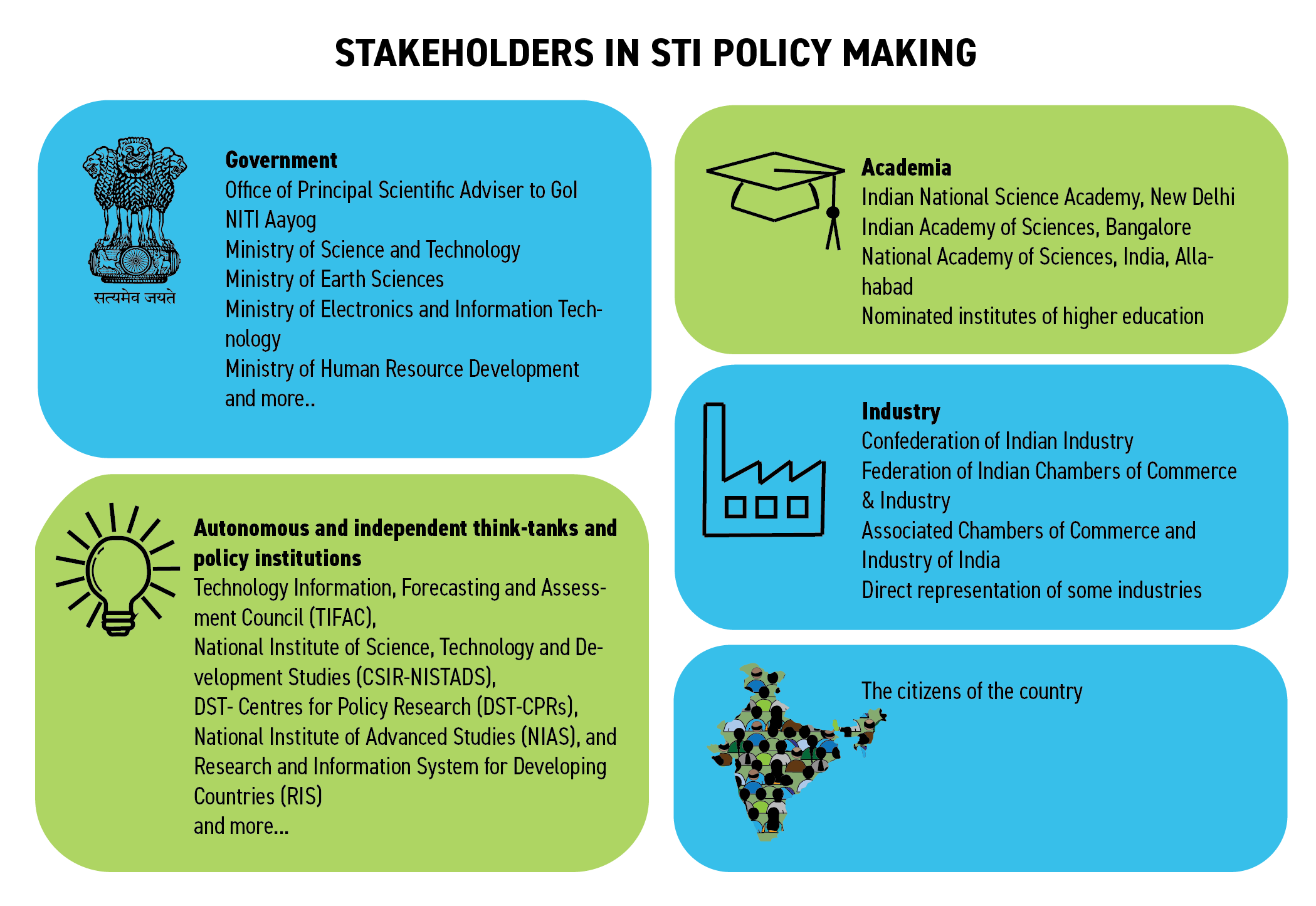
Stakeholders in STI Policy Making
As per the mandate drawn from Government of India’s allocation of business rules 1961, the Department of Science and Technology (DST), which is a part of the Ministry of Science and Technology, is the nodal agency which formulates policies that relate to Science and Technology. Although DST is primarily responsible for making STI policies, it is not the only agency involved in the STI policymaking process. It would be appropriate to say that DST initiates and coordinates this policymaking process, taking various stakeholders on board. DST has a dedicated division called Policy Research Cell (PRC) which coordinates these activities.
STI policies have an impact on all sections of society, and therefore require reflections/interventions from various stakeholders: the government, academia, industry and the society at large.
Priority areas for policymaking are derived through a rigorous multi-stakeholder consultation process. This is a facilitated discussion amongst all involved players with an aim to gather different perspectives, build trust, and develop a better understanding and consensus. It is important to note that within the government’s institutional structure, the scope of public policies related to STI is not only limited to the Ministry of Science and Technology, but cuts across a range of other ministries, departments and agencies.
The Institutional composition has been fairly consistent for all the STI policies made in India so far. However, from time-to-time, there are minor changes in the institutions/actors involved in the policymaking process, and this is influenced by various factors.
How are STI policies made (so far)?
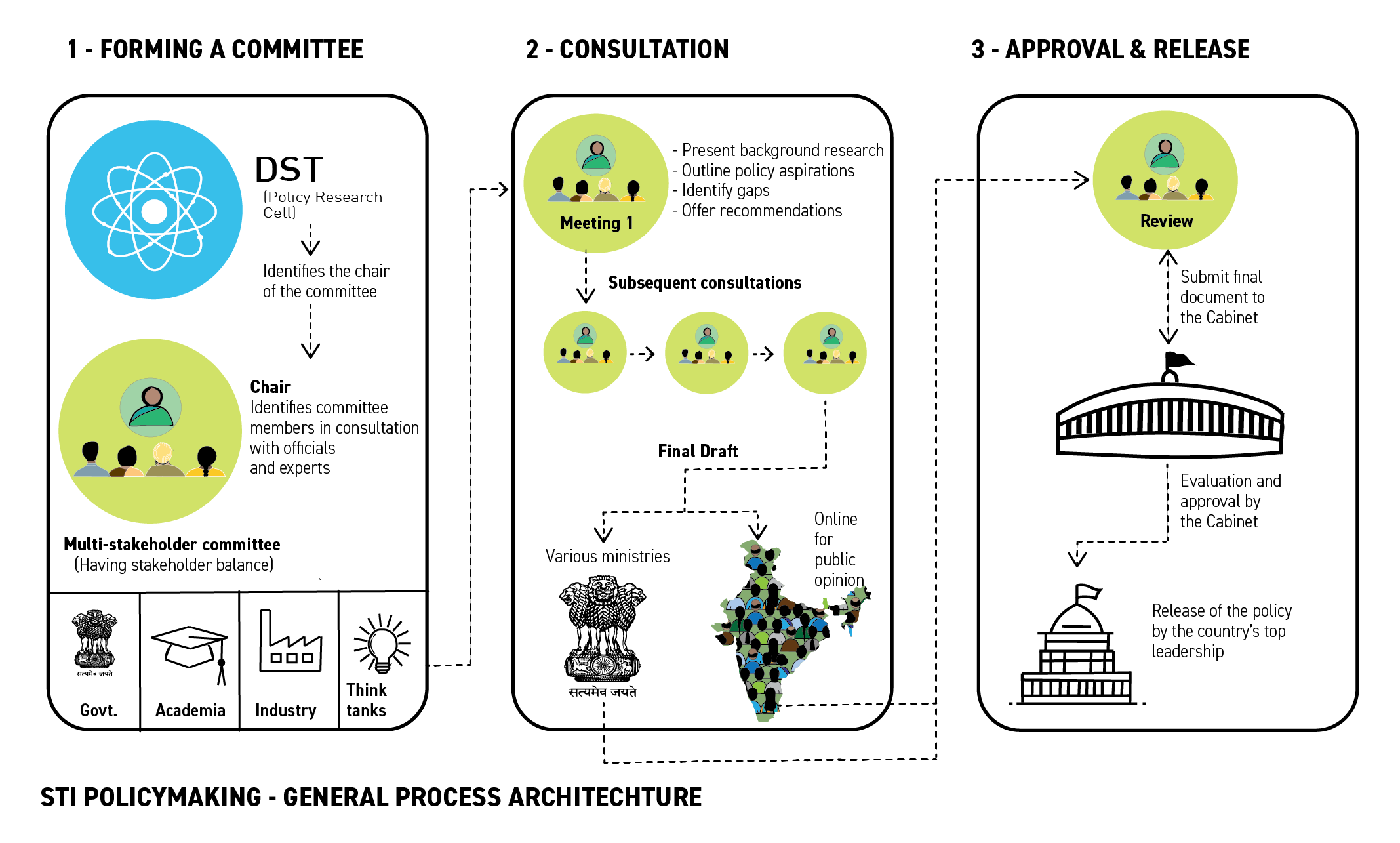
General Process Architecture for STI Policymaking in India
A policy statement is a declaration of plans and intentions which conveys the purpose of a specific policy and spells out a set of principles or guidelines to help achieve certain objectives. There is no one standard way through which the need for a new policy is felt. There is no periodicity followed in releasing a new policy statement. In India, thus far, four STI policy statements have been issued. These include (i) Scientific Policy Resolution (SPR 1958), (ii) Technology Policy Statement (TPS 1983), (iii) Science and Technology Policy (STP 2003) and (iv) Science Technology & Innovation Policy (STIP 2013). The motivation for each of these policy statements was multifactorial and sometimes driven by the needs of that time. [A detailed discussion on motivations, salient features and impact of all four policies will be presented in our next article.]
Once a need for new STI policy arises, the policymaking process starts with the constitution of a Committee. Following are a set of general steps involved.
Forming a Committee
DST identifies a renowned ‘leader’ in Indian Science, usually an eminent scientist, as the Chair of the policy committee.
The Chair, in consultation with various officials and experts, identifies suitable members for the committee. The members are both ex-officio (by the virtue of holding some official post) and subject matter experts.
The committee is constituted to have a balanced stakeholder representation from government, academia, industry and non-governmental organisations/think tanks. Also, gender and geographic representation are taken into consideration while appointing the members of the committee.
Consultation
The committee meets more than once for the multi-stakeholder consultation. The first meeting usually starts with a background document which outlines the policy aspirations through a set of goals and objectives.
Various stakeholders also present a set of additional documents to the committee. These documents may include relevant background studies which identify the gaps and offer recommendations that the committee can consider.
The first consultation largely captures the essential components of the policy in the form of an initial draft. Here, a consensus is built amongst stakeholders.
As per the Chair’s discretion, the committee meets for subsequent consultations where the members deliberate more deeply on individual items of the initial draft, engage more with fellow members of the committee to understand various perspectives, feasibility and challenges. This peer questioning and direct engagement adds necessary rigour to the policy-making process.
After sufficient rounds of consultation, the committee agrees on a final draft version of the policy document. This final draft is then sent out to various ministries and departments for wider consultation. The final draft is also published online to provide sufficient time for the public to view and provide any feedback.
Approval and Release
The committee meets again to discuss and incorporate the feedback and suggestions obtained from the public consultation process.
Once approved by the Chair, the committee submits the document to the Cabinet for approval.
The Cabinet carefully evaluates the policy document and seeks clarity if there are any observations.
The Cabinet approves the policy document after performing its due diligence and the policy is released by the country's top leadership.
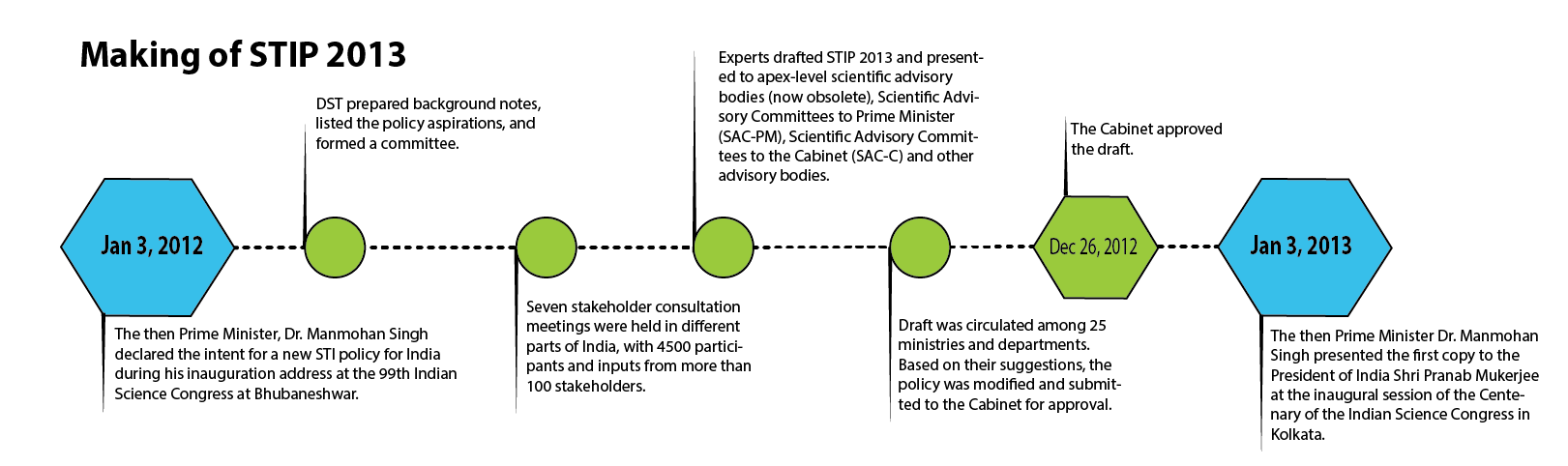
Following is the process and timeline that was followed for the STIP 2013. [Many thanks to Prof. T. Ramasami, former secretary of DST, for sharing these first-hand details]
“Evidence-based” STI policy framework
Around the world, it is widely being acknowledged that evidence plays a critical role in determining success (or failure) of any policy.
Evidence, as it is simply referred to in the policy process, is nothing but rigorously established objective knowledge. Evidence-framework is a term commonly used to denote the institutional mechanism to introduce evidence into the policy process. Evidence could come directly from data, expert-level advice, and through policy research and analysis. In the Indian scenario, the national academies, think tanks and other individual experts bring evidence into the policy process through various means. These could be policy bulletins, inferences drawn from research data (and experimental observations), field reports or expert opinions. Particularly, in the case of STI policies, the data on STI (gathered through R&D and innovation statistics) form a critical portion of the collective evidence base. However, the robustness of evidence-framework in Indian STI policy process is still debatable. To strengthen the institutional mechanism for building a robust evidence framework, starting from 2013 onwards, DST established the Centres for Policy Research (DST-CPRs) in different parts of the country.
Observations
The following are some observations made by the author on the existing national STI policy ecosystem.
The present STI policy ecosystem in India is not structured enough to be easily comprehended. This presents both challenges and opportunities. Sound institutional memory (for preservation of best practices, knowledge, and learned experiences) and knowledge transfer processes (for ease of dissemination of knowledge) have to be built to make the ecosystem more robust and to help transfer good practices to the next generation of policy practitioners.
Evidence should form the basis of the policymaking process and must be used to inform every step of the STI policy process including its implementation. It is promising to see that efforts are being made by DST, MHRD and other agencies in the form of establishing policy centres and fellowship programs to create and institutionalise a robust evidence framework for STI policy in the country.
STI systems are becoming complex, dynamic and are witnessing rapid changes. To support the dynamic nature of these systems, both evaluation and adaptation should be an integral part of the STI policy cycle.
------
Acknowledgement: The author duly acknowledges Prof. VS Ramamurthy, Prof. T. Ramasami, Dr. Arbinda Mitra, Dr. Akhilesh Mishra and Mr. Aditya Kaushik for their direct and indirect inputs and Dr. Lakshmi Ganesan for creating the supporting infographics for this article.
]]>Sowing the seeds of a long-term mental health study in an Indian populationIn addition to limited awareness about mental health in the general populace, a scarcity of large-scale clinical investigations has also been holding back mental health research in India. Recently, three Bengaluru-based research institutions have joined hands for a study that will last two decades and create an extensive resource base of scientific information related to mental illnesses in an Indian population. ]]>tag:indiabioscience.org,2019-10-25:/columns/indian-scenario/sowing-the-seeds-of-a-long-term-mental-health-study-in-an-indian-population2019-10-25T12:04:00+05:302019-10-25T16:44:23+05:30Shantala Hari Dasshttps://indiabioscience.org/authors/w8pNKg39RdKdJRAIn addition to limited awareness about mental health in the general populace, a scarcity of large-scale clinical investigations has also been holding back mental health research in India. Recently, three Bengaluru-based research institutions have joined hands for a study that will last two decades and create an extensive resource base of scientific information related to mental illnesses in an Indian population.
Are mental disorders a serious health concern for the Indian population? The National Institute of Mental Health and Neuro Sciences (NIMHANS) conducted a survey to get to the bottom of this. For a country that has often been discussed in the context of communicable disorders such as cholera and malaria, the results were grim.
The study estimated that almost 14 out of every 100 Indians suffer (or have suffered) from a mental disorder. This could lead to an economic loss of a staggering 90 lac crore rupees over an 18-year window (2012-2030). Adding to this a wide treatment gap, which translates to a large percentage of the affected going untreated, mental health is one of the foremost (and growing) health challenges in India. Based on this, in a meeting in New Delhi in the early 2000s, the World Health Organisation (WHO) threw down the gauntlet to the Indian community – make mental health one of your priorities.
Born out of ideas presented at this meeting, three Bengaluru-based institutions joined hands to establish one of the largest and most ambitious mental health studies in India. Bringing together the fields of modern psychiatry and neuroscience, researchers from the National Centre for Biological Sciences (NCBS), Institute for Stem Cell Science and Regenerative Medicine (InStem) and NIMHANS came together in 2016 to launch the Accelerated program for Discovery in Brain disorders using Stem cells (ADBS).
The Project
Coming at a time when there is a growing awareness in India about the importance of mental health and its impact on our lives and our economy, the ADBS project is designed to be a national and international resource for the scientific community to draw upon. Raghu Padinjat, Coordinator, ADBS, compares this project to building a house, which is currently at the stage of gathering resources and laying a foundation. Here clinicians and scientists bring together their expertise to model brain disorders. Such a multidisciplinary approach allows the core team to tackle everything from an in-depth evaluation of the symptoms to an in-depth examination of the underlying biology.
Mental illness is observed to run in families. How does the ADBS team identify and include such high-risk families into their study? Patients with mental illnesses are identified by the clinical team at NIMHANS, who then collect detailed family history for mental illness. If the family has a high risk for mental illness, the clinical team tries to recruit three more types of people from within the family to the project – a relative with the same diagnosis, a high-risk individual who is too young to show any symptoms, and a low-risk ‘control’ individual.
The study aims to recruit approximately 250 families. Everyone inducted into the study will undergo an extremely detailed clinical examination in addition to tests of brain function such as an MRI. These assessments will be repeated every three years at NIMHANS for twenty years, the first wave of which is to start soon.
Why do we need such a massive and ambitious undertaking? As Padinjat explains, “This is a prospective study.” A prospective study is akin to watching a home video of your childhood - you can observe slow and progressive changes that happen over a long period of time. Similarly, by periodically observing a sample population over a long period of time, we can catch the slow and early changes that can give rise to disease.
“Amongst those individuals who do develop mental health disorders, we can capture the evolution of illness at various levels of brain function,” says Padinjat, “This kind of dataset does not exist anywhere in the world.” In addition to capturing in-depth descriptions of their symptoms and lifestyle from the clinical visits, the study collects DNA samples. This will enable researchers to overlap genetic, epigenetic and environmental factors to map how mental illness develops over time.
ADBS will focus on families affected by the five most common mental disorders — schizophrenia, Alzheimer’s, bipolar disorder, obsessive-compulsive disorder and substance use disorders. There is a growing body of evidence that points towards shared genetic, environmental and developmental risk factors in mental health that transcend the traditional boundaries of specific illnesses. A large-scale study such as ADBS gives us an opportunity to model mental health independent of the specific diagnosis.
One of the unique features of this study is that a portion of the white blood cells harvested from the study participants is converted and maintained as stem cells. These stem cells resemble the cells that are seen at the earliest stages of human foetal development; they can be made to develop into many different types of cells.
In this particular case, the stem cells will be converted into neuron-like cells. These would act as a copy of the neurons from the diseased (or healthy, based on the participant) brain that can then be studied and manipulated in the laboratory. In essence, these stem cells act as a window giving us a glimpse into the biological functioning of that participant’s brain at the level of living brain cells.
Breaking Barriers, changing mindsets
While there is no doubt about the scientific need for carrying out such a project, it is not free from practical difficulties. A project of this scale requires people with different skill sets, for e.g. clinicians and basic science researchers, to come together and work together for the next two decades. On a logistic level, it can be challenging to maintain family participation over this prolonged time period. Typically, prospective studies are fraught with high dropout rates. The key here is to educate the families and keep them engaged along the journey.
The biggest challenge this study has faced has been in recruiting unaffected individuals. The stigma surrounding mental health is entrenched in the Indian community. Unaffected participants and family members of the patient can be apprehensive to participate as they don’t want their family to be labelled as having a mental health problem. To an extent, the success of such studies is intricately tied with the ability to be able to raise awareness about mental health in the Indian community.
A plethora of possibilities
Imagine having an enormous collection of Lego pieces of all colours and types. One can now set out to build anything from a pirate ship to the Hogwarts Great Hall. This is what the ADBS project is doing for mental health - it is compiling a massive amount of data on the occurrence and progression of symptoms, changes in brain functions, genetic and epigenetic markers, and lifestyle. The scope of such a study is immense and future generations of scientists will be able to build upon this, bringing in their own research interests and expertise.
Studies can be conducted on the level of individual biological markers, or at the epidemiological level to see the impact of different environmental conditions. As brain images are being collected, researchers can conduct their studies at the level of a specific brain region or network of brain regions. Such long-term studies have been very successful in breaking down complex human behaviours/disorders. The children of the 90’s study in England
that followed children through the first two decades of life had a profound impact on our understanding of childhood development.
This is one of the first studies of its kind in mental health. Even more striking, it is the first time an Asian cohort is entering the arena. The majority of the genetic and epigenetic studies in mental health are based on Caucasian samples. It should be a top priority to be able to formalise such conclusions from other ethnicities where, often, the genetic make-up of the population and environmental conditions can be very different. As the ADBS project is made-up of Indians (with a bias for those living in south India), it doesn’t just help us understand the diseased brain, it does so for the Indian diseased brain.
The doors of ADBS are open to researchers working on a pertinent question on mental health. Details of the project and how to request access to the data can be found here.
Did you enjoy this article? Please let us know in the comments below.
]]>How is India's meat industry impacting the environment?India's buffalo meat industry is amongst the largest in the world, exporting over 1.2 million tonnes of meat in 2018-19 alone. However, the industry might be extracting a heavy toll on the environment, with reports indicating rapid degradation of pasture lands and release of greenhouse gases as consequences of present livestock rearing practices. ]]>tag:indiabioscience.org,2019-10-12:/columns/indian-scenario/meating-the-needs-of-the-future2019-10-12T10:00:00+05:302019-10-11T15:51:00+05:30Yashika Kapoorhttps://indiabioscience.org/authors/YashikaKapoorIndia's buffalo meat industry is amongst the largest in the world, exporting over 1.2 million tonnes of meat in 2018-19 alone. However, the industry might be extracting a heavy toll on the environment, with reports indicating rapid degradation of pasture lands and release of greenhouse gases as consequences of present livestock rearing practices.
A plate of Shammi kebab, sumptuous butter chicken, or buff tikka, never disappoints a meat lover’s palate. But this romance of palate and meat might be playing a role in aggravating the waning state of the environment.
Indians in the 21st century are experiencing changes in lifestyle and food habits coupled with a population surge. The per capita annual consumption of meat has increased to 4.4 kg per person and is placing pressure on production lines. This, in turn, has resulted in greater demands for water and land resources for rearing livestock.
Feeding the food
India is one of the leading exporters of buffalo meat in the world. On the domestic front, monthly consumption of buffalo meat increased by nearly 13% in rural areas, and 25% in urban areas between 2009 and 2012. In order to produce this buffalo meat, a considerable amount of surface and groundwater is required, especially given that buffaloes have a substantial appetite.
A single buffalo consumes around 4 kg of green fodder, 7 kg of dry fodder, and 0.36 kg of concentrates per day. With a buffalo population of over 100 million, this translates into a daily water requirement of 1 trillion litres for dry fodder, 200 million litres for green fodder, and 29 million litres for concentrates, respectively.
Commenting on the situation, Nilanjan Ghosh, Director, Observer Research Foundation and an economist says, “Per capita availability of water is indeed declining over time, and the meat industry continues to be an area of concern. However, to better assess the situation, additional indicators besides water supply are also required.”
In addition to requiring large volumes of water, livestock also depend on land resources for grazing. Indian pastures sustain a total of 512 million livestock grazing on about 12 million hectares of land. This implies an average of 42 animals grazing per hectare of land, higher than the recommended threshold of five animals per hectare. As a result, issues of overgrazing plague these lands, not only compromising land and soil quality, but also leaving the animals devoid of adequate pastures to feed on.
Maharashtra, one of the top five buffalo meat-producing states, presents the highest percentage of degraded pasture lands at 0.43% of the total geographical area of the state. The figure may seem minuscule at present, but long-term effects might not be so small.
Greenhouse gases from green pastures
Another issue associated with higher meat production is the emission of methane. Ruminants such as buffalo and cattle make up the bulk of livestock in India. The natural digestive processes of these animals produce methane, also known as Enteric Methane Emission (EME). It has been estimated that over 200 million tonnes of CO2 equivalents are released by Indian livestock each year. A continued increase in greenhouse gas emissions can not only cause environmental damage and energy loss, but may increase surface temperatures as well.
According to Jimmy Borah, an experienced biodiversity conservationist, “The meat industry does emit a considerable amount of greenhouse gases, besides other sectors such as electricity, industries, and transportation. However, further converting the livestock into meat is more responsible for greenhouse gas emissions than the livestock alone.”
Are we doing enough?
On this matter, Sayantan Ghosh, a former environmental journalist with Millenium Post, emphasizes the importance of meat as a source of protein for India which not only lags on the human development index but also faces a low level of public knowledge on the impact of the meat industry on land and water resources. “India lacks a holistic approach to nutrition,” he says, “Therefore, till the time we increase the research on making enough and affordable supplementary nutritional food, the people will suffer from the lack of an alternative to meat.”
Fragmented data and a lack of systematic research into the impact of increasing meat consumption on the overall contribution to climate change distorts the situation. For example, as per the National Family Health Survey (NFHS) 2015-16, Kerala was one of the highest-ranked Indian states in weekly consumption of meat/fish. But such data was not followed by any investigation into balancing meat consumption and production with climate and sustainability goals.
Hence, both individual effort and systematic investigations are the need of the hour to balance the consumption of meat with sustainable use of resources. On the policymaking front, assimilating and gathering knowledge could be the first step to recognizing such issues and making decisions.
Did you enjoy this article? Please let us know in the comments below.
]]>Café Oikos: Ecology & conservation straight from the horse's mouthCafé Oikos, a volunteer-driven, not-for-profit initiative, is the brainchild of engineer-turned-ecologists Anisha Jayadevan and Shishir Rao. It is a free and open public event regularly held at Bengaluru bookstores or cafés wherein people from all walks of life can come to learn about ecology and conservation research directly from active scientists. In this article, Anisha writes about how Café Oikos came to be, and what it aims to achieve. ]]>tag:indiabioscience.org,2019-09-13:/columns/indian-scenario/café-oikos-ecology-conservation-straight-from-the-horses-mouth2019-09-13T14:00:00+05:302019-09-13T14:13:20+05:30Anisha Jayadevanhttps://indiabioscience.org/authors/gGWVL6Y5R8MqA6aCafé Oikos, a volunteer-driven, not-for-profit initiative, is the brainchild of engineer-turned-ecologists Anisha Jayadevan and Shishir Rao. It is a free and open public event regularly held at Bengaluru bookstores or cafés wherein people from all walks of life can come to learn about ecology and conservation research directly from active scientists. In this article, Anisha writes about how Café Oikos came to be, and what it aims to achieve.
Why are there so many species in the Himalayas? Why are hornbills called "farmers of the forest"? How does elephant behaviour change in suburban landscapes? These are some of the questions ecologists have addressed as part of Café Oikos— a series of public ecology talks held in informal spaces in Bangalore.
I co-started Café Oikos with Shishir Rao in 2017. We chose to call it "oikos" because it is the etymological root of the word "ecology"; oikos in Greek means 'home' or 'place to live'. We started Café Oikos with the aim of helping make the field of ecology and conservation more visible among the public, share research being carried out on different species and ecosystems and in various parts of the country, and increase awareness of conservation issues in India. We now have three other co-conspirators to brainstorm and co-organise Cafe Oikos with: Ishika Ramakrishna, Janhavi Rajan and Manini Bansal.
Having started out as engineers ourselves, Shishir and I found out rather late about the possibility of a career in ecology, conservation and wildlife biology. Newspapers in India rarely featured the work of scientists in these spheres, and science communication at the time (the 2000s) was not as popular as it is now— ecologists usually communicated their results to audiences that comprised of other ecologists, and there was very little written about their work outside of scientific journals.
India is currently witnessing the effects of the climate emergency, rampant forest conversion towards ill-planned infrastructure, increasing human-wildlife conflict, species extinctions, and wildlife deaths. Our decision-makers have a poor understanding of several ecosystems such as deserts, savannas and wetlands. We need now, more than ever, a better-informed public to stand up for the environment and to demand scientifically-backed policies. We need scientists to engage with the public, especially on topical issues that require urgent attention.
We modelled Café Oikos in the format of Science Café and Café Scientifique, which are not-for-profit, typically volunteer-driven initiatives, and are free and open to everyone. The very first of these Science Cafés, reportedly, was started in Leeds, UK, in 1998. It was in turn inspired by Café Philosophique which started in France in 1992, as a way for philosophers to share ideas with the public in informal, friendly and lively settings such as cafés. There are currently over a hundred Science Cafés across the world. Although many Science Cafés have talks on any discipline of science, Café Oikos is focused on ecology and conservation.
For the first Cafe Oikos talk in Goobe's Book Republic, we turned bookshelves into benches to listen to Nishant Srinivasaiah talk about the behaviour of elephants in human-modified landscapes
India has a small but growing community of ecologists, conservation biologists and evolutionary biologists, working on a range of species and ecosystems across India. Many people among the audience had never even heard of the spiny-tailed lizard which Madhuri Ramesh, Assistant Professor at Azim Premji University, Bangalore, spoke about during our last talk.
It is incredibly inspiring to listen to researchers recount the species, habitats and natural phenomena they study, the people they encountered while in the field, the excitement (or horror) of their findings and the conservation actions that worked. To top it all are the rip-roaring field stories tucked up the sleeves of many a researcher.
In emulating the very western Science Cafés, it is true that such initiatives are not truly open to everyone in India. Despite being free, they are conducted in cafés which not all spectrums of society are likely to visit. They are held in English, which again excludes a large proportion of India's population which speaks 22 official languages, and hundreds of unofficial ones. We hope to collaborate with other science communication initiatives to address the language gap and hold our talks in spaces that are more open to different sections of the public, such as public parks and schools.
If planned well, discussions from these meetings can draw on the strength of both the speaker and the varied professions of the audience, to lead to actionable outcomes. We hope that in the future, Café Oikos, or other similar initiatives that sprout up in India, will evolve to build communities that can meet regularly to discuss solutions to pressing environmental issues. Ultimately, conservation science requires the support of an informed and empowered public.
Did you enjoy this article? Please let us know in the comments below
]]>INSA’s new book examines Indian science’s ethical problemsThe Indian National Science Academy recently published a book with detailed analysis and recommendations on ethical practices for doing science in India. With contributions from eighteen different authors, the book delves into multiple areas of concern and enumerates ethical guidelines for researchers and policymakers at several different levels. The book is freely available to download on INSA's website. ]]>tag:indiabioscience.org,2019-08-02:/columns/indian-scenario/insas-new-book-examines-indian-sciences-ethical-problems2019-08-02T10:06:00+05:302019-10-15T19:17:18+05:30Manupriyahttps://indiabioscience.org/authors/ManupriyaThe Indian National Science Academy (INSA) recently published a book with detailed analysis and recommendations on ethical practices for doing science in India. With contributions from eighteen different authors, the book delves into multiple areas of concern and enumerates ethical guidelines for researchers and policymakers at several different levels. The book is freely available to download on INSA's website.
Reports of plagiarism, scientific misconduct and lack of ethics have made several headlines this year. As per the Retraction Watch Database, in 2019 alone, up to 76 research articles published by Indian researchers have been served retraction notices. Occasionally, papers are retracted because of an unintentional error. However, more often than not, papers are retracted because of unethical conduct, data manipulation or simple plagiarism.
Whether committed intentionally or in ignorance, these unethical practices have become the new monster of Indian science as they end up compromising “truth, which is the goal of science”, say the authors of the new book.
In a hope to address the rise of unethical practices in the Indian scientific community, a group of INSA fellows and other invited experts met in June 2018 to deliberate on ethics and its practice in Indian science. It was here that the concept of this book first took shape. The ideas and thoughts discussed in this meeting have been expanded upon in each chapter of the book. A team of eighteen researchers has contributed to the book, with each chapter being authored by a different set of researchers.
Ethics in research and higher education
Higher education in science is perhaps the first step to starting a career in science. One of the first chapters in the book discusses the need to inculcate the right ethical values at this stage. Binod Kumar Tripathi, Alok Gardia, and Bhavana Behal, the authors of this chapter, say that training in ethics should be integrated with the curriculum. They also describe nine different postulates that can help underpin high ethical standards among students. Some of these postulates are respect for intellectual property, novelty in publication, and objectivity.
One important postulate discussed in this chapter delves into ethical issues pertaining to teachers, who play a crucial role in the entire academic structure. A teacher’s behaviour and conduct can have a lasting impact on students. Their behaviour can be a determinant for what is ethical and acceptable in science and what is not. It is therefore imperative that teachers adhere to a code of high ethical conduct and be committed to professional growth through continuous study and research. The chapter lists suggestions for teachers, following which they can set the right examples for students to emulate.
It is imperative that teachers adhere to a code of high ethical conduct and be committed to professional growth through continuous study and research.
The third chapter in the book focuses on ethics in research. It lays out a roadmap to a fundamental step in any researcher’s carer – choosing a topic of research. The choice should be made in favour of ideas that are original and not copied from others, say Subhash Chandra Lakhotia and Praveen Chaddah, the authors of this chapter.
The authors next draw attention to the process of collaboration. Increasingly, in today’s research environment, a collaboration between several researchers and different institutes is becoming common. In such an environment it is necessary to ensure that the interests of all collaborating parties are protected. According to the authors, the best way to go about this is to clearly outline the basis of credit sharing right at the start of the collaboration. This will help avoid any misunderstandings or disputes at later stages of collaboration.
This chapter also addresses the issue of mentorship of newly recruited researchers and also of young PhD students. It broadly describes the scope of ethical practices that should be adopted to help young researchers and PhD students thrive.
Science is a very empirical endeavour, and the fourth chapter in the book goes into great detail about what practices are considered ethical in conducting experiments, recording them and then putting your results out in front of the world. Written by Munishwar Nath Gupta and Bittianda Kuttapa Thelma, this chapter is filled with practical advice, interspersed with several anecdotes to drive the message home.
On publishing, governance and public engagement
The fifth chapter of the book digs deep into the process of publishing in science. Publishing is the most common way to disseminate science. So, when an error goes unchecked during publishing or unethical practices creep into the process, wrong or false information spreads far and wide.
Falsity in published work is not just detrimental for a researcher and his/her institution’s reputation but it also has an enduring negative impact on research efforts that may have used such false information as the basis for their experiments. Therefore, the authors of this chapter, Subhash Chandra Lakhotia and Srinivasan Chandrasekaran, emphasize that researchers must adhere to the highest standards of ethical behaviour when publishing their work.
They recommend that all authors, editors, reviewers, and publishers follow the guidelines laid down by the Committee on Publication Ethics (COPE). They also share some additional guidelines about the type of authorships researchers should stay away from, choosing the right journal to publish one’s work in, and using pre-print archives.
Falsity in published work is not just detrimental for a researcher and his/her institution’s reputation but it also has an enduring negative impact on research efforts
No scientific institute can expect to succeed without able and ethical governance. In the seventh chapter, authors Manohar Lal Munjal and Ashok Kumar Singhvi examine several governance-related issues common to research/scientific institutions. They discuss relevant day-to-day matters like recruitment of scientific staff, funding of sponsored research, recognition of scientific excellence, choosing of academic leaders, etc and lay out the likely ethical pitfalls in each of these areas.
In the subsequent chapter, Sunil Mukhi and Nandula Raghuram draw attention to science outreach. In no uncertain words, they emphasize that scientists must take their work to the public and help in improving public understanding of science. This is especially important when research is funded by public money. The researchers can engage via the press or through social media.
However, while engaging in outreach, the authors direct researchers to keep in mind the following principles: “do good, do no harm, respect privacy, respect confidentiality, be sensitive to vulnerable people and the environment, maintain scientific objectivity, adhere to truthfulness and healthy skepticism, declare caveats and conflicts of interest and, avoid self-aggrandizement in whatever is communicated and the way it is communicated”.
Scientists must take their work to the public and help in improving public understanding of science.
In outreach, the responsibility to uphold ethics is not limited to researchers, but also extends to journalists who communicate science. They should make sure research outcomes are not exaggerated, reporting is accurate and all caveats and exceptions are spelled out in clear terms.
Gender and Ethics
Towards the end of the book, in the eighth chapter, Shobhona Sharma, LS Shashidhara, Tanusri Saha-Dasgupta, and Rohini Madhusudan Godbole, look at the ethical issues associated with gender-bias. Traditionally, gender bias has not been included in the ambit of ethical issues pertaining to science. The authors of this chapter, however, say that making sexual harassment a moral or ethical issue and not just a legal one can help reduce its occurrence.
The more explicit cases of gender harassment are easier to identify and act against. But, it is the subtle forms of bias, often existing unnoticed, that end up increasing inequities for women in science. The authors discuss several different ways in which these biases manifest and offer recommendations to address these issues. For example, when discussing career opportunities, men and women are often subjected to differential standards when evaluating performance in the workplace. “Such behavior, however unintentional, results over a long time in accumulation of advantages for the career of the male over the female academic,” write the authors.
Making sexual harassment a moral or ethical issue and not just a legal one can help reduce its occurrence.
The last chapter of the book, authored by Kambadur Muralidhar, Amit Ghosh, and Ashok Kumar Singhvi, provide a series of recommendations to address the whole gamut of ethical issues discussed in preceding chapters, which will come handy to any researcher grappling with an ethical issue.
Did you enjoy this article? Please let us know in the comments below.
]]>Networking for navigating the landscape of science careersNext in our series on networking in science, Siddharth Kankaria discusses how building and maintaining a strong professional network can aid the career development of scientists and science professionals both in and out of academia. In particular, he writes about how effective networking can make the process of transitioning to a new career path smoother and more efficient. ]]>tag:indiabioscience.org,2019-07-31:/columns/indian-scenario/networking-for-navigating-the-landscape-of-science-jobs2019-07-31T19:44:00+05:302019-08-02T10:07:54+05:30Siddharth Kankariahttps://indiabioscience.org/authors/SiddharthKankariaIn this next article in our series on networking in science, Siddharth Kankaria discusses how building and maintaining a strong professional network can aid the career development of scientists and science professionals both in and out of academia. In particular, he writes about how effective networking can make the process of transitioning to a new career path smoother and more efficient.
My career in science, albeit short, has already been influenced by networking in both tacit and definitive ways – helping me land summer internships, exposing me to several job opportunities, influencing the articulation of my Master’s dissertation topic, and most importantly, shaping my decision to transition from science to science communication.
The importance of networking in science is not a radically new idea by any means. Science is a collective, interactive, and collaborative process, and constantly requires scientists to exchange ideas with each other for designing better experiments, validating each other’s results, or seeking newer opportunities in the form of scientific positions, grants or research problems to work on.
However, with the rise of non-academic science careers, we are now able to better appreciate the many ways in which networking proves to be crucial for not only transitioning from academic to non-academic science careers, but also continuing to grow and excel in such careers.
How networking helps
Aditi Qamra completed her PhD in computational biology from the National University of Singapore (NUS), Singapore in Dec 2017 and moved to Toronto, Canada, soon afterward. Writing about her career transition story in an online networking & mentorship forum on Facebook, Qamra explains that although she enjoyed her PhD, she preferred a career in industry over academia. Not knowing much about the research & industry landscape of Toronto, she decided that a post-doctoral position was perhaps the best way to ease herself into the system. She was soon able to find a post-doctoral position in Toronto, but quickly realized that she was ill-prepared to take a plunge into the Canadian job market.
This was until Qamra decided to attend an informal meeting organized by the Career Support Group (CSG), a networking and mentorship forum run by PhD students and Post-docs, intended to mentor and support fellow Indian researchers. According to Qamra, networking within the Career Support Group (CSG) was instrumental in her learning about opportunities outside of academia. It also exposed her to legal considerations about working in Canada that she was unaware of.
Ananda Ghosh, one of the founding members of CSG, echoes this sentiment and feels that networking is especially crucial for STEM graduates, since many of them may not even be aware of the diversity of science careers outside of academia.
Why network?
Most non-academic science careers require a different set of skills from those visibly used in a laboratory. Sometimes they may demand acquiring completely new skills, while at other times, one can benefit from the tactical repurposing of skills acquired during a research career in innovative ways to suit the requirements of a new job.
It is in this phase of transitioning and repurposing one’s skills that networking can be very useful. For instance, talking to people who have already made such transitions can be a source of precious experiential knowledge. Similarly, networking can be very useful for understanding the context, guidelines, and rules of engagement in general when switching to a different field.
Qamra benefitted in multiple ways from her networking interactions at CSG. “They helped me improve my resume, my LinkedIn profile, taught me how to connect with potential employers, ask for informational interviews and were always just a message away at all steps of the process,” she explains in her Facebook post.
Further, networking can be a great tool to advertise yourself or your new endeavours. It can help connect you with interested investors or potential collaborators. It can also be a great way to acquire feedback and refine one’s idea, venture, or even streamline the direction of transition from academia to other science careers.
“I realized after 15 years in academia that I was never aware of the job market in academia, meaning of good mentors, understanding the real meaning of a PhD training, ethics in science, diversity, non-academic careers, work-life balance and abuse in academia,” says Ghosh, stating that this was one of the motivations behind him co-founding CSG along with Abhinav Dey, another alumnus of Indian Institute of Science (IISc).
Qamra strongly feels that networking is key to navigating the landscape of non-academic science careers. “Only through connecting with people from diverse backgrounds, can one learn about the array of possibilities available as well as the requirements/challenges that come along with the role. This information is not taught in graduate schools and also not readily available online,” she says.
Developing networking skills
Good networking requires genuine effort on the part of the individual as well as inculcating certain skills which can be practiced and honed over time.
Making use of multiple platforms
There are several conventionally accepted ways to network with people, be it through websites, social media platforms, emails, official meetings, and conferences, or specifically designed networking events. However, there are also many unconventional ways to network, like volunteering, meeting people at cultural and social events, or niche networks built especially for allowing people to discuss field-specific problems. Talking about the success of CSG, Ghosh felt that, “Social media, if used wisely, can be a great tool for networking and education in today's globalized world, where ‘real’ networks are very very dynamic.”
Quality vs. quantity
It is equally important to not get lost in the flood of social media networks and contacts. Effective networking requires personalised two-way communication and relationship building. The mantra of networking today is not quantity but quality – instead of trying to reach out and connect to hundreds of potential contacts, it’s better to trim your network and focus on a few but relevant contacts who can contribute meaningfully to your career aspirations in the form of opportunities, advice, mentorship, and further networking leads.
Stressing on the importance of nurturing your networks over time, Qamra explains in her Facebook post that it is very important to thank your network, since “at the end of the day, roles and companies might change but the network is going to remain the same”.
Parallel and Tangential Networking
It is also important to remember that it is equally important to network with people who are in similar occupations (parallel networking) and people who are in radically different ones (tangential networking). People in the same field as you, or in a field in which you aspire to be, can guide you on the specifics of a career in their respective fields and may be a great source of niche domain knowledge.
On the other hand, people in completely different fields can be a great way to not only connect with people with very different experiences, viewpoints, and reach, but also forge unusual collaborations and expose yourself to rare but meaningful opportunities that could help boost your career.
Networking karma
The idea of networking karma is simple - if you contribute honestly and offer advice and help to others, you have a much greater chance to receive the benefits of networking yourself. In this regard, it is important to remember that the power of networking is exerted not just in a vertical fashion from a mentor to a mentee, but also in a horizontal fashion from experts in one field to another. It is crucial that you try and enable other people in your network, contribute back to the network as much as you can.
It also helps if you make yourself visible in your field of networks as someone who is able to use their area of expertise to influence people. Eventually, you will be able to build much stronger networks if you are approachable, valuable, willing to help people in your network, and ready to share your knowledge and expertise, expose others to potential opportunities to benefit from.
Looking back
The power of networking is quite evident in the example of CSG. Running for about 4 years now, it has already facilitated more than 100 successful career transitions and has led to a sharp rise in awareness about non-academic science careers. Moreover, it is also serving as a great forum to discuss social issues like life in academia, mental health issues, and how to choose better mentors, to name just a few.
“We have seen members finding a niche of their own and becoming field leaders,” says Ghosh. He also mentions about newly initiated STEMpeers Fellows Program, which encourages students and postdocs to not only pursue high-quality research, but also grooms them for becoming leaders in science communication, [science] illustration, community development, and social entrepreneurship.
Ghosh signs off, “Networking helps with understanding job types, how one can transition, [and] gives a chance to showcase your inner strengths. Every network is an opportunity in waiting!”
Did you enjoy this article? Please let us know in the comments below.
]]>Tweet, Post, Share, Like: How is social media shaping Indian science?The advent of social media has greatly increased the ease and speed of sharing information, and the Indian scientific community has not lagged behind. In this first article in our new series on scientific networking, Karishma Kaushik and Snehal Kadam discuss the various ways in which researchers and science professionals can leverage the use of social media for influencing scientific discourse and policy. ]]>tag:indiabioscience.org,2019-06-24:/columns/indian-scenario/tweet-post-share-like-how-is-social-media-shaping-indian-science2019-06-24T11:43:00+05:302023-02-21T13:50:14+05:30Snehal Kadamhttps://indiabioscience.org/authors/aNmEVMkdE3LQPArThe advent of social media has greatly increased the ease and speed of sharing information, and the Indian scientific community has not lagged behind. In this first article in our new series on scientific networking, Karishma Kaushik and Snehal Kadam from The Institute of Bioinformatics and Biotechnology (IBB), University of Pune, discuss the various ways in which researchers and science professionals can leverage the use of social media for influencing scientific discourse and policy.
From Aristotle’s wandering lectures on the entire world of living things to Antoni van Leeuwenhoek’s remarkable illustrations of bacteria under a microscope, science communication and cross-talk in the scientific community has undergone dramatic changes in scale and scope.
Over the years, treatises have given way to journal publications, discourses have been replaced by interactive webinars, and scientific letters have been superseded by almost instantaneous emails. One of the more recent changes is the use of social media platforms to reach the masses at large.
Social media, in general, has enabled a faster and larger reach of news, information, and opinions – whether it is through the sharing of articles on Facebook and Twitter, or via images on Instagram. In fact, the growth, speed and accessibility of these platforms have given each individual a voice, that can be heard louder and faster by people across the globe. Social media has, as clichéd as it sounds, brought the world closer. Tweets have become our new press releases, and everyone is trying to capture that perfect ‘Instagrammable’ moment.
There is a range of different social media platforms available for researchers, such as Facebook, Twitter, Instagram
to connect, share and promote their work, ResearchGate
and Academia.edu
to discuss practical science issues and find collaborators, and professional platforms such as LinkedIn
to build and leverage networks. In addition, popular science blogs/vlogs have made use of the reach and accessibility of social media to communicate scientific information in ways that are easily understandable to the student and citizen science community.
Popular YouTube channels like AsapSCIENCE, which makes videos using attractive drawings explaining the basics of different scientific topics, and Khan Academy, which designs online lectures on various topics, have millions of subscribers. And while text-based blogs provide a lot of in-depth information, in an age of Snapchat and Instagram, pictures have become a powerful tool in attracting and connecting with a larger audience.
Numerous schools and institutes like Harvard Medical School or the Wyss Institute, as well as individual scientists, run their own Instagram pages, sharing colourful microscopy images, complex robots, beautiful bacterial biofilms and highlights from the everyday life of a researcher. This is very valuable, as an attractive image is more likely to strike curiosity in the minds of viewers, who can then turn to various blogs/articles to learn more.
Social media and Indian science
In recent years, the scientific community in India has been seen to have a recognizable presence and engagement with social media platforms. From the scientists’ point of view, benefits range from tangible ones such as finding collaborators and publishing opportunities, to the simple feel-good factor of belonging to a larger community.
We posted the question ‘Has social media impacted or assisted your scientific career or opportunities in any way?’ and received these responses.
“Not any…but many. Not always tangible gains. Could be a simple feel-good factor. Knowing that struggles & bad days are part of science and (being a) scientist & you aren’t alone. Inspirational stories about how others cope with them and do great. Latest sci papers & opportunities as well”.
From @anups_11 (Anup Padmanabhan, Ashoka University, New Delhi, India)
“It’s a great way to keep up with science and stories behind it throughout the world. I got an opportunity to contribute an article and a collaboration request through Twitter. So it has worked great for me.
From @poonam_thakur6 (Poonam Thakur, Goethe-Universität Frankfurt am Main, Germany)
However, beyond this, as both interactors and observers will find, social media discussions and opinions are playing a key role in Indian science. This is evident on multiple fronts, from increasing accessibility to administrators and enforcing policy changes to determining the way the Indian science community wants to be represented and viewed, and even breaking down silos between scientists and citizens.
Here are a few thoughts we put together on how social media platforms are shaping and transforming science in India.
The Twitter ‘morcha’ - Shaping policy through social media
A highly powerful tool, social media allows a single hashtag to become trending overnight, reaching the twitter feed of thousands in a day. Given this immense reach, it can act as a platform for many individuals to come together, allowing users to stage ‘virtual’ protests, that would be difficult to achieve physically.
The 2018-2019 protest for a hike in research fellowship in India is one such example. A similar protest had occurred in 2014 as well, but this time, social media allowed a larger number of people to participate and show their support. The easy access of Twitter and the ability to tweet directly to the concerned authorities allowed researchers to voice their opinions on the need for a stipend increase. As the #hikeresearchfellowship movement gained traction on Twitter and Facebook, researchers submitted a petition to concerned authorities, to revise the fellowship amount.
While a hike in the stipend was recently granted, the decision itself created quite a buzz on social media, with researchers feeling that fraction of the hike was negligible considering the rise in tuition fees over the last few years. However, the reach and feasibility of social media allowed this protest to gain attention and authorities were able to hear the voices of individuals directly.
Social media to #savescience - Breaking down pseudoscientific myths
Pseudoscience in India is no ‘new kid on the block’. Ever so often, Indian science faces the onslaught of cringeworthy claims that have no scientific evidence, from the existence of in vitro fertilization technology in ancient Vedic times to our ancestors being the first to invent planes. When these outrageous claims of Vedic science were made at the recent Indian Science Congress, the Principal Scientific Advisor, Government of India responded in a detailed blog, which among other things, stated that the large scientific community in India must hold the government and individual scientists responsible for untenable scientific claims made at the conference.
After a recent uproar to such claims, the hashtag #savescience, representing all critical issues facing science, health, and medicine, started trending on Twitter, this time spearheaded by the Indian scientific community. Scientists across India tweeted that such pseudoscientific claims not only propagate irrational thought, but they also bring disrepute to the high-quality, cutting-edge science being pursued in India.
Web warriors - Communicating science to citizens
We have all received WhatsApp ‘forwards’ with more than one ludicrous way of curing cancer. While the scientific community balks at these messages that peddle supernatural cures, these very platforms can also be leveraged to breakdown implausible claims, and also communicate evidence-based scientific research being done in India and worldwide.
For example, Whatsapp lends itself well for large-scale communication of science snippets that are easy for public consumption. Recently, scientists at the Centre for Cellular & Molecular Biology (CCMB), Hyderabad, discovered a new enzyme that helps regulates cell wall formation in bacteria and thereby offers a potential new drug target. While this work was very eloquently explained in newspaper articles and gained widespread attention, sharing such discoveries on web-based social media platforms would significantly enhance the dissemination and consumption of original scientific research by the public.
In this context, it would also be important to highlight the careers of accomplished Indian scientists, thereby enabling researchers to be more visible and relatable. For example, an India-focused blog, The Life of Science
(TLoS), is a unique project that focuses on Indian women as role models in science and highlights the work of women scientists in India. Further, TLoS also has a strong Twitter presence, which they leverage for discussion related to gender and equality issues in Indian science. In this manner, social media can be employed as a tool to educate the community on current science developments in India and features on Indian scientists, thereby developing a rational-thinking, curiosity-driven citizen scientist community.
Further, an overwhelmingly large number of institutes maintain updated and interactive websites. What this means is that the scientific community has recognized and embraced the need to leverage social media as a tool. It would have been unheard of a decade ago, but for a young scientist today, ‘tagging’ or having a direct online interaction with a senior administrator in Indian science is possible at the click of a button. The next step could be to popularize these handles (and possibly websites) with the public at large, whereby they could interact with science policy makers and scientists. Given recent findings that of all social media users in India, only 20% followed a science-related account, this is a gap that needs to be filled.
Leveraging social media for Indian science
There are several opportunities to continue to leverage social media to impact, influence, and shape science in India. For starters, it would be critical that individual scientists adopt social media communication as a valuable part of their research communication and outreach process, by sharing their ongoing work, published articles, and professional developments. This survey surprisingly showed that more than 80% of scientists and researchers in India claimed to have never posted updates of their ongoing research on social networking sites; which can be easily addressed.
From the technology end, a key area would be to enable platforms in native Indian languages, which would significantly enhance the reach of Indian science. For example, certain India-centric science blogs, like Science India and Science Bloggers Association, publish content in both English and Hindi. IndiaBioscience has also been pushing the envelope on developing scientific material in regional Indian languages, through their recent science communication series in Indian languages, with features on The Language Project, which offers free videos on synthetic biology in 26 different languages, and Bigyan, a science outreach platform in Bengali.
So, tweet, post, share and like, let’s make Indian science trending.
Did you enjoy this article? Please let us know in the comments below.
]]>Bigyan: A science outreach platform by researchers in BengaliLocated halfway across the world from each other, four dedicated researchers felt the acute lack of well-researched science stories in their mother tongue, Bengali, and decided to come together to fill this gap. The outcome of their efforts - Bigyan.org.in - was launched on National Science Day, 2014. Here is the story of their journey. ]]>tag:indiabioscience.org,2019-04-12:/columns/indian-scenario/bigyan-org-in-a-science-outreach-platform-by-researchers-in-bengali2019-04-12T11:01:00+05:302022-01-25T17:31:24+05:30Anirban Gangopadhyayhttps://indiabioscience.org/authors/8kZyaKoboDL6q5JLocated halfway across the world from each other, four dedicated researchers felt the acute lack of well-researched science stories in their mother tongue, Bengali, and decided to come together to fill this gap. The outcome of their efforts - Bigyan.org.in - was launched on National Science Day, 2014, and in the last five years, it has grown and expanded into a concentrated effort to make science accessible to all. Here is the story of their journey.
For a society that is awash in the fruits of scientific research, we are strangely aloof to the process of science itself. Scientists are partly responsible for this situation. There is a prevailing impression that they simply refuse to explain their esoteric research in terms that an outsider can follow. As a result, many initiatives have come up all over the world dedicated to bridging the gap between scientists and society.
Since we started our journey in creating the platform bigyan.org.in, we have found many such efforts in Bengali as well. Some of them are almost solo efforts forged by a team of local science enthusiasts while others are efforts at a government level.
Somewhere in the process of creating our website, we decided that the onus of communication fell on scientists themselves. If a person trained in science does not take up the responsibility of communicating his/her work, there is really no one else to blame when that science gets misrepresented or stays unrepresented in the media.
We can understand that for many reasons, scientists are not always enthusiastic about communicating their research. The pleasure of doing science probably does not compare favourably with the challenge of explaining its value to a possibly uninterested audience. A researcher probably worries: is it worth investing the time to explain my work? Is there an audience for this?
But that line of thinking is loaded with assumptions. Science is not inherently uninteresting, otherwise so many would have not pursued a career in it. We could perhaps understand a more reasonable assumption that science requires a long period of training before one really starts getting back some dividends. A large proportion of the audience probably would not have the training to appreciate scientific research.
In the end, we in team Bigyan decided to challenge even that assumption. Unlike some countries in the developed world, most of us in India do go through a rigorous science curriculum. Some would say that so much information is squeezed into the space of four to six years (class VI to class XII) that one has little time to think about what it all means. We have the training, each and every one of us. If scientists chose to explain their work, they would find quite an appreciative audience.
With this idea in mind, we started bigyan.org.in in Bengali in early 2014. We felt that a general awareness about science in the society must be spread in the language that most people are comfortable with. Further, there is no shortage of science outreach efforts in English worldwide, but there are very few in the vernacular.
If a person trained in science does not take up the responsibility of communicating his/her work, there is really no one else to blame when that science gets misrepresented or stays unrepresented in the media.
Finding our niche
We wanted our effort to be sustainable, and clearly fill a void. There are many Bengali newspapers that publish stories on scientific discoveries with popular appeal. We agreed that competing with those newspapers on bringing the latest discovery first to the readership is not a meaningful use of our time.
Often, such newspaper articles prioritize sensationalism over accuracy. They do convey the initial excitement of a discovery in broader terms (“scientists find a new cure for cancer”, “Einstein is proven right, once again” etc.), which is, of course, valuable for creating scientific awareness. However, where they fail often is getting the science right. Writing an easily digestible article for a broad audience without making misleading and wrong statements requires a level of deeper understanding of the science itself. We often do not see this deep understanding in science articles published in Bengali newspapers.
So, we asked ourselves the following question: “Let’s say that a reader gets excited by the news of the discovery of gravitational wave detection or a new cure for cancer from reading a newspaper article. Being inquisitive, she wants to understand, in simple terms, the underlying science. What can she read in her native language to gain this understanding?” There is a void between the popular stories published stories in newspapers and research articles.
For instance, take the story of gravitational wave detection that broke in 2016. The bulk of articles on this story described gravitational waves in a somewhat superficial manner relying mostly on analogies. If you wanted to learn more, your only option was to pick up textbooks and launch yourself into a full-blown course in the general theory of relativity. It was difficult to find a simple explanation that began from something you learnt in school.
This kind of gap is not easy to fill. Science popularization efforts worldwide (including that by IndiaBioscience) that bridge this gap effectively end up involving practicing scientists or journalists who have a strong research background.
We took this route as well. Most of us in team Bigyan are in academia, so we started nudging our colleagues for articles. We tried to address the usual concern: do not worry about your topic of research being too esoteric. Whatever you write about — bacteria, evolution of peacocks, high-temperature superconductivity or quantum computing — as long as there is an underlying interesting story, we will publish it.
And we have been overwhelmed by the response. We have started to think that the image of the scientist preferring to work in secret has many, many exceptions. Not only have scientists submitted articles at times explaining the nitty-gritty of their research or giving an introduction to their field, but a significant number of them have also stayed with us throughout our peer-review process and patiently answered our questions and addressed our objections.
A word on the peer-review process: while common in the publishing of new scientific results, the peer review process is not common in popular science. At bigyan.org.in, we have adopted the peer review methodology to ensure the quality of our articles. The editorial team of bigyan.org.in seeks review from experts on submitted articles, focusing on both scientific accuracy and readability. To our delight, most authors, including eminent and senior researchers, have accepted our editing process wholeheartedly.
Collaborations and partnerships
The covers of Bigyan's first print edition (left) and Bigyan patrika's eleventh e-edition (right)
As our collection of articles grew in number and variety, so did the readership. We received encouraging feedback from our readers - students and teachers in particular. Soon, we realized that bigyan.org.in had become a platform of Bengali scientists worldwide who are passionate about science outreach.
This network enabled us to take on projects that we did not envision at the beginning, such as distributing foldscopes to rural high schools of West Bengal (and a few in Bangladesh) with the help of our colleagues at Stanford University. In 2018, we partnered with the Contai Science Academy (CSA), a non-profit organization comprised of high school and college teachers in Contai, West Bengal, to publish and distribute printed magazines to expand our reach beyond the internet.
We are currently working with a few high schools (through CSA) on a pilot project on developing an enhanced learning environment in classrooms, where the teachers are incorporating new teaching materials and methodology to augment the textbooks. An example of the new teaching material is physics cartoons drawn by the world-famous cartoonist Larry Gonick, who has been working with one of the editors of bigyan.org.in on a US National Science Foundation project. An example of the new teaching methodology is the adoption of the ‘classroom response systems’ through cards, employed widely in many Western schools and colleges.
We have been overwhelmed by the response. We have started to think that the image of the scientist preferring to work in secret has many, many exceptions.
The way forward
Of course, there are many challenges to sustaining and further developing bigyan.org.in. Many authors, unfortunately, find it difficult to write in their native language. We need volunteers to translate their articles. The peer review process takes enormous time and effort. A large fraction of submitted articles come from authors who can be described as “experts in the subject matter but not-so-good writers”. Sometimes it takes many months to edit those articles. We need more practising scientists and people with strong scientific training and good writing skills to get involved with us.
In an age of distractions and short attention span, it would help to resurrect many old high-quality articles (over 200 published in bigyan so far) from the internet graveyard in new formats, such as audio and video with attractive illustrations, to reach a wider audience. We need enthusiastic volunteers with technical know-how in graphics and illustrations and creative minds to succeed. But we are hopeful. As we discovered in our journey so far, there will always be like-minded people to extend helping hands!
Did you enjoy this article? Do you know of other such efforts? Please let us know in the comments below.
]]>The Journey of the Language ProjectThis is the first article in our new column series on science popularisation in Indian languages. The Language Project offers free video courses in synthetic biology in 26 different languages (9 of which are Indian), and is the brainchild of a group of undergraduate students from the Indian Institute of Technology (IIT) Madras. ]]>tag:indiabioscience.org,2019-04-05:/columns/indian-scenario/the-journey-of-the-language-project2019-04-05T09:00:00+05:302022-01-25T17:32:20+05:30Mugdha Mohkhedkarhttps://indiabioscience.org/authors/MugdhaMohkhedkarThe Language Project offers free video courses in synthetic biology in 26 different languages (9 of which are Indian), and is the brainchild of a group of undergraduate students from the Indian Institute of Technology (IIT) Madras. Here is their story.
We are a team of undergraduate students from the Department of Biotechnology, IIT Madras, and we decided to create the Language Project as an initiative for the public to easily understand various ideas and research in different areas of biotechnology. Partly fueled by our love for genetically modified organisms (GMOs) and genetic engineering and partly in order to participate in the annual International Genetically Engineered Machine (iGEM) competition, we took up the challenge of making science accessible to all Indians.
iGEM is a synthetic biology competition held every year at Boston, USA, with around 400 teams participating from all over the world. Synthetic biology is the science of manipulating and designing biological systems. Lying at the intersection of engineering and biology, it involves the genetic manipulation of organisms and affects the public directly or indirectly, one famous example of the same being GMOs (Genetically Modified Organisms). IIT Madras has been participating in this prestigious competition since 2008. Every year, our team works on a project that aims to solve local challenges and create awareness among the general public.
We believe that science should reach out to people and not be confined to the laboratory. However, when our team members approached the public to talk about synthetic biology and our project, we faced an unanticipated barrier. Many people were not only unaware of recent developments in the field that make synthetic biology possible, but also could not speak or understand the language most scientific research is communicated in: English.
India is a diverse country with 22 official languages where only 10.6% of the population understands English (2011 census). Synthetic biology is a recent and unique field that can raise several ethical questions and therefore, public engagement is essential. For effective public involvement, we need the audience to understand the science behind synthetic biology. Hence, we decided to design an introductory course on the basics of synthetic biology in several Indian languages.
But the need for a Language Project ran much deeper, as we soon realised. Science in general, and biology in particular, is relevant for everyone. For example, people may know about a disease and its effects but very few bother to learn about the underlying cause or actual mechanism. Many of our peers in school also perceive biology as a dry and boring subject with just rote memorisation of facts. Very few appreciate its beauty and are fascinated by the many unanswered questions which are open to wide areas of research. Many also don’t see biology as a growing interdisciplinary field. Our team believed that we could make a significant impact by generating content in vernacular languages, and hence began the journey of the Language Project.
The enquiry of how life came to be and our quest to understand and deal with its elegant complexity must be inclusive and universal. This introductory course on synthetic biology (originally in 9 major languages spoken in India) aimed at lay people of all age groups and all walks of life, is our humble contribution to the ever-growing revolution of bringing science to all. To make The Language Project easy to access and document, we have developed a website: The Language Project. The languages we’ve made content available in so far are Bengali, English, Gujarati, Hindi, Kannada, Malayalam, Marathi, Tamil and Telugu.
The iGEM-IITM team
We next decided to make simple videos on introductory concepts of biology. Most of us learnt the basics of science in school from NCERT textbooks, which we felt was the best starting material to explain these concepts to others too. The content for all videos was compiled and reviewed by the team members, taking the major concepts from the NCERT biology textbook. This was then translated by the team members who belong to different states of the country.
A challenge faced by many of us was the translation of a few scientific words from English to their native language, because either the words didn’t exist in the regional language or were not well-known to the common people. So, it was decided to use a few English words along with Indian languages, wherever necessary. We also tried showing our videos to people who had little or no knowledge of molecular biology or gene editing concepts, to get some feedback on what we needed to focus more on and cover in the video.
Another major challenge was deciding which images to include in the video. Since iGEM does not allow the use of copyrighted images, we thought that it would be best to have hand-drawn illustrations. This, we believed, would also bring in an element of originality in the videos. We tried to come up with images that best described the text and at the same time took ideas from different textbooks, primarily NCERT, for our drawings. Hand-drawing and stitching the images together was a laborious, time-consuming process. But we knew that in the end, it would impact a large number of people, which kept us motivated.
The next step was syncing the audio with our drawings to make the videos. After multiple edits and drafts, we decided to release our videos on YouTube. Since then, the Language Project has taken off. We began with 9 Indian languages, now we have content in 26 different languages, collaborating with 13 other iGEM teams for 11 foreign languages.
The internal struggles that we faced also deserves a mention. We had to believe and work towards something when we didn't know what it could become. Creating illustrations, translating and writing scripts becomes a laborious and monotonous task. Such times tested our resolve and commitment to our goal. At those times we had to maintain our grit and ensure we create an accessible product, which was taxing but rewarding in the end.
Hopefully, our language project will generate enough interest to make people excited about science. This we believe will promote fruitful discussion between educators, researchers and stakeholders.
The task was arduous at times. Science communication does not only involves creating the content, but also making sure that it is reliable and accessible to the public. This climb uphill was made easy due to the encouragement from not only the faculty, and administration in IIT Madras, but also from CSIR-Centre for Cellular and Molecular Biology (CCMB), Hyderabad. With their help, we were able to gain valuable insights and reach a huge audience.
We are grateful to the Principal Scientific Advisor of the Government of India, K VijayRaghavan, for his continuous support. We sincerely thank CCMB, our professors, advisors, friends and all others who believed in us and guided us. We express our sincere gratitude to IndiaBioscience for connecting with us and representing our work on their platform.
Did you enjoy this article? Do you know of more such efforts? Please let us know in the comments below.
]]>Impact of Young Investigators’ Meetings on life sciences research in IndiaThe 10th Young Investigators’ Meeting was held in Thiruvananthapuram from 5 to 8 March 2018. During this meeting that was attended by YIM alumni from the past ten years, structured discussions were held to understand the pulse of life sciences research in India and brainstorm on the future of Indian life science research. This report, born out of those discussions and recommendations, was published in Current Science on 10 Feb, 2019 ]]>tag:indiabioscience.org,2019-02-27:/columns/indian-scenario/impact-of-young-investigators-meetings-on-life-sciences-research-in-india2019-02-27T09:47:00+05:302019-05-09T21:58:45+05:30Smita Jainhttps://indiabioscience.org/authors/SmitaThe 10th Young Investigators’ Meeting was held in Thiruvananthapuram from 5 to 8 March 2018. During this meeting that was attended by YIM alumni from the past ten years, structured discussions were held to understand the pulse of life sciences research in India and brainstorm on the future of Indian life science research. This report, born out of those discussions and recommendations, was first published in Current Science, on 10 Feb, 2019, and is being reproduced in its entirety here.
IndiaBioscience (IBS), a non-profit initiative, occupies a unique niche in the ecosystem of life sciences in India, serving as an excellent platform for exchange of ideas on different matters related to life sciences research and education [1]. The IBS community includes scientists, educators and students at varying stages of their careers. IBS not only disseminates the scientific achievements of our researchers, but also highlights their efforts at public outreach and involvement in science education. Resources at IBS include a booklet on career opportunities, a space for science communicators to share their experiences, and opportunities for networking amongst young investigators (YIs) and postdoctoral fellows (PDFs). By engaging with academia and government along with the large network of people including educators and industry professionals that IBS has engaged with over a decade, it has now reached a stage where it can be used as an ideal forum for discussions on matters related to science policy.
Starting with the first edition in 2009, the Young Investigators’ Meetings (YIMs) organized by IBS have brought together early-career principal investigators, postdoctoral researchers, and senior scientists for wide-ranging discussions on science and careers in biology, and have helped to create a large network of biologists across India. The YIMs serve as a forum for lively interaction on a diverse set of topics including scientific ideas, building collaborations, securing funding and developing mentorship skills. Participants are able to network with potential collaborators, senior faculty, government leaders and representatives of granting agencies. In this way, the YIMs have acted as a launching pad for young scientists as they plan their independent careers in the life sciences in India.
The tenth edition of YIM (YIM-2018) brought together about 110 participants from all the previous YIMs under one roof for the entire duration of the meeting. The purpose of this YIM was to look in the mirror – to understand the impact of our ten-year long journey on the landscape of Indian life sciences. Did our efforts help recruit bright young minds to the country? How well are these YIs doing, and is there a sense of community, collaboration and togetherness fostered by the YIMs? Are the YIs being good mentors, and are they able to attract and enthuse the next generation of scientists? Looking beyond the YIM, what is the future? Ten years from now, where are we going to be?
Since these questions address the pulse of life sciences research in India, it was anticipated that they would spur a spectrum of responses, concerns and suggestions. In order to have a structured self-evaluation, four discussion sessions were held around the following themes: (1) Best practices for recruitment and mentoring of YIs. (2) Sharing of resources and collaborations. (3) PhD and postdoctoral training. (4) Future of biological sciences research in India.
The participants were divided into four groups, and each group was further divided into subgroups. Each subgroup of about 5–7 members held parallel discussions on a given theme for approximately 90 min. The discussions were enthusiastic and intense. Observations from all the groups have been compiled to prepare this report. What did we hope to achieve by organizing brainstorming sessions of ~100 YIs representing a diversity of research areas, geographical locations and institutional structures (public/private, university/research centre)? To our surprise, much common ground was found. We came up with specific long-term and short-term ‘implementables’ that can be taken up at the individual, institutional and national levels. There was general optimism about what can be achieved, and willingness for honest self-evaluation. These discussions are summarized below under the four themes. We hope that this report will help lay down some new guidelines to improve and incentivization of life sciences research in India.
An important aspect of building up the scientific enterprise is the hiring of faculty members who show promise, and then ensuring that their careers progress in a manner that brings about original and significant contributions to research and teaching. It was unanimously felt that institutions should be more receptive and responsible while evaluating faculty applications. Applications should receive a prompt response and a clearly stated timeline for processing, with mention of specific contacts at the host institution for follow-ups. If hiring is sought in focused areas, then such information should be made available to applicants. It must be clarified whether the offered position at the institution constitutes a tenure track, especially with respect to offers made for INSPIRE, Ramalingaswami and Ramanujan fellowships. Career breaks for women or any nontraditional track could be considered sympathetically in terms of age cut-offs. In addition, assistance in identifying career opportunities for spouses could be offered. It was also suggested that online application portals for science related jobs should incorporate a transgender category.
Faculty applications should be evaluated by a committee that is comprised of members from both within and outside of the host institution, displays gender balance, and has a sufficiently wide range of expertise. In the interest of moving to a self-sustaining scientific ecosystem, host institutions should proactively hire faculty with postdoctoral experience within the country. Once a position is offered, it should be possible for the candidate to discuss terms of employment with a departmental committee. Matters such as availability of start-up funds, hiring of personnel, laboratory space, etc. should be open to honest discussion. Mentorship (formal or informal) and leadership courses could be offered to the young faculty to navigate scientific and administrative matters.
A committee comprising members from within the candidate’s field of research and outside of the field could conduct a review for tenure and promotion. In addition, such review committees could provide detailed and constructive feedback on the scientific accomplishments and trajectory to be taken in the future. Furthermore, mechanism(s) of quantifying contributions to teaching, administration and outreach could be developed for promotion evaluation. Participants also felt that lateral movement of faculty within India should be acceptable, and if needed, the involved institutions should liaison with funding agencies to facilitate such movement.
Actionable goal: Transparent institutional policies for recruitment and mentoring of young faculty.
Collaborations, particularly across disciplines, can significantly improve the impact and volume of our research. There is an urgent need to recognize, incentivize and promote collaborations. In general, it is expected that collaborations bring in a new dimension and add value to the project. However, it was felt during the discussions that evaluation committees are reluctant to give credit to individual scientists in a collaborative project. This discourages young PIs from entering into collaborations. It is therefore important that transparent mechanisms be set up for evaluating collaborative projects. During presentations to committees, collaborators could clearly spell out the scientific contributions of each team member. On the same lines, there can be ‘teamwork’ sessions during meetings where collaborative projects are presented jointly by the involved PIs.
To promote collaborations it is important that researchers have easy access to each other’s science. To do this, we should adopt methods to freely share our published work. This can be achieved by hosting details about our research projects on our websites, publishing in open access journals when possible, archiving our publications in institutional repositories (e.g. Science Central, a repository for DST- and DBT-funded institutions), and opting to submit our work to preprint servers such as bioRxiv. Granting agencies could display the title/ abstract of sanctioned grants on their website. This information should be searchable using keywords, so that researchers can easily find potential collaborators. Similarly, repositories could be set up for model organisms, cell lines, plasmids, cohort data, etc. and information about these resources should be searchable online. Upon retirement, researchers could choose to distribute their reagents and resources to other scientists via a searchable web portal. IBS could partner with an information technology consultant to develop appropriate search engines/portals to execute and manage such projects. Login-based forums for posing questions/seeking collaborators could also be used for this purpose – the IBS portal allows for such discussions. In addition, as an outcome of YIM-2018, IBS is compiling a database of past YIM attendees, which will facilitate peer-to-peer contact and foster collaborations.
Much of modern biological research relies on access to sophisticated and expensive equipment operated by highly trained technical staff. Institutions that have such infrastructure should devise ways to share these resources with other scientists in the same city/region. Such facilities should be run in a well-planned manner to increase their productivity and impact. Due recognition and salary for staff at these facilities would keep them motivated. Usage monitoring systems are needed to evaluate accessibility and usefulness of these facilities. Research institutions could allocate a fixed time for usage of their equipment by researchers from nearby universities/colleges. Staff or students from the research institution can run the instruments during these hours, with suitable compensation being given for such efforts. MoUs between the participating institutions would facilitate such usage. These regional infrastructure hubs would also serve to catalyse collaborative projects. For the ecological sciences, there should be concerted efforts for increased collaboration among institutions to establish and maintain field stations. The recent DST policy initiative on Scientific Research Infrastructure for Maintenance and Networks (SRIMAN) is an excellent step towards promoting and ensuring sharing of expensive research infrastructure within a region. The Regional YIMs, an idea born during discussions at YIM-2018, promise to facilitate collaborations and encourage the formation of stronger local networks of life sciences researchers, educators and industry professionals.
It is important that a collaborative spirit is inculcated early on in students/ researchers. University/college educators could spend time in research labs where they appreciate the spirit of working together, and then impart this to their own students. Institutions such as Universities, IISERs and IITs, where education and research go hand-in-hand, such that students can ‘learn’ and ‘do’, are fertile ground for collaborative research. Training Ph D students and postdocs under joint supervision across institutions could be a way to practice the collaborative spirit. When PIs initiate collaborations, we could encourage postdocs in our respective labs to lead these collaborations. The upcoming Indian PDFs meeting, sponsored in part by IBS, would be useful in building such collaborations. We should also initiate mechanisms to incentivize collaborations amongst Ph D students/postdocs through targeted grants and awards.
Actionable goal: Setting up policies that encourage and allow critical evaluation of collaborative projects.
Students in our schools/colleges are often taught to respect authority, and not to question their teachers. This tradition of veneration is detrimental to the scientific growth of young minds. It was strongly felt that group leaders must do more to empower the Ph D/postdoc community, so that they can break out on their own. Giving students more freedom to think independently and appreciating their original ideas is the first step in this direction. This must go hand-in-hand with training in academic ethics, good lab practices, writing manuscript/ proposals, regular lab meetings, etc. PIs should also explain budgeting and finance to their students, or involve them in the process. Students should be trained in handling high-end instruments, and allowed to use them and when needed. Students must be encouraged to attend national and international meetings so that they communicate with a wider audience. For PhD students, a thesis committee should be constituted mandatorily, and should be available to discuss scientific progress. It is important that students have a wider peer group beyond their supervisor. In the same spirit, with a view to broaden their outlook, students must be sensitized to gender and caste biases prevalent in academia. Access to health care, including mental health, could go a long way in improving the work environment and general wellness of our students. Excelling at research is something we are trained for, but managing personnel and keeping them motivated requires a different set of skills. Therefore, as PIs, we may seek mentorship, advice and training to develop our skills in human management – the EMBO Lab Leadership Courses and professional development resources at iBiology were recommended.
As mentors, we should be aware that every PhD degree does not necessarily and automatically lead to a postdoctoral fellowship. Completion of PhD should be a milestone where other career options are also sought, and are made available. The time has come for us to encourage and guide our PhD students to choose career paths based on their strengths and interests. It was viewed that empowering postdoctoral fellows (PDFs) needs an altogether different approach. They must be encouraged to obtain their own fellowship, which will boost their confidence. Such fellowships should provide them with funds to attend international scientific meetings. Occasionally these fellowships are given for a period of two years. However, for entry level jobs three years of experience is mandatory, and thus it was emphasized that such fellowships should be extended for an additional year. In the same realm, several participants were of the view that to strengthen the PDF culture in India, the fellowship of PDFs must be increased. A PDF must be treated as a future colleague. Institutions should encourage teaching programmes for PDFs to bolster their CVs. Another means to empower PDFs is to host ‘Indian PDF meetings’ across institutions. As the number of PDFs, INSPIRE fellows, India Alliance early career fellows (ECFs), etc. is growing, the question of their job security must be addressed seriously. Industry– academia and clinician–scientist collaborations leading to increased employment opportunities for young scientists are one way forward.
Actionable goal: Independence to PhD students and postdocs in the lab – encourage career paths based on strengths and interests, even if they are outside academia.
This was the last and arguably the most important discussion. Although the topic seemed abstract and intangible, clear ideas did emerge on how we can facilitate a brighter future for life sciences research in India. Participants felt that the teaching and research pyramid is currently ‘top-heavy’. We have a handful of outstanding research centres and universities at the top. Strengthening the base of this pyramid, i.e. undergraduate-level science education and research, is the only way to ensure a healthy future for Indian science. To bring about this change, Central and State Governments need to channel funds towards building basic research infrastructure at undergraduate and postgraduate levels (city/ town colleges and State Universities). The DBT Star College Scheme has had an impact in this direction; yet this is only the beginning, and more such programmes are required to strengthen exposure to research at the college level. A helping hand to improve college and postgraduate-level research could come from research institutions and Central Universities based in the same city. Undergraduate/postgraduate students and educators should be allowed access to research infrastructure at these well funded institutions. Undergraduate-level research (at both Government-funded and private colleges) should be recognized and rewarded at the State and National level.
Science outreach is essential for the general public to appreciate what we do in our labs and the relevance of our work. The importance of research and its tangible outcomes need to be shared with the taxpayers who fund us. The onus is on every individual scientist and research organization to ensure that their scientific achievements are communicated to the public in a simple and factually correct manner without exaggeration. ‘Open days’ for the public to visit labs, sharing our research achievements and outcomes in the public domain, and freewheeling Q&A sessions open to the public are some practices we all must adopt. An even better approach (although not always possible) would be to include the public in our research. The Citizen Science programme in ecological sciences being conducted at the Nature Conservation Foundation in collaboration with NCBS, Bengaluru was mentioned in this context.
Indian research suffers from a lack of interdisciplinary science. At this time, our education system bears some blame for the paucity of scientists who bridge multiple disciplines, such as physics and biology, or engineering and life sciences, or clinical medicine and research. The practice of asking high-school students to choose between biology and mathematics has to stop. School and college curricula should be modified to enable students to opt for all science subjects in high school and cross-disciplinary courses in college. Many of our bright and talented students who take up undergraduate education in engineering or medicine are often ‘lost’ to science. To expose these students to research, engineering and medical colleges should be encouraged to partner with life sciences research organizations in their city, and to set up short-term training and dissertation projects. The ICMR fellowships given to medical post-graduates for a research thesis/dissertation during their MD/MS/MCh course are a great step in this direction. Research institutions and funding organizations should support and reward truly interdisciplinary research programmes, such as those framed on the lines of the Human Frontier Science Program research grants.
The questions that our young PIs choose to work on today will be the future of Indian science. Should this choice be driven by scientific curiosity, societal need or funding opportunities? The YIs were unanimous that scientific curiosity is ultimately the primary driver of research and should continue to remain so. However, scientific curiosity and societal needs are not mutually exclusive – every researcher should find a way to bridge these two motivating factors. Most YIs were in agreement with the concept of ‘directed basic research’ in selected areas of national importance put forth by R. Chidambaram, erstwhile Principal Scientific Advisor to the Government of India. However, they also emphasized that taking the focus away from basic research will leave us without tools to deal with unknown future challenges. Indian research should strike a healthy balance between ‘blue sky’ and ‘product/service-driven’ research. One significant way to promote research that addresses India-specific issues is to fund and support subcontinent-specific repositories for our unique biodiversity and epidemiological data.
Our research can address societal needs if we let the spirit of entrepreneurship develop among scientists. Every one of us must ensure that our research is communicated widely and freely, so that others who can apply or translate our work can find us. Funding for biotech start-ups through BIRAC has made a tremendous contribution towards facilitating entrepreneurship based on outputs from basic research. Several universities and research centres have set up incubation centres where start-ups are provided access to infrastructure, and more such centres should be encouraged. Technology transfer expertise, either in-house or outsourced, should be available at every research institution and clearly defined policies on conflict of interest should be in place to encourage entrepreneurship by scientists.
Actionable Goal: Focus on strengthening undergraduate-level science education and research; formulate and implement policies to encourage entrepreneurship and technology transfer by biologists.
Thus, the ‘theme discussions’ at YIM2018 were lively, fervent and optimistic, and have given us some tangible goals. However, it was felt that these discussions are only the beginning, and that we must work together to bring the ideas outlined above to fruition. YIM-2018 ended with the promise of a brighter future in life sciences research in India. However, the onus to make this happen lies with us at the individual, institutional and national levels. We must recruit the best YIs, ensure that they find a vibrant and collaborative atmosphere within the country, and empower the students who will work with the YIs. A new resolve in Indian science must be visible – within ourselves, and to the public at large. We must engage with the public and inspire students and educators by sharing our research with them. We must strive to create gender-sensitive workspaces in which male, female and transgender scientists work together comfortably, to achieve their full potential [2] .We must also participate in science advocacy by showcasing our ‘lab to field’ and ‘bench to bedside’ success stories to the Government and funding bodies. By doing so we hope for increased support to the Indian scientific community. The scientific community, in turn, must work tirelessly to bring the joys and benefits of science to every Indian citizen.
References:
1. Tole, S. and Vale, R. D., Science, 2010, 329(5998), 1441
2. Tole, S. and Shashidhara, L. S., Curr. Sci., 2018, 114(12), 2425.
Acknowledgements
We gratefully acknowledge the enthusiasm and commitment of every participant – YIs, mentors, and the organizers of YIM-2018 (Debasree Dutta, Piyali Mukherjee and Sharmistha Banerjee). This report is a compilation of their thoughts and ideas. We thank Ron Vale, LS Shashidhara and Satyajit Mayor for their invaluable inputs in assembling this report. We also thank Shreya Ghosh for proofreading and editing this document.
Did you enjoy this article? Please let us know in the comments below