<?xml version="1.0" encoding="UTF-8"?><feed xmlns="http://www.w3.org/2005/Atom" xml:lang="en"><title>IndiaBioscience - Conversations</title><link
    rel="alternate"
    href="https://indiabioscience.org/columns/conversations"
    type="text/html"
    /><link
    rel="self"
    href="https://indiabioscience.org/columns/conversations/feed"
    type="application/atom+xml"
    /><id>https://indiabioscience.org/columns/conversations/feed</id><updated>2026-06-23T04:29:04+05:30</updated><entry><title>The shared world of Leishmania and us: A journey of adaptability and co-evolution</title><link
                  rel="alternate"
                  href="https://indiabioscience.org/columns/conversations/the-shared-world-of-leishmania-and-us-a-journey-of-adaptability-and-co-evolution"
                  type="text/html"
                  /><summary type="html"><![CDATA[
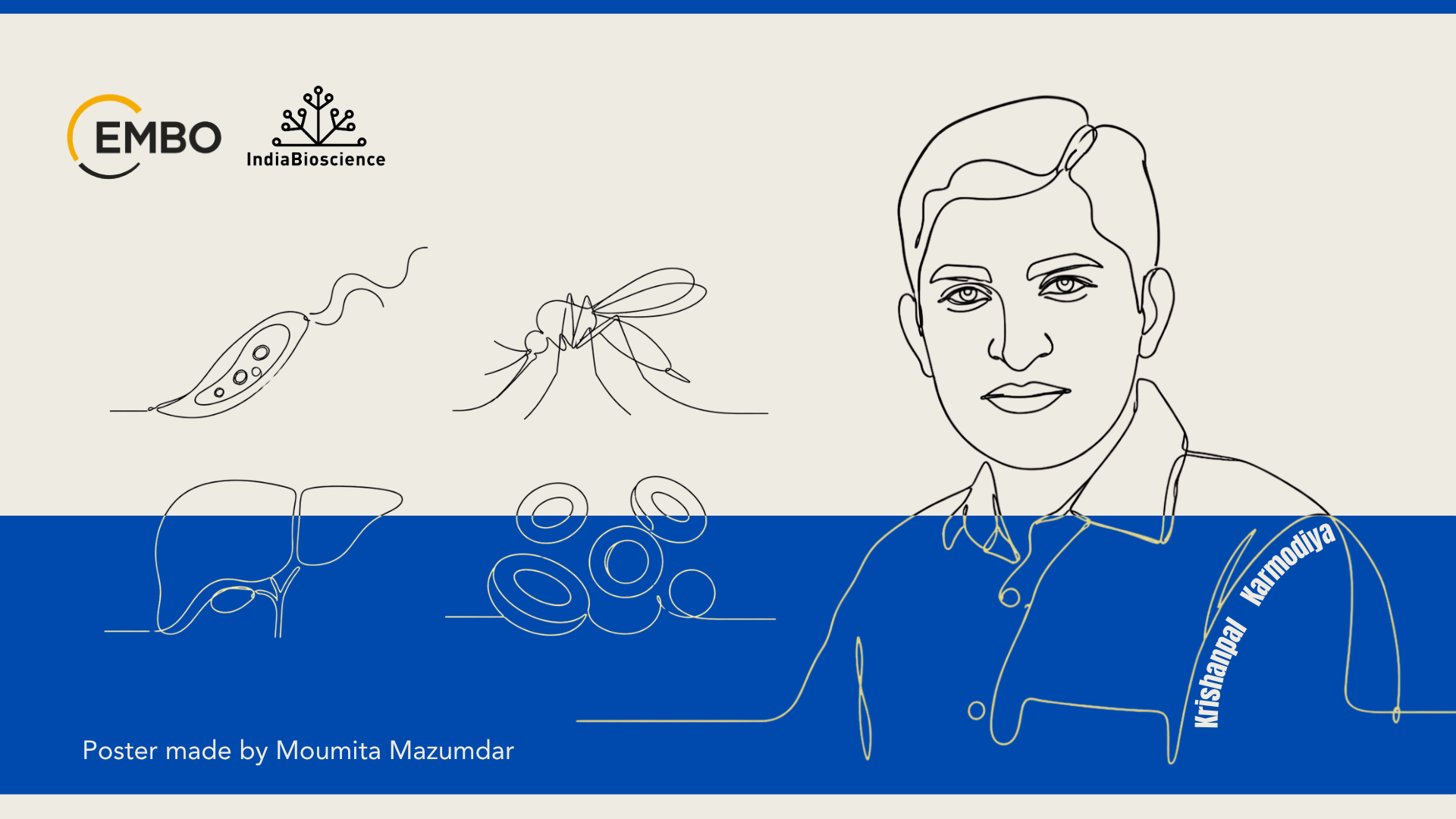
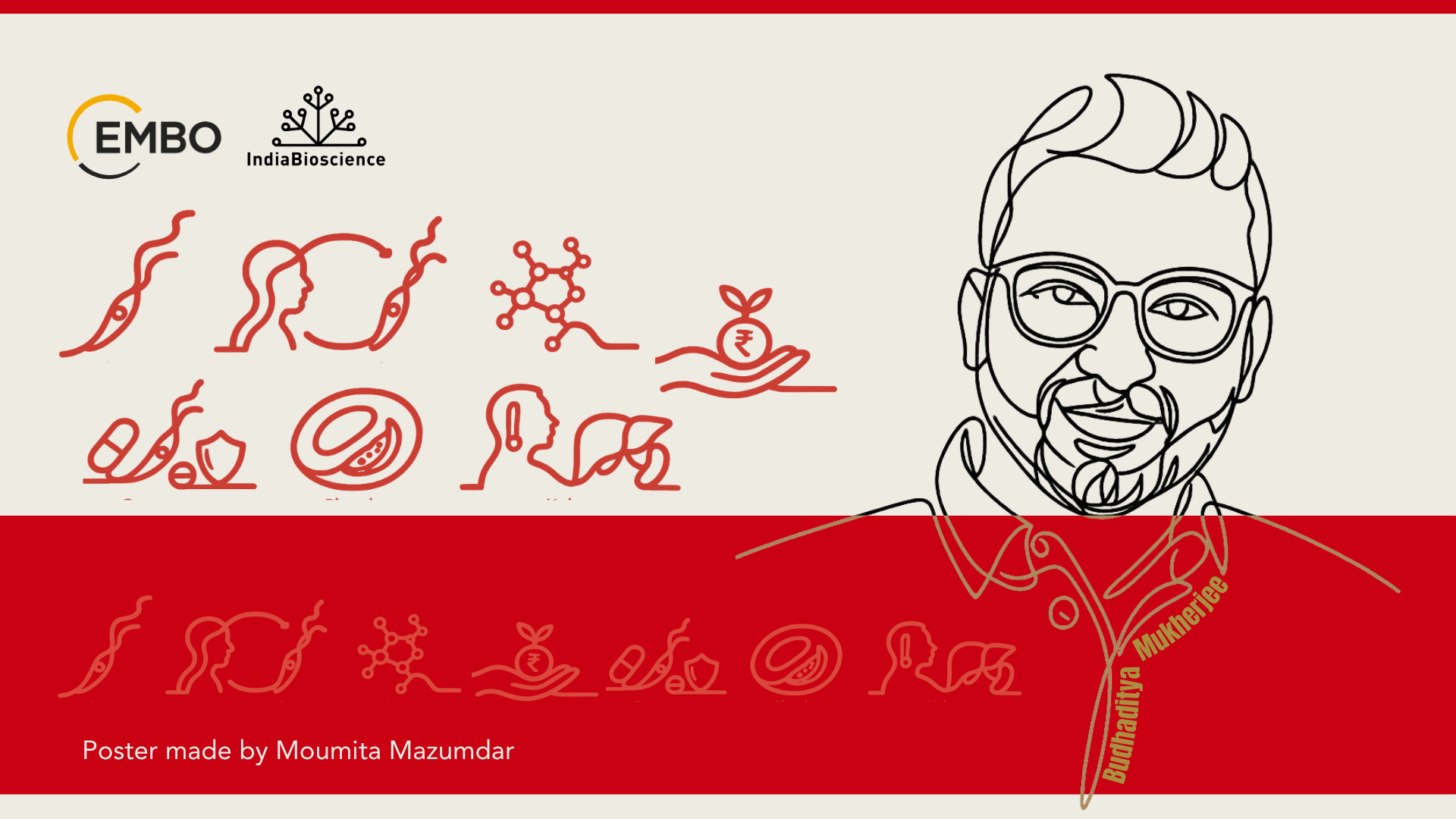
                <p>A childhood fascination with the image of a scientist led <a href="https://scholar.google.com/citations?user=8bV7mn8AAAAJ&amp;hl=en" target="_blank" rel="noreferrer noopener">Budhaditya Mukherjee</a>, an Assistant Professor at the Indian Institute of Technology Kharagpur (IIT Kharagpur) and an EMBO Global Investigator Network (EMBO GIN) awardee, to a career studying one of the world’s most adaptable parasites, <em>Leishmania</em>. In this profile, he reflects on research, resilience, mentorship, genome plasticity, and how understanding pathogen evolution may help address drug resistance and chronic infections.<br /></p>              ]]></summary><id>tag:indiabioscience.org,2026-06-19:/columns/conversations/the-shared-world-of-leishmania-and-us-a-journey-of-adaptability-and-co-evolution</id><published>2026-06-19T10:00:00+05:30</published><updated>2026-06-02T17:40:13+05:30</updated><author><name>Debolina Manna</name><uri>https://indiabioscience.org/authors/GjYBLml2j5My8VJ</uri></author><content type="html"><![CDATA[
                
<p>A childhood fascination with the image of a scientist led <a href="https://scholar.google.com/citations?user=8bV7mn8AAAAJ&amp;hl=en" target="_blank" rel="noreferrer noopener">Budhaditya Mukherjee</a>, an Assistant Professor at the Indian Institute of Technology Kharagpur (IIT Kharagpur) and an EMBO Global Investigator Network (EMBO GIN) awardee, to a career studying one of the world’s most adaptable parasites, <em>Leishmania</em>. In this profile, he reflects on research, resilience, mentorship, genome plasticity, and how understanding pathogen evolution may help address drug resistance and chronic infections.<br /></p><figure><a href="https://indiabioscience.org/columns/conversations/the-shared-world-of-leishmania-and-us-a-journey-of-adaptability-and-co-evolution"><img
                width="1920"
                height="1080"
                style="max-width: 100%; height: auto"
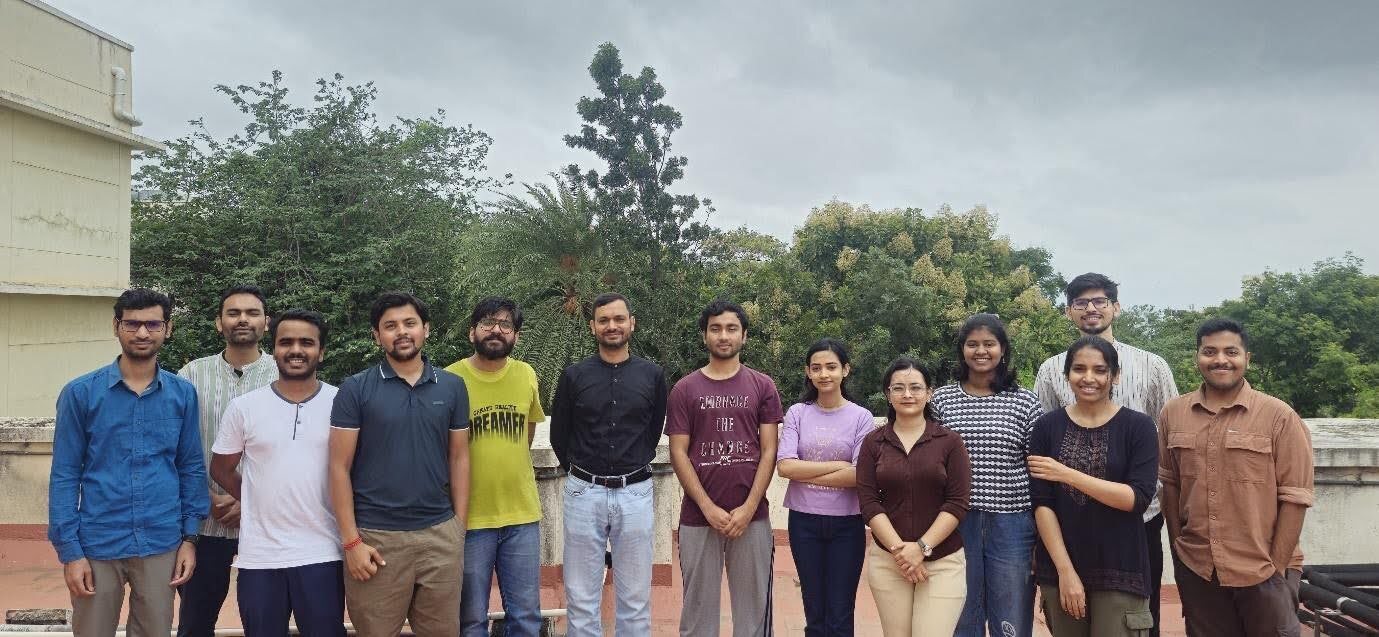
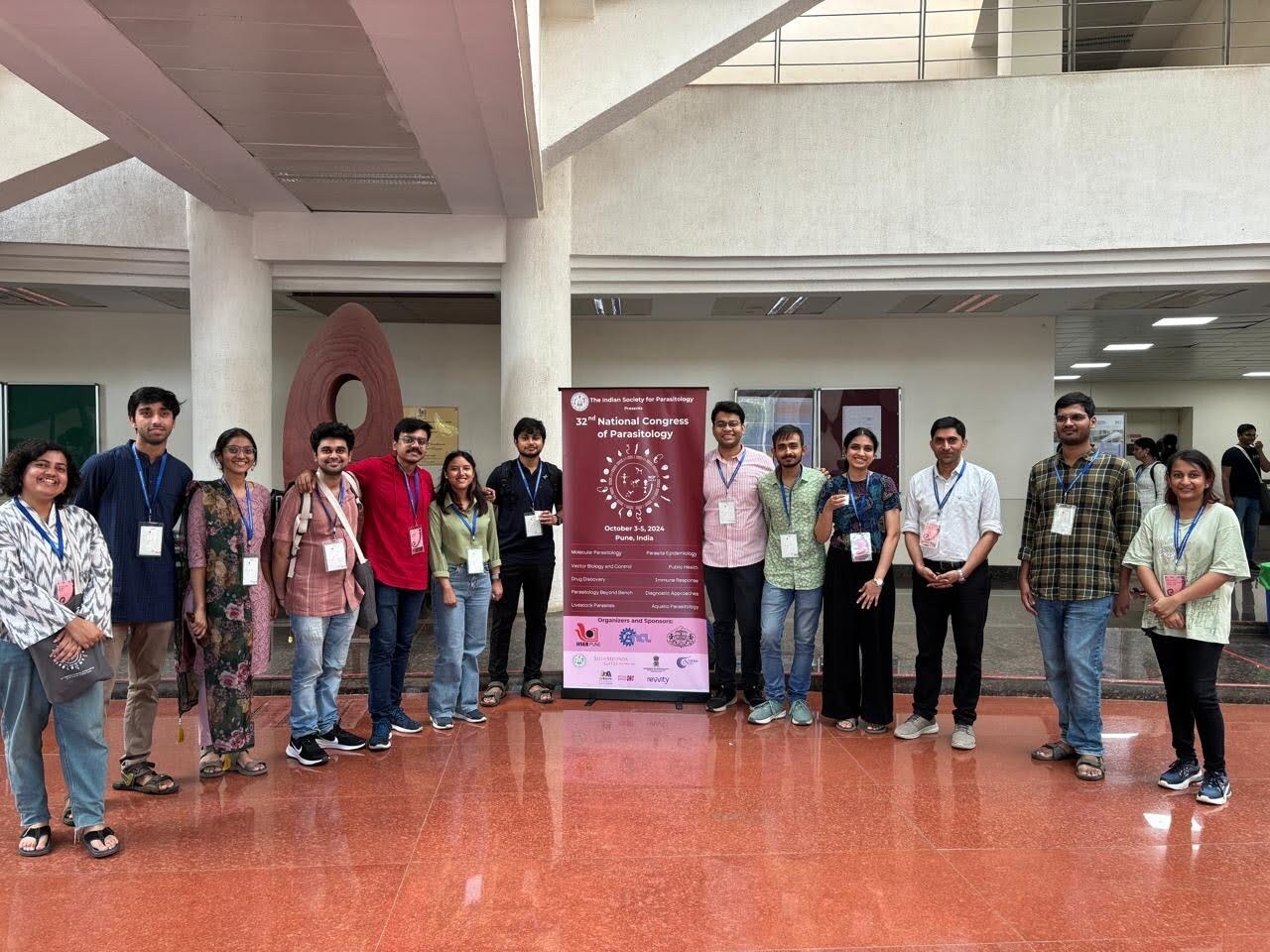
                src="https://cdn.indiabioscience.org/media/articles/architecure-Portfolio.png"></a></figure><p>Sometimes, minute incidents can profoundly shape a person's dreams; similar to a tiny, blood-seeking sandfly whose bite can define the path of a microscopic parasite like <em>Leishmania</em>, causing it to adapt and survive in the liver and spleen of a human.</p><p>For Budhaditya Mukherjee, it was when he attended a lecture by one of his school alumni delivering a research talk at his school. <em>"I was in my seventh grade, and I heard him speak about radiophysics. Although more than science, the imagery of a scientist — intelligent, confident, ambitious, smart and knowledgeable — captivated me, and I wondered what it is like to be one. This one moment shaped the entire trajectory of my career and helped build my dreams".</em></p><p>Now an Assistant Professor at the <a href="https://www.iitkgp.ac.in/" rel="noopener" target="_blank">Indian Institute of Technology Kharagpur</a> (IIT Kharagpur) and a member of the <a href="https://www.embo.org/funding/fellowships-grants-and-career-support/global-investigator-network/" rel="noopener" target="_blank">EMBO Global Investigator Network</a> (GIN), he reflects on his journey and finds it interesting how much we humans have in common with the life of a parasite. Much as we try to embrace the good, neglect the bad, and adapt to adversities, <em>Leishmania</em> modulates its chromosomal patterns and genetic makeup through a phenomenon known as genome plasticity to achieve drug resistance.</p><p>He found the concept so fascinating that it emerged as the core theme of his lab, and his team now focuses on understanding host-parasite co-evolution using <em>Leishmania</em> as the model pathogen. Drug resistance in leishmaniasis has remained a persistent challenge; so they ask a simple but critical question: instead of eliminating the parasite, how does drug pressure sometimes make it fitter and better adapted to survive? Despite the withdrawal of older drugs like antimonials, resistant parasites continue to infect humans and resist newer therapies too — does <em>Leishmania</em>'s genome plasticity make this possible?<br></p><figure style="margin-left: auto; margin-right: auto; text-align: center;"><img src="https://cdn.indiabioscience.org/media/articles/unnamed_2026-06-02-110129_lrom.jpg" data-image="841374"><figcaption style="text-align: center;">Budhaditya Mukherjee with his PhD students during the initial years of the lab. (Left to right: Supratim Pradhan, Budhaditya Mukherjee, Ankita Mandal Mukherjee, Souradeepa Ghosh, Shatarupa Bhattacharya, Shubhangi Chakraborty, Debolina Manna)</figcaption></figure><p dir="ltr">Growing up, he defied the usual "engineering vs medical" dilemma, and went on to pursue a BSc in Zoology and then MSc in Genetics. Amid a series of unplanned events, he eventually joined the lab of Syamal Roy at the <a href="https://iicb.res.in/" rel="noopener" target="_blank">CSIR-Indian Institute of Chemical Biology (CSIR-IICB), Kolkata</a> for his PhD. Budhaditya attributes this achievement to his parents, who never questioned his choices but rather supported whatever he wanted to study, and to his wife and best friend, Ankita, who, to him, is his "pillar of success".<br></p><p dir="ltr">However, the journey of a parasite that constantly struggles to survive the harsh conditions of the sandfly and the human immune system is as challenging as a human's. When asked about his PhD experience at the lab of <a href="https://iicb.res.in/faculty/dr-syamal-roy" target="_blank">Syamal Roy</a> at CSIR-IICB, he reminisced about how the dynamics of drug resistance in <em>Leishmania</em> always bothered him. </p><p>As his initial proteomics-based research to decipher drug resistance failed to gain prominence, his side project on the anti-inflammatory molecule interleukin-10 (IL-10) response in <em>Leishmania</em>-infected immune cells gained traction. Eventually, his PhD research revealed that drug-resistant <em>Leishmania</em> parasites utilise host IL-10 to promote drug resistance, rendering the drugs ineffective for killing. His eagerness to know more about infection biology led him to the lab of <a href="https://www.unige.ch/medecine/mimo/en/groupes/773soldati-favre/g/d" rel="noopener" target="_blank">Dominique Soldati-Favre</a> at the <a href="https://www.unige.ch/en/" rel="noopener" target="_blank">University of Geneva</a>, which significantly trained him in parasite cell biology and genome editing.<br></p><p dir="ltr"></p><p>Having transitioned from bench to office, Budhaditya recognised substantial differences between being a mentor and a mentee. In his PhD, he was strongly encouraged to think critically and defend his ideas, but in a gentle, supportive way. While during his postdoctoral work, he was pushed through direct, probing questions, often without much cushioning. Apart from his work, the major challenge in his postdoctoral journey was the initial cultural transition in a completely new continent — <em>"I doubted myself more than I expected. There wasn't a quick fix, just patience. Over time, adapting to a new environment, both scientifically and personally, became part of the learning process."</em> It was challenging, but it shaped his independence, precision, and resilience. That shift proved crucial in shaping his current research identity.</p><p>Was he adapting and becoming more resistant like <em>Leishmania </em>does in adverse situations? </p><p>Contrary to the idea that the journey of a parasite is smooth, most of them actually die, and few emerge victorious. To counter the odds, some resort to manoeuvring human cells in a way that does not pose a threat to kill them. As a young scientist, Budhaditya had some compelling theories about how parasite factors can drive evolutionary changes in parasites' adaptation. Despite his attempts, subtle suggestions to choose a more global and lethal pathogen like the malaria-causing <em>Plasmodium</em>, rather than <em>Leishmania</em>, frequently arose during his interviews or personal interactions. Eventually, his ideas found a home when he received the opportunity to build an independent research team at IIT Kharagpur.<br></p><p dir="ltr"></p><p>As Budhaditya was almost set to start with his first two PhD scholars on board, they were unexpectedly hit by the COVID-19 pandemic. His lab — fundamentally based on wet-lab experiments — faced multiple challenges with delays, uncertainty and lack of resources. But gradually, through persistence and perseverance, the work started taking shape.</p><blockquote dir="ltr" class="pull-quote"><em>Adapting to changes and evolving together as a group has been key. In many ways, this co-evolution mirrors the very systems we study in the lab. I believe this has taught me a lot, not only about science but things beyond that."</em></blockquote><p>It is through both adversities and support that he transitioned from being a mentee to a mentor. Earlier during his supervision, he stayed closely involved with his PhD scholars, sharing failures and appreciating successes. Over time, he realised that each student is different, with unique motivations and goals.</p><figure style="margin-left: auto; margin-right: auto; text-align: center;"><img src="https://cdn.indiabioscience.org/media/articles/unnamed-3_2026-06-02-110326_hazq.jpg" data-image="841375"><figcaption style="text-align: center;">The present members of Budhaditya Mukherjee’s lab. (Left to right: Shatarupa Bhattacharya, Sohini Mukherjee, Arkapriya Bhattacharya, Shubhangi Chakraborty, Ankita Mandal Mukherjee, Budhaditya Mukherjee, Riddhiman Dey, Nilanjan Pradhan, Debolina Manna, Chandana Dey, Deneshraj S, Sunandini Bhattacharya, Aparajita Pati)</figcaption></figure><p>The correlation between day-to-day experiences and scientific insights gave rise to another solid question in the lab — how adaptations influence where the parasite survives in the body. In conditions like post-kala-azar dermal leishmaniasis (PKDL), where parasites shift from internal visceral organs to the skin, creating long-term reservoirs for transmission, understanding what drives this change in their path or "tropism" is critical. The lab gradually aims to move beyond a drug-centric view of resistance and uncover the broader principles of pathogen adaptability and co-evolution under drug and host pressure, which can combat chronic and relapsing, resistant infections in pathogens with high genome plasticity.</p><p>Being a part of the EMBO Global Investigator Network, he admires its vision, which aims to address the fundamental questions of biology, regardless of the kind of model one uses. The ability to exchange unpublished ideas and get feedback from peers and mentors, often outside his immediate field, has the potential to bring fresh perspectives to the questions still unanswered by his lab.</p><p>For a complex problem like pathogen adaptation, this kind of cross-disciplinary thinking is invaluable. He also agrees that access to training and advanced facilities is equally important. Many of the questions raised in the lab require technologies and expertise that are not readily available in the institute setting. Through EMBO GIN, his students can gain hands-on experience in cutting-edge approaches rather than relying solely on outsourcing, which is critical for long-term capacity building.</p><p>To him, the best part of being one among all in EMBO GIN is the visibility and platform it offers, especially for the students, to connect with the global scientific community. <em>Leishmania</em> is a neglected pathogen, and there are not too many labs that are trying to understand the evolution of drug resistance in this highly adapting parasite. He sees EMBO GIN as an ecosystem that will not only strengthen his current work but also shape how he and his students grow as a lab in the years ahead.</p><p>With such a wonderful global initiative giving him confidence, he also feels the necessity for the Indian scientific ecosystem to flourish more. Compared with when he first started as a new PI in India in 2019, he feels the research ecosystem has improved considerably. Initiatives like the <a href="https://dst.gov.in/anusandhan-national-research-foundation-anrf" rel="noopener" target="_blank">Anusandhan National Research Foundation (ANRF)</a> early-career grants have certainly helped, both in terms of increased funding and, importantly, more timely disbursement.</p><p>Now, as he slowly moves towards a more experienced phase of his journey as a scientist, he believes we should actively work towards making science more accessible, understandable, and meaningful to different audiences, even though we haven't been traditionally trained to do so. In an era marked by advanced scientific technologies, misinformation seems to be rampant too, and it becomes the responsibility of the scientists to ensure clear and trustworthy communication with the broader public. He also thinks that effective communication is a two-way process, where it becomes equally important to engage with the general public to listen to their insights and incorporate them to develop scientific advancements for real-world application, and ensure that science remains accessible, trustworthy, and relevant to society.<br></p>
              ]]></content><category term="health-and-medicine" label="Health &amp; Medicine" /><category term="microbiology" label="Microbiology" /></entry><entry><title>Bodhisatta Nandy on the evolution and value of YIM</title><link
                  rel="alternate"
                  href="https://indiabioscience.org/columns/conversations/bodhisatta-nandy-on-the-evolution-and-value-of-yim"
                  type="text/html"
                  /><summary type="html"><![CDATA[
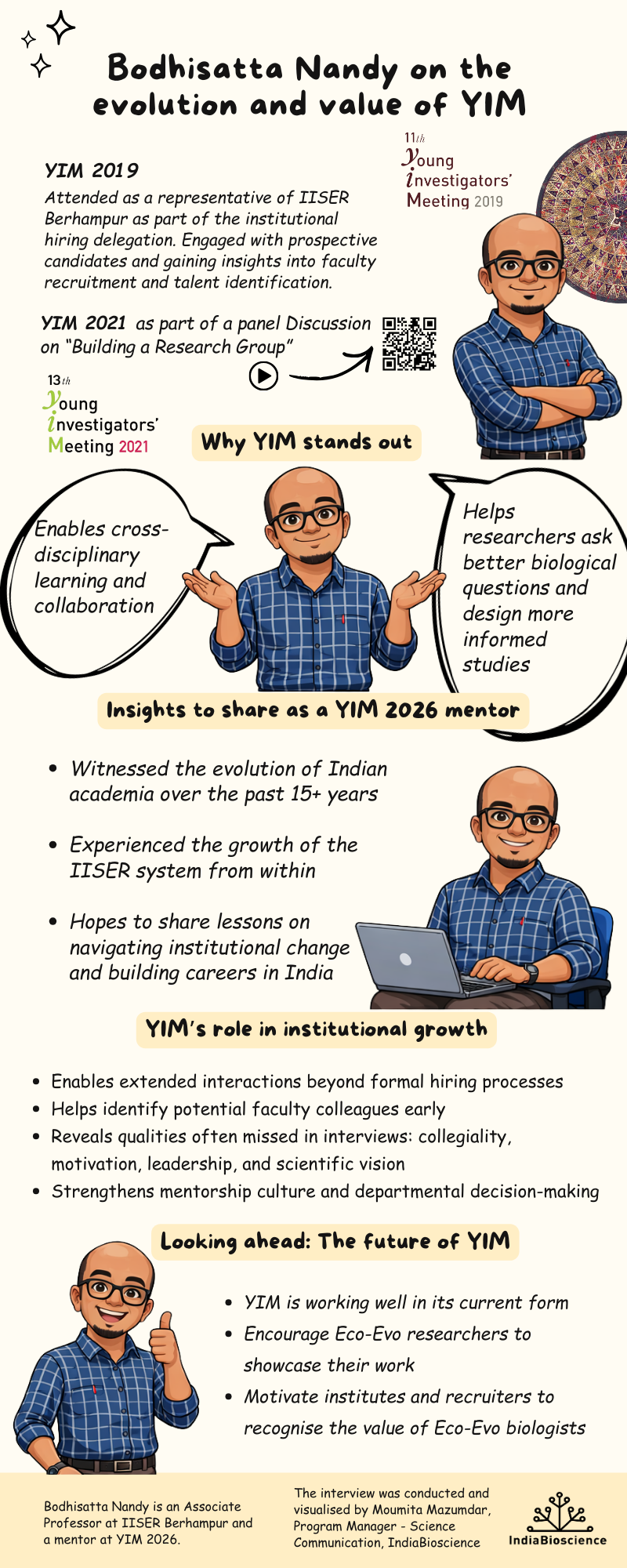
                <p dir="ltr"><strong><a href="https://www.iiserbpr.ac.in/people/profile/nandy" target="_blank" rel="noreferrer noopener">Bodhisatta Nandy</a></strong>, Associate Professor and evolutionary biologist at <a href="https://www.iiserbpr.ac.in" target="_blank" rel="noreferrer noopener">IISER Berhampur</a>, looks back on his association with the Young Investigators’ Meetings (YIMs) over the years, in this conversation with IndiaBioscience. His first interaction with YIM was in 2019, as a faculty representative from IISER Berhampur. The meeting helped him gain an insider’s view of the meeting as a platform for aspiring faculty and institutional networking. He later returned as a panellist at YIM 2021 and is a mentor at YIM 2026.</p>              ]]></summary><id>tag:indiabioscience.org,2026-01-16:/columns/conversations/bodhisatta-nandy-on-the-evolution-and-value-of-yim</id><published>2026-01-16T10:00:00+05:30</published><updated>2025-12-31T15:21:54+05:30</updated><author><name>Moumita Mazumdar</name><uri>https://indiabioscience.org/authors/moumita</uri></author><content type="html"><![CDATA[
                
<p><strong><a href="https://www.iiserbpr.ac.in/people/profile/nandy" target="_blank" rel="noreferrer noopener">Bodhisatta Nandy</a></strong>, Associate Professor and evolutionary biologist at <a href="https://www.iiserbpr.ac.in" target="_blank" rel="noreferrer noopener">IISER Berhampur</a>, looks back on his association with the Young Investigators’ Meetings (YIMs) over the years, in this conversation with IndiaBioscience. His first interaction with YIM was in 2019, as a faculty representative from IISER Berhampur. The meeting helped him gain an insider’s view of the meeting as a platform for aspiring faculty and institutional networking. He later returned as a panellist at YIM 2021 and is a mentor at YIM 2026.</p><figure><a href="https://indiabioscience.org/columns/conversations/bodhisatta-nandy-on-the-evolution-and-value-of-yim"><img
                width="1920"
                height="1080"
                style="max-width: 100%; height: auto"
                src="https://cdn.indiabioscience.org/media/articles/Bodhi-title-image.jpg"></a></figure><figure style="margin-left: auto; margin-right: auto; text-align: center;"><img src="https://cdn.indiabioscience.org/media/articles/Bodhi-Mentor-Feature.png" data-image="823136"></figure><p dir="ltr"><br></p><p dir="ltr">Having experienced YIM from various vantage points, Bodhi shares that the meeting serves as a rare space for extended scientific dialogue across disciplines and for thoughtful faculty engagement. He reflects on YIM’s role in bridging organismal and molecular biology, shaping hiring conversations, and fostering a research culture rooted in long-term thinking, mentorship, and academic community-building.</p><p dir="ltr"><strong>How has your participation at YIM over the years shaped your perspective on the value and evolution of the meeting?</strong></p><p dir="ltr"><em>I did not participate in YIM before joining as a faculty member. My first YIM experience was in 2019, when I represented IISER Berhampur at YIM Guwahati. It was a wonderful experience for me. </em></p><blockquote dir="ltr" class="pull-quote"><em>For aspiring young faculty members, it provided a valuable opportunity not only to showcase their work but also to interact with potential employers and understand the nuances of faculty recruitment in the country.</em></blockquote><p dir="ltr"><strong>YIM brings together scientists from diverse backgrounds and career stages. From your perspective as an evolutionist working in India and a faculty leader, what makes YIM a distinctive platform for creating meaningful scientific connections?</strong></p><p dir="ltr"><em>There is a serious dearth of interaction between organismal biologists, especially ecologists and evolutionary biologists, and sub-organismal biologists such as molecular biologists, cell biologists, and biochemists. </em></p><blockquote dir="ltr" class="pull-quote"><em>YIM has great potential to bring together these diverse yet complementary domains of the biological sciences. </em></blockquote><p dir="ltr"><em>While organismal biologists can benefit from incorporating molecular techniques into their studies, sub-organismal biologists can gain a more holistic biological perspective, develop new questions, and make more informed decisions about study design through such interactions.</em></p><p dir="ltr"><strong>As a mentor at YIM 2026, what insights from your academic journey do you hope to share with early-career researchers navigating their paths in academia?</strong></p><p dir="ltr"><em>I have witnessed the transformation of the Indian academic landscape over the past one and a half decades. I hope to share insights gained from observing the evolution of the IISER system over the years, particularly regarding institutional growth, expectations, and opportunities for early-career researchers.</em></p><p dir="ltr"><strong>You have played a central role in building the Department of Biological Sciences at IISER Berhampur and currently serve as Dean of Student Affairs. How do meetings like YIM contribute to institutional growth, mentorship culture, and the broader research ecosystem in India?</strong></p><blockquote dir="ltr" class="pull-quote"><em>YIM provides an opportunity to meet young, aspiring scientists who may become valuable assets to academic departments. The faculty hiring process often misses nuances of personality and temperament that are crucial for long-term success as a faculty member. Extended interactions at meetings such as YIM allow us to better assess potential colleagues before encouraging them to apply for faculty positions.</em></blockquote><p dir="ltr"><strong>Looking ahead, how do you envision this meeting evolving to adapt to the needs of India’s next generation of scientists?</strong></p><p dir="ltr"><em>I think YIM is functioning very well and does not necessarily need to evolve into something entirely different. However, I would like to see a stronger focus on ecology and evolutionary biology, both by encouraging researchers from these fields to showcase their science and by motivating recruiters and decision-makers to recognise that many institutions would greatly benefit from hiring more ecologists and evolutionary biologists.</em><br></p>
              ]]></content><category term="other" label="Other" /><category term="funding" label="Funding" /></entry><entry><title>Reflections from working in the biotech industry: Key lessons and advice that have stayed</title><link
                  rel="alternate"
                  href="https://indiabioscience.org/columns/conversations/reflections-from-working-in-the-biotech-industry-key-lessons-and-advice-that-has-stayed"
                  type="text/html"
                  /><summary type="html"><![CDATA[
                <p dir="ltr">Reflecting on her journey in biotechnology, Ruchika Srivastava<strong></strong>came to realise that the lessons she learnt extend far beyond the realm of science. They shape how we work, why we work, and how we connect with others, gradually becoming a way of life.</p>              ]]></summary><id>tag:indiabioscience.org,2026-01-05:/columns/conversations/reflections-from-working-in-the-biotech-industry-key-lessons-and-advice-that-has-stayed</id><published>2026-01-05T10:00:00+05:30</published><updated>2026-01-07T14:00:51+05:30</updated><author><name>Ruchika Srivastava</name><uri>https://indiabioscience.org/authors/RuchikaSrivastava</uri></author><content type="html"><![CDATA[
                
<p>Reflecting on her journey in biotechnology, Ruchika Srivastava came to realise that the lessons she learnt extend far beyond the realm of science. They shape how we work, why we work, and how we connect with others, gradually becoming a way of life.</p><figure><a href="https://indiabioscience.org/columns/conversations/reflections-from-working-in-the-biotech-industry-key-lessons-and-advice-that-has-stayed"><img
                width="1920"
                height="1080"
                style="max-width: 100%; height: auto"
                src="https://cdn.indiabioscience.org/media/articles/Ruchika-Srivastava_Empathy.jpg"></a></figure><p>Over the course of a career in biotechnology, learning extends far beyond experiments and publications. It emerges from working with people, navigating uncertainty, confronting failure, and witnessing the real-world impact of scientific work. The reflections below capture key lessons shaped by experience, about teamwork, empathy, resilience, planning, and purpose, that together define what it truly means to build a meaningful and lasting career in biotech.</p><p><strong>1. Take time to know the people you work with</strong></p><p>I learned early in my career that while an organisation’s brand can attract great talent, it doesn’t retain it — <em>people</em> do. The colleagues, mentors, and leaders you work with shape your experience more than any logo or title ever could. Invest time in getting to know the people around you. </p><blockquote class="pull-quote"><em>Be the kind of person others want to work with — and work for.</em> In the end, it’s the people around you who make the work worthwhile.</blockquote><p><strong>2. Team dynamics</strong></p><p>Biotech is never a solitary pursuit. Every breakthrough relies on scientists, clinicians, writers, and many others working together. I once heard team dynamics explained like a Venn diagram — some strengths overlap, but most do not. <em>The best teams recognise and leverage these unique strengths.</em> Bringing people together to work cohesively is what produces the drugs that change the world.</p><p><strong>3. Genuine interest in the field</strong></p><p>Perhaps the most important driver in research is passion. A genuine interest in biotechnology fuels curiosity, persistence, and the willingness to learn. </p><blockquote class="pull-quote"><em>Your career isn’t a sprint; it’s a marathon. Genuine interest helps you sustain the journey.</em></blockquote><p><strong>4. Seeing the bigger picture</strong></p><p>It’s easy to get caught up in the details of experiments. But stepping back to see the bigger picture and the global context of our work keeps us grounded in purpose.</p><p>My biggest learning hasn’t come from a textbook or a research paper, but from witnessing the impact our work has on real lives. That perspective sharpened during the COVID-19 pandemic, when scientists continued working in the lab while much of the world stayed home — layering on safety protocols, working in shifts, and still pushing forward at breakneck speed to deliver solutions the world desperately needed. <em>Their efforts were not only scientific achievements but also profound acts of empathy and commitment to humanity.</em></p><p><strong>5. Empathy</strong></p><p>Biotechnology is driven by experiments, data, and precision — but it is also deeply human. During company-wide meetings, we often watched videos of patients whose lives had been transformed by the treatments we helped develop. In those moments, patients shared their journeys — often emotional, always raw — and expressed gratitude to the scientists who gave them a second chance at life. <em>These stories were powerful reminders that behind every cell culture, every assay, and every regulatory milestone is a human being, a family, and a lived experience.</em></p><p><strong>6. Planning</strong></p><p>Progress in biotech doesn’t happen by chance. Careful planning — from experimental design to regulatory strategy — transforms ideas into breakthroughs<em>. </em></p><blockquote class="pull-quote"><em>Planning gives us the discipline to move forward with intention, while still leaving space for innovation and flexibility. It is the foundation that turns scientific curiosity into structured progress.</em></blockquote><p><strong>7. The value of documentation</strong></p><p>Clear and accurate records enable teams to build upon one another’s work, ensure compliance, and maintain the integrity of results.One of the best pieces of advice I received early in my career came from my father, a food technology expert. He told me, <em>“Write your experimental details as if someone across the ocean is going to repeat it without speaking to you.” </em> In biotech, documentation is not just paperwork — it’s the bridge between innovation and trust, turning experiments into evidence and progress into impact.<br></p><p><strong>8. Stepping outside your comfort zone and saying yes to opportunities</strong></p><p>Growth happens when we challenge ourselves. Whether it’s taking on a new role, learning a new skill, or exploring an unfamiliar area, stepping outside your comfort zone opens doors to opportunities you may never have imagined. </p><blockquote class="pull-quote"><em>Don’t fear the unfamiliar — that’s where growth lives.</em></blockquote><p><strong>9. Accepting failure</strong></p><p>As the saying goes, <em>drug development is not rocket science; it’s harder than rocket science.</em> In biotechnology, failure is not the opposite of success — it’s part of the path to it. </p><blockquote class="pull-quote"><em>Experiments that don’t work, projects that stall, or submissions that face setbacks all teach us valuable lessons if we’re willing to learn.</em></blockquote><p>Accepting failure with humility and resilience allows us to adapt, grow, and ultimately move closer to meaningful breakthroughs.</p><p><strong>10. Invest in training people</strong></p><p>If people are our greatest strength, then training is our greatest investment. Building skills, sharing knowledge, and fostering continuous learning ensure that individuals and teams can thrive in a rapidly changing industry. </p><p><strong>11. Leaving the work in a better state</strong></p><p>From the smallest task to the biggest project, one guiding principle is to leave the work in a better state than when it was handed to you. This mindset builds continuity, raises standards, and ensures lasting impact. </p><blockquote class="pull-quote"><em>Good is never the end point — there is always room to make things better.</em></blockquote><p><strong>12. Take time to reflect</strong></p><p>From time to time, step back and reflect on your career path — where you are, where you want to be, and what truly matters to you. Be conscious of your choices and intentional about your direction. Reflection brings clarity, purpose, and alignment between what you do and why you do it — an essential habit in a fast-paced industry and an even more fast-paced life. </p><blockquote class="pull-quote"><em>The more deeply you understand , the more you realise that abundance isn’t about having more; it’s about seeing more.</em></blockquote><p><strong>13. Giving back</strong></p><p>Reflect on your own career and the individuals who supported you along the way — those who gave you your first opportunities, mentors who guided you, and colleagues who shared advice that helped you grow. If you are in a position to do so, pay it forward. Be the mentor, the supporter, the believer in someone else’s potential. There’s always someone less experienced or simply earlier in their journey. When we give back, we don’t just support someone else’s future — we enrich our own. It gives us a chance to experience happiness in its purest form — not the fleeting kind that comes from acquiring something new, but the enduring joy that stays with us long after the moment has passed. It is the foundation upon which meaningful human connections are built.</p><blockquote class="pull-quote">Because ultimately, science is about people. And so is success.</blockquote><p>Taken together, these lessons remind me that biotechnology is not just about science; it’s about people, processes, and purpose. And it is the balance of all three that makes this work both challenging and profoundly rewarding.</p><p><br></p>
              ]]></content><category term="science" label="Science" /><category term="advice" label="Advice" /></entry><entry><title>Anjana Badrinarayanan on discovery science, DNA repair, and the Infosys Prize 2025</title><link
                  rel="alternate"
                  href="https://indiabioscience.org/columns/conversations/anjana-badrinarayanan-on-discovery-science-dna-repair-and-the-infosys-prize-2025"
                  type="text/html"
                  /><summary type="html"><![CDATA[
                <p>IndiaBioscience spoke with <a href="https://www.infosysprize.org/laureates/2025/anjana-badrinarayanan.html" target="_blank" rel="noreferrer noopener">Anjana Badrinarayanan</a>, winner of the <a href="https://www.infosysprize.org/about-the-prize/categories/life-sciences.html" target="_blank" rel="noreferrer noopener">Infosys Prize 2025 in life sciences</a>, about her scientific journey and research. In response to questions posed by IndiaBioscience, she reflected on the meaning of the award, her work on genome maintenance and DNA repair, the role of live-cell imaging in understanding dynamic cellular processes, and the responsibilities that come with scientific recognition.</p>              ]]></summary><id>tag:indiabioscience.org,2026-01-02:/columns/conversations/anjana-badrinarayanan-on-discovery-science-dna-repair-and-the-infosys-prize-2025</id><published>2026-01-02T10:00:00+05:30</published><updated>2025-12-18T14:57:33+05:30</updated><author><name>Moumita Mazumdar</name><uri>https://indiabioscience.org/authors/moumita</uri></author><content type="html"><![CDATA[
                
<p>IndiaBioscience spoke with <a href="https://www.infosysprize.org/laureates/2025/anjana-badrinarayanan.html" target="_blank" rel="noreferrer noopener">Anjana Badrinarayanan</a>, winner of the <a href="https://www.infosysprize.org/about-the-prize/categories/life-sciences.html" target="_blank" rel="noreferrer noopener">Infosys Prize 2025 in life sciences</a>, about her scientific journey and research. In response to questions posed by IndiaBioscience, she reflected on the meaning of the award, her work on genome maintenance and DNA repair, the role of live-cell imaging in understanding dynamic cellular processes, and the responsibilities that come with scientific recognition.</p><figure><a href="https://indiabioscience.org/columns/conversations/anjana-badrinarayanan-on-discovery-science-dna-repair-and-the-infosys-prize-2025"><img
                width="1920"
                height="1080"
                style="max-width: 100%; height: auto"
                src="https://cdn.indiabioscience.org/media/articles/PCST-and-Biotales-2.jpg"></a></figure><p>In her responses, <a href="https://www.infosysprize.org/laureates/2025/anjana-badrinarayanan.html" target="_blank" rel="noreferrer noopener">Badrinarayanan</a> emphasised that receiving the Infosys Prize has reaffirmed her commitment to curiosity-driven, long-term research. She described how her work challenges static views of DNA repair by revealing it as a dynamic, cell-wide process shaped by movement, timing, and cellular state. She also reflected on the broader importance of patient, high-risk research, mentorship, and building supportive scientific ecosystems that enable young researchers to pursue ambitious questions.<br></p><p dir="ltr"><strong>Congratulations on receiving the Infosys Prize 2025. What does this recognition mean to you at this stage of your scientific career, and how do you see it shaping your future research direction?</strong><br></p><p dir="ltr"><em>Receiving the Infosys Prize at this stage of my career is both affirming and grounding. It is a recognition of long-term, curiosity-driven work that does not always yield quick answers, but steadily builds understanding over time. </em></p><blockquote dir="ltr" class="pull-quote"><em>Personally, it reinforces my belief in asking difficult mechanistic questions and staying with them over time, even when progress is slow or uncertain.<br></em></blockquote><p dir="ltr"><em>In terms of future direction, the prize does not redirect my research so much as strengthen my commitment to it. It gives me confidence to continue pursuing ambitious questions about genome maintenance that require interdisciplinary approaches and sustained effort. It also brings a responsibility to contribute more actively to the broader scientific ecosystem — through mentorship, collaboration, and helping build environments where young scientists feel supported in taking intellectual risks.</em><br></p><p dir="ltr"><strong>Your work uncovers new mechanisms of DNA repair. Could you describe how these discoveries reshape our understanding of genome maintenance?</strong><br></p><p dir="ltr"><em>Genome maintenance has traditionally been viewed as a largely local and passive process, where repair proteins act near sites of damage. Our work challenges this view by showing that DNA repair is highly dynamic and organised at the scale of the whole cell. Cells actively mobilise repair machinery, using energy-dependent processes to search for damaged DNA and coordinate repair efficiently. We have also shown that mutagenic DNA repair can operate outside of the conventional boundaries of the cell cycle, including in dormant or non-dividing cells. This reshapes how we think about when and where mutations arise, and suggests that genome modification is not restricted to actively replicating cells. This shifts our understanding of genome maintenance from a static framework to a dynamic one, where movement, timing, and spatial organisation play central roles. It also suggests that genome architecture and cellular state strongly influence how repair unfolds. These insights help explain how cells maintain stability under stress, and why repair outcomes can differ depending on physiological conditions. More broadly, they have important consequences for stability, adaptation, and evolution, highlighting that genome maintenance is not just about individual enzymes, but about coordinated cellular strategies.</em><br></p><p dir="ltr"><strong>Live-cell imaging is central to your research. How is this technology transforming the way molecular biologists investigate dynamic processes inside cells?</strong><br></p><p dir="ltr"><em>Live-cell imaging has fundamentally changed how we study biology by allowing us to observe processes as they unfold in real time inside living cells. For molecular biologists, this means moving beyond static descriptions to understanding dynamics: how molecules move, interact, and respond to changes over time. In our work, this has been critical for studying DNA repair, where key events occur rapidly and transiently, and would be otherwise missed. By following individual cells, we can capture dynamics and heterogeneity that are completely masked in population-averaged experiments. It has also revealed variability between individual cells, showing that even genetically identical cells can behave differently under the same conditions. More broadly, this approach is transforming molecular biology by revealing temporal order, coordination, and decision-making within cells. As imaging becomes more quantitative and integrated with computational analysis, it is enabling researchers to link molecular mechanisms to cellular behaviour in a far more direct and predictive way.</em><br></p><p dir="ltr"><strong>The Infosys Prize often highlights research with potential societal impact. How do you envision your discoveries contributing to long-term advances in disease research or therapeutic strategies?</strong><br></p><p dir="ltr"><em>Many diseases including cancer, neurodegenerative disorders, and age-related conditions are associated with defects in DNA repair and genome stability. While my research is focused on microbial systems, the underlying principles we uncover are often conserved across evolution. Studying these processes in tractable systems allows us to identify core mechanisms that are difficult to dissect in more complex cells. In the context of infectious disease, understanding DNA repair in bacteria is also important for addressing antibiotic resistance, as repair pathways enable microbes to survive stress and evolve rapidly. </em></p><blockquote dir="ltr" class="pull-quote"><em>I want to highlight that the contribution of fundamental discovery research is often indirect and long-term. Rather than producing immediate therapies, it provides the conceptual foundation that informs future drug targets, treatment strategies, and diagnostic approaches. </em></blockquote><p dir="ltr"><em>In that sense, it shapes the landscape in which applied and clinical research can operate more effectively, and opens new and frontier research directions. In a rapidly changing world, such forward facing, long-term fundamental research is critical to ensure we are future ready.</em><br></p><p dir="ltr"><strong>Frontier research in India often requires deep institutional support. How do you think awards like the Infosys Prize help strengthen basic science ecosystems and inspire confidence in high-risk, curiosity-driven research?</strong><br></p><p dir="ltr"><em>Awards like the Infosys Prize play a vital role in validating discovery science and curiosity-driven research, especially in areas where outcomes are uncertain and timelines are long. By recognising this, the foundation sends a strong message that depth, originality, and persistence matter. </em></p><blockquote dir="ltr" class="pull-quote"><em>Such recognition goes a long way towards strengthening research ecosystems by increasing visibility for basic science, helping attract talented students and collaborators, and reinforcing institutional confidence in supporting ambitious projects. This is particularly important in India, to encourage researchers to aim for long-term impact. </em></blockquote><p dir="ltr"><em>I feel that beyond individual recognition, these awards help shape scientific culture. They encourage institutions and funding agencies to invest in long-term thinking and create environments where researchers feel supported in taking intellectual risks. Over time, this builds resilience and excellence in the scientific system as a whole.</em><br></p><p dir="ltr"><strong>Many young researchers look up to scientists like you. What message would you like to share with early-career scientists, especially women in STEM, who aspire to pursue challenging, long-term scientific questions?</strong><br></p><blockquote dir="ltr" class="pull-quote">I would encourage young scientists to give themselves permission to be curious and to be patient with uncertainty. </blockquote><p dir="ltr"><em>Scientific questions rarely yield quick answers, and progress often comes through periods of confusion and failure. This is a normal and necessary part of discovery. For women in STEM in particular, it is important to recognise that doubts and obstacles are not personal shortcomings, but structural features of the system. Building supportive networks, seeking mentors, and trusting one’s intellectual instincts can make a tremendous difference. Finally, choose questions that genuinely excite you. Sustained curiosity is what carries you through difficult phases. Science is not a straight path, and success does not look the same for everyone. There is space for diverse voices, styles, and trajectories in research.<br></em></p><p dir="ltr"><em><strong>Scientific recognition often brings new responsibilities. Do you see this award influencing your roles in mentorship, scientific leadership, or in shaping the broader research culture at National Centre for Biological Sciences (NCBS-TIFR)or beyond?</strong><br></em></p><p dir="ltr"><em>Scientific recognition does bring a certain sense of responsibility, though I see it more as a continuation than a change. Mentorship has always mattered deeply to me, and that commitment remains central, particularly supporting early-career scientists as they navigate uncertainty and failure. It is important to foster environments where rigorous and creative science can thrive together. At NCBS, which has a strong and vibrant culture of fundamental research, I feel it is important to help sustain and strengthen this environment that values curiosity, rigor, and intellectual risk-taking. That includes encouraging conversations across disciplines and ensuring that young researchers feel confident pursuing original ideas. I do hope to contribute to conversations about how we define and assess scientific success. Moving beyond short-term metrics to recognise depth, integrity, and long-term impact is essential. </em></p><blockquote dir="ltr" class="pull-quote"><em>Shaping research culture is always a collective effort, but recognition can help give weight and visibility to these conversations.</em><br></blockquote>
              ]]></content><category term="science" label="Science" /><category term="advice" label="Advice" /></entry><entry><title>Mayurika Lahiri’s YIM Journey: PDF, YI and now mentor</title><link
                  rel="alternate"
                  href="https://indiabioscience.org/columns/conversations/mayurika-lahiris-yim-journey-pdf-yi-and-now-mentor"
                  type="text/html"
                  /><summary type="html"><![CDATA[
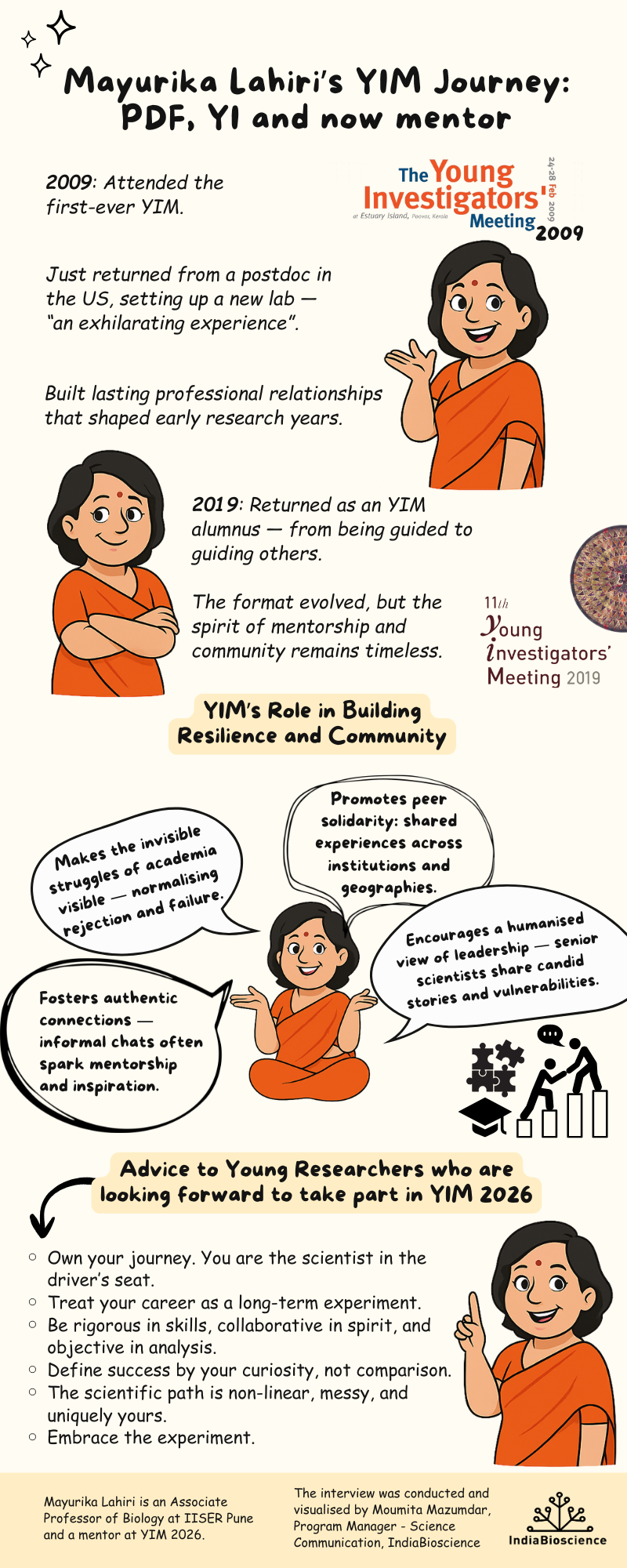
                <p dir="ltr"><strong><a href="https://www.iiserpune.ac.in/research/department/biology/people/faculty/regular-faculty/mayurika-lahiri/289" target="_blank" rel="noreferrer noopener">Mayurika Lahiri</a></strong>, Associate Professor at the <a href="https://www.iiserpune.ac.in" target="_blank" rel="noreferrer noopener">Indian Institute of Science Education and Research (IISER) Pune</a>, reflects on her long association with the Young Investigators’ Meeting (YIM) in this conversation with us. She attended the inaugural edition in 2009 after returning from her postdoctoral fellowship in the US, participated again as a YIM alumnus in 2019, and will return as a mentor at YIM 2026.<br /></p>              ]]></summary><id>tag:indiabioscience.org,2025-12-22:/columns/conversations/mayurika-lahiris-yim-journey-pdf-yi-and-now-mentor</id><published>2025-12-22T10:00:00+05:30</published><updated>2025-12-23T10:03:59+05:30</updated><author><name>Moumita Mazumdar</name><uri>https://indiabioscience.org/authors/moumita</uri></author><content type="html"><![CDATA[
                
<p><strong><a href="https://www.iiserpune.ac.in/research/department/biology/people/faculty/regular-faculty/mayurika-lahiri/289" target="_blank" rel="noreferrer noopener">Mayurika Lahiri</a></strong>, Associate Professor at the <a href="https://www.iiserpune.ac.in" target="_blank" rel="noreferrer noopener">Indian Institute of Science Education and Research (IISER) Pune</a>, reflects on her long association with the Young Investigators’ Meeting (YIM) in this conversation with us. She attended the inaugural edition in 2009 after returning from her postdoctoral fellowship in the US, participated again as a YIM alumnus in 2019, and will return as a mentor at YIM 2026.</p><figure><a href="https://indiabioscience.org/columns/conversations/mayurika-lahiris-yim-journey-pdf-yi-and-now-mentor"><img
                width="1920"
                height="1080"
                style="max-width: 100%; height: auto"
                src="https://cdn.indiabioscience.org/media/articles/Mayurika-Lahiri-YIM-article.png"></a></figure><figure style="margin-left: auto; margin-right: auto; text-align: center;"><img src="https://cdn.indiabioscience.org/media/articles/Mayurika-lahiri-mentor-feature-1.png" data-image="817101"></figure><p dir="ltr"><br></p><p dir="ltr">Having seen the meeting both as a young investigator and now as a senior mentor, she shares how YIM has changed in format but has stayed true to its core values of community, mentorship, and collaboration. She speaks about the networks she built in her early years, the lessons in empathy and leadership she hopes to pass on, and how YIM creates a sense of belonging for young researchers navigating the uncertainties of academia.</p><p dir="ltr"><strong>1. How has your YIM experience evolved over the years?</strong></p><ol></ol><p dir="ltr"><em>Attending the first YIM in 2009 was memorable since it was the first meeting of its kind in India. It gave me a chance to meet researchers across the country, many of whom I am still connected with. I had just returned from my postdoctoral work in the US and was setting up my laboratory, so the experience was exciting and energising. A decade later, returning to YIM 2019 felt very different. By then, I had spent almost ten years establishing my research programme. I was no longer a young investigator in the same sense and could enjoy the meeting from a mentoring perspective. It was fulfilling to guide others who were setting up their labs. Over the years, the meeting has evolved, but the spirit of openness, support, and community has remained exactly the same</em><br></p><p dir="ltr"><strong>2. As a YI in 2009, what were the key takeaways or connections that shaped your academic journey at that stage?</strong></p><ol></ol><p dir="ltr"><em>Since I had not done research in India (I left right after my BSc), the 2009 YIM helped me connect with established researchers in the country. These early connections grew into long-term networks that would have been difficult to build otherwise. IISER Pune was also very young at the time, so advice on administrative processes, sharing of reagents, and early collaborations were incredibly helpful. These relationships made my transition into the Indian research ecosystem much smoother</em><br></p><p dir="ltr"><strong>3. Coming back as a mentor in YIM 2026, what will be most important for you to share with the next generation of scientists?</strong></p><ol></ol><p dir="ltr"><em>(i) Build networks with your peers. These relationships will support you throughout your career.</em></p><p dir="ltr"><em>(ii) Lead with empathy and inclusivity. A lab thrives when every member feels safe, respected, and motivated.</em></p><p dir="ltr"><em>(iii) Collaborate meaningfully. Complex research questions cannot be solved alone; they will benefit from multiple perspectives and shared expertise.</em><br></p><p dir="ltr"><strong>4. From your perspective, how does YIM help build resilience and community among early-career researchers in India?</strong></p><ol></ol><p dir="ltr"><em>Academia is competitive, and failure often feels personal and isolating. At YIM, early-career researchers realise they are not alone. When a senior scientist or Nobel Laureate talks openly about a rejected grant, a failed experiment, or a setback in their career, it breaks the myth of the “perfect” scientific journey. It helps ECRs see struggle as a normal part of the process, not a personal flaw. This shift is central to building resilience.</em><br></p><p dir="ltr"><em>YIM also creates a strong peer community. An ECR from a small university might meet someone from a premier institute and discover they face similar challenges, whether with resources, administrative hurdles, or work-life balance. These connections often become long-term collaborations and friendships. When a paper is rejected or an experiment fails, there is a community that understands and supports them.</em><br></p><p dir="ltr"><em>Informal interactions over meals, poster sessions, or during breaks also play a big role. Seeing senior scientists as approachable, everyday people breaks psychological barriers. It shows ECRs that leadership roles are attainable and encourages them to imagine themselves in those positions one day. This sense of community, belonging, and shared experience is what makes YIM special.</em><br></p><p dir="ltr"><strong>5. Looking back, what advice would you give to today’s Young Investigators, especially those facing uncertainties in academia?</strong></p><ol></ol><p dir="ltr"><em>I would say that the uncertainty is real, but they are not passive travellers. </em></p><p dir="ltr"><em>They are in the driver’s seat. Think of the career as the most important long-term experiment. Build skills with intention, collaborate generously, and don’t take failure personally. Let curiosity guide one’s choices and define what success means to them. The journey will be messy and non-linear, but it is theirs to shape. They should embrace it like any good experiment, with openness, patience, and confidence in the process.</em><br></p>
              ]]></content><category term="other" label="Other" /><category term="funding" label="Funding" /></entry><entry><title>Steering science: Pallavi Kshetrapal’s reflections from the first YIM</title><link
                  rel="alternate"
                  href="https://indiabioscience.org/columns/conversations/steering-science-pallavi-kshetrapals-reflections-from-the-first-yim"
                  type="text/html"
                  /><summary type="html"><![CDATA[
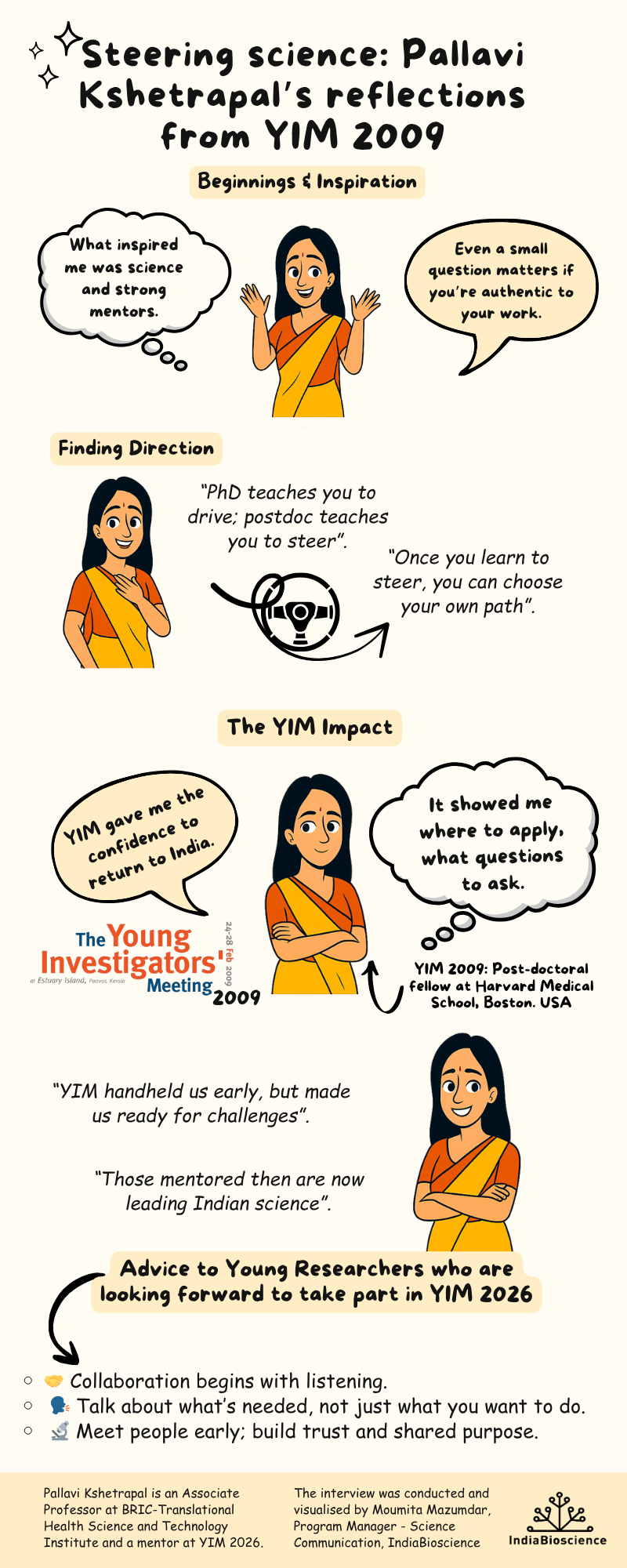
                <p dir="ltr">Molecular geneticist <a href="https://thsti.res.in/en/faculty-profile/Pallavi-K" target="_blank" rel="noreferrer noopener"><strong>Pallavi Kshetrapal</strong></a>, Associate Professor at BRIC-THSTI, traces her scientific journey from curiosity-driven beginnings to mentoring and leadership. Reflecting on the inaugural <strong>Young Investigators’ Meeting (YIM) 2009</strong>, she highlights how mentorship, collaboration, and authentic science shaped her career and continue to strengthen India’s research ecosystem.<br /></p>              ]]></summary><id>tag:indiabioscience.org,2025-12-08:/columns/conversations/steering-science-pallavi-kshetrapals-reflections-from-the-first-yim</id><published>2025-12-08T10:00:00+05:30</published><updated>2025-11-10T17:26:47+05:30</updated><author><name>Moumita Mazumdar</name><uri>https://indiabioscience.org/authors/moumita</uri></author><content type="html"><![CDATA[
                
<p>Molecular geneticist <a href="https://thsti.res.in/en/faculty-profile/Pallavi-K" target="_blank" rel="noreferrer noopener"><strong>Pallavi Kshetrapal</strong></a>, Associate Professor at BRIC-THSTI, traces her scientific journey from curiosity-driven beginnings to mentoring and leadership. Reflecting on the inaugural <strong>Young Investigators’ Meeting (YIM) 2009</strong>, she highlights how mentorship, collaboration, and authentic science shaped her career and continue to strengthen India’s research ecosystem.</p><figure><a href="https://indiabioscience.org/columns/conversations/steering-science-pallavi-kshetrapals-reflections-from-the-first-yim"><img
                width="1920"
                height="1080"
                style="max-width: 100%; height: auto"
                src="https://cdn.indiabioscience.org/media/articles/eeting_2025-11-10-115624_fllr.jpg"></a></figure><figure><img src="https://cdn.indiabioscience.org/media/articles/YIM-2026-interviews-with-co-organisers_2025-11-10-115301_qhvu.png" data-image="816471" width="770" height="1925"></figure><p dir="ltr"><br><a href="https://thsti.res.in/en/faculty-profile/Pallavi-K" rel="noopener" target="_blank">Pallavi Kshetrapal</a> is a molecular geneticist and an Associate Professor at <a href="http://thsti.res.in/" rel="noopener" target="_blank">BRIC-Translational Health Science and Technology Institute</a>. She recalls the beginnings of her scientific journey, attributing her career path to both curiosity and the mentors she met. <em>“When I started my PhD at </em><a href="https://www.ccmb.res.in/" rel="noopener" target="_blank"><em>CSIR-CCMB</em></a><em>, I realised there were deeper biological questions about understanding phenomena, who we are, and how we are made, that I wanted to explore.”</em> Pallavi emphasises that rigorous, ethical, and authentic science lays the foundation for a strong research career. <br></p><blockquote dir="ltr" class="pull-quote"><em>As scientists, we have to ground our experiments in logic and evidence. Even when you're working on a small part of a bigger question, the integrity you bring to it builds trust, and that commitment carries you through your postdoc and beyond.</em>”</blockquote><p dir="ltr">YIM has played a pivotal role in shaping Pallavi’s postdoc trajectory and the eventual decision to return to India. Reflecting on YIM 2009, which was also the inaugural YIM, she says, <em>“It gave me a basis for how to apply in India, what questions could be answered here, and where to seek funding. We met mentors like Shubha Tole, L.S. Shashidhara, Ron Vale, and Anuradha Lohia who told us about critical areas of research, and the ways we can contribute meaningfully”.</em></p><p dir="ltr">Pallavi emphasises the long-term value of collaboration and networking. <em>“Collaborations are key. You should seek them early, look for technical and scientific compatibility, and be open to multidisciplinary approaches. Be a good listener and understand others' perspectives. Give time to build trust, networking early shortens the path to success”.</em> She stresses that communication is central to these collaborations. <em>“You need to understand their language. If you go to a clinical or immunology group, you can’t just talk about basic biology; you need to present what your work implies in a way they understand. A clinician should grasp your idea in a minute”.</em></p><p dir="ltr">Looking back, Pallavi credits YIM for providing mentorship at a crucial juncture. <em>“YIM handheld us in the beginning. They were honest about the struggles you’d face, the competitive environments, and the challenges of returning to India, but they also gave us a safety net. We learned to persevere, stay authentic, and network effectively”.</em> She reflects with pride on the trajectory of those who attended YIM alongside her: <em>“The senior researchers who attended then are now directors at different institutions. It’s heartening to see that the mentorship we received has shaped India’s scientific leadership”.</em></p><p dir="ltr">For young scientists, Pallavi’s advice is clear: seek collaboration, respect all stakeholders, and cultivate networks early. </p><blockquote dir="ltr" class="pull-quote"><em>You can struggle together, generate good ideas, and establish meaningful partnerships. That’s the way to accelerate your career. And always keep the long-term vision in mind: mentorship, collaboration, and authentic science are what steer you towards leadership”.</em></blockquote><p dir="ltr">Through Pallavi’s reflections, it becomes evident how mentorship programmes like YIM not only guide scientific careers but also build the collaborative and visionary leadership necessary for India’s research ecosystem.<br></p>
              ]]></content><category term="other" label="Other" /><category term="funding" label="Funding" /></entry><entry><title>From Postdoc to organiser: Neha Jain’s YIM story</title><link
                  rel="alternate"
                  href="https://indiabioscience.org/columns/conversations/from-postdoc-to-organiser-neha-jains-yim-story"
                  type="text/html"
                  /><summary type="html"><![CDATA[
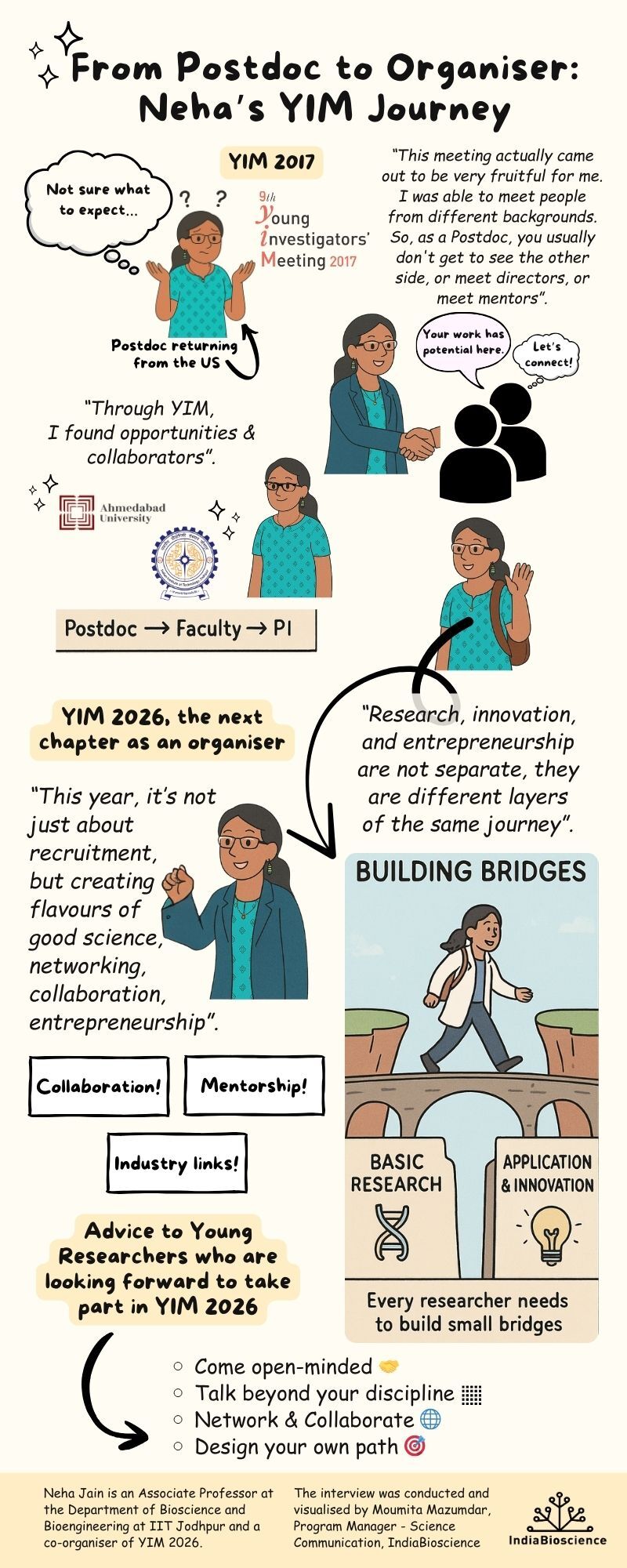
                <p dir="ltr">When <a href="https://www.iitj.ac.in/People/Profile/1cf4dea1-95f5-4df3-98c8-58dafdc29fbb" target="_blank" rel="noreferrer noopener">Neha Jain</a> walked into her first Young Investigators’ Meeting (YIM) in 2017 as a postdoctoral researcher from the United States, she didn’t know what to expect. <em>“As a postdoc, you usually don’t get to see the other side, or meet directors, or meet mentors”,</em> she recalls. To her surprise, leaders from institutions reached out even before YIM, and those conversations soon turned into real opportunities. Within a year, she landed her first faculty position at Ahmedabad University. A year later, she moved to the Department of Bioscience and Bioengineering at the Indian Institute of Technology Jodhpur, where she is now an Associate Professor. Looking back, she calls YIM 2017 ‘a huge milestone’ that shaped her career in India.<br /></p>              ]]></summary><id>tag:indiabioscience.org,2025-10-17:/columns/conversations/from-postdoc-to-organiser-neha-jains-yim-story</id><published>2025-10-17T10:00:00+05:30</published><updated>2025-09-22T17:03:12+05:30</updated><author><name>Moumita Mazumdar</name><uri>https://indiabioscience.org/authors/moumita</uri></author><content type="html"><![CDATA[
                
<p>When <a href="https://www.iitj.ac.in/People/Profile/1cf4dea1-95f5-4df3-98c8-58dafdc29fbb" target="_blank" rel="noreferrer noopener">Neha Jain</a> walked into her first Young Investigators’ Meeting (YIM) in 2017 as a postdoctoral researcher from the United States, she didn’t know what to expect. <em>“As a postdoc, you usually don’t get to see the other side, or meet directors, or meet mentors”,</em> she recalls. To her surprise, leaders from institutions reached out even before YIM, and those conversations soon turned into real opportunities. Within a year, she landed her first faculty position at Ahmedabad University. A year later, she moved to the Department of Bioscience and Bioengineering at the Indian Institute of Technology Jodhpur, where she is now an Associate Professor. Looking back, she calls YIM 2017 ‘a huge milestone’ that shaped her career in India.</p><figure><a href="https://indiabioscience.org/columns/conversations/from-postdoc-to-organiser-neha-jains-yim-story"><img
                width="1920"
                height="1080"
                style="max-width: 100%; height: auto"
                src="https://cdn.indiabioscience.org/media/articles/eeting-1.jpg"></a></figure><figure><img src="https://cdn.indiabioscience.org/media/articles/YIM-2026-interviews-with-co-organisers-1.jpg" data-image="801683" alt="Neha Jain Infographics"></figure><p dir="ltr"><strong>Pushing boundaries</strong></p><p dir="ltr">Neha’s work is driven by a simple but ambitious question: “<em>How can basic research, rich with potential applications, find meaning through collaboration?</em>” At Ahmedabad and later at IIT Jodhpur, she actively sought interdisciplinary places, working not only with scientists but also with engineers, social scientists, and industry partners. Convinced that research and entrepreneurship cannot be separated, she now brings this mindset to her role as co-organiser of YIM 2026. She describes the meeting as a platform to build purposeful connections across research, entrepreneurship, and industry. </p><blockquote dir="ltr" class="pull-quote"><em>Our nation is driving into more entrepreneurial activity. YIM 2026 will be a great platform to bring scientists and industry people together, and to help postdocs and young investigators think beyond what they have been doing”.</em></blockquote><p dir="ltr"><strong>Balancing research and impact</strong></p><p dir="ltr">Neha has also learned to balance research, teaching, administration, and innovation. <em>“Initially, it seemed very challenging. But I thought of it as an upgrade of myself. Publishing papers is great, but how do you make an impact on your publications”? </em>She decided to step beyond her comfort zone, reached out to startups, the industry, and intellectual property experts. This helped her team to apply for their first patent, a process which took close to four years, but came with a great sense of accomplishment.<em>“That feeling, when it comes, is really encouraging for you to move ahead”,</em> she says. For her, translational thinking doesn’t replace fundamental research; instead, it builds bridges between discovery, innovation, and application. </p><blockquote dir="ltr" class="pull-quote"><em>The science you are doing today may see application tomorrow if you can cross that bridge”.</em></blockquote><p dir="ltr"><strong>Mentorship and Networking</strong></p><p dir="ltr">At YIM 2017, Neha met leaders of India’s life science and biotech community - among them Gagandeep Kang, Jyotsna Dhawan, Pankaj Chandra, Pradeep Sinha, and L. S. Shashidhara - and those conversations stayed with her. What began as networking soon grew into meaningful collaborations and a community of mentors and peers. <em>“That gives you confidence that people are there to help you, and that you are not alone”</em>, she says.</p><p dir="ltr"><strong>Looking ahead to YIM 2026</strong></p><p dir="ltr">As she returns this year as a co-organiser, Neha’s advice to early-career investigators and post-docs is clear: build bridges, seek mentors, think broadly, and, most importantly, build a career that is both personally fulfilling and nationally impactful.<br></p>
              ]]></content><category term="other" label="Other" /><category term="funding" label="Funding" /></entry><entry><title>Navigating science and beyond: Sudarshan’s (aka Sudi) YIM journey</title><link
                  rel="alternate"
                  href="https://indiabioscience.org/columns/conversations/navigating-science-and-beyond-sudarshans-aka-sudi-yim-journey"
                  type="text/html"
                  /><summary type="html"><![CDATA[
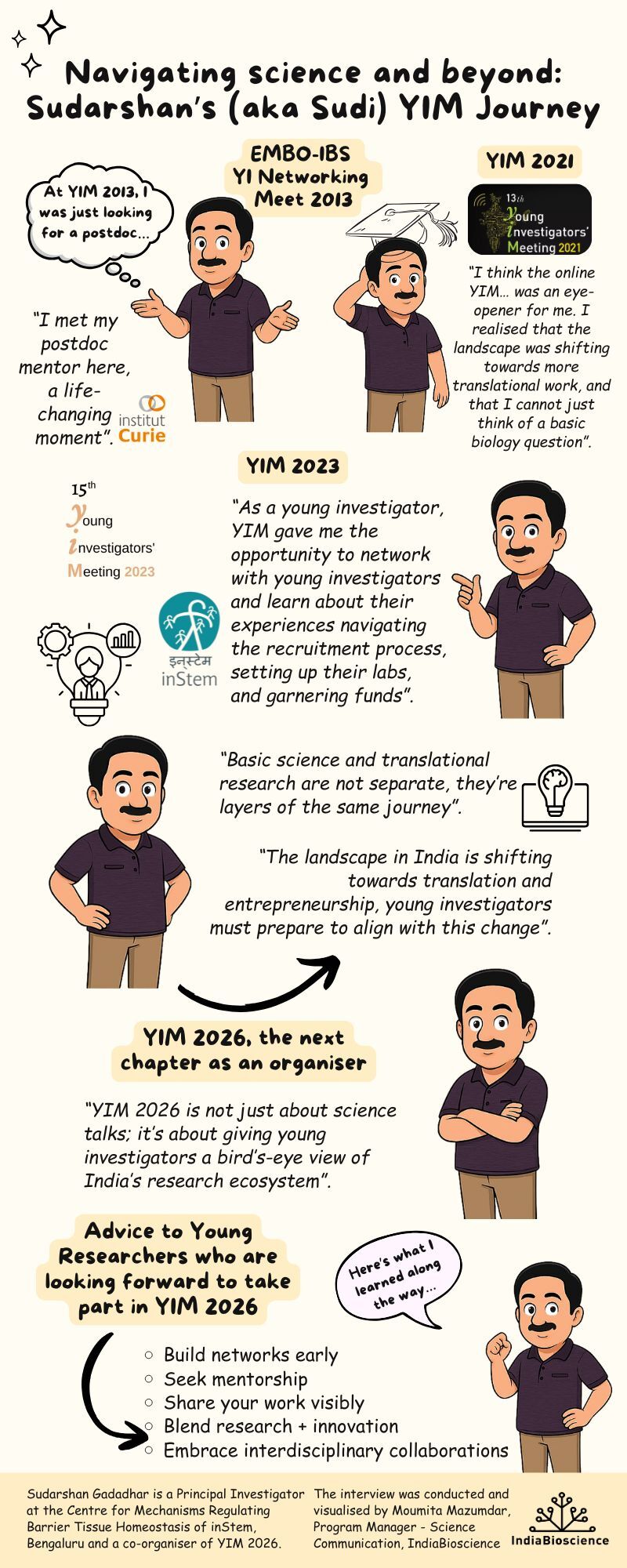
                <p>When <a href="https://instem.res.in/people/sudarshan-gadadhar/" target="_blank" rel="noreferrer noopener">Sudarshan Gadadhar</a> first attended the Young Investigators’ Meeting (YIM), he came in with a lot of questions. <em>“I was not sure about where I was heading, about the kind of science I wanted to do, and whether I was ready for the challenges of independent research”</em>, he recalls. YIM gave him more than answers; it provided perspectives, peers in similar transitions, and mentors who had walked the path before.</p>              ]]></summary><id>tag:indiabioscience.org,2025-10-06:/columns/conversations/navigating-science-and-beyond-sudarshans-aka-sudi-yim-journey</id><published>2025-10-06T10:00:00+05:30</published><updated>2025-09-23T10:40:54+05:30</updated><author><name>Moumita Mazumdar</name><uri>https://indiabioscience.org/authors/moumita</uri></author><content type="html"><![CDATA[
                
<p>When <a href="https://instem.res.in/people/sudarshan-gadadhar/" target="_blank" rel="noreferrer noopener">Sudarshan Gadadhar</a> first attended the Young Investigators’ Meeting (YIM), he came in with a lot of questions. <em>“I was not sure about where I was heading, about the kind of science I wanted to do, and whether I was ready for the challenges of independent research”</em>, he recalls. YIM gave him more than answers; it provided perspectives, peers in similar transitions, and mentors who had walked the path before.</p><figure><a href="https://indiabioscience.org/columns/conversations/navigating-science-and-beyond-sudarshans-aka-sudi-yim-journey"><img
                width="1920"
                height="1080"
                style="max-width: 100%; height: auto"
                src="https://cdn.indiabioscience.org/media/articles/eeting_2025-09-22-110707_dbyz.jpg"></a></figure><figure style="margin-left: auto; margin-right: auto; text-align: center; width: 746px; max-width: 746px;"><img src="https://cdn.indiabioscience.org/media/articles/YIM-2026-interviews-with-co-organisers.jpg" data-image="801666" alt="Sudarshan infographics" width="746" height="1864"></figure><blockquote dir="ltr" class="pull-quote"><em>Those conversations stayed with me. YIM was not just about opportunities; it was about finding a sense of community”.</em></blockquote><p dir="ltr"><strong>Beyond science alone</strong></p><p dir="ltr">From the beginning, Sudarshan believed that science is not a solitary act. “<em>You can’t grow in a silo. Collaboration and community are not add-ons; they are essential”, </em>he says. This ethos shaped his early years as an independent researcher, as he sought collaborations that pushed him beyond his comfort zone. <em>“Whether it was reaching across disciplines or learning how to communicate science beyond academia, I always wanted the work to have impact”.</em><br></p><p dir="ltr">For him, impact is not only in publications or grants, but in ideas, connections, and opportunities for others. </p><blockquote dir="ltr" class="pull-quote"><em>Ask questions, build networks, reflect often, and remember that growth in science is always about more than science alone”.</em></blockquote><p dir="ltr"><strong>Balancing challenges</strong></p><p dir="ltr">The transition from postdoc to independent scientist was not without strain. <em>“At first, I felt the weight of everything: research, teaching, administration, expectations from students, and my own ambitions”, </em>he says. He learned to reframe it as an opportunity for growth. </p><blockquote dir="ltr" class="pull-quote"><em>You have to let go and build trust with your students as they take ownership of the scientific question. Handing over the bench work isn’t easy, but it’s essential”.</em></blockquote><p dir="ltr"><strong>Mentors, peers and inspiration</strong></p><p dir="ltr">At YIM and beyond, mentors played a critical role. Sudarshan values both the senior scientists who offered advice and the peers who fostered a sense of being part of a community. <em>“Networking is not about collecting contacts. It is about meaningful conversations that can open up new directions</em>. <em>Even a single thoughtful piece of advice, or a nudge from a mentor, can change the way you see your career”. He adds, “I want young scientists to know they are not alone, that there are people who will support them, even if only with a small word of encouragement”.</em></p><p dir="ltr"><strong>Looking ahead</strong><br></p><p dir="ltr">Years after first attending YIM, Sudarshan is now back as one of the organisers. He sees the meeting evolving alongside his own career. <em>“When I first attended, I was looking for directions. Today, YIM is not only about research opportunities, but about entrepreneurship, collaborations across science, industry and clinics, mentorship, and networks that extend beyond science”. </em><br></p><p dir="ltr">His advice to participants: </p><blockquote dir="ltr" class="pull-quote"><em>Come with curiosity. Don’t just look for jobs or collaborations. Look for ideas, look for mentors, and look for the bigger picture of what kind of a scientist, and person, you want to become”.</em><br></blockquote>
              ]]></content><category term="other" label="Other" /><category term="funding" label="Funding" /></entry><entry><title>Building a research career: Harinath’s reflections from YIM</title><link
                  rel="alternate"
                  href="https://indiabioscience.org/columns/conversations/building-a-research-career-harinaths-reflections-from-yim"
                  type="text/html"
                  /><summary type="html"><![CDATA[
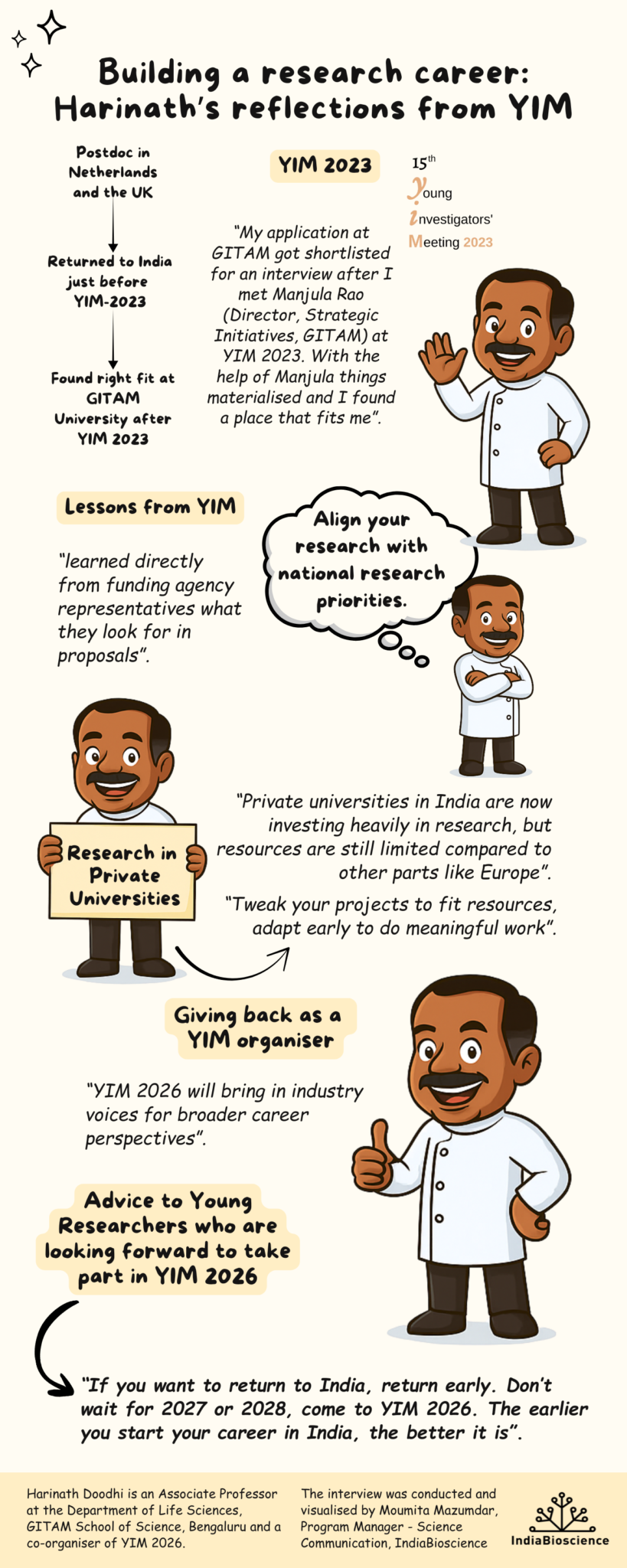
                <p>At YIM 2023, <a href="https://www.linkedin.com/in/harinath-doodhi-a8861a54/?originalSubdomain=in" target="_blank" rel="noreferrer noopener">Harinath Doodhi’s </a>career took a surprising turn, from a chance encounter to a faculty position and his first funded grant in India. For him, YIM became more than a meeting; it was a launchpad for connections, mentorship, and understanding India’s research landscape.</p>              ]]></summary><id>tag:indiabioscience.org,2025-10-03:/columns/conversations/building-a-research-career-harinaths-reflections-from-yim</id><published>2025-10-03T10:00:00+05:30</published><updated>2025-10-03T15:42:29+05:30</updated><author><name>Moumita Mazumdar</name><uri>https://indiabioscience.org/authors/moumita</uri></author><content type="html"><![CDATA[
                
<p>At YIM 2023, <a href="https://www.linkedin.com/in/harinath-doodhi-a8861a54/?originalSubdomain=in" target="_blank" rel="noreferrer noopener">Harinath Doodhi’s </a>career took a surprising turn, from a chance encounter to a faculty position and his first funded grant in India. For him, YIM became more than a meeting; it was a launchpad for connections, mentorship, and understanding India’s research landscape.</p><figure><a href="https://indiabioscience.org/columns/conversations/building-a-research-career-harinaths-reflections-from-yim"><img
                width="1920"
                height="1080"
                style="max-width: 100%; height: auto"
                src="https://cdn.indiabioscience.org/media/articles/eeting.jpg"></a></figure><figure style="margin-left: auto; margin-right: auto; text-align: center;"><img src="https://cdn.indiabioscience.org/media/articles/YIM-2026-interviews-with-co-organisers.png" data-image="801551"></figure><p dir="ltr"><br>A significant number of encounters at YIMs have evolved beyond conversations to form lasting connections. When Harinath Doodhi attended his first Young Investigators’ Meeting in 2023, after a postdoctoral fellowship in the UK and Netherlands and as a young faculty member at Chennai’s SRM University, he didn’t know this would be a turning point in his career. He met several institutional leaders, one of them being Manjula Rao from GITAM University, an organisation to which Harinath had applied but hadn’t heard back from. One has to be at YIM to know what happened next can only occur at a meeting like this:</p><p dir="ltr"><em>“I had applied to GITAM but never heard back. At YIM, Manjula </em><em>dug up my application, pushed for an interview, and things materialised. I found a place that suited me better than SRM”,</em> he says.</p><p dir="ltr"><strong>Understanding the funding ecosystem</strong><br></p><p dir="ltr">For Harinath, YIM was not only a way to connect with people, but it was also a crash course in the research funding ecosystem in India. Building relationships and meeting funders helped clarify some ways he could improve the quality of his grant applications.</p><p dir="ltr"><em>“I learned directly from funding agency representatives what they look for in proposals. That helped me make small but important changes in my applications. My first grant in India got funded soon after YIM”</em>, he shares.</p><p dir="ltr">These early lessons were critical, as he faced numerous challenges in establishing a research lab upon his return to India. They reaffirmed an important point: much of funding success, especially when considering grants, is about being aligned with national priorities.</p><blockquote dir="ltr" class="pull-quote"><em>As Vijay [K VijayRaghavan, a YIM mentor] said, you might have done great work abroad, but every country has its own focus. Aligning with that helps a lot”</em>, Harinath reflects.</blockquote><p dir="ltr"><strong>Research in private universities: Opportunities and challenges</strong><br></p><p dir="ltr">Harinath has found a home at GITAM University, where he is currently building his group. He acknowledges the emerging role of private institutions in research in India. His experience illustrates the development of a research culture in private universities, which may not have previously been an option for young investigators but is available now.<br></p><p dir="ltr"><em>“Private universities in India are now investing heavily in research, but resources are still limited compared to other parts like Europe. You need to tweak your projects to fit available facilities. If you adapt early, you can still do meaningful research”</em>, he notes.</p><p dir="ltr"><strong>Giving back as a YIM organiser</strong></p><p dir="ltr">Harinath is a co-organiser of YIM 2026 and still regards the meeting as a unique space, providing mentorship, collaboration, and inspiration.</p><p dir="ltr"><em>“Mentors and funding bodies give you insights you can’t get elsewhere. This time, including industry voices will also help, since many scientists are curious about careers beyond academia”</em>, he says.</p><p dir="ltr">As YIM continues to evolve, Harinath sees another level of change in understanding the implications of expanding its scope to bring together academia, industry, and policy, which is necessary to support the next generation of scientists.</p><p dir="ltr">Looking back, Harinath (with a broad smile) offers candid advice to those contemplating a return to India after training from abroad:</p><blockquote dir="ltr" class="pull-quote"><em>If you want to return to India, return early. Don’t wait for 2027 or 2028, come to YIM 2026. The earlier you start your career in India, the better it is”</em>.<br></blockquote>
              ]]></content><category term="networking" label="Networking" /><category term="personal-experience" label="Personal Experience" /><category term="networking" label="Networking and Collaboration" /></entry><entry><title>The science of safety: A conversation with Srikanta K Rath</title><link
                  rel="alternate"
                  href="https://indiabioscience.org/columns/conversations/the-science-of-safety-a-conversation-with-srikanta-k-rath"
                  type="text/html"
                  /><summary type="html"><![CDATA[
                <p dir="ltr">In this conversation, <a href="https://www.cdri.res.in/1478r" target="_blank" rel="noreferrer noopener">Srikanta K Rath</a>, Chief Scientist &amp; Professor at <a href="https://acsir.res.in/" target="_blank" rel="noreferrer noopener">Academy of Scientific and Innovative Research</a> (AcSIR) and Head, Division of Toxicology, <a href="https://cdri.res.in/" target="_blank" rel="noreferrer noopener">CSIR-Central Drug Research Institute</a> (CSIR-CDRI), Lucknow, shares insights into the field of regulatory toxicology, its implementation from research to risk management, related key issues, and the role of researchers/scientists.</p>              ]]></summary><id>tag:indiabioscience.org,2025-07-07:/columns/conversations/the-science-of-safety-a-conversation-with-srikanta-k-rath</id><published>2025-07-07T10:08:00+05:30</published><updated>2025-07-07T10:08:43+05:30</updated><author><name>Akshita Puri Bajaj</name><uri>https://indiabioscience.org/authors/bO3xKOVr92L79W5</uri></author><content type="html"><![CDATA[
                
<p>In this conversation, <a href="https://www.cdri.res.in/1478r" target="_blank" rel="noreferrer noopener">Srikanta K Rath</a>, Chief Scientist &amp; Professor at <a href="https://acsir.res.in/" target="_blank" rel="noreferrer noopener">Academy of Scientific and Innovative Research</a> (AcSIR) and Head, Division of Toxicology, <a href="https://cdri.res.in/" target="_blank" rel="noreferrer noopener">CSIR-Central Drug Research Institute</a> (CSIR-CDRI), Lucknow, shares insights with Akshita into the field of regulatory toxicology, its implementation from research to risk management, related key issues, and the role of researchers/scientists.</p><figure><a href="https://indiabioscience.org/columns/conversations/the-science-of-safety-a-conversation-with-srikanta-k-rath"><img
                width="740"
                height="440"
                style="max-width: 100%; height: auto"
                src="https://cdn.indiabioscience.org/media/articles/akshita-puri-in-conversation.png"></a></figure><p dir="ltr"><strong>1. Please tell us about the field of regulatory toxicology, research in this field and its implementation for risk management.</strong></p><p dir="ltr">Toxicology as a subject is still underrepresented in Indian academia, with very few universities offering it formally. Regulatory toxicology, a more specialised branch, is even less understood. I was introduced to it at CDRI. Those working in pesticides, and human or veterinary drugs engage more with regulatory toxicology, but regulatory requirements vary across these sectors. For instance, pesticide regulators demand near-zero tolerance, given the potential harm to humans and ecosystems. In contrast, drug toxicology balances safety with therapeutic benefits—since no drug is completely non-toxic. Regulatory toxicologists must evaluate how much risk is acceptable for the expected benefit. </p><p dir="ltr">In India, long-term studies and risk management research are limited due to funding, infrastructure, and awareness gaps. Most data still come from Western sources. Despite limited manpower and resources, Indian institutes like CDRI are making earnest efforts to bridge this gap. Moreover, academia and industry differ—academia focuses on mechanisms, while industry emphasises proving safety and efficacy quickly for regulatory approval.</p><p dir="ltr"><strong>2. Who are the key role players in formulating and implementing regulatory norms and what is the role of researchers/scientists in this?</strong></p><p dir="ltr">The key players in regulatory implementation are government authorities such as Drugs Controller General of India (DCGI) for pharmaceuticals, the <a href="https://ppqs.gov.in/central-insecticides-board" target="_blank">Central Insecticides Board</a> for pesticides, <a href="https://fssai.gov.in/" target="_blank">FSSAI </a>for food, and the <a href="https://ayush.gov.in/#!/" target="_blank">Ministry of AYUSH</a> for traditional products. Each sector has a dedicated regulatory body that frames guidelines and oversees their enforcement. These authorities constitute expert committees that include pharmacists, physicians, academicians, toxicologists, and pharmacologists. In my experience serving on over 100 such committees, I’ve observed that many members began as researchers or academicians. Over time, through in-depth research and hands-on experience across various domains of regulatory science, they became subject matter experts. Thus, researchers and scientists play a crucial role, not only in generating data but also in shaping and applying regulatory norms based on their deep understanding of safety, efficacy, and risk assessment.</p><p dir="ltr"><strong>3. What are the key focus areas and associated issues when we look from a regulatory compliance perspective?</strong></p><p dir="ltr">Regulatory compliance is essential across all sectors—pharma, veterinary, agriculture, food, and more. In the veterinary sector, animals are often treated with hormones for increased milk production, which may harm humans, as some cancers are now linked to such milk. For pesticides, although minimum and maximum dose guidelines exist, untrained users in rural areas often exceed recommended levels, leading to self-exposure and environmental harm. In pharmaceuticals, compliance issues extend beyond use; improper disposal of antibiotics, for instance, contributes to antimicrobial resistance (MDR/XDR), posing long-term public health risks. Regulatory bodies exist, but implementation often lags due to economic constraints, lack of awareness, or urgency in production. </p><blockquote dir="ltr" class="pull-quote">As the saying goes, “if it is <em>ati</em> (excess), then it will be <em>iti</em> (end).” Hence, regulation is not just necessary—it’s critical for sustainability and safety across sectors.</blockquote><p dir="ltr"><strong>4. What is the present Indian scenario with respect to education, implementation and ways to overcome challenges in the field?</strong></p><p dir="ltr">In India, toxicology, especially regulatory toxicology, is rarely included in academic curriculum. I believe it should be introduced as a core subject within biological sciences to build foundational understanding. Without proper education, effective implementation is not possible. Currently, decisions are often made without fully understanding ground realities, or based only on outdated documentation. To overcome these challenges, we need to revisit the basics and align top-level policies with actual field conditions. India has three toxicology societies—two in the South and one national body, the <a href="https://www.toxicologyindia.org/" target="_blank">Society of Toxicology (India)</a>, which is among the oldest. However, these platforms sometimes drift from their core mission, and regulatory discussions remain limited. While seminars are regularly held, there’s a need for unified efforts to actively involve both young and experienced professionals to bridge knowledge gaps and foster meaningful dialogue in regulatory toxicology.</p><p dir="ltr"><strong>5. A piece of advice to young minds.</strong></p><blockquote dir="ltr" class="pull-quote">My simple advice: Be good and do good. </blockquote><p dir="ltr">Be good by building a strong foundation of knowledge, especially if you're a biologist, don’t shy away from learning toxicology, pharmacology, or regulatory science. Stay ethically grounded and aim for a holistic understanding. Today, we have access to abundant information, but without proper application, it’s of little value. Don’t get lost in data-focus, learn deeply, and apply wisely. If you’ve chosen biology, explore both its strengths and risks, and think about how harmful aspects can be regulated, because we ourselves are biological beings. Our duty is to care for ourselves, society, and the environment. I believe change is coming. <br></p><figure style="margin-left: auto; margin-right: auto; text-align: center; width: 568px; max-width: 568px;"><img src="https://cdn.indiabioscience.org/media/articles/newsletters/second-photo.png" data-image="782327" alt="Akshita with Rath" width="568" height="330"><figcaption style="text-align: center;">Akshita with Rath during the interview. Photo Credit: Akshita</figcaption></figure>
              ]]></content><category term="biochemistry" label="Biochemistry" /><category term="health-and-medicine" label="Health &amp; Medicine" /><category term="other" label="Other" /><category term="ethics" label="Ethics" /></entry><entry><title>In conversation with Shivkumar Kalyanaraman, CEO, Anusandhan National Research Foundation</title><link
                  rel="alternate"
                  href="https://indiabioscience.org/columns/conversations/in-conversation-with-shivkumar-kalyanraman-ceo-anusandhan-national-research-foundation"
                  type="text/html"
                  /><summary type="html"><![CDATA[
                <p>The Anusandhan National Research Foundation (ANRF) Act, 2023, signalled a shift in how research will be supported in India. We spoke with Shivkumar Kalyanaraman (CEO, ANRF) to understand how these changes will shape funding, how we define research impact, and more.</p>              ]]></summary><id>tag:indiabioscience.org,2025-06-27:/columns/conversations/in-conversation-with-shivkumar-kalyanraman-ceo-anusandhan-national-research-foundation</id><published>2025-06-27T13:00:00+05:30</published><updated>2025-06-26T17:40:51+05:30</updated><author><name>Siuli Mitra</name><uri>https://indiabioscience.org/authors/PRYwLlb3kA1gO0Q</uri></author><content type="html"><![CDATA[
                
<p>The Anusandhan National Research Foundation (ANRF) Act, 2023, signalled a shift in how research will be supported in India. We spoke with Shivkumar Kalyanaraman (CEO, ANRF) to understand how these changes will shape funding, how we define research impact, and more.</p><figure><a href="https://indiabioscience.org/columns/conversations/in-conversation-with-shivkumar-kalyanraman-ceo-anusandhan-national-research-foundation"><img
                width="1920"
                height="1080"
                style="max-width: 100%; height: auto"
                src="https://cdn.indiabioscience.org/media/articles/Resilience-and-representation-in-research-2.png"></a></figure><p dir="ltr">In June 2025, the <a href="https://www.anrfonline.in/ANRF/HomePage" target="_blank">Anusandhan National Research Foundation</a> announced the first leg of the <a href="https://anrfonline.in/ANRF/arg_anrf" target="_blank">Advanced Research Grants (ARG)</a>, which builds upon the erstwhile Science and Engineering Research Board’s Core Research Grants (CRG). The ARG will fund basic, applied, and translational research, allow flexible funding, increase travel funding to enable meaningful collaborations, and facilitate the communication of research with the public, as explained by the <a href="https://www.linkedin.com/in/shivkumar-kalyanaraman-1942451/?originalSubdomain=in" target="_blank">CEO, Shivkumar Kalyanaraman</a>, in <a href="https://www.linkedin.com/posts/shivkumar-kalyanaraman-1942451_anrf-india-announces-call-for-proposals-under-activity-7339497536195317760-MgKi?utm_source=share&utm_medium=member_desktop&rcm=ACoAABbMuvYBq43I5_0qCUIKICHMfr1h7UjTF6Y" target="_blank">this post on LinkedIn</a>. To dig deeper, we spoke with him to better understand the shifts in how research will be funded by ANRF going forward and to decode that for early career researchers in India.</p><p dir="ltr"><strong>Siuli: </strong>Congratulations on completing three months at ANRF, and thank you for joining us. Since the ANRF Act of 2023 and new grants and fellowships, there's been a lot of change in the funding landscape. You’ve been meeting stakeholders across the country—how is this shaping your goals? Could you share your top priorities for the next few years and longer term?<br></p><p dir="ltr"><strong>Shiv:</strong> Thank you. At ANRF, our work has three main parts:<br></p><p dir="ltr">First, our horizontal approach supports broad-based, fundamental and applied research; programmes like the <a href="https://armssfa.com/serb_website/assets/pdf/CALL_FOR_PROPOSALS_ARG(1).pdf" target="_blank">Advanced Research Grants</a> and the <a href="https://anrfonline.in/ANRF/ecrg_anrf?HomePage=New" target="_blank">Prime Minister Early Career Research Grant</a>. These are bottom-up, allowing researchers to propose novel ideas, as many breakthroughs come from unexpected places. We have improved our ARG evaluation metrics to reflect this.<br></p><blockquote dir="ltr" class="pull-quote">I often get asked, ‘Do you [ANRF] support fundamental research?’ The answer is yes, we do.<br></blockquote><p dir="ltr">Second, there are the vertical, mission-driven programmes — take the Electric Vehicle Mission, for example. These programmes come in two types: ones that focus on building or strengthening economic value chains and ecosystems, and others that tackle India’s societal challenges, where research, innovation, and science and technology can really make a difference.<br></p><p dir="ltr">Third, we are working to catalyse more investment in research in India through partnerships with industry, foundations, and other organisations. </p><blockquote dir="ltr" class="pull-quote">We want to see many more research labs come forward to create more employment opportunities for others, expand beyond postdoctoral fellowships and academic circles, and find many more employers who value PhDs."</blockquote><p dir="ltr">We are also expanding partnerships with philanthropic groups and CSR initiatives, encouraging the industry to support and conduct research.<br></p><p dir="ltr">Looking ahead, we aim to further liberalise funding, especially in mission-driven programs. The overall goal, if I were to sum it up in one sentence, is to foster greater collaboration for better research outcomes and a stronger return on investment.<br></p><p dir="ltr"><strong>Siuli: </strong>That was very succinct. As we work towards these goals, I think we will need to redefine scientific excellence. It can’t just be about the number of publications anymore. Do you also see these goals changing our definition of excellence? If so, please share your thoughts on that.<br></p><p dir="ltr"><strong>Shiv:</strong> That is an important question. It is crucial for researchers to consider the broader impact of their work. Since research funding ultimately comes from society, whether through taxpayers or foundations, there is a responsibility to ensure it benefits the public. We are asking our grantees to articulate potential impact in grant proposals, and that goes beyond just publications and patents.<br></p><p dir="ltr">Now, coming to the potential impact beyond publications and patents, I want to reemphasise what I mean by “beyond publications.” Let me articulate this in a few ways, as its meaning can vary across different communities, and I don’t want to make assumptions.<br></p><p dir="ltr">For example, fundamental research might result in a high-profile paper, but real impact could be to drive deeper scientific and non-scientific dissemination that accelerates downstream value creation. Scientific dissemination could also be done via social media, and it could attract translational innovators to pick up on new fundamental work faster. Beyond pure scientific dissemination, there is value in creating simplified or exciting, scientifically based content that demystifies that work and inspires others. Platforms like IndiaBioscience could encourage researchers to communicate their work more broadly, even to friends and family. The former is only documentation, while the latter has an impact.<br></p><p dir="ltr">We are also making research dissemination through social media a requirement in some programmes, focusing on quality content. At ANRF, we are developing tools to help convert scientific papers into posters, videos, podcasts, and translations, making research more accessible. Human conversations will still remain vital.<br></p><p dir="ltr">Impact also includes sharing datasets or open-source software, making your research useful to others: the more people use your data or tools, the greater the impact.<br></p><p dir="ltr">Ultimately, impact has many forms. </p><blockquote dir="ltr" class="pull-quote"><em>We welcome ongoing conversations within the community. Tell us what impact means for you, and how that definition might evolve. We want these definitions to come from the community, not just from the top down."</em></blockquote><p dir="ltr"><strong>Siuli: </strong>Thank you. At IndiaBioscience, we have been gathering community perspectives on how researchers view impact.<br></p><p dir="ltr"><strong>Shiv:</strong> I would also like to see an impact framework from your community, with categories defined by what matters to you, not just numbers. Research impact should go beyond metrics and factor in societal and community benefits. We need to broaden how we think about dissemination and technology diffusion, from basic science to advanced applications.<br></p><p dir="ltr">The transition from fundamental to advanced research relies on technology diffusion, which is complex and people-driven—there is no set formula. Our goal is to speed up this process and improve success rates.</p><p dir="ltr">We should also assess research impact at the portfolio level. Not every paper will have a big impact, and that is fine, but the overall body of work should make a difference. Impact doesn’t mean everything must be translational. It is not just about patents. Consider prototypes and unit economics as well. Having worked across fundamental, applied, and translational research, I know each requires a distinct approach.<br></p><p dir="ltr">I sometimes say, you can't make every Einstein become an Elon Musk. They are very different.<br></p><p dir="ltr">At the same time, if we want to arrive at meaningful outcomes, specialisation is essential. But while specialising, it is equally important to collaborate with others who can extend that work into different areas.<br></p><p dir="ltr"><strong>Siuli: </strong>That brings us to my next question. You have, at other avenues too, emphasised the importance of collaboration across disciplines, institutions, and countries. The new ARG program also encourages this. While interdisciplinary research offers great opportunities, it comes with communication and coordination challenges. What advice do you have for researchers entering these spaces, especially when funding supports collaboration but institutional culture may lag?<br></p><p dir="ltr"><strong>Shiv:</strong> I think great work is done when people follow their heart, and significant impact comes from tackling big problems, not just incremental work. So, the first thing I would urge is for people to always want to do great work. Funding agencies like ours are actively encouraging breakthroughs and risk-taking; we want to reward ambitious work. For example, the ARG programme allows honorary PIs, so you can bring in industry or international collaborators. We have also updated policies to make collaboration easier, such as allowing multiple grants and supporting international travel. And of course, we will convey the same message to our programme committees so that they value that.</p><p dir="ltr">The thing to remember is that problems don’t respect disciplinary boundaries—these are constructs we create. While depth is important, we must move beyond silos and learn enough of each other’s “language” to collaborate effectively. Respect and a willingness to understand even a bit of another field’s vocabulary are important.<br></p><p dir="ltr">Second, we are working to lower barriers to collaboration, whether between countries, institutions, or industry and academia. This includes rethinking how research labs are set up to encourage collaboration from the start.<br></p><p dir="ltr">Finally, I would be remiss if I didn’t acknowledge that academic recognition still tends to favour individual-centric work. So, we continue our discussions with institutional leaders to better value collaborative work, while still recognising individual contributions. Structural barriers remain, but acknowledging them is the first step.<br></p><blockquote dir="ltr" class="pull-quote">Change won’t happen overnight, but I’m optimistic. With India’s strong talent pool, we’re on the verge of becoming a global research partner, not just a service provider, and that is a story I would like to tell."<br></blockquote><p dir="ltr"><strong>Siuli: </strong>To close, I have noticed you emphasise impact, not just today, but throughout your talks and visits. Do you think these conversations will actually influence how funding and evaluation decisions are made? How practical is that?<br></p><p dir="ltr"><strong>Shiv: </strong>The simple answer is, yes. And there is a simple way to look at it. <br></p><p dir="ltr">Think of it like investing: if one option gives a higher return, you naturally gravitate toward it, even if it carries some risk. The idea of return on investment is central; it is about productivity and impact, not just input.</p><p dir="ltr">Currently, we invest about 0.7% of GDP in research. To justify and potentially increase this, we need to boost the productivity of our research system; AND we need greater levels of non-governmental participation in this investment. At ANRF, we are aiming to catalyse BOTH of these. If we make our “engine” more efficient, we will see better outcomes and attract more investment. That’s why I focus on impact and collaboration; they help solve bigger problems and make the system stronger.</p><p dir="ltr">Ultimately, greater impact leads to greater returns for science and society. If we deliver more, we will naturally draw more investment, compounding benefits over time.<br></p>
              ]]></content><category term="other" label="Other" /><category term="funding" label="Funding" /></entry><entry><title>From proteins and pathways to policy: A conversation with Vid Nukala</title><link
                  rel="alternate"
                  href="https://indiabioscience.org/columns/conversations/from-proteins-pathways-to-policy-a-conversation-with-vid-nukala"
                  type="text/html"
                  /><summary type="html"><![CDATA[
                <p>In this conversation, <a href="https://www.linkedin.com/in/vidnukala" target="_blank" rel="noreferrer noopener">Vid Nukala</a>, Senior Community Engagement Officer and Head - Government Relations, Global Activities at <a href="https://www.embo.org/policy/" target="_blank" rel="noreferrer noopener">EMBO</a>, Heidelberg, discusses the interplay between science and policy, the key actors and issues in science policy, and how researchers can get involved in science policy.</p>              ]]></summary><id>tag:indiabioscience.org,2023-05-08:/columns/conversations/from-proteins-pathways-to-policy-a-conversation-with-vid-nukala</id><published>2023-05-08T03:30:00+05:30</published><updated>2023-05-08T15:23:48+05:30</updated><author><name>Vid Nukala</name><uri>https://indiabioscience.org/authors/RpdwL5Y0QgLrezo</uri></author><content type="html"><![CDATA[
                
<p>In this conversation, <a href="https://www.linkedin.com/in/vidnukala" target="_blank" rel="noreferrer noopener">Vid Nukala</a>, Senior Community Engagement Officer and Head - Government Relations, Global Activities at <a href="https://www.embo.org/policy/" target="_blank" rel="noreferrer noopener">EMBO</a>, Heidelberg, discusses the interplay between science and policy, the key actors and issues in science policy, and how researchers can get involved in science policy. </p><figure><a href="https://indiabioscience.org/columns/conversations/from-proteins-pathways-to-policy-a-conversation-with-vid-nukala"><img
                width="2048"
                height="1256"
                style="max-width: 100%; height: auto"
                src="https://cdn.indiabioscience.org/media/articles/A-conversation-with-Vid-Nukala.png"></a></figure><p>1) <strong>Tell us something about your professional path in science policy, and how that ties into what you are doing now.</strong></p><p dir="ltr">I have spent the last 15 years working in international biomedical science, technology, and innovation cooperation, and let me tell you, it's been an exhilarating ride with no set destination. My academic journey started with a Bachelor's degree from <a href="https://www.osmania.ac.in/" target="_blank">Osmania University</a> in India, and then I ventured out to the United States to pursue a PhD in Neurobiology at the <a href="https://www.uky.edu/" target="_blank"></a><a href="https://www.uky.edu/" target="_blank">University of Kentucky</a>. But as I approached the end of my degree, I realised that while I loved science, I didn't necessarily want to spend my days at the bench. Looking to better understand science policy, I pursued a Masters of Arts in International Science & Technology Policy at <a href="https://www.gwu.edu/" target="_blank">The George Washington University</a>. </p><p dir="ltr">While this equipped me with the necessary theoretical frameworks related to science policy, to gain practical experience, I worked at the <a href="https://www.altfutures.org/" target="_blank">Institute for Alternative Futures</a>, the <a href="https://www.potomacinstitute.org/" target="_blank">Potomac Institute for Policy Studies</a>, and the <a href="https://iusstf.org/" target="_blank">Indo-US Science & Technology Forum</a>. I wanted to delve into topics like foresight & governance, emerging and dual-use technologies, and facilitating international collaborations. After a decade, I returned to India and joined the <a href="https://www.indiaalliance.org/" target="_blank">DBT/Wellcome India Alliance</a>, where I administered fellowships to promote ‘brain-gain’, and developed draft research integrity policies - good research practices, scientific misconduct, conflicts of interest & commitment. </p><p dir="ltr">I moved to the U.S. Embassy, where my work included analysing policy developments in the U.S. and India, organising high-level policy dialogues, and setting up collaborations i.e. bilateral diplomacy. In my current role, I am with <a href="https://www.embo.org/" target="_blank">EMBO</a>, an intergovernmental international organisation where I support and engage with the life sciences research community across Europe and beyond, including India. My role is to enable life scientists interested in science policy, facilitate dialogue among various stakeholders, and build bridges between the scientific community and policymakers.<br><br></p><p dir="ltr">2. <strong>We hear about ‘Science for Policy’ and ‘Policy for Science’. Can you tell us more about it?</strong></p><p>In simple terms, ‘Policy’ can be understood as an interplay among choices, decisions, and their consequences. Science, technology, and innovation (ST&I) policy is influenced by, and influences, developments in a range of sectors such as energy, space, information and communication, or life sciences. When we talk about "Policy for Science," it means that the government or policymakers are creating plans, laws, and programs to support scientific research and development. This includes providing funding, training, and resources for scientists, as well as monitoring programs and evaluating outcomes in ST&I.<br></p><p dir="ltr"></p><p dir="ltr">On the other hand, "Science for Policy" means that scientific evidence is being used to inform policymakers when making decisions about policies. For instance, scientists might conduct research to understand how air pollution affects our health and the environment. Policymakers can then use this information to create regulations and laws to reduce air pollution and protect public health. While the distinction helps us better understand the topic, we know that reality is more complex than a simple dichotomy.<br></p><blockquote dir="ltr" class="pull-quote">ST&I and policy need each other. Scientists can provide the evidence needed to inform policy decisions, while policymakers can create the conditions for science and technology to flourish.<br></blockquote><p dir="ltr">3. <strong>Who are the key actors and what are key issues in science policy?</strong></p><p>Governments are usually the major funders in ST&I Policy in most countries, but industries and philanthropic organisations can also have significant influence. In a few countries, learned societies, professional associations, and think tanks also provide independent advice and perspectives. Regardless of the actors involved, evidence ought to be the key factor in ST&I policy making.<br></p><p dir="ltr">ST&I policies require keeping up with fast-paced emerging scientific and technological advancements, as they can be interdependent and can sometimes have irreversible consequences. Public concerns over health and safety, and challenges to deeply held beliefs about human identity and dignity add to the complexity.</p><p dir="ltr">It is not just about science, either. ST&I policies are shaped by social, economic, and political values and interests. Ethics can play a crucial role in helping to balance these competing forces. Responsible research and innovation, open science, and issues of privacy and confidentiality are all important considerations. Access, affordability, and equitable benefits must also be taken into account.<br></p><p dir="ltr">4.<strong> How can early career researchers and scientists get involved in science policy? </strong></p><ol></ol><p>Getting involved in ST&I policy does not necessarily mean leaving the lab bench behind. Start by identifying your interests and finding ways to lend your scientific expertise or volunteer your time. This could be through your institution, a professional organisation, or by participating in consultations with government or policy bodies. </p><p dir="ltr">Keep an open mind, broaden your network, understand policy issues, stakeholders, processes and context, and learn to communicate effectively to non-scientific audiences. The key is to make yourself available as a resource! <br></p><blockquote dir="ltr" class="pull-quote">Straying from the traditional path may seem unsettling, but it can be an exciting journey brimming with possibilities. The world is vast enough to carve a new path and make a mark for yourself!</blockquote><p dir="ltr">5. <strong>What are some paths for science graduates and scientists to build careers in science policy? </strong></p><ol></ol><p>ST&I policy can benefit immensely from a cadre of scientifically-trained, policy-oriented researchers and can be a viable career option if you are willing to explore and take risks. The first step is self-reflection - to pause and evaluate your career trajectory so far. Identify your interests, strengths and seek opportunities to enhance your knowledge and skills through continuous learning. </p><p dir="ltr">Critical thinking, methodological approach, data analysis, and communication skills are transferable from science to policy, which are essential skills required for a career in ST&I policy. You can explore several options from summer courses, immersion programs to diplomas, degrees and fellowships, depending on your career goals. </p><p dir="ltr">Before taking the plunge, it is essential to be pragmatic, and carry out due diligence about the job market, finances, security clearances, citizenship/residence requirements. Decide on your role in the ST&I policy spectrum, whether you want to be involved in analysis, formulation, implementation, or evaluation. Wherever you start, be curious and willing to move out of your comfort zone, whether it is in different subjects, sectors, or countries. <br></p>
              ]]></content><category term="career-development" label="Career Development" /><category term="policy" label="Policy" /><category term="personal-experience" label="Personal Experience" /></entry><entry><title>10 Leaders, 10 Questions: Anuradha Lohia</title><link
                  rel="alternate"
                  href="https://indiabioscience.org/columns/conversations/10-leaders-10-questions-anuradha-lohia"
                  type="text/html"
                  /><summary type="html"><![CDATA[
                <p>Anuradha Lohia is currently the Vice-Chancellor of the <a href="https://indiabioscience.org/orgs/presidency-university">Presidency University</a>, Kolkata. She served as the founding Chief Executive Officer of the <a href="https://indiabioscience.org/orgs/the-wellcome-trust-dbt-india-alliance">DBT/Wellcome Trust India Alliance</a> from 2009-2012. She is the recipient of several prestigious national and international grants and awards. In this interview, she chats with IndiaBioscience about her thoughts on leadership.</p>              ]]></summary><id>tag:indiabioscience.org,2022-07-25:/columns/conversations/10-leaders-10-questions-anuradha-lohia</id><published>2022-07-25T00:00:00+05:30</published><updated>2022-07-25T00:00:01+05:30</updated><author><name>Sumedha Sengupta</name><uri>https://indiabioscience.org/authors/5lQbLQXwlQMvjex</uri></author><content type="html"><![CDATA[
                
<p>Anuradha Lohia is currently the Vice-Chancellor of the <a href="https://indiabioscience.org/orgs/presidency-university">Presidency University</a>, Kolkata. She served as the founding Chief Executive Officer of the <a href="https://indiabioscience.org/orgs/the-wellcome-trust-dbt-india-alliance">DBT/Wellcome Trust India Alliance</a> from 2009-2012. She is the recipient of several national and international awards: the National Award for Young Women Scientists, the Stree Shakti award, and the Rockefeller Foundation Biotechnology Career Award, to name a few. Seminal research on infectious diseases has earned her prestigious grants and fellowships from the Government of India, the <a href="https://www.nih.gov/" target="_blank" rel="noreferrer noopener">National Institutes of Health</a> (USA), and the Global Network for Molecular and Cell Biology. She is an elected fellow of the <a href="https://indiabioscience.org/orgs/indian-academy-of-sciences">Indian Academy of Sciences</a> and has served on the editorial board of many prestigious journals. In this interview, she chats with IndiaBioscience about her thoughts on leadership.</p><figure><a href="https://indiabioscience.org/columns/conversations/10-leaders-10-questions-anuradha-lohia"><img
                width="720"
                height="440"
                style="max-width: 100%; height: auto"
                src="https://cdn.indiabioscience.org/media/articles/10L-10Q-Lohia.png"></a></figure><p><strong>According to you, what are the key qualities that a leader should have?</strong></p><p>A leader is a person with dreams and the desire to make a difference. A leader will always act first, even if they don’t know the outcome. I think taking risks makes a leader. A leader jumps right ahead with instinct, intuition, and responsibility. </p><p><strong>How and where did you pick up the leadership traits/​skills necessary to bring you where you are now? Was there a point in your career that made you realise that you were on the path to becoming a leader?</strong></p><p>I did not dream or plan to be a leader. It just happened that I was put in leadership roles. So whenever people ask me questions about leadership, I say I just did what I had to do. </p><blockquote class="pull-quote">Leadership is about daring to do unconventional things</blockquote><p>Professionally, it isn’t easy to decide what to do when you set out to become a scientist. First, you go after what attracts you; later, you may reject it. But if you have the courage to discard what you once thought was worth it, that gives you the strength to build on what you really want to do; it allows you to grow with the changing landscape of your own evolution. </p><p>I also think that leadership is about daring to do unconventional things. For example, when I was offered the CEO position at Wellcome Trust/DBT India Alliance, I was not sure why I was selected because I did not have any experience as an administrator. However, I accepted it because I thought I could make a difference. I believed we needed that kind of an organisation in India where we could have competitive funding and Grants to carry out quality research to support scientific excellence.</p><p>I had to set up an office in a city I had never lived in and start from scratch —find an office space, recruit staff, and implement the program. So, this kind of role teaches you a lot because it takes you out of your comfort zone, and you must strive to learn. So, I realised that leadership might come with a lack of specific knowledge in new areas.</p><p>The next challenge I had to take up was when I was asked to become the Vice-Chancellor of Presidency University — something very different from whatever I had done previously. The steepest learning curve of my career came after I became the Vice-Chancellor. I think that a lifetime of experience and the opportunity to do something unknown inspired me to take up this challenge.</p><p><strong>What would you consider your biggest success?</strong></p><p>My biggest successes have been in facing completely unknown territories. When I started as a PhD scholar, I had no clue about what I was heading in for. The PhD and postdoc years were difficult, but it was even more difficult to set up my lab, get grants and guide students. I think reaching the level where I successfully published papers with graduate students was one of my earliest successes.</p><p>Then, setting up the Wellcome Trust/DBT India Alliance had its share of challenges. Apart from that, Presidency College had just become a university, and I had to lead a new university. These were all challenges that I think I succeeded in (at least partly). </p><p><strong>What are some instances where you faced failure, and what have these taught you?</strong></p><p>Failure has been a part of my life every single day! But it’s only for that one day. The moment you fail, you will find ways to overcome it because you now understand what doesn’t work. </p><blockquote class="pull-quote">Failures are as you perceive them</blockquote><p>I remember the first ‘failure’ I had in the first three years of my PhD tenure. None of our experiments or data proved the hypothesis. Later it turned out that our initial assumption was incorrect. Failure taught me to pursue a different approach. </p><p>So, failures are as you perceive them. But, if we take the time and have the patience to read the data without preconceived notions, we can truly turn them around into a success.</p><p><strong>H</strong><strong>ow much value, as a leader, do you give to human relationships?</strong></p><p>You can’t do anything without people. The hardest thing that you learn in the process is how to manage and understand the people you’re working with. I like building teams and allowing individuals the independence to perform responsibly so that they learn and grow.</p><p>I have always relied heavily on my team, and they have relied on me. </p><p><strong>How do you manage to keep your team happy and motivated? </strong></p><p>By letting them participate and take risks.</p><p> Everyone is important; they should feel they are a part of what you are doing. Avoiding a person never works because you end up crippling one arm of your organisation. You have to spend time with different people, and sometimes you have to give them more attention. A leader must have enormous resilience, patience, and the desire to be inclusive.</p><p><strong>How do you deal with difficult people or situations?</strong></p><p>While working in a team, you must first learn how to identify who will be difficult to work with! Rejecting a person because they are difficult never works. If you do that, you make them feel humiliated, and they will not function that way. Instead, it is best to subtly coax a person to be interactive and to perform. Help him overcome his challenges without confrontation.</p><p><strong>What do you think would be the best way to learn leadership skills for an aspiring leader</strong><strong>?</strong></p><p>There is no textbook for it. Every person has to face a different path. But if you think about the common denominator in leadership, it is to have a desire and to act on that desire without measuring the difficulty. If you desire to do something, you will instinctively find a way to do it, and along the path, you will also see that a lot of support and help comes to you. </p><blockquote class="pull-quote">One cannot be a leader by wanting something and sitting on an armchair just talking about it</blockquote><p>A true leader should not bother with the “ifs”; they shouldn’t keep questioning if they will be accepted. They deal with challenges even if they don’t know how to deal with them. People should be courageous dreamers who desire to do things and then go ahead and try to accomplish those dreams. Leaders must be energetic. One cannot be a leader by wanting something and sitting on an armchair just talking about it; one has to do the work. People will give you advice and offer criticism, but doing the actual work is tough work, and you are the one that has to do it.</p><p>Most leaders don’t know they are leaders; they do it just because they have a desire and an intuition to do something. And if that particular dream is ‘the right dream’, it cannot be something far removed from reality where people don’t benefit from it.</p><p><strong>F</strong><strong>or scientific </strong><strong>and academic environments, what role do you think leadership plays, and how important is it to have an able leader at the helm?</strong></p><p>For scientific or academic environments, I think whoever is in a leadership role must have clarity. It would help if you had a roadmap of where you want to see your organisation. The leader as an individual does not matter; it is the institution that matters. For example, it was with this purpose that I took up this role in Presidency – to deliver a university with academic excellence. If it was academic excellence that we are striving for, then, in that case, I cannot make compromises on it because of any other peripheral factors that might create pressure. </p><p>At one level, you have to accept that you will be a very unpopular person, but I found out that unpopularity doesn’t matter. So along with academic excellence, I maintained that there should be freedom of expression, a transparent faculty selection policy, and a fair recruitment and student admission process. All these things promote good ethical practices. </p><p><strong>So, to sum it all up, what would be the most important principle of leadership according to you?</strong></p><p>To have the courage and honesty to implement your vision or dream!<br><br><br></p>
              ]]></content><category term="women-in-science" label="Women in Science" /><category term="advice" label="Advice" /><category term="leadership" label="Leadership" /></entry><entry><title>A balanced team asking interdisciplinary, fundamental, and venturous questions wins HFSP</title><link
                  rel="alternate"
                  href="https://indiabioscience.org/columns/conversations/a-balanced-team-asking-interdisciplinary-fundamental-and-venturous-questions-wins-hfsp"
                  type="text/html"
                  /><summary type="html"><![CDATA[
                <p>Tamal Das is the Head of the <a href="https://www.tifrh.res.in/~tamal/" target="_blank" rel="noreferrer noopener">Collective Cellular Dynamics (CCD)</a> Lab at the <a href="https://indiabioscience.org/orgs/tifr-h">Tata Institute of Fundamental Research (TIFR)</a> in Hyderabad. He has been awarded the Human Frontier Science Program (HFSP) grant for the year 2022. In this interview, Tamal discusses his work and how his team won the HFSP funding.</p>              ]]></summary><id>tag:indiabioscience.org,2022-06-20:/columns/conversations/a-balanced-team-asking-interdisciplinary-fundamental-and-venturous-questions-wins-hfsp</id><published>2022-06-20T00:00:00+05:30</published><updated>2022-06-20T16:21:20+05:30</updated><author><name>Mohit Rajabhoj</name><uri>https://indiabioscience.org/authors/J6wpLXd0DxLEar7</uri></author><content type="html"><![CDATA[
                
<p>Tamal Das is the Head of the <a href="https://www.tifrh.res.in/~tamal/" target="_blank" rel="noreferrer noopener">Collective Cellular Dynamics (CCD)</a> Lab at the <a href="https://indiabioscience.org/orgs/tifr-h">Tata Institute of Fundamental Research (TIFR)</a> in Hyderabad. He has been awarded the Human Frontier Science Program (HFSP) grant for the year 2022. In this interview, Tamal discusses his work and how his team won the HFSP funding.</p><figure><a href="https://indiabioscience.org/columns/conversations/a-balanced-team-asking-interdisciplinary-fundamental-and-venturous-questions-wins-hfsp"><img
                width="720"
                height="440"
                style="max-width: 100%; height: auto"
                src="https://cdn.indiabioscience.org/media/articles/iGAP_Tamal-Das-HFSP.png"></a></figure><p><strong>You recently received the prestigious Human Frontier Science Program (HFSP) grant of 1 million dollars to pursue your work on epidermis development. Can you describe the research that helped you win this grant?</strong></p><p>I work in the field of mechanobiology, where I combine the tools of physics and biology to answer the questions about how the mammalian epidermis develops. I completed my Ph.D. at the Indian Institute of Technology Kharagpur (IIT-KGP), combining microfluidics and cancer biology. There, I was first introduced to the world of epidermis development. Later, I did my post-doctoral research in the lab of Prof. Joachim Spatz, Max Planck Institute for Medical Research, Dept. Cellular Biophysics University of Heidelberg. In his lab, I focused on understanding the biophysics of epithelial cell migration. When I joined TIFR, Hyderabad, I committed myself to discover the mechanisms of cell migrations and cell division in a multilayer setup. Here, I decided to answer the question of multilayer epidermis formation in the mammalian system. My previous experience had helped me understand the biomechanics of the unilayer of epidermis development, but now I wanted to know the dynamics behind multilayer epidermis formation. You might ask, what's the difference between monolayer and multilayer development of mammalian epidermis? Well, till now, we know that multilayers of cells display a different molecular identity than cells that are unilayer, and that there is a mechanical drive behind how this multilayer of cells progresses to form the epidermis. This novel quest of deciphering epidermis development through an understanding of the dynamics of multilayer cell development fetched us the HFSP grant this year. </p><p><strong>How crucial was the research topic in getting the funding?</strong></p><p>When it comes to research ideas for HFSP, the keywords are risk and fundamental questions. In our case, our research idea and the hypothesis involved answering questions with considerable risk. Although we stand on the shoulders of giants, our topics are still relatively untested in the scientific community. For a long time, epidermis development has been seen through the eyes of fixed tissue, but rarely are the dynamics behind this phenomenon noticed. My team aims to clear the murky waters of multilayer epidermis dynamics with a completely new approach of using mouse embryonic stem cells and skin embryoids. Our topic is both fundamental in nature as well as untested for any other funding agency to grant us money. The HFSP recognizes such topics and invests readily to help scientists like us take them further.</p><p><strong>How did your team and research come together? Which came first – the team or the question?</strong></p><p>My team comprises two long-known companions, Friedhelm Serwane from Ludwig-Maximilians-University, Munich, and Dapeng "Max" Bi from Northeastern University, Boston. It was almost simultaneously that the research idea and the team came together. The idea of working with the epidermis was always there. Then came Max. Being a theoretical physicist, he added the concepts of cell competition and cell mechanics to my question and offered to further dissect the mechanism through his computational models. On the other hand, Friedhelm offered his ferrofluid droplet technology for understanding the viscoelastic properties of cells during division and migration. The addition of my team members improved the perspective of my question, which I think helped us in getting the grant. </p><p><strong>In what ways did you ensure that each team member brought a novel approach while building a proposal? </strong></p><p>In my lab, we work with elastic properties of the epidermis, where we follow cell dynamics in monolayer conditions. When I collaborated with Friedhelm, he suggested that we understand the fluidic properties of the epidermal cells too, as they behave more like sheets when in multilayer. His approach of using ferrofluids in the magnetic field would give us an upper hand in studying the fluidic properties of the cell. On the other hand, Max utilized his expertise in the physics behind cell shape and size to fine-tune the problem. He brought computational power to the table. His idea was to build a robust model, using the biological data that Friedhelm and I were going to give, that would predict essential factors responsible for proper multilayer of epidermis development. All three of us had defined roles. However, the success of the grant was because although we all brought together different approaches, we kept the project's objective unified. Each member of our team is a vital cog in solving this puzzle. Hence, we decided not to segregate our objectives but rather keep them together and answer collectively in a thematic fashion.</p><p><strong>How did you ensure that your team was well balanced?</strong></p><p>I realized earlier that my team would consist of individuals who use an interdisciplinary approach to solving problems of cell dynamics. The HFSP also insisted that the team should be intercontinental in nature. These criteria helped me narrow down to Max and Friedhelm, who work in North America and Europe, respectively. I now understand that the principal investigator must address the scientific problem upfront and identify the best people who may answer the problem in their own manner. Both of my team members brought in expertise which was essential for the success of the grant. </p><p><strong>How and when did you start thinking about applying for HFSP?</strong></p><p>I started working on the grant in January 2021. I focussed on including innovative and collaborative elements in the grant. With collaborators on board, we started working towards the letter of intent due to be submitted in early April. When it comes to HFSP, a letter of intent is considered for the initial screening of applicants. We kept the brief description of our project concise with elements of risk and solid rationale supporting our hypothesis. After we were selected in July, we began the tenacious process of writing the main grant proposal. The three time zones we all were in also helped in our cause, as we all spent substantial amounts of time scrutinizing each other's work. This improved the writing quality of the proposal and the question we asked in the process. For example, we started initially by working on the monolayers of the epidermis. As discussions and inputs from my team went on, we proposed using the epidermis multilayer to answer the questions. As we approached the deadline, we started putting in more inputs and the proposal was constantly under watch, improving its quality significantly. Writing a risky proposal for HFSP meant relying less on proof-of-concept and more on innovation and a will to go beyond what we currently do to answer a fundamental question in biology. </p><p><strong>Any advice for prospective HFSP applicants from India? </strong></p><p>They must actively work on the concept and consider their area of expertise for their input to be essential. In most collaborations, there is usually one major contributor and several supporting members. In the case of HFSP, that will not function. Every team member should play a critical role in the project; otherwise, it would be incomplete. Another aspect to consider is that, while the HFSP requires that what you propose to accomplish be distinct from what your lab is currently doing, reviewers must also be convinced that you can carry out your proposal. It's critical to strike a balance between these two seemingly opposing features.<br></p>
              ]]></content></entry><entry><title>Let’s not miss the grasses for the trees: In conversation with Mahesh Sankaran</title><link
                  rel="alternate"
                  href="https://indiabioscience.org/columns/conversations/lets-not-miss-the-grasses-for-the-trees-in-conversation-with-mahesh-sankaran"
                  type="text/html"
                  /><summary type="html"><![CDATA[
                <p>Mahesh Sankaran is Professor at the National Centre for Biological Sciences (NCBS), Bengaluru where he heads the Community and Ecosystems Ecology lab. He is the recipient of the Infosys Prize 2021 for Life Sciences, the first ecologist to have won this prestigious award. In this interview, he talks about his work on grasslands and climate change, and on winning the Infosys Prize. The interview has been edited for clarity and brevity.</p>              ]]></summary><id>tag:indiabioscience.org,2022-03-07:/columns/conversations/lets-not-miss-the-grasses-for-the-trees-in-conversation-with-mahesh-sankaran</id><published>2022-03-07T00:30:00+05:30</published><updated>2022-03-07T00:30:01+05:30</updated><author><name>Yashada Kulkarni</name><uri>https://indiabioscience.org/authors/rZeGMw9J3zKo8lY</uri></author><content type="html"><![CDATA[
                
<p><strong>Mahesh Sankaran is Professor at the National Centre for Biological Sciences (NCBS), Bengaluru where he heads the Community and Ecosystems Ecology lab. He is the recipient of the Infosys Prize 2021 for Life Sciences, the first ecologist to have won this prestigious award. In this interview, he talks about his work on grasslands and climate change, and on winning the Infosys Prize. The interview has been edited for clarity and brevity.</strong></p><figure><a href="https://indiabioscience.org/columns/conversations/lets-not-miss-the-grasses-for-the-trees-in-conversation-with-mahesh-sankaran"><img
                width="720"
                height="440"
                style="max-width: 100%; height: auto"
                src="https://cdn.indiabioscience.org/media/articles/Untitled-design-5.png"></a></figure><p><strong>You were recently awarded the Infosys Prize for Life Sciences for your pioneering work on tropical savanna ecosystems and for research that permeated into policy. Can you tell us about your experiences on this path?</strong></p><p>I worked in the computer science field for a couple of years before I realised I did not want to pursue it as a career. Since there were very few places in India that offered degrees in ecology at that time, I did my Master’s at Auburn University in the US in Wildlife Biology and PhD from Syracuse University. The fieldwork for my PhD was in the amazing ecosystem of Kalakad Mundanthurai Tiger Reserve in southern India. This was my first serious exposure to fieldwork. My postdocs were in the UK and the US, with fieldwork in the savanna ecosystems of Africa. I moved to India in 2009, where my work expanded from grassland ecosystems to forests. Some long-term research continues in Africa. </p><p>Around 2015–16, I got involved with the Intergovernmental Science-Policy Platform on Biodiversity and Ecosystem Services (IPBES). Later, I was also a reviewer-editor for the Intergovernmental Panel on Climate Change (IPCC). Last year, I was part of a one-of-its-kind joint workshop of IPBES and IPCC. This workshop highlighted the link between biodiversity and ecosystem services and why we need to consider them in dealing with climate change. </p><p><strong>When we think of India’s natural landscapes, the word ‘forest’ may come to mind, but not so much the words ‘savanna’ and ‘grassland’. Can you tell us something about these tropical grassy biomes in India and how they differ from forests?</strong></p><p>Tropical grasses are C4 grasses, that is, they use a different photosynthetic pathway than trees. ‘Savanna’, as is currently defined in literature, is a system where trees are interspersed in a C4 grass matrix. </p><p>Grasslands and savannas were classified from a forest perspective by colonial foresters in India in the 1800s. Many are wrongly called dry thorn scrubs, open or dry deciduous forests. In India, majority of these biomes today have been transformed to other land uses and are facing many challenges since they are easy to clear and some of them are quite fertile. </p><p>Overall, people seem to value forests more than grasslands. There is a term for this – biome awareness disparity. But grasslands are biomes in their own right and support many charismatic megafauna such as the great Indian bustard. Nearly 1/5th of the world’s population depends on them.</p><p><strong>What is the connection between grassy biomes and climate change?</strong></p><p>Less than 5% of the plants on Earth are C4 grasses. While they occupy a very small fraction of plant diversity, they contribute to almost 25% of the global carbon cycle. Droughts, which are predicted to become more frequent due to climate change, cause trees to die and release carbon into the atmosphere. Since most of the carbon is below the ground in grasslands, during a drought, it stays below ground. It is argued that grasslands are thus more consistent and reliable carbon stores. Climate mitigation ventures such as tree plantation activities on grasslands can sometimes harm the ecosystem and be counter-productive. When it comes to their role in the carbon cycle, policy managers need to see what is below the ground and not just focus on above-ground carbon.<br></p><p></p><p></p><p><strong>What would you put in your wishlist for policy changes in India for grassland conservation? </strong></p><p>My wishlist would include a greater appreciation of grasslands, recognition of the ecosystem services they provide and greater protection for them. Protection does not always mean designating grasslands as Protected Areas, such as National Parks, where human activities, fire and grazing are banned. Protection can also mean restoring grasslands and not allowing ill-conceived tree planting activities. </p><p><strong>You are the first scientist from the ecological sciences to have been awarded the esteemed Infosys Prize. What are your thoughts on the recognition of Indian ecological research outside academia and in mainstream society? </strong></p><p>It was an honour to receive the Infosys Award and gratifying to know it was given to somebody from the ecological sciences. Ecology is still a niche field in India and although there are more ecologists today, the number is still small. Hopefully, this recognition will make people aware that there are opportunities in ecology, climate and sustainability science. In terms of awareness outside academia, I think scientists need to do more to communicate their research, on more accessible platforms, particularly at the vernacular level. Also, there is a need for colleges in India to offer undergraduate courses in ecology. </p><p><strong>Any advice for young ecologists? </strong></p><p>We have some really great ecologists in the country today and more institutes offering courses in ecology. But many tend to work in evolution, behavioural and population-level ecology; few study larger-scale systems like climate modelling, energy and water cycles. Ecologists need to address these questions since they are critical in today’s world. My further advice – read, read, read! Also, spend more time in the field. Only when you spend time in the field can you reach a greater depth of understanding of ecological processes. </p><p><strong>How can we interest the future generation to take up stewardship of our Earth?</strong></p><p>Immersion is key here since we learn through experiential and immersive learning. It is also critical that schools introduce nature and Earth education early, not just as classroom learning, but through, say, citizen science activities. Having undergraduate programs that bring technological, ecological and social aspects together is important. We have excellent young minds. We just need to engage them to work on planetary problems.</p><p><strong>What are your observations on the trajectory of ecological research in India?</strong></p><p>It has been very positive since India has a lot more early-career ecologists of excellent cadre. But we need more. In terms of ecological research, we as a country seem to have lagged behind others in setting up long-term research monitoring programs. The Ministry of Environment and Forests has approved long term ecological observatories and that is a good sign, as it is better to start late than never. </p>
              ]]></content><category term="ecology" label="Ecology" /><category term="policy" label="Policy" /><category term="advice" label="Advice" /></entry></feed>