<?xml version="1.0" encoding="UTF-8"?><feed xmlns="http://www.w3.org/2005/Atom" xml:lang="en"><title>IndiaBioscience - News from 2019</title><link
    rel="alternate"
    href="https://indiabioscience.org/news/2019"
    type="text/html"
    /><link
    rel="self"
    href="https://indiabioscience.org/news/2019/feed"
    type="application/atom+xml"
    /><id>https://indiabioscience.org/news/2019/feed</id><updated>2026-06-22T02:11:39+05:30</updated><entry><title>Hy-Sci 2019: Hyderabad’s first student-centric conference</title><link
                  rel="alternate"
                  href="https://indiabioscience.org/news/2019/hy-sci-2019-hyderabads-first-student-centric-conference"
                  type="text/html"
                  /><summary type="html"><![CDATA[
                <p>In one of India's first student-led scientific conferences, Hy-Sci (Hyderabad Science) 2019 brought together graduate students, researchers, and science professionals on a single platform to discuss science as well as to deliberate on the scientific ecosystem in India.</p>              ]]></summary><id>tag:indiabioscience.org,2019-12-18:/news/2019/hy-sci-2019-hyderabads-first-student-centric-conference</id><published>2019-12-18T09:00:00+05:30</published><updated>2019-12-18T14:12:05+05:30</updated><author><name>Shambhavi Garde</name><uri>https://indiabioscience.org/authors/ndkALVpExG1qYl6</uri></author><content type="html"><![CDATA[
                
<p>In one of India's first student-led scientific conferences, Hy-Sci (Hyderabad Science) 2019 brought together graduate students, researchers, and science professionals on a single platform to discuss science as well as to deliberate on the scientific ecosystem in India.</p><figure><a href="https://indiabioscience.org/news/2019/hy-sci-2019-hyderabads-first-student-centric-conference"><img
                width="720"
                height="440"
                style="max-width: 100%; height: auto"
                src="https://cdn.indiabioscience.org/media/articles/Collage_HySci.png"></a></figure><p>On 29 August 2019, Hyderabad witnessed an unconventional confluence of researchers from institutes and universities across the city, called Hy-Sci (Hyderabad Science) 2019. The meeting was organised by students of <a href="https://indiabioscience.org/orgs/ccmb">CSIR-Centre for Cellular and Molecular Biology (CCMB)</a>. A striking feature of this event was that unlike conventional conferences, this was conceptualised, curated and executed entirely by graduate students. The objective was to foster dialogue and collaborations among researchers in the city.</p><p>Collaborations are indispensable for research. When great minds come together, the whole is larger than the sum of its parts. Hyderabad is a hub of biological research with over 14 independent multidisciplinary research institutes and universities, and has immense potential for top-class collaborative research. Hy-Sci was attended by over 250 students and more than 50 principal investigators across the city.</p><p><strong>Oral and poster presentations</strong></p><figure style="float: right; width: 774px; max-width: 318px; margin: 0px 0px 20px 20px;"><img src="https://cdn.indiabioscience.org/media/articles/graph_for-hysci-report2.jpg" data-image="138338" alt="time allotted for oral presentations" width="318" height="248"></figure><p>A unique feature of this meeting was that all of the presentations (talks and posters) were by the students, as opposed to many conferences, where the time allotted for student presentations is less than ten per cent of the total. </p><p>The speakers for oral presentations were chosen by a panel of principal investigators from different institutes in Hyderabad. The talks covered a wide range of topics, ranging from the regulation of chromosome replication in bacteria to a potential mechanism of evolution of terrestrial life. “The students' talks ranged from very good, through excellent to outstanding,” said Durgadas P Kasbekar, principal investigator in the <a href="https://indiabioscience.org/orgs/cdfd">Centre for DNA Fingerprinting and Diagnostics (CDFD), Hyderabad</a>.</p><p>In addition, poster presenters were given the option to present a flash talk wherein they given 90 seconds on the stage to summarise their research in an ‘elevator pitch’. This challenging feat was much appreciated by the audience. “The 90-second presentation format was a great way to power-present your data for maximum impact, to get support for your research,” said Suman Sahai, founder and CEO of <a href="https://genecampaign.org/">Gene Campaign, New Delhi</a>.</p><p>The oral and poster presentations were evaluated by a group of principal investigators from different institutes, and the best presentations were awarded.</p><p><strong>Panel discussions</strong></p><p>Two panel discussions were arranged during the conference to deliberate on points relevant to graduate students. Questions for the panellists were collected beforehand using social media. The first discussion, titled <em>“Ten years down the line” </em>was aimed at discussing the research areas that demand attention in the near future. As the grad students of today will be the flagbearers of research for the coming decade, such discussions can help sculpt the research landscape. </p><p>The panellists were D Balasubramanian (<a href="https://indiabioscience.org/orgs/l-v-prasad-eye-institute">LV Prasad Eye Institute, Hyderabad</a>), J Gowrishankar (<a href="https://indiabioscience.org/orgs/cdfd">CDFD, Hyderabad</a>), Mukund Thattai (<a href="https://indiabioscience.org/orgs/ncbs">National Centre for Biological Sciences (NCBS), Bengaluru</a>) and Suman Sahai (<a href="https://genecampaign.org/">Gene Campaign, New Delhi</a>). The panel was moderated by Jyotsna Dhawan (<a href="https://indiabioscience.org/orgs/ccmb">CCMB, Hyderabad</a>). </p><p>A wide range of issues was discussed, including the challenge of balancing fundamental curiosity-driven research with the need to have dedicated labs for research tailored for societal relevance. The issue of mental health and wellbeing in academia was also discussed. This topic has gained a lot of momentum recently and the panellists agreed that it is high time. They commented on the need to have better support facilities for mental wellbeing in academic institutions. </p><p>The second panel, <em>“Life beyond PhD”</em>, touched upon post-PhD careers and the taboo of “alternate careers”. The panellists were Ramaswamy S (<a href="https://www.purdue.edu/">Purdue University, USA</a>), Smita Jain (<a href="https://indiabioscience.org/orgs/ncbs/ibs">IndiaBioscience, Bengaluru</a>), Satya Prakash Dash (PATH Foundation, New Delhi) and Shambhavi Naik (<a href="https://indiabioscience.org/orgs/takshashila-institution">Takshashila Institution, Bengaluru</a>). The moderator was N Madhusudhana Rao (<a href="https://indiabioscience.org/orgs/ccmb">CCMB, Hyderabad</a>). </p><p>Given the number of PhDs that India produces, academia does not have sufficient positions to accommodate them, while a variety of other fields could significantly benefit from the skills imbibed during PhD training. This discussion addressed these areas. The panellists talked about their experience and struggles of establishing themselves in their respective career paths. Both panel discussions are available for viewing on the <a href="https://www.youtube.com/channel/UCura12DSJisJl3GolbJrLyA">CCMB YouTube channel</a>.</p><p><strong>Plenary talk</strong></p><p>Durgadas P Kasbekar (<a href="https://indiabioscience.org/orgs/cdfd">CDFD, Hyderabad</a>) concluded the day with a plenary talk dedicated to the legacy of Sydney Brenner, titled <em>“Brenner’s elegant nonsense”</em>. Sydney Brenner was a biologist who made significant contributions to decoding the genetic code and other areas of molecular biology. In his talk, Kasbekar shed light on the fascinating trajectory of Brenner’s career and also discussed the seminal paper on the identification of UGA as the third nonsense codon in 1967. As Brenner’s “academic grandchild” (Kasbekar’s PhD supervisor, Eugene Katz, was Brenner’s student), he ended the talk with take-homes from Brenner’s life that helped shape his own research, and shared anecdotes for the young researchers to follow suit.</p><p><strong>Outcomes</strong></p><p>Hy-Sci was set in motion with the anticipation that it will become an annual event, and act as a stepping stone for the formation of the Hyderabad bio-cluster. Not limited to a single-day event, this has created a platform for continued discussions among the participants, through a discussion forum on the website. It is now a space for researchers to share resources, from reagents to ideas to expertise.</p><p>In the ever-evolving field of biological research, new models of communication can enhance the nature and quality of research. Small steps like Hy-Sci can be an inspiration for researchers across the country to encourage the formation of a strong research network.</p>
              ]]></content><category term="networking" label="Networking and Collaboration" /></entry><entry><title>Teabots, ahoy! Self-navigating nano-robots for drug delivery</title><link
                  rel="alternate"
                  href="https://indiabioscience.org/news/2019/teabots-ahoy-self-navigating-nano-robots-for-drug-delivery"
                  type="text/html"
                  /><summary type="html"><![CDATA[
                <p>In the last few years, research into engineered microscopic particles (nanobots) that can navigate through the body to deliver drugs with precision has intensified. Now, Researchers from IIT Guwahati have come up with nanobots synthesized from tea extracts, playfully named 'teabots', which can serve as biocompatible drug-delivery agents.</p>              ]]></summary><id>tag:indiabioscience.org,2019-12-13:/news/2019/teabots-ahoy-self-navigating-nano-robots-for-drug-delivery</id><published>2019-12-13T08:00:00+05:30</published><updated>2019-12-11T14:06:54+05:30</updated><author><name>Susheela</name><uri>https://indiabioscience.org/authors/ANQdMn8qkRK6OE7</uri></author><content type="html"><![CDATA[
                
<p>In the last few years, research into engineered microscopic particles (nanobots) that can navigate through the body to deliver drugs with precision has intensified. Now, Researchers from IIT Guwahati have come up with nanobots synthesized from tea extracts, playfully named 'teabots', which can serve as biocompatible drug-delivery agents.</p><figure><a href="https://indiabioscience.org/news/2019/teabots-ahoy-self-navigating-nano-robots-for-drug-delivery"><img
                width="720"
                height="440"
                style="max-width: 100%; height: auto"
                src="https://cdn.indiabioscience.org/media/articles/Teabots-01.png"></a></figure><p>Poised on the threshold of the robotic age, machines performing tasks ranging from home care to critical medical procedures are visible all around us. At the same time, scientists are actively researching tiny devices that can transform therapeutics. For example, one could design nanoscale-robots that could delve into our body, reach a diseased site, and smartly deliver the correct drugs.</p><p><a href="https://pubs.acs.org/doi/10.1021/acsabm.9b00677">In one such attempt</a>, Dipankar Bandyopadhyay and his team of researchers from the <a href="https://indiabioscience.org/orgs/iit-g">Indian Institute of Technology, Guwahati</a>, have fabricated biocompatible, vitamin C-fortified robotic antioxidant molecules from tea extracts. The novelty of the research lies in the environment-friendly fabrication method of these <strong>Teabots</strong> and their fuel-free navigation. </p><p>Free radicals or <a href="https://www.ncbi.nlm.nih.gov/pubmed/17295675">reactive oxygen species (ROS) </a>are reactive by-products produced in cells during metabolic activity. ROS can damage proteins and other cellular components, a phenomenon known as <strong>oxidative stress</strong>. The researchers demonstrated that the Teabots<strong>,</strong> propelled by sound waves, can swim towards free radicals in cells and neutralise them. </p><p>Any mechanical device designed for drug delivery has to pass through the rigours of the body’s defence mechanism, which can easily reject it as a foreign element. Even if made from biocompatible materials, the device faces hurdles from<a href="http://www.nanomedicine.dtu.dk/Research/Biological-barriers"> biological barriers</a> such as the intestinal layers or blood-brain barrier. Hence there is an increasing demand for nanobots synthesised from non-toxic sources such as plants, which are often readily accepted by the body.</p><p>Bandyopadhyay’s team zeroed in on white tea buds <em>(Camellia sinensis)</em> for their high antioxidant content and biocompatibility. Using <a href="https://en.wikipedia.org/wiki/Green_chemistry">green chemistry principles</a> (methods that avoid the use of toxic chemicals for synthesising the product), they distilled 100-200 nanometre-sized purified pellets from the tea extract, to derive the Teabots. These nanobots have a mesh-like surface with a negative charge on them. </p><p>Now, the researchers were faced with the task of piloting the particles. For this, the researchers took advantage of <a href="https://www.ncbi.nlm.nih.gov/pubmed/25851515">existing studies</a> which have shown that nanoscale particles can be steered by ultrasound waves. By using 3-10MHz waves (a safe range often used in medical diagnosis), the team found that they could control the movement of the Teabots. </p><p>“The nanomotors absorbed the sound energy converting it to mechanical energy. By altering the direction of the waves falling on the Teabots, the direction of motion could be changed. This way, the Teabots moved about without any fuel,” says Tamanna Bhuyan, first author of the study.</p><figure><img src="https://cdn.indiabioscience.org/media/articles/Image-3.jpg" data-image="137855"><figcaption>The team from IIT Guwahati that developed the Teabots</figcaption></figure><p>The researchers first subjected cells grown in culture to oxidative stress and then added the Teabots to the system. When exposed to optimised sound waves, the Teabots moved towards the diseased cells. Upon reaching the target cells, the Teabots neutralised 65% of the free radicals. </p><p>To enhance efficacy, the team decided to load the Teabots with <a href="https://www.intechopen.com/books/vitamin-c/vitamin-c-an-antioxidant-agent">Ascorbic Acid (AA) or Vitamin C</a>, another potent antioxidant. However, Vitamin C is an unstable molecule and to overcome this hurdle and deliver stable molecules inside the cells, they made use of the electrostatic interaction between them. The charged mesh-like surface of the Teabots readily encapsulated the positively charged Vitamin C molecules along with preventing them from degrading. </p><p>At the stressed cells, the acidic conditions of the cell fluids gradually broke down the Vitamin C loaded Teabots to release the antioxidant molecules. The AA-Teabots could now scavenge up to 90% of the free radicals. In another experiment, the team found that the AA-Teabot combination was also effective in breaking down <a href="https://www.ncbi.nlm.nih.gov/pmc/articles/PMC2634529/">toxic amyloid fibres</a> (which form in neurodegenerative disorders like Alzheimer’s disease). </p><p>Aynur Unal, former Dean of engineering and technology at <a href="https://ansaluniversity.edu.in/">Ansal University</a> and Founder of <a href="https://www.digitalmonozukuri.net/">Digital Monozukuri</a><em>, </em>who was not involved in the study comments: "This proof-of-concept study indicates potential in creating Nano motors for smart drug delivery systems which can play a critical role in Precision Medicine.” </p><p> “Our study offers a scope for on-site acoustic control of Teabots for drug delivery using safe hand-held ultrasonic probes, which is an attractive alternative to regular oral or injected drug formulations,” says Bhuyan.</p>
              ]]></content><category term="biotechnology" label="Biotechnology" /><category term="research" label="Research" /></entry><entry><title>Unveiling the secrets of plant defence against pests</title><link
                  rel="alternate"
                  href="https://indiabioscience.org/news/2019/unveiling-the-secrets-of-plant-defense-against-pests"
                  type="text/html"
                  /><summary type="html"><![CDATA[
                <p>Just like animals, plants often face threats from their environment, including attacks by parasites, pests, and grazing animals. Unlike animals, however, plants cannot simply move away from the source of such threats. A new study from researchers at NIPGR, New Delhi, offers insights into the intricacies of the plant defence system and how it recognizes and responds to danger, particularly from insect pests.</p>              ]]></summary><id>tag:indiabioscience.org,2019-12-11:/news/2019/unveiling-the-secrets-of-plant-defense-against-pests</id><published>2019-12-11T02:00:00+05:30</published><updated>2019-12-11T13:37:37+05:30</updated><author><name>Amruta Morone</name><uri>https://indiabioscience.org/authors/xNeZ6MdG5q1Bydq</uri></author><content type="html"><![CDATA[
                
<p>Just like animals, plants often face threats from their environment, including attacks by parasites, pests, and grazing animals. Unlike animals, however, plants cannot simply move away from the source of such threats. A new study from researchers at NIPGR, New Delhi, offers insights into the intricacies of the plant defence system and how it recognizes and responds to danger, particularly from insect pests. </p><figure><a href="https://indiabioscience.org/news/2019/unveiling-the-secrets-of-plant-defense-against-pests"><img
                width="720"
                height="440"
                style="max-width: 100%; height: auto"
                src="https://cdn.indiabioscience.org/media/articles/pic4.jpg"></a></figure><p>Have you ever wondered how plants, in spite of lacking a nervous system, respond quickly to dangers like hungry insects? <a href="http://www.plantcell.org/content/31/7/1539">A recent study</a> from researchers led by Jyothilakshmi Vadassery at <a href="https://indiabioscience.org/orgs/nipgr">National Institute of Plant Genome Research (NIPGR)</a>, New Delhi <a href="http://www.plantcell.org/content/31/7/1539">sheds light on this question</a> by revealing the role of calcium channels in recognizing such danger and activating the plant defence system.</p><p>Many agricultural pests damage plant leaves by feeding on them, a process known as <strong>herbivory</strong>. Insect herbivory restricts plant growth and causes crop loss in many economically significant crops. In an agricultural economy like ours, such crop losses can be particularly alarming. </p><p>In order to protect themselves, plants adopt an armoury of chemical strategies including setting up structural barriers, producing secondary metabolites, and releasing phytohormones (plant hormones). Generally, plants recognize and respond to herbivory by raising calcium levels in leaf cells, which signals danger to the rest of the plant and triggers its defence mechanisms. However, how these calcium waves arise in the first place remains poorly understood. </p><p>Vadassery’s team, led by postdoctoral fellow Mukesh Kumar Meena, investigated this question by using the plant model system <em>Arabidopsis</em>, and a nocturnal moth known as tobacco cutworm (also cotton leafworm) which feeds on <em>Arabidopsis </em>leaves<em>. </em>Through their experiments, they identified a calcium channel called CNGC19 which appeared to be responsive to herbivory. </p><p>“In order to validate this, we created mutant plants lacking the calcium channel and investigated it against a natural one,” says Vadassery. The researchers found that insects fed much more extensively on the leaves of the mutant plants (without the calcium channel), while the control plants still had some undamaged leaf tissue left. The likely reason for this was that mutant plants could not signal and activate their defence systems to protect against the insect once it had begun feeding. </p><p>The researchers next attempted to understand the mechanism by which a plant generates and propagates calcium waves in response to an attack by pests. For this, they worked in collaboration with MK Mathew at the <a href="https://indiabioscience.org/orgs/ncbs">National Centre for Biological Sciences (NCBS), Bengaluru</a> and proved that CNGC19 is indeed a calcium channel. “This interdisciplinary collaboration encouraged us to ask more questions as to what happens to plants if they do not have this crucial channel (CNGC19),” says Vadassery. </p><p>Calcium channels like CNGC19 function like gates that can be opened and closed in response to a signal. When an insect starts feeding on a leaf, proteins embedded in the leaf cell membrane respond and activate these channels. This results in the ‘gates’ opening and allowing the entry of calcium ions into the cells, generating a calcium wave.</p><p>Using fluorescence imaging techniques, the researchers could observe this process in action. They observed that the calcium signals started at the insect biting site on the leaf and spread to the entire leaf within 60 seconds. However, the mutant plants which lacked the calcium channel had highly reduced and restricted calcium signals. “This confirmed that the CNGC19 channel is not only involved in calcium passage but also played a significant role in the spread of signals through leaves,” explains Vadassery. </p><p>Plants often accumulate certain chemicals (also called secondary metabolites) in their leaves as a defence mechanism. These make the leaves less tasty and difficult to digest for insects. The researchers showed that CNGC19 can play a role in regulating the production of certain defensive chemicals (jasmonic acid and glucosinolate) as the mutant plants had lower levels of these in their leaves. The study is the first report to reveal that the secondary metabolite pathways are also controlled by this calcium channel.</p><p>“This study will help to understand the inherent signalling mechanism in plants for crop protection,” says Ashok Giri, Principal Scientist and Chair, <a href="https://indiabioscience.org/orgs/csir-ncl">CSIR-National Chemical Laboratory (NCL), Pune</a>, adding that it will be important to study molecules like CNGC19 in other economically significant crop plants. </p><p>This study is a step forward in comprehending the mechanism of plant defences and opens the door for more basic studies on how plants activate diverse calcium channels to recognize insect herbivory.</p>
              ]]></content><category term="plant-biology" label="Plant Biology" /><category term="cell-biology" label="Cell Biology" /><category term="research" label="Research" /></entry><entry><title>A low-cost paper-and-plastic device to detect tuberculosis</title><link
                  rel="alternate"
                  href="https://indiabioscience.org/news/2019/a-low-cost-paper-and-plastic-device-to-detect-tuberculosis"
                  type="text/html"
                  /><summary type="html"><![CDATA[
                <p>Tuberculosis is an infectious disease that kills lakhs of Indians every year. Early detection of the disease is key to administering treatment; however, this has been hampered by the fact that current diagnostic techniques are often costly and time-consuming. Now, researchers from the Indian Institute of Science, Bengaluru, have come up with an inexpensive paper-based diagnostic device for tuberculosis detection.</p>              ]]></summary><id>tag:indiabioscience.org,2019-11-28:/news/2019/a-low-cost-paper-and-plastic-device-to-detect-tuberculosis</id><published>2019-11-28T14:30:00+05:30</published><updated>2019-11-28T13:07:56+05:30</updated><author><name>Joel P. Joseph</name><uri>https://indiabioscience.org/authors/rbydKYRYdp1AJjG</uri></author><content type="html"><![CDATA[
                
<p>Tuberculosis is an infectious disease that kills lakhs of Indians every year. Early detection of the disease is key to administering treatment; however, this has been hampered by the fact that current diagnostic techniques are often costly and time-consuming. Now, researchers from the Indian Institute of Science, Bengaluru, have come up with an inexpensive paper-based diagnostic device for tuberculosis detection. </p><figure><a href="https://indiabioscience.org/news/2019/a-low-cost-paper-and-plastic-device-to-detect-tuberculosis"><img
                width="720"
                height="440"
                style="max-width: 100%; height: auto"
                src="https://cdn.indiabioscience.org/media/articles/Mycobacterium_tuberculosis_MEB_1.jpg"></a></figure><p>The lack of inexpensive and rapid diagnostic methods has been a hurdle in effective TB treatment. Now, scientists led by Bhushan J. Toley from the Department of Chemical Engineering, <a href="https://indiabioscience.org/orgs/iisc">Indian Institute of Science (IISc), Bengaluru</a><a href="https://www.nature.com/articles/s41598-019-51873-8"> have developed a low-cost, portable device</a> to detect tuberculosis.</p><p>Tuberculosis (TB), caused by the bacteria <em>Mycobacterium tuberculosis</em>, <a href="https://www.tballiance.org/news/tb-now-worlds-leading-infectious-killer">kills more people</a> every year than any other infectious disease. India has the highest TB burden in the world with about 2.2 lakh reported deaths each year. Despite being curable, detecting TB cases has been difficult as current diagnostic tests are expensive and time-consuming and difficult to access. There are only about 3000 GeneXpert machines across India, which makes it difficult for a population as large as India’s to access the test.</p><p>“The WHO-endorsed rapid molecular diagnostic test called GeneXpert is prohibitively expensive for many and there are too few of them available in the country, given the massive disease load,” Toley says. Using his past experience in developing technologies that enable sophisticated chemical reactions to be carried out on paper strips (paper-based microfluidics), Toley decided to address the TB diagnosis problem. </p><p>The paper-and-plastic device developed by the team enables rapid detection of tuberculosis at the point-of-care. It selectively amplifies (increases the number of copies of) the DNA of <em>Mycobacterium tuberculosis (Mtb) </em>from the DNA isolated from patient sputum. The presence of this DNA indicates TB. </p><p>The test consists of a few simple steps. First, one must add the DNA of the patient into a spot on the device (test-zone) and seal the device with an adhesive strip that comes with the kit. This set up must be kept at a temperature of 63°C for an hour. After this, one must add a fluorescent dye that binds to <em>Mtb</em>DNA, flash ultraviolet light with a UV torch, and take a picture using a cell phone. Green fluorescence in the test zone indicates the presence of <em>Mtb</em> DNA, hence a positive diagnosis for TB. The technology is called <strong>Fl</strong>uorescent <strong>I</strong>sothermal <strong>P</strong>aper-and-<strong>P</strong>lastic <strong>N</strong>ucleic <strong>A</strong>cid <strong>A</strong>mplification <strong>T</strong>est (FLIPP-NAAT).</p><figure><img src="https://cdn.indiabioscience.org/media/articles/Steps-in-FLIPP-NAAT.png" data-image="135479"><figcaption>Steps in FLIPP-NAAT (Image: Kaur et al, Scientific Reports, 2019)</figcaption></figure><p>“With FLIPP-NAAT, we have tried to address the challenges of affordability, accessibility and user-friendliness,” says Navjot Kaur, first author of the paper. While the GeneXpert test costs about Rs. 1800, a FLIPP-NAAT test has the potential to bring down the cost substantially – the team is aiming at bringing the cost down to less than Rs. 300 per test. “It is quite an important study,” says Debjani Paul, Associate Professor, Indian Institute of Technology, Bombay (IIT-B), who was not involved in the study, “The World Health Organisation (WHO) has been pushing for a molecular test for TB that is suitable for primary healthcare centres. This certainly takes one step towards that goal.”</p><p>Coming this far was not easy. Speaking of the challenges she faced in the process, Kaur says, “The DNA amplification technique that we use in FLIPP-NAAT is a difficult technique to handle and standardize.” If the protocols were not followed religiously and the reagents not handled with utmost care, it would cost the researchers a lot of time and resources to figure out what was going wrong and to fix them. It took them almost a year to learn how to handle the technique and to understand the factors that affected the results. But once they had understood the factors that controlled the test performance, the technique was robust and reproducible.</p><p>Although this is a significant step forward in the rapid diagnosis of TB, some challenges remain – overcoming false positives and developing a rapid DNA extraction technique. Of the 30 patient samples that were tested using FLIP-NAAT and compared with the GeneXpert test, there were five false positives. But the group is working on these aspects. “These are very initial results and there is a long way to go for it to be comparable with the existing molecular tests,” Debjani Paul says. The device also lacks an integrated DNA extraction step, which is a crucial step for this test for TB.</p><p>“The main focus of future work would be to reduce the false positives generated by the test. We currently have multiple approaches in mind to tackle this issue. Our lab is also working on methods to make TB DNA extraction portable and low-cost,” Toley says. <br></p><p>Once these hurdles are crossed, FLIPP-NAAT could be a game-changer in the rapid diagnosis of TB in India. Besides its application for the diagnosis of TB in this device, it could be modified to detect other diseases as well.</p><p>Toley is careful in his claims, however. “One must be cautious about making these predictions too soon,” he says, “because technology is just one link in the chain of delivering quality healthcare. For this technology to reach the masses, many other pieces need to fall in place, e.g. a commercial partner to manufacture the prototype and market it, large-scale clinical trials, and inclusion of the test in the diagnostic algorithm of the national tuberculosis control program. We are trying to take one step at a time towards this ultimate goal.” </p><hr><p><em>Did you enjoy this article? Please let us know in the comments below.</em></p>
              ]]></content><category term="health-and-medicine" label="Health &amp; Medicine" /><category term="biotechnology" label="Biotechnology" /><category term="research" label="Research" /></entry><entry><title>A hunt for novel antibiotic targets</title><link
                  rel="alternate"
                  href="https://indiabioscience.org/news/2019/a-hunt-for-novel-antibiotic-targets"
                  type="text/html"
                  /><summary type="html"><![CDATA[
                <p>As the problem of antibiotic resistance mounts worldwide, there is a pressing need for identifying and testing novel drug targets. Recently, a team of researchers from the Indian Institute of Science Education and Research (IISER), Pune, and the Central Drug Research Institute (CSIR-CDRI), Lucknow, has identified a protein pathway in an antibiotic-resistant bacterial strain which can be targeted using a small molecule to effectively kill the bacteria.</p>              ]]></summary><id>tag:indiabioscience.org,2019-11-18:/news/2019/a-hunt-for-novel-antibiotic-targets</id><published>2019-11-18T12:15:00+05:30</published><updated>2019-11-18T14:20:22+05:30</updated><author><name>Keerthi Raj B S</name><uri>https://indiabioscience.org/authors/gBa9MDy4jvL6j4v</uri></author><content type="html"><![CDATA[
                
<p>As the problem of antibiotic resistance mounts worldwide, there is a pressing need for identifying and testing novel drug targets. Recently, a team of Indian researchers has identified a protein pathway in an antibiotic-resistant bacterial strain which can be targeted using a small molecule to effectively kill the bacteria.</p><figure><a href="https://indiabioscience.org/news/2019/a-hunt-for-novel-antibiotic-targets"><img
                width="913"
                height="558"
                style="max-width: 100%; height: auto"
                src="https://cdn.indiabioscience.org/media/articles/StaphAur.jpg"></a></figure><p><a href="https://www.ncbi.nlm.nih.gov/pmc/articles/pmid/31241934/">In a recent study</a>, researchers led by Harinath Chakrapani and Siddhesh Kamat at the <a href="https://indiabioscience.org/orgs/iiser-pune">Indian Institute of Science Education and Research (IISER), Pune</a>, and Sidharth Chopra at the <a href="https://indiabioscience.org/orgs/csir-cdri">Central Drug Research Institute (CSIR-CDRI), Lucknow,</a> have identified druggable targets (“vulnerabilities”) in an antibiotic-resistant strain of <em>Staphylococcus aureus</em>. </p><p><em>Staphylococcus aureus</em> (<em>S. aureus</em>) is a species of bacteria commonly found on human skin and mucosal membranes (such as the inside of the nose). However, if allowed to enter the bloodstream or internal tissues, it can cause serious or fatal infections such as pneumonia, endocarditis (heart valve infection leading to heart failure or stroke), osteomyelitis (bone infection) etc. </p><p><a href="http://www.ijcm.org.in/text.asp?2019/44/1/4/253907">As reported by the</a> World Health Organization (WHO), drug-resistant pathogens might cause up to 10 million deaths a year in India by 2050, a number which is among the highest in the world. Bacteria can become resistant to antibiotics in several ways. They can 'neutralize' an antibiotic, making it harmless. They can pump an antibiotic out of the cell before it causes any harm. They can also change their outer structure such that the antibiotic has no way of attaching to them. </p><p><em>S. aureus</em> can readily become resistant to antibiotics, limiting treatment options. In the present study, researchers have identified proteins in <em>S. aureus </em>that can be targeted to kill the antibiotic-resistant strain of the bacteria. The researchers have also developed a novel small molecule that can act on the identified protein targets to destroy the bacteria.</p><p>The new molecule, an indole-based quinone epoxide (IND-QE), can cross the bacterial cell barrier and destroy the bacteria by inhibiting the function of MarR proteins, which are essential for the growth and survival of <em>S. aureus</em>. The indole moiety in IND-QE increases its permeability into bacterial cells. The epoxy group ensures the molecule's reactivity with the target proteins. </p><p>Expertise in various areas is necessary to address an issue as complex as antibiotic resistance. IND-QE compounds were synthesised at Chakrapani’s laboratory at <a href="https://indiabioscience.org/orgs/iiser-pune">IISER Pune</a>, while Chopra’s team at <a href="https://indiabioscience.org/orgs/csir-cdri">CSIR-CDRI</a> screened the compounds against a panel of pathogens. This was followed by experiments to identify and validate the protein targets of these compounds at Kamat’s laboratory. “We had to eliminate a few hundreds of possible targets to discover that the MarR family of proteins could be targeted to effectively kill the bacteria,” says Chopra.</p><p>“New antibiotics are usually discovered from natural products such as fungal or plant extracts, or from large chemical libraries, which are a series of stored chemicals. The novelty of the study is in its attempt to establish a relatively less-explored process of antibiotic discovery,” says Nishad Matange, <a href="https://indiabioscience.org/orgs/iiser-pune">IISER Pune</a>, a researcher who specializes in antibiotic resistance, who was not associated with this study. “IND-QE is an interesting molecule that could prove valuable in the development of new antibacterial agents,” he adds.</p><p>“Some people predict that it is only a matter of time that we have infections that are not treatable. It is, therefore, possible that routine infections may become fatal,” says Chakrapani, explaining his motivation behind studying antibiotic resistance. The protein targets identified in this study can provide an impetus for further drug discovery and screening.</p><hr><p><em>Did you enjoy this article? Please let us know in the comments below.</em></p>
              ]]></content><category term="health-and-medicine" label="Health &amp; Medicine" /><category term="biotechnology" label="Biotechnology" /><category term="microbiology" label="Microbiology" /><category term="research" label="Research" /></entry><entry><title>Infosys Prize winners announced for 2019</title><link
                  rel="alternate"
                  href="https://indiabioscience.org/news/2019/infosys-prize-winners-announced-for-2019"
                  type="text/html"
                  /><summary type="html"><![CDATA[
                <p>From cell walls to differential equations, cultural history to machine learning, artificial enzymes to anthropology - this year’s Infosys Prize winners represent a wide diversity of research areas and backgrounds. The list of awardees for 2019 was announced by the Infosys Science Foundation on Thursday during a formal event in Bengaluru.</p>              ]]></summary><id>tag:indiabioscience.org,2019-11-12:/news/2019/infosys-prize-winners-announced-for-2019</id><published>2019-11-12T01:00:00+05:30</published><updated>2019-12-11T11:13:43+05:30</updated><author><name>Shreya Ghosh</name><uri>https://indiabioscience.org/authors/ShreyaGhosh</uri></author><content type="html"><![CDATA[
                
<p>From cell walls to differential equations, cultural history to machine learning, artificial enzymes to anthropology - this year’s Infosys Prize winners represent a wide diversity of research areas and backgrounds. The list of awardees for 2019 was announced by the Infosys Science Foundation on Thursday during a formal event in Bengaluru.</p><figure><a href="https://indiabioscience.org/news/2019/infosys-prize-winners-announced-for-2019"><img
                width="720"
                height="440"
                style="max-width: 100%; height: auto"
                src="https://cdn.indiabioscience.org/media/articles/InfosysPrize2019.jpg"></a></figure><p>The Infosys Science Foundation (ISF) announced the winners of the prestigious Infosys Prize for 2019 on Thursday, 7 Nov, in Bengaluru. The award, which includes a cash prize of USD 100,000 in addition to a citation and a gold medal, recognizes outstanding contribution by researchers across six categories: Engineering and Computer Sciences, Humanities, Life Sciences, Mathematical Sciences, Physical Sciences and Social Sciences. </p><p>Nominations across each category were analysed by a jury of five eminent researchers headed by a jury chair. This year’s jury chairs were Kaushik Basu (Social Sciences), Arvind (Engineering and Computer Sciences), Shrinivas Kulkarni (Physical Sciences), Akeel Bilgrami (Humanities), Mriganka Sur (Life Sciences), and Srinivasa S.R. Varadhan (Mathematical Sciences).</p><p><strong>The Winners</strong></p><p><strong>Manjula Reddy</strong></p><p>Chief Scientist, <a href="https://indiabioscience.org/orgs/ccmb">Center for Cellular and Molecular Biology (CCMB), Hyderabad</a></p><figure style="float: left; width: 591px; max-width: 263px; margin: 0px 20px 20px 0px;"><img src="https://cdn.indiabioscience.org/media/articles/ManjulaReddy.2.jpg" data-image="134050" alt="Manjula Reddy" width="263" height="263"><figcaption>Photo: Infosys Science Foundation</figcaption></figure><p>Manjula Reddy was awarded the Infosys Prize in the category <strong>Life Sciences</strong> for her extensive work on the biological processes involved in the synthesis and degradation of bacterial cell walls. Her work, which includes the identification, isolation, and characterization of ‘spacemaker’ enzymes which break down cell walls to make space for new growth, can help in identifying potential targets for antibiotic action. A member of the Telengana Academy of Sciences, Reddy was also one of the organizers of the Young Investigators’ Meeting 2014 held in Hyderabad. Mriganka Sur, Jury Chair for Life Sciences congratulated Reddy by saying, “Your work on the development and growth of cell wall in bacteria has really transformed the field.” </p><p><strong>G Mugesh</strong></p><p>Professor, Department of Inorganic and Physical Chemistry, <a href="https://indiabioscience.org/orgs/iisc">Indian Institute of Science (IISc), Bengaluru</a></p><figure style="float: right; width: 1026px; max-width: 218px; margin: 0px 0px 20px 20px;"><img src="https://cdn.indiabioscience.org/media/articles/Mugesh_ISF_2019_2.jpg" data-image="134052" alt="G Mugesh" width="218" height="218"><figcaption>Photo: Infosys Science Foundation</figcaption></figure><p>Hailing from a farming family in a small village in Tamil Nadu, G Mugesh went on to complete his PhD from the <a href="https://indiabioscience.org/orgs/iitb">Indian Institute of Technology (IIT) Bombay</a>, and set up his independent laboratory in IISc in 2002. Mugesh was awarded the Infosys Prize in <strong>Physical Sciences </strong> “for his seminal work in the chemical synthesis of small molecules and nanomaterials for biomedical applications.” Mugesh, who received the Shanti Swarup Bhatnagar Prize in 2012, thanked the Infosys Science Foundation for recognizing the field of chemical biology through this award. “Your work is fundamental and also has practical applications,” said Shrinivas Kulkarni, Jury Chair, while congratulating Mugesh.</p><p><strong>Siddhartha Mishra</strong></p><p>Professor, Department of Mathematics, ETH Zürich</p><figure style="max-width: 251px; float: left; width: 403px; margin: 0px 20px 20px 0px;"><img src="https://cdn.indiabioscience.org/media/articles/Siddhartha_Mishra_portrait_1.jpg" data-image="134054" alt="Siddhartha Mishra" width="251" height="255"><figcaption>Photo: Infosys Science Foundation</figcaption></figure><p>This year’s winner in the category of <strong>Mathematical Sciences</strong>, Siddharth Mishra is an alumnus of the Applied Mathematics program run jointly by <a href="https://indiabioscience.org/orgs/iisc">IISc</a> and <a href="https://indiabioscience.org/orgs/tifr">Tata Institute of Fundamental Research (TIFR)</a> in Bengaluru, from where he completed his PhD in 2005. The Infosys Prize recognized his contribution in designing and analysing computational methods to solve partial differential equations, work that has found applications ranging from simulating cloud dynamics for climate studies to making astrophysical calculations related to exploding supernovas.</p><p><strong>Sunita Sarawagi</strong></p><p>Institute Chair Professor, Computer Science and Engineering, <a href="https://indiabioscience.org/orgs/iitb">Indian Institute of Technology (IIT), Bombay</a></p><figure style="float: right; width: 356px; max-width: 222px; margin: 0px 0px 20px 20px;"><img src="https://cdn.indiabioscience.org/media/articles/Sunita-Sarawagi_Institute-Chair-Professor-Computer-Science-and-Engineering.png" data-image="134055" width="222" height="241"><figcaption>Photo: Infosys Science Foundation</figcaption></figure><p>Sunita Sarawagi won the Infosys Prize in the category <strong>Engineering and Computer science</strong>, which cited her work on “databases, data mining, machine learning and natural language processing, and for important applications of these research techniques.” Sarawagi, whose profile includes a short stint at Google inc. Mountain view where she worked on deep learning models for personalizing and diversifying YouTube and Google Play recommendations, has made significant contributions to creating models and methods for extracting usable information from unstructured data. “Your pioneering research in using machine learning to analyze and understand unstructured data makes it possible to use the wealth of information in the world wide web and other sources for the betterment of society and for creating new businesses,” said Arvind, Jury Chair, Engineering and Computer Science, while congratulating Sarawagi on her award.</p><p><strong>Ananda Pandian</strong></p><p>Professor, Department of Anthropology, Krieger School of Arts & Sciences, Johns Hopkins University</p><figure style="float: left; width: 829px; max-width: 236px; margin: 0px 20px 20px 0px;"><img src="https://cdn.indiabioscience.org/media/articles/PandianOfc.jpg" data-image="134053" width="236" height="244"><figcaption>Photo: Infosys Science Foundation</figcaption></figure><p>Ananda Pandian, the winner of the Infosys Prize 2019 in <strong>Social Sciences</strong>, was recognized for his research on “ethics, selfhood, and the creative process.” A noted anthropologist, Pandian’s body of work includes <em>Reel World: An Anthropology of Creation (2015)</em> a treatise on the complex human processes associated with the Tamil Film industry, and <em>Crooked Stalks: Cultivating Virtue in South India (2009)</em>, a monograph based on his research into the Piramalai Kallar community in South India, viewing development through the lens of individual morality and ethical aspirations. “Anand Pandian is among the most creative anthropologists of his generation,” said Kaushik Basu, Jury Chair, while congratulating Pandian, “He is known for pushing the frontiers of the discipline and for the mastery of his craftsmanship.”</p><p><strong>Manu Devadevan</strong></p><p>Assistant Professor, School of Humanities and Social Sciences, <a href="https://indiabioscience.org/orgs/iit-mandi">Indian Institute of Technology, Mandi</a></p><figure style="float: right; width: 565px; max-width: 226px; margin: 0px 0px 20px 20px;"><img src="https://cdn.indiabioscience.org/media/articles/Manu-Devadevan.jpg" data-image="134051" width="226" height="250"><figcaption>Photo: Infosys Science Foundation</figcaption></figure><p>Manu Devadevan, the winner of this year’s Infosys Prize in <strong>Humanities</strong>, is a historian and a prolific writer in both Kannada and English. In addition to his noted book, <em>A Pre-history of Hinduism</em>, Devadevan’s work has covered areas as diverse as the history of the Jagannatha temple and cult in Puri, the cultural history of south India, and the history of Indian mathematics and astronomy. “You greatly deserve this prize for having deepened our understanding of the social and cultural history of South India in the pre-modern period and for your remarkable revisions of the conventional wisdoms of this history,” said Akeel Bilgrami, Jury Chair in Humanities, while congratulating Devadevan on his receipt of the award.</p><p><strong>Nurturing original and innovative research </strong><br></p><p>Infosys co-founder and ISF trustee Narayana Murthy stressed the importance of fundamental research in the progress of the country in his pre-announcement address. Using notable examples from both Indian and International research, he urged the youth to come forward. “Our youth is capable of original thinking if we create an environment that encourages such adventures of the mind,” he said. </p><p>S Gopalakrishnan, Chairman of Axilor Ventures, Infosys co-founder, and ISF Trustee, concurred with Murthy and stressed on the need for “affordable, system-level, holistic solutions” to the problems that India is facing today. He also called for greater investment in research, particularly from the private sector and philanthropic sources, citing India’s low GDP investment in research (~0.6-0.7%).</p><p>When informed of their selection for the award, many of the winners acknowledged the contributions of their host institutes, colleagues, family, and students. Siddharth Mukherjee called the award “a recognition of not just my work, but all the people that I have worked with, my teachers, my family.” Manjula Reddy also extended her thanks to the staff and student of her laboratory. “Without them, nothing is possible,” she said.</p><p>These researchers join the list of 70+ laureates of the Infosys Prize since its inception in 2008. “The Infosys laureates engage with society through lectures and interactions across the country…to promote scientific temperament, showcase research as a career avenue and to create awareness regarding pathbreaking research happening across fields,” said S. D. Shibulal, President, ISF, in his address to the audience. </p><p>The winners will be felicitated during a formal award ceremony on January 7, 2020.</p><hr><p><em>Did you enjoy this article? Please let us know in the comments below.</em></p>
              ]]></content><category term="other" label="Other" /></entry><entry><title>Scientists discover a molecule that may help fight Huntington&#039;s disease</title><link
                  rel="alternate"
                  href="https://indiabioscience.org/news/2019/scientists-discover-a-molecule-that-may-help-combat-huntington-disease"
                  type="text/html"
                  /><summary type="html"><![CDATA[
                <p>A new study by researchers at the <a href="http://www.iitk.ac.in/">Indian Institute of Technology, Kanpur</a> has identified a small molecule drug which shows therapeutic promise against Huntington's disease, a fatal neurodegenerative disorder. The molecule prevents the formation of protein clumps or aggregates which are detrimental for the health of neurons.</p>              ]]></summary><id>tag:indiabioscience.org,2019-11-06:/news/2019/scientists-discover-a-molecule-that-may-help-combat-huntington-disease</id><published>2019-11-06T09:00:00+05:30</published><updated>2019-11-06T09:36:41+05:30</updated><author><name>Susheela</name><uri>https://indiabioscience.org/authors/ANQdMn8qkRK6OE7</uri></author><content type="html"><![CDATA[
                
<p>A new study by researchers at the <a href="http://www.iitk.ac.in/">Indian Institute of Technology, Kanpur</a> has identified a small molecule drug which shows therapeutic promise against Huntington's disease, a fatal neurodegenerative disorder. The molecule prevents the formation of protein clumps or aggregates which are detrimental for the health of neurons.</p><figure><a href="https://indiabioscience.org/news/2019/scientists-discover-a-molecule-that-may-help-combat-huntington-disease"><img
                width="720"
                height="440"
                style="max-width: 100%; height: auto"
                src="https://cdn.indiabioscience.org/media/articles/FeaturedHuntingtin.jpg"></a></figure><p>Huntington’s disease is a debilitating neurodegenerative condition caused by the abnormal activity of the huntingtin gene, which leads to the build-up of unwanted proteins in brain cells. A <a href="https://pubs.acs.org/doi/10.1021/acschemneuro.9b00167">recent study</a> has inched a step closer in the attempt to find a remedy for this incurable condition. </p><p>An international team of Indian scientists, led by Ashwani Kumar Thakur from the <a href="https://indiabioscience.org/orgs/iitk">Indian Institute of Technology (IIT), Kanpur</a>, <a href="https://pubs.acs.org/doi/10.1021/acschemneuro.9b00167">report that</a> a molecule called <strong>Arginine Ethyl Ester (AEE)</strong> exhibits potential in inhibiting huntingtin protein aggregation. The molecule is a derivative of <strong>arginine</strong>, a natural amino acid found in the body. </p><p><a href="https://ghr.nlm.nih.gov/condition/huntington-disease#targetText=Huntington%20disease%20is%20a%20progressive,a%20person's%20thirties%20or%20forties.">Huntington's Disease</a> (HD) is an inherited genetic disorder affecting nearly <a href="https://www.medicalnewstoday.com/articles/159552.php">one in every 10000 to 30000</a> individuals. The symptoms develop gradually, characterised by uncontrolled movements, depression, and inability to perform locomotor functions like walking, talking and swallowing, eventually killing the patient.</p><p>The huntingtin gene (which produces the huntingtin protein) contains a chain of basic DNA building blocks called <a href="https://ind.ucsf.edu/research/huntingtons-disease">CAG (Cytosine, Adenine and Guanine)</a>. However, a mutation in the huntingtin gene gives rise to a flawed process wherein <a href="http://predictivetestingforhd.com/what-is-hd/genetics/cag-repeats/">CAG is replicated excessively</a>. These extra CAG repeats form long chains of an amino acid called glutamine in the huntingtin protein, which clump together and form a fibrous tangle. The tangles clog the brain cells and eventually destroy them.</p><figure><img src="https://cdn.indiabioscience.org/media/articles/CAG.jpg" data-image="128754" alt="Huntingtin repeats"><figcaption>Image: National Institute of Standards and Technology [Public domain]</figcaption></figure><p>In this study, the team attempted to find out if <a href="https://pubchem.ncbi.nlm.nih.gov/compound/Arginine#targettext=Arginine%20is%20an%20essential%20amino%2Cand%20stimulate%20the%20immune%20system.">arginine</a>, a naturally occurring amino acid known to show <a href="https://pubs.acs.org/doi/abs/10.1021/bi047528r">protein stabilising properties</a>, could help suppress the excessive huntingtin protein. “We found that Arginine tends to break intermolecular hydrogen bonds which are one of the responsible factors for making aggregates of huntingtin protein through glutamine-glutamine interaction,” says Thakur.</p><p>While deciphering the mode of action of arginine in suppressing the protein accumulation, the team looked into its derivatives to broaden the scope of availability of therapeutic molecules. Among four such probable candidates, they found that Arginine Ethyl Ester (AEE) was the most suitable. To their surprise, they discovered that AEE was better at suppressing protein aggregates than arginine itself. </p><p>Advanced <a href="https://en.wikipedia.org/wiki/Nuclear_magnetic_resonance_spectroscopy">NMR </a>spectroscopy revealed that AEE acts in two ways: it not only breaks intermolecular interactions but also directly binds to one of the parts of the huntingtin protein and blocks a crucial step of clumping. Encouraged by this discovery, the team exhaustively tested AEE to understand how huntingtin fragments change and the accumulated proteins destabilize upon interacting with it.</p><p>Thakur’s team then demonstrated the efficacy of the molecule in multiple laboratory models, including neuronal cells, yeast cells, and <em>Drosophila</em> (fruit flies). These models imitate many features of Huntington’s disease; for example, the fruit flies were incapable of movement. In all three models, arginine and AEE delayed protein accumulation, with the derivative performing better than arginine. In the case of the diseased drosophila, the flies regained their locomotion when they were given AEE molecules. </p><figure><img src="https://cdn.indiabioscience.org/media/articles/Thakur-with-his-team-at-IIT-Kanpur.jpg" data-image="128787" alt="Ashwani K Thakur with his research team at IIT, Kanpur"><figcaption>Ashwani K Thakur with his research team at IIT Kanpur</figcaption></figure><p>Ravi Yadav, Additional Professor of Neurology and Consultant at the Parkinson’s & Movement Disorders Clinic at the <a href="https://indiabioscience.org/orgs/nimhans">National Institute of Mental Health and Neurosciences, NIMHANS, Bengaluru</a>,
says, “Till date, many drugs have been tried in various studies, but none have shown any significant effect. This novel research and the results from the laboratory experiments appear to indicate that Arginine Ethyl Ester (AEE) may have the potential to reduce the aggregation of pathological huntingtin protein in cells.” Yadav was not involved in the study. </p><p>The discovery of the molecule is under review for an Indian patent. The team is hopeful that their research will provide a platform for the development of arginine-based treatments for Huntington’s disease in the future. “It will be interesting to see the outcomes of the subsequent phases of experiments — in animal models and beyond. Further studies will validate its use in humans,” adds Yadav.</p><hr><p><em>Did you enjoy this article? Please let us know in the comments below.</em></p>
              ]]></content><category term="health-and-medicine" label="Health &amp; Medicine" /><category term="neuroscience" label="Neuroscience" /><category term="research" label="Research" /></entry><entry><title>Researchers combat tumour growth by packing three drugs into a single biomaterial</title><link
                  rel="alternate"
                  href="https://indiabioscience.org/news/2019/researchers-combat-tumour-growth-by-packing-three-drugs-into-a-single-biomaterial"
                  type="text/html"
                  /><summary type="html"><![CDATA[
                <p>A recurring challenge for combination cancer therapy has been delivering drugs with widely differing properties to the tumour site. Now, researchers at the Regional Centre for Biotechnology, Faridabad, and Amity University, Haryana, have come up with a novel strategy for combining three different drugs into a single package that can induce tumour shrinkage when injected.</p>              ]]></summary><id>tag:indiabioscience.org,2019-10-31:/news/2019/researchers-combat-tumour-growth-by-packing-three-drugs-into-a-single-biomaterial</id><published>2019-10-31T09:00:00+05:30</published><updated>2019-10-29T16:06:39+05:30</updated><author><name>Navodita Jain</name><uri>https://indiabioscience.org/authors/NavoditaJain</uri></author><content type="html"><![CDATA[
                
<p>A recurring challenge for combination cancer therapy has been delivering drugs with widely differing properties to the tumour site. Now, researchers at the <a href="https://indiabioscience.org/orgs/rcb">Regional Centre for Biotechnology, Faridabad</a>, and <a href="https://indiabioscience.org/orgs/amity-university">Amity University, Haryana</a>, have come up with a novel strategy for combining three different drugs into a single package that can induce tumour shrinkage when injected.</p><figure><a href="https://indiabioscience.org/news/2019/researchers-combat-tumour-growth-by-packing-three-drugs-into-a-single-biomaterial"><img
                width="720"
                height="440"
                style="max-width: 100%; height: auto"
                src="https://cdn.indiabioscience.org/media/articles/Mouse_TriGel.jpg"></a></figure><p>One way of dealing with a complex problem is employing a strategy that utilizes the best of multiple approaches, also known as a combinatorial approach. Powered by the expertise of two scientists working towards a common problem, <a href="https://pubs.acs.org/doi/10.1021/acscentsci.9b00551">a recent study</a> uses such a combinatorial approach to restrict tumour progression in mice.</p><p>Cancer specialists argue that the best way to restrict tumour growth and manage drug resistance is to target multiple biological pathways. However, combining multiple drugs into one therapeutic delivery system is challenging, mainly because of the varied chemistry of anticancer drugs.</p><p>Avinash Bajaj and his team at <a href="https://indiabioscience.org/orgs/rcb">Regional Centre for Biotechnology, Faridabad</a>, experts in the field of biomaterials and nanomedicine, have designed an efficient drug delivery system that packs three different drugs that counter tumour growth. The other member of the collaboration, Ujjaini Dasgputa, faculty at <a href="https://indiabioscience.org/orgs/amity-university">Amity University, Haryana</a>, and an expert in lipid biology, investigated how this novel system manages to halt tumour growth.</p><p>Bajaj and his team used biomaterials derived from bile acid (lithocholic acid) to synthesize a hydrogel that could serve as a delivery courier for the three anti-tumour drugs. Hydrogels are water-insoluble crystals that expand by absorbing water and are used to pack drugs which are released when the hydrogel degrades or shrinks.</p><p>The drugs packed into the hydrogel target three biological processes that are key to tumour growth - uncontrolled cell proliferation, blood vessel invasion (angiogenesis), and inflammation. The drugs thus target the tumour microenvironment and <a href="https://www.nature.com/articles/nm.2938">are predicted to have a combinatorial effect against drug resistance</a>. The scientists have termed the delivery package - TRI-Gel.</p><p>Scientists have earlier found it challenging to pack together drugs with varying chemical properties, especially their solubility in water. Bajaj and his team circumvented this problem by stitching a water-soluble moiety to the component of the gel that is water-insoluble or hydrophobic. This allowed the gel to be amphiphilic – able to interact with both water-soluble and water-insoluble drugs. As a result, the water-soluble drug (which targets cell proliferation) could be released at the tumour site via slow diffusion. The other two drugs, which are water-insoluble, are released when the gel eventually gets degraded inside the body. This allows TRI-Gel to release the drugs in a slow and sustained manner, leading to efficient drug action.</p><p>Bajaj also hopes to address complex diseases such as diabetes and tuberculosis using this intervention. “I hope to create implants that can be placed in the body for a desired and sustained release of a single drug or combination of drugs.”</p><p>The scientists injected mouse models of lung carcinoma with TRI-gel to test its efficacy. Interestingly, they discovered that TRI-Gel was better at inhibiting tumour growth than a direct injection of the three drugs, highlighting the effectiveness of the hydrogel. By day 20 of the injection, the researchers found a significant decrease in tumour volume.</p><p>Ujjaini Dasgupta and her young team then elucidated the mechanism of TRI-Gel induced tumour regression. They periodically analysed RNA and protein from the mice injected with TRI-Gel and found that TRI-Gel increased the level of GBA1, a protein involved in sphingolipid metabolism. Sphingolipids are important components of cell membranes and their metabolism can give rise to certain lipid metabolites that can either cause cell death or uncontrolled cell division.</p><p>On TRI-Gel therapy, enhanced GBA1 activity led to a decrease in a small lipid biomolecule known as ‘glucosylceramide’ which is <a href="https://www.ncbi.nlm.nih.gov/pmc/articles/PMC4051614/">implicated in tumour progression and drug resistance</a>. Dasgupta is thrilled at this finding and says, “Though most studies assess the genomic impact of a therapy, the cellular or biological effects are a result of the action of small molecules.” Dasgupta postulates a decrease in glucosylceramide to be a mechanism of TRI-Gel induced cell death and tumour regression.</p><figure><a href="https://pubs.acs.org/doi/10.1021/acscentsci.9b00551"><img src="https://cdn.indiabioscience.org/media/articles/Trigel_Graphical_Abstract.jpeg" data-image="128152" alt="TRI-Gel Graphical Abstract"></a><figcaption>Packaging three different anti-tumour drugs, TRI-Gel modifies cellular metabolism pathways and induces tumour shrinkage (Image: Pal et al, ACS Cent. Sci.20195101648-1662, CC-BY-NC-ND)</figcaption></figure><p>Chittranjan Patra, a scientist at <a href="https://indiabioscience.org/orgs/csir-iict">Indian Institute of Chemical Technology</a>, not associated with the study, says, “It is interesting to note that the delivery system targets the tumour microenvironment via post-transcriptional modulation of gene expression,” pointing out that TRI-gel impacts the mRNA that codes for GBA1. He believes that quite a number of studies discuss therapy-induced changes in gene expression but don’t explain how such changes actually come about.</p><p>Both the group leaders talk about the far-reaching impacts of this collaboration. Dasgupta says, “I am a relatively new faculty, just 3 years old. This collaboration has widened the experience of my students; they got to experience the benefits of interdisciplinary science at its complementary best.” Bajaj says, “I am a biological chemist with expertise in drug delivery design – Ujjaini’s perspective has added a biological value to this project.” Bajaj adds that without Ujjaini’s and her group’s insights the study would have lacked mechanistic details into the action of TRI-Gel.</p><p>On being asked whether this hydrogel can be used for accommodating non-traditional, specific cancer therapy (such as therapeutic antibodies), Bajaj says that the fabrication process needs to be optimized to package drugs with varying chemical and structural properties. Dasgupta, on the other hand, plans to expand her focus to understand other mechanisms (for e.g. epigenetic effects) via which other nano therapeutics may act on tumours.</p><p>Pralay Maiti, a biomaterial specialist at the <a href="https://indiabioscience.org/orgs/iit-bhu">Indian Institute of Technology (IIT) BHU</a>, though excited about the study, wants to visualize a step ahead, “Tumour suppression is well proven in the paper, but would TRI-Gel lead to complete remission – could it be curative?” Bajaj points out that it would be difficult to answer this question using mouse models since their tumours tend to be highly aggressive in nature. However, the efficacy of TRI-Gel in inducing tumour shrinkage in such models shows promise for the future of this new therapy.<br></p><hr><p><em>Did you enjoy this article? Please let us know in the comments below.</em></p>
              ]]></content><category term="health-and-medicine" label="Health &amp; Medicine" /><category term="biotechnology" label="Biotechnology" /><category term="research" label="Research" /></entry><entry><title>Evolution of geckos linked with past climatic conditions</title><link
                  rel="alternate"
                  href="https://indiabioscience.org/news/2019/evolution-of-geckos-linked-with-past-climatic-conditions"
                  type="text/html"
                  /><summary type="html"><![CDATA[
                <p>The Hemidactylus geckos have evolved into several distinct species in the Indian peninsula, some of which often show up as uninvited guests in our houses. Researchers at the Center for Ecological Sciences, Indian Institute of Science (CES-IISc) have shown that differences in morphology among species of ground-dwelling geckos can indicate changes in the past climate of peninsular India.</p>              ]]></summary><id>tag:indiabioscience.org,2019-10-22:/news/2019/evolution-of-geckos-linked-with-past-climatic-conditions</id><published>2019-10-22T11:35:00+05:30</published><updated>2019-10-24T11:08:20+05:30</updated><author><name>Sumeet Kulkarni</name><uri>https://indiabioscience.org/authors/SumeetKulkarni</uri></author><content type="html"><![CDATA[
                
<p>The <em>Hemidactylus</em> geckos have evolved into several distinct species in the Indian peninsula, some of which often show up as uninvited guests in our houses. Researchers at the <a href="https://indiabioscience.org/orgs/iisc">Center for Ecological Sciences, Indian Institute of Science (CES-IISc)</a> have shown that differences in morphology among species of ground-dwelling geckos can indicate changes in the past climate of peninsular India.</p><figure><a href="https://indiabioscience.org/news/2019/evolution-of-geckos-linked-with-past-climatic-conditions"><img
                width="720"
                height="440"
                style="max-width: 100%; height: auto"
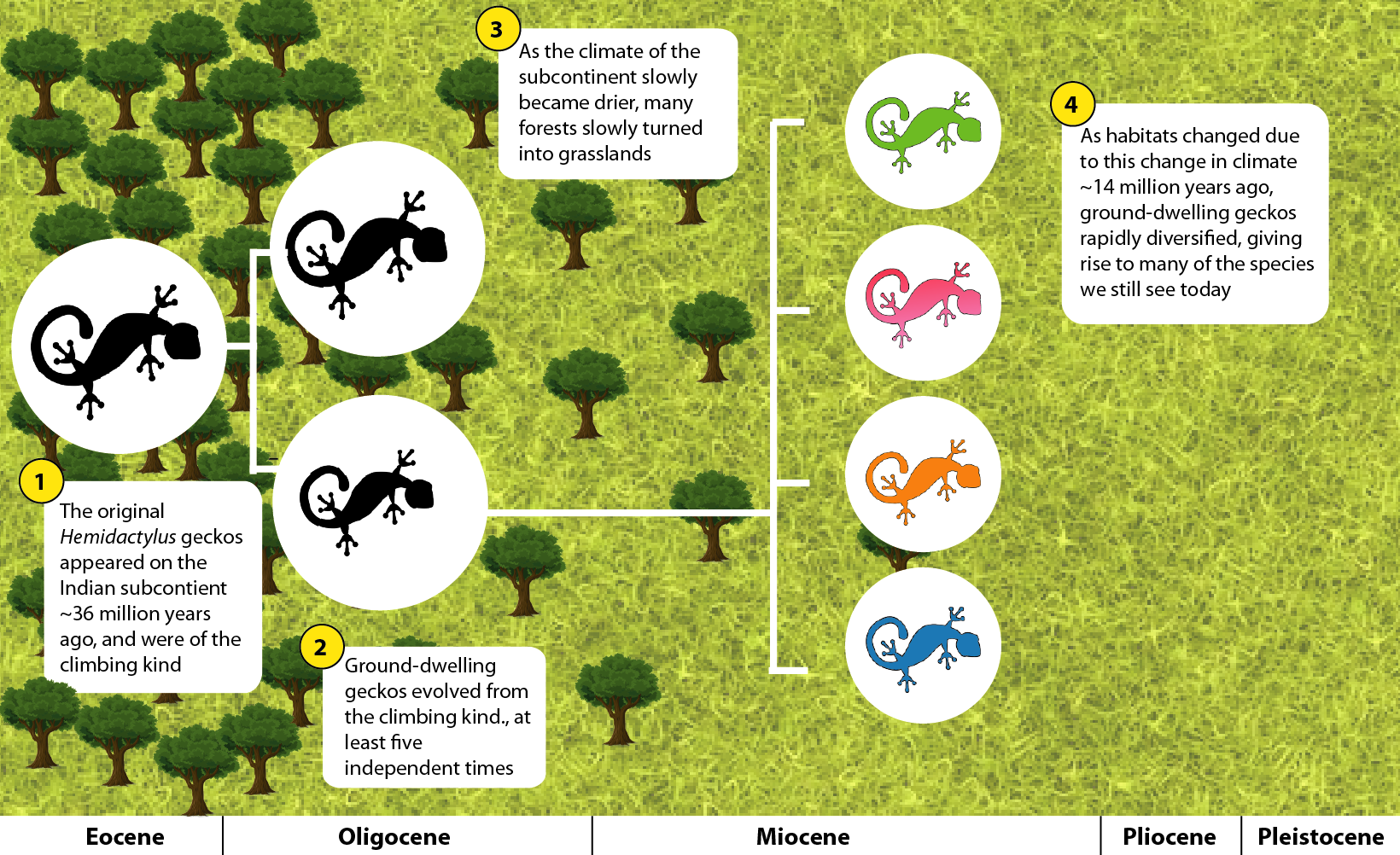
                src="https://cdn.indiabioscience.org/media/articles/GeckoFeatured.jpg"></a></figure><p>“You might not appreciate how pretty they are,'' says Aparna Lajmi of the geckos she studied over the course of her PhD at the <a href="https://indiabioscience.org/orgs/iisc">Indian Institute of Science (IISc), Bengaluru</a>. She is the lead author of <a href="https://onlinelibrary.wiley.com/doi/abs/10.1111/jeb.13544">a new study linking</a> these little critters to changing past climates in the subcontinent. “Beyond the pale ones we see in our house, one can find many related species in the wild which have different body types and patterns, and they’re all pretty,” Lajmi says. </p><p>Lajmi and her colleagues found that the evolutionary timescales over which distinct body forms started appearing in different species of geckos correlate with changes in their habitat as a result of the evolving climate in the Indian peninsula millions of years ago.</p><p>Based on a technique known as the '<a href="https://www.nature.com/scitable/topicpage/the-molecular-clock-and-estimating-species-divergence-41971/">molecular clock</a>', scientists believe that geckos belonging to the genus <em>Hemidactylus</em>
first appeared on the Indian subcontinent about 36 million years ago. From their common ancestor, the geckos today have evolved into many species which can be divided into 2 broad categories: the <em><strong>scansorial </strong></em>kind which has the ability to climb vertical walls and live in rocks, crevices, trees and urban households, and the <em><strong>terrestrial </strong></em>kind which lives mainly on flat ground. The former are generally longer and have enlarged toepads which help them climb.</p><p>How did these different lineages develop? Whenever a group of organisms first occupies an entirely new patch of land, they tend to quickly diversify. This leads to a burst in the formation of new species. This is because competition drives individuals to occupy different comfort zones in terms of the place they live, the food they eat and so on. Each comfort zone forms what is known as an <strong>‘ecological niche</strong>’. A group of individuals adapting to a particular niche will start accumulating characteristics unique to surviving in that niche and will eventually diverge to form a new species. </p><p>Many such niches give rise to many closely related but distinct species evolving from a common ancestor, like rays emanating from a common point. This phenomenon is called <a href="https://en.wikipedia.org/wiki/Adaptive_radiation"><strong>‘adaptive radiation’</strong></a>. </p><p>This is what <a href="https://www.thoughtco.com/charles-darwins-finches-1224472">Darwin observed</a> in the famed finches of the tiny Galapagos islands. The tiny islands harboured as many as 15 different species of finches with slight variations in their features, most prominently in the size and shape of their beaks. Darwin realized that this resulted from the fact that each type of finch had uniquely adapted to eat a particular kind of food like seeds, insects and nectar - which formed the niche for that particular species.</p><p>Lajmi and her colleagues came across this kind of differentiation while sampling for terrestrial geckos in the arid landscape of the Deccan plateau. They discovered a new species which showed features different from anything seen before. Speaking over the phone with her advisor Praveen Karanth soon after, Lajmi recalls exulting “Wow, this looks like a case of adaptive radiation!”. </p><p>Originally working on a different question, the researchers diverted their attention to closely studying the morphological differences between different species of ground-dwelling <em>Hemidactylus</em>
geckos. Among these, they observed many different forms that seemed to correlate with different kinds of habitat. </p><figure style="float: left; margin: 0px 20px 20px 0px;"><a href="https://indiabioscience.org/media/articles/GeckosInfographic2-01.png"><img src="https://cdn.indiabioscience.org/media/articles/GeckosInfographic2-01.png" data-image="127917" alt="Gecko Evolution"></a><figcaption>Ground-dwelling (terrestrial) geckos underwent rapid diversification when a drier climate converted forests to grasslands on the Indian peninsula (Note: Geological epochs not drawn to scale)</figcaption></figure><p>When these geckos originated in India 36 million years ago, they were all of the climbing kind. Interestingly, the researchers found that geckos began to live on the ground and diversified into several different ground-dwelling species <em>much later</em> than this, around 14 million years ago. This is contrary to the expectation of the <a href="https://science.sciencemag.org/content/323/5915/732.short">‘early-burst’ model of adaptive radiation</a>, which says that most of the species diversification occurs immediately after the first appearance of a population.</p><p>“It was expected that the ground-dwelling type of morphology evolved independently from the more climbing variety of geckos, but the timing of when that happened is the most exciting thing here,” says Aaron Bauer, a Professor of Biology at <a href="http://villanova.edu/">Villanova University, USA</a>, and an expert on geckos who was not involved with this study.</p><p>What caused this delayed diversification? The period around 14 million years ago is referred to as the late Miocene era. The climate in the Indian subcontinent at that time morphed into much drier conditions which led to the conversion of forest habitats into dry grasslands. This created new niches for geckos to adapt, which in turn led to the development of distinct morphological features to facilitate their terrestrial life. </p><p>By linking the diversification of terrestrial geckos to the late Miocene era, the researchers have placed an important timestamp on when the climatic conditions governing their habitat changed. “The climate change seen during the Miocene era is a global phenomenon, and this is one of the first studies to show that the same is also true for India,” Bauer notes.</p><p>Species diversification is a complex process that depends on a multitude of factors. While it is hard to definitively link the evolution of ground-dwelling gecko species to changing climates, there is a strong correlation. The case can be strengthened by observing the same patterns in the evolution of other organisms around the same period, which is an area of active research. </p><p>This study serves as an example of how investigating the glorious diversity of life on the planet we now call home can provide snapshots of how it looked like when it was our cradle. </p><hr><p><em>Did you enjoy this article? Please let us know in the comments below.</em></p>
              ]]></content><category term="evolution" label="Evolutionary Biology" /><category term="ecology" label="Ecology" /><category term="research" label="Research" /></entry><entry><title>Fruit fly study reveals a toxic relationship between lead and immunity</title><link
                  rel="alternate"
                  href="https://indiabioscience.org/news/2019/fruit-fly-study-reveals-a-toxic-relationship-between-lead-and-immunity"
                  type="text/html"
                  /><summary type="html"><![CDATA[
                <p>Lead is a heavy metal that was once used extensively in paints, gasoline, batteries, plumbing etc. Now, a new study by Indian researchers shows that in addition to its many known toxic effects, lead may lower immunity as well. Through a series of experiments on fruit flies, the researchers have demonstrated a link between lead exposure and susceptibility towards bacterial infections.</p>              ]]></summary><id>tag:indiabioscience.org,2019-10-18:/news/2019/fruit-fly-study-reveals-a-toxic-relationship-between-lead-and-immunity</id><published>2019-10-18T12:25:00+05:30</published><updated>2019-10-18T19:41:31+05:30</updated><author><name>Ananya Mukherjee</name><uri>https://indiabioscience.org/authors/gGWVL6YANpMqA6a</uri></author><content type="html"><![CDATA[
                
<p>Lead is a heavy metal that was once used extensively in paints, gasoline, batteries, plumbing etc. Now, a new study by Indian researchers shows that in addition to its many known toxic effects, lead may lower immunity as well. Through a series of experiments on fruit flies, the researchers have demonstrated a link between lead exposure and susceptibility towards bacterial infections.</p><figure><a href="https://indiabioscience.org/news/2019/fruit-fly-study-reveals-a-toxic-relationship-between-lead-and-immunity"><img
                width="800"
                height="489"
                style="max-width: 100%; height: auto"
                src="https://cdn.indiabioscience.org/media/articles/800px-Drosophila_melanogaster.jpg"></a></figure><p>Lead, a metal that<a href="https://economictimes.indiatimes.com/industry/cons-products/food/supreme-court-revives-governments-case-in-ncdrc-against-nestle-india/articleshow/67363564.cms"> made us question</a> the safety of our favourite instant noodles not too long ago, may have damaging effects on the immune system, as shown by<a href="https://www.sciencedirect.com/science/article/pii/S0045653519315681"> a recent study by</a> Hena Firdaus and her team from the <a href="https://indiabioscience.org/orgs/central-university-of-jharkhand">Central University of Jharkhand</a>. Using fruit flies as a model system, Firdaus’s team showed that higher lead levels can make flies more susceptible to bacterial infections, possibly due to a decrease in the number of blood cells (hemocytes).</p><p>Lead is one of the most toxic naturally occurring metals, for both humans and the environment. We can get exposed to lead through paints, contaminated food, water, dust, smelting, gasoline, aviation fuel etc. Even though acute lead poisoning occurs only when the level of exposure exceeds 100 µg/ dl, the<a href="https://www.cdc.gov/niosh/topics/lead/health.html"> Centre for Disease Control (CDC), USA,</a> has recently declared levels greater than 2 µg/dl as toxic.<a href="https://www.cdc.gov/niosh/docs/95-123/pdfs/95-123.pdf"> Lead exposure can result</a> in anaemia, unequal size of red blood cells, hypertension, kidney failure and nervous toxicity.</p><p>Fruit flies (<em>Drosophila melanogaster)</em> are often used as model systems since they are easy to work on and can be used to understand complex phenomena in other organisms. Fruit flies also have a significant similarity in their heavy metal tolerance mechanism with humans, which can be studied using genetic approaches.</p><p>Previous studies have shown<a href="https://www.ncbi.nlm.nih.gov/pubmed/21645631"> evidence of DNA damage in flies due</a> to exposure to heavy metals resulting in a delay in development. Firdaus and her team confirmed this finding with the help of a growth-based assay wherein they exposed fruit fly larvae to lead in their diets. Dietary lead not only hindered development in fruit fly from eggs into adults but also caused a drop in the rate of survival. Moreover, many of the flies exposed to high lead concentrations tended to die prematurely due to bacterial infections. In particular, the researchers found that the lead-exposed flies were more susceptible to <em>B.subtilis,</em> a fly pathogen, when compared to flies fed a lead-free diet.</p><p>Hemocytes are analogues of blood cells in Drosophila which play an important role in<a href="https://www.ncbi.nlm.nih.gov/pmc/articles/PMC4051208/"> controlling cellular immunity and immune responses</a>. They do this by clearing microbial pathogens and engulfing other parasites. “As lead continually enters into the environment due to many unavoidable natural activities, it will be interesting to see what kind of effect on hemocytes, if any, can be found in lead-fed <em>Drosophila</em>, ” said Ashim Kumar Basak from the Institute of Genetic Engineering, who was not a part of this study.</p><p>Interestingly, the researchers found that hemocyte count drops when fruit fly larvae are exposed to dietary lead. Hemocytes also have certain developmental functions which may be tied to the high mortality seen in lead-fed fruit flies. Firdaus points out that, “So far studies have not talked about hemocyte levels decreasing due to lead-based stress in <em>Drosophila</em> which connects our data to the other major finding of a compromised immune system in lead-exposed flies.”</p><p>This research also supports previous studies investigating the effects of lead exposure in zebrafish which also<a href="https://www.ncbi.nlm.nih.gov/pubmed/26965280"> showed</a> compromised immunity. When asked about their next steps, Firdaus said, “In future, we hope to conduct more experiments on <em>Drosophila</em> to study the mechanism behind declining hemocytes.” </p><hr><p><em>Did you enjoy this article? Please let us know in the comments below.</em></p>
              ]]></content><category term="health-and-medicine" label="Health &amp; Medicine" /><category term="research" label="Research" /></entry><entry><title>A deal to heal: a unique peptide from Russell’s viper venom</title><link
                  rel="alternate"
                  href="https://indiabioscience.org/news/2019/a-deal-to-heal-a-unique-peptide-from-russells-viper-venom"
                  type="text/html"
                  /><summary type="html"><![CDATA[
                <p>The global <a>wound care market</a> is on the rise with exorbitant costs incurred each year for skin wound care. Nature-derived drugs with wound healing properties that can be manufactured at a lower cost are presently a global requirement. Now, a study by scientists at Tezpur University has identified the country’s first wound-healing peptide from snake venom with anti-bacterial, anti-inflammatory and non-enzymatic properties.</p>              ]]></summary><id>tag:indiabioscience.org,2019-10-14:/news/2019/a-deal-to-heal-a-unique-peptide-from-russells-viper-venom</id><published>2019-10-14T15:00:00+05:30</published><updated>2019-10-14T16:53:47+05:30</updated><author><name>Shalini Roy Choudhury</name><uri>https://indiabioscience.org/authors/ShaliniRoyChowdhury</uri></author><content type="html"><![CDATA[
                
<p>The global <a href="https://indiabioscience.org/www.marketsandmarkets.com/PressReleases/wound-care.asp">wound care market</a> is on the rise with exorbitant costs incurred each year for skin wound care. Nature-derived drugs with wound healing properties that can be manufactured at a lower cost are presently a global requirement. Now, a study by scientists at Tezpur University has identified the country’s first wound-healing peptide from snake venom with anti-bacterial, anti-inflammatory and non-enzymatic properties.</p><figure><a href="https://indiabioscience.org/news/2019/a-deal-to-heal-a-unique-peptide-from-russells-viper-venom"><img
                width="720"
                height="440"
                style="max-width: 100%; height: auto"
                src="https://cdn.indiabioscience.org/media/articles/Russels_viper-_Attack_is_the_best_form_of_defence.jpg"></a></figure><p>If you have not already seen one, then you would have surely heard of it as one of India’s big four snakes. Widely distributed throughout the country, <a href="https://indiabiodiversity.org/species/show/238674">the Russell’s viper</a> is (in)famous for its blood-clotting venom and for causing the maximum number of deaths among the venomous snakes of India. </p><p>There is a silver lining to this cloud, however. <a href="https://reader.elsevier.com/reader/sd/pii/S0041010119301291?token=9E4E4D091005C41DF0F0D703BF51AA49BB54441DB4B1798C918316A3D7BC54F79A35EC3FE78085851760E54755489167">A recent study</a> led by <a href="http://www.tezu.ernet.in/dmbbt/people/AKM/MUKHEERJEE%20SIR%20LAB.htm">Ashis K Mukherjee</a>, Professor at <a href="https://indiabioscience.org/orgs/tezpur-university">Tezpur University, Assam</a>, has identified a peptide in Russell’s viper venom that can heal skin wounds by inducing the formation of new blood vessels, a process known as <strong>angiogenesis</strong>.</p><p>The wound healing drug market today is dominated by concoctions of <a href="https://en.wikipedia.org/wiki/Debridement">enzyme-based agents</a> which cleanse the wound of foreign material and dead tissue for faster healing. Drugs that facilitate wound-healing through angiogenesis are almost non-existent. </p><p>“Unfortunately, the availability of drugs from natural sources capable of cutaneous (skin) wound repair is still limited, although it can occupy a huge global market,” says Mukherjee. </p><p>The Russell’s viper venom is a cocktail of toxic and non-toxic proteins. <strong>RVVAP</strong> (Russell’s Viper Venom pro-Angiogenic Peptide) is a low molecular mass, non-enzymatic peptide found in Russell’s viper venom. Small peptides are easily absorbed by the skin and are not recognised as foreign entities, thereby having little to no side-effects. </p><p>As part of an attempt to develop drugs from natural sources, Mukherjee’s team <a href="https://reader.elsevier.com/reader/sd/pii/S0041010113004108?token=323B8B78972A6100A1C9331659C475934C2B19CEA1ADC0F0D6B645EA9F6B213EABFEC7CCE898878AAED094B47E2DDE13">had purified RVVAP</a> from crude Russell’s viper venom in 2014. Intrigued by the small size and pro-angiogenic properties of this peptide, the researchers explored its role in wound healing. They prepared cream-based formulations of purified RVVAP and applied them topically twice daily to skin wounds created in rats. Freshly prepared <em>Aloe vera</em> extract served as a positive control, due to its well-known <a href="https://www.aloe-medical-group.com/en/aloe-vera/history.html">wound-healing and anti-bacterial properties</a>. </p><p>The researchers monitored the wounds for a week by outlining the area of wound closure on tracing paper. To examine the anti-bacterial properties of these formulations, they streaked swabs from the treated wounds onto agar plates and checked if there was a reduction in the number of surviving bacterial colonies. Anti-bacterial properties in wound-healing creams reduce the risk of secondary infections. </p><p>Although RVVAP independently showed wound-healing and anti-bacterial properties, the best results were obtained with a formulation combining RVVAP and <em>Aloe vera</em>. RVVAP also reduced inflammation from skin injuries. RVVAP-treated mice had normal physical, behavioural and blood parameters and the peptide was non-toxic and non-lethal at a low dose. </p><p><a href="https://www.venomicslab.com/">Kartik Sunagar</a>, Assistant Professor at the <a href="http://ces.iisc.ernet.in/new/?q=user/307">Evolutionary Venomics Lab</a>, <a href="https://indiabioscience.org/orgs/iisc">Indian Institute of Science, Bangalore</a>, who was not associated with this research considers this a well-planned, proof-of-concept study that has added to the domain of wound-healing drug discovery from bioresources. He believes that many such components can be promising, but a follow-up study like this is absolutely essential. He says, “Discovery of this peptide is in itself very interesting. This study emphasizes that more research needs to be done on venoms from a perspective of drug discovery in human therapeutics, especially by venom biologists in India.” </p><p>“In future, we are planning to work on two aspects: First, deduce the primary structure of RVVAP so that it can be chemically synthesized or cloned and manoeuvred for better wound healing activity. Second, understand its mechanism of action in the presence of <em>Aloe vera</em> which may help in developing RVVAP as a prototype for peptide-based wound healing therapeutic agent.” says Mukherjee. He adds that the fact that RVVAP is non-enzymatic could mean that it would have a longer shelf-life compared to enzyme-based agents in the market, if developed into a drug prototype.</p><p>RVVAP is the first peptide reported from Russell’s viper venom with these unique properties and a role in wound healing. Although there have been <a href="https://onlinelibrary.wiley.com/doi/epdf/10.1111/j.1742-481X.2011.00776.x">previous reports</a> of snake venom peptides with wound healing potency, this is the first such report from India. This study potentiates the <a href="https://europepmc.org/backend/ptpmcrender.fcgi?accid=PMC5173653&blobtype=pdf">longstanding history</a> of snake venoms in therapeutics and has opened up a new avenue in the underexplored domain of Russell’s viper venom peptides in wound healing. </p><hr><p><em>Did you enjoy this article? Please let us know in the comments below.</em></p>
              ]]></content><category term="biochemistry" label="Biochemistry" /><category term="health-and-medicine" label="Health &amp; Medicine" /><category term="research" label="Research" /></entry><entry><title>Decoding the mysteries of viral infection responses</title><link
                  rel="alternate"
                  href="https://indiabioscience.org/news/2019/decoding-the-mysteries-of-viral-infection-responses"
                  type="text/html"
                  /><summary type="html"><![CDATA[
                <p>A team of researchers from the Indian Institute of Science, Bengaluru have come up with a computational model to explain why different people respond differently to viral infections. According to this model, a delicate balance between specific immune cells and viral antigens determines infection outcome.</p>              ]]></summary><id>tag:indiabioscience.org,2019-09-30:/news/2019/decoding-the-mysteries-of-viral-infection-responses</id><published>2019-09-30T10:23:00+05:30</published><updated>2019-09-30T13:35:49+05:30</updated><author><name>Susheela</name><uri>https://indiabioscience.org/authors/ANQdMn8qkRK6OE7</uri></author><content type="html"><![CDATA[
                
<p>A team of researchers from the Indian Institute of Science, Bengaluru have come up with a computational model to explain why different people respond differently to viral infections. According to this model, a delicate balance between specific immune cells and viral antigens determines infection outcome. </p><figure><a href="https://indiabioscience.org/news/2019/decoding-the-mysteries-of-viral-infection-responses"><img
                width="720"
                height="440"
                style="max-width: 100%; height: auto"
                src="https://cdn.indiabioscience.org/media/articles/FeaturedViralInfection-01.png"></a></figure><p>Immunologists have long been trying to comprehend why similar viral infections give rise to diverse responses in different individuals. Until now, this was believed to be due to several complex mechanisms implemented by the <a href="https://www.immunology.org/public-information/bitesized-immunology/pathogens-and-disease/immune-responses-viruses">immune system</a> to tackle the infection. </p><p>In a <a href="https://www.pnas.org/content/116/35/17393">recent study</a>, a group of scientists led by Narendra M Dixit from the <a href="https://indiabioscience.org/orgs/iisc">Indian Institute of Science, Bengaluru</a>, report a contrasting theory that outcomes of viral infections are dependent primarily on the interplay of only two factors: infection-triggering agents called <strong>antigens</strong> and specialized immune cells called <strong>CD8 T cells</strong>.</p><p>Viral infections baffle us: some are rapidly cleared in a few days by the immune system (such as the common cold), while others such as HIV give rise to a persistently infected state, while yet others such as Ebola or swine flu cause rapid deterioration, even leading to death. Sometimes, the same virus causes different outcomes in different individuals. For example, <a href="https://www.webmd.com/hepatitis/digestive-diseases-hepatitis-c">Hepatitis C</a> infections are seen to spontaneously clear in <a href="https://www.who.int/news-room/fact-sheets/detail/hepatitis-c">30% of the people</a> infected, whereas it can turn chronic in others. </p><p>When viruses attack healthy cells, they use them as replicating factories to proliferate. Viruses carry structures called <a href="https://en.wikipedia.org/wiki/Antigen">antigens</a> which can trigger the immune system. In response to the invasion, the immune system immediately summons a host of immune factors and <a href="https://www.immunology.org/public-information/bitesized-immunology/cells/natural-killer-cells">killer cells</a>. Among them, specialised cells called <a href="https://en.wikipedia.org/wiki/Cytotoxic_T_cell">CD8 T cells</a> are equipped with receptors that can identify the antigen patterns on the infected cells. CD8 T cells immediately attack the infected cells and destroy them to arrest the progression of the infection.</p><p>In turn, the virus generates chemicals to ward off the CD8 T cells. If the virus is aggressive or present in large numbers, it can overwhelm the killer cells and induce <a href="http://www.bloodjournal.org/content/122/21/SCI-38?sso-checked=true">cell exhaustion</a>, wherein the cells lose their vigour and multiplying capacity. </p><p> “In the course of this battle, the major factor that determines the outcome of the infection is the balance between CD8 T cell activity and exhaustion,” says Dixit. If the CD8 T cells overpower the virus, the infection is cleared. However, if they are exhausted, the infection persists and can turn into a chronic condition.</p><p>The researchers observed that all other cellular factors released during the initial immune response act as mediators or modulators for this primary interaction between the antigens and CD8 T cells. The study also found that there exists a threshold for cell exhaustion, based on the balance between antigen load and CD 8 T cell numbers.</p><p>Dixit’s team explored the possibility of arriving at a unified explanation based on their observations. They devised a simple mathematical model to encode the dynamics of the events and variables associated with viral infections. </p><p>Their model describes disease progression based on the balance of antigen-CD8 T cell interaction, factoring in the strength and severity of the infection at the start. Also, the model gives an estimate of the threshold level of CD8 T cells required to overcome the infection.</p><p>Soumen Basak, Staff Scientist at the <a href="https://indiabioscience.org/orgs/nii-new-delhi">National Institute of Immunology (NII), New Delhi</a>, who was not connected with the study, says, “Such experimentally verified computational models offer powerful tools for advancing immunology research. They enable a quantitative mechanistic analysis of intricate immune processes, and can direct novel discoveries because of their predictive capabilities.”</p><p>Dixit claims that the new theory proposes ways to alter the outcomes of viral infections. Understanding the interactions that determine infection outcome would help researchers devise interventions to suitably modulate these key interactions and cure chronic infections. Also, biochemical modifications may raise the CD8 T cell exhaustion thresholds, paving the way for new treatments. </p><p>“The research provides not only testimony to these claims but also bears promise for improved anti-viral therapeutic strategies. Tweaking of the core circuit might allow the elimination of persistent viral infection without provoking <a href="https://aacijournal.biomedcentral.com/articles/10.1186/s13223-018-0278-1">immunopathology</a>,” says Basak.</p><p>In the meantime, the work shows promise for both basic and translational research on anti-viral immunity and anti-viral therapy.</p><p>Commenting on this, Satyajit Rath, Adjunct Professor at the <a href="https://indiabioscience.org/orgs/iiser-pune">Indian Institute of Science Education and Research (IISER), Pune</a>, who was also not connected with the study says, “The model can drive more refined empirical work so that it can make quantitative and testable predictions, thereby allowing conceptual and translational advances in the future.” </p><hr><p><em>Did you enjoy this article? Please let us know in the comments below.</em></p>
              ]]></content><category term="health-and-medicine" label="Health &amp; Medicine" /><category term="theoretical-biology" label="Theoretical Biology" /><category term="research" label="Research" /></entry><entry><title>Scientists capture the misfolding of rogue proteins in action</title><link
                  rel="alternate"
                  href="https://indiabioscience.org/news/2019/scientists-capture-the-misfolding-of-rogue-proteins-in-action"
                  type="text/html"
                  /><summary type="html"><![CDATA[
                <p>Researchers at the National Center for Biological Sciences (NCBS), Bengaluru have used a combination of techniques to unravel the mystery of how prions misfold. Prions are proteins that undergo structural changes to form compound assemblies called amyloid fibrils, which can lead to fatal infectious neurodegenerative diseases like the Mad Cow disease and other Transmissible Spongiform Encelopathies in mammals.</p>              ]]></summary><id>tag:indiabioscience.org,2019-09-19:/news/2019/scientists-capture-the-misfolding-of-rogue-proteins-in-action</id><published>2019-09-19T09:00:00+05:30</published><updated>2019-09-19T17:11:58+05:30</updated><author><name>Sumeet Kulkarni</name><uri>https://indiabioscience.org/authors/SumeetKulkarni</uri></author><content type="html"><![CDATA[
                
<p>Researchers at the <a href="https://indiabioscience.org/orgs/ncbs">National Center for Biological Sciences (NCBS), Bengaluru</a>, have used a combination of techniques to unravel the mystery of how prions misfold. Prions are proteins that undergo structural changes to form compound assemblies called amyloid fibrils, which can lead to fatal infectious neurodegenerative diseases like the <a href="https://www.urmc.rochester.edu/encyclopedia/content.aspx?ContentTypeID=85&amp;ContentID=P01444">Mad Cow disease</a> and other <a href="https://en.wikipedia.org/wiki/Transmissible_spongiform_encephalopathy">Transmissible Spongiform Encelopathies </a>in mammals.</p><figure><a href="https://indiabioscience.org/news/2019/scientists-capture-the-misfolding-of-rogue-proteins-in-action"><img
                width="720"
                height="440"
                style="max-width: 100%; height: auto"
                src="https://cdn.indiabioscience.org/media/articles/Prion_Protein_Fibrils_8656058266.jpg"></a></figure><p>Proteins are the building blocks of life. But imagine if a protein could morph into a completely different, rogue avatar of itself at the flick of a switch. Even worse, imagine this dysfunction spreading to similar proteins in the neighbourhood of the affected protein, eventually damaging the surrounding tissue. </p><p>Ishita Sengupta is an Assistant Professor at the <a href="https://indiabioscience.org/orgs/iitk">Indian Institute of Technology (IIT), Kanpur</a>, who studies <strong>prions</strong>, the villainous proteins in this plot. Nearly seven decades after their discovery, there is still a lot of mystery surrounding prions. “The high-resolution structure of the misfolded, aggregated and infectious form of the prion protein has still not been solved,” Sengupta notes. </p><p>Over the course of her post-doctoral work in Jayant Udgaonkar’s lab at the <a href="https://indiabioscience.org/orgs/ncbs">National Center for Biological Sciences (NCBS), Bengaluru</a>, Sengupta used a combination of experimental techniques to get a detailed, step-by-step <a href="https://elifesciences.org/articles/44698#s3">understanding of how prions operate.</a></p><p>The term ‘infectious disease’ brings to mind the picture of a pathogen that spreads it, like a bacterium, a fungus, or a virus. All of these depend on nucleic acids, i.e. DNA or RNA, to replicate as they propagate between organisms and spread disease. That is why <a href="https://www.ncbi.nlm.nih.gov/pmc/articles/PMC4626585/">the discovery of the prion</a>, a protein created by our own body which seemed to be the sole agent for the spread of certain diseases, was so enigmatic. </p><p>We don’t really know what role prions play in our bodies. Like all proteins, they are made up of a string of amino acids which fold into a characteristic shape. Under the influence of various physical and chemical forces, this string of amino acids may self-assemble into two main kinds of structures: spiral-pasta-like alpha-helices, and flat-noodle-shaped beta-sheets. </p><figure><img src="https://cdn.indiabioscience.org/media/articles/Secondary-Structures-01.png" data-image="124725" alt="Protein secondary structures"><figcaption spellcheck="false">Protein Secondary structures: Alpha-helix and Beta-sheet (Modified from illustration by Thomas Shafee [CC BY-SA 4.0 (https://creativecommons.org/licenses/by-sa/4.0)])</figcaption></figure><p>The prion protein does not have the ability to cause disease in its normal configuration, which is a complex 3-dimensional structure primarily composed of spiral alpha-helices. Under certain kinds of triggers, it can misfold into a completely different shape and form aggregated structures called <strong>amyloid fibrils</strong>, which have more flat beta-sheets. Not all misfolded prions lead to disease - but when they do, such amyloid fibrils have been shown to be highly correlated with severe tissue damage. Despite being very rare, all prion diseases are fatal and there is no known cure.</p><p>We do not know for certain what triggers prion proteins to misfold. “However, if we can understand how these triggers cause small changes in the prion molecule, and if we have a timeline of the sequence of these changes, then we can start thinking about how to address the corresponding diseases,'' says Neelanjana Sengupta, an associate professor at the <a href="https://indiabioscience.org/orgs/iiser-kolkata">Indian Institute of Science Education and Research (IISER) Kolkata</a>, who was not involved with this study.</p><p>To investigate this process, the researchers tagged different chemical parts of the mouse prion protein. Using a technique called <a href="https://www.biotek.com/resources/white-papers/an-introduction-to-fluorescence-resonance-energy-transfer-fret-technology-and-its-application-in-bioscience/">Fluorescence Resonance Energy Transfer</a>, the researchers tracked energy changes within the molecule. This allowed them to monitor extremely minute changes in the relative distance between the tagged protein parts. The experiments were performed under acidic conditions, which are believed to facilitate prion misfolding in living systems. </p><p>It was known that unlike their original alpha-helical form, misfolded prions in aggregated structures have a greater proportion of flat beta-sheets. This study provides a greater resolution of what the resulting structure looks like and also provides fresh insights on how this process unfolds. For the first time, the researchers were actually able to pinpoint which parts of the protein changed their shape, and exactly when they did so. Detailed surveillance of every way in which these rogues operate is crucial to developing strategies to stop them.</p><p>This may just be the first step towards drug development, Ishita notes. “Since our experiments have been performed in-vitro with purified proteins, drawing conclusions about disease-relevance from these results would be premature,” she warns. </p><p>However, the innovative fashion in which this series of standard biochemical techniques have been combined can also inspire research on misfolding pathways for other proteins responsible for other neurodegenerative diseases like Alzheimer’s and Parkinson’s disease.</p><hr><p><em>Did you enjoy this article? Let us know in the comments below.</em></p>
              ]]></content><category term="biochemistry" label="Biochemistry" /><category term="molecular-biology" label="Molecular Biology" /><category term="research" label="Research" /></entry><entry><title>Plugging the leak: a novel microparticle to the rescue</title><link
                  rel="alternate"
                  href="https://indiabioscience.org/news/2019/plugging-the-leak-a-novel-microparticle-to-the-rescue"
                  type="text/html"
                  /><summary type="html"><![CDATA[
                <p>Uncontrolled blood loss following an accident or injury can pose severe risks to the health and life of the patient. Now, a team of Indian researchers from the Institute of Nano Science and Technology have developed a novel environment-friendly microparticle which can stop bleeding quickly if applied to the injury site. </p>              ]]></summary><id>tag:indiabioscience.org,2019-09-06:/news/2019/plugging-the-leak-a-novel-microparticle-to-the-rescue</id><published>2019-09-06T09:00:00+05:30</published><updated>2019-09-06T10:53:44+05:30</updated><author><name>Susheela</name><uri>https://indiabioscience.org/authors/ANQdMn8qkRK6OE7</uri></author><content type="html"><![CDATA[
                
<p>Uncontrolled blood loss following an accident or injury can pose severe risks to the health and life of the patient. Now, a team of Indian researchers from the Institute of Nano Science and Technology have developed a novel environment-friendly microparticle which can stop bleeding quickly if applied to the injury site. </p><figure><a href="https://indiabioscience.org/news/2019/plugging-the-leak-a-novel-microparticle-to-the-rescue"><img
                width="720"
                height="439"
                style="max-width: 100%; height: auto"
                src="https://cdn.indiabioscience.org/media/articles/HaemostatInfo.png"></a></figure><p>Haemorrhage or severe blood loss can soon turn into a life-threatening situation. In <a href="https://www.sciencedirect.com/science/article/pii/S2589152919301693">a recent study</a>, a team of Indian scientists led by Deepa Ghosh from the <a href="https://indiabioscience.org/orgs/inst">Institute of Nano Science and Technology (INST), Mohali</a><u>,</u> fabricated a biodegradable powder which can prevent haemorrhaging. When sprinkled over an injury, the powder rapidly arrests bleeding and quickens healing.</p><p>The study was performed in collaboration with the <a href="https://indiabioscience.org/orgs/niper-hyderabad">National Institute of Pharmaceutical Education and Research (NIPER), Hyderabad.</a></p><p>Special materials which can soak up excess fluid and aid in stopping local bleeding are known as <a href="https://www.ncbi.nlm.nih.gov/pmc/articles/PMC4869418/"><strong>topical haemostats</strong></a>. Topical Haemostats are much in demand during emergencies as they can arrest profuse bleeding from injuries. However, currently, they are usually made up of expensive, nondegradable materials.</p><p>Despite advancements in science, no single material can prevent all types of bleeding. Some currently available options in the west such as <a href="https://www.sciencedirect.com/science/article/pii/S0144861717309931">Chitosan sponge and Kaolin</a> are either not flexible enough to properly cover the contours of the wound area or are non-biodegradable. They have to be removed immediately after absorbing the blood, leading to the risk of disrupting the just-formed clot and causing further bleeding. </p><p>Moreover, these materials are expensive and therefore may not be affordable for many in developing nations like India. A few upcoming <a href="https://www.ncbi.nlm.nih.gov/pubmed/28168995">starch-based haemostats</a> are biodegradable, but are slow in absorbing blood and poor in adhering to the injured site, thereby limiting their clinical application.</p><p>To overcome these limitations, Ghosh’s team modified a natural starch compound to convert it into a better performing haemostat. They started with a biodegradable <a href="https://onlinelibrary.wiley.com/doi/abs/10.1002/star.201500337">pharmaceutical excipient</a> — a type of starch used as the base material in medicines — and tweaked the hydroxyl groups in the compounds to carboxymethyl (CM) groups. They then converted this into a powder form consisting of <strong>CM-starch microparticles</strong>. </p><p>The team observed that when these free-flowing microparticles came in contact with blood, they absorbed the excess fluid within 30 seconds and formed a sticky gel-like network. The gel served as a barrier to prevent blood flow, thereby abating the bleeding. As the gel was biodegradable, it could be left at the wound site without causing toxicity or disrupting clot formation.</p><figure><img src="https://cdn.indiabioscience.org/media/articles/Image-2.jpg" data-image="122714"><figcaption>Deepa Ghosh with her research team at INST, Mohali</figcaption></figure><p>Ghosh says, “We wanted the microparticles to facilitate the clotting mechanism as well. So in a bid to quicken clot formation, we fortified the powder with Calcium ions.” Calcium (Ca) plays a crucial role in <a href="https://www.ncbi.nlm.nih.gov/pmc/articles/PMC4260295/" target="_blank">clot formation</a>. During this process, activated platelets release protein factors that combine with calcium ions to create a mesh-like substance, which then forms the clot that plugs the injury site.</p><p>When the researchers sprinkled the Calcium-fortified powder (Ca-CM Starch) on injuries in animal models, it could stop the bleeding in less than one minute. This was due to the combined action of the gel creating a barrier to blood flow, and the Calcium providing a pathway for the natural clotting mechanism to take over.</p><p> “The Ca-CM Starch appears to be a promising haemostat, ready for the next phase of testing in clinical trials,” says Santhosh Satheesh, Professor of Cardiology at the <a href="https://indiabioscience.org/orgs/jipmer">Jawaharlal Institute of Postgraduate Medical Education and Research (JIPMER), Pondicherry</a>, who was not associated with the study. He adds, “Another potential use could be as a replacement for PVC microparticles used in surgical procedures (such as arterial embolization) where the flow to a blood vessel is stopped.”</p><p>“Our new material has demonstrated its efficacy in meeting the pressing demand for a better and cost-effective haemostat, that could prevent the complications associated with heavy bleeding,” says Ghosh. The researchers look forward to patenting the product for use as single-use sachets.</p><hr><p><em>Did you enjoy this article? Please let us know in the comments below.</em></p>
              ]]></content><category term="health-and-medicine" label="Health &amp; Medicine" /><category term="biotechnology" label="Biotechnology" /><category term="research" label="Research" /></entry><entry><title>Solving the mystery of a fishy apocalypse</title><link
                  rel="alternate"
                  href="https://indiabioscience.org/news/2019/solving-the-mystery-of-a-fishy-apocalypse"
                  type="text/html"
                  /><summary type="html"><![CDATA[
                <p>Researchers from the Centre for Climate Studies, Sathyabama Institute of Science and Technology, Chennai, have discovered that the accumulation of chromium (a heavy metal) and low salinity might have caused mass death of fish in the Adyar estuary in Tamil Nadu in 2017. </p>              ]]></summary><id>tag:indiabioscience.org,2019-09-04:/news/2019/solving-the-mystery-of-a-fishy-apocalypse</id><published>2019-09-04T09:00:00+05:30</published><updated>2019-09-01T16:31:42+05:30</updated><author><name>Annapoorna P K</name><uri>https://indiabioscience.org/authors/76ldNMzk3kL29rX</uri></author><content type="html"><![CDATA[
                
<p>Researchers from the Centre for Climate Studies, Sathyabama Institute of Science and Technology, Chennai, have discovered that the accumulation of chromium (a heavy metal) and low salinity might have been responsible for the mass death of fish in the Adyar estuary in Tamil Nadu in 2017.</p><figure><a href="https://indiabioscience.org/news/2019/solving-the-mystery-of-a-fishy-apocalypse"><img
                width="960"
                height="587"
                style="max-width: 100%; height: auto"
                src="https://cdn.indiabioscience.org/media/articles/clean-1223168_960_720.png"></a></figure><p><em>“You wouldn't think you could kill an ocean, would you? But we'll do it one day. That's how negligent we are.”</em> wrote Ian Rankin in his novel ‘Blood hunt’. Studying yet another instance of the adverse effects of pollution on habitat and environment, researchers led by Vinitha Ebenezer from the <a href="https://indiabioscience.org/orgs/sathyabama-institute-of-science-and-technology">Centre for Climate Studies, Sathyabama Institute of Science and Technology, Chennai</a>, <a href="https://link.springer.com/article/10.1007/s10661-019-7636-4">have found that</a> chromium toxicity and low salinity caused the mass death of fish in Adyar estuary, Tamil Nadu, two years ago. </p><p>In November 2017, hundreds of dead fish washed up on the shores of the Adyar estuary located at the mouth of the Adyar River, creating panic across the city, especially among the local fishermen. The fishermen blamed the discharge of untreated sewage into the water body for the mass death. This was the second such occurrence within three years, the first having taken place in December 2014.</p><p>While environmentalists and researchers proposed several plausible reasons for this, a detailed explanation was not available before this study. Ebenezer and her team analysed the water collected from the estuary and determined the concentration of heavy metals in it. The concentration of chromium in the water immediately stood out, being more than thirty times higher than the maximum permissible limit.</p><p>Heavy metals like chromium are required by most organisms in trace amounts, but too much of it is toxic. Analysis of the fish specimens collected from the site revealed the effects of the toxicity. The gills showed evidence of cell death and structural changes, which made it difficult for the fishes to breathe, ultimately resulting in death. </p><p>Talking about the possible cause of increased chromium in the estuary, Umer Khalifa S.R., the lead author of the study says, “It is most likely from the release of a leather industry which uses chromium in the tanning process.” Tanneries use toxic mixtures of chromium salts for tanning animal skins to obtain leather. </p><p>Along with increased chromium, low salinity in the estuary made matters worse. Optimum salinity or salt content in water prevents the accumulation of heavy metal ions. “Increased chromium alone could not have caused the mass death of fish in a short time span. Low salinity was the compounding factor,” says Khalifa. </p><p>Estuaries are unique environments since they connect to both freshwater and marine water sources, making them a dynamic habitat for many aquatic organisms. The Adyar estuary connects to the Adyar River and the Bay of Bengal. The mouth of the Adyar River brings in marine water into the estuary. </p><p>K Venkataraman, Senior Scientific Consultant at the <a href="https://indiabioscience.org/orgs/ncscm">National Centre for Sustainable Coastal Management (NCSCM), Chennai</a>, says, “The Adyar River mouth has been clogged due to the garbage and sewage that get dumped into it. In addition, the mouth is completely silted. This prevents the entry of seawater into the estuary and thereby reduces the salinity.”</p><p>This mass death of fish can serve as a warning bell for the larger community and the governing bodies. For the fishermen who rely on the Adyar estuary for their livelihood, the situation is dire. For the larger community, consuming fishes which have accumulated heavy metals is a potential health concern. </p><p>Studies like these reiterate how human intervention can destroy perfectly functioning habitats. As K Venkataraman says, “There is an urgent requirement for awareness both at the public and the government level. Measures like unclogging of the river mouth and reducing sewage discharge into the river need to be taken.” <em><br></em></p><hr><p><em>Did you enjoy this article? Please let us know in the comments below.</em></p>
              ]]></content><category term="ecology" label="Ecology" /><category term="conservation-biology" label="Conservation Biology" /><category term="research" label="Research" /></entry></feed>