<?xml version="1.0" encoding="UTF-8"?><feed xmlns="http://www.w3.org/2005/Atom" xml:lang="en"><title>IndiaBioscience - Education from 2016</title><link
    rel="alternate"
    href="https://indiabioscience.org/columns/education/2016"
    type="text/html"
    /><link
    rel="self"
    href="https://indiabioscience.org/columns/education/2016/feed"
    type="application/atom+xml"
    /><id>https://indiabioscience.org/columns/education/2016/feed</id><updated>2026-06-23T04:29:51+05:30</updated><entry><title>Jigsaw classroom: using student differences to bolster student learning</title><link
                  rel="alternate"
                  href="https://indiabioscience.org/columns/education/jigsaw-classroom-using-student-differences-to-bolster-student-learning"
                  type="text/html"
                  /><summary type="html"><![CDATA[
                <p>A primer on the jigsaw teaching method and how it can be implemented in undergraduate classrooms.</p>              ]]></summary><id>tag:indiabioscience.org,2016-10-24:/columns/education/jigsaw-classroom-using-student-differences-to-bolster-student-learning</id><published>2016-10-24T14:46:00+05:30</published><updated>2019-05-09T21:57:59+05:30</updated><author><name>Reeteka Sud</name><uri>https://indiabioscience.org/authors/reeteka</uri></author><content type="html"><![CDATA[
                
<p>Jigsaw teaching takes into account students who don’t speak up in class for whatever reason—poor prior knowledge of content or language difficulties or are shy. Whether it is completing assigned syllabus, teaching undergraduates to read original scientific literature or the process of writing scientific manuscripts, jigsaw technique can be implemented for any number of objectives in large classes.</p><figure><a href="https://indiabioscience.org/columns/education/jigsaw-classroom-using-student-differences-to-bolster-student-learning"><img
                width="500"
                height="278"
                style="max-width: 100%; height: auto"
                src="https://cdn.indiabioscience.org/media/articles/Art-Edu_Jigsaw-Oct2016.jpg"></a></figure><p>Consider a typical undergraduate classroom — students from different economic sections, who have had different types of schooling, who differ widely in their grasp of English language as well as of subject matter — are thrown in the mix together, in the same class in college. In the face of this immense diversity, not to mention the large class sizes and tight teaching schedule, the teacher is forced to assume a “middle path” — a level they think is “middle of the curve” for their students. This method leaves behind more students than it includes; the weaker students flounder their way through the academic year with next to no chances for the teacher to address their concerns or give them extra time. The brighter students get bored as the class cannot be challenging enough for them. As a teacher, how do you use this diverse spectrum of student abilities to benefit them? Is there a way to add up the differences? With jigsaw classroom, there is.</p><p>Elliot Aronson (currently Professor Emeritus at the University of California in Santa Cruz) developed the jigsaw classroom over four decades ago. This method takes into account students who don’t speak up in class for whatever reason—poor prior knowledge of content or language difficulties or are shy.</p><p>Here, the class is divided into groups of equal size. Experts recommend the more heterogenous the group, in terms of student background, abilities, and gender (if applicable), the higher the chances of success. Number of groups in the class should equal the number of topics that need to be covered. For instance, if the topic to be covered is ‘Cytoplasmic streaming’, the class could be divided in four groups, each for the four types of streaming movements of the cytoplasm. Or if the topic is ‘chromosomal aberrations’ in a Genetics course, the number of groups would be the same as the number of aberrations that the teacher plans to cover in that class.</p><p>To begin with, each student is assigned a sub-topic. So, in our example of Genetics class, some students will be assigned aneuploidy, some would have polyploidy, etc. Students are given time for each individual to familiarise themselves with their topic, using the reading material assigned by the teacher. After sufficient time (predetermined by the instructor), all students with the same assigned topic are brought together. Here, students hone their understanding by quizzing each other, learning from each other. They discuss the main points of their segment and to rehearse their presentations. These are called “expert groups”, for it is here students are to develop expertise in their respective topics.</p><p>Next, students proceed to the groups they were originally assigned to; but now each student is an expert in one distinct sub-topic. Each such group is now “jigsaw group”. Just like each piece of jigsaw is essential to complete a puzzle, expertise of each student is essential for the class to complete their knowledge of the topic. Each of the students now present their topic to other members in their jigsaw group. During this time, the teacher does the rounds of groups, making sure presentations are proceeding smoothly. Towards the end, the teacher gives a quiz to the entire class. The only way for students to do well in the quiz is to learn from each other. </p><p><a href="http://archive.wceruw.org/cl1/cl/doingcl/insttask.htm" target="_blank">This page</a> offers more advice for instructors specifically on how to organise student groups; the logistics of which are just as important as <a href="http://archive.wceruw.org/cl1/cl/doingcl/prepstud.htm" target="_blank">preparing students</a> for what to expect. The activity can be spread over multiple classes or confined to one, depending on topic at hand. If there isn’t enough class time, the final jigsaw activity could also be a collaborative homework exercise.</p><p>Barbara Lom, faculty at Davidson College in the US state of North Carolina wrote an <a href="https://www.ncbi.nlm.nih.gov/pmc/articles/PMC3592730/" target="_blank">article on simple classroom strategies</a> to develop student-centric activities in undergraduate classroom. Here, she outlined how jigsaw method can be used to introduce students to reading original scientific literature: “Initial groups may first focus on specific sections (or figures) in a paper, then reconfigure so that each group has at least one member with expertise on each portion of the article.” Aaron M. Broege, Visiting Faculty at Carleton College in Northfield, Minnesota (US), has written a <a href="https://uminntilt.com/2013/02/19/primary-literature-can-puzzle-undergraduates-using-the-jigsaw-to-build-understanding/" target="_blank">post</a> about his experience of carrying this out in his classroom. In his article, he says, “my greatest concern was that after organizing this system, the students would come to class the Friday they were supposed to discuss, and just sit there….Initially, I wanted to have a more formal “wrap-up” in which I go figure-by-figure in lecture format and pull together all of the main points; however, students engage over the paper so much, that I often am unable to complete summary in that course period.” Clearly, the method was effective in getting students to openly engage with peers.</p><p>Writing practicals in their practical files can be a platform to introduce students to the process of writing scientific manuscripts; and with jigsaw technique, it takes the form of cooperative learning. The initial groups would discuss individual sections (introduction/background, methods, results, discussion), and subsequently collaborate in writing of the complete practical exercise. An example of this, with details on organisation of student groups, was published in an <a href="https://www.jstor.org/stable/pdf/1313137.pdf" target="_blank">article</a> by Joseph Colosi and Charlotte Zales, educators from the American state of Pennsylvania. In their experience, using jigsaw replaced the pre-lab lecture with focused student discussions. In their words, “most important, students are more involved with their lab exercises, they rely on one another to solve problems, and they take responsibility for their own learning”. </p><p>Does this sound tempting enough for you to try jigsaw teaching? Interested in trying this out for yourself? In the ‘Discussion’ section below, post your questions on implementing this technique, and your experience after trying it.</p><p>=================</p><p>Further readings:</p><ol><li>Founding teacher Eliot Aronson’s page: <a href="https://www.jigsaw.org" target="_blank">https://www.jigsaw.org</a></li><li>Lom B. Classroom Activities: Simple Strategies to Incorporate Student-Centered Activities within Undergraduate Science Lectures. J Undergrad Neurosci Educ. 2012. 11: A64–A71. <a href="https://www.ncbi.nlm.nih.gov/pmc/articles/PMC3592730/" target="_blank">https://www.ncbi.nlm.nih.gov/pmc/articles/PMC3592730/</a></li><li>Blog post by Aaron M. Broege: <a href="https://uminntilt.com/2013/02/19/primary-literature-can-puzzle-undergraduates-using-the-jigsaw-to-build-understanding/" target="_blank">https://uminntilt.com/2013/02/19/primary-literature-can-puzzle-undergraduates-using-the-jigsaw-to-build-understanding/</a></li><li>Joseph C. Colosi and Charlotte Rappe Zales. Jigsaw Cooperative Learning Improves Biology Lab Courses. BioScience, Vol. 48, No. 2 (Feb., 1998), pp. 118-124. 		 	 <a href="http://www.jstor.org/stable/1313137" target="_blank">http://www.jstor.org/stable/1313137</a></li></ol>
              ]]></content><category term="teaching" label="Teaching" /><category term="undergraduate" label="Undergraduate" /></entry><entry><title>Undergraduate faculty discuss meaningful pedagogy </title><link
                  rel="alternate"
                  href="https://indiabioscience.org/columns/education/faculty-discuss-meaningful-pedagogy"
                  type="text/html"
                  /><summary type="html"><![CDATA[
                <p>What makes teaching meaningful? 12 participants, most of whom were practicing undergraduate teachers from four colleges, considered this question at a recently held meeting, from two perspectives: were the students engaged? Did they learn?</p>              ]]></summary><id>tag:indiabioscience.org,2016-10-11:/columns/education/faculty-discuss-meaningful-pedagogy</id><published>2016-10-11T00:00:00+05:30</published><updated>2019-05-09T21:57:59+05:30</updated><author><name>Reeteka Sud</name><uri>https://indiabioscience.org/authors/reeteka</uri></author><content type="html"><![CDATA[


              <figure><a href="https://indiabioscience.org/columns/education/faculty-discuss-meaningful-pedagogy"><img
                width="507"
                height="288"
                style="max-width: 100%; height: auto"
                src="https://cdn.indiabioscience.org/media/articles/Art-Edu-FacultyMeet-Oct16.jpg"></a></figure><p>What makes teaching meaningful? 12 participants, most of whom were practicing undergraduate teachers from four colleges, considered this question at a recently held meeting, from two perspectives: were the students engaged? Did they learn?</p><p>Susan Philip, faculty at <a href="https://indiabioscience.org/orgs/st-josephs-college">St. Joseph’s college</a> in Bangalore, shared with the group that on one occasion, students in their college were tasked to use different art forms to convey scientific concepts. As the preparations went underway, students got very involved in the process, which was heartwarming for their teachers; but only until an informal student survey highlighted that while they were into logistics of the performances, the students really did not gain any better understanding of the scientific concepts involved. </p><p>How should a teacher plan their classes so as to reconcile student engagement with student learning? In an attempt to answer questions like this, IndiaBioscience aims to bring together undergraduate teachers in a <a href="https://indiabioscience.org/meetings/focus-group-meet-for-ug-teachers">discussion forum</a>. Broadly, these events are aimed at facilitation of networking among teachers, as well as to bring researchers and educators on the same platform. The first of these meetings was held on October 1st at <a href="https://indiabioscience.org/orgs/mount-carmel-college">Mount Carmel College</a> in Bangalore.</p><p>Sindhu Mathai, faculty from <a href="https://indiabioscience.org/orgs/azim-premji-university">Azim Premji University</a> Bangalore, was one of the speakers. Being a researcher in science education, she shared highlights from her own research as well as from literature, on ‘emergent curriculum’. She made the case that even within the constraints of present education system, teachers and students can exercise flexibility, leading to effective student learning. “Exams in the current education system are not aligned to student learning. If we evaluate students on the knowledge they’ll need after they graduate, they would be more involved in their education than just being there for the degree”, believes Grace Prabhakar, faculty at St. Joseph’s college, Bangalore. </p><p>Participants appreciated gaining knowledge on structure of teaching from Mathai’s presentation. “This was very helpful. It introduced me to new concepts on structure I was unaware of; gave me a perspective on how I can organise my teaching”, shared Grace Prabhakar.</p><p>The importance of teachers to reconceptualise syllabus at the delivery stage, in their respective classrooms, was unanimously asserted by all participating teachers. Networking with other teachers is key in this regard. As one of the participants, Manohar GM from <a href="https://indiabioscience.org/orgs/government-science-college">Government Science College</a>, Bangalore, shared “meeting teachers of the same discipline from other colleges facilitates one’s own teaching. When trying a new teaching method, it helps to know from your peers who are trying the same, or have tried themselves. Current system makes it very hard to try something all on your own.” </p><p>“Future meetings should have hands-on activities for teachers; perhaps include pre-workshop reading material that would be discussed during the workshop”, shared Asim Auti from <a href="{entry:7587:url}">Garware College</a>, Pune. </p><p>The next meeting in this series is expected to be held in December 2016 in Bangalore.</p>
              ]]></content><category term="teaching" label="Teaching" /><category term="undergraduate" label="Undergraduate" /></entry><entry><title>Teachers weigh in… </title><link
                  rel="alternate"
                  href="https://indiabioscience.org/columns/education/teachers-weigh-in"
                  type="text/html"
                  /><summary type="html"><![CDATA[
                <p>The first installment of a series of interviews with undergraduate teachers in colleges across India.</p>              ]]></summary><id>tag:indiabioscience.org,2016-09-07:/columns/education/teachers-weigh-in</id><published>2016-09-07T16:35:00+05:30</published><updated>2019-05-09T21:57:58+05:30</updated><author><name>Reeteka Sud</name><uri>https://indiabioscience.org/authors/reeteka</uri></author><content type="html"><![CDATA[
                
<p>In an education landscape where syllabus reigns supreme, some teachers/educators go the extra mile for their students, and constantly strive to improve teaching and learning in their classrooms.</p><figure><a href="https://indiabioscience.org/columns/education/teachers-weigh-in"><img
                width="639"
                height="480"
                style="max-width: 100%; height: auto"
                src="https://cdn.indiabioscience.org/media/articles/Art_TeachersInterview_Sept2016.jpg"></a></figure><p>Komal Kamra is an Associate Professor in Zoology at <a target="_blank" href="http://www.sgtbkhalsadu.ac.in">SGTB Khalsa College</a>, New Delhi. She has been teaching for over 40 years.</p><p>Sangeeta Shetty is an Asst. Professor at the Dept. of Life Sciences &amp; Biochemistry in<a target="_blank" href="http://xaviers.edu/main/"> St. Xavier’s college</a>. She is currently teaching courses in Microbiology, Biotechnology, Immunology and Bioinformatics, at both UG &amp; PG levels. 

</p><p><br /></p><p><strong class="redactor-inline-converted">Q. How did you come to choose teaching as your profession?</strong></p><p><em><strong>KK:</strong></em> As long as I can remember, I always needed to teach. Even the games I played were always related to teaching somehow. When I got a little older I would get the maids’ children together and teach during vacation time. It was but natural for me to opt for teaching as a career. </p><p><em class="redactor-inline-converted"><strong class="redactor-inline-converted">SS:</strong></em> I never really thought about teaching as a career choice. It was rather serendipitous! I taught a course as a substitute for a friend for one semester. I was amazed at the response I got from students. I have grown and gained so much from all these wonderful lives I have been able to touch. I am so glad teaching “happened” to me.</p><p><strong class="redactor-inline-converted">Q. How would you describe your teaching philosophy?</strong></p><p><em class="redactor-inline-converted"><strong class="redactor-inline-converted">KK:</strong></em> To impart knowledge in the best possible way. I believe in taking a holistic approach; I don’t want to limit to curriculum only. A wholesome education is what the students should be getting when they come to college, otherwise they could have just done a correspondence course.</p><p><em class="redactor-inline-converted"><strong class="redactor-inline-converted">SS:</strong></em> Every batch of students is different, so I don’t believe in a “one size fits all” teaching philosophy. Mine is a very student-centered approach to teaching; the specifics of techniques I use in class varies depending on the batch of students, what their needs are. </p><p><strong class="redactor-inline-converted">Q. How do you see your role in the classroom?</strong></p><p><em class="redactor-inline-converted"><strong class="redactor-inline-converted">KK:</strong></em> My classes have, over a period of time, become more interactive. Often, it’s the students who bring more information and enrich me. So I become a part of them and am enjoying this role. </p><p><em class="redactor-inline-converted"><strong class="redactor-inline-converted">SS:</strong></em> I tell my students I am not here to “cover the syllabus”; rather, my job is to “uncover the syllabus” — to make them curious about things. I don’t give “notes”, only references and lecture outlines. Our college uses the online learning platform <a target="_blank" href="https://moodle.org/">Moodle</a>. There’s additional e-resources we make available to students, as and when needed.</p><p><strong class="redactor-inline-converted">Q. What are main teaching methods you rely on?</strong></p><p><em class="redactor-inline-converted"><strong class="redactor-inline-converted">KK:</strong></em> Chalk-and-board remains the mainstay. Of late, I have started giving typed material ahead of the teaching schedule and asking students to read before class. That allows for in-class discussions. These discussions give an opportunity to throw the floor open for lateral discussions too; which often prove to be far more interesting and exciting than traditional methods. I do use power point presentations but rarely. </p><p><em class="redactor-inline-converted"><strong class="redactor-inline-converted">SS:</strong></em> Visuals are a far better way of teaching. Plus, the present generation of students are highly tech-savvy. So I rely on copious use of technology— animation is my preferred method, also YouTube videos, PowerPoints, games etc.</p><p><strong class="redactor-inline-converted">Q. How do you assess your students?</strong></p><p><em class="redactor-inline-converted"><strong class="redactor-inline-converted">KK:</strong></em> I like to assess students not by comparison among them but by measuring how a particular student was before a course began and at the end of it. This makes them compete with themselves not with each other.</p><p><em class="redactor-inline-converted"><strong class="redactor-inline-converted">SS:</strong></em> Our college requires two internal and one final exam each semester. For one of these exams, teachers have a free hand at how they want to assess students. For instance, in the literature department, students had to watch a video, and discuss questions based on that. Some of my colleagues use the <a target="_blank" href="http://er.educause.edu/articles/2007/1/clickers-in-the-classroom-an-active-learning-approach">clicker system</a> but I haven't tried it yet. I have asked my students’ practical exams, to develop research proposals with all relevant parts-- research plan, budget, proposed experiments. This was followed by research work done, presentation and finally ability to write a research paper of their work done. On another occasion, students had to propose business development plans for Biotech Entrepreneurship.</p><p><strong class="redactor-inline-converted">Q. Do you agree or disagree with the statement — “today’s students are lazier, or less prepared, or less motivated than my generation.”</strong></p><p><em class="redactor-inline-converted"><strong class="redactor-inline-converted">KK:</strong></em> I have found motivating students is not an issue — whether it is staying late on a weekday or getting together to work on a sunday, they are generally willing. When they can’t, it is because of practical concerns -- as in they live far away so commuting is an issue, especially for girls. Higher education centres should be residential. That can make a big difference.</p><p><em class="redactor-inline-converted"><strong class="redactor-inline-converted">SS:</strong></em> I don’t believe they are lazy or unmotivated. They do seem to be confusing “information” for “knowledge”. There is no question that students today are different. And this difference does create friction at times. For instance, we depend on them to do background reading before class. That is needed for classrooms to be more interactive but more frequently, students fail to follow-up. That is very problematic. So, what we do is- we send that student to the library- their task is to read given topic for 40 minutes, come back to class and present to the class. And we’ve had success with that.</p><p><strong class="redactor-inline-converted">Q. What are some myths you think are around regarding teaching profession?</strong></p><p><em class="redactor-inline-converted"><strong class="redactor-inline-converted">KK:</strong></em> The teaching profession is looked down upon as compared to the more lucrative administrative services or jobs at MNCs. Myth. I have never felt I am lesser. The teachers are paid less. Myth. I think we get good salaries and what we get from children as love and respect are far beyond any compensation.</p><p><em class="redactor-inline-converted"><strong class="redactor-inline-converted">SS:</strong></em> That teaching is a part-time job, and teachers don’t have much work to do. The problem with this line of thinking is that it assumes that you are a teacher only when you are in front of the class; when in reality that’s just the tip of the iceberg.</p><p><strong class="redactor-inline-converted">Q. What are your views on research experience as being part of students’ undergraduate training?</strong></p><p><em class="redactor-inline-converted"><strong class="redactor-inline-converted">KK:</strong></em> College curriculum is rather restrictive, for both teachers and students. There is no room for students to question, to explore. This is true even for science labs. Students have so much energy. And all we are offering is book knowledge. Education is much, much more than just exams. Frequently, I’ll offer students, who are willing, a chance to do projects over their semester breaks. This may or may not be related to Zoology. But mainly, it is a chance for students to explore on their own. And it can yield big returns! </p><p>Three years ago, we did an ‘innovation project’ in collaboration with one of the faculty in Forensics department in our college, and we got a patent out of it! Last year, we participated in a NASA-led worldwide challenge. From India, there are several schools that participate but in the 18-21 age category, there has never been any representation from our country. So, we took that up as a challenge. The students set up a group, and they would come to my house every sunday, 9am. We did make it to the international challenge, but unfortunately were not able to secure funds to go to America for the finals. </p><p>On another occasion, out of discussion with students came the idea of a mobile app for spine injury— a community-based rehabilitation project. I was able to bring my own experience with spine injury to the project. This project culminated in the development of an app called “<a target="_blank" href="http://www.hindustantimes.com/education/a-mobile-app-for-spinal-injuries/story-aiEUkmTywgXheQQLVa66BK.html">SpineVeda</a>” (trademarked in our name), being translated now in 16 Indian languages. Out of 250 projects funded by University of Delhi that year, SpineVeda bagged the best innovation award. </p><p>Presently, we are also wrapping up a project on epilepsy, EpiReach, also funded by the University of Delhi. For this project, students go to jhuggi clusters to reach out to individuals with epilepsy who remain stigmatized. One Sunday a month, we hold epilepsy camps where a team of AIIMS doctors give free prescriptions and we give medicines free of cost. Recently, we met the Union Minister of Health and Family Welfare to launch a National Epilepsy Control Programme with very positive output. </p><p><em class="redactor-inline-converted"><strong class="redactor-inline-converted">SS:</strong></em> Research experience provides students with different kind of training, and they start to think very analytically. It of course puts departmental infrastructure and finance in stress, specifically at undergraduate level where class sizes are larger. It is also quite challenging for the teachers, but it has been a rewarding experience. Few months ago, I attended <a target="_blank" href="https://indiabioscience.org/columns/education/training-the-trainers-a-report-on-teacher-training-workshop-at-iiser-pune">a workshop on research-based pedagogical tools</a>, at IISER Pune, which gave more structure to my teaching. So, incorporating elements of research benefits not only students, but teachers stand to gain too.</p>
              ]]></content><category term="teaching" label="Teaching" /><category term="undergraduate" label="Undergraduate" /></entry><entry><title>Where there is ‘skill’, there are many ways</title><link
                  rel="alternate"
                  href="https://indiabioscience.org/columns/education/where-there-is-skill-there-are-many-ways"
                  type="text/html"
                  /><summary type="html"><![CDATA[
                <p>The focus of college education needs to shift, from just passing examinations to attaining employability after graduation. </p>              ]]></summary><id>tag:indiabioscience.org,2016-07-28:/columns/education/where-there-is-skill-there-are-many-ways</id><published>2016-07-28T12:43:00+05:30</published><updated>2019-05-09T21:57:57+05:30</updated><author><name>Charu D. Rawat</name><uri>https://indiabioscience.org/authors/cdrawat</uri></author><content type="html"><![CDATA[
                
<p>On the importance of skill development in undergraduate students</p><figure><a href="https://indiabioscience.org/columns/education/where-there-is-skill-there-are-many-ways"><img
                width="1600"
                height="1200"
                style="max-width: 100%; height: auto"
                src="https://cdn.indiabioscience.org/media/articles/art_op_Jul2016.jpg"></a></figure><p>William Butler Yeats, the greatest poet of the 20th century, once said, “Education is not the filling of a pail, but the lighting of a fire’. ‘Filling of a pail’ meaning acquiring factual knowledge; whereas the ‘lighting of a fire’ points to making learners capable of applying the acquired knowledge. I would argue that a ‘lit fire’ is far more productive outcome of education than a ‘filled pail’.</p><p>At the start of their first year of college, students are enthused, filled with hopes and aspirations. Thrilled to have an opportunity to nurture and eventually fulfill their dreams, they are exploding with ideas, creativity and passion. Unfortunately, these are the very things that get suppressed as they go through the three years of a standard college curriculum. </p><p>A commonly heard criticism is that our colleges work on the same principle as factories—just as factories churn out standardised products, so too our higher education centers generate many ‘educated’ individuals. But there are no takers for these ‘educated’ individuals—you don’t hear anymore of a BSc student getting a job right out of college, not in academia or industry. They are not self-employable either. Why? Because the tag ‘educated’ only reflects proverbial ‘filled pail’. They possess knowledge but they are not ‘lit fire’, not ‘skilled’, nor do they know where and how to apply the knowledge they possess. Here, I use the term ‘skilled’ to encompass the abilities required to be employable: the ability to ask and answer questions (communication skills), be inventive (creative/innovative skills), apply previous knowledge to solve new problems (application skills), explore (research skills), etc; in addition to subject-specific skills. </p><p>Pedagogy needs overhaul, no doubt about it. The focus of college education needs to shift, from just passing examinations to attaining employability after graduation. And this can be achieved only if colleges produce ‘skilled’ and not just ‘educated’ individuals. So, what do we do to develop skills in undergraduate students? Below , I share some examples of skills and various classroom strategies that I use to develop these skills in my students:</p><p><strong class="redactor-inline-converted">1. Effective Communication:</strong> Interactive sessions and peer discussions form an integral part of my classroom. Students are also periodically asked to give formal presentations to the class. For honing their writing skills, I urge students to write in their own words. To this end, I will also be introducing in-class writing for students in the near future. Students would be assigned brief writing exercises (as opposed to dictating notes, for example, to write what they understood in the last 15 minutes of the class) which would then be peer-reviewed. In my experience, their course assignments can be used to stimulate thinking as well as develop scientific writing abilities. To this end, I ask students to write a synopsis after reading a research paper or review article. I make sure they know what’s expected of them, and why such an exercise is important to their training. I also sensitize them about plagiarism and its consequences. My students are encouraged to consult resources such as science magazines, research articles, reviews etc. beyond their textbooks on a regular basis. </p><p><strong class="redactor-inline-converted">2. Knowledge application and practical work:</strong> A real-world relevance helps students better their understanding of curricular material. Dissolving the boundaries of disciplines in the classroom is also important as students are able to view the broader picture and learn to connect the discrete knowledge they acquire. Interdisciplinary innovation projects are undertaken in my classes to achieve this. Experiments prescribed in the curriculum are performed while making students accustomed to various techniques used in scientific discoveries that act as a foundation for the mainstream scientific research, if they choose pursue it.</p><p><strong class="redactor-inline-converted">3. Research aptitude:</strong> Instead of this “cookbook” approach to science, lab exercises can be used to stimulate scientific inquiry in students. My approach is to weave the prescribed exercises into a project rather than teach them as discrete entities in different lab periods. The students collect background information, design protocols, perform experiments and interpret the results generated. At the end, they submit a report that includes the various sections of a research paper (Introduction, Literature Review, Methods, Results, Discussion, and Reference List). I conducted a feedback survey of students about this approach. To my delight, practically every student gave positive feedback. On the whole, they felt that such project-based learning made them gain conceptual knowledge as well as master practical skills. At least 70% of the students claimed it helped them in entrance exams or interviews for research institutes after graduation.</p><p>	After attending a <a href="https://indiabioscience.org/columns/education/training-the-trainers-a-report-on-teacher-training-workshop-at-iiser-pune">recent workshop on research-based pedagogical tools</a> at IISER-Pune, I am also planning to introduce inquiry or research-based learning in theory classes. A relevant context, based on prescribed syllabus, will be presented to the class. The students will define the problem, identify resources, devise methodologies and use them to formulate answer/solution. Diagnostic, formative and summative assessments would be done to assess students’ learning. </p><p><strong class="redactor-inline-converted">4. Collaboration and teamwork:</strong> Cooperative working stimulates positive interaction among students, helps to develop social and interpersonal skills in them and also improves academic achievement. Students do encounter differences (of opinions, ideas and expertise) but learn to recognize, tolerate, resolve and gain from these differences. Teamwork lessens individual competitiveness and orients the students towards higher collaborative goals such as of finding solution to a problem. Group presentations, group discussions and collaborative/cooperative projects are some of the activities that are adopted. </p><p><strong>5. Digital literacy:</strong> In addition to classroom hours, I also interact with students in virtual classrooms. These can be a valuable in providing them with resource materials that they can access and utilize as per their own convenience and pace, as well as in facilitating discussions. Frequently, I conduct tutorial sessions to help students learn operation of common digital tools. They make PowerPoint presentations with animations and videos. Subsequently, they submit an academic script (in MS Word) of the presentation. For assignments, I ask them to populate a <a href="https://academictech.uchicago.edu/news/teach-smart-technology-using-wikis-collaborative-learning" target="_blank">collaborative wiki</a> or design an e-poster on a topic. </p><p>By no means is this an exhaustive list. These are only some practices that can impart essential skills in students. Incorporating such approaches will definitely open many more doors for them after graduation. As one of my students said, acquiring essential skills will certainly help increase hiring of college graduates, just like “microbial population increases during log phase of a culture”.</p>
              ]]></content><category term="teaching" label="Teaching" /><category term="personal-experience" label="Personal Experience" /><category term="undergraduate" label="Undergraduate" /></entry><entry><title>Traditional lecturing, flipped</title><link
                  rel="alternate"
                  href="https://indiabioscience.org/columns/education/traditional-lecturing-flipped"
                  type="text/html"
                  /><summary type="html"><![CDATA[
                <p>What is a flipped classroom? How can a teacher flip their class? Is it effective? </p>              ]]></summary><id>tag:indiabioscience.org,2016-05-19:/columns/education/traditional-lecturing-flipped</id><published>2016-05-19T00:30:00+05:30</published><updated>2019-05-09T21:57:56+05:30</updated><author><name>Reeteka Sud</name><uri>https://indiabioscience.org/authors/reeteka</uri></author><content type="html"><![CDATA[


              <figure><a href="https://indiabioscience.org/columns/education/traditional-lecturing-flipped"><img
                width="888"
                height="500"
                style="max-width: 100%; height: auto"
                src="https://cdn.indiabioscience.org/media/articles/art_edu_may2016_flipped_learning.jpg"></a></figure><p>Inspired by one guiding question, “what is best for students in my classroom”, high school chemistry teacher Jon Bergmann, along with his colleague Aaron Sams, developed a teaching method now called flipped classroom or flipped learning. Jon defines it as “a pedagogical approach in which direct instruction moves from the group learning space (classroom) to the individual learning space (the student at home), and the resulting group space is transformed into a dynamic, interactive learning environment where the educator guides students as they apply concepts and engage creatively in the subject matter.” In other words, the learning environment in the class, as we know it, is flipped on its head.</p><p>Pedagogical tools like these can be particularly useful when the topic tends to be confusing for students—class time can be used for discussions directed at clearing their misconceptions. In fact, teachers who routinely flip their classes use this criterion in choosing whether or not to flip their classroom: which topics would be better covered if students are actively engaged in class? </p><p>Flipped classrooms have been tried effectively in many countries; at every class level, from kindergarten to college; in classes of all sizes, from a dozen students to few hundred (the largest count of students was 350 students at a university in Ohio, US). In following such a method, teachers provide resources to students to review before they come to class, where this prior knowledge is made use of in way of either discussions or activities. <br />Quite often, these are in the form of video lectures, either created by the teacher themselves or curated from one of the many popular lecture videos freely available online. Notable examples of such online portals include <a href="http://ed.ted.com/" target="_blank">Ted Ed</a>, <a href="https://www.khanacademy.org/" target="_blank">Khan Academy</a>, <a href="http://www.ibiology.org/ibioeducation.html" target="_blank">iBiology</a>, etc. Interested teachers can also model their flipped classrooms after experienced peers, for example, <a href="http://msmbio.weebly.com/" target="_blank">Ms. M's Biology class</a> or <a href="http://bio1510.biology.gatech.edu/" target="_blank">Biological Principles course</a> at Georgia Tech University. A <a href="https://learningsciences.utexas.edu/sites/default/files/utflipquickstartguide112114.pdf" target="_blank">'Quick Start Guide'</a> from the Center for Teaching and Learning, University of Texas Austin, recommends instructors make available 3-5 videos each week, each lasting only 3-5 minutes. Short videos are crucial so neither teachers nor students feel overwhelmed. Examples of tools to help teachers make their own videos include <a href="http://www.teachertube.com/" target="_blank">TeacherTube</a>, Windows Movie Maker, and <a href="https://screencast-o-matic.com/" target="_blank">ScreenCast</a>, to name a few. A collection of videos showing instructors using this mode of teaching in their classrooms can be accessed at <a href="http://flippedclassroom.org/" target="_blank">http://flippedclassroom.org/</a>.</p><p>Multiple tools are available for teachers to make the most out it when they choose to flip their class. One option for teachers is to use “guide questions” during recorded lecture. These questions can be dispersed at different points in the lecture video in a “scavenger hunt” sort of format. They are generally open-ended questions, meant for students to know what they are expected to learn in a given topic. For instance, a lesson in Genetics might include a guiding question “are your genes your destiny?” A lesson in Ecology might include a question as “Should endangered species be allowed to go extinct?” — questions where both sides can be argued. </p><p>Although video lectures are commonly employed, they are by no means, an absolute necessity to flip a classroom. Textbook chapter readings or pertinent references can be employed just as well when making or watching videos is not a plausible option for teachers and/or students.</p><p>During class discussions that follow, teachers can get valuable insight into student understanding (and misunderstanding) of the material covered. In discussing with their peers, and getting feedback from teachers, students learn more deeply. And teachers can reach students at different levels of understanding, and different styles of learning. Teachers experienced in using flipped learning insist that the success of these measures, and in essence, of flipped learning as a pedagogical tool depends on how closely the in-class discussion questions relate to the pre-class lecture material. </p><p>As a teacher, how do you know students are using the tools you make available? In one of the best examples of ensuring accountability than Bergmann shared with us, the teacher asked his students to complete an online quiz after watching video lectures. That made it clear to him which students had watched the videos, what they understood, and to what extent. Those who did not, or could not watch were set up in a separate group during class-time, and asked to watch it then. Those who scored 90% or higher in the online quiz were handed assignments, and those who had average or lower scores were given one-on-one time with the instructor. Jon Bergmann says the success of this approach hinges, to a large extent, on how a teacher uses class-time. “I would argue it (use of class-time) is not by lecturing. What exactly is done—activities, assignments or discussion—depends on the topic at hand. But it must be interactive”, says Bergmann. </p><p>Much like pre-class materials, low-tech options can also be availed to ensure students have completed the preparatory work. Examples include “entrance ticket” — assignments based on pre-class lectures, that students hand in at the time of coming to class. These can be tied to student attendance if need be—attendance is given to only those who turn in the assignment. Alternatively, the teacher can ask students to answer reflective, or thought-provoking questions at the beginning of the class. </p><p>What makes this form of teaching particularly appealing for classrooms in India is that it can make it possible for teachers to reach larger number of students in ways not possible following the traditional lecture format. For instance, a class of 150 students scheduled for three times a week, can be split three ways and each group meet only once for discussions on that week’s videos. Plus, teachers save on the time spent on grading student assignments, as what used to be homework assignments are done in presence of the instructor in a ‘flipped class’. </p><p>Pankaj Khanna, faculty at the Department of Chemistry at <a href="https://indiabioscience.org/orgs/andc" target="_blank">Acharya Narendra Dev College</a>, New Delhi, actively uses recordings of his lectures. A big proponent of blended learning, he recalls how beneficial it was for him as a student to be able to watch recordings of his teachers’ lectures in his student days. Asim Auti, faculty at the Department of Biotechnology at <a href="https://indiabioscience.org/orgs/mes-abasaheb-garware-college">MES Garware College (Pune)</a> used flipped learning when his students along with students from Anna University (Chennai) and Osmania University (Hyderabad) participated in a short online course, “Frontiers course on Genomics, Proteomics and Ethics”. The lectures were conducted by faculty from Ohio State University, Columbus, Ohio (USA), available for streaming or download. </p><p>“The experience was quite new for our students, and they really enjoyed that! However, internet connectivity was an issue for some of them. The thing about flipped classroom is that apart from role of the teacher, the nature of student participation also changes: it requires planning on their part to write down questions as they are watching lecture videos, because it would be 2-3 days till in-class discussion.” On the subject of student evaluation, he says “all students had the opportunity to interact with the teaching faculty (at Ohio State). They were graded on the basis of individual interactions, and final presentation that each of them made.” Zainab Khan was one of the students in this course, pursuing her MSc in Garware college at the time. She recalls, “it was highly enriching experience—many new topics came out of discussions with other students, even ones that happened virtually [with students at other centres]. The faculty made sure we were actively involved throughout. I always looked forward to the class."</p><p>Thus, flipped classroom affords benefits of both extensive group discussion, and individual attention to students -- to the extent that’s usually not possible within the traditional [lecture] setting. Going through the traditional learning system for years on, students at any level become experts at “playing school” — they are used to getting specific directions. This is not to make a case against giving them directions. But if they can effectively repeat back definitions from textbook or regurgitate teacher’s words from a previous lecture, does that mean they have learned? Are the students “playing school”, or actually learning?</p><p>Additional resources:</p><p>Jon Bergmann’s lecture video on “how small is an atom”:<br /><a href="https://www.ted.com/talks/just_how_small_is_an_atom" target="_blank">https://www.ted.com/talks/just_how_small_is_an_atom</a></p><p>How to motivate students to participate actively in a flipped classroom:<br /><a href="https://daryncambridge.files.wordpress.com/2013/02/10-learning-incentives-for-a-flipped-classroom-1.pdf" target="_blank">https://daryncambridge.files.wordpress.com/2013/02/10-learning-incentives-for-a-flipped-classroom-1.pdf</a></p>
              ]]></content><category term="teaching" label="Teaching" /><category term="undergraduate" label="Undergraduate" /></entry><entry><title>On developing research-based pedagogy in India: a conversation with Pete Sides</title><link
                  rel="alternate"
                  href="https://indiabioscience.org/columns/education/on-developing-research-based-pedagogy-in-india-a-conversation-with-pete-sides"
                  type="text/html"
                  /><summary type="html"><![CDATA[
                <p>Pete Sides, currently a National Leader of Mathematics Education in the UK, was one of the teacher trainers at a <a href="https://indiabioscience.org/columns/education/training-the-trainers-a-report-on-teacher-training-workshop-at-iiser-pune">recent workshop at IISER Pune</a>. He spoke with IndiaBioscience during his visit to Pune.</p>              ]]></summary><id>tag:indiabioscience.org,2016-04-28:/columns/education/on-developing-research-based-pedagogy-in-india-a-conversation-with-pete-sides</id><published>2016-04-28T12:13:00+05:30</published><updated>2019-05-09T21:57:55+05:30</updated><author><name>Reeteka Sud</name><uri>https://indiabioscience.org/authors/reeteka</uri></author><content type="html"><![CDATA[
                
<p>Pete Sides is currently a National Leader of Mathematics Education in the UK. His “Raising Achievement in Maths” programme gives Maths teachers the opportunity to reflect on pedagogy and prioritise improvement strategies.</p><p>Sides was one of the teacher trainers from Sheffield Hallam University, visiting India as part of collaboration between the governments of India and UK. A <a href="https://indiabioscience.org/columns/education/training-the-trainers-a-report-on-teacher-training-workshop-at-iiser-pune">recent workshop at IISER Pune</a> was the first of events planned in this collaborative venture. He spoke with IndiaBioscience during his visit to Pune.</p><figure><a href="https://indiabioscience.org/columns/education/on-developing-research-based-pedagogy-in-india-a-conversation-with-pete-sides"><img
                width="1427"
                height="1000"
                style="max-width: 100%; height: auto"
                src="https://cdn.indiabioscience.org/media/articles/art_edu_Apr2016_Pete-Sides.jpg"></a></figure><p><strong>Q: What are your impressions about the education system in India?</strong><br />It has been interesting to know about the educational landscape of the country—the state-supported institutions vs. the autonomous institutions. India is not the only culture where lecturing predominates as the teaching method; it is like that in many countries, and a lot of them are moving away of that as the principal method.</p><p><strong>Q: What do you think it will take to successfully establish research-based pedagogy in Indian classrooms?</strong><br />The challenge is that in the short term, it is harder work for teachers. But if they can see past that, it will be worth it. Crucially, it will require administrative support at the collegial level—that will lead people to develop this fully in their classrooms.</p><p><strong>Q: How has your experience been of this workshop? Have your initial expectations been met?</strong><br />All of us from Sheffield Hallam University found that among the participants at this workshop, there is a great deal of passion and desire to adapt current practices and to incorporate more of the inquiry-based/ research-based learning. This workshop has broken the ice in terms of what will be a major development in education across India. I think the networking among peers across India, across disciplines, has been useful. It is a matter of being prepared to learn from each other, recognise that it will take time—we are talking about not only about changing classroom practices but also social attitudes. I hope that the participants can feel that we are supporting them going in that direction. </p><p><strong>Q: Do you see the cultural differences between the two countries as a factor affecting the application of this learning method in classroom?</strong><br />I don’t think the cultural differences are as much of a factor as the practical challenges of applying this to extremely large groups of students, which is generally the case in India. Given the chance, I think students will very much like this style of learning. But parental influence, which is a crucial factor in Indian students’ life, could be a factor. People might believe that the traditional [lecturing] style is better, simply because it is the traditional way.</p><p><strong>Q: Do you see a relation between population size and educational needs of a country?</strong><br />Definitely. Socially, India has a lot more strata than the UK. So, scaling up of the interactive component of research-based pedagogy can be challenging. At this time, I don’t know enough about the aspirations of students here to be able to offer support. The five of us from Sheffield Hallam who are here have been talking about this gap in our understanding, and we would like to visit colleges, talk to students and find out more about where and how our support can be beneficial. </p><p><strong>Q: Could you tell us about similar events in future? What will be your role?</strong><br />Through this workshop, we have had a better understanding of India. Going forward, we would be better prepared for workshops in future—either one like this, or go to specific colleges<br />There would be more emphasis on dealing with practical issues, as dealing with large classes.</p>
              ]]></content><category term="teaching" label="Teaching" /><category term="undergraduate" label="Undergraduate" /></entry><entry><title>Training the trainers: A report on teacher training workshop at IISER Pune</title><link
                  rel="alternate"
                  href="https://indiabioscience.org/columns/education/training-the-trainers-a-report-on-teacher-training-workshop-at-iiser-pune"
                  type="text/html"
                  /><summary type="html"><![CDATA[
                <p><a href="https://indiabioscience.org/orgs/iiser-pune" target="_blank" rel="noreferrer noopener">IISER Pune</a> and <a href="https://indiabioscience.org/orgs/bc" target="_blank" rel="noreferrer noopener">British Council of India</a> recently organised a teacher training workshop on research-based pedagogical tools for undergraduate science faculty.</p>              ]]></summary><id>tag:indiabioscience.org,2016-04-14:/columns/education/training-the-trainers-a-report-on-teacher-training-workshop-at-iiser-pune</id><published>2016-04-14T00:00:00+05:30</published><updated>2019-05-09T21:57:55+05:30</updated><author><name>Reeteka Sud</name><uri>https://indiabioscience.org/authors/reeteka</uri></author><content type="html"><![CDATA[


              <figure><a href="https://indiabioscience.org/columns/education/training-the-trainers-a-report-on-teacher-training-workshop-at-iiser-pune"><img
                width="2048"
                height="1365"
                style="max-width: 100%; height: auto"
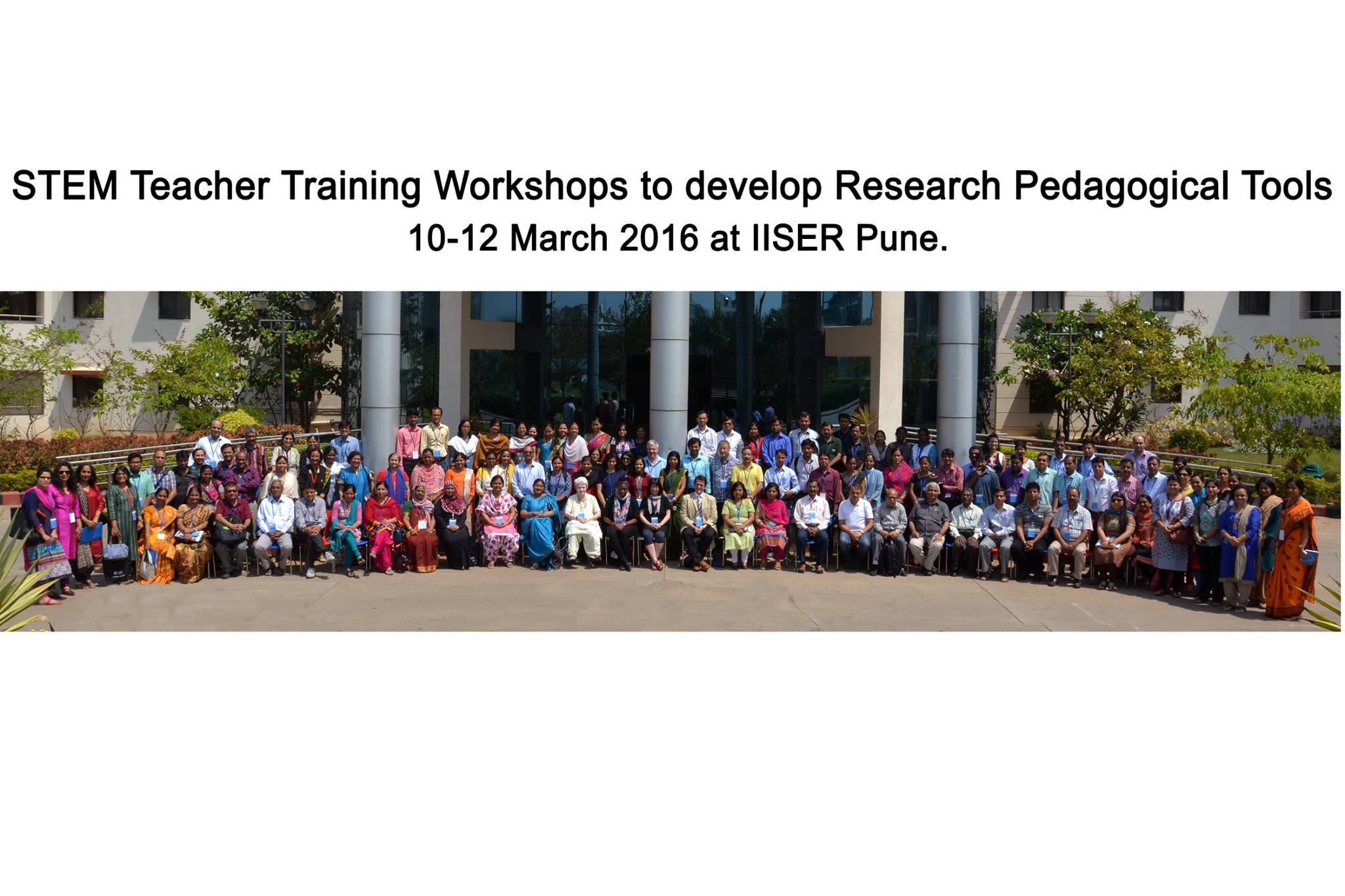
                src="https://cdn.indiabioscience.org/media/articles/Pune-STEM-training-2016.jpg"></a></figure><p>Without knowing the process of discovery, learning science gets reduced to conglomeration of facts, that may or may not seem connected. Most first year undergraduate biology students will faithfully recite the three tenets when asked about Cell Theory; but few would have any idea how it was developed. However, supplementing classroom teaching with an online resource like <a href="http://ed.ted.com/lessons/the-wacky-history-of-cell-theory">"the wacky history of cell theory"</a> video can help the students appreciate the incremental developments that led to the theory that is the foundation of Cell Biology.</p><p>In an attempt to bridge the gap between science that is taught and the way it is done, <a href="https://indiabioscience.org/orgs/iiser-pune" target="_blank">Indian Institute of Science Education and Research, Pune</a> (IISER Pune) in collaboration with <a href="https://indiabioscience.org/orgs/bc">British Council of India</a>, organised a workshop at their campus entitled “STEM Teacher Training workshop to develop research-based pedagogical tools” for undergraduate science faculty, from 10-12 March 2016. Invited from <a href="https://indiabioscience.org/orgs/dbt">DBT Star Colleges</a> across India, the participants were either administrators or faculty from various science streams.</p><p>In describing the objectives behind organising this workshop, <a href="https://indiabioscience.org/authors/LSShashidhara">L S Shashidhara</a> from IISER Pune said, “the intent was to introduce undergraduate teachers to research-based pedagogy. Many people think that the concept involves students doing research projects. But that is not so. It is about educating students about research methods used in their respective disciplines to produce new knowledge. We believe that knowing so will make it easier for them to understand textbook-based knowledge. Otherwise they cannot understand the context of the information that they are provided. This context comes only when they know how research is practiced. That’s what this workshop was all about.” </p><p>The title “research based pedagogical tools” alludes to incorporating elements of research in science taught in the classroom: it is question-driven. The question in turn arises from basic/background knowledge on the topic at hand, that students already have. In the process, not only is the syllabus covered, but students also develop soft skills (critical thinking, logical reasoning, working in teams, etc.) that will serve them well into their future, in any career of their choice.</p><p>Inquiry-based or problem-based learning was not new to this group,so expectations at the beginning of the three-day workshop were a mixed bag—some people were unclear on what else they could learn about a teaching method they already practice. The first day of the workshop included brief presentations by subject experts from Sheffield Hallam University, UK, in applying research-based pedagogy: Gareth Price and Julie Jordan in Biology, Pete Sides in Mathematics, John Walker in Chemistry and Diana Bracewell in Physics. The initial presentations were designed to give participants the idea of the different parts to a research-based teaching technique, with the intent that being able to recognise these components would enable teachers to incorporate them in their classes. Over the course of the workshop, through multiple sessions, teachers from different colleges, working in groups developed examples of subject-specific exercises that can be incorporated in class. These were presented as posters on the last (third) day of the workshop. “The enthusiasm of the teachers who participated was striking. Even though they were familiar with inquiry-based teaching, they have been very receptive towards using research-based pedagogy”, says Manjula Rao from the British Council.</p><p>From his experience, Gareth Price shared in his opening presentation, “students are good at giving teachers answers they want to hear, without changing their own ideas”. To actually change their view of the world, to ensure learning has taken place, requires that a teacher’s “toolbox” includes additional techniques besides traditional lecturing. There is also research showing that of the various approaches to student learning, lecturing ranks at the bottom of the rung, with less than 10% retained by students just 3 days after a lecture. Pete Sides, Mathematics instructor from Sheffield Hallam University, shared, “India is not the only culture where lecturing predominates as the teaching method. It’s like that in many countries, and a lot of them are moving away from using that as the principal method.”</p><p>Urmila Kumawat from <a href="https://indiabioscience.org/orgs/b-n-bandodkar-college-of-science-thane">B.N. Bandodkar College of Science, Thane</a>, said “I learnt how to frame a research problem in classroom context. While pursuing our PhDs, we learn how to frame and probe questions for research projects. But doing that in the classroom is a different matter altogether. And this workshop helped a great deal in that respect.” Sangeeta Shetty, from <a href="https://indiabioscience.org/orgs/xaviers">Xavier’s college, Mumbai</a>, shared “I was apprehensive at first since we’re already doing a lot of inquiry-driven teaching in our classes; but at the end now, I feel it’s given more structure to what we already do”. More and more participants accepted the potential, and by the end were even excited about how they could take it further.</p><p><em>Teaching resource related to research-based pedagogy:</em><br /><a href="http://teachcreate.org/">http://teachcreate.org/</a></p>
              ]]></content><category term="teaching" label="Teaching" /><category term="undergraduate" label="Undergraduate" /></entry><entry><title>Challenging teachers to question their own assumptions about students — a conversation with Teri Balser</title><link
                  rel="alternate"
                  href="https://indiabioscience.org/columns/education/challenging-teachers-to-question-their-own-assumptions-about-students-a-conversation-with-teri-balser"
                  type="text/html"
                  /><summary type="html"><![CDATA[
                <p>The education model of teachers as “providers of content” is outdated; it is time to enlist the help of students in their own learning, says Teri Balser, Dean of Teaching and Learning for the Faculty of Science and Engineering at Curtin University, Perth, Australia.</p>              ]]></summary><id>tag:indiabioscience.org,2016-03-24:/columns/education/challenging-teachers-to-question-their-own-assumptions-about-students-a-conversation-with-teri-balser</id><published>2016-03-24T11:00:00+05:30</published><updated>2019-05-09T21:57:52+05:30</updated><author><name>Reeteka Sud</name><uri>https://indiabioscience.org/authors/reeteka</uri></author><content type="html"><![CDATA[
                
<p>Professor Teri Balser is Dean of Teaching and Learning for the Faculty of Science and Engineering at Curtin University, Perth, Australia. She is also a Co-founder of the <a href="https://saber-biologyeducationresearch.wikispaces.com/">Society for Advancement of Biology Education Research</a> (SABER). Prior to her current appointment, she was awarded the <a href="http://www.usief.org.in/US-Fulbright-Nehru-Distinguished-Chair-Fellowships.aspx">Fulbright-Nehru Distinguished Chair Fellowship</a> while she was the Dean of the College of Agricultural and Life Sciences at the University of Florida. She worked in India for four months, with IIT Madras as her host institute. During this time, she also visited NCBS, Bangalore, where she <a href="https://indiabioscience.org/videos/education">talked with audience about innovative teaching techniques</a>.</p><figure><a href="https://indiabioscience.org/columns/education/challenging-teachers-to-question-their-own-assumptions-about-students-a-conversation-with-teri-balser"><img
                width="1280"
                height="720"
                style="max-width: 100%; height: auto"
                src="https://cdn.indiabioscience.org/media/articles/art_edu_mar2016_Teri_interview.jpg"></a></figure><p><strong>What led you to choose India as your destination for the Fulbright Fellowship?<br /></strong>While I was at the University of Wisconsin, I met Anil Kumar Challa, who was a Postdoctoral Fellow there at the time. Some time later, he invited me for the <a href="https://indiabioscience.org/columns/education/national-workshop-for-undergraduate-biology-teachers">National Undergraduate Teachers Conference</a> he was organising in Pune in 2012. On that trip, I was struck by how much interest there is among Indian teachers in new learning and teaching techniques. So, when applying for a Fullbright, it seemed an obvious choice for me to come back to India.</p><p><strong>What are your impressions about India?</strong><br />I am astounded by so much diversity that is here, so much contrast! Everything seems to exist on a spectrum of extremes, things changing and yet not changing at the same time. I am so touched by the passion of the people here, that is so hard to put in words. Something about India that I haven’t seen anywhere is the way of thinking about “people first”.<br /><br /><strong>Specifically with reference to the Indian education system, what have you observed?</strong><br />The sheer size of India—the enormous number of people that need to be educated—is daunting. College-going population is on the decline in US, but their numbers are on the rise here. The challenge of educating students from such diverse social and economic strata, is enormous. Governments need to recognise that the education needs of someone who is barely above poverty level are going to be different from someone who is from the middle class—this dissension is greater here than anywhere else, from what I have seen. These differences need to be taken into account for “education for everybody”— type of programs that administrations roll out. I am not seeing this recognition just yet.<br />My focus is on higher education, and in this specific realm, I am really struck by the commitment and dedication of teachers to their students. I see a lot of recognition in current faculty that the present system needs changing; though not everyone is sure how to go about it.</p><p><strong>Could you give us a specific example? </strong><br />Sure. One of the biggest problems when changing anything is trying to change too much too quickly. I see faculty being asked to implement all these newer techniques, something they have no training in doing. Active learning techniques are valuable, of course. But a sudden switch can backfire on so many levels. So let’s look at why we need to implement active learning—because it engages students, helps them learn better and helps them learn more. That is our goal. Instead of jumping right into new things, let’s look at lecturing itself — how can we make lecturing better. Classroom lecturing can be active too, even in a large class. One of the simplest ways is “Stop-Ask-Listen”. Or just “Stop”, take breaks during lecture. Lecturing itself is not evil, but continually lecturing for the entire duration of the class will not help.</p><p><strong>For any of the learning techniques to be effective, teachers have to be able to trust students (and vice-versa). What have you observed in this regard in Indian teachers?</strong><br />One of the things I frequently do is to challenge teachers to, in turn, challenge their assumptions about students. A very common belief is that they don't want to learn. I really do believe that it is just the opposite. They don’t learn the way we learned. [If] We set up a learning environment properly, the students will respond. What that will take is developing trust with students. Specially in a culture like India’s, where you don’t question authority, students need to be led to the point that they learn to question in the classroom. They have to be able to see that is ok for them to question, to challenge something. But the professor has to allow that, has to be ok with that. And the students will come to see that they are not punished for questioning/challenging. It doesn’t have to take a long time to get there as a class. It will require that the teacher uses the time at the beginning of the semester to build trust with students, before diving head-first into the syllabus. </p><p><strong>How does that translate to an individual undergraduate class?</strong><br />It is important that as teachers, we sequence the semester properly. Take class content for instance—we can’t lecture on advanced-level content before we do basics. The same principle applies to learning techniques. For students used to very specific, detailed instructions on doing assignments (most are), I would start the semester that way. And then through the semester, progressively reduce details on how much instruction I give them. That is what I mean by “sequence”. We have to think not only in terms of content we teach them, but also “what are they going to be able to do” by a certain point into the semester. Think about how a student will develop through the semester.</p><p><strong>In general when you try to change something, you encounter resistance. For all its benefits, active learning demands more of students too. When they resist, how can a teacher tell if that is because they are doing something different, or if the students are really in over their heads?</strong><br />One of the things I talk about in my workshops on active learning is the “spectrum of perceived risk by students”. Their willingness to do something the teacher asks of them has a lot more to do with “risk” than “effort”. What the students perceive as risky can very well be different from what the teacher perceives as risky. For instance, if you ask a faculty member (a trained professional with a PhD) to form and state their opinion on something, it is not risky to them. It is what they are trained to do. But if you ask a student to do that, it is not the same. To the student, this may be perceived as ‘highly risky’. So, if students perceive an active learning approach as risky, they are likely to resist, because they probably feel “I don’t know how this is going to affect me; what about my grades; what if my classmates think I am stupid”, etc. Teachers can misinterpret this resistance as laziness, or apathy, on the part of the students. But it’s hardly that! What the teachers can do is to create a safe learning environment in their classes, so students come to see that what you are trying to do is really ok. Asking students to raise their hands is one example of a low-risk technique, as is asking them to write a ‘1-minute paper’ (asking students to write one sentence each on what they did, and did not, understand during the class; teacher collects the responses at the end of the class).</p><p><strong>Teachers at any level face the challenge of having to cover too much syllabus content during the academic year. How can they promote active learning, and keep it from it becoming all about covering syllabus?</strong><br />What it comes down to, is this misconception about what the role of the teacher is—it is not the teacher’s job to provide content. Teachers have to be able to take this leap of faith! The teacher’s job is to get the students to manage content—get them curious about it, get them interested in it. Because when the students get curious, they will figure out where to get content. In this age of internet, that is not hard for them to do. For this same reason, there is so much information, so much content generated so fast, that teachers can’t keep up as “providers of the content” anyway.<br /> As a teacher, if I think it’s my job to stuff the ever-increasing syllabus content into the heads of students, it is going to be frustrating. But if I think it’s my job to enlist the students into a collaborative [learning] process that is for their own good—that’s a very different mindset. If it were me that’s faced with the giant syllabus; at the first day of class, I would level with the students: “this syllabus is our challenge; not just mine, not yours; but ours! Here is this giant syllabus, here is a copy of the exam that you’re going to have to take at the end, and we only have x number of class-hours to get you from point A to point B. Let us figure out how we are going to do this”. And that is putting some of the ownership, some of the responsibility for their own learning, on the students. They could very well resist at first—they are used to other people doing things for them. But then, they are the ones who are going to need to do a job after passing their tests.</p><p><strong>What would your message be to a science teacher in a high school? In a college?</strong><br />To the high school teachers, I would say help students prepare for what college is going to be like - start to challenge them with unstructured questions. You are doing a great job providing content, but the students are going to need more than content to be successful in college, and in later life. <br />For college teachers, I would say they should not repress questioning by students. In fact, this applies to both high school and college teachers—let the students ask good questions. Not just “can you repeat what you said”, but real questions, like “how do we know ….; or where did … come from; or what is the significance of …”. We can do this even while helping them prepare for standardised tests.<br /> I ask that each teacher find his/her own style through which they can enlist the students’ help in their own learning. In some form, teachers have to be able to do this. If for no other reason than to realise that the world is different now from when they were students. Students are different now. We can blame the students, call them lazy or unmotivated. But just because we are old does not mean we are right! What if the students are motivated and we are not giving them credit?</p>
              ]]></content><category term="teaching" label="Teaching" /><category term="undergraduate" label="Undergraduate" /><category term="advice" label="Advice" /></entry><entry><title>Teri Balser on current state of higher education: “the problem isn’t one of motivation, but of misalignment”</title><link
                  rel="alternate"
                  href="https://indiabioscience.org/columns/education/teri-balser-on-current-state-of-higher-education-the-problem-isnt-one-of-motivation-but-of-misalignment"
                  type="text/html"
                  /><summary type="html"><![CDATA[
                <p>Teri Balser conducted a two-day workshop at NCBS, Bangalore, where she talked with participants on the perceived problems and opportunities in higher education.</p>              ]]></summary><id>tag:indiabioscience.org,2016-03-11:/columns/education/teri-balser-on-current-state-of-higher-education-the-problem-isnt-one-of-motivation-but-of-misalignment</id><published>2016-03-11T11:27:00+05:30</published><updated>2019-05-09T21:57:52+05:30</updated><author><name>Reeteka Sud</name><uri>https://indiabioscience.org/authors/reeteka</uri></author><content type="html"><![CDATA[
                
<p>A renewed outlook on the role of teacher in the classroom—not as a subject expert, but rather as a “more experienced learner”.</p><figure><a href="https://indiabioscience.org/columns/education/teri-balser-on-current-state-of-higher-education-the-problem-isnt-one-of-motivation-but-of-misalignment"><img
                width="4608"
                height="2592"
                style="max-width: 100%; height: auto"
                src="https://cdn.indiabioscience.org/media/articles/Art_Edu_Mar2016_TeriBalser.JPG"></a></figure><p>“I once asked a group of students where they would go when they wanted to learn something. One of them quipped—certainly not the classroom.” Teri Balser, Dean of Teaching and Learning for the Faculty of Science and Engineering at Curtin University (Perth, Australia), shared this with audience at the <a href="https://indiabioscience.org/orgs/ncbs" target="_blank">National Centre for Biological Sciences</a> (NCBS) in a workshop organised by IndiaBioscience, echoing sentiments felt widely among educators: there may be a whole lot of teaching going on in our classrooms, but not a whole lot of learning.</p><p>While this is commonly ascribed to a lack of motivation on the part of the students, this might not be the case. Firstly, there is the not-so-trivial question of how to motivate students in the classroom. Teri Balser summed it this way for teachers: how would I teach differently if I thought that my students actually wanted to learn? When appropriately challenged, students often surpass instructor’s expectations. For one of the assignments in a Soil Ecology class that Balser had taught at the University of Florida, students wrote biology lyrics, based on music to a popular song. Today this <a href="https://www.youtube.com/watch?v=hBuETFOu8mA" target="_blank">Endospore song</a> has had more than 17,000 views on YouTube. She also started a course titled “<a href="http://challenge2050.ifas.ufl.edu/wp-content/uploads/2013/10/HUF-Course-Overview-2013.pdf" target="_blank">Humanity’s 2050 challenge</a>”, which required students to brainstorm together to solve real challenges for real people, and use their classroom knowledge in the process.</p><p>Teachers today will be <a href="https://www.youtube.com/watch?v=YmwwrGV_aiE" target="_blank">preparing students for jobs that don’t yet exist, for using technologies that haven’t been invented, and in order to solve problems we don’t know are problems yet.</a> Lecturing alone cannot achieve this. So why do it? Because it is what we know. And before the information explosion of the internet age, lecturing used to be necessary, as the linear transmission from the teacher (or the textbook) was how students learned. But now, with information available in multiple media, the role of a teacher evident in the classroom must transform, from content-provider to one that gives framework to syllabus content.</p><p> During her two-day workshop, the participants, who were largely postdoctoral fellows and graduate students at NCBS and inStem with an acute interest in a teaching career, were introduced to a renewed outlook on the role of teacher in the classroom—not as a subject expert, but rather as a “more experienced learner”. The workshop started with thought-provoking questions to the participants: what makes someone good at teaching? Balser went on to discuss that great teachers are accomplished in four domains: curation, oration, facilitation and evaluation. The workshop included an exercise for participants, to practice curation, specifically selection of content: what are the factors to consider while selecting content for a class? Several options are available for teachers; one that she shared with participants was to evaluate choices for content on a scale of “must know, important to know, and good to know”. She advised that teachers should actively devise learning outcomes for students, along the lines of “After this class, my students should be able to …..”. </p><p>A significant proportion of discussion time during the workshop was spent on ways to improve the lecturing system, by making the lectures ‘active’: for instance, asking students to write a one-minute paper (in one minute, students write one sentence each on what they did and did not understand in the class), on-the-spot discussions between students sitting together (students are asked to turn to their neighbours and discuss class topic), group assignments, case studies, etc. Teri Balser encouraged participants to incorporate any of these measures as they see fit. “It [choice of method] doesn’t have to be complicated, almost anything that focuses student attention and makes them think is effective.” Teri Balser’s slides for this workshop can be viewed <a href="https://indiabioscience.org/videos/education/teaching101-teri-balsers-workshop-at-ncbs-bangalore" target="_blank">here</a>.</p><p>Recognising that teachers cannot create, but they surely can influence interest, part of the workshop also included information on how teachers can create classroom environments conducive to student learning. Seemingly small things can go a long way to that effect. For instance, being cognisant of the attention span of students, teachers can “stop [lecturing] part way through class, ask [students], and listen [to their feedback, concerns]. Teri cautioned participants to not use questions such as “Does anyone have a question?” In general, yes/no questions are not helpful tools for teachers. Rather, ask open-ended questions that can yield insight into what students are actually understanding. She also advised participants to not point at students when calling on them, but use an open-palm gesture which is less threatening and more inviting. Throughout the workshop, she modeled these behaviours herself. </p><p>“This workshop enforced the belief in me that good teaching and mentorship can make a major difference to students’ lives and that it is worth making that effort. ..Good teaching also helps teach people the importance of working together instead of competing against each other”, commented Lena Robra, one of graduate students at NCBS. Gnaneshwar Yadav, currently a postdoctoral fellow, was struck by the many ways, and simple ways, that can be used to draw students out in classroom learning. “This workshop helped in knowing how to effectively translate what is taught to what is learnt by a student.”</p><p>The workshop concluded on a hopeful note for all participants: “you’re never done learning to be a teacher”.<br /></p><p><em>Listen to Teri Balser's talk at NCBS <a href="https://indiabioscience.org/education/teaching-as-if-learning-mattered-teri-balser" target="_blank">here</a>.</em></p>
              ]]></content><category term="teaching" label="Teaching" /><category term="mentorship" label="Mentorship" /></entry><entry><title>Bacteriophages: Beacon of hope amidst the sea of superbugs</title><link
                  rel="alternate"
                  href="https://indiabioscience.org/columns/education/bacteriophages-beacon-of-hope-amidst-the-sea-of-superbugs"
                  type="text/html"
                  /><summary type="html"><![CDATA[
                <p>2015 was the year of the phage—it marked the 100th anniversary of the discovery of the phage. Urmi Bajpai talks about her induction into the phage community and proposes that activities and simple experiments around phages should be included in school and college curricula.</p>              ]]></summary><id>tag:indiabioscience.org,2016-01-18:/columns/education/bacteriophages-beacon-of-hope-amidst-the-sea-of-superbugs</id><published>2016-01-18T12:18:03+05:30</published><updated>2019-05-09T21:57:50+05:30</updated><author><name>Urmi Bajpai</name><uri>https://indiabioscience.org/authors/UrmiBajpai</uri></author><content type="html"><![CDATA[
                
<p>A call to collectively explore local phages, both as a means to develop and strengthen the culture of discovery-based science, and to collectively create repositories of local phages.</p><figure><a href="https://indiabioscience.org/columns/education/bacteriophages-beacon-of-hope-amidst-the-sea-of-superbugs"><img
                width="1500"
                height="844"
                style="max-width: 100%; height: auto"
                src="https://cdn.indiabioscience.org/media/articles/art_edu_jan2016_phagelab.JPG"></a></figure><p>After the discovery of the magic drugs called antibiotics in the early 1940s and for various other reasons that were not in the best interest of pharmaceutical companies, interest in bacteriophages as therapeutic agents against bacterial infections declined globally (but for in a few east European countries and the erstwhile Soviet Union). Now, several decades later, the euphoria is subsiding and we are witnessing the emergence of antibiotic-resistant bacteria as a serious threat. This scenario has stimulated interest in finding alternative strategies for fighting infections and the forgotten phages have the potential for a comeback. They are found in big numbers (ten for one bacterium), have huge genetic diversity, are extremely specific for their host, and safe for humans but are largely unexplored, waiting to be discovered in proportion to their abundance in nature and be of service. As of now, limited work is being done in India. Concerted effort is required to bring together research groups in the country to explore and tap the potential of local phages.</p><p>My first brush with the bacteriophages from natural resources happened in summer of 2012. It was at a ‘HHMI funded Phage Hunter Workshop’, organiszed primarily for school teachers by Graham Hatfull, a professor at the University of Pittsburgh, USA, which has served as an exemplary model for introducing research at school level. Anil Challa, then a postdoctoral fellow at the University of Wisconsin and now an instructor at the University of Alabama, had urged me to attend the same. I agreed but honestly wasn’t too inclined. Phages were in no way related to my research interests then, neither had I any plans to include them in my quest for finding new anti-mycobacterial drugs (through a CSIR-OSDD funded research project, we are trying to find novel drugs that target multiple enzymes involved in the synthesis of Muramic acid in <em>M. tuberculosis</em>).</p><p>We were asked by the organisers to bring along soil samples and I randomly collected them from New York and New Jersey, noted GPS location of the sites and headed to my first potential meeting with the phages.</p><p>Each of the participants was trained to test their soil samples for the presence of mycobacteriophages, using <em>M. smegmatis</em> Mc<sup>2</sup>155 as the host. It takes about two days for plaques to appear on the culture plate and so on the day 3, we were told by the very energetic instructor, Debbie, to observe the incubated plates for the presence of plaques, if any. And, to the dismay of all the participants but for the writer of this piece, no one found a phage (out of a total of about 60 samples) while there were three types of mycobacteriophages, as evident by different morphology of the plaques, spotted on my plates. Suddenly, a quiet lab atmosphere turned into a sort of jubilation and I was being addressed as the ‘girl who got phages’. Until now, I was just going through the motions, following instructions mechanically, but seeing those plaques and the TEM images of the purified phages, it was love at first sight (yes, they had to show up on my plates, I wouldn’t fall for images in text books or journals!) </p><p>This experience was indeed impactful and spawned into various activities around phages in my own lab. After a period of lull and a few hiccups, in the following academic semester, ‘isolation of mycobacteriophages from soil/water samples’ was included in lab experiments for B.Sc. (Hons) Biomedical Science students. Furthermore, I conducted one winter project and two summer projects for ten students each, supported by the ELITE fellowship program of the college, which provides a stipend to students who take up summer projects. Here, another faculty member from the department also joined in. In the past couple of years, we have been able to isolate a good number of lytic mycobacteriophages and interestingly some of them have been found to infect pathogenic <em>M. tuberculosis</em> as well, which is usually the challenging part. The discovered phages are submitted by the students to a database on mycobacteriophages, maintained by the University of Pittsburgh. Currently, a team consisting of TATA-CSIR-OSDD fellows (TCOFs) and the undergraduate students are screening a large number of samples, annotating the genome of discovered phages, followed by purification, characterisation and assay of a few proteins. We are particularly interested in Endolysins, enzymes produced by bacteriophages in order to cleave the host's cell wall, and in regulatory proteins and sequences from these local mycobacteriophages. </p><p>Engaging undergraduates (and school students) in such research activities is another encouraging example of crowdsourcing for building data and repositories. This approach is not only cost effective but also trains a large number of students in the process. The time and energy the students spend in carrying out lab classes and on random and often redundant short-term projects could be channelized in creating resources with downstream applications. My proposition is: how about such simple experiments be included in various schools and colleges across the country? It would not only develop and strengthen the culture of discovery-based science, but gradually and collectively create repositories of local phages. This build-up exercise can yield useful findings given huge genetic diversity found in phages and their potential in offering solutions as anti-bacterials, in diagnosis of infectious organisms, in food industry, for treatment of waste-water and many more such applications. There are various research groups in the country who are already carrying out application based work on bacteriophages against <em>Staphylococcus</em> bacteria, enteric bacteria, biofilms of<em> Pseudomonas</em>, to name a few. The well known Ganga water project is another.</p><p>So, from someone who casually collected soil samples and half-heartedly participated in the workshop, here is a convert whose eyes are forever looking for a suitable spot to collect samples where phages could be found lurking, whatever the region, the landscape may be. All my acquaintances have been pestered at least once to get samples from their travels. I hope this enthusiasm gets infectious and eventually translates into strategies for managing infectious diseases caused by the superbugs in times to come. Though it’s still a long way to go, the phage community hopes that the momentum continues to build. </p><p><em>Acknowledgements:<br /></em><em>I acknowledge the support received for this work from CSIR-OSDD grant, TATA-CSIR-OSDD fellowships and ELITE fellowships for the undergraduates, granted by <a href="https://indiabioscience.org/orgs/andc" target="_blank">Acharya Narendra Dev College</a>.</em></p>
              ]]></content><category term="health-and-medicine" label="Health &amp; Medicine" /><category term="microbiology" label="Microbiology" /><category term="molecular-biology" label="Molecular Biology" /><category term="teaching" label="Teaching" /><category term="personal-experience" label="Personal Experience" /><category term="undergraduate" label="Undergraduate" /></entry></feed>