<?xml version="1.0" encoding="UTF-8"?><feed xmlns="http://www.w3.org/2005/Atom" xml:lang="en"><title>IndiaBioscience - Events in 2026</title><link
    rel="alternate"
    href="https://indiabioscience.org/events/2026"
    type="text/html"
    /><link
    rel="self"
    href="https://indiabioscience.org/events/2026/feed"
    type="application/atom+xml"
    /><id>https://indiabioscience.org/events/2026/feed</id><updated>2026-06-22T19:12:55+05:30</updated><entry><title>EMBO | IndiaBioscience Online Course on Fundamentals of Communication: Pitches, Posters and Presentations</title><link
                  rel="alternate"
                  href="https://indiabioscience.org/events/embo-indiabioscience-online-course-on-fundamentals-of-communication-pitches-posters-and-presentations"
                  type="text/html"
                  /><summary type="html"><![CDATA[
                
<em>
  Other
</em>
from
<time>
  07 September
</time>
  to
  <time>
    11 September 2026
  </time>
at
Online.
              ]]></summary><id>tag:indiabioscience.org,2026-06-22:/events/embo-indiabioscience-online-course-on-fundamentals-of-communication-pitches-posters-and-presentations</id><published>2026-06-22T17:17:00+05:30</published><updated>2026-06-22T17:17:17+05:30</updated><content type="html"><![CDATA[
                
<dl><dt>
    Date
  </dt><dd><time datetime="2026-09-07">
      September 07</time><time datetime="2026-09-11">-11, 2026
      </time></dd><dt>
      Location
    </dt><dd>
      Online
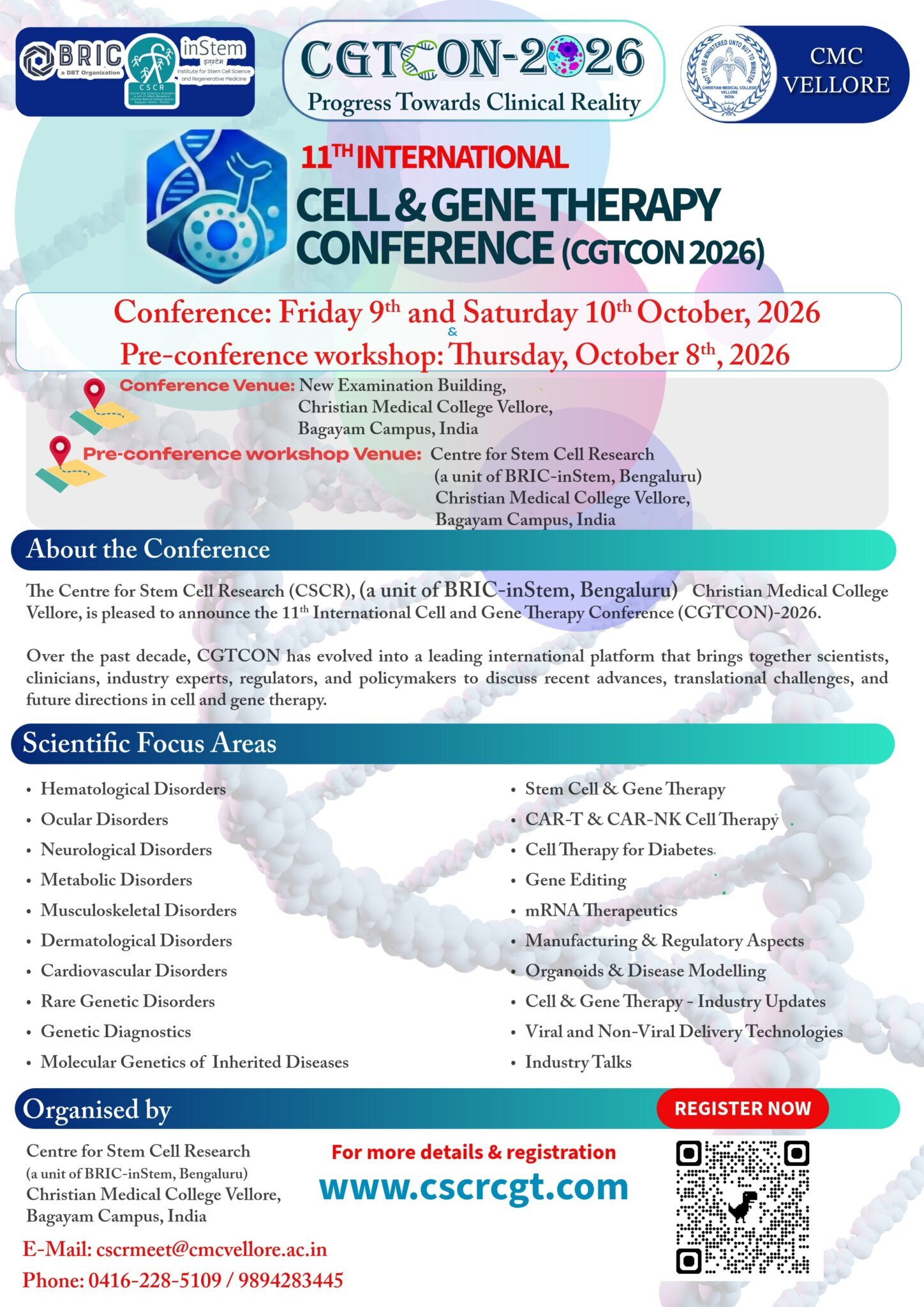
    </dd></dl><p>This interactive course will help participants strengthen essential scientific communication skills, including storytelling, slide and poster design, visual clarity, and effective research presentations.</p><p>Curated by Laura Moro-Martín, the course combines interactive learning with practical exercises and structured feedback sessions based on participants’ own presentations. </p><figure><img src="https://cdn.indiabioscience.org/media/yim/EMBO-IndiaBioscience-Online-Course-template-1.png" data-image="845910"></figure>
              ]]></content><category term="other" label="Other" /><category term="online" label="Online" /></entry><entry><title>Next-Generation Drug Discovery: Network Pharmacology, Docking and Zebrafish Models</title><link
                  rel="alternate"
                  href="https://indiabioscience.org/events/next-generation-drug-discovery-network-pharmacology-docking-and-zebrafish-models"
                  type="text/html"
                  /><summary type="html"><![CDATA[
                
<em>
  Workshop
</em>
from
<time>
  16 July
</time>
  to
  <time>
    18 July 2026
  </time>
at
Chennai.
              ]]></summary><id>tag:indiabioscience.org,2026-06-19:/events/next-generation-drug-discovery-network-pharmacology-docking-and-zebrafish-models</id><published>2026-06-19T14:51:00+05:30</published><updated>2026-06-19T14:51:41+05:30</updated><content type="html"><![CDATA[
                
<dl><dt>
    Date
  </dt><dd><time datetime="2026-07-16">
      July 16</time><time datetime="2026-07-18">-18, 2026
      </time></dd><dt>
      Location
    </dt><dd>
      Chennai, Tamil Nadu
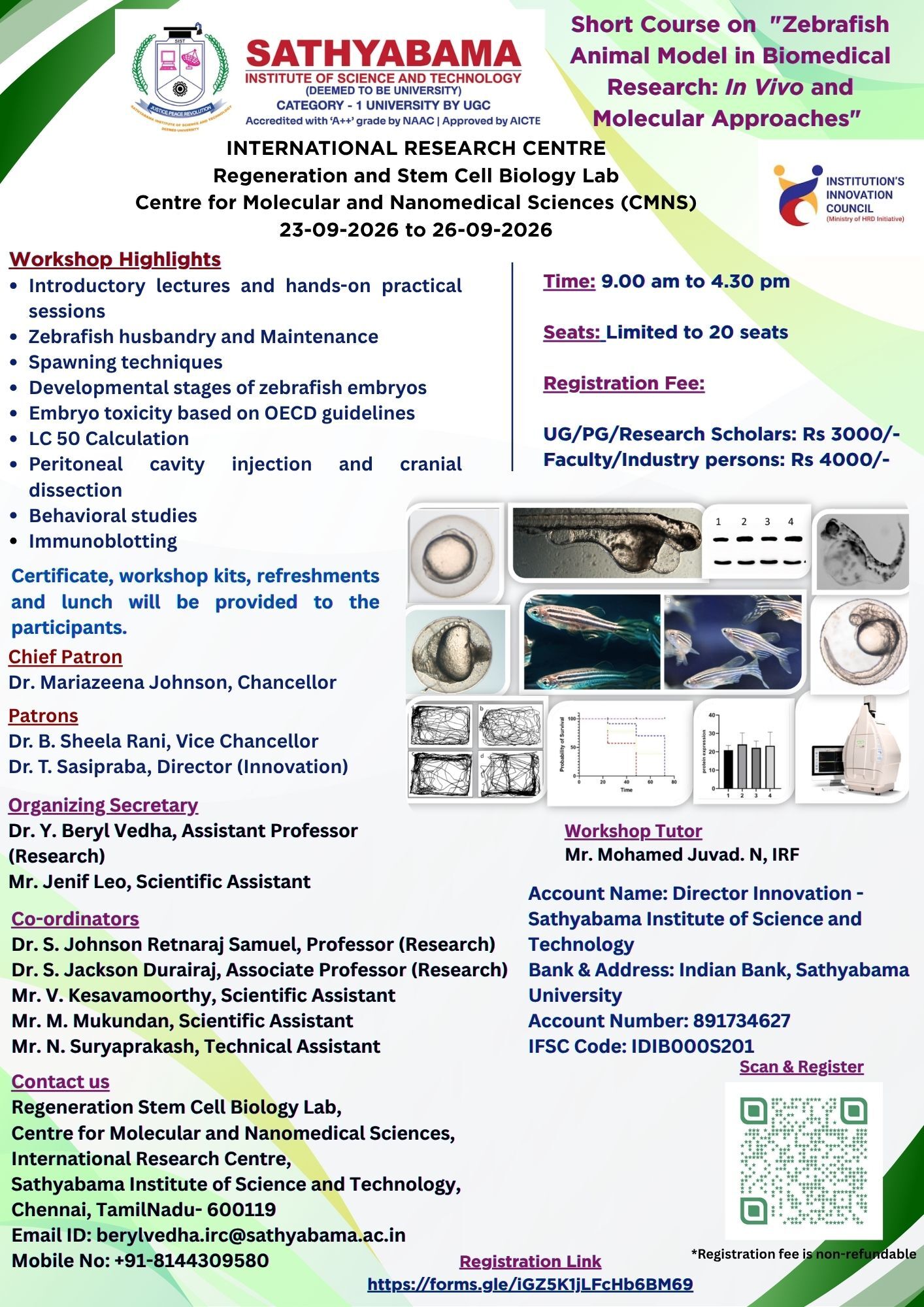
    </dd></dl><p>Sathyabama Institute of Science and Technology is organising Three-day online workshop on "Next-Generation Drug Discovery: Network Pharmacology, Docking and Zebrafish Models" from 16th to 18th July 2026 at 'International Research Center of Sathyabama Institute of Science and Technology, Chennai through online mode.<br /><br />This training is ideal for UG/PG students, research scholars, faculty, and industry professionals who wish to explore in silico computational analyses and Zebrafish models in their research.</p><p>Workshop highlights:<br />• Database introduction and compound selection, ADME/toxicity profiling<br />• Target identification, PPI network construction, STRING and Cytoscape<br />• Gene ontology and functional enrichment, molecular docking and visualization<br />• Introduction to zebrafish as a model, developmental stages, embryo toxicity, and survival analysis</p><figure><img src="https://cdn.indiabioscience.org/media/yim/Next-Gen-Drug-Discovery-Online-July-2026.jpeg" data-image="845898"></figure>
              ]]></content><category term="workshop" label="Workshop" /><category term="chennai" label="Chennai" /></entry><entry><title>Recent Advances in Fermentation Technology and Instrumentation Techniques</title><link
                  rel="alternate"
                  href="https://indiabioscience.org/events/recent-advances-in-fermentation-technology-and-instrumentation-techniques"
                  type="text/html"
                  /><summary type="html"><![CDATA[
                
<em>
  Workshop
</em>
from
<time>
  03 July
</time>
  to
  <time>
    04 July 2026
  </time>
at
Chennai.
              ]]></summary><id>tag:indiabioscience.org,2026-06-19:/events/recent-advances-in-fermentation-technology-and-instrumentation-techniques</id><published>2026-06-19T14:48:00+05:30</published><updated>2026-06-19T15:39:04+05:30</updated><content type="html"><![CDATA[
                
<dl><dt>
    Date
  </dt><dd><time datetime="2026-07-03">
      July 03</time><time datetime="2026-07-04">-04, 2026
      </time></dd><dt>
      Location
    </dt><dd>
      Chennai, Tamil Nadu
    </dd></dl><figure><img src="https://cdn.indiabioscience.org/media/yim/July-3-4-workshop-Bro_page-0001.jpg" data-image="845895"></figure>
              ]]></content><category term="workshop" label="Workshop" /><category term="chennai" label="Chennai" /></entry><entry><title>VESICON 2026 – Annual International Conference on Extracellular Vesicles and Translational Medicine</title><link
                  rel="alternate"
                  href="https://indiabioscience.org/events/vesicon-2026-annual-international-conference-on-extracellular-vesicles-and-translational-medicine"
                  type="text/html"
                  /><summary type="html"><![CDATA[
                
<em>
  Conference
</em>
on
<time>
  05 October 2026
</time>
at
New Delhi.
              ]]></summary><id>tag:indiabioscience.org,2026-06-09:/events/vesicon-2026-annual-international-conference-on-extracellular-vesicles-and-translational-medicine</id><published>2026-06-09T14:42:00+05:30</published><updated>2026-06-09T14:42:59+05:30</updated><content type="html"><![CDATA[
                
<dl><dt>
    Date
  </dt><dd><time datetime="2026-10-05">
      October 05, 2026</time></dd><dt>
      Location
    </dt><dd>
      New Delhi, Delhi &amp; NCR
    </dd><dt>Website</dt><dd><a
        href="https://www.vesicon2026.com">
        vesicon2026.com &rarr;
      </a></dd></dl><p>VESICON 2026 is an Annual International Conference on Extracellular Vesicles and Translational Medicine, organized at the All India Institute of Medical Sciences (AIIMS), New Delhi. The conference will be held from 5th–7th October 2026, followed by a hands-on post-conference workshop on 8th–9th October 2026.</p><p>Abstract Submission: <a href="https://www.vesicon2026.com/abstract" target="_blank" rel="noreferrer noopener">https://www.vesicon2026.com/ab...</a><br /></p><p>The event aims to bring together scientists, clinicians, faculty members, researchers, industry experts, and young investigators to discuss recent advances in extracellular vesicle biology, biomarkers, diagnostics, therapeutics, drug delivery, regenerative medicine, multi-omics, bioinformatics, neurodegenerative diseases, wound healing, and translational applications of EV research.</p><p>VESICON 2026 will provide a focused platform for scientific exchange through keynote lectures, invited talks, oral and poster presentations, networking opportunities, and practical workshop sessions.</p><figure><img src="https://cdn.indiabioscience.org/media/yim/Vesicon_Poster.png" data-image="845742"></figure>
              ]]></content><category term="conference" label="Conference" /><category term="delhi" label="New Delhi" /></entry><entry><title>Good Cell Culture Practices in Stem Cells</title><link
                  rel="alternate"
                  href="https://indiabioscience.org/events/good-cell-culture-practices-in-stem-cells"
                  type="text/html"
                  /><summary type="html"><![CDATA[
                
<em>
  Workshop
</em>
from
<time>
  01 July
</time>
  to
  <time>
    03 July 2026
  </time>
at
Bengaluru.
              ]]></summary><id>tag:indiabioscience.org,2026-06-08:/events/good-cell-culture-practices-in-stem-cells</id><published>2026-06-08T16:58:00+05:30</published><updated>2026-06-08T16:58:27+05:30</updated><content type="html"><![CDATA[
                
<dl><dt>
    Date
  </dt><dd><time datetime="2026-07-01">
      July 01</time><time datetime="2026-07-03">-03, 2026
      </time></dd><dt>
      Location
    </dt><dd>
      Bengaluru, Karnataka
    </dd><dt>Website</dt><dd><a
        href="https://instem.res.in/events/good-cell-culture-practices-in-stem-cells/">
        instem.res.in/events/good-cell… &rarr;
      </a></dd></dl><p>This is Part I: Good Cell Culture Practices workshop. Completion of Part I is a prerequisite for applying to Part II: Advanced Training in Human Pluripotent Stem Cell Culture.</p><figure><img src="https://cdn.indiabioscience.org/media/yim/GCCP-Workshop-July-1-3-2026-Poster_Final-1-scaled.jpg" data-image="845665"></figure>
              ]]></content><category term="workshop" label="Workshop" /><category term="bengaluru" label="Bengaluru" /></entry><entry><title>Two Weeks Certified Internship Program on CRISPR &amp; Personalized Medicine</title><link
                  rel="alternate"
                  href="https://indiabioscience.org/events/two-weeks-certified-internship-program-on-crispr-personalized-medicine"
                  type="text/html"
                  /><summary type="html"><![CDATA[
                
<em>
  Other
</em>
from
<time>
  16 July
</time>
  to
  <time>
    30 July 2026
  </time>
at
Online.
              ]]></summary><id>tag:indiabioscience.org,2026-06-03:/events/two-weeks-certified-internship-program-on-crispr-personalized-medicine</id><published>2026-06-03T15:03:00+05:30</published><updated>2026-06-03T15:52:45+05:30</updated><content type="html"><![CDATA[
                
<dl><dt>
    Date
  </dt><dd><time datetime="2026-07-16">
      July 16</time><time datetime="2026-07-30">-30, 2026
      </time></dd><dt>
      Location
    </dt><dd>
      Online
    </dd></dl><figure><img src="https://cdn.indiabioscience.org/media/articles/CRISPR-JULY-26.jpg" data-image="841408"></figure>
              ]]></content><category term="other" label="Other" /><category term="online" label="Online" /></entry><entry><title>BioWISE Internship and Scholarship Program – Open Call for UG &amp; PG Cohorts</title><link
                  rel="alternate"
                  href="https://indiabioscience.org/events/biowise-internship-and-scholarship-program-open-call-for-ug-pg-cohorts"
                  type="text/html"
                  /><summary type="html"><![CDATA[
                
<em>
  Other
</em>
from
<time>
  01 September
</time>
  to
  <time>
    01 March 2027
  </time>
at
Bengaluru.
              ]]></summary><id>tag:indiabioscience.org,2026-05-30:/events/biowise-internship-and-scholarship-program-open-call-for-ug-pg-cohorts</id><published>2026-05-30T11:33:00+05:30</published><updated>2026-05-30T11:33:42+05:30</updated><content type="html"><![CDATA[
                
<dl><dt>
    Date
  </dt><dd><time datetime="2026-09-01">
      September 01</time><time datetime="2027-03-01">-March 01, 2027
      </time></dd><dt>
      Location
    </dt><dd>
      Bengaluru, Karnataka
    </dd><dt>Website</dt><dd><a
        href="https://www.bestkc.in/open-calls/">
        bestkc.in/open-calls &rarr;
      </a></dd></dl><p>BioWISE (Bio – Women in STEM Empowered) is a flagship initiative of the BeST – Bengaluru Science and Technology Cluster (an initiative of the Office of PSA, GoI), in collaboration with the Biocon Foundation India (CSR arm of Biocon Biologics) and the National Centre for Biological Sciences (NCBS) as the academic and knowledge partner.</p><p>The programme brings together academia, industry, and government stakeholders to bridge the gap between academic learning and workforce readiness for women in STEM.</p><p>BioWISE aims to strengthen women’s participation in STEM fields by creating meaningful access to research, mentorship, networking, and professional growth opportunities, particularly for students from Tier 2 and Tier 3 institutions across Karnataka.</p><p>BioWISE Undergraduate Internship & Scholarship Programme (UG Cohort)</p><p>Applications are invited from women undergraduate students in Lifesciences disciplines across Karnataka for a 3-month internship and scholarship programme designed to provide:</p><ul><li>Hands-on research exposure</li><li>Scholarship support</li><li>Expert mentorship</li><li>Exposure to leading academic and R&D institutions and industry environments in Bengaluru</li><li>Networking opportunities</li><li>Life skill development</li></ul><p>Eligibility Criteria – UG Cohort</p><ul><li>Female students currently in the final year of UG studies or those who completed their UG degree within the last one year and is currently not enrolled in any academic courses</li><li>Minimum 75% marks or equivalent academic performance</li><li>Commitment to the full 3-month programme duration</li><li>Family annual income generally below ₹6 lakhs</li><li>Students from Tier 2/Tier 3 colleges or universities in Karnataka</li><li>Demonstrated interest in applied research</li><li>First-generation learners will be given preference</li><li>Students pursuing Life Sciences disciplines including B.Sc., B.Tech. in Life Sciences, and allied fields are eligible</li></ul><p>UG Application Link: (<a href="https://forms.gle/smsE6kFhoq3Qm7br8" rel="noopener" target="_blank">https://forms.gle/smsE6kFhoq3Q...</a>)</p><p>BioWISE Postgraduate Internship & Scholarship Programme (PG Cohort)</p><p>Applications are invited from women postgraduate students in Lifesciences disciplines across Karnataka for a 6-month internship and scholarship programme designed to provide:</p><ul><li>Hands-on research exposure</li><li>Scholarship support</li><li>Expert mentorship</li><li>Exposure to leading academic and R&D institutions and industry environments in Bengaluru</li><li>Networking opportunities</li><li>Life skill development</li></ul><p>Eligibility Criteria – PG Cohort</p><ul><li>Female students currently in the final year of Master’s studies or those who completed their Master’s degree within the last one year (MSc/M-Tech - Life Sciences) and is not currently enrolled in any other academic programme</li><li>Minimum 75% marks or equivalent CGPA</li><li>Commitment to the full 6-month programme duration</li><li>Family annual income generally below ₹6 lakhs</li><li>Students from Tier 2/Tier 3 colleges or universities in Karnataka</li><li>Demonstrated interest in applied research</li><li>First-generation learners will be given preference</li><li>Applicants must submit the required self-declaration form for first-generation learner status</li></ul><p>• Students and immediate relatives affiliated with our promoting partners (BIOCON, BeST, or NCBS) are not eligible to apply.</p><p>PG Application Link: (<a href="https://forms.gle/iwQcKeUBB1n8Jze17" rel="noopener" target="_blank">https://forms.gle/iwQcKeUBB1n8...</a>)<br></p><figure><img src="https://cdn.indiabioscience.org/media/yim/Application-call-12.png" data-image="841325"></figure><p><br></p><p><br></p>
              ]]></content><category term="other" label="Other" /><category term="bengaluru" label="Bengaluru" /></entry><entry><title>EMBO | IndiaBioscience Online Course on Writing Successful Fellowship Applications</title><link
                  rel="alternate"
                  href="https://indiabioscience.org/events/embo-indiabioscience-online-course-on-writing-successful-fellowship-applications"
                  type="text/html"
                  /><summary type="html"><![CDATA[
                
<em>
  Other
</em>
from
<time>
  22 July
</time>
  to
  <time>
    24 July 2026
  </time>
at
Online.
              ]]></summary><id>tag:indiabioscience.org,2026-05-27:/events/embo-indiabioscience-online-course-on-writing-successful-fellowship-applications</id><published>2026-05-27T14:34:00+05:30</published><updated>2026-05-27T16:14:30+05:30</updated><content type="html"><![CDATA[
                
<dl><dt>
    Date
  </dt><dd><time datetime="2026-07-22">
      July 22</time><time datetime="2026-07-24">-24, 2026
      </time></dd><dt>
      Location
    </dt><dd>
      Online
    </dd><dt>Website</dt><dd><a
        href="https://meetings.embo.org/event/writing-successful-fellowship-applications-1">
        meetings.embo.org/event/writin… &rarr;
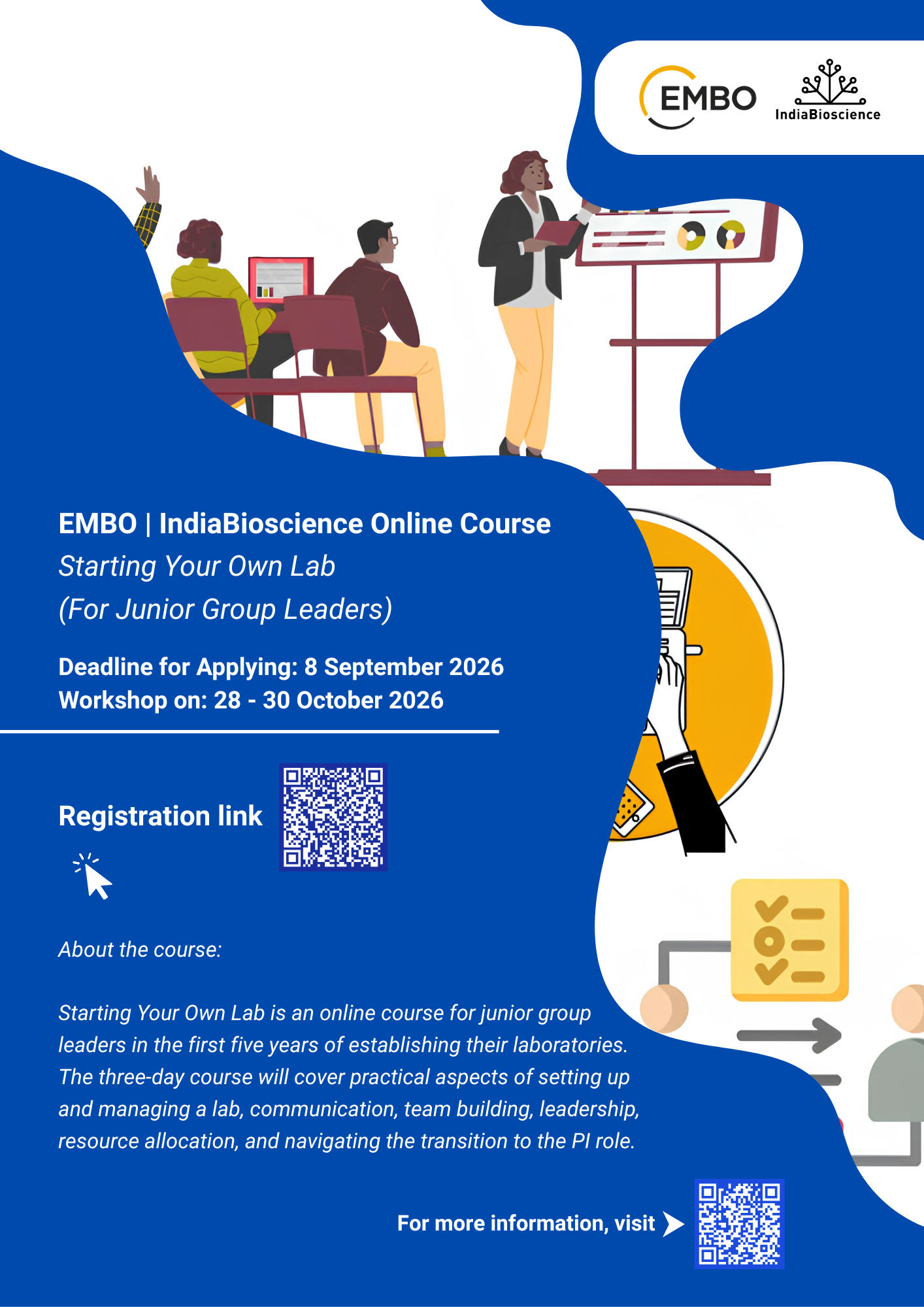
      </a></dd></dl><p>The upcoming online course on fellowship applications, jointly organised by <a href="https://www.embo.org/about-embo/global-activities/" target="_blank" rel="noreferrer noopener">EMBO Global Activities</a>, IndiaBioscience, and Fellowsherpa, will be held from 22–24 July 2026 from 14:00–18:00 IST each day. Designed for senior PhD students and early postdoctoral researchers, the course offers a practical introduction to navigating the highly competitive scientific funding landscape.</p><p>Through lectures, workshops, and personalised feedback sessions, participants will learn how to identify suitable fellowship programmes and host laboratories, approach potential supervisors, prepare strong fellowship applications, and navigate post-decision steps. The course will also cover important but often overlooked aspects of fellowship calls, including eligibility criteria, formatting, documentation, and application instructions that can significantly influence outcomes.<br /></p><p>The programme will be led by Thiago Carvalho and David del Álamo, both of whom bring extensive experience in graduate training, scientific publishing, and international fellowship programmes including EMBO and Marie Skłodowska-Curie fellowships. Participants will work with mock applications and supervisor contact emails, receive individualised feedback, and engage with internationally recognised fellowship formats.<br><br>Applications are open until 20 June 2026, and selected participants will be notified by 10 July 2026. A total of 20 participants will be selected for the course</p><p>For more information click <a href="https://meetings.embo.org/event/writing-successful-fellowship-applications-1" target="_blank">here</a></p><figure><img src="https://cdn.indiabioscience.org/media/yim/EMBO-IndiaBioscience-Online-Course-template.png" data-image="841309"></figure>
              ]]></content><category term="other" label="Other" /><category term="online" label="Online" /></entry><entry><title>i3c-BRIC-RCB PhD programme 2026-27</title><link
                  rel="alternate"
                  href="https://indiabioscience.org/events/i3c-bric-rcb-phd-programme-2026-27"
                  type="text/html"
                  /><summary type="html"><![CDATA[
                
<em>
  Other
</em>
on
<time>
  27 May 2026
</time>
at
Faridabad.
              ]]></summary><id>tag:indiabioscience.org,2026-05-27:/events/i3c-bric-rcb-phd-programme-2026-27</id><published>2026-05-27T12:01:00+05:30</published><updated>2026-05-27T12:47:35+05:30</updated><content type="html"><![CDATA[
                
<dl><dt>
    Date
  </dt><dd><time datetime="2026-05-27">
      May 27, 2026</time></dd><dt>
      Location
    </dt><dd>
      Faridabad, Haryana
    </dd><dt>Website</dt><dd><a
        href="https://rcb.res.in/i3c/session-2026-27.php">
        rcb.res.in/i3c/session-2026-27… &rarr;
      </a></dd></dl><p dir="ltr">A need was felt to establish a nationally cohesive, interdisciplinary Ph.D. programme in biosciences to expand the scale of generating highly skilled, globally competitive human resource. It was envisioned that the trained human resource produced through this programme would be better equipped to provide bioscience-based pioneering solutions to contemporary problems relevant nationally and globally. The main objective of the proposed programme would be to foster greater academic and research interaction among the institutions of the DBT BRIC (iBRICs), RCB and ICGEB, and to increase the professional networking opportunities for the Ph.D. scholars.</p><p dir="ltr">The objectives of the i3C BRIC-RCB PhD programme in biosciences will be catalysed by enrolling highly talented PhD scholars in foundational coursework and training in high-end technology platforms during the first semester at RCB. The new PhD programme would be on the blueprint of the ongoing RCB PhD programme but with significant novel content, while leveraging the academic and infrastructural strengths of RCB and the iBRICs. The programme will be governed by RCB statutes, ordinances, and regulations, while aligning with the latest UGC regulations on eligibility, duration, and coursework credit requirements. The PhD programme would also include a relevant immersion programme (field internship) for an additional three months immediately following the first semester of coursework. This immersion programme is expected to provide scholars with practical exposure to areas of societal need, enabling them to integrate productively into the professional biotechnology enterprise and create a transformative human resource pool that will shape the future. The doctoral research with the respective supervisors in the iBRICs, RCB or ICGEB will follow the coursework and internship.<br /></p><p dir="ltr">The new i3C BRIC-RCB PhD programme is expected to include highly talented students from backgrounds in the broad fields encompassing biotechnology, medicine and engineering. There will be two proposed entry tracks into the programme.</p><p dir="ltr">Track I</p><p dir="ltr">Indian students with a 4-year Bachelor’s degree or a Master’s degree from a recognised institution in any area of science and technology, or a Bachelor of Medicine, Bachelor of Surgery degree, or an equivalent degree are eligible to apply. An aggregate score of 60% or an equivalent grade in the preceding qualifying degree examination is an essential qualification (with a 5% relaxation for SC/ST/OBC- NCL/differently-abled (PwBD) allowed as per extant statutory norms). All applicants must have a valid 5-year national-level fellowship, such as DBT-JRF, CSIR-JRF, UGC-JRF, ICMR-JRF, or a similar one.</p><p dir="ltr">Track II</p><p dir="ltr">Undergraduation in medicine (MBBS) or in any branch of engineering from the non-biological sciences (BTech/ BE) with 60% aggregate marks in the preceding qualifying degree examination is an essential qualification (with a 5% relaxation for SC/ST/OBC-NCL/differently-abled (PwBD) allowed as per extant statutory norms). Age limit: 30 years on the application deadline.</p><p dir="ltr">No of seats: Track I- up to 70, Track II - up to 5.</p><p dir="ltr">Reservation of seats: As per GoI guidelines.</p><p dir="ltr"><strong>Selection Process</strong></p><p dir="ltr">Only online applications will be accepted at <a href="https://i3cbricphd.rcb.ac.in/" rel="noopener" target="_blank">https://i3cbricphd.rcb.ac.in/</a>, which includes payment of an application fee of Rs. 500/-, if applicable. SC/ST/PwBD/EWS candidates are exempted from payment of the application fee. The selection process is likely to be as per the schedule.</p><p dir="ltr">The selected students will be required to activate their respective PhD fellowships directly through their respective parent iBRIC+ institutions. During the scholars' stay at RCB in the first semester, RCB will provide the monthly attendance record to the respective institutions to facilitate fellowship disbursement from the funding agencies. Selected students will be housed at RCB-administered accommodation for the first semester, during which all campus facilities available to RCB students will be made available. These include twin-shared, off-campus leased accommodation, transport to and from the campus, meal facilities, access to campus medical and counselling facilities, and access to library, IT, and sports facilities.</p><p dir="ltr">The fee structure for the i3C BRIC-RCB PhD programme in biosciences will follow extant RCB norms.<br></p><p dir="ltr"><strong>Programme Structure</strong></p><p dir="ltr"><em>Curriculum Structure and Requirements</em></p><p dir="ltr">The courses offered in the first semester at RCB (~August to December) will be taught by RCB and iBRIC faculty members, as well as external experts. Students are expected to complete 14 mandatory credits during the coursework. The overall structure of the course is outlined below:</p><p dir="ltr">Students will be expected to complete the courses outlined below:<br></p><ul><li dir="ltr"><p dir="ltr">Instrumentation-powered research methodology (4 credits)</p></li><li dir="ltr"><p dir="ltr">Biostatistics and Data Science (3 credits)</p></li><li dir="ltr"><p dir="ltr">Science communication and ethics (2 credits)</p></li><li dir="ltr"><p dir="ltr">Translational Research and Entrepreneurship (2 credits)</p></li><li dir="ltr"><p dir="ltr">Immersion programme (3 credits)</p></li></ul><p dir="ltr">As part of the coursework in the instrumentation-powered research methodology, training modules will be provided on foundational lab training and high-end instrumentation facilities at the Advanced Technology Platform Centre (ATPC) of RCB and iBRIC facilities. The purpose of this module is to acclimatise scholars with training in fundamental lab techniques and to expose them to the latest advanced technology platforms used in modern biosciences, such as protein purification, optical imaging, flow cytometry, mass spectrometry, data analysis, and genomics. These modules will be taught by qualified technical personnel recruited for this purpose. These training modules represent a novel component of the doctoral coursework pioneered through this programme.</p><p dir="ltr"><em>Immersion Programme</em></p><p dir="ltr">The 3-month mandatory research immersion programme (field internship) across the broad areas of medical, social, animal, and agricultural biotechnology will follow the first semester of coursework. Students will be evaluated appropriately to earn the designated course credits. The programme will be supported by dedicated funds of INR 1.50 lakh per fellow to meet the costs associated with the immersion programme.</p><p dir="ltr"><em>Monitoring PhD research progress</em></p><p dir="ltr">The thesis will be supervised by the designated PhD supervisor at one of the iBRICs/RCB/ICGEB. A thesis committee (student advisory committee, or SAC), constituted for each student as per RCB norms, will regularly monitor the research progress. An annual conclave will be held for scholars and supervisors at iBRICs/ RCB/ ICGEB in rotation. Each registered scholar will be required to participate in two such conclaves, most likely during the third and fifth years of their PhD tenure. Students will present posters and/or give oral presentations on their research. Participating students will meet the expenses related to attending the conclave from their respective fellowship contingency funds.</p><p dir="ltr">To get to know more about the programme, watch the IndiaBiostreams Virtual Town Hall on 25 May, 2026: <a href="https://www.youtube.com/live/rJSLX3Wromw" rel="noopener" target="_blank">https://www.youtube.com/live/rJSLX3Wromw</a><br></p>
              ]]></content><category term="other" label="Other" /><category term="faridabad" label="Faridabad" /></entry><entry><title>National Symposium on Chemical Biology &amp; Drug Design-Chapter II</title><link
                  rel="alternate"
                  href="https://indiabioscience.org/events/national-symposium-on-chemical-biology-drug-design-chapter-ii"
                  type="text/html"
                  /><summary type="html"><![CDATA[
                
<em>
  Other
</em>
from
<time>
  01 July
</time>
  to
  <time>
    02 July 2026
  </time>
at
Kerala.
              ]]></summary><id>tag:indiabioscience.org,2026-05-27:/events/national-symposium-on-chemical-biology-drug-design-chapter-ii</id><published>2026-05-27T11:08:00+05:30</published><updated>2026-05-27T11:08:04+05:30</updated><content type="html"><![CDATA[
                
<dl><dt>
    Date
  </dt><dd><time datetime="2026-07-01">
      July 01</time><time datetime="2026-07-02">-02, 2026
      </time></dd><dt>
      Location
    </dt><dd>
      Kerala, India
    </dd></dl><p>The Jubilee Centre for Medical Research (JCMR), is located in Thrissur, the Cultural Capital of Kerala, is a leading research institute known for fostering scientific innovation and collaborative research. The Laboratory for Computational and Structural Biology (LCSB) (<a href="http://www.lcsb.in/" target="_blank" rel="noreferrer noopener">www.lcsb.in</a> or <a href="https://jcmr.jmmcri.org/laboratory/3" target="_blank" rel="noreferrer noopener">https://jcmr.jmmcri.org/laboratory/3</a>), one of the key research laboratories at JCMR, is organizing the “National Symposium on Chemical Biology &amp; Drug Design-Chapter II” on 01-02 July 2026 at Jubilee Hall, JMMC&amp;RI, Thrissur.</p><p>The symposium aims to bring together researchers, academicians, industry professionals, and students working in the fields of chemical biology, computational biology, structural biology, artificial intelligence in drug discovery, and translational biomedical research. The event will provide a platform for scientific discussions, knowledge exchange, and networking with experts from academia and industry.<br><br>The symposium will include both academic and industrial presentations, along with poster and oral presentation sessions for participants to showcase their research findings and innovative ideas.<br><br>Topics covered include:<br>• Chemical Biology<br>• Drug Design and Discovery<br>• Computational and Structural Biology<br>• Molecular Modelling and Simulation<br>• Translational Medical Research<br></p><figure><img src="https://cdn.indiabioscience.org/media/yim/NSCBDD-II-2026.jpeg" data-image="841301"></figure>
              ]]></content><category term="other" label="Other" /><category term="kerala" label="Kerala" /></entry><entry><title>Workshop on ‘qPCR and data analysis</title><link
                  rel="alternate"
                  href="https://indiabioscience.org/events/workshop-on-qpcr-and-data-analysis"
                  type="text/html"
                  /><summary type="html"><![CDATA[
                
<em>
  Workshop
</em>
from
<time>
  24 June
</time>
  to
  <time>
    26 June 2026
  </time>
at
Chennai.
              ]]></summary><id>tag:indiabioscience.org,2026-05-21:/events/workshop-on-qpcr-and-data-analysis</id><published>2026-05-21T12:11:00+05:30</published><updated>2026-05-21T12:11:38+05:30</updated><content type="html"><![CDATA[
                
<dl><dt>
    Date
  </dt><dd><time datetime="2026-06-24">
      June 24</time><time datetime="2026-06-26">-26, 2026
      </time></dd><dt>
      Location
    </dt><dd>
      Chennai, Tamil Nadu
    </dd></dl><p>Sathyabama Institute of Science and Technology is organising a "Workshop on ‘qPCR and data analysis’" from 24.06.2026 - 26.06.2026 (3 Days) at 'International Research Center of Sathyabama Institute of Science and Technology, Chennai through physical mode.</p><p>qPCR is a sensitive, specific, and high-fidelity method for measuring gene expression, clinical quantification, genotyping, and molecular diagnostics. This hands-on workshop covers the complete RNA-to-result workflow: total RNA isolation, cDNA synthesis, qPCR primer design, instrument setup (Bio‑Rad CFX Opus 96), and data analysis. Participants will gain practical skills and confidence to implement qPCR assays and translate them into novel diagnostic applications for infectious diseases.</p><figure><img src="https://cdn.indiabioscience.org/media/yim/qPCR-workshop_June-2026_page-0001.jpg" data-image="841250"></figure>
              ]]></content><category term="workshop" label="Workshop" /><category term="chennai" label="Chennai" /></entry><entry><title>Biomedical Techniques in Modern Biology</title><link
                  rel="alternate"
                  href="https://indiabioscience.org/events/biomedical-techniques-in-modern-biology-5"
                  type="text/html"
                  /><summary type="html"><![CDATA[
                
<em>
  Other
</em>
from
<time>
  29 June
</time>
  to
  <time>
    06 August 2026
  </time>
at
Chennai.
              ]]></summary><id>tag:indiabioscience.org,2026-05-19:/events/biomedical-techniques-in-modern-biology-5</id><published>2026-05-19T17:20:00+05:30</published><updated>2026-05-19T17:20:06+05:30</updated><content type="html"><![CDATA[
                
<dl><dt>
    Date
  </dt><dd><time datetime="2026-06-29">
      June 29</time><time datetime="2026-08-06">-August 06, 2026
      </time></dd><dt>
      Location
    </dt><dd>
      Chennai, Tamil Nadu
    </dd></dl><p>Sathyabama Institute of Science and Technology, Chennai is organising a Training Program on ‘BIOMEDICAL TECHNIQUES IN MODERN BIOLOGY’ Sponsored by Department of Health Research (ICMR-DHR) from 29 June 2026 to 06 August 2026 at 'International Research Center of Sathyabama Institute of Science and Technology, Chennai through physical mode.<br /><br />This workshop provides hands-on training in biomedical techniques Confocal Microscopy techniques, Flow Cytometry Analysis, Immunofluorescence and Immunoblotting, Live Cell Imaging, qPCR Analysis, 3D Cell Culture and 3D Printing, Gene Transfer Techniques, Cell Culture and Cell-based Assays, Advanced Microscopy Techniques and Molecular Docking.</p><figure><img src="https://cdn.indiabioscience.org/media/yim/DHR-brochure_Cycle-II_page-0001.jpg" data-image="841233"></figure>
              ]]></content><category term="other" label="Other" /><category term="chennai" label="Chennai" /></entry><entry><title>Animal cell culture techniques</title><link
                  rel="alternate"
                  href="https://indiabioscience.org/events/animal-cell-culture-techniques-2"
                  type="text/html"
                  /><summary type="html"><![CDATA[
                
<em>
  Workshop
</em>
from
<time>
  15 June
</time>
  to
  <time>
    16 June 2026
  </time>
at
Chennai.
              ]]></summary><id>tag:indiabioscience.org,2026-05-18:/events/animal-cell-culture-techniques-2</id><published>2026-05-18T11:01:00+05:30</published><updated>2026-05-18T11:01:47+05:30</updated><content type="html"><![CDATA[
                
<dl><dt>
    Date
  </dt><dd><time datetime="2026-06-15">
      June 15</time><time datetime="2026-06-16">-16, 2026
      </time></dd><dt>
      Location
    </dt><dd>
      Chennai, Tamil Nadu
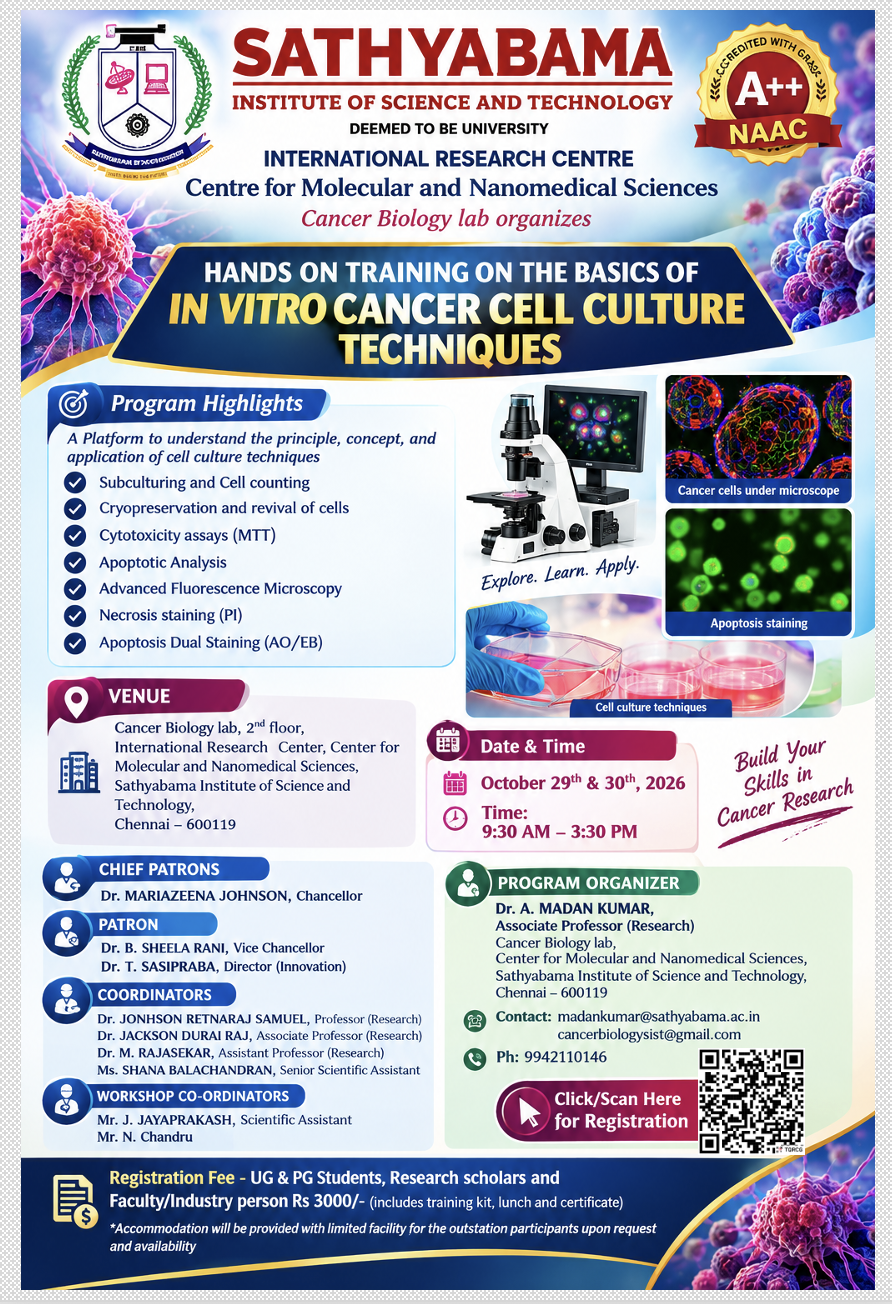
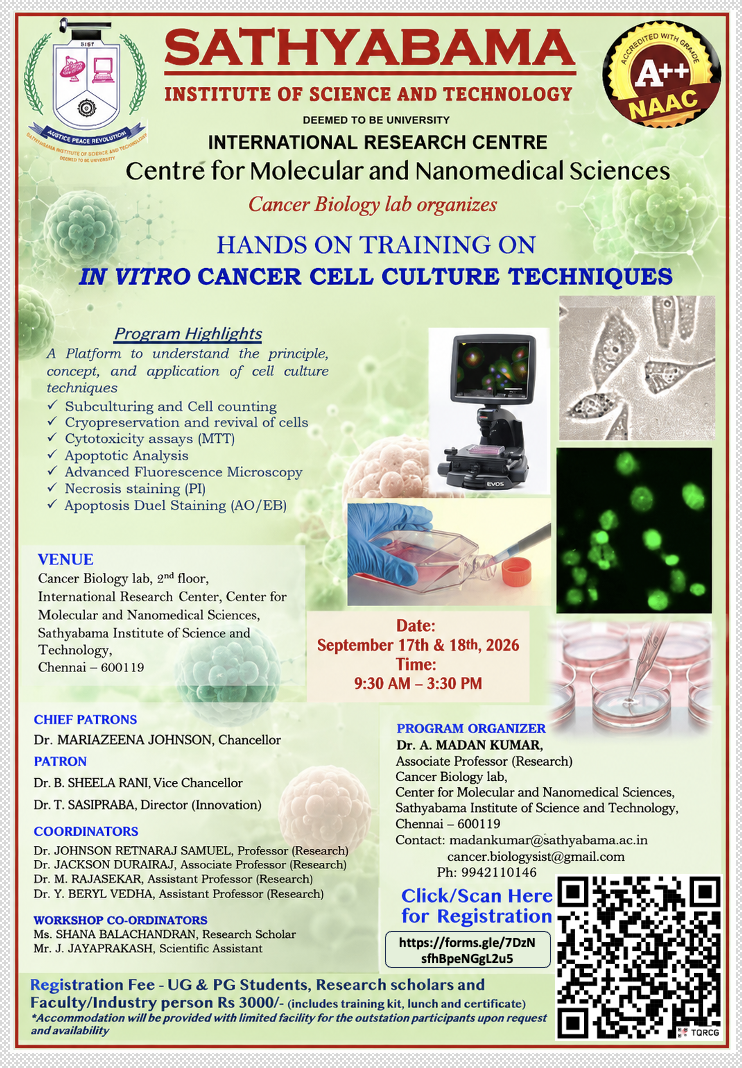
    </dd></dl><p>Sathyabama Institute of Science and Technology is organising Two days workshop in "Animal cell culture techniques" which will be held on June 15th to 16th, 2026 at our Cancer biology lab, International Research Centre, Sathyabama Institute of Science and Technology, Chennai through Physical mode.</p><p>The program will cover an introduction to in vitro cancer cell maintenance and Hands on Training in performing on Subculturing and Cell counting, Cryopreservation and revival of cells, Cytotoxicity assays (MTT), Apoptotic staining &amp; Analysis, Propidium Iodide staining. Participants will gain insights into in vitro and advanced imaging techniques. The workshop also includes intensive practical training modules and detailed sessions on cancer cell culture for experimental research.</p><figure><img src="https://cdn.indiabioscience.org/media/yim/Animal-Cell-culture-techniques-June-15-16.png" data-image="841213"></figure>
              ]]></content><category term="workshop" label="Workshop" /><category term="chennai" label="Chennai" /></entry><entry><title>Flow cytometry Techniques</title><link
                  rel="alternate"
                  href="https://indiabioscience.org/events/flow-cytometry-techniques-3"
                  type="text/html"
                  /><summary type="html"><![CDATA[
                
<em>
  Workshop
</em>
from
<time>
  22 June
</time>
  to
  <time>
    23 June 2026
  </time>
at
Chennai.
              ]]></summary><id>tag:indiabioscience.org,2026-05-18:/events/flow-cytometry-techniques-3</id><published>2026-05-18T10:57:00+05:30</published><updated>2026-05-18T10:57:20+05:30</updated><content type="html"><![CDATA[
                
<dl><dt>
    Date
  </dt><dd><time datetime="2026-06-22">
      June 22</time><time datetime="2026-06-23">-23, 2026
      </time></dd><dt>
      Location
    </dt><dd>
      Chennai, Tamil Nadu
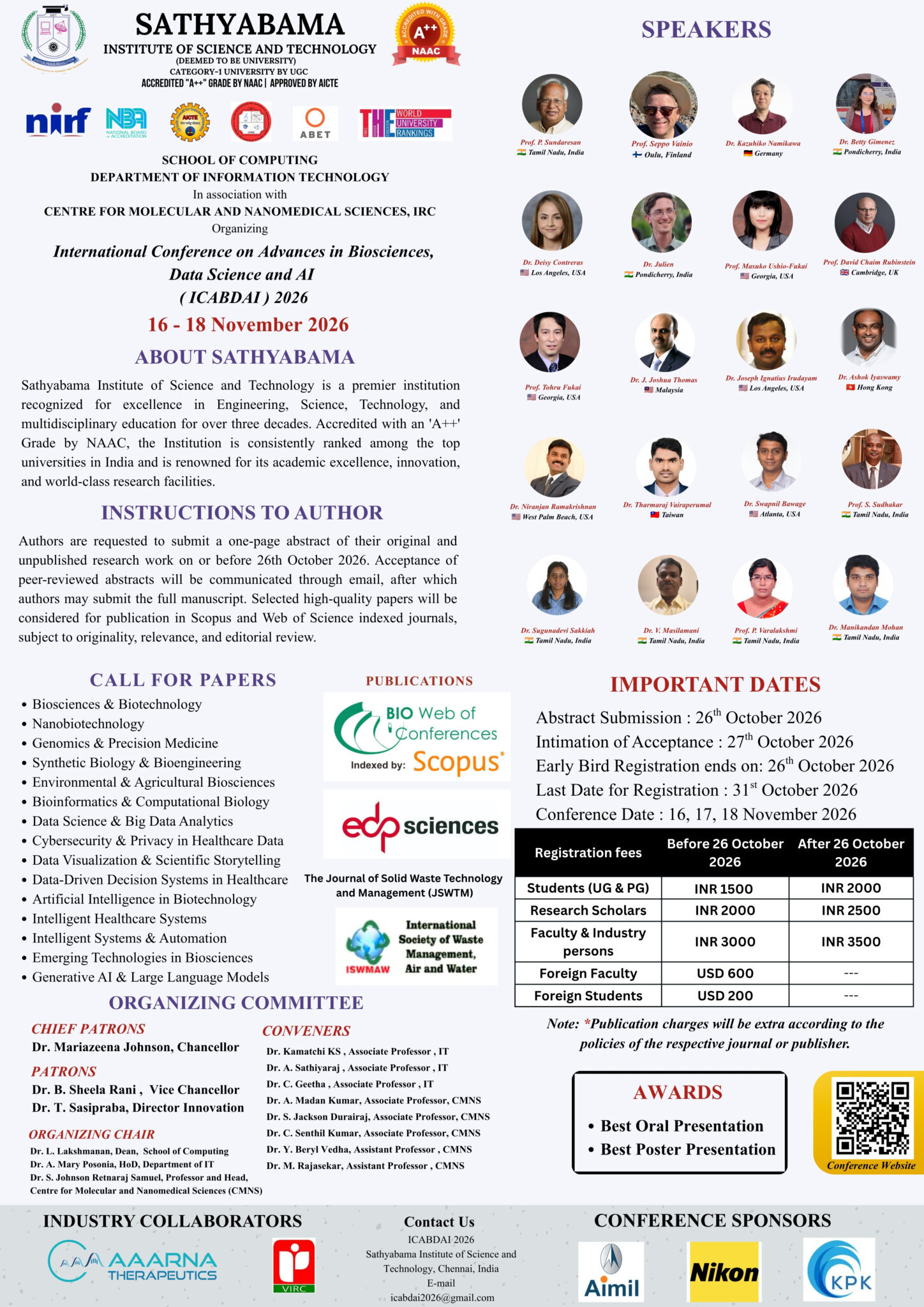
    </dd></dl><p>Sathyabama Institute of Science and Technology is organising Two days National level workshop on "Flow cytometry Techniques" which will be held June 22rd &amp; 23rd, 2026 at Flow cytometry research facility, Cancer biology lab, International Research Centre, Sathyabama Institute of Science and Technology, Chennai through Physical mode.</p><p>The workshop will cover the following topics: Basics of Flow cytometry analysis, Overview of instrument and its setup, Quality control, Experimental plan and design, Cell cycle analysis using mammalian cells, Apoptosis and Cell health analysis along with Data analysis and interpretation</p><figure><img src="https://cdn.indiabioscience.org/media/yim/Flowcytometry-workshop-June-22-23.png" data-image="841210"></figure>
              ]]></content><category term="workshop" label="Workshop" /><category term="chennai" label="Chennai" /></entry><entry><title>AI in Research: A User&#039;s Perspective (Second Edition)</title><link
                  rel="alternate"
                  href="https://indiabioscience.org/events/ai-in-research-a-users-perspective-second-edition"
                  type="text/html"
                  /><summary type="html"><![CDATA[
                
<em>
  Workshop
</em>
from
<time>
  03 July
</time>
  to
  <time>
    05 July 2026
  </time>
at
Pune.
              ]]></summary><id>tag:indiabioscience.org,2026-05-15:/events/ai-in-research-a-users-perspective-second-edition</id><published>2026-05-15T11:25:00+05:30</published><updated>2026-05-15T12:28:51+05:30</updated><content type="html"><![CDATA[
                
<dl><dt>
    Date
  </dt><dd><time datetime="2026-07-03">
      July 03</time><time datetime="2026-07-05">-05, 2026
      </time></dd><dt>
      Location
    </dt><dd>
      Pune, Maharashtra
    </dd><dt>Website</dt><dd><a
        href="https://sites.google.com/acads.iiserpune.ac.in/ai-in-research/home">
        sites.google.com/acads.iiserpu… &rarr;
      </a></dd></dl><p>This is a paid in-person workshop about how to leverage Gen AI (and various AI tools) for the purpose of research.</p><p>For years, Artificial Intelligence and Machine Learning remained within computer science departments. This changed in late 2022, when generative AI became widely accessible to researchers across disciplines. Experts proclaimed scientific research would never be the same. The reality has proven more complex. Generative AI can do remarkable things, but also produces wrong information with complete confidence. Some researchers swear by its help in their work, while others swear at it. The tool landscape is overwhelming: comparable and contrasting offerings, subscriptions from free to several hundred dollars monthly, and cost-effective approaches that usually demand daunting technical setup. Most online guides either oversell AI's magic or assume one is a developer. This leaves a real gap for researchers who wish to use AI effectively and mindfully, without changing what they work on or becoming AI experts. Our workshop is for such researchers.</p><p>For more details click <a href="https://sites.google.com/acads.iiserpune.ac.in/ai-in-research/home?pli=1" target="_blank" rel="noreferrer noopener">here</a></p><figure><img src="https://cdn.indiabioscience.org/media/yim/AIResearch_edition2-Sutirth-Dey.jpg" data-image="841188"></figure>
              ]]></content><category term="workshop" label="Workshop" /><category term="pune" label="Pune" /></entry></feed>