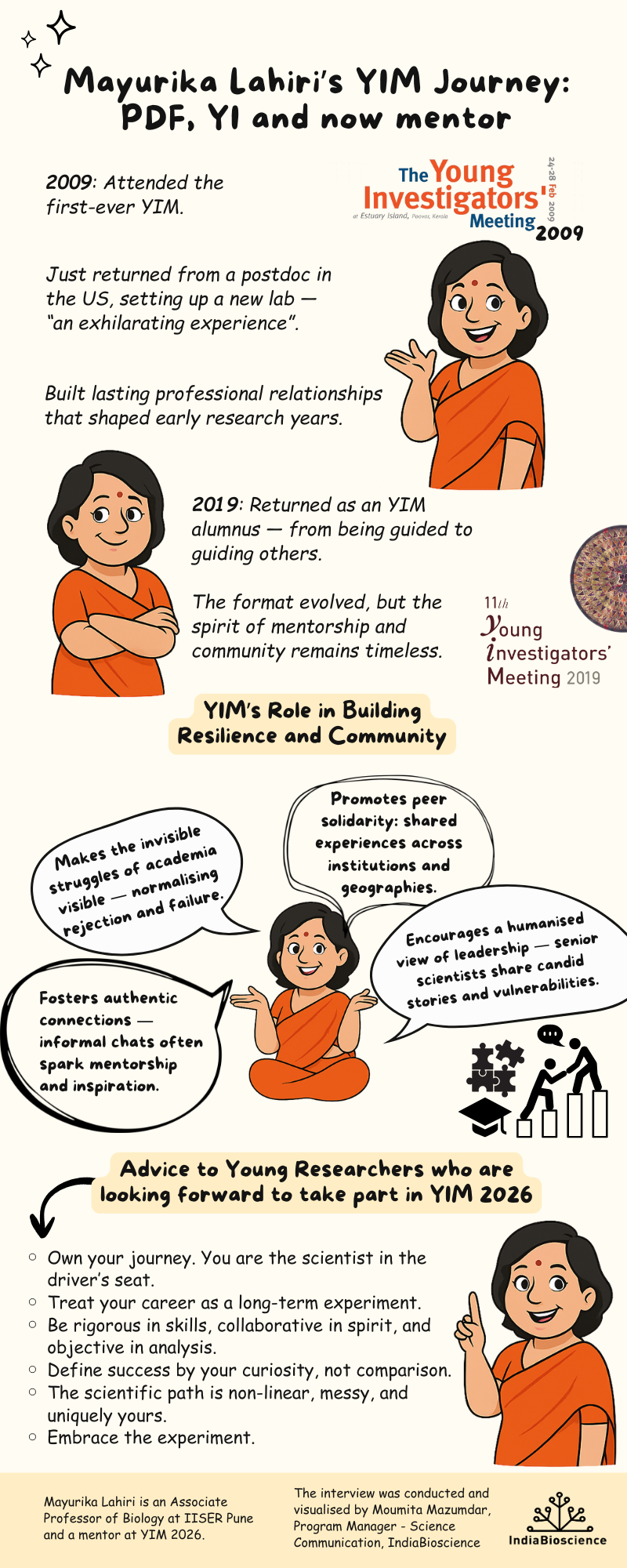
IndiaBioscience - Conversations from 2025https://indiabioscience.org/columns/conversations/2025/feed2026-10-07T00:16:02+05:30Mayurika Lahiri’s YIM Journey: PDF, YI and now mentorMayurika Lahiri, Associate Professor at the Indian Institute of Science Education and Research (IISER) Pune, reflects on her long association with the Young Investigators’ Meeting (YIM) in this conversation with us. She attended the inaugural edition in 2009 after returning from her postdoctoral fellowship in the US, participated again as a YIM alumnus in 2019, and will return as a mentor at YIM 2026. ]]>tag:indiabioscience.org,2025-12-22:/columns/conversations/mayurika-lahiris-yim-journey-pdf-yi-and-now-mentor2025-12-22T10:00:00+05:302025-12-23T10:03:59+05:30Moumita Mazumdarhttps://indiabioscience.org/authors/moumitaMayurika Lahiri, Associate Professor at the Indian Institute of Science Education and Research (IISER) Pune, reflects on her long association with the Young Investigators’ Meeting (YIM) in this conversation with us. She attended the inaugural edition in 2009 after returning from her postdoctoral fellowship in the US, participated again as a YIM alumnus in 2019, and will return as a mentor at YIM 2026.
Having seen the meeting both as a young investigator and now as a senior mentor, she shares how YIM has changed in format but has stayed true to its core values of community, mentorship, and collaboration. She speaks about the networks she built in her early years, the lessons in empathy and leadership she hopes to pass on, and how YIM creates a sense of belonging for young researchers navigating the uncertainties of academia.
1. How has your YIM experience evolved over the years?
Attending the first YIM in 2009 was memorable since it was the first meeting of its kind in India. It gave me a chance to meet researchers across the country, many of whom I am still connected with. I had just returned from my postdoctoral work in the US and was setting up my laboratory, so the experience was exciting and energising. A decade later, returning to YIM 2019 felt very different. By then, I had spent almost ten years establishing my research programme. I was no longer a young investigator in the same sense and could enjoy the meeting from a mentoring perspective. It was fulfilling to guide others who were setting up their labs. Over the years, the meeting has evolved, but the spirit of openness, support, and community has remained exactly the same
2. As a YI in 2009, what were the key takeaways or connections that shaped your academic journey at that stage?
Since I had not done research in India (I left right after my BSc), the 2009 YIM helped me connect with established researchers in the country. These early connections grew into long-term networks that would have been difficult to build otherwise. IISER Pune was also very young at the time, so advice on administrative processes, sharing of reagents, and early collaborations were incredibly helpful. These relationships made my transition into the Indian research ecosystem much smoother
3. Coming back as a mentor in YIM 2026, what will be most important for you to share with the next generation of scientists?
(i) Build networks with your peers. These relationships will support you throughout your career.
(ii) Lead with empathy and inclusivity. A lab thrives when every member feels safe, respected, and motivated.
(iii) Collaborate meaningfully. Complex research questions cannot be solved alone; they will benefit from multiple perspectives and shared expertise.
4. From your perspective, how does YIM help build resilience and community among early-career researchers in India?
Academia is competitive, and failure often feels personal and isolating. At YIM, early-career researchers realise they are not alone. When a senior scientist or Nobel Laureate talks openly about a rejected grant, a failed experiment, or a setback in their career, it breaks the myth of the “perfect” scientific journey. It helps ECRs see struggle as a normal part of the process, not a personal flaw. This shift is central to building resilience.
YIM also creates a strong peer community. An ECR from a small university might meet someone from a premier institute and discover they face similar challenges, whether with resources, administrative hurdles, or work-life balance. These connections often become long-term collaborations and friendships. When a paper is rejected or an experiment fails, there is a community that understands and supports them.
Informal interactions over meals, poster sessions, or during breaks also play a big role. Seeing senior scientists as approachable, everyday people breaks psychological barriers. It shows ECRs that leadership roles are attainable and encourages them to imagine themselves in those positions one day. This sense of community, belonging, and shared experience is what makes YIM special.
5. Looking back, what advice would you give to today’s Young Investigators, especially those facing uncertainties in academia?
I would say that the uncertainty is real, but they are not passive travellers.
They are in the driver’s seat. Think of the career as the most important long-term experiment. Build skills with intention, collaborate generously, and don’t take failure personally. Let curiosity guide one’s choices and define what success means to them. The journey will be messy and non-linear, but it is theirs to shape. They should embrace it like any good experiment, with openness, patience, and confidence in the process.
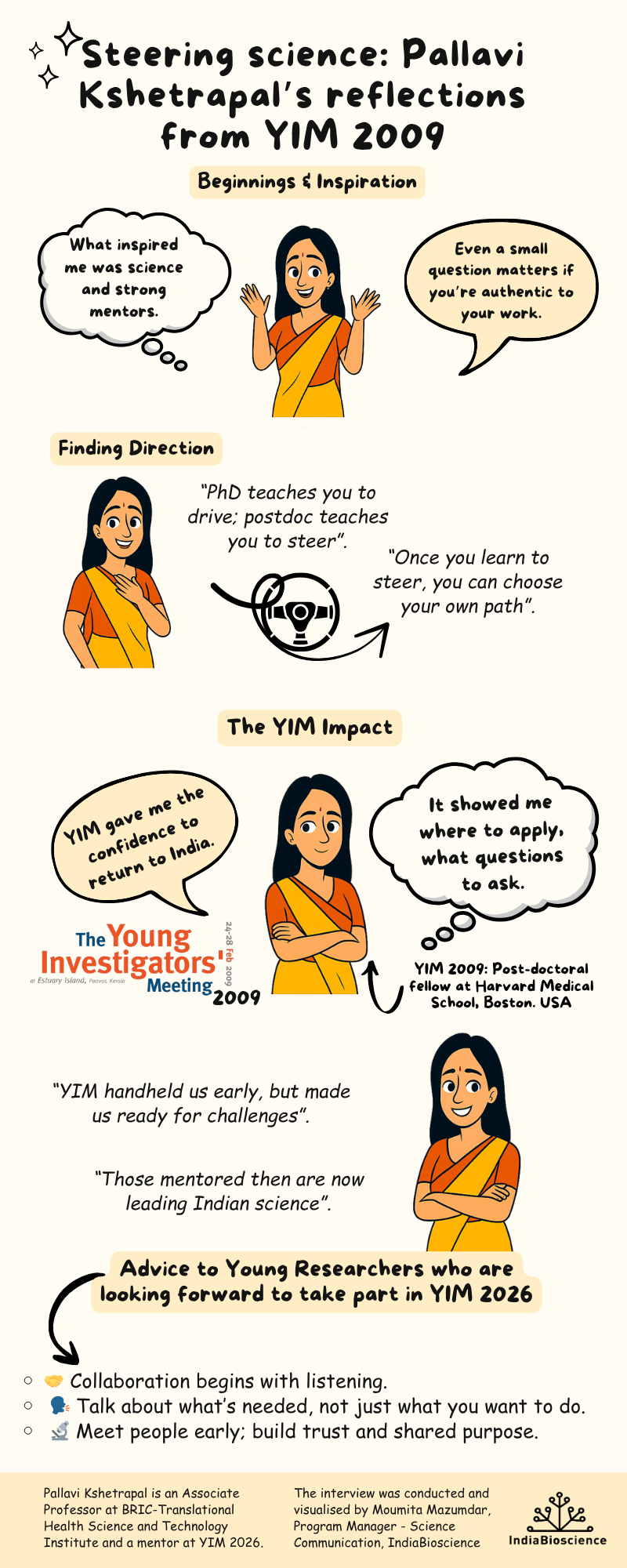
]]>Steering science: Pallavi Kshetrapal’s reflections from the first YIMMolecular geneticist Pallavi Kshetrapal, Associate Professor at BRIC-THSTI, traces her scientific journey from curiosity-driven beginnings to mentoring and leadership. Reflecting on the inaugural Young Investigators’ Meeting (YIM) 2009, she highlights how mentorship, collaboration, and authentic science shaped her career and continue to strengthen India’s research ecosystem. ]]>tag:indiabioscience.org,2025-12-08:/columns/conversations/steering-science-pallavi-kshetrapals-reflections-from-the-first-yim2025-12-08T10:00:00+05:302025-11-10T17:26:47+05:30Moumita Mazumdarhttps://indiabioscience.org/authors/moumitaMolecular geneticist Pallavi Kshetrapal, Associate Professor at BRIC-THSTI, traces her scientific journey from curiosity-driven beginnings to mentoring and leadership. Reflecting on the inaugural Young Investigators’ Meeting (YIM) 2009, she highlights how mentorship, collaboration, and authentic science shaped her career and continue to strengthen India’s research ecosystem.
Pallavi Kshetrapal is a molecular geneticist and an Associate Professor at BRIC-Translational Health Science and Technology Institute. She recalls the beginnings of her scientific journey, attributing her career path to both curiosity and the mentors she met. “When I started my PhD at CSIR-CCMB, I realised there were deeper biological questions about understanding phenomena, who we are, and how we are made, that I wanted to explore.” Pallavi emphasises that rigorous, ethical, and authentic science lays the foundation for a strong research career.
As scientists, we have to ground our experiments in logic and evidence. Even when you're working on a small part of a bigger question, the integrity you bring to it builds trust, and that commitment carries you through your postdoc and beyond.”
YIM has played a pivotal role in shaping Pallavi’s postdoc trajectory and the eventual decision to return to India. Reflecting on YIM 2009, which was also the inaugural YIM, she says, “It gave me a basis for how to apply in India, what questions could be answered here, and where to seek funding. We met mentors like Shubha Tole, L.S. Shashidhara, Ron Vale, and Anuradha Lohia who told us about critical areas of research, and the ways we can contribute meaningfully”.
Pallavi emphasises the long-term value of collaboration and networking. “Collaborations are key. You should seek them early, look for technical and scientific compatibility, and be open to multidisciplinary approaches. Be a good listener and understand others' perspectives. Give time to build trust, networking early shortens the path to success”. She stresses that communication is central to these collaborations. “You need to understand their language. If you go to a clinical or immunology group, you can’t just talk about basic biology; you need to present what your work implies in a way they understand. A clinician should grasp your idea in a minute”.
Looking back, Pallavi credits YIM for providing mentorship at a crucial juncture. “YIM handheld us in the beginning. They were honest about the struggles you’d face, the competitive environments, and the challenges of returning to India, but they also gave us a safety net. We learned to persevere, stay authentic, and network effectively”. She reflects with pride on the trajectory of those who attended YIM alongside her: “The senior researchers who attended then are now directors at different institutions. It’s heartening to see that the mentorship we received has shaped India’s scientific leadership”.
For young scientists, Pallavi’s advice is clear: seek collaboration, respect all stakeholders, and cultivate networks early.
You can struggle together, generate good ideas, and establish meaningful partnerships. That’s the way to accelerate your career. And always keep the long-term vision in mind: mentorship, collaboration, and authentic science are what steer you towards leadership”.
Through Pallavi’s reflections, it becomes evident how mentorship programmes like YIM not only guide scientific careers but also build the collaborative and visionary leadership necessary for India’s research ecosystem.
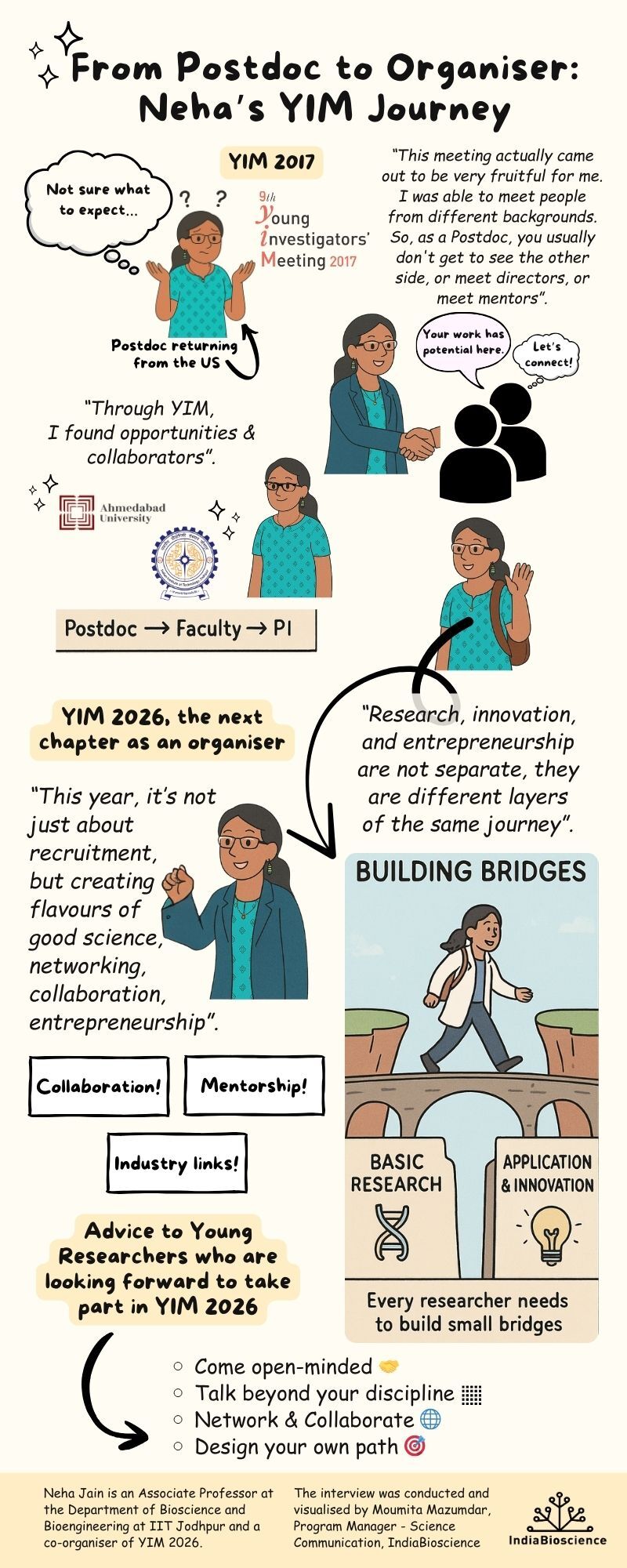
]]>From Postdoc to organiser: Neha Jain’s YIM storyWhen Neha Jain walked into her first Young Investigators’ Meeting (YIM) in 2017 as a postdoctoral researcher from the United States, she didn’t know what to expect. “As a postdoc, you usually don’t get to see the other side, or meet directors, or meet mentors”, she recalls. To her surprise, leaders from institutions reached out even before YIM, and those conversations soon turned into real opportunities. Within a year, she landed her first faculty position at Ahmedabad University. A year later, she moved to the Department of Bioscience and Bioengineering at the Indian Institute of Technology Jodhpur, where she is now an Associate Professor. Looking back, she calls YIM 2017 ‘a huge milestone’ that shaped her career in India. ]]>tag:indiabioscience.org,2025-10-17:/columns/conversations/from-postdoc-to-organiser-neha-jains-yim-story2025-10-17T10:00:00+05:302025-09-22T17:03:12+05:30Moumita Mazumdarhttps://indiabioscience.org/authors/moumitaWhen Neha Jain walked into her first Young Investigators’ Meeting (YIM) in 2017 as a postdoctoral researcher from the United States, she didn’t know what to expect. “As a postdoc, you usually don’t get to see the other side, or meet directors, or meet mentors”, she recalls. To her surprise, leaders from institutions reached out even before YIM, and those conversations soon turned into real opportunities. Within a year, she landed her first faculty position at Ahmedabad University. A year later, she moved to the Department of Bioscience and Bioengineering at the Indian Institute of Technology Jodhpur, where she is now an Associate Professor. Looking back, she calls YIM 2017 ‘a huge milestone’ that shaped her career in India.
Pushing boundaries
Neha’s work is driven by a simple but ambitious question: “How can basic research, rich with potential applications, find meaning through collaboration?” At Ahmedabad and later at IIT Jodhpur, she actively sought interdisciplinary places, working not only with scientists but also with engineers, social scientists, and industry partners. Convinced that research and entrepreneurship cannot be separated, she now brings this mindset to her role as co-organiser of YIM 2026. She describes the meeting as a platform to build purposeful connections across research, entrepreneurship, and industry.
Our nation is driving into more entrepreneurial activity. YIM 2026 will be a great platform to bring scientists and industry people together, and to help postdocs and young investigators think beyond what they have been doing”.
Balancing research and impact
Neha has also learned to balance research, teaching, administration, and innovation. “Initially, it seemed very challenging. But I thought of it as an upgrade of myself. Publishing papers is great, but how do you make an impact on your publications”? She decided to step beyond her comfort zone, reached out to startups, the industry, and intellectual property experts. This helped her team to apply for their first patent, a process which took close to four years, but came with a great sense of accomplishment.“That feeling, when it comes, is really encouraging for you to move ahead”, she says. For her, translational thinking doesn’t replace fundamental research; instead, it builds bridges between discovery, innovation, and application.
The science you are doing today may see application tomorrow if you can cross that bridge”.
Mentorship and Networking
At YIM 2017, Neha met leaders of India’s life science and biotech community - among them Gagandeep Kang, Jyotsna Dhawan, Pankaj Chandra, Pradeep Sinha, and L. S. Shashidhara - and those conversations stayed with her. What began as networking soon grew into meaningful collaborations and a community of mentors and peers. “That gives you confidence that people are there to help you, and that you are not alone”, she says.
Looking ahead to YIM 2026
As she returns this year as a co-organiser, Neha’s advice to early-career investigators and post-docs is clear: build bridges, seek mentors, think broadly, and, most importantly, build a career that is both personally fulfilling and nationally impactful.
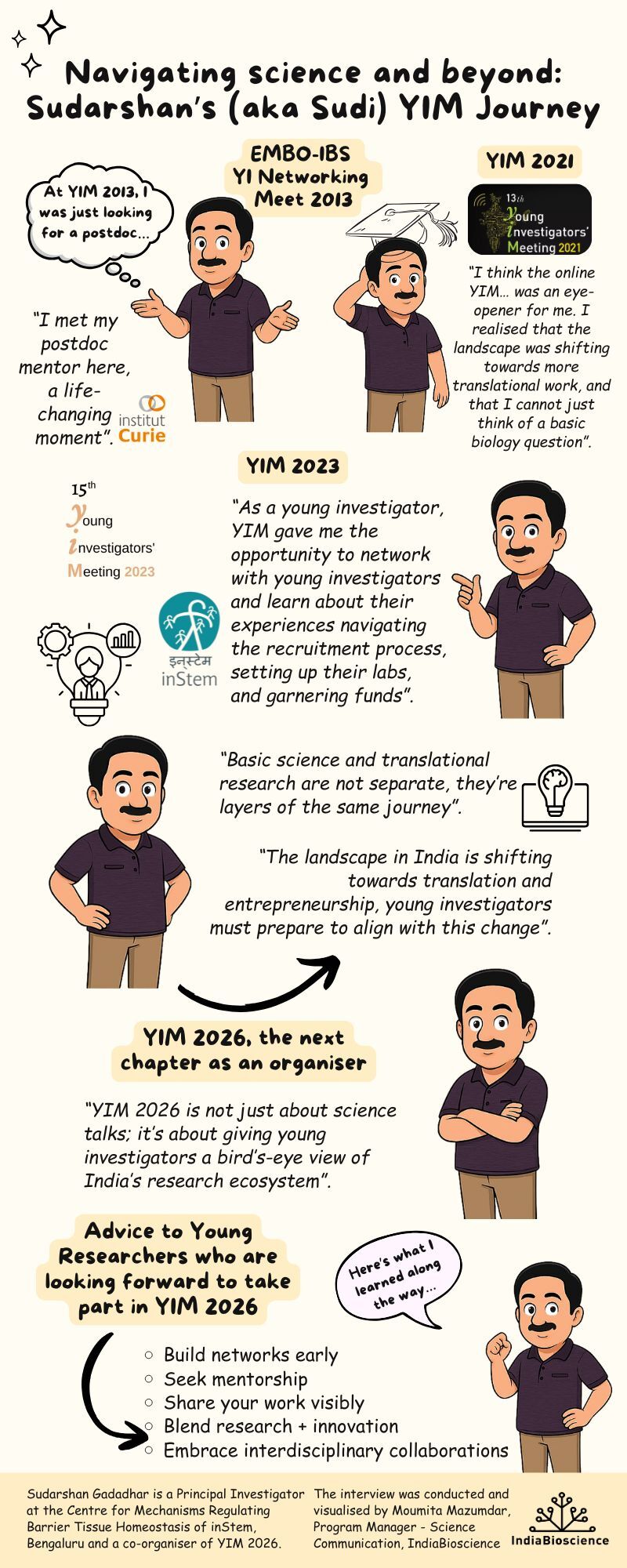
]]>Navigating science and beyond: Sudarshan’s (aka Sudi) YIM journeyWhen Sudarshan Gadadhar first attended the Young Investigators’ Meeting (YIM), he came in with a lot of questions. “I was not sure about where I was heading, about the kind of science I wanted to do, and whether I was ready for the challenges of independent research”, he recalls. YIM gave him more than answers; it provided perspectives, peers in similar transitions, and mentors who had walked the path before. ]]>tag:indiabioscience.org,2025-10-06:/columns/conversations/navigating-science-and-beyond-sudarshans-aka-sudi-yim-journey2025-10-06T10:00:00+05:302025-09-23T10:40:54+05:30Moumita Mazumdarhttps://indiabioscience.org/authors/moumitaWhen Sudarshan Gadadhar first attended the Young Investigators’ Meeting (YIM), he came in with a lot of questions. “I was not sure about where I was heading, about the kind of science I wanted to do, and whether I was ready for the challenges of independent research”, he recalls. YIM gave him more than answers; it provided perspectives, peers in similar transitions, and mentors who had walked the path before.
Those conversations stayed with me. YIM was not just about opportunities; it was about finding a sense of community”.
Beyond science alone
From the beginning, Sudarshan believed that science is not a solitary act. “You can’t grow in a silo. Collaboration and community are not add-ons; they are essential”, he says. This ethos shaped his early years as an independent researcher, as he sought collaborations that pushed him beyond his comfort zone. “Whether it was reaching across disciplines or learning how to communicate science beyond academia, I always wanted the work to have impact”.
For him, impact is not only in publications or grants, but in ideas, connections, and opportunities for others.
Ask questions, build networks, reflect often, and remember that growth in science is always about more than science alone”.
Balancing challenges
The transition from postdoc to independent scientist was not without strain. “At first, I felt the weight of everything: research, teaching, administration, expectations from students, and my own ambitions”, he says. He learned to reframe it as an opportunity for growth.
You have to let go and build trust with your students as they take ownership of the scientific question. Handing over the bench work isn’t easy, but it’s essential”.
Mentors, peers and inspiration
At YIM and beyond, mentors played a critical role. Sudarshan values both the senior scientists who offered advice and the peers who fostered a sense of being part of a community. “Networking is not about collecting contacts. It is about meaningful conversations that can open up new directions. Even a single thoughtful piece of advice, or a nudge from a mentor, can change the way you see your career”. He adds, “I want young scientists to know they are not alone, that there are people who will support them, even if only with a small word of encouragement”.
Looking ahead
Years after first attending YIM, Sudarshan is now back as one of the organisers. He sees the meeting evolving alongside his own career. “When I first attended, I was looking for directions. Today, YIM is not only about research opportunities, but about entrepreneurship, collaborations across science, industry and clinics, mentorship, and networks that extend beyond science”.
His advice to participants:
Come with curiosity. Don’t just look for jobs or collaborations. Look for ideas, look for mentors, and look for the bigger picture of what kind of a scientist, and person, you want to become”.
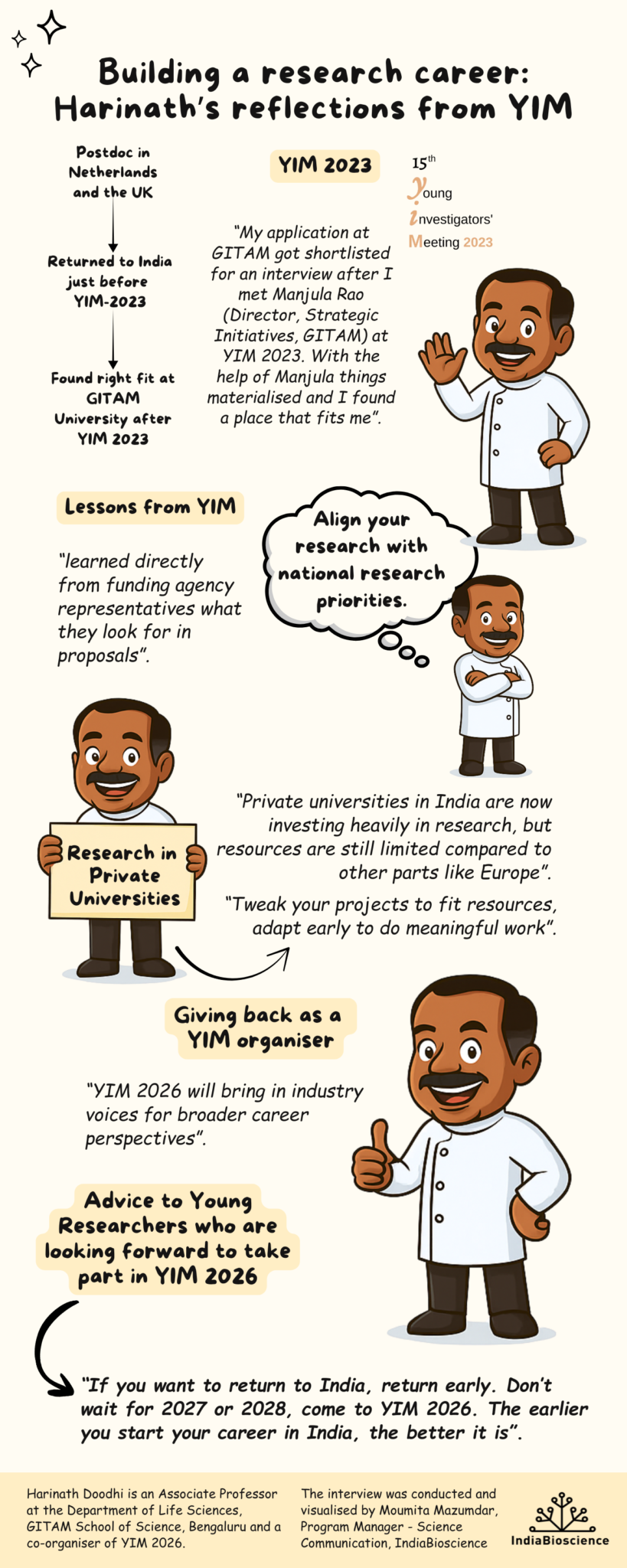
]]>Building a research career: Harinath’s reflections from YIMAt YIM 2023, Harinath Doodhi’s career took a surprising turn, from a chance encounter to a faculty position and his first funded grant in India. For him, YIM became more than a meeting; it was a launchpad for connections, mentorship, and understanding India’s research landscape. ]]>tag:indiabioscience.org,2025-10-03:/columns/conversations/building-a-research-career-harinaths-reflections-from-yim2025-10-03T10:00:00+05:302025-10-03T15:42:29+05:30Moumita Mazumdarhttps://indiabioscience.org/authors/moumitaAt YIM 2023, Harinath Doodhi’s career took a surprising turn, from a chance encounter to a faculty position and his first funded grant in India. For him, YIM became more than a meeting; it was a launchpad for connections, mentorship, and understanding India’s research landscape.
A significant number of encounters at YIMs have evolved beyond conversations to form lasting connections. When Harinath Doodhi attended his first Young Investigators’ Meeting in 2023, after a postdoctoral fellowship in the UK and Netherlands and as a young faculty member at Chennai’s SRM University, he didn’t know this would be a turning point in his career. He met several institutional leaders, one of them being Manjula Rao from GITAM University, an organisation to which Harinath had applied but hadn’t heard back from. One has to be at YIM to know what happened next can only occur at a meeting like this:
“I had applied to GITAM but never heard back. At YIM, Manjula dug up my application, pushed for an interview, and things materialised. I found a place that suited me better than SRM”, he says.
Understanding the funding ecosystem
For Harinath, YIM was not only a way to connect with people, but it was also a crash course in the research funding ecosystem in India. Building relationships and meeting funders helped clarify some ways he could improve the quality of his grant applications.
“I learned directly from funding agency representatives what they look for in proposals. That helped me make small but important changes in my applications. My first grant in India got funded soon after YIM”, he shares.
These early lessons were critical, as he faced numerous challenges in establishing a research lab upon his return to India. They reaffirmed an important point: much of funding success, especially when considering grants, is about being aligned with national priorities.
As Vijay [K VijayRaghavan, a YIM mentor] said, you might have done great work abroad, but every country has its own focus. Aligning with that helps a lot”, Harinath reflects.
Research in private universities: Opportunities and challenges
Harinath has found a home at GITAM University, where he is currently building his group. He acknowledges the emerging role of private institutions in research in India. His experience illustrates the development of a research culture in private universities, which may not have previously been an option for young investigators but is available now.
“Private universities in India are now investing heavily in research, but resources are still limited compared to other parts like Europe. You need to tweak your projects to fit available facilities. If you adapt early, you can still do meaningful research”, he notes.
Giving back as a YIM organiser
Harinath is a co-organiser of YIM 2026 and still regards the meeting as a unique space, providing mentorship, collaboration, and inspiration.
“Mentors and funding bodies give you insights you can’t get elsewhere. This time, including industry voices will also help, since many scientists are curious about careers beyond academia”, he says.
As YIM continues to evolve, Harinath sees another level of change in understanding the implications of expanding its scope to bring together academia, industry, and policy, which is necessary to support the next generation of scientists.
Looking back, Harinath (with a broad smile) offers candid advice to those contemplating a return to India after training from abroad:
If you want to return to India, return early. Don’t wait for 2027 or 2028, come to YIM 2026. The earlier you start your career in India, the better it is”.
]]>The science of safety: A conversation with Srikanta K RathIn this conversation, Srikanta K Rath, Chief Scientist & Professor at Academy of Scientific and Innovative Research (AcSIR) and Head, Division of Toxicology, CSIR-Central Drug Research Institute (CSIR-CDRI), Lucknow, shares insights into the field of regulatory toxicology, its implementation from research to risk management, related key issues, and the role of researchers/scientists. ]]>tag:indiabioscience.org,2025-07-07:/columns/conversations/the-science-of-safety-a-conversation-with-srikanta-k-rath2025-07-07T10:08:00+05:302025-07-07T10:08:43+05:30Akshita Puri Bajajhttps://indiabioscience.org/authors/bO3xKOVr92L79W5In this conversation, Srikanta K Rath, Chief Scientist & Professor at Academy of Scientific and Innovative Research (AcSIR) and Head, Division of Toxicology, CSIR-Central Drug Research Institute (CSIR-CDRI), Lucknow, shares insights with Akshita into the field of regulatory toxicology, its implementation from research to risk management, related key issues, and the role of researchers/scientists.
1. Please tell us about the field of regulatory toxicology, research in this field and its implementation for risk management.
Toxicology as a subject is still underrepresented in Indian academia, with very few universities offering it formally. Regulatory toxicology, a more specialised branch, is even less understood. I was introduced to it at CDRI. Those working in pesticides, and human or veterinary drugs engage more with regulatory toxicology, but regulatory requirements vary across these sectors. For instance, pesticide regulators demand near-zero tolerance, given the potential harm to humans and ecosystems. In contrast, drug toxicology balances safety with therapeutic benefits—since no drug is completely non-toxic. Regulatory toxicologists must evaluate how much risk is acceptable for the expected benefit.
In India, long-term studies and risk management research are limited due to funding, infrastructure, and awareness gaps. Most data still come from Western sources. Despite limited manpower and resources, Indian institutes like CDRI are making earnest efforts to bridge this gap. Moreover, academia and industry differ—academia focuses on mechanisms, while industry emphasises proving safety and efficacy quickly for regulatory approval.
2. Who are the key role players in formulating and implementing regulatory norms and what is the role of researchers/scientists in this?
The key players in regulatory implementation are government authorities such as Drugs Controller General of India (DCGI) for pharmaceuticals, the Central Insecticides Board for pesticides, FSSAI for food, and the Ministry of AYUSH for traditional products. Each sector has a dedicated regulatory body that frames guidelines and oversees their enforcement. These authorities constitute expert committees that include pharmacists, physicians, academicians, toxicologists, and pharmacologists. In my experience serving on over 100 such committees, I’ve observed that many members began as researchers or academicians. Over time, through in-depth research and hands-on experience across various domains of regulatory science, they became subject matter experts. Thus, researchers and scientists play a crucial role, not only in generating data but also in shaping and applying regulatory norms based on their deep understanding of safety, efficacy, and risk assessment.
3. What are the key focus areas and associated issues when we look from a regulatory compliance perspective?
Regulatory compliance is essential across all sectors—pharma, veterinary, agriculture, food, and more. In the veterinary sector, animals are often treated with hormones for increased milk production, which may harm humans, as some cancers are now linked to such milk. For pesticides, although minimum and maximum dose guidelines exist, untrained users in rural areas often exceed recommended levels, leading to self-exposure and environmental harm. In pharmaceuticals, compliance issues extend beyond use; improper disposal of antibiotics, for instance, contributes to antimicrobial resistance (MDR/XDR), posing long-term public health risks. Regulatory bodies exist, but implementation often lags due to economic constraints, lack of awareness, or urgency in production.
As the saying goes, “if it is ati (excess), then it will be iti (end).” Hence, regulation is not just necessary—it’s critical for sustainability and safety across sectors.
4. What is the present Indian scenario with respect to education, implementation and ways to overcome challenges in the field?
In India, toxicology, especially regulatory toxicology, is rarely included in academic curriculum. I believe it should be introduced as a core subject within biological sciences to build foundational understanding. Without proper education, effective implementation is not possible. Currently, decisions are often made without fully understanding ground realities, or based only on outdated documentation. To overcome these challenges, we need to revisit the basics and align top-level policies with actual field conditions. India has three toxicology societies—two in the South and one national body, the Society of Toxicology (India), which is among the oldest. However, these platforms sometimes drift from their core mission, and regulatory discussions remain limited. While seminars are regularly held, there’s a need for unified efforts to actively involve both young and experienced professionals to bridge knowledge gaps and foster meaningful dialogue in regulatory toxicology.
5. A piece of advice to young minds.
My simple advice: Be good and do good.
Be good by building a strong foundation of knowledge, especially if you're a biologist, don’t shy away from learning toxicology, pharmacology, or regulatory science. Stay ethically grounded and aim for a holistic understanding. Today, we have access to abundant information, but without proper application, it’s of little value. Don’t get lost in data-focus, learn deeply, and apply wisely. If you’ve chosen biology, explore both its strengths and risks, and think about how harmful aspects can be regulated, because we ourselves are biological beings. Our duty is to care for ourselves, society, and the environment. I believe change is coming.
Akshita with Rath during the interview. Photo Credit: Akshita
]]>In conversation with Shivkumar Kalyanaraman, CEO, Anusandhan National Research FoundationThe Anusandhan National Research Foundation (ANRF) Act, 2023, signalled a shift in how research will be supported in India. We spoke with Shivkumar Kalyanaraman (CEO, ANRF) to understand how these changes will shape funding, how we define research impact, and more. ]]>tag:indiabioscience.org,2025-06-27:/columns/conversations/in-conversation-with-shivkumar-kalyanraman-ceo-anusandhan-national-research-foundation2025-06-27T13:00:00+05:302025-06-26T17:40:51+05:30Siuli Mitrahttps://indiabioscience.org/authors/PRYwLlb3kA1gO0QThe Anusandhan National Research Foundation (ANRF) Act, 2023, signalled a shift in how research will be supported in India. We spoke with Shivkumar Kalyanaraman (CEO, ANRF) to understand how these changes will shape funding, how we define research impact, and more.
In June 2025, the Anusandhan National Research Foundation announced the first leg of the Advanced Research Grants (ARG), which builds upon the erstwhile Science and Engineering Research Board’s Core Research Grants (CRG). The ARG will fund basic, applied, and translational research, allow flexible funding, increase travel funding to enable meaningful collaborations, and facilitate the communication of research with the public, as explained by the CEO, Shivkumar Kalyanaraman, in this post on LinkedIn. To dig deeper, we spoke with him to better understand the shifts in how research will be funded by ANRF going forward and to decode that for early career researchers in India.
Siuli: Congratulations on completing three months at ANRF, and thank you for joining us. Since the ANRF Act of 2023 and new grants and fellowships, there's been a lot of change in the funding landscape. You’ve been meeting stakeholders across the country—how is this shaping your goals? Could you share your top priorities for the next few years and longer term?
Shiv: Thank you. At ANRF, our work has three main parts:
First, our horizontal approach supports broad-based, fundamental and applied research; programmes like the Advanced Research Grants and the Prime Minister Early Career Research Grant. These are bottom-up, allowing researchers to propose novel ideas, as many breakthroughs come from unexpected places. We have improved our ARG evaluation metrics to reflect this.
I often get asked, ‘Do you [ANRF] support fundamental research?’ The answer is yes, we do.
Second, there are the vertical, mission-driven programmes — take the Electric Vehicle Mission, for example. These programmes come in two types: ones that focus on building or strengthening economic value chains and ecosystems, and others that tackle India’s societal challenges, where research, innovation, and science and technology can really make a difference.
Third, we are working to catalyse more investment in research in India through partnerships with industry, foundations, and other organisations.
We want to see many more research labs come forward to create more employment opportunities for others, expand beyond postdoctoral fellowships and academic circles, and find many more employers who value PhDs."
We are also expanding partnerships with philanthropic groups and CSR initiatives, encouraging the industry to support and conduct research.
Looking ahead, we aim to further liberalise funding, especially in mission-driven programs. The overall goal, if I were to sum it up in one sentence, is to foster greater collaboration for better research outcomes and a stronger return on investment.
Siuli: That was very succinct. As we work towards these goals, I think we will need to redefine scientific excellence. It can’t just be about the number of publications anymore. Do you also see these goals changing our definition of excellence? If so, please share your thoughts on that.
Shiv: That is an important question. It is crucial for researchers to consider the broader impact of their work. Since research funding ultimately comes from society, whether through taxpayers or foundations, there is a responsibility to ensure it benefits the public. We are asking our grantees to articulate potential impact in grant proposals, and that goes beyond just publications and patents.
Now, coming to the potential impact beyond publications and patents, I want to reemphasise what I mean by “beyond publications.” Let me articulate this in a few ways, as its meaning can vary across different communities, and I don’t want to make assumptions.
For example, fundamental research might result in a high-profile paper, but real impact could be to drive deeper scientific and non-scientific dissemination that accelerates downstream value creation. Scientific dissemination could also be done via social media, and it could attract translational innovators to pick up on new fundamental work faster. Beyond pure scientific dissemination, there is value in creating simplified or exciting, scientifically based content that demystifies that work and inspires others. Platforms like IndiaBioscience could encourage researchers to communicate their work more broadly, even to friends and family. The former is only documentation, while the latter has an impact.
We are also making research dissemination through social media a requirement in some programmes, focusing on quality content. At ANRF, we are developing tools to help convert scientific papers into posters, videos, podcasts, and translations, making research more accessible. Human conversations will still remain vital.
Impact also includes sharing datasets or open-source software, making your research useful to others: the more people use your data or tools, the greater the impact.
Ultimately, impact has many forms.
We welcome ongoing conversations within the community. Tell us what impact means for you, and how that definition might evolve. We want these definitions to come from the community, not just from the top down."
Siuli: Thank you. At IndiaBioscience, we have been gathering community perspectives on how researchers view impact.
Shiv: I would also like to see an impact framework from your community, with categories defined by what matters to you, not just numbers. Research impact should go beyond metrics and factor in societal and community benefits. We need to broaden how we think about dissemination and technology diffusion, from basic science to advanced applications.
The transition from fundamental to advanced research relies on technology diffusion, which is complex and people-driven—there is no set formula. Our goal is to speed up this process and improve success rates.
We should also assess research impact at the portfolio level. Not every paper will have a big impact, and that is fine, but the overall body of work should make a difference. Impact doesn’t mean everything must be translational. It is not just about patents. Consider prototypes and unit economics as well. Having worked across fundamental, applied, and translational research, I know each requires a distinct approach.
I sometimes say, you can't make every Einstein become an Elon Musk. They are very different.
At the same time, if we want to arrive at meaningful outcomes, specialisation is essential. But while specialising, it is equally important to collaborate with others who can extend that work into different areas.
Siuli: That brings us to my next question. You have, at other avenues too, emphasised the importance of collaboration across disciplines, institutions, and countries. The new ARG program also encourages this. While interdisciplinary research offers great opportunities, it comes with communication and coordination challenges. What advice do you have for researchers entering these spaces, especially when funding supports collaboration but institutional culture may lag?
Shiv: I think great work is done when people follow their heart, and significant impact comes from tackling big problems, not just incremental work. So, the first thing I would urge is for people to always want to do great work. Funding agencies like ours are actively encouraging breakthroughs and risk-taking; we want to reward ambitious work. For example, the ARG programme allows honorary PIs, so you can bring in industry or international collaborators. We have also updated policies to make collaboration easier, such as allowing multiple grants and supporting international travel. And of course, we will convey the same message to our programme committees so that they value that.
The thing to remember is that problems don’t respect disciplinary boundaries—these are constructs we create. While depth is important, we must move beyond silos and learn enough of each other’s “language” to collaborate effectively. Respect and a willingness to understand even a bit of another field’s vocabulary are important.
Second, we are working to lower barriers to collaboration, whether between countries, institutions, or industry and academia. This includes rethinking how research labs are set up to encourage collaboration from the start.
Finally, I would be remiss if I didn’t acknowledge that academic recognition still tends to favour individual-centric work. So, we continue our discussions with institutional leaders to better value collaborative work, while still recognising individual contributions. Structural barriers remain, but acknowledging them is the first step.
Change won’t happen overnight, but I’m optimistic. With India’s strong talent pool, we’re on the verge of becoming a global research partner, not just a service provider, and that is a story I would like to tell."
Siuli: To close, I have noticed you emphasise impact, not just today, but throughout your talks and visits. Do you think these conversations will actually influence how funding and evaluation decisions are made? How practical is that?
Shiv: The simple answer is, yes. And there is a simple way to look at it.
Think of it like investing: if one option gives a higher return, you naturally gravitate toward it, even if it carries some risk. The idea of return on investment is central; it is about productivity and impact, not just input.
Currently, we invest about 0.7% of GDP in research. To justify and potentially increase this, we need to boost the productivity of our research system; AND we need greater levels of non-governmental participation in this investment. At ANRF, we are aiming to catalyse BOTH of these. If we make our “engine” more efficient, we will see better outcomes and attract more investment. That’s why I focus on impact and collaboration; they help solve bigger problems and make the system stronger.
Ultimately, greater impact leads to greater returns for science and society. If we deliver more, we will naturally draw more investment, compounding benefits over time.